

Financial Literacy
Accountant Explains What Is the 60/20/20 Money Rule?


Table of Contents
- Why the Old Budget Rules Are Breaking Down
- What Is the 60/20/20 Money Management Rule?
- The Three Budget Categories: What Goes Where?
- The 60% — Needs: Essential Non-Negotiable Expenses
- The 20% — Wants: Discretionary and Lifestyle Spending
- The 20% — Savings and Debt Repayment: Your Financial Future
- The 60/20/20 Rule in Real Numbers: UK and US Income Examples
- How to Implement the 60/20/20 Rule: A Step-by-Step Guide
- Worked Example: The 60/20/20 Rule for a UK Household
- Budget Rules Compared: How 60/20/20 Fits the Current Landscape
- When the 60/20/20 Rule Works — and When to Adapt It
- The Rule Works Best For:
- When to Consider a Different Approach:
- Conclusion
- Frequently Asked Questions (FAQ)
Why the Old Budget Rules Are Breaking Down
For a decade, the 50/30/20 budget rule was the go-to framework for personal finance: allocate 50% of take-home pay to needs, 30% to wants, and 20% to savings. The mathematics worked elegantly — until the cost of living crisis, persistent housing inflation, and rising essential expenses made that 50% ceiling for needs unreachable for millions of households. According to The Penny Hoarder's 2026 Financial Anxiety Barometer, 65% of Americans say the cost of essential living expenses — rent, groceries, utilities — is their biggest source of financial anxiety. Analysis from personal finance platforms, cited by Policy Pulse in April 2026, shows that essential costs now consume 55% to 60% of take-home pay for most households, fundamentally breaking the 50/30/20 model for anyone in a high-cost area.Enter the 60/20/20 rule — a percentage-based budgeting framework that honestly acknowledges what essential expenses actually cost in 2026. It allocates 60% of monthly net (after-tax) income to needs, 20% to wants, and 20% to savings or debt repayment. The rule does not try to squeeze essential spending into an artificially low category; it accepts the reality that housing, food, utilities, transport, insurance, and minimum debt payments will consume a larger share of most households' income than the classic 50% ceiling allows — and it builds a budget that still preserves a meaningful 20% savings rate while leaving 20% for discretionary enjoyment.
This guide explains everything about the 60/20/20 rule: what falls into each of the three buckets, how to calculate it from your own take-home pay, worked examples at common UK and US income levels, the key differences from the 50/30/20 and other competing budget frameworks, when the rule works and when it needs adjusting, how to implement it practically through automation, and the honest limitations to be aware of. Whether you are budgeting for the first time or recalibrating a budget that no longer fits your life in 2026's cost environment, this guide provides the complete and practical framework.
What Is the 60/20/20 Money Management Rule?
The 60/20/20 rule is a percentage-based budgeting method that divides your monthly after-tax (take-home) income into three categories. PocketGuard's January 2026 guide provides the clearest definition: 'The 60/20/20 rule is a budgeting approach that divides your after-tax income into three categories: spend 60 percent of your income on needs (such as housing, food, and utilities), dedicate 20 percent toward financial goals (debt reduction, savings, and retirement investing), and reserve the remaining 20 percent for wants or discretionary spending.'The key word throughout is after-tax. The budget is applied to your take-home pay — what actually lands in your bank account after income tax, National Insurance (in the UK), or FICA taxes (in the US), as well as any pre-tax deductions such as pension contributions or health insurance premiums. Using after-tax income rather than gross salary avoids a common beginner mistake where the budget appears to work on paper but fails in practice because taxes and deductions have not been accounted for.
The appeal of the rule is its simplicity. The Penny Hoarder's June 2026 analysis identifies this as the defining advantage: 'The appeal is simplicity. You don't have to track 30 different categories — you only have to manage three. Once you know your monthly net pay, you do the math one time, set up your accounts to mirror those proportions, and revisit the numbers when your income changes.' This low-maintenance character makes 60/20/20 particularly suitable for people who want a structured approach to money without becoming full-time budget managers.
Why 60/20/20 matters in 2026: 65% of people say essential costs are their biggest financial anxiety — and essentials now consume 55-60% for most households — The Penny Hoarder's 2026 Financial Anxiety Barometer confirms 65% of Americans cite essential living costs as their top financial stress. Policy Pulse (April 2026), citing Bureau of Labor Statistics CPI-U data and personal finance platform analysis: 'Essential needs now demand 55-60% of income, a clear sign the old model is broken.' The 60/20/20 rule is specifically designed for this environment — it acknowledges the reality that 50% is no longer a realistic ceiling for needs in most urban areas
The Three Budget Categories: What Goes Where?
The 60/20/20 rule's power and simplicity both depend on correctly categorising your expenses. Misclassifying spending — putting wants into needs to justify overspending, or over-restricting the wants category until the budget becomes unsustainable — are the most common implementation failures. Here is a precise breakdown of what belongs in each bucket:The 60% — Needs: Essential Non-Negotiable Expenses
The needs category covers every expense that is genuinely non-discretionary — costs you cannot stop paying without significant harm to your housing security, health, employment, or legal obligations. The Penny Hoarder's June 2026 guide lists the standard needs: 'rent or mortgage, utilities, groceries, transportation, insurance, child care and minimum debt payments.' In UK terms this translates to: rent or mortgage payments, council tax, electricity, gas, water, broadband (increasingly essential for work), food shopping, commuting costs (bus, rail, fuel), car insurance, home contents insurance, minimum credit card and loan repayments, and any essential childcare costs.The most common debate is where to draw the line. A basic mobile phone contract is a need in 2026 — it enables work, banking, and emergency contact. The most expensive smartphone upgrade is a want. A basic car used for the daily commute when public transport is not available is a need. A premium car upgrade is a want. Basic groceries are a need. Restaurant-standard premium ingredients or weekly takeaways are wants. When in doubt: ask whether you could genuinely maintain your employment and household without this expense. If yes — it is probably a want. If no — it belongs in needs.
The 20% — Wants: Discretionary and Lifestyle Spending
The wants category covers every expense that improves quality of life but is not strictly necessary for survival, employment, or health. The Penny Hoarder's standard list: 'dining out, streaming subscriptions, hobbies, travel, shopping and gifts.' In UK terms: restaurants and takeaways, cinema and live events, holidays and short breaks, gym membership, streaming services beyond the most basic, clothing beyond essentials, home improvements and decorating, gifts, hobbies, alcohol, and any subscription services that are not genuinely essential to work.The 20% wants allocation in the 60/20/20 rule is tighter than the 30% allocation in the 50/30/20 rule. This is the rule's principal trade-off: the additional 10% absorbed by needs comes directly from the wants bucket. For people whose essential expenses genuinely run at 55-60% of take-home pay, this trade-off is simply acknowledging reality — the wants category was never actually 30% in practice; it was being compressed by high essential costs. The 60/20/20 rule makes that compression explicit and intentional, rather than leaving people feeling as though they are failing a budget they could never have met.
The 20% — Savings and Debt Repayment: Your Financial Future
The savings bucket is the most important of the three — it is the category that builds financial security and long-term wealth. PocketGuard's 2026 guide identifies its components: 'debt reduction, savings, and retirement investing.' In UK practical terms, the 20% savings allocation should be prioritised in roughly the following order: first, build a starter emergency fund (Tier 1: £500-£1,000 in an instant-access account) if you do not already have one; second, capture any employer pension match available (free money that should never be left unclaimed); third, repay high-interest debt (credit cards above 10% APR, store cards, payday loans); fourth, build Tier 2 emergency fund (1-3 months of essential expenses); fifth, contribute to a Stocks and Shares ISA or pension for long-term wealth building.The Penny Hoarder's June 2026 guide is emphatic about protecting this bucket: 'The 20% savings bucket is a line item to protect.' This means setting up an automated transfer to a savings account on payday — before you have had a chance to spend it — so the savings allocation happens first, and only the remaining 80% is available for needs and wants. This 'pay yourself first' automation is the single most reliable implementation practice for any percentage-based budget.
Why the savings category includes debt repayment: In the 60/20/20 framework, extra debt repayment (above the minimum required payment) belongs in the savings bucket rather than the needs bucket. Minimum payments — the amount required to keep the debt current and avoid penalties — are a need: you must pay them. But the additional payment above the minimum — which accelerates debt clearance and saves interest — is a financial goal, exactly like investing. This distinction matters because it prevents people from using debt repayment as a reason to underfund the savings bucket: both extra debt repayment and saving serve the same function of building future financial strength.
The 60/20/20 Rule in Real Numbers: UK and US Income Examples
The rule becomes immediately clear when applied to real income levels. All figures below use monthly after-tax take-home pay — your net income after income tax, National Insurance (UK) or FICA (US), and any pre-tax pension deductions: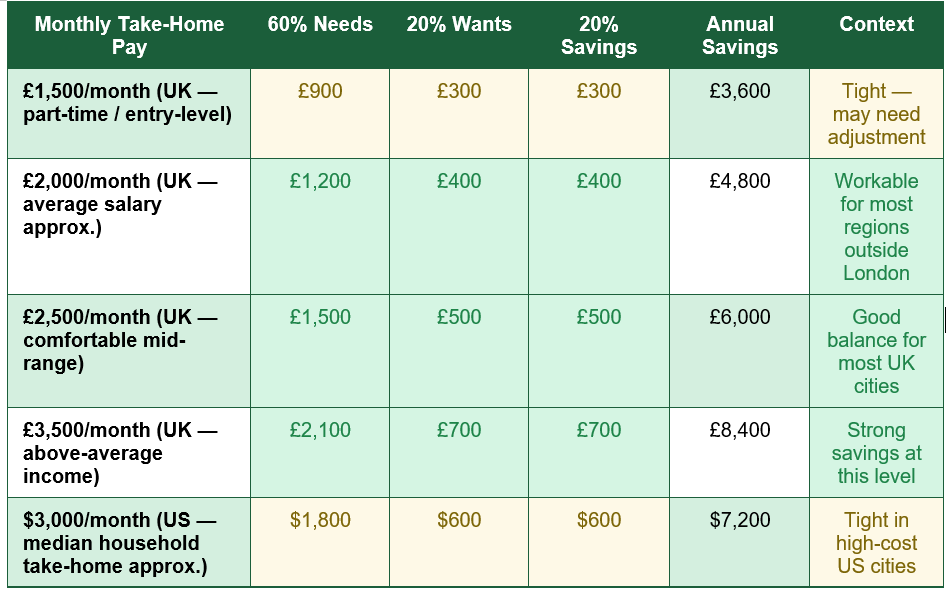

These figures illustrate the rule's scalability — the percentages remain the same regardless of income, but the absolute amounts grow with earnings. A household on £2,000/month saves £4,800 per year. The same household on £3,500/month saves £8,400 per year at the same 20% rate. The rule applies consistently across income levels, though higher earners will find more comfortable headroom in each category and lower earners in very high-cost cities may need to adjust the needs percentage temporarily while working to reduce fixed costs.
How to Implement the 60/20/20 Rule: A Step-by-Step Guide
- Calculate your monthly net take-home pay: Start with your actual bank deposit after taxes, National Insurance, and pension deductions — not your gross salary. If you are paid weekly or fortnightly, multiply to a monthly equivalent. If your income varies (self-employed, commission-based, zero-hours contracts), use a conservative estimate of your typical monthly floor — the lowest reliable income month from the past six months.
- Calculate the three budget amounts: Multiply your net monthly pay by 0.60, 0.20, and 0.20. These are your needs ceiling, wants budget, and savings target. Write these three numbers down where you can see them.
- List your current monthly needs and compare to the 60% ceiling: Write out every expense in the needs category for a typical month. Total them up. If they exceed the 60% ceiling, you have three options: reduce some discretionary costs currently sitting in needs (upgrade some 'wants' disguised as 'needs'), find ways to reduce genuine essential costs (switch energy provider, renegotiate rent, reduce commuting costs), or temporarily flex the percentages while working toward lower essential costs.
- Automate the savings transfer on payday: Set up a standing order for the exact savings amount to transfer automatically to a separate savings account on the day your salary arrives. This is the most critical implementation step — savings that leave your account before you see the full balance are not spent. Most UK bank apps support this through the scheduled payments function.
- Set up a second account for wants (optional but highly effective): Consider opening a separate bank account or using a dedicated pot (available in digital banks like Monzo, Starling, and Revolut) for the 20% wants allocation. Transfer this amount on payday. When the wants pot is empty, wants spending stops for the month — automatic enforcement without spreadsheets.
- Review monthly for the first three months, then quarterly: Track whether your spending actually aligned with the categories for the first 90 days. Most people discover expenses they miscategorised as needs that are actually wants, or recurring subscriptions they had forgotten that drain the wants budget. After three months, quarterly reviews are usually sufficient unless income or circumstances change.
Worked Example: The 60/20/20 Rule for a UK Household
Sarah is 28, renting a one-bedroom flat in Manchester. Her monthly take-home pay after income tax, National Insurance, and a 5% workplace pension contribution is £2,200.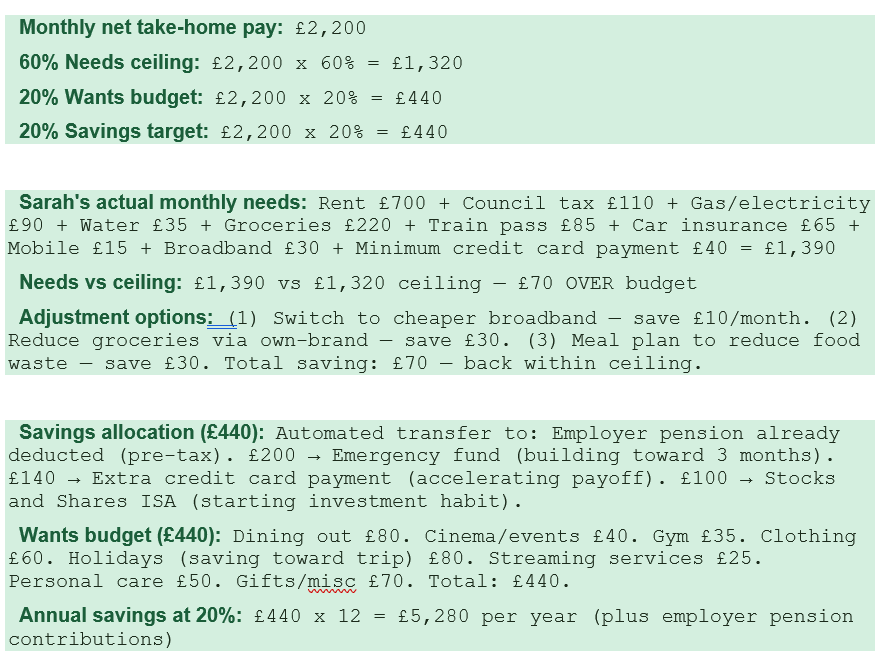
THE AUTOMATION RULE: Set up your savings standing order before doing anything else on payday. The exact sequence matters: money that leaves your account first cannot be spent. Name your savings account something motivating ("House Deposit," "Emergency Shield," "Freedom Fund") — research consistently shows that named accounts with a specific purpose have higher retention than generic savings accounts. Most UK digital banks (Monzo, Starling, Revolut) allow multiple named savings pots within a single account for no additional cost.
Budget Rules Compared: How 60/20/20 Fits the Current Landscape
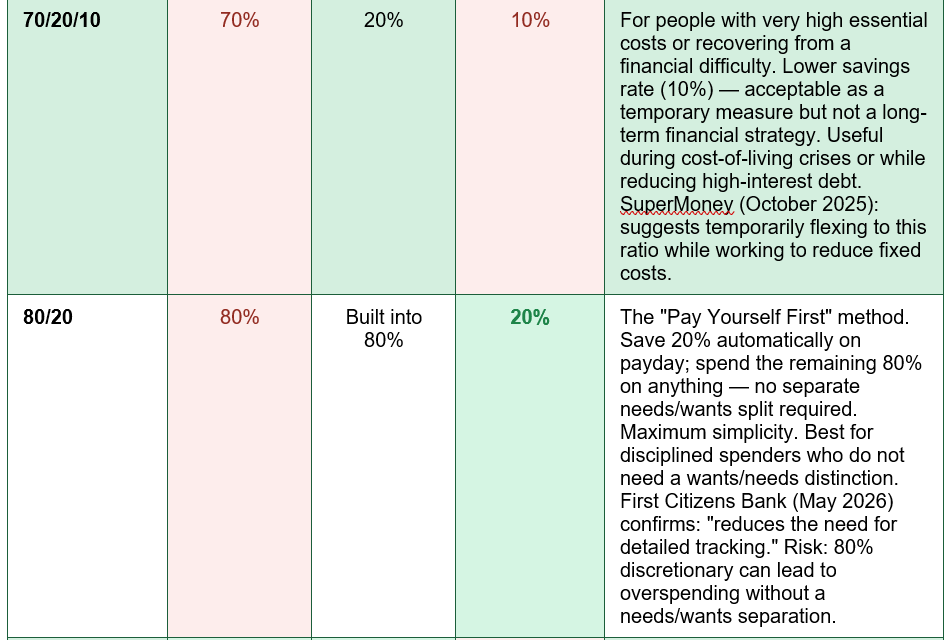
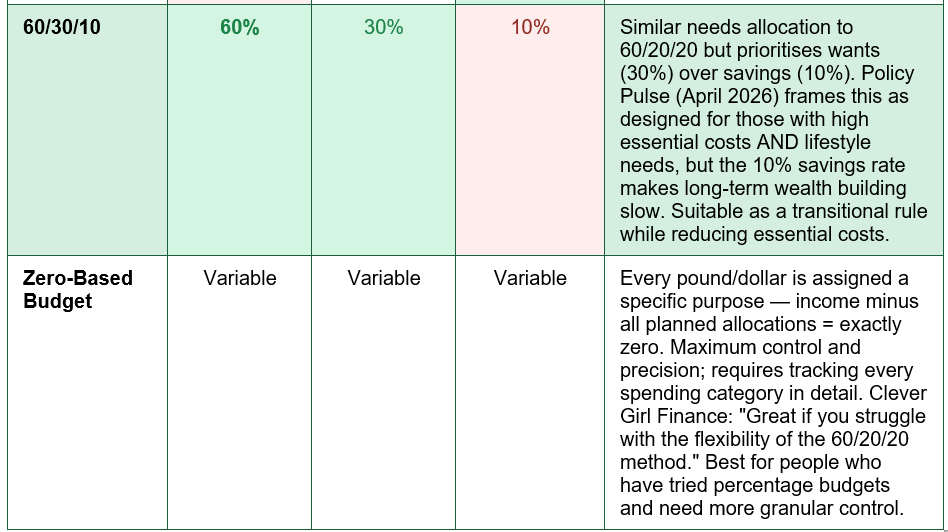
The 60/20/20 rule is one of several percentage-based budgeting frameworks. Understanding how it compares to the alternatives helps you choose the right starting point for your circumstances — or decide when and how to flex between them: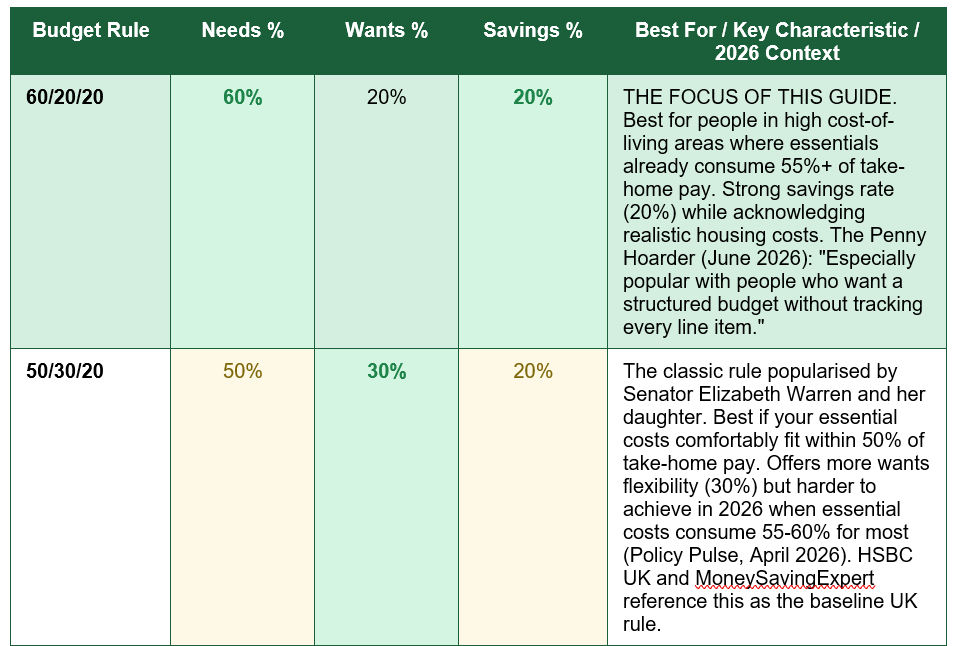
When the 60/20/20 Rule Works — and When to Adapt It
The Rule Works Best For:
- High cost-of-living households: If you live in London, Manchester, Edinburgh, New York, or Los Angeles — cities where rent alone commonly consumes 35-45% of take-home pay — the 60/20/20 rule provides a realistic framework where the 50/30/20 rule simply does not. The Penny Hoarder's June 2026 guide is explicit: 'The 60/20/20 rule tends to fit people in higher cost-of-living areas where rent and essentials consume more than half of take-home pay.'
- People new to budgeting: Three categories and simple arithmetic lower the barrier to starting. Most people find 30 budget categories overwhelming enough to abandon budgeting entirely. Three categories — needs, wants, savings — create immediate structure with minimal complexity. SuperMoney (October 2025) describes it as 'flexible and beginner-friendly: perfect for those new to budgeting who want structure with freedom.'
- Savers who feel guilty about discretionary spending: PocketGuard's January 2026 guide identifies a key psychological benefit: the rule provides permission to spend on wants within the 20% limit. 'A 60/20/20 budget focuses on balance, helping people cover essentials, plan for the future, and still enjoy life without guilt.' The explicit wants allocation prevents the overcorrection of trying to live like a monk and abandoning the budget when it becomes unsustainable.
- Dual-income households tracking combined finances: The percentage-based approach scales automatically to any combined income level, making it easy to apply to a joint budget without recalculating absolute amounts when income changes.
When to Consider a Different Approach:
- Your needs already exceed 70% of take-home pay: If your non-discretionary expenses genuinely consume 70% or more of net income, the 60/20/20 rule does not fit your current circumstances without changes. SuperMoney's October 2025 guide recommends temporarily shifting to a 70/20/10 structure while actively working to reduce fixed costs — negotiating rent, switching to cheaper providers, or increasing income — then transitioning back to 60/20/20 as the situation improves.
- You have significant high-interest debt: If you are carrying substantial credit card or personal loan debt at high interest rates, temporarily directing more than 20% to debt repayment — at the expense of the wants allocation — will likely produce better financial outcomes than rigidly following the standard split. A 60/5/35 structure (60% needs, 5% minimal wants, 35% debt payoff) during an aggressive debt clearance phase accelerates the path to financial stability.
- You need more precision than three buckets: If you have complex financial commitments — multiple debt obligations, saving for several goals simultaneously, irregular income, business expenses mixed with personal — a zero-based budget may provide the granular control that a three-category percentage system cannot.
THE 60% NEEDS TRAP — INFLATION CREEP IN DISGUISE: The biggest long-term risk of the 60/20/20 rule is lifestyle inflation disguised as 'needs.' As income rises, the 60% needs ceiling rises with it — and there is a natural tendency to allow lifestyle upgrades (a more expensive flat, a newer car, premium gym membership) to flow into the needs category and consume the expanded ceiling. A household on £2,000/month with a £1,200 needs ceiling should not automatically fill the £2,100 needs ceiling when income rises to £3,500. The correct approach: when income rises, keep needs spending broadly stable and direct the additional capacity to savings and wants. Review the needs category annually to identify lifestyle inflations that have crept in and reclassify them. The 60% is a ceiling, not a target.
Conclusion
The 60/20/20 rule addresses one of the most practically significant failures of traditional budget frameworks in the current economic environment: the reality that essential costs — rent, food, utilities, transport, insurance — now consume 55% to 60% of take-home pay for most households, making the 50/30/20 rule's 50% needs ceiling unreachable without artificial constraint. By acknowledging this reality and allocating 60% of net income to genuine essential needs, the rule creates a budget that is both structurally sound and actually liveable — while still preserving a 20% savings rate that builds meaningful long-term financial security.The three categories — needs (60%), wants (20%), savings and debt (20%) — provide enough structure to create accountability without enough complexity to become a burden. The worked example in this guide shows how a household on £2,200/month can save £5,280 per year, make extra debt repayments, and begin investing through a Stocks and Shares ISA — all within the 60/20/20 framework. The budget rule comparison table illustrates where 60/20/20 sits relative to the alternatives: more realistic than 50/30/20 for high-cost areas; more savings-focused than 70/20/10; more structured than 80/20.
The critical implementation disciplines are simple and consistent across all sources reviewed: use net (after-tax) income not gross pay; categorise expenses honestly (wants are wants, not needs); automate the 20% savings transfer before you see the money; and review the categories when income or circumstances change. Do not treat the 60% ceiling as a target to fill — when income rises, the additional capacity should flow primarily to savings rather than lifestyle inflation in the needs category. Budgeting is not about perfection in any given month; it is about building a consistent structure that gradually shifts the balance of your financial life from spending everything earned to systematically building the security, freedom, and options that savings provide over time.
0 Comments
Be the first to share your thoughts on this article.