
AI for business
AI Automation for Restaurant Practice Managers

87% of restaurant operators are comfortable with AI (Toast, 676 operators, 2026). Only 26% actively use it (NRA 2026). The gap between comfort and deployment is where practice managers have the highest competitive opportunity.
Restaurant practice managers occupy a specific and demanding position in the hospitality industry. Unlike general managers who are accountable for one location, practice managers are typically responsible for operational standards, staff performance, profitability, and compliance across multiple sites. Their time is structurally scarce: every hour spent on scheduling, inventory, reporting, or administrative tasks is an hour not spent on training, culture, and the quality of guest experience that actually drives revenue and retention. AI automation does not eliminate these tasks. It compresses them. A scheduling process that takes four hours becomes a twenty-minute review. An inventory count that requires a team of three becomes a daily automated dashboard. A weekly performance report that requires pulling data from five systems becomes an automated summary delivered to the inbox before Monday’s manager meeting. Toast’s April 2026 survey of 676 US restaurant operators found that 87% are comfortable with AI and nearly nine in ten are experimenting with tools. The National Restaurant Association’s independent February 2026 data puts active adoption at 26% — a figure that defines the competitive gap that early adopters can exploit. This article covers five operational areas where AI automation delivers the most consistently documented ROI for restaurant practice managers, with the 2025-2026 research behind each.
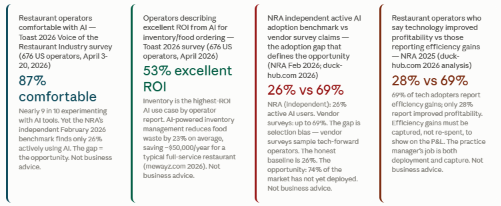
Toast’s April 2026 survey of 676 US restaurant operators found that 87% are comfortable with AI — nearly nine in ten are experimenting with tools. The National Restaurant Association’s independent February 2026 benchmark places active deployment at 26%. That 61-percentage-point gap between comfort and deployment represents both where the industry currently is and where practice managers who deploy thoughtfully are gaining advantage.
87% of restaurant operators comfortable with AI; nearly 9 in 10 experimenting (Toast 676 operators, April 2026). 26% actively use AI tools (NRA independent benchmark, February 2026). 76% of restaurants use 3+ automated tools already (Capterra via restroworks.com). Sources: Toast 2026; NRA 2026; restroworks.com.
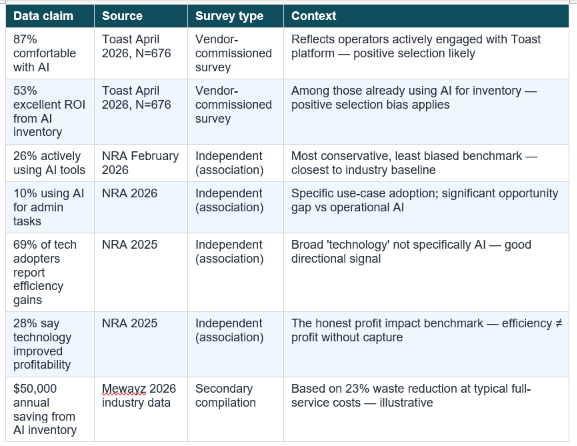
A second important distinction: only 28% of operators say technology improved profitability, even though 69% of tech adopters report efficiency gains (NRA 2025). This gap between efficiency gains and profit improvement is not a failure of AI. It is a failure of capture — efficiency gains that are simply re-spent on other costs, without being converted to margin, do not show up as profit improvement. The practice manager’s role is to ensure that AI-delivered efficiencies are captured rather than absorbed. The Restaurant365 2026 ROI guide puts the operational principle plainly: ‘AI amplifies good operations but cannot fix broken foundational processes.
53% of operators using AI for inventory described excellent ROI (Toast 676 operators, 2026). AI-powered inventory management reduces food waste by average 23%, saving ~$50,000/year for typical full-service restaurant (mewayz.com 2026). 70% of operators believe AI can reduce wastage by 25% (restroworks.com). Sources: Toast 2026; mewayz.com 2026; Restaurant365 2026 ROI guide.
Restaurant365 (restaurant365.com): AI-powered inventory and food cost management integrated with POS and accounting. BlueCart: AI ordering and inventory for independent and chain restaurants. Compeat (Ramp): inventory and purchasing automation. Toast: inventory features within the broader Toast POS ecosystem.
Restaurant365 2026 ROI guide: inventory and purchasing automation has a typical ROI period of 3-6 months, making it one of the fastest-payback AI investments available. The $50,000 annual saving estimate at $50-200/month software cost produces a compelling return even at the high end of pricing.
AI inventory management requires accurate, current POS data to function effectively. Restaurant365's 2026 guide specifically identifies poor data quality as the primary cause of AI implementation failure. Before deploying AI inventory tools, ensure your POS data is clean, your menu items are correctly categorised, and your recipe costing is current.
62% of restaurant operators planned labour management software investment increases by 2026 (mewayz.com 2026, up from 38% in 2023). Average hourly restaurant wage +28% since 2020 (Bureau of Labor Statistics via mewayz.com). Toast 2026: positive ROI reported from AI labour/staffing by operators using the tools.
7shifts: AI-powered restaurant-specific scheduling with demand forecasting. HotSchedules (Fourth): scheduling, labour forecasting, and compliance management. Schedulefly: independent restaurant scheduling. When I Work: automated scheduling across hospitality. Toast (labour module): integrated within POS ecosystem.
Even a 5% reduction in over-scheduling on a $1M annual labour spend saves $50,000/year. At $100-200/month for scheduling software, the ROI typically arrives within 60-90 days of clean deployment. The practice manager ROI multiplies across locations: three locations × $50,000 = $150,000 recovered annually. Not business advice.
AI scheduling works best when staff availability, certifications, and role qualifications are kept current in the system. Outdated staff data (departures not removed, certifications not updated, availability restrictions not captured) produces scheduling errors that undermine trust in the tool. Assign one administrator ownership of staff data hygiene before deployment.
Toast 2026: positive ROI from AI guest engagement tools. Restaurant365 2026: voice automation and guest service bots consistently deliver ROI. 65% faster order fulfilment from digital transformation (incentivio.com 2026). 60% of diners prefer ordering via mobile apps (restroworks.com). 60% improvement in operational efficiency from comprehensive digital transformation (incentivio.com).
OpenTable: AI-powered reservation management with real-time availability and guest preference learning. Resy: reservation and waitlist management with CRM integration. Yelp Guest Manager: combining reviews and reservations in one system. Popmenu: AI phone answering + digital menus + online ordering. Slang.ai: restaurant-specific AI phone answering bot.
A 20% reduction in no-shows on a restaurant doing 200 covers/night with a 5% no-show rate: recovering 10 covers × $40 average check = $400/night × 300 service nights = $120,000 recovered revenue annually. Voice AI phone answering frees approximately 1-2 hours of staff time per day.
AI reservation systems require integration with your POS and floor management system to maintain real-time accuracy. A reservation tool that does not see the full floor picture can overbook or create seating conflicts that damage the guest experience the tool is supposed to improve.
67% of major chains deploying AI for personalised marketing by 2026 vs 29% in 2023 (mewayz.com 2026). Toast 2026: positive ROI reported from AI menu optimisation tools. AI recommendation engines increase average order value through personalised digital ordering (incentivio.com 2026). Deloitte 2025: 60% of restaurant leaders expect AI to benefit customer experience.
Galley Solutions: AI menu management and recipe costing integrated with inventory. Toast (menu analytics module): real-time item performance data within POS. Lightspeed Restaurant: POS with built-in menu engineering analytics. Restaurant365: menu engineering with integrated food cost reporting. Avero Slingshot: analytics and menu performance across locations.
A 1% increase in average check on a restaurant doing $2M annual revenue = $20,000 additional revenue. Menu engineering to identify and eliminate low-margin items can improve gross margin by 1-2 percentage points on the food cost line.
Menu engineering AI is only as good as the recipe costing data feeding it. If your theoretical food costs are outdated, inaccurate, or not built for menu engineering (portion sizes wrong, ingredient costs not updated), the AI output will optimise toward the wrong targets.
10% of operators use AI for administrative tasks currently (NRA 2026) — significant opportunity gap vs operational AI. 69% of tech adopters report efficiency gains (NRA 2025). Incentivio 2026: 60% operational efficiency improvement from comprehensive digital transformation. Toast 2026: 87% of operators comfortable with AI, suggesting low barrier to administrative AI adoption.
Restaurant365: automated P&L reporting, multi-location dashboard, AI-generated insights. 7shifts: automated labour reporting and schedule summaries. OpenAI / Claude (Anthropic): general-purpose LLMs for drafting reports, staff communications, menu descriptions, and operational documentation. Craftable: food cost and operational reporting with automated insights.
A practice manager saving 5 hours/week on administrative tasks across three locations = 15 hours/week × 50 weeks = 750 hours/year redirected to higher-value activities. At $40/hour management value, that is $30,000 in redirected management capacity annually.
General-purpose AI tools (GPT-4, Claude) require the practice manager to have strong prompt skills and to review outputs carefully — these tools do not know your specific business context unless you provide it. Invest 30 minutes in building a master 'context prompt' that describes your restaurant group, your standards, and your reporting format. This single document dramatically improves AI output quality for operational use.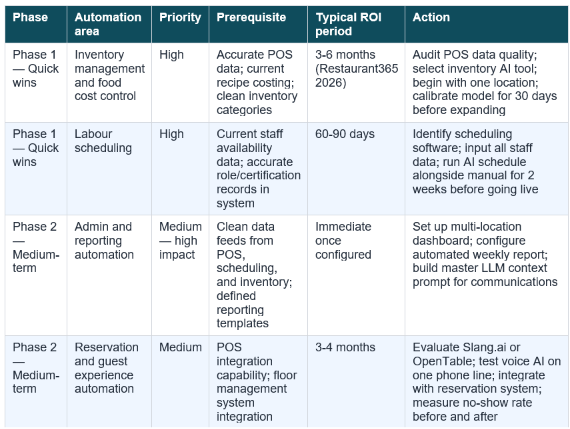
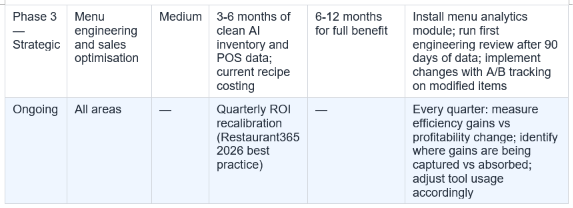
The honest framing from duck-hub.com’s 2026 analysis holds: AI delivers efficiency gains reliably. Profit improvement requires those gains to be captured rather than simply spent elsewhere. The practice manager’s job is both to deploy and to capture — to ensure that the hours recovered from scheduling, the dollars recovered from food waste, and the covers recovered from no-shows actually land on the P&L rather than disappearing into the operational overhead. That is a management discipline, not a technology problem. The technology is increasingly ready. The gap is deployment and capture.
Based on the two most credible 2026 data sources: inventory and purchasing automation. Toast's April 2026 survey of 676 US restaurant operators found that 53% of those using AI for inventory described receiving excellent ROI — the highest positive rating of any use case in the survey. Restaurant365's 2026 AI ROI guide identifies inventory and purchasing automation as one of the two AI use cases that 'consistently deliver measurable ROI across restaurant types' alongside voice automation. The mewayz.com 2026 industry data compilation estimates an average 23% food waste reduction, saving approximately $50,000 annually for a typical full-service restaurant. The Restaurant365 guide puts the typical ROI period at 3-6 months. For a practice manager deploying across multiple locations, this is the highest-conviction starting point.
What is the honest adoption rate for AI in restaurants?
There are two benchmarks, and both matter. The National Restaurant Association's independent February 2026 survey found that 26% of restaurant operators actively use AI-related tools — this is the most credible conservative benchmark, as it is not commissioned by a vendor. Vendor surveys report adoption as high as 69%, but duck-hub.com's 2026 independent analysis explains that this reflects selection bias: vendor surveys typically sample tech-forward operators or their own customer bases, skewing toward higher adoption. The NRA's 26% is the most useful baseline for practice managers to compare against. The 10% using AI specifically for administrative tasks (also NRA 2026) is the most striking opportunity gap, since administrative AI is the easiest to deploy with the least operational integration required.
How much does restaurant AI cost and how do I calculate ROI?
The cost ranges vary significantly. Practice management and multi-location restaurant software platforms (Restaurant365, 7shifts, HotSchedules) typically run $200-$1,000/month depending on location count and feature depth. Inventory-specific AI tools run $100-$500/month. Voice AI for phones (Slang.ai, Popmenu AI phone) runs $200-$600/month. The Restaurant365 2026 ROI guide recommends measuring ROI through operational efficiencies and incremental revenue: food cost as % of revenue before and after; labour cost as % of revenue before and after; no-show rate before and after; weekly manager administrative hours before and after. The honest warning from duck-hub.com: 69% of tech adopters report efficiency gains but only 28% report improved profitability. Efficiency gains must be captured — not re-spent — to show up as profit.
What are the most important prerequisites before deploying AI in a restaurant?
Restaurant365's 2026 ROI guide is specific: 'AI fails most often when it's disconnected from live operations or bogged down by poor data.' The three prerequisites that appear across the research: (1) Clean POS data — accurate menu items, correct categories, recipe costs current. If your POS data has years of orphaned items, inconsistent naming, and outdated recipe costs, AI inventory and menu engineering tools will optimise toward incorrect targets. (2) Current staff records — accurate availability, roles, and certifications for AI scheduling. (3) System integration capability — AI tools that cannot connect to your POS, scheduling, and inventory systems in real time produce outdated insights. The pre-deployment data audit is not glamorous, but restaurant365.com identifies it as the step most skipped by operators who then report poor AI outcomes.
Can AI replace the need for experienced restaurant practice managers?
No — and the research makes this clear. Toast's 2026 survey found that while operators are comfortable with AI, 'they still want oversight from actual people.' The Restaurant365 2026 guide specifically states that 'AI amplifies good operations but cannot fix broken foundational processes.' The practice manager's judgment about culture, training, guest experience standards, supplier relationships, and team development is not automatable. What AI changes is the ratio of the practice manager's time between administrative and strategic tasks. Duck-hub.com's 2026 analysis confirms that even among active AI adopters, human oversight remains the dominant operating model. The competitive advantage goes to practice managers who can deploy AI to recover time and then invest that time in the human dimensions of the role that technology cannot replicate.
Restaurant practice managers occupy a specific and demanding position in the hospitality industry. Unlike general managers who are accountable for one location, practice managers are typically responsible for operational standards, staff performance, profitability, and compliance across multiple sites. Their time is structurally scarce: every hour spent on scheduling, inventory, reporting, or administrative tasks is an hour not spent on training, culture, and the quality of guest experience that actually drives revenue and retention. AI automation does not eliminate these tasks. It compresses them. A scheduling process that takes four hours becomes a twenty-minute review. An inventory count that requires a team of three becomes a daily automated dashboard. A weekly performance report that requires pulling data from five systems becomes an automated summary delivered to the inbox before Monday’s manager meeting. Toast’s April 2026 survey of 676 US restaurant operators found that 87% are comfortable with AI and nearly nine in ten are experimenting with tools. The National Restaurant Association’s independent February 2026 data puts active adoption at 26% — a figure that defines the competitive gap that early adopters can exploit. This article covers five operational areas where AI automation delivers the most consistently documented ROI for restaurant practice managers, with the 2025-2026 research behind each.
Table of Contents
- The Practice Manager’s AI Opportunity in 2026
- Understanding the Adoption Gap: The Honest Data Picture
- Automation Area 1 Inventory Management and Food Cost Control
- Automation Area 2 Labour Scheduling and Workforce Optimisation
- Automation Area 3 Reservations, Waitlists, and Guest Experience Automation
- Automation Area 4 Menu Engineering and Sales Optimisation
- Automation Area 5 Administrative Automation: Reporting, Compliance, and Communications
- The AI Implementation Roadmap for Practice Managers
- Conclusion: The 74% Opportunity
- Frequently Asked Questions
The Practice Manager’s AI Opportunity in 2026
The restaurant industry’s relationship with AI has moved from curiosity to quiet urgency. The cost pressures that have accumulated since 2020 — food inflation, the 28% average wage increase per Bureau of Labor Statistics data (via mewayz.com 2026), and rising energy costs — have made the margin for operational inefficiency thinner than it has been in a generation. In that context, AI’s ability to reduce waste, optimise scheduling, and automate administrative tasks is not a luxury investment. It is a defensive necessity. For a practice manager overseeing multiple locations, the pressure is compounded: every inefficiency that exists in one location also exists in the others. An AI tool that solves a $50,000 annual food waste problem at one site solves it at every site simultaneously. The leverage is structural.Toast’s April 2026 survey of 676 US restaurant operators found that 87% are comfortable with AI — nearly nine in ten are experimenting with tools. The National Restaurant Association’s independent February 2026 benchmark places active deployment at 26%. That 61-percentage-point gap between comfort and deployment represents both where the industry currently is and where practice managers who deploy thoughtfully are gaining advantage.
87% of restaurant operators comfortable with AI; nearly 9 in 10 experimenting (Toast 676 operators, April 2026). 26% actively use AI tools (NRA independent benchmark, February 2026). 76% of restaurants use 3+ automated tools already (Capterra via restroworks.com). Sources: Toast 2026; NRA 2026; restroworks.com.
Understanding the Adoption Gap: The Honest Data Picture
Before investing in AI tools, practice managers benefit from understanding the honest state of the data. The duck-hub.com 2026 analysis of AI in restaurants statistics is the most methodologically transparent source available. It identifies a significant discrepancy: vendor-commissioned surveys report adoption near 69%, while the NRA’s independent February 2026 benchmark finds only 26% of operators actively using AI tools. The gap is explained by selection bias — vendor surveys typically sample their own customer bases, which skews toward tech-forward adopters.A second important distinction: only 28% of operators say technology improved profitability, even though 69% of tech adopters report efficiency gains (NRA 2025). This gap between efficiency gains and profit improvement is not a failure of AI. It is a failure of capture — efficiency gains that are simply re-spent on other costs, without being converted to margin, do not show up as profit improvement. The practice manager’s role is to ensure that AI-delivered efficiencies are captured rather than absorbed. The Restaurant365 2026 ROI guide puts the operational principle plainly: ‘AI amplifies good operations but cannot fix broken foundational processes.
Automation Area 1 Inventory Management and Food Cost Control
Food cost is typically 28-35% of revenue for a full-service restaurant. It is also the operational area where AI delivers the most consistently documented ROI. The mechanism is prediction: AI inventory systems analyse historical sales data, day-part patterns, weather forecasts, local events, and seasonal trends to predict the precise quantities to order before the week begins, reducing both over-ordering (which produces food waste and wasted cash) and under-ordering (which produces the dreaded ‘86’d’ items and the lost sales they represent). The Mewayz 2026 industry data compilation puts the average waste reduction at 23%, translating to approximately $50,000 annually for a typical full-service restaurant. Toast’s 2026 survey of 676 operators found that 53% of those using AI for inventory and food ordering described receiving excellent ROI — the highest positive rating of any AI use case surveyed. The Restaurant365 2026 AI ROI guide identifies inventory and purchasing automation as one of the two use cases that ‘consistently deliver measurable ROI across restaurant types.’ For a practice manager overseeing multiple locations, the compound effect is significant: a $50,000 annual saving per location across a three-location operation represents $150,000 of recovered margin without adding a single cover.53% of operators using AI for inventory described excellent ROI (Toast 676 operators, 2026). AI-powered inventory management reduces food waste by average 23%, saving ~$50,000/year for typical full-service restaurant (mewayz.com 2026). 70% of operators believe AI can reduce wastage by 25% (restroworks.com). Sources: Toast 2026; mewayz.com 2026; Restaurant365 2026 ROI guide.
Restaurant365 (restaurant365.com): AI-powered inventory and food cost management integrated with POS and accounting. BlueCart: AI ordering and inventory for independent and chain restaurants. Compeat (Ramp): inventory and purchasing automation. Toast: inventory features within the broader Toast POS ecosystem.
Restaurant365 2026 ROI guide: inventory and purchasing automation has a typical ROI period of 3-6 months, making it one of the fastest-payback AI investments available. The $50,000 annual saving estimate at $50-200/month software cost produces a compelling return even at the high end of pricing.
AI inventory management requires accurate, current POS data to function effectively. Restaurant365's 2026 guide specifically identifies poor data quality as the primary cause of AI implementation failure. Before deploying AI inventory tools, ensure your POS data is clean, your menu items are correctly categorised, and your recipe costing is current.
Automation Area 2 Labour Scheduling and Workforce Optimisation
Labour is the largest controllable cost in a restaurant, typically running 30-35% of revenue, and it is also the most time-intensive management task for a practice manager. The average restaurant manager spends 4-6 hours per week on scheduling — time that competes directly with training, quality control, guest relations, and strategic planning. AI scheduling tools replace that manual process with demand-based scheduling: the system analyses historical sales patterns, reservations, event calendars, weather, and day-part data to build an optimised schedule that matches staffing levels to predicted demand, rather than to manager intuition or habit. The Mewayz 2026 industry data compilation found that 62% of restaurant operators planned to increase investment in labour management software by 2026, up from 38% in 2023 — a 24-percentage-point increase in three years driven primarily by the 28% average hourly wage increase since 2020. When labour costs rise structurally, the ROI of scheduling precision increases proportionally: overstaffing a shift by two people at $18/hour for six hours costs $216. Multiply that by three locations and five overstaffed shifts per week and the annual cost exceeds $150,000. AI scheduling tools typically reduce over-staffing by 5-15% in the first quarter of deployment. Toast’s 2026 survey found that operators using AI for labour/staffing largely described positive ROI.62% of restaurant operators planned labour management software investment increases by 2026 (mewayz.com 2026, up from 38% in 2023). Average hourly restaurant wage +28% since 2020 (Bureau of Labor Statistics via mewayz.com). Toast 2026: positive ROI reported from AI labour/staffing by operators using the tools.
7shifts: AI-powered restaurant-specific scheduling with demand forecasting. HotSchedules (Fourth): scheduling, labour forecasting, and compliance management. Schedulefly: independent restaurant scheduling. When I Work: automated scheduling across hospitality. Toast (labour module): integrated within POS ecosystem.
Even a 5% reduction in over-scheduling on a $1M annual labour spend saves $50,000/year. At $100-200/month for scheduling software, the ROI typically arrives within 60-90 days of clean deployment. The practice manager ROI multiplies across locations: three locations × $50,000 = $150,000 recovered annually. Not business advice.
AI scheduling works best when staff availability, certifications, and role qualifications are kept current in the system. Outdated staff data (departures not removed, certifications not updated, availability restrictions not captured) produces scheduling errors that undermine trust in the tool. Assign one administrator ownership of staff data hygiene before deployment.
Automation Area 3 Reservations, Waitlists, and Guest Experience Automation
Guest experience automation operates at the front-of-house and pre-arrival touchpoints where practice managers have historically relied on phone calls, manual reservation books, and reactive waitlist management. AI changes all three. AI reservation systems handle inbound booking requests across multiple channels — phone (via voice AI), website, Google, social media, and third-party platforms — without requiring staff time for each booking. They manage availability in real time, send automated confirmations and reminders that reduce no-shows by 20-30%, and learn guest preferences over time to personalise future interactions. The Toast 2026 survey found that operators using AI for guest engagement described positive ROI. Restaurant365’s 2026 ROI guide specifically identifies voice automation and guest service bots as one of the two use cases that ‘consistently deliver measurable ROI across restaurant types.’ The incentivio.com 2026 technology trends report finds that restaurants implementing comprehensive digital transformation strategies report 65% faster order fulfilment and 60% improvement in operational efficiency. For a practice manager overseeing multiple locations, the front-of-house automation case is partly about efficiency but primarily about consistency: every location answering the phone at the same rate, providing the same information, and managing reservations to the same standard, regardless of which staff member happens to be available.Toast 2026: positive ROI from AI guest engagement tools. Restaurant365 2026: voice automation and guest service bots consistently deliver ROI. 65% faster order fulfilment from digital transformation (incentivio.com 2026). 60% of diners prefer ordering via mobile apps (restroworks.com). 60% improvement in operational efficiency from comprehensive digital transformation (incentivio.com).
OpenTable: AI-powered reservation management with real-time availability and guest preference learning. Resy: reservation and waitlist management with CRM integration. Yelp Guest Manager: combining reviews and reservations in one system. Popmenu: AI phone answering + digital menus + online ordering. Slang.ai: restaurant-specific AI phone answering bot.
A 20% reduction in no-shows on a restaurant doing 200 covers/night with a 5% no-show rate: recovering 10 covers × $40 average check = $400/night × 300 service nights = $120,000 recovered revenue annually. Voice AI phone answering frees approximately 1-2 hours of staff time per day.
AI reservation systems require integration with your POS and floor management system to maintain real-time accuracy. A reservation tool that does not see the full floor picture can overbook or create seating conflicts that damage the guest experience the tool is supposed to improve.
Automation Area 4 Menu Engineering and Sales Optimisation
Menu engineering — the discipline of optimising the mix of items by profitability and popularity — has historically required a spreadsheet, a consultant, and a quarterly management session. AI compresses this into a continuous, data-driven process. AI menu analysis tools cross-reference POS sales data with food cost, margin per cover, and order frequency to identify the ‘stars’ (high margin, high popularity), ‘ploughhorses’ (high popularity, low margin), ‘puzzles’ (high margin, low popularity), and ‘dogs’ (low margin, low popularity) in real time. The output is actionable: highlight stars, reprice or reposition ploughhorses, merchandise puzzles through specials, and remove or replace dogs. Toast’s 2026 survey found positive ROI from AI menu optimisation tools. Mewayz’s 2026 data compilation found that 67% of major restaurant chains will deploy AI for personalised marketing by 2026, up from 29% in 2023 — an indication of the growing confidence in AI-driven revenue optimisation. Incentivio’s 2026 technology report notes that AI-powered menu recommendation engines personalise the digital ordering experience based on individual customer history, increasing average order value. For a practice manager, menu engineering AI delivers two things simultaneously: it makes the menu more profitable per cover, and it reduces the time required to do the analysis from a quarterly project to an automated weekly dashboard.67% of major chains deploying AI for personalised marketing by 2026 vs 29% in 2023 (mewayz.com 2026). Toast 2026: positive ROI reported from AI menu optimisation tools. AI recommendation engines increase average order value through personalised digital ordering (incentivio.com 2026). Deloitte 2025: 60% of restaurant leaders expect AI to benefit customer experience.
Galley Solutions: AI menu management and recipe costing integrated with inventory. Toast (menu analytics module): real-time item performance data within POS. Lightspeed Restaurant: POS with built-in menu engineering analytics. Restaurant365: menu engineering with integrated food cost reporting. Avero Slingshot: analytics and menu performance across locations.
A 1% increase in average check on a restaurant doing $2M annual revenue = $20,000 additional revenue. Menu engineering to identify and eliminate low-margin items can improve gross margin by 1-2 percentage points on the food cost line.
Menu engineering AI is only as good as the recipe costing data feeding it. If your theoretical food costs are outdated, inaccurate, or not built for menu engineering (portion sizes wrong, ingredient costs not updated), the AI output will optimise toward the wrong targets.
Automation Area 5 Administrative Automation: Reporting, Compliance, and Communications
The practice manager’s day is not just operations. It is also reporting to ownership groups, preparing shift reports, managing compliance documentation (food safety, allergen records, health inspection prep), handling staff communications, and producing the weekly or monthly performance numbers that drive strategic decisions. This administrative load is where AI’s most immediate personal ROI for the practice manager lies, even if it is less discussed than kitchen automation. The National Restaurant Association’s 2026 data found that 10% of operators currently use AI specifically for administrative tasks — a low figure that represents a significant opportunity gap, since this is precisely where AI tools require the least operational integration and can deliver immediate time savings. Duck-hub.com’s 2026 independent analysis confirms that 69% of tech adopters report efficiency gains from technology broadly. Large language model-based tools (GPT-4 class models) can draft operational reports from data inputs, generate staff communications, create menu descriptions, review compliance documentation for completeness, and answer operational questions in natural language. For a practice manager overseeing multiple locations, AI reporting tools that pull data from POS, scheduling, and inventory systems and generate automated weekly summaries can reduce reporting time from several hours per location to minutes.10% of operators use AI for administrative tasks currently (NRA 2026) — significant opportunity gap vs operational AI. 69% of tech adopters report efficiency gains (NRA 2025). Incentivio 2026: 60% operational efficiency improvement from comprehensive digital transformation. Toast 2026: 87% of operators comfortable with AI, suggesting low barrier to administrative AI adoption.
Restaurant365: automated P&L reporting, multi-location dashboard, AI-generated insights. 7shifts: automated labour reporting and schedule summaries. OpenAI / Claude (Anthropic): general-purpose LLMs for drafting reports, staff communications, menu descriptions, and operational documentation. Craftable: food cost and operational reporting with automated insights.
A practice manager saving 5 hours/week on administrative tasks across three locations = 15 hours/week × 50 weeks = 750 hours/year redirected to higher-value activities. At $40/hour management value, that is $30,000 in redirected management capacity annually.
General-purpose AI tools (GPT-4, Claude) require the practice manager to have strong prompt skills and to review outputs carefully — these tools do not know your specific business context unless you provide it. Invest 30 minutes in building a master 'context prompt' that describes your restaurant group, your standards, and your reporting format. This single document dramatically improves AI output quality for operational use.
The AI Implementation Roadmap for Practice Managers
Conclusion
The most useful single statistic in this article for a practice manager is not the 87% comfort rate or the 53% excellent ROI from AI inventory. It is the 26% active adoption figure from the NRA’s independent February 2026 benchmark. It means that 74% of the industry has not yet deployed AI operationally. Every month that passes, that window narrows as early adopters embed AI-driven advantages into their cost structures and guest experience delivery. For practice managers overseeing multiple locations, the leverage available is disproportionate: the same tool deployed across three or five locations delivers three or five times the absolute saving at roughly the same implementation cost.The honest framing from duck-hub.com’s 2026 analysis holds: AI delivers efficiency gains reliably. Profit improvement requires those gains to be captured rather than simply spent elsewhere. The practice manager’s job is both to deploy and to capture — to ensure that the hours recovered from scheduling, the dollars recovered from food waste, and the covers recovered from no-shows actually land on the P&L rather than disappearing into the operational overhead. That is a management discipline, not a technology problem. The technology is increasingly ready. The gap is deployment and capture.
Frequently Asked Questions
What is the most proven AI use case for restaurant ROI in 2026?Based on the two most credible 2026 data sources: inventory and purchasing automation. Toast's April 2026 survey of 676 US restaurant operators found that 53% of those using AI for inventory described receiving excellent ROI — the highest positive rating of any use case in the survey. Restaurant365's 2026 AI ROI guide identifies inventory and purchasing automation as one of the two AI use cases that 'consistently deliver measurable ROI across restaurant types' alongside voice automation. The mewayz.com 2026 industry data compilation estimates an average 23% food waste reduction, saving approximately $50,000 annually for a typical full-service restaurant. The Restaurant365 guide puts the typical ROI period at 3-6 months. For a practice manager deploying across multiple locations, this is the highest-conviction starting point.
What is the honest adoption rate for AI in restaurants?
There are two benchmarks, and both matter. The National Restaurant Association's independent February 2026 survey found that 26% of restaurant operators actively use AI-related tools — this is the most credible conservative benchmark, as it is not commissioned by a vendor. Vendor surveys report adoption as high as 69%, but duck-hub.com's 2026 independent analysis explains that this reflects selection bias: vendor surveys typically sample tech-forward operators or their own customer bases, skewing toward higher adoption. The NRA's 26% is the most useful baseline for practice managers to compare against. The 10% using AI specifically for administrative tasks (also NRA 2026) is the most striking opportunity gap, since administrative AI is the easiest to deploy with the least operational integration required.
How much does restaurant AI cost and how do I calculate ROI?
The cost ranges vary significantly. Practice management and multi-location restaurant software platforms (Restaurant365, 7shifts, HotSchedules) typically run $200-$1,000/month depending on location count and feature depth. Inventory-specific AI tools run $100-$500/month. Voice AI for phones (Slang.ai, Popmenu AI phone) runs $200-$600/month. The Restaurant365 2026 ROI guide recommends measuring ROI through operational efficiencies and incremental revenue: food cost as % of revenue before and after; labour cost as % of revenue before and after; no-show rate before and after; weekly manager administrative hours before and after. The honest warning from duck-hub.com: 69% of tech adopters report efficiency gains but only 28% report improved profitability. Efficiency gains must be captured — not re-spent — to show up as profit.
What are the most important prerequisites before deploying AI in a restaurant?
Restaurant365's 2026 ROI guide is specific: 'AI fails most often when it's disconnected from live operations or bogged down by poor data.' The three prerequisites that appear across the research: (1) Clean POS data — accurate menu items, correct categories, recipe costs current. If your POS data has years of orphaned items, inconsistent naming, and outdated recipe costs, AI inventory and menu engineering tools will optimise toward incorrect targets. (2) Current staff records — accurate availability, roles, and certifications for AI scheduling. (3) System integration capability — AI tools that cannot connect to your POS, scheduling, and inventory systems in real time produce outdated insights. The pre-deployment data audit is not glamorous, but restaurant365.com identifies it as the step most skipped by operators who then report poor AI outcomes.
Can AI replace the need for experienced restaurant practice managers?
No — and the research makes this clear. Toast's 2026 survey found that while operators are comfortable with AI, 'they still want oversight from actual people.' The Restaurant365 2026 guide specifically states that 'AI amplifies good operations but cannot fix broken foundational processes.' The practice manager's judgment about culture, training, guest experience standards, supplier relationships, and team development is not automatable. What AI changes is the ratio of the practice manager's time between administrative and strategic tasks. Duck-hub.com's 2026 analysis confirms that even among active AI adopters, human oversight remains the dominant operating model. The competitive advantage goes to practice managers who can deploy AI to recover time and then invest that time in the human dimensions of the role that technology cannot replicate.
0 Comments
Be the first to share your thoughts on this article.