

AI Tools
AI Can’t Replace Being There: Experience Economy Stocks

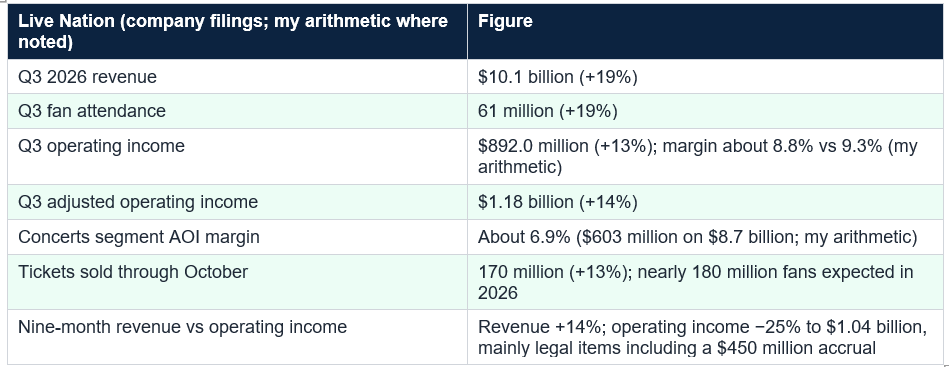
Revenue $10.1 billion (+19%); operating income $892.0 million (+13%); adjusted operating income $1.18 billion (+14%); fan attendance 61 million (+19%); 170 million tickets sold through October (+13%); nearly 180 million fans expected in 2026; nine-month revenue +14% but operating income −25% to $1.04 billion, mainly from governmental investigations and litigation including a $450 million accrual. Disney (fiscal Q3 2026, quarter ended June 27): Experiences operating income $3.02 billion (+20%, about four points from a tariff refund); domestic attendance +3%; per-capita spending +4%; global guests +4%; Experiences was about 54% of segment operating income in my arithmetic; fiscal Q4 results due November 17 (Q4 guidance about $4.9 billion including a roughly $600 million extra week). My arithmetic: Live Nation’s concerts segment earned about 6.9% AOI on $8.7 billion of revenue, and its Q3 operating margin was about 8.8% versus 9.3% a year earlier; a 10% position in a $100,000 portfolio that falls 30% costs $3,000 (3% of the portfolio) and needs a 42.9% gain to recover.
It is an appealing idea in a market that has spent 2026 worrying about which businesses AI will make obsolete. This guide takes the argument seriously and then tests it against the latest filings from Live Nation and Disney, noting what the thesis leaves out. The author works at an investment adviser, and the article is informational.
Then, in early November, AI-linked stocks themselves sold off, which Invesco’s Brian Levitt attributed to rising interest rates, aggressive capital spending and local opposition to data-center expansion. So investors worry both that AI will destroy some businesses and that the AI boom is overheated, and experience businesses sit outside both worries. But a business can avoid AI risk and still be hit by the other forces in that selloff, particularly higher rates.
He is careful to say these businesses can have bad years, citing weather, gas prices, airfare, consumer confidence and labor costs, and that finding the right industry is only the beginning: price matters, and companies in the same industry differ widely on balance sheets and management. He closes by suggesting an adviser can help. I list the names only to describe the article, not to recommend them.
The details add nuance. Stadium activity shifted from the second to the third quarter because of the FIFA World Cup, which helped Q3. Profit growth lagged revenue growth: in my arithmetic the Q3 operating margin was about 8.8% versus 9.3% a year earlier, and the concerts segment earned about 6.9% adjusted operating income on $8.7 billion of revenue, a thin margin. And nine-month operating income fell 25% to $1.04 billion even as revenue rose 14%, which the 10-Q attributes primarily to governmental investigations and litigation, including a $450 million accrual. Demand is strong; legal and regulatory risk is real.
Live Nation Q3 2026: revenue $10.1B (+19%), attendance 61M (+19%), operating income $892M (+13%), AOI $1.18B (+14%); 170M tickets sold through October (+13%). Nine-month operating income −25% on legal items including a $450M accrual. Disney Experiences (FQ3 2026): operating income $3.02B (+20%, about four points from a tariff refund); domestic attendance +3%, per-capita spending +4%.
But there are caveats. About four points of the 20% growth came from a tariff refund, so underlying growth was about 16%. Disney flagged continued softness at its Shanghai and Hong Kong parks, and weaker international visitors to its domestic parks, though that moderated. The fiscal Q4 report is due November 17, with guidance of about $4.9 billion of segment operating income including an extra week worth roughly $600 million, so the numbers will need careful reading. I did not retrieve Comcast’s Universal or United Parks’ results.
Ski resorts illustrate the distinction the article draws: Vail Resorts called the last western US season one of its most challenging winters because of poor snowfall. That is a weather risk, not a technology one, but it shows these companies can still disappoint shareholders. For casinos, the article contrasts operators such as MGM, Caesars and Wynn, exposed to room rates and gaming volumes, with VICI Properties, a REIT that owns many of the properties and leases them to operators and is more exposed to rent collection, tenant credit, rates and leverage.
Valuation is the other unknown. A wonderful business can be a poor investment at a high price, as the article says, and I did not retrieve valuations for any of these stocks; if investors crowd into an AI-safe theme, prices can rise ahead of earnings. Disney, Comcast and Live Nation are also large holdings in many index funds (general knowledge), so you may already own more of this theme than you think. AI-resistance is a useful lens, but only one of many.
The largest indirect risk is income. If AI disrupts jobs and weakens household budgets, people may cut discretionary spending, including on experiences. In my earlier research the labor market was described as low-hire, low-fire, with unemployment at 4.2% in September, so there is no sign of that yet, but it is the scenario that most threatens the thesis: an AI-resistant business still depends on customers who can afford it.
Remember overlap, too: if you own an S&P 500 fund you probably already hold Disney, Comcast and Live Nation (general knowledge), so a new position adds weight rather than diversification. And check how the theme fits your goals: the article notes one company might suit long-term appreciation while another suits income or lower volatility. A theme should follow your plan, not replace it.

AI-resistant is not recession-proof. These businesses depend on consumers’ discretionary budgets and face rates, weather, regulation and valuation risks. The article is by an adviser and is informational, not advice. Never invest money you may need soon. Common mistakes include treating a good theme as a good stock, paying any price for an AI-safe label, ignoring debt and interest-rate risk, assuming strong attendance means strong profits, overlooking overlap with index funds and relying on a single article, including this one. Check the companies’ own filings, and remember an adviser’s article may point toward the adviser’s services.
So AI-resilient does not mean risk-free. Rates, consumer budgets, weather, regulation and valuation all remain, and AI could still matter through jobs and income. Treat the theme as one lens, size it so a bad year would not hurt your plans, check balance sheets and prices, and remember the author works for an adviser. This is general education, not personalized investment advice.
It refers to businesses that sell experiences rather than goods: live concerts, theme parks, cruises, ski resorts, casinos and similar leisure and travel activities. The argument in a November 10 Kiplinger article by portfolio manager Michael Joseph is that these businesses are hard for artificial intelligence to replace, because what customers buy is being physically present. That is a different risk from technological obsolescence, though not a risk-free one.
Can AI really not affect these businesses?
It can affect how they operate, but probably not what they sell. The article says AI could change marketing, pricing, staffing and back-office work. It could also hurt them indirectly: if AI weakens household incomes or job security, discretionary spending on experiences could fall. And competition for attention is real. So AI-resistant does not mean AI-proof, and each company still faces weather, costs, regulation and consumer confidence.
How are Live Nation and Disney actually doing?
Both reported strong demand in their latest filings. Live Nation’s third-quarter revenue rose 19% to $10.1 billion on a 19% rise in attendance to 61 million, though its nine-month operating income fell 25% after items including a $450 million litigation accrual. Disney’s Experiences segment grew operating income 20% to $3.02 billion in its fiscal third quarter, about four points of it from a tariff refund, with softness in its Asian parks.
Are experience stocks a safe way to avoid AI disruption?
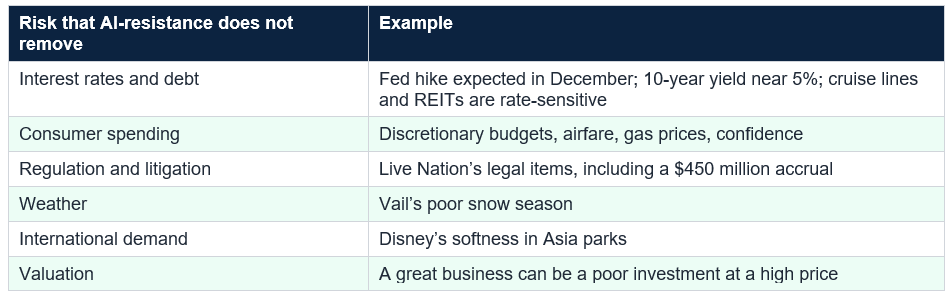
No. They avoid one risk, technological obsolescence, but keep others: recessions, high interest rates, fuel and airfare costs, weather, labor costs, regulation and valuation. The Fed is expected to hike again in December and the 10-year Treasury yield is near 5%, which pressures leveraged and rate-sensitive companies such as cruise lines and real estate investment trusts. This is general education, not personal advice.
Should I buy these stocks because of the article?
That is your decision, and I cannot make it for you. The author works for an investment adviser, and the article ends by pointing readers to professional management, so treat it as one informed view, not a recommendation. If you are interested, research each company’s balance sheet and valuation, consider funds that spread the risk and size any position so a bad year would not harm your plans.
Table of Contents
- The Pitch
- The Short Answer
- Why Investors Are Asking What AI Cannot Replace
- The Five Areas in the Article
- Live Entertainment: What Live Nation’s Filings Show
- Theme Parks: What Disney’s Filings Show
- Cruises, Ski Resorts and Casinos
- AI-Resilient Is Not Risk-Free
- How AI Could Still Hurt These Businesses
- Sizing the Idea in a Portfolio
- Questions to Ask Before Buying
- Common Mistakes
- Conclusion
- Frequently Asked Questions
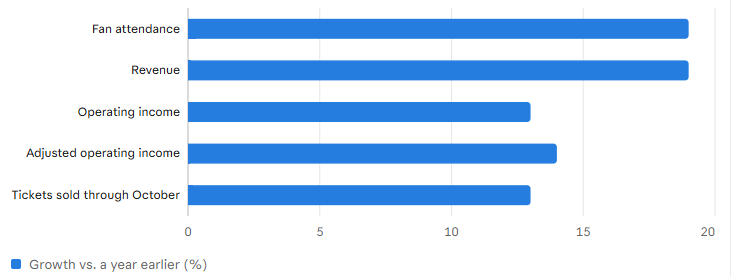
Live Nation Q3 2026: demand surged, profit grew more slowly (% change vs. a year earlier)
Growth (%) by Live Nation Form 8-K and 10-Q, third quarter 2026 (SEC): attendance 61 million, revenue $10.1 billion, operating income $892 million, AOI $1.18 billion; 170 million tickets through October; nine-month operating income fell 25% on legal items
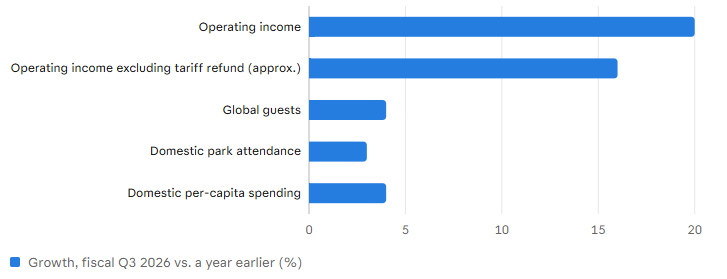
Disney Experiences, fiscal Q3 2026: operating income growth vs. demand drivers (%)
Growth (%) by Disney earnings release, August 5, 2026 (SEC): operating income $3,017 million vs $2,516 million; the tariff refund contributed roughly four points of growth (author's arithmetic gives about 16% underlying); quarter ended June 27, 2026
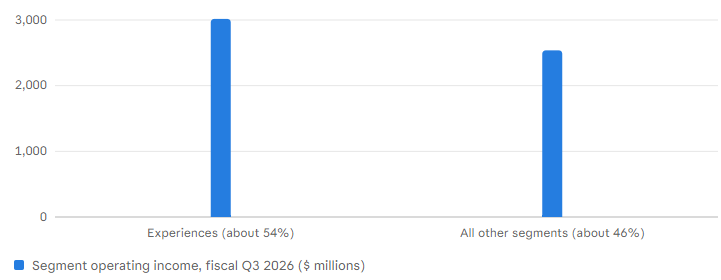
More than a side business: Disney's Experiences vs. its other segments, fiscal Q3 2026 ($ millions)
$ millions by Disney earnings release (SEC): total segment operating income $5,555 million, Experiences $3,017 million; the other segments figure ($2,538 million) and the percentages are the author's arithmetic
The Pitch
Most investing talk about artificial intelligence asks what AI can do and who will profit. A November 10 Kiplinger article by portfolio manager Michael Joseph flips the question: what can AI not replace? His answer is things people still do in person: a Caribbean cruise, a concert, a roller coaster ride with your kids, a day on a ski mountain, a weekend in Las Vegas. AI might change how those businesses market, price and staff, he argues, but is unlikely to replace what they sell.It is an appealing idea in a market that has spent 2026 worrying about which businesses AI will make obsolete. This guide takes the argument seriously and then tests it against the latest filings from Live Nation and Disney, noting what the thesis leaves out. The author works at an investment adviser, and the article is informational.
The Short Answer
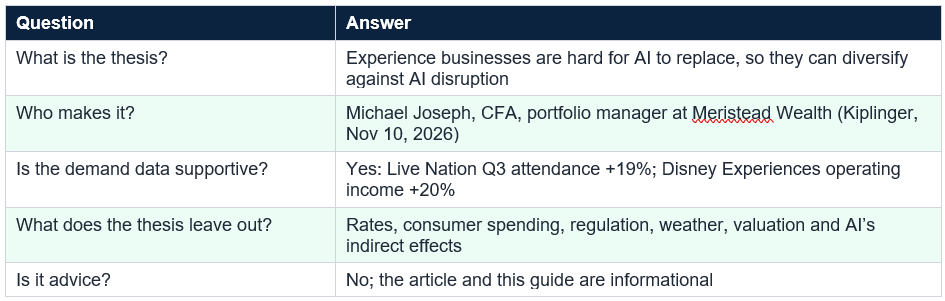
The case is reasonable. Businesses that sell shared, physical experiences are unlikely to be made obsolete by AI, and the latest data show demand holding up: Live Nation’s attendance rose 19% to 61 million in the third quarter, and Disney’s Experiences operating income rose 20% in its latest quarter. But “AI-resilient” is not “risk-free”: Live Nation’s nine-month operating income fell 25% after items including a $450 million litigation accrual, Disney faces softness in Asia and a tariff refund flattered its growth, and all of these businesses are exposed to rates, consumers, weather and valuation.
Why Investors Are Asking What AI Cannot Replace
The question has a backdrop. Early in 2026, markets sold off software and service businesses seen as vulnerable to AI: J.P. Morgan Asset Management described legal-services shares falling by double digits and a freight platform dropping as much as 24% in a day on an AI automation claim, and Capital Group wrote in April that investors had fled “AI roadkill” business models such as software for old-economy companies that make physical goods. Looking for businesses on the safe side of that line is a natural response.Then, in early November, AI-linked stocks themselves sold off, which Invesco’s Brian Levitt attributed to rising interest rates, aggressive capital spending and local opposition to data-center expansion. So investors worry both that AI will destroy some businesses and that the AI boom is overheated, and experience businesses sit outside both worries. But a business can avoid AI risk and still be hit by the other forces in that selloff, particularly higher rates.
The Five Areas in the Article
Joseph names five areas and associated stocks. Cruises: Royal Caribbean (RCL), Carnival (CCL) and Norwegian (NCLH), citing Carnival’s record second quarter and an all-time high $9 billion of customer deposits. Theme parks: Walt Disney (DIS), Comcast (CMCSA) through Universal and United Parks & Resorts (PRKS). Ski resorts: Vail Resorts (MTN), which had one of its most challenging winters on poor western snowfall. Live entertainment: Live Nation (LYV). Casinos: MGM (MGM), Caesars (CZR), Wynn (WYNN) and the landlord VICI Properties (VICI).He is careful to say these businesses can have bad years, citing weather, gas prices, airfare, consumer confidence and labor costs, and that finding the right industry is only the beginning: price matters, and companies in the same industry differ widely on balance sheets and management. He closes by suggesting an adviser can help. I list the names only to describe the article, not to recommend them.
Live Entertainment: What Live Nation’s Filings Show
Live Nation is the article’s clearest example, and its latest results are stronger than the second-quarter figures the article cites. In the third quarter revenue rose 19% to $10.1 billion, fan attendance rose 19% to 61 million, operating income rose 13% to $892 million and adjusted operating income rose 14% to $1.18 billion, per the company. Through October it had sold 170 million tickets, up 13%, and expects nearly 180 million fans in 2026; international attendance grew 29%. Its message echoes the article: amid screens and AI-generated content, being there cannot be replicated.The details add nuance. Stadium activity shifted from the second to the third quarter because of the FIFA World Cup, which helped Q3. Profit growth lagged revenue growth: in my arithmetic the Q3 operating margin was about 8.8% versus 9.3% a year earlier, and the concerts segment earned about 6.9% adjusted operating income on $8.7 billion of revenue, a thin margin. And nine-month operating income fell 25% to $1.04 billion even as revenue rose 14%, which the 10-Q attributes primarily to governmental investigations and litigation, including a $450 million accrual. Demand is strong; legal and regulatory risk is real.
Live Nation Q3 2026: revenue $10.1B (+19%), attendance 61M (+19%), operating income $892M (+13%), AOI $1.18B (+14%); 170M tickets sold through October (+13%). Nine-month operating income −25% on legal items including a $450M accrual. Disney Experiences (FQ3 2026): operating income $3.02B (+20%, about four points from a tariff refund); domestic attendance +3%, per-capita spending +4%.
Theme Parks: What Disney’s Filings Show
For theme parks, Disney’s most recent reported quarter (fiscal Q3, ended June 27) supports the thesis. Experiences revenue rose 10% to about $10 billion and segment operating income rose 20% to $3.02 billion from $2.52 billion, per Disney’s release; domestic attendance rose 3%, per-capita spending 4% and global guests 4%, with new cruise ships adding capacity. In my arithmetic Experiences was about 54% of the company’s $5.56 billion of segment operating income, so the parks are far more than a side business at Disney.But there are caveats. About four points of the 20% growth came from a tariff refund, so underlying growth was about 16%. Disney flagged continued softness at its Shanghai and Hong Kong parks, and weaker international visitors to its domestic parks, though that moderated. The fiscal Q4 report is due November 17, with guidance of about $4.9 billion of segment operating income including an extra week worth roughly $600 million, so the numbers will need careful reading. I did not retrieve Comcast’s Universal or United Parks’ results.
Cruises, Ski Resorts and Casinos
On cruises, the article cites Carnival’s record second quarter, record net yields and an all-time high $9 billion of customer deposits, and says Royal Caribbean reported strong demand, record pricing and bookings ahead of last year. I did not retrieve those filings or third-quarter results, so I rely on the article. It acknowledges traditional risks: fuel, geopolitics, airfare and the capital cost of ships, and it notes operators took on enormous debt during the pandemic, which makes them sensitive to interest rates.Ski resorts illustrate the distinction the article draws: Vail Resorts called the last western US season one of its most challenging winters because of poor snowfall. That is a weather risk, not a technology one, but it shows these companies can still disappoint shareholders. For casinos, the article contrasts operators such as MGM, Caesars and Wynn, exposed to room rates and gaming volumes, with VICI Properties, a REIT that owns many of the properties and leases them to operators and is more exposed to rent collection, tenant credit, rates and leverage.
AI-Resilient Is Not Risk-Free
The article itself makes this point, and it is the most important caveat. Experience businesses depend on discretionary spending, so they are sensitive to the economy. The backdrop includes a Fed expected to raise rates again in December and a 10-year Treasury yield near 5% (earlier research in this series), which raises borrowing costs for debt-heavy cruise lines and rate-sensitive REITs. Fuel, airfare and geopolitics affect travel, weather affects parks and ski resorts, and regulators affect ticketing, as Live Nation’s legal accruals show.Valuation is the other unknown. A wonderful business can be a poor investment at a high price, as the article says, and I did not retrieve valuations for any of these stocks; if investors crowd into an AI-safe theme, prices can rise ahead of earnings. Disney, Comcast and Live Nation are also large holdings in many index funds (general knowledge), so you may already own more of this theme than you think. AI-resistance is a useful lens, but only one of many.
How AI Could Still Hurt These Businesses
It is worth being honest about how AI could still matter. It could change pricing and marketing, raising or squeezing margins depending on who uses it better, and reduce labor needs, which helps costs but could affect jobs. It could also compete for attention and time: if AI-generated entertainment becomes more engaging and cheaper, fewer people might prioritize an expensive concert ticket, although the article argues the opposite, that screens make being there more valuable. Live Nation’s record attendance supports the article, but one year is not proof.The largest indirect risk is income. If AI disrupts jobs and weakens household budgets, people may cut discretionary spending, including on experiences. In my earlier research the labor market was described as low-hire, low-fire, with unemployment at 4.2% in September, so there is no sign of that yet, but it is the scenario that most threatens the thesis: an AI-resistant business still depends on customers who can afford it.
Sizing the Idea in a Portfolio
If you like the idea, the key question is how much. A theme should be a slice, not the whole portfolio. In my illustration, a 10% position in a $100,000 portfolio is $10,000, and if it fell 30% it would cost $3,000, or 3% of the portfolio, and need a 42.9% gain to recover. Spread across the article’s five areas, that is $2,000 each, which reduces the chance that one bad winter or legal ruling dominates.Remember overlap, too: if you own an S&P 500 fund you probably already hold Disney, Comcast and Live Nation (general knowledge), so a new position adds weight rather than diversification. And check how the theme fits your goals: the article notes one company might suit long-term appreciation while another suits income or lower volatility. A theme should follow your plan, not replace it.
Questions to Ask Before Buying
Before acting on any theme, ask: how much debt must the company refinance at today’s rates? What is the valuation against its earnings and history? How much of its profit comes from the experience itself? What legal, regulatory or weather risks does it face? How much of my portfolio already depends on the same stocks? And would I be comfortable if it fell by a third? The answers matter more than the theme.AI-resistant is not recession-proof. These businesses depend on consumers’ discretionary budgets and face rates, weather, regulation and valuation risks. The article is by an adviser and is informational, not advice. Never invest money you may need soon. Common mistakes include treating a good theme as a good stock, paying any price for an AI-safe label, ignoring debt and interest-rate risk, assuming strong attendance means strong profits, overlooking overlap with index funds and relying on a single article, including this one. Check the companies’ own filings, and remember an adviser’s article may point toward the adviser’s services.
Conclusion
The experience economy case is sensible: parks, concerts, cruises, ski resorts and casinos sell something AI is unlikely to replace, and the latest data support demand. Live Nation’s third-quarter attendance rose 19% to 61 million with revenue up 19% to $10.1 billion, and Disney’s Experiences operating income rose 20% to $3.02 billion, about 16% excluding a tariff refund. But the same filings show the limits: Live Nation’s nine-month operating income fell 25% on legal items including a $450 million accrual, its concert margins are thin and Disney faces weakness in Asia.So AI-resilient does not mean risk-free. Rates, consumer budgets, weather, regulation and valuation all remain, and AI could still matter through jobs and income. Treat the theme as one lens, size it so a bad year would not hurt your plans, check balance sheets and prices, and remember the author works for an adviser. This is general education, not personalized investment advice.
Frequently Asked Questions
What is the experience economy?It refers to businesses that sell experiences rather than goods: live concerts, theme parks, cruises, ski resorts, casinos and similar leisure and travel activities. The argument in a November 10 Kiplinger article by portfolio manager Michael Joseph is that these businesses are hard for artificial intelligence to replace, because what customers buy is being physically present. That is a different risk from technological obsolescence, though not a risk-free one.
Can AI really not affect these businesses?
It can affect how they operate, but probably not what they sell. The article says AI could change marketing, pricing, staffing and back-office work. It could also hurt them indirectly: if AI weakens household incomes or job security, discretionary spending on experiences could fall. And competition for attention is real. So AI-resistant does not mean AI-proof, and each company still faces weather, costs, regulation and consumer confidence.
How are Live Nation and Disney actually doing?
Both reported strong demand in their latest filings. Live Nation’s third-quarter revenue rose 19% to $10.1 billion on a 19% rise in attendance to 61 million, though its nine-month operating income fell 25% after items including a $450 million litigation accrual. Disney’s Experiences segment grew operating income 20% to $3.02 billion in its fiscal third quarter, about four points of it from a tariff refund, with softness in its Asian parks.
Are experience stocks a safe way to avoid AI disruption?
No. They avoid one risk, technological obsolescence, but keep others: recessions, high interest rates, fuel and airfare costs, weather, labor costs, regulation and valuation. The Fed is expected to hike again in December and the 10-year Treasury yield is near 5%, which pressures leveraged and rate-sensitive companies such as cruise lines and real estate investment trusts. This is general education, not personal advice.
Should I buy these stocks because of the article?
That is your decision, and I cannot make it for you. The author works for an investment adviser, and the article ends by pointing readers to professional management, so treat it as one informed view, not a recommendation. If you are interested, research each company’s balance sheet and valuation, consider funds that spread the risk and size any position so a bad year would not harm your plans.
0 Comments
Be the first to share your thoughts on this article.