

Investing
Best Dividend Growth Stocks to Buy: Complete Guide
Dividends reinvested have contributed approximately 84% of the S&P 500's total return since 1960. Price-only returns average 4% per year; total return with dividends reinvested averages 7% — nearly doubling the compounding rate. Aflac investors who bought shares a decade ago now collect an 8.6% yield on their original cost, even though the stock only yields 2.1% today. This is the mathematics of dividend growth investing. This guide covers what makes a dividend dependable, explains the Dividend Aristocrats and Kings, and profiles ten of the best dividend growth stocks to buy in 2026.
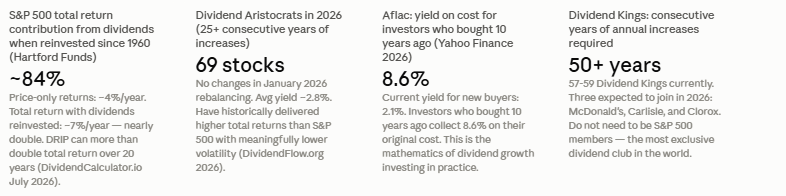
Dividends reinvested have contributed approximately 84% of the S&P 500's total return since 1960, according to Hartford Funds research cited by DividendCalculator.io in July 2026.
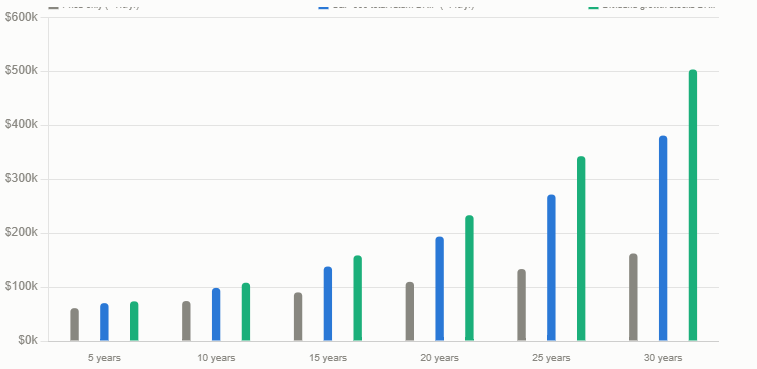
Federal Reserve FRED data and Robert Shiller's historical S&P 500 dataset, as analysed by TheModernWallet.com in June 2026, quantify the compounding gap: price-only returns have averaged roughly 4% per year while total return with dividends reinvested averages closer to 7% — nearly doubling the compounding rate. Over 20 to 30 years, that gap produces dramatically different ending balances.
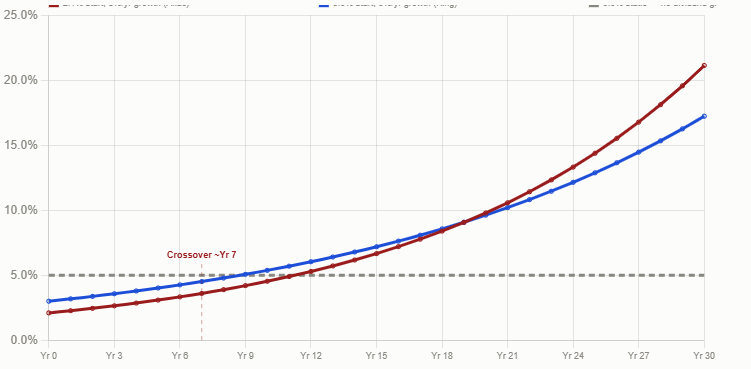
The specific reward of dividend growth investing — as opposed to simply buying high-yield stocks — is the concept of yield on cost. When you buy a stock that currently yields 2% but grows its dividend by 8% per year, your yield on the original purchase price compounds automatically. After ten years, you are collecting 4.3% on what you originally paid. After twenty years, 9.3%. After thirty years, 20% per year on your original investment, from dividends alone — without selling a single share. The Aflac investor who bought shares ten years ago now enjoys an 8.6% yield on cost while the stock's current yield is just 2.1%, per Yahoo Finance's 2026 reporting. That is the practical illustration.
Dividends contributed ~84% of S&P 500 total return since 1960 when reinvested (Hartford Funds; DividendCalculator.io July 2026). Price-only returns: ~4%/year; total return with DRIP: ~7%/year (FRED / Shiller data; TheModernWallet.com June 2026). DRIP can more than double total return over 20 years. Average Dividend Aristocrats yield 2026: ~2.8% (DividendFlow.org). 69 Dividend Aristocrats (25+ consecutive years of increases); 57-59 Dividend Kings (50+ years). Aflac: bought 10 years ago, 8.6% yield on cost at 2.1% current yield (Yahoo Finance 2026). S&P 500 current dividend yield: ~1.3-1.5%.
The Dividend Aristocrats are S&P 500 companies that have raised their dividends annually for at least 25 consecutive years. The S&P 500 membership requirement is important: it means Aristocrats must also meet minimum size, liquidity, and profitability standards to be included in the index. As of 2026, there are 69 Dividend Aristocrats. S&P made no changes to the list in its January 2026 rebalancing, according to Kiplinger's July 2026 coverage. The ProShares S&P 500 Dividend Aristocrats ETF (NOBL) provides access to the entire index with $11.3 billion in assets and a 0.35% expense ratio.
The Dividend Kings are a more exclusive set: companies with at least 50 consecutive years of annual dividend increases. Dividend Kings do not need to be in the S&P 500, which means the list includes several smaller companies with outstanding dividend track records that are not S&P 500 members. There are currently 57 to 59 Dividend Kings, per Simply Safe Dividends' July 2026 analysis. Three companies are expected to join the Kings in 2026: McDonald's, Carlisle, and Clorox — all of whom are approaching their 50th consecutive year of increases.
Not all Dividend Kings are Dividend Aristocrats: Dividend Aristocrats must be in the S&P 500 and meet its size and liquidity requirements, while Dividend Kings do not. All Dividend Aristocrats with 50+ year streaks are also Kings. Companies in both lists have delivered rising payouts through multiple recessions, market crashes, and inflation cycles — demonstrating resilient business models and dependable cash flows, as Simply Safe Dividends' 2026 analysis notes.
All yields and valuations cited are from published 2026 sources. Dividend histories are from company disclosures and S&P data. Not financial advice — individual suitability depends on income, tax situation, risk tolerance, portfolio composition, and many other factors. Always consult a qualified financial adviser and read each company's annual report before investing.
The business behind the dividend is one of the world's largest consumer goods operations: brands including Tide, Pampers, Gillette, Oral-B, Febreze, and Dawn generate over $80 billion in annual revenue and the kind of pricing power that allows PG to pass along cost inflation without losing significant market share. When consumers are under financial pressure, they may trade down to store brands, but they typically return to trusted Procter & Gamble brands as their finances recover.
Procter & Gamble (PG): Dividend King. Current yield: ~2.9%. 60+ consecutive years of increases. Business: world's largest consumer goods manufacturer. Best for: anchor position in a dividend growth portfolio; investors seeking the highest yield among established Dividend Kings; long-term compounders comfortable with modest growth rate in exchange for extreme stability. Source: Simply Safe Dividends 2026. Not financial advice.
The economic moat in J&J's remaining business comes from pharmaceutical patent protection, FDA-approval barriers that require years and billions of dollars to replicate, and medical device switching costs in hospital systems. The combination of healthcare spending's relative recession-resistance (people continue to need medications and medical procedures through economic downturns) and the fortress balance sheet makes J&J a bedrock of income investing.
Johnson & Johnson (JNJ): Dividend King. 60+ consecutive years of increases. Business: pharmaceuticals and medical devices (consumer health spun off as Kenvue 2023). Best for: investors who want healthcare sector dividend exposure from a company with the highest-rated balance sheet in the sector. Note: patent cliffs on key drugs 2026-2028 flagged by Morningstar but viewed as manageable from strong financial position. Source: Morningstar; Simply Safe Dividends. Not financial advice.
Coca-Cola's dividend growth streak has now extended beyond 60 years, placing it firmly among the top tier of Dividend Kings. The business serves approximately 2.2 billion drinks per day across 200+ countries, with a portfolio that has expanded well beyond cola into water, tea, juice, coffee, and energy drinks. The brand moat — the combination of distribution dominance, consumer habit formation, and global brand recognition — is the structural reason the dividend has grown through wars, recessions, inflation spikes, and competitive challenges for six decades.
Coca-Cola (KO): Dividend King. 60+ consecutive years of increases. Business: global beverages across 200+ countries. Best for: investors who want maximum brand moat stability in consumer discretionary; Buffett-style long-term compounders; portfolios where capital preservation is as important as income growth. The starting yield may not be exceptional but the growth and safety of the payout are among the highest in any asset class. Not financial advice.
Yahoo Finance's 2026 analysis of the three best Dividend Aristocrats to buy identifies Lowe's alongside Aflac and Nordson, noting its Dividend King status and the consistent delivery through multiple housing cycles, recessions, and competitive disruptions from online retail and big-box competitors. The essential nature of home improvement spending — particularly in an aging housing stock environment — provides some structural protection for the revenue stream that supports the dividend.
Lowe's (LOW): Dividend King. 62 consecutive years of increases. Current yield: ~2%. Business: home improvement retail; accelerating professional contractor focus. Best for: investors who want a dividend growth track record from a retail sector that has sustained payouts through multiple cycles; those comfortable with some cyclical exposure. 2% current yield with high dividend growth rate means yield on cost compounds rapidly over a long holding period. Source: Yahoo Finance 2026; Simply Safe Dividends. Not financial advice.
Aflac operates as a supplemental insurance business — the 'gap' insurance that pays policyholders directly when traditional health insurance does not cover all costs of serious illness. The business has strong recurring premium revenue, significant exposure to Japan (where Aflac is the largest life insurer), and a financial model that generates predictable, growing cash flows that have supported 43 years of uninterrupted dividend increases. The 2.1% current yield, growing at a historically high single-digit rate, is the starting point for what could be a 6-8%+ yield on cost in another decade for investors who buy today.
Aflac yield on cost projection. Current yield: 2.1%. Historical dividend growth rate: approximately 8-10%/year. Starting with 2.1% yield and 8% annual dividend growth: Year 5: 3.1% yield on cost. Year 10: 4.5% yield on cost. Year 15: 6.6% yield on cost. Year 20: 9.8% yield on cost. At 10% dividend growth rate: Year 10: 5.4% yield on cost. Year 20: 14.1% yield on cost. Current investors who bought 10 years ago: 8.6% yield on cost (Yahoo Finance 2026). Source: Yahoo Finance 2026; DividendCalculator.io. Not financial advice — historical dividend growth rates do not guarantee future increases.
The Morningstar long-term dividend forecast for PepsiCo calls for the payout ratio to stabilise in the low 70s on average over the coming decade, with the dividend payment increasing at a mid-single-digit annual pace. This is the profile of a mature, dependable dividend grower — not a stock that will produce dramatic dividend growth rates, but one whose payment is highly secure and whose business model (beverages plus Frito-Lay snack foods) has proven recession-resistant across multiple economic cycles. The dividend is supported by one of the most powerful consumer brand portfolios in the world: Pepsi, Mountain Dew, Gatorade, Doritos, Lay's, Quaker Oats, and dozens more.
PepsiCo (PEP): Dividend King. 50+ consecutive years of increases. Current yield: approximately 3-3.5%. Morningstar: 17% below fair value estimate (Jan 2026). Business: global beverages and snack foods. Best for: income investors who want yield slightly above PG or KO combined with solid brand moat, reasonable growth prospects, and what Morningstar characterises as an attractive entry point. Source: Morningstar January 23, 2026; Simply Safe Dividends 2026. Not financial advice.
At that January 2026 date, Clorox was trading at a 30% discount to Morningstar's $163 fair value estimate — a significant valuation gap for a company with a near-50-year dividend growth streak and a portfolio of dominant household brand names including Clorox disinfecting products, Glad trash bags, Hidden Valley salad dressings, Brita water filters, and Burt's Bees. The brand moat provides the pricing power to pass along cost increases, which has supported the dividend growth through the cost inflation cycles of the mid-2020s.
Clorox (CLX): Expected Dividend King 2026 (approaching 50th consecutive year). Morningstar #1 Dividend Aristocrat pick January 2026; 30% discount to $163 fair value estimate at that date. Mid-single-digit dividend growth expected over 10 years; payout ratio near 60% long-term. Business: household cleaning, food, and personal care brands. Best for: investors who want a premium brand moat dividend grower at what Morningstar characterised as a significant discount to intrinsic value. Source: Morningstar January 23, 2026; Simply Safe Dividends July 7, 2026. Not financial advice.
The moat in S&P Global's business is structural and durable: its credit ratings, market indices (including the S&P 500 itself), and financial data products are embedded into the regulatory, contractual, and operational processes of global finance in ways that create switching costs measured in years and hundreds of millions of dollars. Every bond issued globally that requires an S&P credit rating, every S&P 500 index fund that pays index licensing fees, and every financial services firm that subscribes to S&P Capital IQ contributes to the recurring revenue stream that supports the dividend.
S&P Global (SPGI): Dividend King (50+ consecutive years). Business: credit ratings, market indices, financial data (Platts, Capital IQ). Best for: investors who want dividend growth backed by a structural near-monopoly rather than consumer brand loyalty; those with longer time horizons who prioritise dividend growth rate over current yield. The yield is modest but the business model's recurring revenue generates exceptional dividend coverage. Source: Simply Safe Dividends 2026. Not financial advice.
Fastenal's business is industrial distribution — bolts, screws, cutting tools, janitorial supplies, safety equipment, and thousands of industrial maintenance items sold primarily to manufacturing and construction customers. The business model involves embedding sales representatives and vending machines at customer locations, creating switching costs and high customer retention that support predictable, recurring revenue. As manufacturing activity remains solid in the domestic economy, Fastenal's distribution volumes and margins support continued dividend growth.
Fastenal (FAST): Dividend Aristocrat (added January 2024). January 2026 dividend hike: +9.1% to $0.24/quarter. Business: industrial distribution, on-site supply management. Best for: investors who want above-average dividend growth rate in the industrial sector; those constructing a diversified Aristocrat portfolio with industrial sector representation. The 9.1% 2026 hike is among the most aggressive increases in the Aristocrats group for the year. Source: Kiplinger July 15, 2026. Not financial advice.
Morningstar analyst Bischof identifies WEC's narrow economic moat as coming from two regulated utility advantages: service territory monopolies (where WEC is the only legal provider in its geographic areas) and efficient scale advantages. The management team is targeting a 65% to 70% dividend payout ratio — a level that provides room for dividend growth while maintaining the financial flexibility to invest in the regulated rate base expansion that drives earnings growth for utilities.
Utilities are the sector most associated with income investing for good reason: regulated revenues, predictable cash flows, and monopoly service territories create the structural conditions for decades of reliable dividend payments. WEC's combination of a Morningstar-identified economic moat, targeted payout ratio, and identified valuation discount makes it one of the more attractive utility dividend growers at current prices.
WEC Energy Group (WEC): Dividend Aristocrat (approaching). Morningstar: 8% below $116 fair value (most recent analysis, ~3 weeks ago). Narrow economic moat: service territory monopoly + efficient scale. Target payout ratio: 65-70%. Business: regulated Midwest utility (Wisconsin, Illinois, Michigan, Minnesota). Best for: retirees and income-focused investors who want the highest predictability of dividend continuation; utility-sector diversification in a dividend growth portfolio. Source: Morningstar (most recent analysis September 2026). Not financial advice.
All yields are approximate estimates from published 2026 sources and fluctuate with stock prices. Consecutive-year streaks include 2026 if the company has announced a 2026 increase as of publication. Morningstar fair value estimates as of the dates cited. Not financial advice. Past dividend history does not guarantee future payments. Always verify current data at each company's investor relations page and read the fund prospectus or annual report before investing.
The ten stocks in this guide represent different profiles on the dividend growth spectrum: from the ultra-conservative stability of Procter & Gamble and Coca-Cola, to the higher-growth yield on cost trajectory of Aflac and Fastenal, to the value-oriented entry points identified by Morningstar in PepsiCo and Clorox, to the structural monopolies of S&P Global and WEC Energy. No single stock is right for every investor. Together, they illustrate the range of choices available from the universe of Dividend Aristocrats and Kings.
The Dividend Aristocrats have historically delivered higher total returns than the broader S&P 500 with meaningfully lower volatility, according to DividendFlow.org's 2026 analysis. The average yield of approximately 2.8% is modest in isolation, but the combination of growing income and capital appreciation has compounded exceptionally over 10 to 20 year periods. The starting yield is not the story. The growth of that yield, year after year, across decades — that is the dividend growth investor's reward for patience.
Not financial advice. All investments involve risk including possible loss of principal. Dividends are not guaranteed. Past performance is not indicative of future results. Consult a qualified financial adviser before investing.
A Dividend Aristocrat is an S&P 500 company that has increased its dividend every year for at least 25 consecutive years. The S&P 500 membership requirement means Aristocrats must also meet minimum size, liquidity, and financial viability standards. As of 2026, there are 69 Dividend Aristocrats, according to Kiplinger's July 15, 2026 coverage of the complete index. S&P made no changes to the Aristocrats in its January 2026 annual rebalancing. Three companies were added to the Aristocrats in 2025: FactSet Research Systems, Erie Indemnity, and Eversource Energy. The ProShares S&P 500 Dividend Aristocrats ETF (NOBL) holds all 69 members with $11.3 billion in assets and a 0.35% expense ratio. Other dividend growth ETFs include VIG (Vanguard Dividend Appreciation), DGRO (iShares Core Dividend Growth), and SDY (State Street SPDR S&P Dividend ETF).
What is the difference between a Dividend Aristocrat and a Dividend King?
The key differences are the streak length and index membership requirements. Dividend Aristocrats have raised their dividend for at least 25 consecutive years AND must be members of the S&P 500, meeting minimum size and liquidity standards. Dividend Kings have raised their dividend for at least 50 consecutive years but do NOT need to be in the S&P 500 — the Kings list can include smaller companies with exceptional dividend track records. There are currently 57 to 59 Dividend Kings (Simply Safe Dividends 2026) versus 69 Dividend Aristocrats. All Dividend Aristocrats with 50+ year streaks are also Dividend Kings. Three companies are expected to join the Kings in 2026: McDonald's, Carlisle, and Clorox, as they approach their 50th consecutive year of annual increases. Kiplinger's June 2026 Dividend Kings guide notes that the Kings 'should be top of mind for any investor who puts income stability above all else.'
Why do dividends matter so much for long-term returns?
The data is compelling. Dividends reinvested have contributed approximately 84% of the S&P 500's total return since 1960, according to Hartford Funds research cited by DividendCalculator.io in July 2026. Federal Reserve FRED data and Robert Shiller's historical S&P 500 dataset show price-only returns averaging roughly 4% per year while total return with dividends reinvested averages closer to 7% — nearly doubling the compounding rate. Over 20 to 30 years, that difference produces dramatically different portfolio values. The DRIP (Dividend Reinvestment Plan) mechanism is the key: it automatically uses each dividend payment to purchase additional shares, which themselves pay dividends, which purchase more shares. DividendCalculator.io states that DRIP can more than double total return over 20 years compared to taking dividends as cash. Not financial advice.
What is yield on cost and why does it matter for dividend investors?
Yield on cost is the annual dividend income you receive as a percentage of your original purchase price — not the current stock price. It is the metric that reveals what dividend growth investing actually delivers to patient investors over time. If you buy a stock for $100 that yields 2.1% at purchase, you receive $2.10 per year in dividends. If the company raises its dividend by 8% per year for ten years, the dividend payment grows to $4.53 per year. Your yield on cost is now 4.53% — on an original investment of $100 — even though the current buyer of the stock at a higher market price might only be receiving a 2% current yield. Aflac provides the concrete 2026 illustration: investors who bought Aflac shares ten years ago now collect an 8.6% yield on cost, even though the stock's current yield for new buyers is just 2.1%, according to Yahoo Finance's 2026 analysis. This is why dividend growth rate — how fast the dividend is growing — matters more than starting yield for long-term investors.
Should I buy individual dividend stocks or a dividend ETF like NOBL?
Both approaches are valid depending on your circumstances. Individual Dividend Aristocrats and Kings allow you to select specific businesses you understand and believe in, concentrate in sectors you find most compelling, and avoid companies with concerns about their future dividend trajectory. The trade-off is ongoing monitoring of multiple positions. The ProShares S&P 500 Dividend Aristocrats ETF (NOBL) provides instant diversified exposure to all 69 Aristocrats with $11.3 billion in AUM and a 0.35% expense ratio (Kiplinger July 2026). NOBL uses equal weighting rather than market-cap weighting, giving smaller Aristocrats proportionally more exposure. Other options include VIG (Vanguard Dividend Appreciation ETF), DGRO (iShares Core Dividend Growth ETF), and SDY (State Street SPDR S&P Dividend ETF), which Kiplinger also cites as top-rated dividend growth ETFs. For most investors new to dividend growth investing, starting with a diversified ETF and adding individual positions over time as conviction develops is a reasonable approach. Not financial advice — consult a qualified financial adviser.
Table of Contents
- The Mathematics of Dividend Growth
- What Makes a Dividend Dependable? The Three Tests
- Dividend Aristocrats vs Dividend Kings: What Is the Difference?
- The Ten Best Dividend Growth Stocks for 2026
- Stock #1 — Procter & Gamble (PG): 130+ Years of Staying Power
- Stock #2 — Johnson & Johnson (JNJ): 60+ Years, Healthcare Moat
- Stock #3 — Coca-Cola (KO): The Dividend Buffett Never Sells
- Stock #4 — Lowe's Companies (LOW): 62 Consecutive Years
- Stock #5 — Aflac (AFL): 43 Years and 8.6% Yield on Cost
- Stock #6 — PepsiCo (PEP): Dividend King, 17% Undervalued
- Stock #7 — Clorox (CLX): Expected Dividend King in 2026
- Stock #8 — S&P Global (SPGI): Recurring Revenue Dividend Machine
- Stock #9 — Fastenal (FAST): 9.1% Dividend Hike in January 2026
- Stock #10 — WEC Energy Group (WEC): The Utility That Keeps Paying
- The Full Comparison Table: All Ten Stocks at a Glance
- How to Invest in Dividend Growth: Stocks vs ETFs
- Conclusion: Yield on Cost Is the Reward for Patience
- Frequently Asked Questions
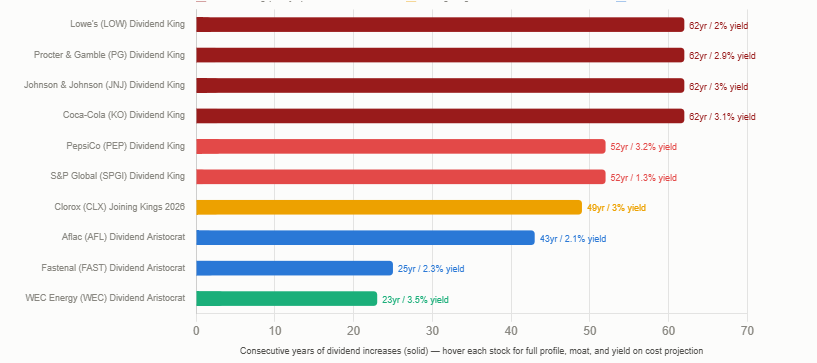
Top 10 dividend growth stocks: streak, yield and category
Yield On Cost: What Patience Actually Delivers
DRIP compounding: price-only vs total return
The Mathematics of Dividend Growth
Most investors focus on dividend yield — the current income a stock pays as a percentage of its price — when selecting dividend stocks. But the investors who build the most wealth from dividends focus on something different: dividend growth. The distinction matters enormously over time, and the mathematics behind it are the foundation of everything in this guide.Dividends reinvested have contributed approximately 84% of the S&P 500's total return since 1960, according to Hartford Funds research cited by DividendCalculator.io in July 2026.
Federal Reserve FRED data and Robert Shiller's historical S&P 500 dataset, as analysed by TheModernWallet.com in June 2026, quantify the compounding gap: price-only returns have averaged roughly 4% per year while total return with dividends reinvested averages closer to 7% — nearly doubling the compounding rate. Over 20 to 30 years, that gap produces dramatically different ending balances.
The specific reward of dividend growth investing — as opposed to simply buying high-yield stocks — is the concept of yield on cost. When you buy a stock that currently yields 2% but grows its dividend by 8% per year, your yield on the original purchase price compounds automatically. After ten years, you are collecting 4.3% on what you originally paid. After twenty years, 9.3%. After thirty years, 20% per year on your original investment, from dividends alone — without selling a single share. The Aflac investor who bought shares ten years ago now enjoys an 8.6% yield on cost while the stock's current yield is just 2.1%, per Yahoo Finance's 2026 reporting. That is the practical illustration.
Dividends contributed ~84% of S&P 500 total return since 1960 when reinvested (Hartford Funds; DividendCalculator.io July 2026). Price-only returns: ~4%/year; total return with DRIP: ~7%/year (FRED / Shiller data; TheModernWallet.com June 2026). DRIP can more than double total return over 20 years. Average Dividend Aristocrats yield 2026: ~2.8% (DividendFlow.org). 69 Dividend Aristocrats (25+ consecutive years of increases); 57-59 Dividend Kings (50+ years). Aflac: bought 10 years ago, 8.6% yield on cost at 2.1% current yield (Yahoo Finance 2026). S&P 500 current dividend yield: ~1.3-1.5%.
What Makes a Dividend Dependable? The Three Tests
Not every dividend is created equal. A stock with a 7% yield may look attractive — until the company cuts its dividend, the stock falls 30%, and the yield drops to 2% while the investor has locked in a permanent loss. Understanding what makes a dividend genuinely dependable is the prerequisite for selecting dividend growth stocks that compound wealth rather than destroy it.- Test 1 — Payout ratio: the payout ratio is the percentage of earnings paid out as dividends. A payout ratio below 60% for most non-utility businesses is generally considered sustainable. Utilities can sustain higher ratios (65-75%) because of their regulated, predictable cash flows. When a payout ratio exceeds 80-90%, the dividend is consuming most of the company's earnings, leaving little margin for earnings fluctuations or reinvestment. A stock yielding 7% with a 95% payout ratio is a dividend cut waiting to happen.
- Test 2 — Free cash flow coverage: earnings can be manipulated through accounting choices; free cash flow (operating cash flow minus capital expenditure) is harder to fake. A company consistently generating free cash flow well in excess of its dividend payment has genuine capacity to maintain and grow the dividend. Companies that pay dividends from free cash flow rather than debt or asset sales are structurally more dependable.
- Test 3 — Consecutive years of dividend growth: this is the metric that defines the Dividend Aristocrats (25+ years) and Dividend Kings (50+ years). Companies that have raised their dividend every year for a quarter century have done so through multiple recessions, market crashes, inflation cycles, and business disruptions. The consecutive-year streak is not just a historical record — it is evidence of management culture, balance sheet strength, and business model durability that has survived conditions that eliminated most competitors.
Dividend Aristocrats vs Dividend Kings: What Is the Difference?
The terms Dividend Aristocrat and Dividend King are specific, defined categories — not marketing terms — and the distinction matters when selecting dividend growth stocks.The Dividend Aristocrats are S&P 500 companies that have raised their dividends annually for at least 25 consecutive years. The S&P 500 membership requirement is important: it means Aristocrats must also meet minimum size, liquidity, and profitability standards to be included in the index. As of 2026, there are 69 Dividend Aristocrats. S&P made no changes to the list in its January 2026 rebalancing, according to Kiplinger's July 2026 coverage. The ProShares S&P 500 Dividend Aristocrats ETF (NOBL) provides access to the entire index with $11.3 billion in assets and a 0.35% expense ratio.
The Dividend Kings are a more exclusive set: companies with at least 50 consecutive years of annual dividend increases. Dividend Kings do not need to be in the S&P 500, which means the list includes several smaller companies with outstanding dividend track records that are not S&P 500 members. There are currently 57 to 59 Dividend Kings, per Simply Safe Dividends' July 2026 analysis. Three companies are expected to join the Kings in 2026: McDonald's, Carlisle, and Clorox — all of whom are approaching their 50th consecutive year of increases.
Not all Dividend Kings are Dividend Aristocrats: Dividend Aristocrats must be in the S&P 500 and meet its size and liquidity requirements, while Dividend Kings do not. All Dividend Aristocrats with 50+ year streaks are also Kings. Companies in both lists have delivered rising payouts through multiple recessions, market crashes, and inflation cycles — demonstrating resilient business models and dependable cash flows, as Simply Safe Dividends' 2026 analysis notes.
The Ten Best Dividend Growth Stocks for 2026
The following ten stocks represent a cross-section of the most dependable dividend growth payers in the US market in 2026. They span consumer staples, healthcare, industrials, technology services, financial services, and utilities. They are drawn from Morningstar's January 2026 and September 2026 top dividend stock lists, Kiplinger's July 2026 Dividend Aristocrats coverage, Simply Safe Dividends' 2026 analysis, and Yahoo Finance's 2026 dividend king profiles. Not every stock will be right for every investor — the profiles that follow are designed to help you evaluate which combination fits your portfolio's income, growth, and risk requirements.All yields and valuations cited are from published 2026 sources. Dividend histories are from company disclosures and S&P data. Not financial advice — individual suitability depends on income, tax situation, risk tolerance, portfolio composition, and many other factors. Always consult a qualified financial adviser and read each company's annual report before investing.
Stock #1 — Procter & Gamble (PG): 130+ Years of Staying Power
Procter & Gamble is among the oldest dividend payers of any company in the world, with roots dating back to 1837 — over 130 years of continuous operation before the first S&P 500 even existed. As a Dividend King with an unbroken streak of annual dividend increases spanning more than six decades, PG is the definition of dependability in dividend investing. Its current yield of approximately 2.9% is the highest among the blue-chip Dividend Kings, according to Simply Safe Dividends' 2026 analysis.The business behind the dividend is one of the world's largest consumer goods operations: brands including Tide, Pampers, Gillette, Oral-B, Febreze, and Dawn generate over $80 billion in annual revenue and the kind of pricing power that allows PG to pass along cost inflation without losing significant market share. When consumers are under financial pressure, they may trade down to store brands, but they typically return to trusted Procter & Gamble brands as their finances recover.
Procter & Gamble (PG): Dividend King. Current yield: ~2.9%. 60+ consecutive years of increases. Business: world's largest consumer goods manufacturer. Best for: anchor position in a dividend growth portfolio; investors seeking the highest yield among established Dividend Kings; long-term compounders comfortable with modest growth rate in exchange for extreme stability. Source: Simply Safe Dividends 2026. Not financial advice.
Stock #2 — Johnson & Johnson (JNJ): 60+ Years, Healthcare Moat
Johnson & Johnson holds one of the longest dividend growth streaks of any publicly traded company: more than 60 consecutive years of annual dividend increases. The company spun off its consumer health division as Kenvue in 2023, retaining its pharmaceuticals and medical devices businesses, with Kenvue given credit for J&J's long consumer health dividend history. The retained J&J business — operating as a pure-play pharmaceutical and medtech company — maintains a strong balance sheet and the financial flexibility to continue its dividend growth history.The economic moat in J&J's remaining business comes from pharmaceutical patent protection, FDA-approval barriers that require years and billions of dollars to replicate, and medical device switching costs in hospital systems. The combination of healthcare spending's relative recession-resistance (people continue to need medications and medical procedures through economic downturns) and the fortress balance sheet makes J&J a bedrock of income investing.
Johnson & Johnson (JNJ): Dividend King. 60+ consecutive years of increases. Business: pharmaceuticals and medical devices (consumer health spun off as Kenvue 2023). Best for: investors who want healthcare sector dividend exposure from a company with the highest-rated balance sheet in the sector. Note: patent cliffs on key drugs 2026-2028 flagged by Morningstar but viewed as manageable from strong financial position. Source: Morningstar; Simply Safe Dividends. Not financial advice.
Stock #3 — Coca-Cola (KO): The Dividend Buffett Never Sells
Coca-Cola is perhaps the most famous dividend growth stock in the world — in no small part because Warren Buffett's Berkshire Hathaway has held it since 1988, and the position now generates a yield on cost of approximately 60% annually based on Buffett's original purchase price. For ordinary investors, the lesson is not the specific extraordinary compounding Buffett achieved, but the principle it illustrates: a quality business with a durable brand moat, bought at a reasonable price and held patiently, eventually produces extraordinary yields on the original investment.Coca-Cola's dividend growth streak has now extended beyond 60 years, placing it firmly among the top tier of Dividend Kings. The business serves approximately 2.2 billion drinks per day across 200+ countries, with a portfolio that has expanded well beyond cola into water, tea, juice, coffee, and energy drinks. The brand moat — the combination of distribution dominance, consumer habit formation, and global brand recognition — is the structural reason the dividend has grown through wars, recessions, inflation spikes, and competitive challenges for six decades.
Coca-Cola (KO): Dividend King. 60+ consecutive years of increases. Business: global beverages across 200+ countries. Best for: investors who want maximum brand moat stability in consumer discretionary; Buffett-style long-term compounders; portfolios where capital preservation is as important as income growth. The starting yield may not be exceptional but the growth and safety of the payout are among the highest in any asset class. Not financial advice.
Stock #4 — Lowe's Companies (LOW): 62 Consecutive Years
Lowe's has increased its dividend for 62 consecutive years — a streak that places it in the top tier of Dividend Kings and makes it a standout among home improvement and retail companies, a sector that is notoriously difficult to sustain long dividend growth streaks in because of its cyclicality. The current yield of approximately 2% does not look striking, but the growth rate of that dividend has been exceptional: Lowe's has accelerated its payout significantly over the past decade as the company transformed under management changes that shifted focus toward higher-margin professional contractor business and more aggressive share buybacks.Yahoo Finance's 2026 analysis of the three best Dividend Aristocrats to buy identifies Lowe's alongside Aflac and Nordson, noting its Dividend King status and the consistent delivery through multiple housing cycles, recessions, and competitive disruptions from online retail and big-box competitors. The essential nature of home improvement spending — particularly in an aging housing stock environment — provides some structural protection for the revenue stream that supports the dividend.
Lowe's (LOW): Dividend King. 62 consecutive years of increases. Current yield: ~2%. Business: home improvement retail; accelerating professional contractor focus. Best for: investors who want a dividend growth track record from a retail sector that has sustained payouts through multiple cycles; those comfortable with some cyclical exposure. 2% current yield with high dividend growth rate means yield on cost compounds rapidly over a long holding period. Source: Yahoo Finance 2026; Simply Safe Dividends. Not financial advice.
Stock #5 — Aflac (AFL): 43 Years and 8.6% Yield on Cost
Aflac is arguably the best illustration in this list of what dividend growth investing actually delivers to patient investors over time. The company has raised its dividend for 43 consecutive years. Its current yield is 2.1% — not exceptional by income standards. But investors who bought Aflac shares ten years ago are now collecting a yield of 8.6% on their original cost, per Yahoo Finance's 2026 analysis. That 8.6% is not a promised future return; it is what those investors are already receiving in actual cash, every year, without selling shares.Aflac operates as a supplemental insurance business — the 'gap' insurance that pays policyholders directly when traditional health insurance does not cover all costs of serious illness. The business has strong recurring premium revenue, significant exposure to Japan (where Aflac is the largest life insurer), and a financial model that generates predictable, growing cash flows that have supported 43 years of uninterrupted dividend increases. The 2.1% current yield, growing at a historically high single-digit rate, is the starting point for what could be a 6-8%+ yield on cost in another decade for investors who buy today.
Aflac yield on cost projection. Current yield: 2.1%. Historical dividend growth rate: approximately 8-10%/year. Starting with 2.1% yield and 8% annual dividend growth: Year 5: 3.1% yield on cost. Year 10: 4.5% yield on cost. Year 15: 6.6% yield on cost. Year 20: 9.8% yield on cost. At 10% dividend growth rate: Year 10: 5.4% yield on cost. Year 20: 14.1% yield on cost. Current investors who bought 10 years ago: 8.6% yield on cost (Yahoo Finance 2026). Source: Yahoo Finance 2026; DividendCalculator.io. Not financial advice — historical dividend growth rates do not guarantee future increases.
Stock #6 — PepsiCo (PEP): Dividend King, 17% Undervalued
PepsiCo is a Dividend King with a dividend growth streak spanning more than 50 consecutive years, and in early 2026 it represented one of the more attractive entry points among established Dividend Kings: trading approximately 17% below Morningstar's $169 fair value estimate as of January 23, 2026. Morningstar's senior analyst Kristoffer Inton notes that near-term challenges from consumer belt-tightening are not expected to derail PepsiCo's long-term growth from innovation and international expansion.The Morningstar long-term dividend forecast for PepsiCo calls for the payout ratio to stabilise in the low 70s on average over the coming decade, with the dividend payment increasing at a mid-single-digit annual pace. This is the profile of a mature, dependable dividend grower — not a stock that will produce dramatic dividend growth rates, but one whose payment is highly secure and whose business model (beverages plus Frito-Lay snack foods) has proven recession-resistant across multiple economic cycles. The dividend is supported by one of the most powerful consumer brand portfolios in the world: Pepsi, Mountain Dew, Gatorade, Doritos, Lay's, Quaker Oats, and dozens more.
PepsiCo (PEP): Dividend King. 50+ consecutive years of increases. Current yield: approximately 3-3.5%. Morningstar: 17% below fair value estimate (Jan 2026). Business: global beverages and snack foods. Best for: income investors who want yield slightly above PG or KO combined with solid brand moat, reasonable growth prospects, and what Morningstar characterises as an attractive entry point. Source: Morningstar January 23, 2026; Simply Safe Dividends 2026. Not financial advice.
Stock #7 — Clorox (CLX): Expected Dividend King in 2026
Clorox is on the cusp of achieving Dividend King status in 2026 — approaching its 50th consecutive year of annual dividend increases, making it one of three companies (alongside McDonald's and Carlisle) expected to join the Kings this year according to Simply Safe Dividends' July 2026 analysis. Morningstar placed Clorox at the top of its January 2026 list of best Dividend Aristocrats to buy, with Morningstar director Erin Lash expecting mid-single-digit dividend growth over the next 10 years, resulting in a payout ratio near 60% long term.At that January 2026 date, Clorox was trading at a 30% discount to Morningstar's $163 fair value estimate — a significant valuation gap for a company with a near-50-year dividend growth streak and a portfolio of dominant household brand names including Clorox disinfecting products, Glad trash bags, Hidden Valley salad dressings, Brita water filters, and Burt's Bees. The brand moat provides the pricing power to pass along cost increases, which has supported the dividend growth through the cost inflation cycles of the mid-2020s.
Clorox (CLX): Expected Dividend King 2026 (approaching 50th consecutive year). Morningstar #1 Dividend Aristocrat pick January 2026; 30% discount to $163 fair value estimate at that date. Mid-single-digit dividend growth expected over 10 years; payout ratio near 60% long-term. Business: household cleaning, food, and personal care brands. Best for: investors who want a premium brand moat dividend grower at what Morningstar characterised as a significant discount to intrinsic value. Source: Morningstar January 23, 2026; Simply Safe Dividends July 7, 2026. Not financial advice.
Stock #8 — S&P Global (SPGI): Recurring Revenue Dividend Machine
S&P Global stands apart from the consumer goods and utility names on this list because its dividend is supported by a fundamentally different business model: a near-monopoly in financial data, credit ratings, and market intelligence that generates recurring subscription and transaction revenue from the world's largest financial institutions. Simply Safe Dividends' 2026 Dividend Kings analysis specifically names S&P Global as one of the Kings for whom 'recurring revenue, earnings growth, and valuation recovery' are the primary drivers — a more growth-oriented profile than yield-focused Kings like Hormel or PepsiCo.The moat in S&P Global's business is structural and durable: its credit ratings, market indices (including the S&P 500 itself), and financial data products are embedded into the regulatory, contractual, and operational processes of global finance in ways that create switching costs measured in years and hundreds of millions of dollars. Every bond issued globally that requires an S&P credit rating, every S&P 500 index fund that pays index licensing fees, and every financial services firm that subscribes to S&P Capital IQ contributes to the recurring revenue stream that supports the dividend.
S&P Global (SPGI): Dividend King (50+ consecutive years). Business: credit ratings, market indices, financial data (Platts, Capital IQ). Best for: investors who want dividend growth backed by a structural near-monopoly rather than consumer brand loyalty; those with longer time horizons who prioritise dividend growth rate over current yield. The yield is modest but the business model's recurring revenue generates exceptional dividend coverage. Source: Simply Safe Dividends 2026. Not financial advice.
Stock #9 — Fastenal (FAST): 9.1% Dividend Hike in January 2026
Fastenal is a relatively newer member of the Dividend Aristocrats, having been added to the index in January 2024 after replacing Walgreens Boots Alliance. Most recently, in January 2026, Fastenal hiked its quarterly cash dividend by 9.1% to $0.24 per share, according to Kiplinger's July 15, 2026 Dividend Aristocrats coverage. This 9.1% hike demonstrates the kind of above-inflation dividend growth that compounds yield on cost most rapidly.Fastenal's business is industrial distribution — bolts, screws, cutting tools, janitorial supplies, safety equipment, and thousands of industrial maintenance items sold primarily to manufacturing and construction customers. The business model involves embedding sales representatives and vending machines at customer locations, creating switching costs and high customer retention that support predictable, recurring revenue. As manufacturing activity remains solid in the domestic economy, Fastenal's distribution volumes and margins support continued dividend growth.
Fastenal (FAST): Dividend Aristocrat (added January 2024). January 2026 dividend hike: +9.1% to $0.24/quarter. Business: industrial distribution, on-site supply management. Best for: investors who want above-average dividend growth rate in the industrial sector; those constructing a diversified Aristocrat portfolio with industrial sector representation. The 9.1% 2026 hike is among the most aggressive increases in the Aristocrats group for the year. Source: Kiplinger July 15, 2026. Not financial advice.
Stock #10 — WEC Energy Group (WEC): The Utility That Keeps Paying
WEC Energy Group rounds out this list as the utility sector representative — and a reminder that not all dividend growth stocks are consumer goods or financial services companies. WEC is the largest Midwest utility provider, serving customers in Wisconsin, Illinois, Michigan, and Minnesota. Morningstar's recent analysis (published within the past three weeks) places WEC in its top ten best dividend stocks to buy, noting the stock trades 8% below its $116 fair value estimate.Morningstar analyst Bischof identifies WEC's narrow economic moat as coming from two regulated utility advantages: service territory monopolies (where WEC is the only legal provider in its geographic areas) and efficient scale advantages. The management team is targeting a 65% to 70% dividend payout ratio — a level that provides room for dividend growth while maintaining the financial flexibility to invest in the regulated rate base expansion that drives earnings growth for utilities.
Utilities are the sector most associated with income investing for good reason: regulated revenues, predictable cash flows, and monopoly service territories create the structural conditions for decades of reliable dividend payments. WEC's combination of a Morningstar-identified economic moat, targeted payout ratio, and identified valuation discount makes it one of the more attractive utility dividend growers at current prices.
WEC Energy Group (WEC): Dividend Aristocrat (approaching). Morningstar: 8% below $116 fair value (most recent analysis, ~3 weeks ago). Narrow economic moat: service territory monopoly + efficient scale. Target payout ratio: 65-70%. Business: regulated Midwest utility (Wisconsin, Illinois, Michigan, Minnesota). Best for: retirees and income-focused investors who want the highest predictability of dividend continuation; utility-sector diversification in a dividend growth portfolio. Source: Morningstar (most recent analysis September 2026). Not financial advice.
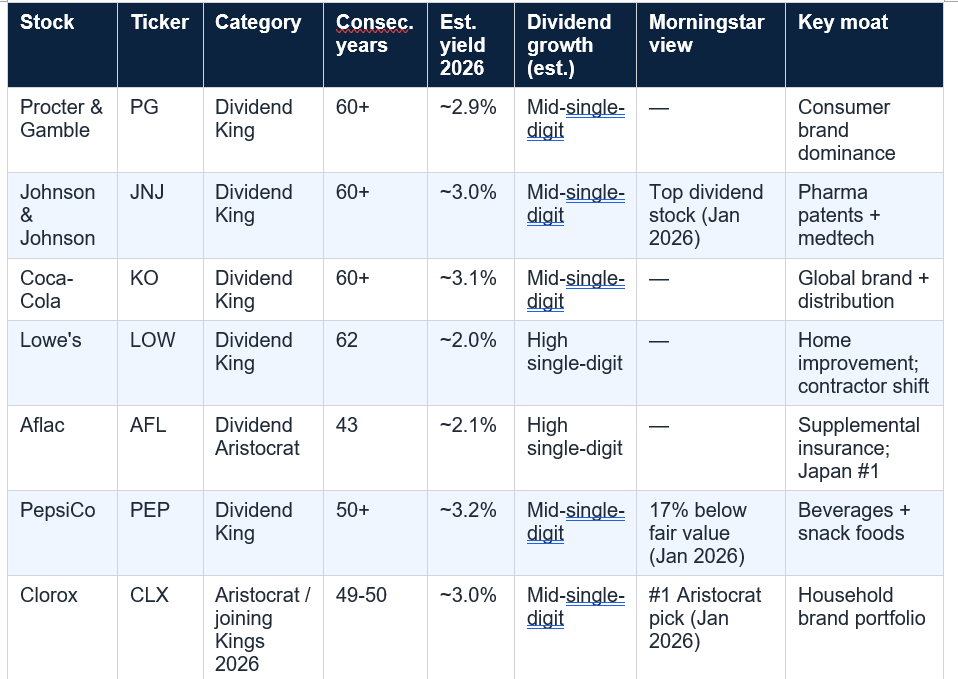
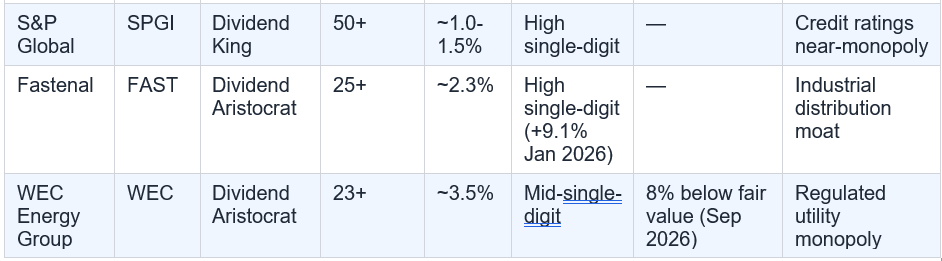
The Full Comparison Table: All Ten Stocks at a Glance
All yields are approximate estimates from published 2026 sources and fluctuate with stock prices. Consecutive-year streaks include 2026 if the company has announced a 2026 increase as of publication. Morningstar fair value estimates as of the dates cited. Not financial advice. Past dividend history does not guarantee future payments. Always verify current data at each company's investor relations page and read the fund prospectus or annual report before investing.
How to Invest in Dividend Growth: Stocks vs ETFs
Investors new to dividend growth investing face an initial choice: build a portfolio of individual stocks or buy a diversified fund that holds many dividend growers simultaneously. Both approaches have merit, and the right choice depends on the investor's time, interest, and portfolio size.- Individual stocks: selecting specific Dividend Aristocrats and Kings allows investors to concentrate in the names they find most compelling, overweight sectors they understand, and avoid companies they have concerns about. The trade-off is that managing a portfolio of 10-20 individual dividend stocks requires ongoing monitoring of each company's financial health, payout ratio, earnings trends, and dividend growth prospects. Dividend cuts, while rare among Aristocrats, do happen — and individual positions are concentrated enough to materially affect portfolio income when they do.
- The ProShares S&P 500 Dividend Aristocrats ETF (NOBL) provides instant exposure to all 69 Dividend Aristocrats in a single fund at a 0.35% expense ratio, with $11.3 billion in assets under management (Kiplinger July 15, 2026). NOBL's equal-weight methodology gives each Aristocrat the same weight rather than weighting by market cap, which means smaller Aristocrats receive proportionally more exposure.
- Other dividend growth ETFs cited in Kiplinger's July 2026 Dividend Aristocrats coverage include the Vanguard Dividend Appreciation ETF (VIG), the iShares Core Dividend Growth ETF (DGRO), and the State Street SPDR S&P Dividend ETF (SDY). VIG and DGRO are particularly popular for investors who want broad dividend growth exposure at lower expense ratios than NOBL.
- DRIP (Dividend Reinvestment Plan): regardless of whether you invest in stocks or ETFs, enabling DRIP — the automatic reinvestment of dividends to purchase additional shares — is the mechanism that converts growing dividends into growing share counts and the compounding effect that makes long-term dividend investing so powerful. Most brokerages offer commission-free DRIP on eligible stocks and ETFs. DividendCalculator.io July 2026 states that DRIP can more than double total return over 20 years versus holding without reinvestment.
Conclusion
The investors who build the most wealth from dividends are rarely those who chase the highest current yields. They are the ones who buy businesses with dependable, growing dividends at reasonable prices — and then hold for decades while the compounding does its work. Aflac's 8.6% yield on cost for ten-year holders is not an accident or a lucky outcome. It is the inevitable mathematical result of buying a quality business at a reasonable price and allowing 43 years of uninterrupted dividend growth to compound.The ten stocks in this guide represent different profiles on the dividend growth spectrum: from the ultra-conservative stability of Procter & Gamble and Coca-Cola, to the higher-growth yield on cost trajectory of Aflac and Fastenal, to the value-oriented entry points identified by Morningstar in PepsiCo and Clorox, to the structural monopolies of S&P Global and WEC Energy. No single stock is right for every investor. Together, they illustrate the range of choices available from the universe of Dividend Aristocrats and Kings.
The Dividend Aristocrats have historically delivered higher total returns than the broader S&P 500 with meaningfully lower volatility, according to DividendFlow.org's 2026 analysis. The average yield of approximately 2.8% is modest in isolation, but the combination of growing income and capital appreciation has compounded exceptionally over 10 to 20 year periods. The starting yield is not the story. The growth of that yield, year after year, across decades — that is the dividend growth investor's reward for patience.
Not financial advice. All investments involve risk including possible loss of principal. Dividends are not guaranteed. Past performance is not indicative of future results. Consult a qualified financial adviser before investing.
Frequently Asked Questions
What is a Dividend Aristocrat and how many are there in 2026?A Dividend Aristocrat is an S&P 500 company that has increased its dividend every year for at least 25 consecutive years. The S&P 500 membership requirement means Aristocrats must also meet minimum size, liquidity, and financial viability standards. As of 2026, there are 69 Dividend Aristocrats, according to Kiplinger's July 15, 2026 coverage of the complete index. S&P made no changes to the Aristocrats in its January 2026 annual rebalancing. Three companies were added to the Aristocrats in 2025: FactSet Research Systems, Erie Indemnity, and Eversource Energy. The ProShares S&P 500 Dividend Aristocrats ETF (NOBL) holds all 69 members with $11.3 billion in assets and a 0.35% expense ratio. Other dividend growth ETFs include VIG (Vanguard Dividend Appreciation), DGRO (iShares Core Dividend Growth), and SDY (State Street SPDR S&P Dividend ETF).
What is the difference between a Dividend Aristocrat and a Dividend King?
The key differences are the streak length and index membership requirements. Dividend Aristocrats have raised their dividend for at least 25 consecutive years AND must be members of the S&P 500, meeting minimum size and liquidity standards. Dividend Kings have raised their dividend for at least 50 consecutive years but do NOT need to be in the S&P 500 — the Kings list can include smaller companies with exceptional dividend track records. There are currently 57 to 59 Dividend Kings (Simply Safe Dividends 2026) versus 69 Dividend Aristocrats. All Dividend Aristocrats with 50+ year streaks are also Dividend Kings. Three companies are expected to join the Kings in 2026: McDonald's, Carlisle, and Clorox, as they approach their 50th consecutive year of annual increases. Kiplinger's June 2026 Dividend Kings guide notes that the Kings 'should be top of mind for any investor who puts income stability above all else.'
Why do dividends matter so much for long-term returns?
The data is compelling. Dividends reinvested have contributed approximately 84% of the S&P 500's total return since 1960, according to Hartford Funds research cited by DividendCalculator.io in July 2026. Federal Reserve FRED data and Robert Shiller's historical S&P 500 dataset show price-only returns averaging roughly 4% per year while total return with dividends reinvested averages closer to 7% — nearly doubling the compounding rate. Over 20 to 30 years, that difference produces dramatically different portfolio values. The DRIP (Dividend Reinvestment Plan) mechanism is the key: it automatically uses each dividend payment to purchase additional shares, which themselves pay dividends, which purchase more shares. DividendCalculator.io states that DRIP can more than double total return over 20 years compared to taking dividends as cash. Not financial advice.
What is yield on cost and why does it matter for dividend investors?
Yield on cost is the annual dividend income you receive as a percentage of your original purchase price — not the current stock price. It is the metric that reveals what dividend growth investing actually delivers to patient investors over time. If you buy a stock for $100 that yields 2.1% at purchase, you receive $2.10 per year in dividends. If the company raises its dividend by 8% per year for ten years, the dividend payment grows to $4.53 per year. Your yield on cost is now 4.53% — on an original investment of $100 — even though the current buyer of the stock at a higher market price might only be receiving a 2% current yield. Aflac provides the concrete 2026 illustration: investors who bought Aflac shares ten years ago now collect an 8.6% yield on cost, even though the stock's current yield for new buyers is just 2.1%, according to Yahoo Finance's 2026 analysis. This is why dividend growth rate — how fast the dividend is growing — matters more than starting yield for long-term investors.
Should I buy individual dividend stocks or a dividend ETF like NOBL?
Both approaches are valid depending on your circumstances. Individual Dividend Aristocrats and Kings allow you to select specific businesses you understand and believe in, concentrate in sectors you find most compelling, and avoid companies with concerns about their future dividend trajectory. The trade-off is ongoing monitoring of multiple positions. The ProShares S&P 500 Dividend Aristocrats ETF (NOBL) provides instant diversified exposure to all 69 Aristocrats with $11.3 billion in AUM and a 0.35% expense ratio (Kiplinger July 2026). NOBL uses equal weighting rather than market-cap weighting, giving smaller Aristocrats proportionally more exposure. Other options include VIG (Vanguard Dividend Appreciation ETF), DGRO (iShares Core Dividend Growth ETF), and SDY (State Street SPDR S&P Dividend ETF), which Kiplinger also cites as top-rated dividend growth ETFs. For most investors new to dividend growth investing, starting with a diversified ETF and adding individual positions over time as conviction develops is a reasonable approach. Not financial advice — consult a qualified financial adviser.

0 Comments Comments