

Investing
Should You Buy an Annuity in Tranches?
Annuity rates in 2026 are the best they have been in over a decade. Yet locking your entire pension into a single annuity on one day remains one of the biggest irrevocable financial decisions you will ever make. Buying in tranches — gradually converting portions of your pension pot into guaranteed income over several years — is a strategy that spreads the timing risk, preserves flexibility, and can significantly improve lifetime income outcomes. But it is not right for everyone. This guide explains how it works, what it costs, who it suits, and what the experts say.

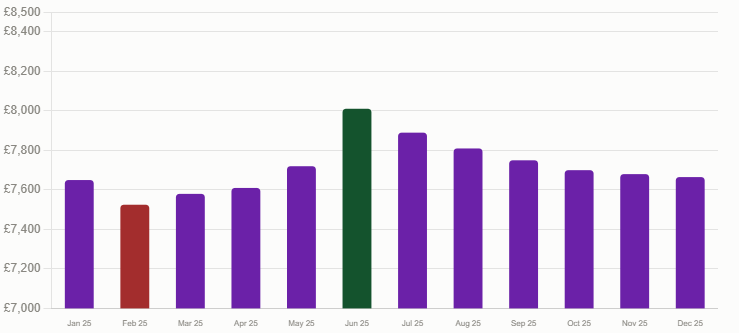
This irreversibility creates a timing problem. Annuity rates move with long-term gilt yields, which in turn respond to Bank of England policy, inflation expectations, and global bond markets. In 2025 alone, the best month to buy a £100,000 annuity produced £8,011 per year — while the worst month produced £7,525. The difference of £486 per year is not trivial when multiplied over a retirement of twenty or thirty years: over twenty years that gap is £9,720; over thirty years, £14,580. And that is just the variation within a single year.
Buying in tranches — converting your pension to annuity income in stages rather than all at once — is a strategy specifically designed to address this problem. Rather than betting your entire retirement income on a single day's gilt yield, you spread your purchases over months or years, averaging the rate you receive and preserving the ability to react to changing circumstances. This guide explains how it works in the 2026 market, what it costs and gains you, and whether it is the right approach for your situation.
Best annuity rate on £100k (September 2026): 8.03% from Standard Life = £8,030/year single-life level (Retirement Line, 1 Sep 2026). L&G average rate: 7.24% as at 7 September 2026. Provider gap January 2026: best £7,649 vs worst £7,100 on same £100k = £549/year gap for life (MoneyWeek). Month-to-month 2025 gap: £486/year between best (June: £8,011) and worst (February: £7,525) months. Annuity rates over 50% higher than 2021 lows. UK gilt yields: ~4.2–4.5% as of mid-2026 (GlobalInvestments.net). Bank of England base rate: 3.75%.
Annuity rates are driven primarily by long-term UK gilt yields. When an insurer receives your premium, they invest it predominantly in gilts to match their future payment liability. When gilt yields are high, the insurer earns more on your premium and can offer a higher income. When gilt yields are low — as they were from 2009 to 2021 — annuity rates fall accordingly. GlobalInvestments.net describes the dynamic clearly: 'When the 10-year UK gilt yield was 1.5% (as it was in 2020–2021), the insurer could generate only modest returns on the premium, which meant the annuity income rate was low. When gilt yields rose to 4–5% (as they did from 2022–2024), the insurer could generate substantially higher returns, and annuity rates rose accordingly.'
The 2026 market represents a generational opportunity for annuity buyers. Rates in September 2026 are the best they have been since before the 2008 financial crisis, with the best single-life level annuity rate for a 65-year-old reaching 8.03% from Standard Life as of 1 September 2026 (Retirement Line). As recently as 2021, a 65-year-old with £100,000 could buy only approximately £5,000 per year. The improvement exceeds 50% in four years.
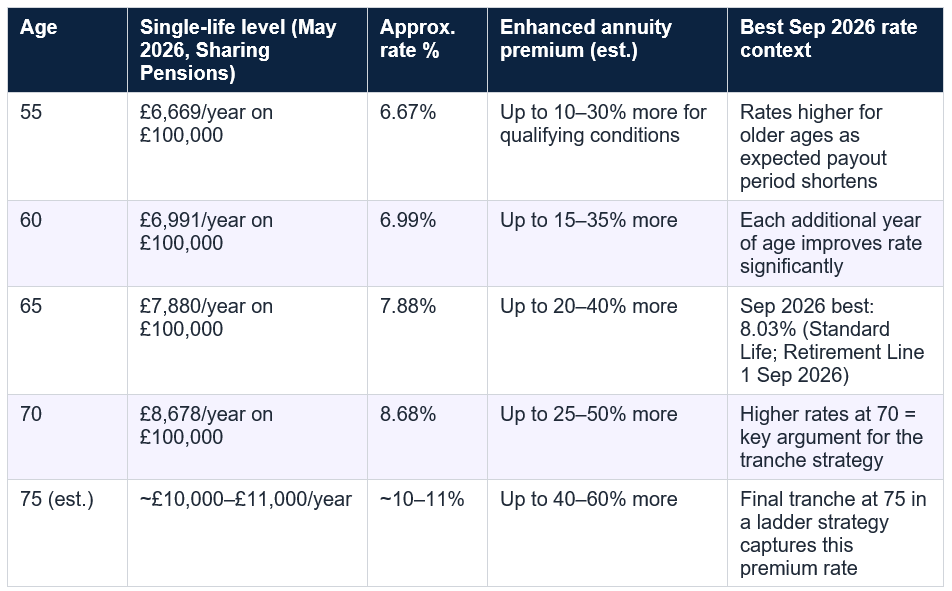
Sources: Sharing Pensions May 2026, cited Over50choices.co.uk; Retirement Line (1 September 2026); pensionestimate.uk (April 2026); PensionHelper.co.uk (checked August 2026). Enhanced annuity premiums are illustrative estimates; actual uplift depends on specific health conditions and provider underwriting. Rates change daily — always obtain a live quote before committing. Not financial advice.
Professional Paraplanner (July 2025) describes the strategy as combining 'a gradual build-up of guaranteed income through annuities' with 'ongoing investment flexibility for the uncrystallised portion of the fund.' The key distinction from a standard single annuity purchase is that only part of the pension is crystallised at any given time. The remaining, unconverted portion stays within the pension wrapper — typically in flexi-access drawdown — where it remains invested, retains some inheritance tax advantages (subject to the April 2027 reforms), and can be converted in future tranches at the rates available at that point.
GlobalInvestments.net (June 2026) summarises the mechanism: 'Annuity laddering — purchasing in tranches across time — spreads timing risk, preserves flexibility, and can significantly improve lifetime income outcomes.' The word 'ladder' refers to the stepped structure of guaranteed income: each new tranche adds another rung, building the guaranteed floor of retirement income progressively toward a level that meets essential expenditure needs.
The tranche strategy is not a single product you buy from an insurer. It is a decumulation approach — a strategy for how you convert your pension to income over time. It requires an active decision to purchase each tranche, a vehicle for holding the unconverted portion (typically drawdown), and a plan for how many tranches you will buy, when, and of what size. This is exactly the kind of decision where independent financial advice adds significant value.
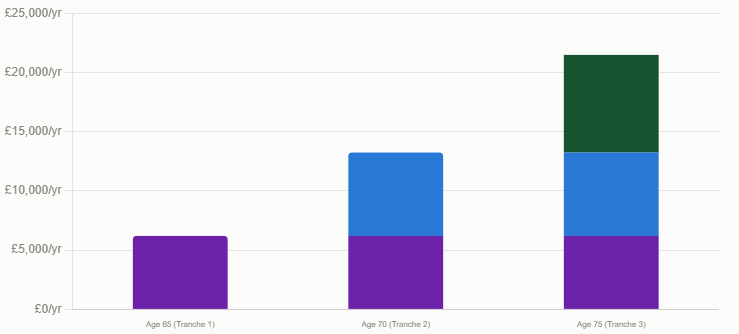
Example: A 65-year-old with a £240,000 DC pension pot decides to buy an annuity in three tranches of £80,000 each. Tranche 1 (age 65): annuitises £80,000 at approximately 7.75% = £6,200/year guaranteed for life. The remaining £160,000 stays in drawdown, invested and inheritable. Tranche 2 (age 70): annuitises a further £80,000 at approximately 8.8% (if the slice holds its value in drawdown) = £7,040/year additional guaranteed income. Total guaranteed income at 70: £13,240/year. Tranche 3 (age 75): annuitises the final £80,000 at approximately 10.3% = £8,240/year additional. Total guaranteed income at 75: £21,480/year — built up in three steps, each at a better rate than the last, while the unspent tranches stayed invested and inheritable in the meantime. Source: PensionHelper.co.uk (checked August 2026). Illustrative only — not personalised financial advice.
The CalcHub.uk guide (2026/27) describes a similar blended approach for a 67-year-old with £250,000: taking 25% PCLS (£62,500 tax-free), annuitising £100,000 at 7.2% (£7,200/year guaranteed for life covering essential bills), and keeping £87,500 in drawdown at a 4% withdrawal rate for discretionary spending. This is the 'core and satellite' variation of the tranche strategy — where the annuity covers essential expenditure and drawdown covers flexible spending.
The number of tranches, their size, and their timing are entirely discretionary. Common structures include two tranches (at retirement and at 70 or 75), three tranches (as in the PensionHelper example), or a continuous ladder where small amounts are annuitised annually. The right structure depends on the size of the pot, income needs in each phase of retirement, tax position, and health trajectory.
This is a critical distinction from the usual argument against pound-cost averaging. For equities, the expected return is positive, which means staying out of the market costs you the growth on uninvested money. Annuity rates, by contrast, are driven by gilt yields — which could rise or fall from current levels depending on inflation, monetary policy, and global conditions. There is no universal expectation that tomorrow's rate will be higher than today's. Spreading purchases therefore hedges a genuinely unpredictable risk rather than sacrificing expected return.
The MoneyWeek analysis quantifies the downside of bad timing on a single purchase: in 2025, the gap between the best and worst month was £486 per year for life. Over a 25-year retirement, that is £12,150 — from the same £100,000, with the same provider, simply bought in a different month. The tranche strategy would have averaged across both the good and bad months.
The January 2026 provider gap is equally instructive: £549 per year difference between the most and least generous provider on the same £100,000. You can close the provider gap by collecting quotes through the open market option. But you cannot close the timing gap unless you buy in stages.
Spreading the timing risk works in both directions. If gilt yields rise significantly after your first tranche — meaning annuity rates improve — you benefit from buying later tranches at better rates. But if gilt yields fall — as they could if the Bank of England cuts rates aggressively — your later tranches will be bought at worse rates than your first. The tranche strategy is insurance, not a guarantee of better outcomes. It eliminates the risk of the single worst day but also eliminates the chance of the single best day.
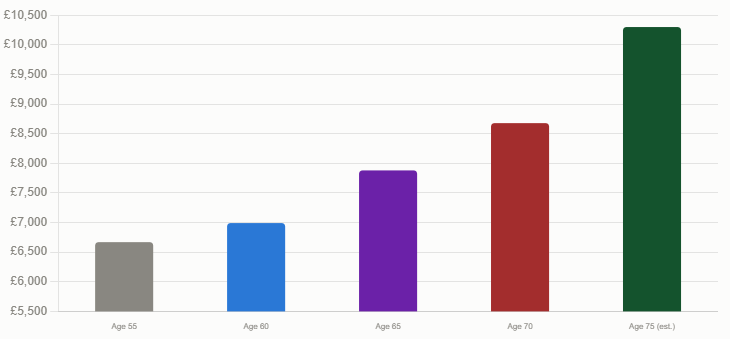
In the May 2026 Sharing Pensions data (cited Over50choices.co.uk), the rate progression is clear: £6,991 at age 60, rising to £7,880 at 65, and £8,678 at 70 — on the same £100,000 purchase price. PensionHelper.co.uk's tranche model projects approximately 10.3% at age 75. Each five-year delay in purchasing a tranche therefore comes with a higher rate — partially offsetting any investment return the unannuitised capital could generate in drawdown.
PoundSense (March 2026) explains the pattern: 'The older you are, the higher the rate (because the provider expects to pay out for fewer years).' This is the structural tailwind behind the tranche strategy: you are not simply hoping rates improve — you are guaranteed to receive a better rate on later tranches simply because you are older. Even if gilt yields stay flat, a tranche purchased at 75 will pay more per year than the same tranche purchased at 65.
The age benefit is the tranche strategy's most reliable advantage — unlike timing, it does not depend on market movements. The difference between a 65-year-old's rate and a 70-year-old's rate in May 2026 was approximately 10% (£7,880 vs £8,678 on £100,000). Waiting five years to annuitise the second tranche adds approximately £798 per year of guaranteed income per £100,000 — before accounting for any investment return on the drawdown capital in the interim. The question is whether the drawdown capital grows enough to produce a larger absolute income than immediate full annuitisation would have.
The tranche strategy changes this. GlobalInvestments.net (June 2026) explains: 'The two can be combined: each time a tranche is annuitised, a 25 per cent PCLS can be taken from that tranche before conversion, so the tax-free cash entitlement is used incrementally rather than all at once at retirement. This combination can be particularly effective for individuals in the 40 per cent tax band who wish to take tax-free cash gradually rather than triggering a large taxable income in a single year.'
The practical benefit is tax smoothing. Taking a large PCLS at retirement and deploying it immediately may push you into a higher tax bracket in that year, particularly if you have other income (State Pension, part-time earnings, investment income). Spreading the PCLS across multiple tranche purchases means smaller amounts of tax-free cash arrive in each year, keeping total income below the higher-rate threshold in each individual year.
Example: Illustrative tax smoothing: a 65-year-old with a £400,000 pension pot and a full State Pension (£12,547/year) who takes the entire 25% PCLS (£100,000) at retirement and then annuitises the remaining £300,000 at 7% would have £12,547 + £21,000 annuity income = £33,547 taxable income in year one. If instead they crystallise £100,000 immediately (taking £25,000 PCLS and annuitising £75,000 at 7% = £5,250 annuity income), total taxable income = £12,547 + £5,250 = £17,797 — well within the basic-rate band, and significantly below the £60,000 HICBC threshold. The remaining three tranches of £100,000 are crystallised in later years. Source: illustrative only; based on CalcHub.uk (2026/27) approach and 2026/27 Personal Allowance £12,570. Not financial advice. Tax position varies by individual.
Before April 2027, a defined contribution pension pot remaining in drawdown at death could typically pass to beneficiaries free of inheritance tax — and free of income tax if the deceased was under 75. This made drawdown a powerful tool for intergenerational wealth transfer. After April 2027, that IHT advantage is significantly reduced: unused pension pots will be counted alongside the rest of the estate for the 40% IHT charge above the nil-rate band.
This reform changes the calculus in two ways that are directly relevant to the tranche strategy. First, it reduces one of the key advantages of staying fully in drawdown — the ability to pass the whole pot to beneficiaries without IHT. Second, it makes annuities comparatively more attractive for those whose primary concern was legacy: if the IHT treatment of drawdown and annuity is moving closer together, the guaranteed income certainty of an annuity becomes more compelling on a like-for-like basis.
Standard Life's Samantha Griffith noted in April 2026: 'Looking ahead, we expect annuity rates, as well as the demand for these types of products, to remain strong, especially with pensions being brought into scope for inheritance tax from 2027. Wealthier savers may be encouraged to access more of their pensions, with annuities becoming an increasingly attractive way of doing so.'
The April 2027 IHT reform does not mean annuities are automatically better than drawdown for everyone with legacy objectives. Annuities with a joint-life or guarantee period feature do pass some benefit to a surviving spouse or beneficiaries. But a standard single-life annuity with no guarantee period pays nothing on death. If leaving an inheritance remains a priority, a joint-life annuity, or a tranche strategy that leaves some capital in drawdown, may be more appropriate than full immediate annuitisation. Obtain specific advice on your estate planning needs.
The drawdown bridge phase requires active investment management. Unlike a deferred annuity (which is a fixed promise from an insurer), drawdown carries market risk. The capital in the unannuitised portion can fall in value — which means the second or third tranche may be smaller than planned if markets perform poorly. This is a genuine risk that the tranche strategy introduces compared to a single full annuity purchase.
The appropriate investment strategy for the drawdown bridge depends on the timeline to the next tranche. For a ten-year bridge (first tranche at 65, second at 75), a broadly diversified portfolio with meaningful equity exposure is typically appropriate — the long horizon allows recovery from market downturns. For a three-to-five-year bridge (first tranche at 65, second at 68–70), a more cautious balanced or multi-asset portfolio reduces the risk of capital loss just before the next tranche purchase.
The drawdown bridge is not a set-and-forget arrangement. It requires: (1) an appropriate investment mandate for the timeline; (2) annual reviews of the capital value and income projection; (3) a clear decision framework for when to trigger the next tranche (e.g., when the capital reaches a target value, when you reach a target age, or when rates improve beyond a threshold). This level of ongoing management is one reason why the tranche strategy is better suited to those with access to ongoing financial advice than to those managing their pension entirely independently.
Enhanced annuities (also called impaired life annuities) pay a higher income to people with health conditions that reduce life expectancy or impair daily living. The uplift is significant: pensionestimate.uk (April 2026) estimates that qualifying health conditions can increase annuity income by 15–50%. Over50choices.co.uk confirms that conditions including heart disease, diabetes, cancer, stroke, chronic obstructive pulmonary disease, and certain lifestyle factors such as smoking can qualify.
The enhanced annuity market is one where the open market option is particularly valuable. Your existing pension provider may not offer enhanced rates, or may not offer the best rate for your specific condition. Specialist providers — such as Canada Life, Legal & General, Aviva, Just Group, and Standard Life — all underwrite health conditions differently. A 65-year-old with a qualifying condition might receive £9,000–£10,500 per year from £100,000 rather than the healthy-life rate of £7,880–£8,030.
Before purchasing any annuity — in one payment or in tranches — complete a full health and lifestyle questionnaire from at least three specialist providers or via a whole-of-market annuity broker. Common qualifying conditions include: heart attack, stroke, cancer (any diagnosis within specified periods), type 2 diabetes with complications, Parkinson's disease, multiple sclerosis, chronic kidney disease, and smoking. Even less serious conditions may qualify for a modest uplift. The questionnaire takes 15–20 minutes and can be worth thousands of pounds per year for life. Under the tranche strategy, complete this assessment at each tranche purchase, as your health profile may change over time — and often in a direction that increases your enhanced rate eligibility.
The market data demonstrates why this matters. In January 2026, MoneyWeek found the most generous provider offered £7,649 per year on £100,000 while the least generous offered £7,100 — a gap of £549 per year for life. Over twenty years that difference is £10,980. The OMO closes this gap completely at no additional cost to you — it simply requires you to compare quotes.
The most efficient way to exercise the OMO is through a whole-of-market annuity broker or comparison service. These services — including Retirement Line, Hargreaves Lansdown, Just Group, and others — collect quotes from all major providers simultaneously and present them in ranked order. Many of these services are free to the buyer; they are remunerated by the annuity provider. For large purchases (above approximately £100,000), regulated financial advice may be required or strongly advisable.
Under the tranche strategy, exercise the open market option for every tranche separately — not just the first one. Your health profile, provider pricing, and market conditions will all change between tranches. The provider that offers the best rate for a 65-year-old may not be the best rate for a 70-year-old. Collect fresh quotes at each purchase point, including a full health and lifestyle questionnaire each time.
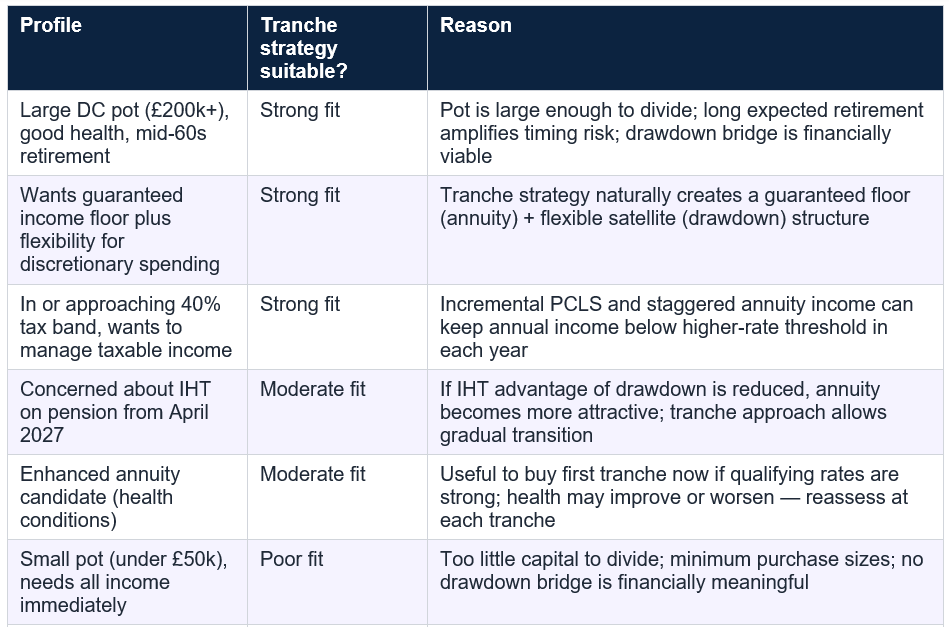
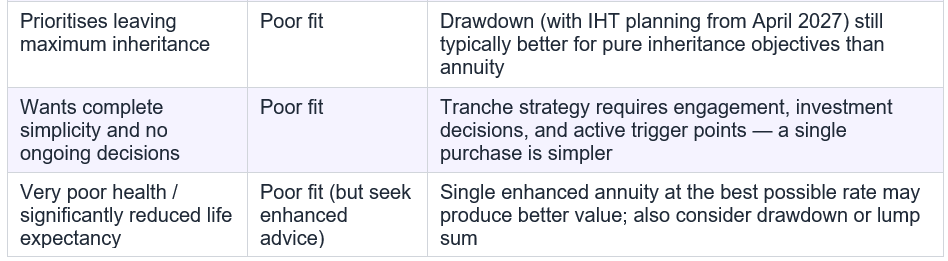
Not financial advice. Individual circumstances vary significantly. This table is a starting-point framework — not a substitute for regulated financial advice tailored to your specific pension, health, tax, and income situation.
The case for buying in tranches is more nuanced — but compelling for the right person. The strategy addresses the annuity's single greatest weakness (irrevocability) by spreading the timing risk across multiple purchases. It captures the structural benefit of ageing (higher rates with each tranche). It allows tax-efficient use of tax-free cash. It preserves flexibility and some capital accessibility in the drawdown bridge. And it aligns well with a retirement in which spending needs and income certainty requirements evolve over time — higher flexibility needs in the active early years, higher income certainty needs in the later years.
The risks are real: market risk on the drawdown bridge, rate risk if gilt yields fall, complexity, and the absence of a published UK historical track record. The strategy is better suited to those with larger pots, access to financial advice, and a willingness to remain engaged with their pension after retirement.
The April 2027 IHT pension reform further shifts the landscape in annuities' favour by reducing one of drawdown's primary advantages. As Standard Life noted, annuities are likely to see increased demand for exactly this reason. For those approaching retirement with a sizeable DC pot in 2026, the question is no longer simply 'annuity or drawdown?' — it is 'how much annuity, when, and in how many tranches?'
Buying an annuity in tranches — also called phased annuity purchase, annuity laddering, or staged annuitisation — means converting your pension pot to a guaranteed lifetime income in stages rather than all at once. Instead of handing your entire pension to an insurer on one day, you crystallise a portion and annuitise it, leave the remainder invested in drawdown, then repeat the process at intervals. Each tranche is bought at the rate available on the day of purchase, meaning your overall annuity income reflects an average of the rates at each purchase date rather than a single day's rate. The strategy is designed to spread timing risk and capture the age benefit (higher rates at older ages) while preserving flexibility and continued investment growth on the unconverted portion. Source: Professional Paraplanner (July 2025); GlobalInvestments.net (June 2026).
What are the best annuity rates in 2026?
Annuity rates in 2026 are at their highest level since before the 2008 financial crisis, driven by elevated UK gilt yields of approximately 4.2–4.5%. As of 1 September 2026, the best single-life level annuity rate for a healthy 65-year-old with £100,000 is 8.03% from Standard Life — equivalent to £8,030 per year for life (Retirement Line, 1 September 2026). Legal & General's average rate was 7.24% as at 7 September 2026. A 70-year-old can expect approximately £8,678+ per year on the same amount (Sharing Pensions, May 2026). Rates change daily with gilt yields and provider pricing — always obtain a live quote before committing. The open market option allows you to shop across all major providers simultaneously; using it is essential as provider gaps can exceed £500 per year on a £100,000 purchase.
Does the tranche strategy guarantee a better outcome than buying all at once?
No — it is insurance against the timing risk, not a guarantee of better outcomes. If gilt yields (and therefore annuity rates) rise significantly between your first and later tranches, those later tranches will benefit. But if rates fall, your later tranches will be worse than the rate available today on a full purchase. The tranche strategy eliminates the risk of committing entirely on the single worst day at the cost of also giving up the possibility of committing on the single best day. MoneyWeek (September 2026) notes that 'buying in stages is insurance against a rate move nobody can forecast' — and that, unlike shares, annuity rates carry no inherent expectation of rising over time. The structural tailwind — higher rates at older ages — is the strategy's more reliable advantage.
How does tax-free cash (PCLS) work under the tranche strategy?
Each time you crystallise a tranche of your pension for annuitisation, you can take 25% of that tranche as a pension commencement lump sum (PCLS) — tax-free cash — before converting the remainder to annuity income. The overall 25% tax-free entitlement (capped at £268,275 for most people) is used incrementally across the tranches rather than all at once. This can be particularly valuable for people in or approaching the 40% tax band, because spreading the PCLS across several years keeps annual income below the higher-rate threshold in each individual year, rather than triggering a large tax bill in a single year. The CalcHub.uk 2026/27 guide and GlobalInvestments.net (June 2026) both highlight this as a key tax-planning advantage of the tranche approach.
How does the April 2027 IHT pension reform affect the annuity decision?
From 6 April 2027, under the Finance Act 2026 (Royal Assent 18 March 2026), unused defined contribution pension funds will fall within the estate for inheritance tax purposes. Before this date, drawdown pots could typically pass to beneficiaries free of IHT (and free of income tax if death was before age 75). The reform significantly reduces one of drawdown's primary advantages over annuities for those with legacy objectives. Annuities were already irreversible (no capital to pass on from a standard single-life product), but the tax comparison between drawdown and annuity has moved materially in annuities' favour. Standard Life noted in April 2026 that wealthier savers may be encouraged to access more of their pensions as a result, with annuities becoming an increasingly attractive vehicle. The tranche strategy allows you to transition toward annuity income gradually as the reform approaches.
Should I use a financial adviser for an annuity tranche strategy?
Yes — strongly advisable, particularly for the tranche strategy. A single annuity purchase from your existing provider can be done without advice, though even then shopping around is essential. The tranche strategy requires: a drawdown provider for the bridge period; an investment mandate appropriate for the bridge timeline; active management and annual reviews; a decision framework for triggering each tranche; a health and lifestyle assessment at each purchase point; tax planning around PCLS and annual income; and consideration of the April 2027 IHT reform. Each of these elements has significant financial consequences and interacts with the others in complex ways. An independent financial adviser authorised by the FCA — particularly one specialising in retirement income — can build a decumulation plan that integrates all these elements. The cost of advice is typically recoverable many times over from the income improvement achieved through enhanced rates, provider shopping, and optimised tax-free cash strategy.
Table of Contents
- The Annuity Timing Problem
- How Annuities Work in 2026: Rates, Gilt Yields, and the Current Market
- What Is Buying an Annuity in Tranches?
- How the Tranche Strategy Works in Practice
- The Key Advantage: Spreading Timing Risk
- The Age Benefit: Higher Rates with Each Tranche
- Tax-Free Cash and the Incremental PCLS Benefit
- Inheritance Tax: Why 2027 Changes the Calculus
- The Drawdown Bridge: Managing the Uncrystallised Portion
- The Risks and Limitations of Buying in Tranches
- Enhanced Annuities: Don't Overlook the Health Question
- The Open Market Option: Always Shop Around
- Who Should — and Shouldn't — Buy in Tranches
- Conclusion: A Strategy Whose Time Has Come
- Frequently Asked Questions
Annuity Rate By Age: The Case For Buying Later
The £240k Tranches Strategy: Income Buildt in 3 Step
Timing Risk: Month To Month Rate Vairation 2025
The Annuity Timing Problem
Buying a lifetime annuity is one of the few truly irrevocable financial decisions most people make. You hand over your pension pot — or a portion of it — and in exchange you receive a guaranteed income for life. Once purchased, the terms are fixed. You cannot change your mind if annuity rates improve next year. You cannot reclaim the capital if your circumstances change. The income will be the same whether you live for five years or thirty-five.This irreversibility creates a timing problem. Annuity rates move with long-term gilt yields, which in turn respond to Bank of England policy, inflation expectations, and global bond markets. In 2025 alone, the best month to buy a £100,000 annuity produced £8,011 per year — while the worst month produced £7,525. The difference of £486 per year is not trivial when multiplied over a retirement of twenty or thirty years: over twenty years that gap is £9,720; over thirty years, £14,580. And that is just the variation within a single year.
Buying in tranches — converting your pension to annuity income in stages rather than all at once — is a strategy specifically designed to address this problem. Rather than betting your entire retirement income on a single day's gilt yield, you spread your purchases over months or years, averaging the rate you receive and preserving the ability to react to changing circumstances. This guide explains how it works in the 2026 market, what it costs and gains you, and whether it is the right approach for your situation.
Best annuity rate on £100k (September 2026): 8.03% from Standard Life = £8,030/year single-life level (Retirement Line, 1 Sep 2026). L&G average rate: 7.24% as at 7 September 2026. Provider gap January 2026: best £7,649 vs worst £7,100 on same £100k = £549/year gap for life (MoneyWeek). Month-to-month 2025 gap: £486/year between best (June: £8,011) and worst (February: £7,525) months. Annuity rates over 50% higher than 2021 lows. UK gilt yields: ~4.2–4.5% as of mid-2026 (GlobalInvestments.net). Bank of England base rate: 3.75%.
How Annuities Work in 2026: Rates, Gilt Yields, and the Current Market
An annuity is a contract between you and an insurance company. You pay a lump sum — typically from your pension pot — and the insurer pays you a guaranteed income for life (a lifetime annuity) or for a fixed period (a fixed-term annuity). The rate you receive — expressed as annual income per £100,000 of purchase price — is set at the point of purchase and never changes.Annuity rates are driven primarily by long-term UK gilt yields. When an insurer receives your premium, they invest it predominantly in gilts to match their future payment liability. When gilt yields are high, the insurer earns more on your premium and can offer a higher income. When gilt yields are low — as they were from 2009 to 2021 — annuity rates fall accordingly. GlobalInvestments.net describes the dynamic clearly: 'When the 10-year UK gilt yield was 1.5% (as it was in 2020–2021), the insurer could generate only modest returns on the premium, which meant the annuity income rate was low. When gilt yields rose to 4–5% (as they did from 2022–2024), the insurer could generate substantially higher returns, and annuity rates rose accordingly.'
The 2026 market represents a generational opportunity for annuity buyers. Rates in September 2026 are the best they have been since before the 2008 financial crisis, with the best single-life level annuity rate for a 65-year-old reaching 8.03% from Standard Life as of 1 September 2026 (Retirement Line). As recently as 2021, a 65-year-old with £100,000 could buy only approximately £5,000 per year. The improvement exceeds 50% in four years.
Sources: Sharing Pensions May 2026, cited Over50choices.co.uk; Retirement Line (1 September 2026); pensionestimate.uk (April 2026); PensionHelper.co.uk (checked August 2026). Enhanced annuity premiums are illustrative estimates; actual uplift depends on specific health conditions and provider underwriting. Rates change daily — always obtain a live quote before committing. Not financial advice.
What Is Buying an Annuity in Tranches?
Buying an annuity in tranches — also called phased annuity purchase, annuity laddering, or staged annuitisation — means converting your pension pot into annuity income in stages over a period of years rather than all at once at retirement.Professional Paraplanner (July 2025) describes the strategy as combining 'a gradual build-up of guaranteed income through annuities' with 'ongoing investment flexibility for the uncrystallised portion of the fund.' The key distinction from a standard single annuity purchase is that only part of the pension is crystallised at any given time. The remaining, unconverted portion stays within the pension wrapper — typically in flexi-access drawdown — where it remains invested, retains some inheritance tax advantages (subject to the April 2027 reforms), and can be converted in future tranches at the rates available at that point.
GlobalInvestments.net (June 2026) summarises the mechanism: 'Annuity laddering — purchasing in tranches across time — spreads timing risk, preserves flexibility, and can significantly improve lifetime income outcomes.' The word 'ladder' refers to the stepped structure of guaranteed income: each new tranche adds another rung, building the guaranteed floor of retirement income progressively toward a level that meets essential expenditure needs.
The tranche strategy is not a single product you buy from an insurer. It is a decumulation approach — a strategy for how you convert your pension to income over time. It requires an active decision to purchase each tranche, a vehicle for holding the unconverted portion (typically drawdown), and a plan for how many tranches you will buy, when, and of what size. This is exactly the kind of decision where independent financial advice adds significant value.
How the Tranche Strategy Works in Practice
The most widely cited UK illustration of the tranche strategy comes from PensionHelper.co.uk (checked August 2026) using rates it describes as sitting at an 18-year high:Example: A 65-year-old with a £240,000 DC pension pot decides to buy an annuity in three tranches of £80,000 each. Tranche 1 (age 65): annuitises £80,000 at approximately 7.75% = £6,200/year guaranteed for life. The remaining £160,000 stays in drawdown, invested and inheritable. Tranche 2 (age 70): annuitises a further £80,000 at approximately 8.8% (if the slice holds its value in drawdown) = £7,040/year additional guaranteed income. Total guaranteed income at 70: £13,240/year. Tranche 3 (age 75): annuitises the final £80,000 at approximately 10.3% = £8,240/year additional. Total guaranteed income at 75: £21,480/year — built up in three steps, each at a better rate than the last, while the unspent tranches stayed invested and inheritable in the meantime. Source: PensionHelper.co.uk (checked August 2026). Illustrative only — not personalised financial advice.
The CalcHub.uk guide (2026/27) describes a similar blended approach for a 67-year-old with £250,000: taking 25% PCLS (£62,500 tax-free), annuitising £100,000 at 7.2% (£7,200/year guaranteed for life covering essential bills), and keeping £87,500 in drawdown at a 4% withdrawal rate for discretionary spending. This is the 'core and satellite' variation of the tranche strategy — where the annuity covers essential expenditure and drawdown covers flexible spending.
The number of tranches, their size, and their timing are entirely discretionary. Common structures include two tranches (at retirement and at 70 or 75), three tranches (as in the PensionHelper example), or a continuous ladder where small amounts are annuitised annually. The right structure depends on the size of the pot, income needs in each phase of retirement, tax position, and health trajectory.
The Key Advantage: Spreading Timing Risk
The most fundamental argument for buying in tranches is the reduction of timing risk. As MoneyWeek observed in its September 2026 analysis — published just two days before this article — the timing problem is unique to annuities: 'While drip-feeding into equities usually leaves you worse off than buying the lot at once, because shares are expected to rise and uninvested money misses the climb, annuity rates carry no such expectation. Buying in stages is insurance against a rate move nobody can forecast.'This is a critical distinction from the usual argument against pound-cost averaging. For equities, the expected return is positive, which means staying out of the market costs you the growth on uninvested money. Annuity rates, by contrast, are driven by gilt yields — which could rise or fall from current levels depending on inflation, monetary policy, and global conditions. There is no universal expectation that tomorrow's rate will be higher than today's. Spreading purchases therefore hedges a genuinely unpredictable risk rather than sacrificing expected return.
The MoneyWeek analysis quantifies the downside of bad timing on a single purchase: in 2025, the gap between the best and worst month was £486 per year for life. Over a 25-year retirement, that is £12,150 — from the same £100,000, with the same provider, simply bought in a different month. The tranche strategy would have averaged across both the good and bad months.
The January 2026 provider gap is equally instructive: £549 per year difference between the most and least generous provider on the same £100,000. You can close the provider gap by collecting quotes through the open market option. But you cannot close the timing gap unless you buy in stages.
Spreading the timing risk works in both directions. If gilt yields rise significantly after your first tranche — meaning annuity rates improve — you benefit from buying later tranches at better rates. But if gilt yields fall — as they could if the Bank of England cuts rates aggressively — your later tranches will be bought at worse rates than your first. The tranche strategy is insurance, not a guarantee of better outcomes. It eliminates the risk of the single worst day but also eliminates the chance of the single best day.
The Age Benefit: Higher Rates with Each Tranche
Beyond timing, the tranche strategy benefits from a structural feature of annuity pricing: the older you are, the higher the rate. Annuity providers set income based on life expectancy — they price the guarantee to reflect how many years they expect to pay it. A 65-year-old annuity costs more per pound of annual income than a 75-year-old annuity, because the insurer expects to pay it for more years.In the May 2026 Sharing Pensions data (cited Over50choices.co.uk), the rate progression is clear: £6,991 at age 60, rising to £7,880 at 65, and £8,678 at 70 — on the same £100,000 purchase price. PensionHelper.co.uk's tranche model projects approximately 10.3% at age 75. Each five-year delay in purchasing a tranche therefore comes with a higher rate — partially offsetting any investment return the unannuitised capital could generate in drawdown.
PoundSense (March 2026) explains the pattern: 'The older you are, the higher the rate (because the provider expects to pay out for fewer years).' This is the structural tailwind behind the tranche strategy: you are not simply hoping rates improve — you are guaranteed to receive a better rate on later tranches simply because you are older. Even if gilt yields stay flat, a tranche purchased at 75 will pay more per year than the same tranche purchased at 65.
The age benefit is the tranche strategy's most reliable advantage — unlike timing, it does not depend on market movements. The difference between a 65-year-old's rate and a 70-year-old's rate in May 2026 was approximately 10% (£7,880 vs £8,678 on £100,000). Waiting five years to annuitise the second tranche adds approximately £798 per year of guaranteed income per £100,000 — before accounting for any investment return on the drawdown capital in the interim. The question is whether the drawdown capital grows enough to produce a larger absolute income than immediate full annuitisation would have.
Tax-Free Cash and the Incremental PCLS Benefit
The pension commencement lump sum (PCLS) — commonly called tax-free cash — allows you to take 25% of your crystallised pension as a one-off tax-free lump sum, up to a lifetime maximum of £268,275 (2026/27). Under a standard approach, many people take all their tax-free cash at the point of retirement, crystallising the entire pension at once.The tranche strategy changes this. GlobalInvestments.net (June 2026) explains: 'The two can be combined: each time a tranche is annuitised, a 25 per cent PCLS can be taken from that tranche before conversion, so the tax-free cash entitlement is used incrementally rather than all at once at retirement. This combination can be particularly effective for individuals in the 40 per cent tax band who wish to take tax-free cash gradually rather than triggering a large taxable income in a single year.'
The practical benefit is tax smoothing. Taking a large PCLS at retirement and deploying it immediately may push you into a higher tax bracket in that year, particularly if you have other income (State Pension, part-time earnings, investment income). Spreading the PCLS across multiple tranche purchases means smaller amounts of tax-free cash arrive in each year, keeping total income below the higher-rate threshold in each individual year.
Example: Illustrative tax smoothing: a 65-year-old with a £400,000 pension pot and a full State Pension (£12,547/year) who takes the entire 25% PCLS (£100,000) at retirement and then annuitises the remaining £300,000 at 7% would have £12,547 + £21,000 annuity income = £33,547 taxable income in year one. If instead they crystallise £100,000 immediately (taking £25,000 PCLS and annuitising £75,000 at 7% = £5,250 annuity income), total taxable income = £12,547 + £5,250 = £17,797 — well within the basic-rate band, and significantly below the £60,000 HICBC threshold. The remaining three tranches of £100,000 are crystallised in later years. Source: illustrative only; based on CalcHub.uk (2026/27) approach and 2026/27 Personal Allowance £12,570. Not financial advice. Tax position varies by individual.
Inheritance Tax: Why 2027 Changes the Calculus
One of the most significant factors reshaping the annuity-versus-drawdown decision in 2026 is the forthcoming pensions inheritance tax reform. Under the Finance Act 2026 (Royal Assent 18 March 2026), unused pension funds will fall within the estate for inheritance tax purposes from 6 April 2027 (GlobalInvestments.net, June 2026; PoundSense, March 2026).Before April 2027, a defined contribution pension pot remaining in drawdown at death could typically pass to beneficiaries free of inheritance tax — and free of income tax if the deceased was under 75. This made drawdown a powerful tool for intergenerational wealth transfer. After April 2027, that IHT advantage is significantly reduced: unused pension pots will be counted alongside the rest of the estate for the 40% IHT charge above the nil-rate band.
This reform changes the calculus in two ways that are directly relevant to the tranche strategy. First, it reduces one of the key advantages of staying fully in drawdown — the ability to pass the whole pot to beneficiaries without IHT. Second, it makes annuities comparatively more attractive for those whose primary concern was legacy: if the IHT treatment of drawdown and annuity is moving closer together, the guaranteed income certainty of an annuity becomes more compelling on a like-for-like basis.
Standard Life's Samantha Griffith noted in April 2026: 'Looking ahead, we expect annuity rates, as well as the demand for these types of products, to remain strong, especially with pensions being brought into scope for inheritance tax from 2027. Wealthier savers may be encouraged to access more of their pensions, with annuities becoming an increasingly attractive way of doing so.'
The April 2027 IHT reform does not mean annuities are automatically better than drawdown for everyone with legacy objectives. Annuities with a joint-life or guarantee period feature do pass some benefit to a surviving spouse or beneficiaries. But a standard single-life annuity with no guarantee period pays nothing on death. If leaving an inheritance remains a priority, a joint-life annuity, or a tranche strategy that leaves some capital in drawdown, may be more appropriate than full immediate annuitisation. Obtain specific advice on your estate planning needs.
The Drawdown Bridge: Managing the Uncrystallised Portion
Between annuity purchases, the unconverted portion of your pension must be held somewhere. The standard vehicle is flexi-access drawdown — a pension arrangement that keeps your fund invested and allows flexible withdrawals. GlobalInvestments.net (June 2026) describes the role clearly: 'The capital remains invested (usually in a diversified portfolio suited to a medium-term horizon), can generate returns, and retains the inheritance tax advantages of pension wrappers — though note that, under the Finance Act 2026, unused pension funds will fall within the estate for IHT from 6 April 2027.'The drawdown bridge phase requires active investment management. Unlike a deferred annuity (which is a fixed promise from an insurer), drawdown carries market risk. The capital in the unannuitised portion can fall in value — which means the second or third tranche may be smaller than planned if markets perform poorly. This is a genuine risk that the tranche strategy introduces compared to a single full annuity purchase.
The appropriate investment strategy for the drawdown bridge depends on the timeline to the next tranche. For a ten-year bridge (first tranche at 65, second at 75), a broadly diversified portfolio with meaningful equity exposure is typically appropriate — the long horizon allows recovery from market downturns. For a three-to-five-year bridge (first tranche at 65, second at 68–70), a more cautious balanced or multi-asset portfolio reduces the risk of capital loss just before the next tranche purchase.
The drawdown bridge is not a set-and-forget arrangement. It requires: (1) an appropriate investment mandate for the timeline; (2) annual reviews of the capital value and income projection; (3) a clear decision framework for when to trigger the next tranche (e.g., when the capital reaches a target value, when you reach a target age, or when rates improve beyond a threshold). This level of ongoing management is one reason why the tranche strategy is better suited to those with access to ongoing financial advice than to those managing their pension entirely independently.
The Risks and Limitations of Buying in Tranches
The tranche strategy is not universally superior to a single annuity purchase. Its risks and limitations include:- Market risk on the drawdown bridge: the unannuitised capital remains invested and can fall in value. If equity markets decline significantly between tranches, the capital available for later purchases is reduced — potentially negating the rate benefit of buying later at an older age.
- Rate risk: gilt yields could fall between tranches. If the Bank of England cuts rates aggressively — as it did between 2009 and 2021 — annuity rates will follow downward. The rate on a later tranche might be worse than the rate available on the full purchase today, even accounting for the age benefit.
- Longevity risk on the first tranche: the first tranche buys income from now. If you die early, you will have received fewer payments from the first tranche than a single later purchase would have provided — and the unannuitised capital may pass to beneficiaries anyway. The tranche strategy potentially trades longevity risk protection (the core purpose of an annuity) for flexibility.
- Complexity and management cost: the tranche strategy requires ongoing engagement, a drawdown provider, annual reviews, and active decisions at each tranche point. For people who want simplicity — which is itself a valid retirement objective — a single annuity purchase is a lower-complexity solution.
- Minimum purchase sizes: some annuity providers have minimum purchase thresholds (typically £5,000–£10,000). Very small pots may not be divisible into tranches with any provider.
- No published UK track record: MoneyWeek (September 2026) notes that 'I can find no published estimate of what a UK annuity ladder would actually have returned.' The tranche strategy is theoretically compelling and has intuitive logic, but its historical UK return data compared with single purchases is not available in the academic literature in the way, say, equity market strategies are. The argument rests on the logic of averaging, not on historical proof.
Enhanced Annuities: Don't Overlook the Health Question
Before deciding whether to buy in tranches — and regardless of the timing of any purchase — the single most important question for many retirees is whether they qualify for an enhanced annuity.Enhanced annuities (also called impaired life annuities) pay a higher income to people with health conditions that reduce life expectancy or impair daily living. The uplift is significant: pensionestimate.uk (April 2026) estimates that qualifying health conditions can increase annuity income by 15–50%. Over50choices.co.uk confirms that conditions including heart disease, diabetes, cancer, stroke, chronic obstructive pulmonary disease, and certain lifestyle factors such as smoking can qualify.
The enhanced annuity market is one where the open market option is particularly valuable. Your existing pension provider may not offer enhanced rates, or may not offer the best rate for your specific condition. Specialist providers — such as Canada Life, Legal & General, Aviva, Just Group, and Standard Life — all underwrite health conditions differently. A 65-year-old with a qualifying condition might receive £9,000–£10,500 per year from £100,000 rather than the healthy-life rate of £7,880–£8,030.
Before purchasing any annuity — in one payment or in tranches — complete a full health and lifestyle questionnaire from at least three specialist providers or via a whole-of-market annuity broker. Common qualifying conditions include: heart attack, stroke, cancer (any diagnosis within specified periods), type 2 diabetes with complications, Parkinson's disease, multiple sclerosis, chronic kidney disease, and smoking. Even less serious conditions may qualify for a modest uplift. The questionnaire takes 15–20 minutes and can be worth thousands of pounds per year for life. Under the tranche strategy, complete this assessment at each tranche purchase, as your health profile may change over time — and often in a direction that increases your enhanced rate eligibility.
The Open Market Option: Always Shop Around
Whether you buy all at once or in tranches, using the open market option (OMO) is essential. You are never obliged to buy an annuity from your existing pension provider. Under the OMO, you can take the crystallised portion of your fund to any FCA-authorised annuity provider on the market and buy from the one offering the best rate for your circumstances.The market data demonstrates why this matters. In January 2026, MoneyWeek found the most generous provider offered £7,649 per year on £100,000 while the least generous offered £7,100 — a gap of £549 per year for life. Over twenty years that difference is £10,980. The OMO closes this gap completely at no additional cost to you — it simply requires you to compare quotes.
The most efficient way to exercise the OMO is through a whole-of-market annuity broker or comparison service. These services — including Retirement Line, Hargreaves Lansdown, Just Group, and others — collect quotes from all major providers simultaneously and present them in ranked order. Many of these services are free to the buyer; they are remunerated by the annuity provider. For large purchases (above approximately £100,000), regulated financial advice may be required or strongly advisable.
Under the tranche strategy, exercise the open market option for every tranche separately — not just the first one. Your health profile, provider pricing, and market conditions will all change between tranches. The provider that offers the best rate for a 65-year-old may not be the best rate for a 70-year-old. Collect fresh quotes at each purchase point, including a full health and lifestyle questionnaire each time.
Who Should — and Shouldn't — Buy in Tranches
The tranche strategy is not universally appropriate. Here is a framework for assessing whether it fits your situation:Not financial advice. Individual circumstances vary significantly. This table is a starting-point framework — not a substitute for regulated financial advice tailored to your specific pension, health, tax, and income situation.
Conclusion
Annuity rates in September 2026 are the best they have been in over a decade. The best single-life level rate for a 65-year-old has reached 8.03% from Standard Life — a figure that would have seemed impossible in 2021 when the equivalent rate was approximately 5%. Against this backdrop, the case for annuities in general is stronger than it has been for a generation.The case for buying in tranches is more nuanced — but compelling for the right person. The strategy addresses the annuity's single greatest weakness (irrevocability) by spreading the timing risk across multiple purchases. It captures the structural benefit of ageing (higher rates with each tranche). It allows tax-efficient use of tax-free cash. It preserves flexibility and some capital accessibility in the drawdown bridge. And it aligns well with a retirement in which spending needs and income certainty requirements evolve over time — higher flexibility needs in the active early years, higher income certainty needs in the later years.
The risks are real: market risk on the drawdown bridge, rate risk if gilt yields fall, complexity, and the absence of a published UK historical track record. The strategy is better suited to those with larger pots, access to financial advice, and a willingness to remain engaged with their pension after retirement.
The April 2027 IHT pension reform further shifts the landscape in annuities' favour by reducing one of drawdown's primary advantages. As Standard Life noted, annuities are likely to see increased demand for exactly this reason. For those approaching retirement with a sizeable DC pot in 2026, the question is no longer simply 'annuity or drawdown?' — it is 'how much annuity, when, and in how many tranches?'
Frequently Asked Questions
What is buying an annuity in tranches?Buying an annuity in tranches — also called phased annuity purchase, annuity laddering, or staged annuitisation — means converting your pension pot to a guaranteed lifetime income in stages rather than all at once. Instead of handing your entire pension to an insurer on one day, you crystallise a portion and annuitise it, leave the remainder invested in drawdown, then repeat the process at intervals. Each tranche is bought at the rate available on the day of purchase, meaning your overall annuity income reflects an average of the rates at each purchase date rather than a single day's rate. The strategy is designed to spread timing risk and capture the age benefit (higher rates at older ages) while preserving flexibility and continued investment growth on the unconverted portion. Source: Professional Paraplanner (July 2025); GlobalInvestments.net (June 2026).
What are the best annuity rates in 2026?
Annuity rates in 2026 are at their highest level since before the 2008 financial crisis, driven by elevated UK gilt yields of approximately 4.2–4.5%. As of 1 September 2026, the best single-life level annuity rate for a healthy 65-year-old with £100,000 is 8.03% from Standard Life — equivalent to £8,030 per year for life (Retirement Line, 1 September 2026). Legal & General's average rate was 7.24% as at 7 September 2026. A 70-year-old can expect approximately £8,678+ per year on the same amount (Sharing Pensions, May 2026). Rates change daily with gilt yields and provider pricing — always obtain a live quote before committing. The open market option allows you to shop across all major providers simultaneously; using it is essential as provider gaps can exceed £500 per year on a £100,000 purchase.
Does the tranche strategy guarantee a better outcome than buying all at once?
No — it is insurance against the timing risk, not a guarantee of better outcomes. If gilt yields (and therefore annuity rates) rise significantly between your first and later tranches, those later tranches will benefit. But if rates fall, your later tranches will be worse than the rate available today on a full purchase. The tranche strategy eliminates the risk of committing entirely on the single worst day at the cost of also giving up the possibility of committing on the single best day. MoneyWeek (September 2026) notes that 'buying in stages is insurance against a rate move nobody can forecast' — and that, unlike shares, annuity rates carry no inherent expectation of rising over time. The structural tailwind — higher rates at older ages — is the strategy's more reliable advantage.
How does tax-free cash (PCLS) work under the tranche strategy?
Each time you crystallise a tranche of your pension for annuitisation, you can take 25% of that tranche as a pension commencement lump sum (PCLS) — tax-free cash — before converting the remainder to annuity income. The overall 25% tax-free entitlement (capped at £268,275 for most people) is used incrementally across the tranches rather than all at once. This can be particularly valuable for people in or approaching the 40% tax band, because spreading the PCLS across several years keeps annual income below the higher-rate threshold in each individual year, rather than triggering a large tax bill in a single year. The CalcHub.uk 2026/27 guide and GlobalInvestments.net (June 2026) both highlight this as a key tax-planning advantage of the tranche approach.
How does the April 2027 IHT pension reform affect the annuity decision?
From 6 April 2027, under the Finance Act 2026 (Royal Assent 18 March 2026), unused defined contribution pension funds will fall within the estate for inheritance tax purposes. Before this date, drawdown pots could typically pass to beneficiaries free of IHT (and free of income tax if death was before age 75). The reform significantly reduces one of drawdown's primary advantages over annuities for those with legacy objectives. Annuities were already irreversible (no capital to pass on from a standard single-life product), but the tax comparison between drawdown and annuity has moved materially in annuities' favour. Standard Life noted in April 2026 that wealthier savers may be encouraged to access more of their pensions as a result, with annuities becoming an increasingly attractive vehicle. The tranche strategy allows you to transition toward annuity income gradually as the reform approaches.
Should I use a financial adviser for an annuity tranche strategy?
Yes — strongly advisable, particularly for the tranche strategy. A single annuity purchase from your existing provider can be done without advice, though even then shopping around is essential. The tranche strategy requires: a drawdown provider for the bridge period; an investment mandate appropriate for the bridge timeline; active management and annual reviews; a decision framework for triggering each tranche; a health and lifestyle assessment at each purchase point; tax planning around PCLS and annual income; and consideration of the April 2027 IHT reform. Each of these elements has significant financial consequences and interacts with the others in complex ways. An independent financial adviser authorised by the FCA — particularly one specialising in retirement income — can build a decumulation plan that integrates all these elements. The cost of advice is typically recoverable many times over from the income improvement achieved through enhanced rates, provider shopping, and optimised tax-free cash strategy.

0 Comments Comments