

Investing
What Is a Preference Share? Types & Complete Guide

The complete guide to preference shares: how they work, the six types, their advantages and disadvantages, and how they differ from ordinary shares and bonds

IG UK’s January 2026 guide describes them precisely: preference shares sit between bonds and ordinary shares in the capital structure, providing more stability than equities but less security than debt. Charles Schwab’s June 2026 guide states the same principle from the investor’s perspective: preferred stock combines features of stocks and bonds, offering income potential with risks that differ from both. Understanding what preference shares are, how their different types work, and where they fit in an investment portfolio is the purpose of this guide.
Definition — Preference Share: A class of share capital that gives the holder preferential rights over ordinary (equity) shareholders in two key areas: priority in receiving dividends at a fixed or stated rate, and priority in claiming company assets in the event of liquidation. Preference shareholders typically do not hold voting rights in the company.
The three defining features that set preference shares apart from ordinary shares:
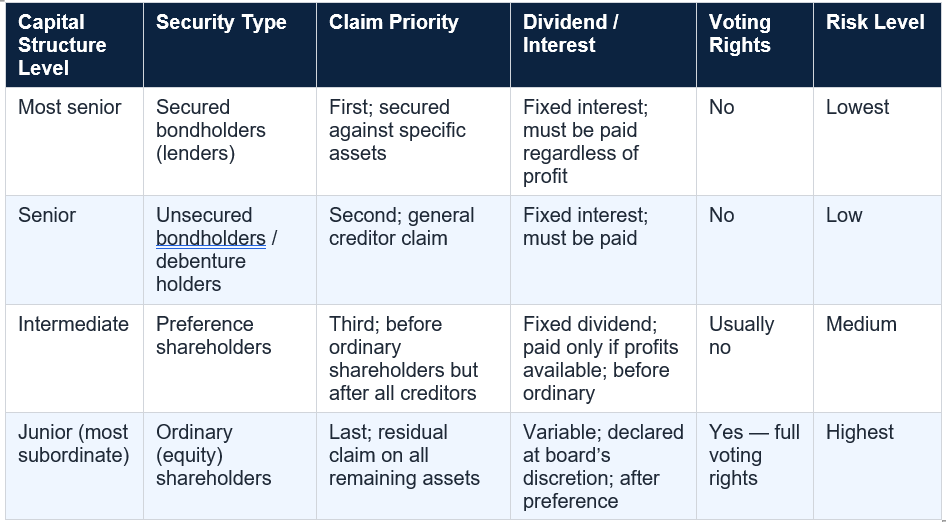
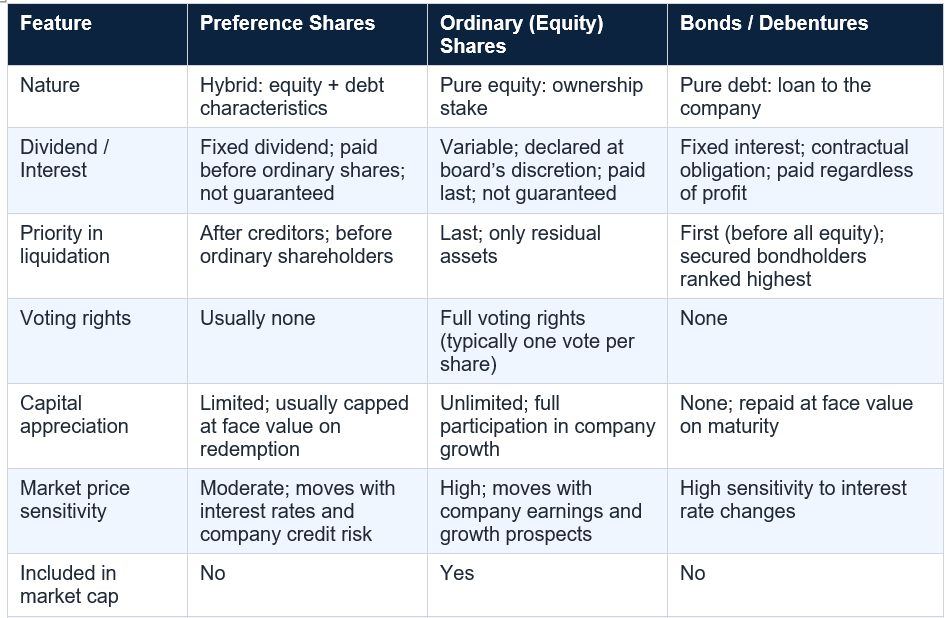
This hierarchy is the most important context for any preference share investor. Preference shareholders are safer than ordinary shareholders — they are paid first in dividends and in liquidation. But they are significantly more exposed than bondholders, who have a contractual right to interest and capital repayment, and whose claim is ahead of all equity holders. As Charles Schwab’s June 2026 guide notes: because preference shares rank below bonds in the capital structure, preferred shareholders typically have less protection than bondholders if the company runs into trouble.
Key Point: Preference shares are NOT bonds. The dividend is not a contractual obligation — it can be missed if the company has no profits. Bond interest is a contractual obligation — missing it triggers default. This single difference explains why preference shares carry more risk than bonds despite offering some of the same income characteristics.
Cumulative preference shares are the most protective type for investors. If the company skips a dividend payment due to insufficient profits, the missed amount is not lost — it carries forward. The company must clear all accumulated dividend arrears before ordinary shareholders receive any payment. This gives cumulative preference shareholders significant security of income over time, even during difficult periods.
Example — Cumulative Preference Shares: You own 10% cumulative preference shares with a face value of £100 per share. The company cannot pay dividends in Year 1 or Year 2 due to losses. In Year 3, the company is highly profitable. Before paying any ordinary dividend, it must first pay you £30 per share: Year 1 arrears (£10) + Year 2 arrears (£10) + Year 3 current dividend (£10). Only after clearing these arrears can the company pay ordinary shareholders anything.
.
Non-cumulative preference shares carry greater income risk for investors but are more advantageous for the issuing company, as missed dividends create no future obligation. If the company has a bad year and skips the dividend, that year’s dividend is forfeited. The shareholder cannot claim it later, even if the company reports high profits the following year.
Example — Non-Cumulative Preference Shares: You own 10% non-cumulative preference shares with a face value of £100 per share. The company pays no dividend in Year 1 or Year 2 due to losses. In Year 3, it returns to profitability. It pays you £10 per share (the Year 3 dividend only). The Year 1 and Year 2 dividends are permanently lost. Unlike cumulative shares, there are no arrears to clear before ordinary shareholders are paid.
The trade-off for this greater income risk: non-cumulative preference shares are typically issued at a lower price or higher stated dividend rate than cumulative equivalents, reflecting the reduced security for investors. For companies, they are preferable because they carry no accumulated dividend liability.
Convertible preference shares offer a bridge between the income stability of preference shares and the capital appreciation potential of ordinary shares. The investor receives the fixed preference dividend while holding the shares, and retains the option to convert to ordinary shares if the company’s performance makes ordinary shares more valuable.
Key elements of any convertible preference share:
Non-convertible preference shares are pure income instruments. They provide no access to ordinary share upside, but they also carry no conversion risk (the risk that a conversion ratio proves unfavourable). For income-oriented investors who have no interest in equity participation, non-convertible preference shares are simpler and more predictable.
The choice between convertible and non-convertible depends on the investor’s goals. Convertible shares suit investors who want income now but also want the option to participate in equity growth. Non-convertible shares suit investors who want predictable, bounded income with no equity exposure whatsoever.
Redeemable preference shares give both the company and the investor an exit from the preference share structure. The redemption date and price are set at the time of issuance. Investors know in advance when their principal will be returned. Companies appreciate the ability to retire capital that may become expensive relative to prevailing interest rates.
The callable feature within redeemable shares deserves particular investor attention. Bajaj Finserv’s guide notes that some preference shares may also have a callable option, allowing the company to repurchase them at an agreed price after a specified date. This is beneficial for the company but potentially disadvantageous for investors: if a company calls (redeems) shares when market interest rates have fallen and reinvestment rates are lower, the investor receives their principal back but can only reinvest it at a lower yield than the preference dividend they were receiving. This is call risk or reinvestment risk.
Irredeemable preference shares behave most like perpetual bonds. They pay a fixed income indefinitely without a maturity date. For the company, they provide permanent capital without a repayment obligation. For the investor, they provide potentially indefinite income but no return of principal unless the company is liquidated.
The key risk of irredeemable preference shares is interest rate sensitivity. Because there is no maturity date, the market value of irredeemable preference shares moves inversely with prevailing interest rates, much like a perpetual bond. When interest rates rise, the market price of these shares falls (because their fixed dividend becomes less attractive relative to new, higher-yielding instruments), and when rates fall, their market price rises.
Key Point: Irredeemable preference shares can be a highly suitable long-term income instrument in a falling interest rate environment, where their fixed rate looks increasingly attractive. In a rising rate environment, their market value may decline significantly. This is the price risk that redeemable preference shareholders avoid by having a defined maturity.
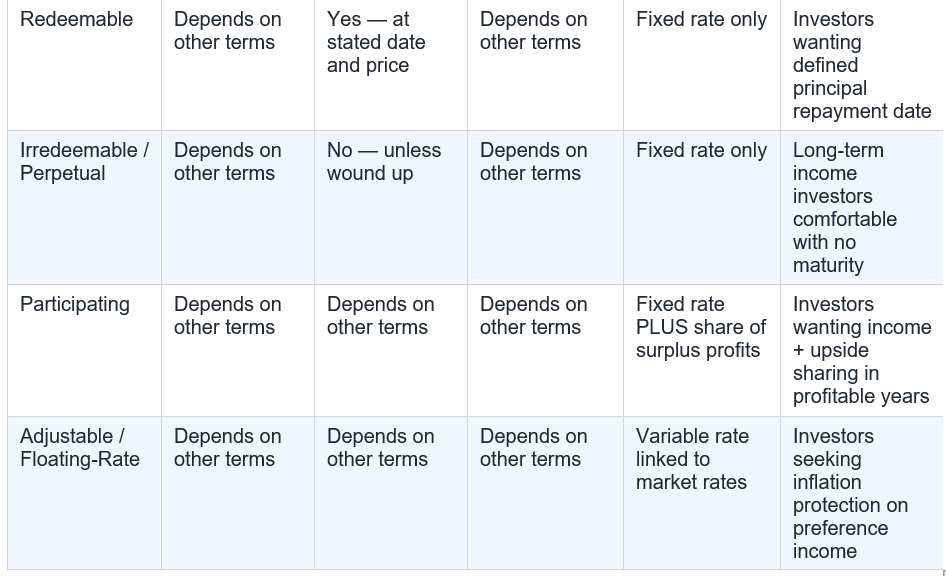
Participating preference shares are the most generously structured type for investors. Unlike standard preference shares (which cap returns at the fixed dividend), participating shares allow holders to receive extra dividends when the company performs exceptionally well. The trigger and mechanism vary by terms, but the general structure is: preference dividend paid first; ordinary shareholders receive a stated minimum; then any surplus profits are shared between preference and ordinary shareholders according to a specified ratio.
This participation feature makes these shares attractive in high-growth companies where ordinary shareholders might otherwise benefit enormously while preference shareholders are limited to their fixed rate. The trade-off is that participating preference shares typically carry a lower stated dividend rate, reflecting the additional value of the participation feature.
Adjustable-rate preference shares solve one of the main disadvantages of fixed-rate preference shares: inflation and interest rate erosion. As market interest rates rise, the dividend rate on these shares rises with them, protecting the investor’s real yield. As rates fall, the dividend falls too, which benefits the company. LiteFinance’s September 2025 guide notes that adjustable-rate preference shares protect investors against inflation but also lower payouts when rates fall.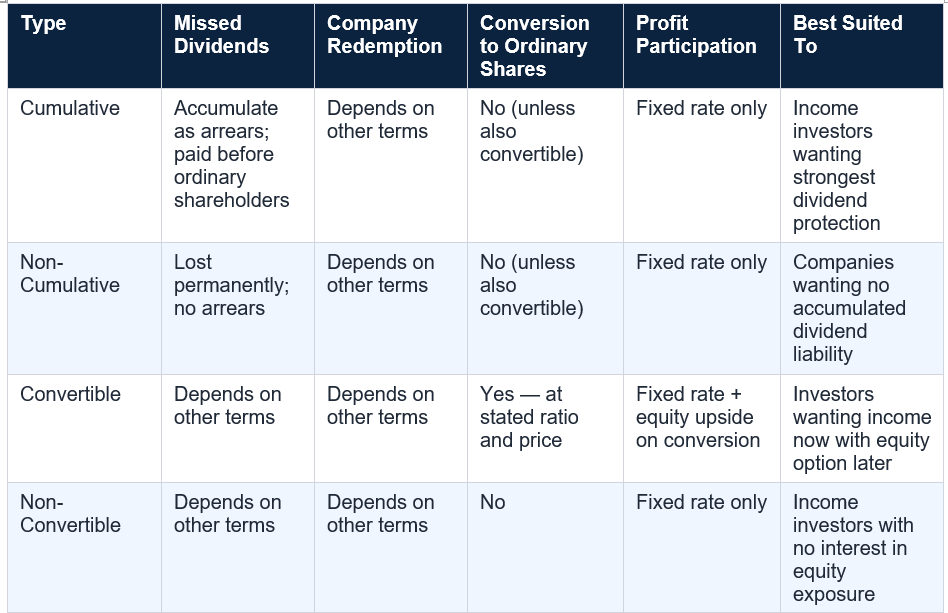

As ATFX’s February 2026 analysis describes: every preferred share an investor bought was guaranteed a 6.5% return on the initial investment every year in the form of dividends. Ford raised substantial funds through this preferred share issue, helping the company navigate the financial crisis. For investors willing to accept Ford’s credit risk at the time, the 6.5 percent fixed dividend provided a high yield that reflected the company’s difficulty in raising capital through other means.
This example illustrates several key points about preference shares in practice:
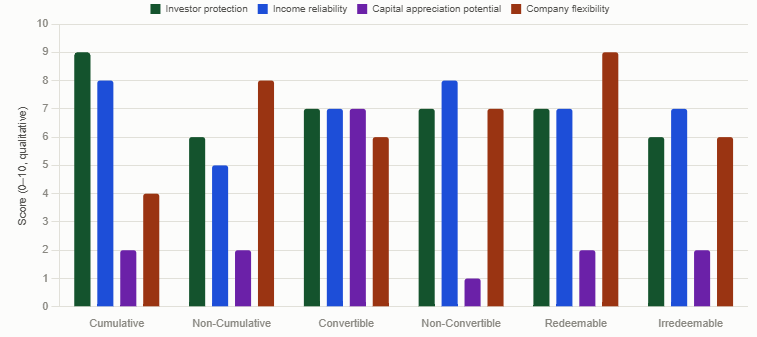
The six core types — cumulative, non-cumulative, convertible, non-convertible, redeemable, and irredeemable — each address a different combination of investor and company needs. Cumulative shares maximise income security. Non-cumulative shares minimise company obligations. Convertible shares offer an equity option alongside income. Redeemable shares provide a defined exit. Irredeemable shares provide perpetual income. Participating shares share in extraordinary profits.
For the investor, the key questions before purchasing any preference share are: Is this cumulative or non-cumulative? Is it redeemable or perpetual? Is it callable by the company? Is the dividend rate adequate compensation for the company’s credit risk? And — most importantly — does the company have the profitability and financial strength to actually pay the dividend consistently? Those answers, more than the type label, determine whether any specific preference share is an appropriate investment for any specific investor.
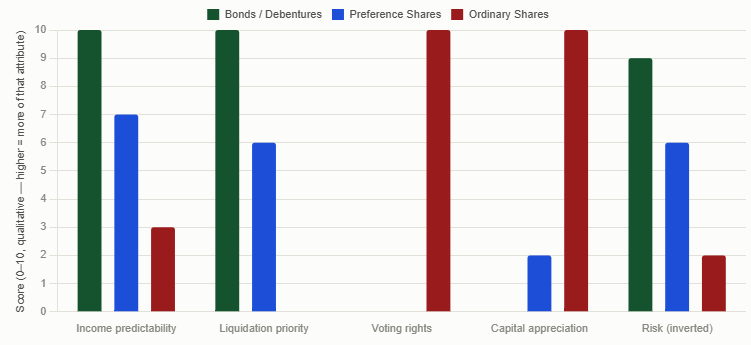
The main advantages of preference shares over ordinary shares are dividend priority (preference shareholders receive their dividend before any ordinary dividend can be paid), priority in liquidation (preference shareholders are paid before ordinary shareholders if the company is wound up), and more predictable income (the dividend is fixed rather than variable). The trade-off for these advantages is that preference shareholders typically have no voting rights and limited capital appreciation potential. Preference shares are particularly suited to income-oriented investors who prioritise income stability over growth and governance participation.
What is the difference between cumulative and non-cumulative preference shares?
Cumulative preference shares allow unpaid dividends to accumulate as arrears. If the company misses a dividend in Year 1 and Year 2, these amounts carry forward and must be paid before any ordinary dividend can be declared. Non-cumulative preference shares do not accumulate arrears: if the company cannot pay the dividend in any year, that year’s dividend is permanently lost and cannot be claimed in future years. Cumulative shares are more protective for investors; non-cumulative shares are more advantageous for companies because missed dividends create no future obligation.
Can a company be forced to pay preference share dividends?
No. Unlike bond interest, preference share dividends are paid only from distributable profits and are not a contractual obligation. If the company makes no profit, or has no distributable reserves, it is not legally obligated to pay the preference dividend. However, for cumulative preference shares, any missed dividend accumulates as an arrear that must be cleared before ordinary shareholders can receive any dividend in future years. The distinction from bonds is critical: missing bond interest payment triggers a default event; missing preference dividend does not.
What is a convertible preference share?
A convertible preference share gives the holder the right to exchange their preference shares for a specified number of ordinary shares at a predetermined conversion price and on or after specified dates. The investor receives the fixed preference dividend while holding the shares and can convert to ordinary shares if the ordinary share price rises above the implied conversion price — allowing participation in equity upside. The conversion option is only valuable if the ordinary share price exceeds the conversion price. Bajaj Finserv’s guide notes that the conversion price is typically set at a premium to the market price at the time of issuance.
Where do preference shares sit in the capital structure?
Preference shares sit between bonds (senior) and ordinary shares (junior) in the capital structure. In the event of company liquidation, the payment sequence is: (1) secured bondholders, (2) unsecured bondholders and general creditors, (3) preference shareholders, (4) ordinary shareholders. This means preference shareholders have more protection than ordinary shareholders but less than bondholders. IG UK’s January 2026 guide describes preference shares as providing more stability than equities but less security than debt.
Are preference share dividends tax-deductible?
No. Unlike bond interest, which is a business expense deductible against taxable profits, preference share dividends are paid from after-tax profits. This is a cost disadvantage for companies compared to debt financing, because the tax deductibility of bond interest reduces its effective cost. For companies in high tax brackets, this makes debt financing cheaper on an after-tax basis than preference share financing. GeeksforGeeks’ guide identifies no tax benefit on dividends as one of the disadvantages of preference shares from the company’s perspective.
Table of Contents
- The Hybrid Security Between Bonds and Shares
- The Core Definition: What a Preference Share Is
- Where Preference Shares Sit in the Capital Structure
- The Key Features of Preference Shares
- Type 1: Cumulative Preference Shares
- Type 2: Non-Cumulative Preference Shares
- Type 3: Convertible Preference Shares
- Type 4: Non-Convertible Preference Shares
- Type 5: Redeemable Preference Shares
- Type 6: Irredeemable (Perpetual) Preference Shares
- Bonus Types: Participating and Adjustable-Rate Preference Shares
- The Full Types Comparison Table
- Preference Shares vs Ordinary Shares vs Bonds
- Advantages of Preference Shares
- Disadvantages of Preference Shares
- Who Should Invest in Preference Shares?
- A Real-World Example: Ford Motor Company
- Conclusion: The Investor’s Hybrid
- Frequently Asked Questions
Types Comparison
Capital Structure Comparison
The Hybrid Security Between Bonds and Shares
Not every investor is comfortable with the uncertainty of ordinary shares. Not every investor is satisfied with the limited upside of bonds. Preference shares — known as preferred stock in the United States — exist precisely in that space: a security that combines elements of both, sitting between them in the corporate capital structure and offering a distinctive profile of income stability, priority protection, and limited growth potential.IG UK’s January 2026 guide describes them precisely: preference shares sit between bonds and ordinary shares in the capital structure, providing more stability than equities but less security than debt. Charles Schwab’s June 2026 guide states the same principle from the investor’s perspective: preferred stock combines features of stocks and bonds, offering income potential with risks that differ from both. Understanding what preference shares are, how their different types work, and where they fit in an investment portfolio is the purpose of this guide.
Definition — Preference Share: A class of share capital that gives the holder preferential rights over ordinary (equity) shareholders in two key areas: priority in receiving dividends at a fixed or stated rate, and priority in claiming company assets in the event of liquidation. Preference shareholders typically do not hold voting rights in the company.
The Core Definition: What a Preference Share Is
Preference shares are a type of equity security issued by a company to investors, providing them with a preferential claim to the company’s earnings and assets. SmallCase’s investor guide describes them as a type of share capital that gives shareholders preferential treatment over common shareholders in dividend payments and asset claims — and notes the key structural characteristic: they are hybrid securities that possess characteristics of both common stocks and bonds.The three defining features that set preference shares apart from ordinary shares:
- Fixed or stated dividend: preference shareholders receive a dividend at a predetermined rate (for example, 8 percent of face value) before any dividend is paid to ordinary shareholders. This makes income more predictable than ordinary shares, though it is still not guaranteed in the way bond interest is.
- Priority in liquidation: if the company is wound up, preference shareholders receive payment from the company’s assets before ordinary shareholders. They do not, however, rank ahead of creditors or bondholders. The capital structure sequence is: secured bondholders → unsecured bondholders → preference shareholders → ordinary shareholders.
- Limited or no voting rights: in most cases, preference shareholders cannot vote at general meetings of the company. This is the principal trade-off for the security advantages they enjoy. Bajaj Finserv’s preference shares guide notes that the main drawback is that holders of preference shares do not usually get voting rights in the company, unlike equity shareholders.
Where Preference Shares Sit in the Capital Structure
Understanding the capital structure position of preference shares is essential for evaluating their risk and return profile. The capital structure of a company orders its claimants from the most senior (safest, first to be paid) to the most junior (riskiest, last to be paid):This hierarchy is the most important context for any preference share investor. Preference shareholders are safer than ordinary shareholders — they are paid first in dividends and in liquidation. But they are significantly more exposed than bondholders, who have a contractual right to interest and capital repayment, and whose claim is ahead of all equity holders. As Charles Schwab’s June 2026 guide notes: because preference shares rank below bonds in the capital structure, preferred shareholders typically have less protection than bondholders if the company runs into trouble.
Key Point: Preference shares are NOT bonds. The dividend is not a contractual obligation — it can be missed if the company has no profits. Bond interest is a contractual obligation — missing it triggers default. This single difference explains why preference shares carry more risk than bonds despite offering some of the same income characteristics.
The Key Features of Preference Shares
Before exploring the types, understanding the core features that apply to most preference shares:- Fixed dividend rate: typically expressed as a percentage of the share’s face (nominal) value. A 10% preference share with a face value of £100 pays £10 per share per year. The board declares this dividend before any ordinary dividend is declared.
- Dividend priority: preference dividends are declared and paid first. Only after all preference dividends have been paid can the company declare an ordinary dividend. HDFC Sky’s April 2026 guide notes that preference shareholders always receive dividends before common shareholders, even if the company’s profits fluctuate.
- Non-participation in ordinary profits (in most types): unless the shares are participating (see Section 11), preference shareholders do not benefit if the company’s profits are exceptionally high. Their return is capped at the stated dividend rate. This limits upside compared to ordinary shares.
- No guaranteed dividend: unlike bond interest, preference dividends are paid only if the company has sufficient distributable profits. The company is not legally required to pay them in a loss-making year. Bajaj Finserv’s guide is explicit: the company may decide to suspend or reduce the dividend if it is experiencing financial difficulties.
- Priority in liquidation: preference shareholders rank above ordinary shareholders in claiming assets if the company is wound up. They do not, however, rank above creditors.
- No market capitalisation inclusion: preference shares are not typically included in the calculation of a company’s market capitalisation (market cap = ordinary shares outstanding × market price per share). LiteFinance’s September 2025 guide confirms this distinction.
- Typically no voting rights: the standard position. In some jurisdictions and under specific terms, preference shareholders may gain limited voting rights (for example, the right to vote on matters that directly affect preference share terms), but they do not typically vote on general company matters.
Type 1: Cumulative Preference Shares
Definition — Cumulative Preference Shares: Preference shares on which any dividend not paid in a given year accumulates as arrears and must be paid in full to preference shareholders before any dividend can be distributed to ordinary shareholders in any future year.Cumulative preference shares are the most protective type for investors. If the company skips a dividend payment due to insufficient profits, the missed amount is not lost — it carries forward. The company must clear all accumulated dividend arrears before ordinary shareholders receive any payment. This gives cumulative preference shareholders significant security of income over time, even during difficult periods.
Example — Cumulative Preference Shares: You own 10% cumulative preference shares with a face value of £100 per share. The company cannot pay dividends in Year 1 or Year 2 due to losses. In Year 3, the company is highly profitable. Before paying any ordinary dividend, it must first pay you £30 per share: Year 1 arrears (£10) + Year 2 arrears (£10) + Year 3 current dividend (£10). Only after clearing these arrears can the company pay ordinary shareholders anything.
.
Type 2: Non-Cumulative Preference Shares
Definition — Non-Cumulative Preference Shares: Preference shares on which any dividend not paid in a given year is permanently lost. Unpaid dividends do not accumulate and cannot be claimed in future years.Non-cumulative preference shares carry greater income risk for investors but are more advantageous for the issuing company, as missed dividends create no future obligation. If the company has a bad year and skips the dividend, that year’s dividend is forfeited. The shareholder cannot claim it later, even if the company reports high profits the following year.
Example — Non-Cumulative Preference Shares: You own 10% non-cumulative preference shares with a face value of £100 per share. The company pays no dividend in Year 1 or Year 2 due to losses. In Year 3, it returns to profitability. It pays you £10 per share (the Year 3 dividend only). The Year 1 and Year 2 dividends are permanently lost. Unlike cumulative shares, there are no arrears to clear before ordinary shareholders are paid.
The trade-off for this greater income risk: non-cumulative preference shares are typically issued at a lower price or higher stated dividend rate than cumulative equivalents, reflecting the reduced security for investors. For companies, they are preferable because they carry no accumulated dividend liability.
Type 3: Convertible Preference Shares
Definition — Convertible Preference Shares: Preference shares that give the holder the right to exchange (convert) them into a predetermined number of ordinary shares at a specified conversion price and on specified dates or after a specified period.Convertible preference shares offer a bridge between the income stability of preference shares and the capital appreciation potential of ordinary shares. The investor receives the fixed preference dividend while holding the shares, and retains the option to convert to ordinary shares if the company’s performance makes ordinary shares more valuable.
Key elements of any convertible preference share:
- Conversion ratio: the number of ordinary shares received for each preference share surrendered upon conversion.
- Conversion price: the effective price per ordinary share implied by the conversion ratio. Usually set at a premium to the market price at the time of issuance.
- Conversion period / trigger: the dates or conditions on which conversion can occur (for example, any time after a specified date, or on specific anniversary dates).
Type 4: Non-Convertible Preference Shares
Definition — Non-Convertible Preference Shares: Preference shares that cannot be converted into ordinary shares. They provide fixed dividend income for their term and are redeemed at their face value on maturity (if redeemable) or held indefinitely (if irredeemable).Non-convertible preference shares are pure income instruments. They provide no access to ordinary share upside, but they also carry no conversion risk (the risk that a conversion ratio proves unfavourable). For income-oriented investors who have no interest in equity participation, non-convertible preference shares are simpler and more predictable.
The choice between convertible and non-convertible depends on the investor’s goals. Convertible shares suit investors who want income now but also want the option to participate in equity growth. Non-convertible shares suit investors who want predictable, bounded income with no equity exposure whatsoever.
Type 5: Redeemable Preference Shares
Definition — Redeemable Preference Shares: Preference shares that have a specified redemption date (or redemption conditions) on which the company will buy them back at the stated redemption price, returning the investor’s principal. They may also include a callable feature allowing early redemption at the company’s discretion.Redeemable preference shares give both the company and the investor an exit from the preference share structure. The redemption date and price are set at the time of issuance. Investors know in advance when their principal will be returned. Companies appreciate the ability to retire capital that may become expensive relative to prevailing interest rates.
The callable feature within redeemable shares deserves particular investor attention. Bajaj Finserv’s guide notes that some preference shares may also have a callable option, allowing the company to repurchase them at an agreed price after a specified date. This is beneficial for the company but potentially disadvantageous for investors: if a company calls (redeems) shares when market interest rates have fallen and reinvestment rates are lower, the investor receives their principal back but can only reinvest it at a lower yield than the preference dividend they were receiving. This is call risk or reinvestment risk.
Type 6: Irredeemable (Perpetual) Preference Shares
Definition — Irredeemable Preference Shares: Preference shares that are not redeemed (bought back) by the company during its normal lifetime. They pay a fixed dividend indefinitely and are only returned to shareholders in the event of the company being wound up. Also called perpetual preference shares.Irredeemable preference shares behave most like perpetual bonds. They pay a fixed income indefinitely without a maturity date. For the company, they provide permanent capital without a repayment obligation. For the investor, they provide potentially indefinite income but no return of principal unless the company is liquidated.
The key risk of irredeemable preference shares is interest rate sensitivity. Because there is no maturity date, the market value of irredeemable preference shares moves inversely with prevailing interest rates, much like a perpetual bond. When interest rates rise, the market price of these shares falls (because their fixed dividend becomes less attractive relative to new, higher-yielding instruments), and when rates fall, their market price rises.
Key Point: Irredeemable preference shares can be a highly suitable long-term income instrument in a falling interest rate environment, where their fixed rate looks increasingly attractive. In a rising rate environment, their market value may decline significantly. This is the price risk that redeemable preference shareholders avoid by having a defined maturity.
Bonus Types: Participating and Adjustable-Rate Preference Shares
Participating Preference Shares
Definition — Participating Preference Shares: Preference shares that entitle the holder to both the fixed preference dividend and an additional share of the company’s remaining profits after ordinary shareholders have received a specified minimum return.Participating preference shares are the most generously structured type for investors. Unlike standard preference shares (which cap returns at the fixed dividend), participating shares allow holders to receive extra dividends when the company performs exceptionally well. The trigger and mechanism vary by terms, but the general structure is: preference dividend paid first; ordinary shareholders receive a stated minimum; then any surplus profits are shared between preference and ordinary shareholders according to a specified ratio.
This participation feature makes these shares attractive in high-growth companies where ordinary shareholders might otherwise benefit enormously while preference shareholders are limited to their fixed rate. The trade-off is that participating preference shares typically carry a lower stated dividend rate, reflecting the additional value of the participation feature.
Adjustable-Rate (Floating-Rate) Preference Shares
Definition — Adjustable-Rate Preference Shares: Preference shares whose dividend rate is not fixed but adjusts periodically according to a reference interest rate (such as the base rate or LIBOR/SONIA equivalent). Also called floating-rate or variable-rate preference shares.Adjustable-rate preference shares solve one of the main disadvantages of fixed-rate preference shares: inflation and interest rate erosion. As market interest rates rise, the dividend rate on these shares rises with them, protecting the investor’s real yield. As rates fall, the dividend falls too, which benefits the company. LiteFinance’s September 2025 guide notes that adjustable-rate preference shares protect investors against inflation but also lower payouts when rates fall.
The Full Types Comparison Table
Preference Shares vs Ordinary Shares vs Bonds
Advantages of Preference Shares
For investors
- Fixed income predictability: the fixed dividend rate provides a more predictable income stream than ordinary share dividends, which vary with company performance. This is particularly valuable for income-dependent investors such as retirees.
- Dividend priority: preference shareholders receive their dividend before ordinary shareholders. HDFC Sky’s April 2026 guide states this provides regular income with less risk than ordinary shares.
- Priority in liquidation: if the company is wound up, preference shareholders receive payment before ordinary shareholders, reducing downside risk compared to holding ordinary shares.
- Portfolio diversification: adding preference shares to a portfolio of equity and bonds introduces an income stream with a different risk and return profile from either asset class.
- Convertible option (for convertible type): allows participation in equity upside if the company grows significantly, while receiving income in the meantime.
- Cumulative protection (for cumulative type): missed dividends accumulate and must be paid, protecting income even through temporary loss years.
For companies
- Capital without debt: preference shares raise permanent capital without creating a debt obligation that must be repaid on a specific schedule or that triggers default if a payment is missed.
- Preserving ordinary shareholder control: since preference shareholders typically have no voting rights, issuing preference shares does not dilute voting control for existing ordinary shareholders.
- Flexibility: companies can structure preference shares with various features (redeemable, convertible, participating) to meet specific financing objectives.
- Raising large amounts from cautious investors: GeeksforGeeks’ July 2025 guide notes that preference shares attract cautious investors and financial institutions, enabling companies to raise large amounts of funds from sources that would not hold ordinary shares.
Disadvantages of Preference Shares
For investors
- No voting rights: preference shareholders cannot vote on company decisions. This limits their ability to influence management or protect their investment through governance. 5paisa’s May 2026 guide identifies this as a significant disadvantage.
- Limited capital appreciation: preference shareholders generally do not benefit from the company’s growth in profits. Returns are mostly limited to the fixed dividend, making them unattractive for growth-oriented investors. 5paisa states: most returns are limited to fixed dividend payments, making them less attractive for growth-oriented investors.
- Dividend not guaranteed: unlike bond interest, preference dividends can be missed if the company has no profits. The dividend is only paid from distributable profits, not as a contractual obligation.
- Inflation erosion (fixed-rate types): the real value of a fixed dividend declines as inflation rises. HDFC Sky’s April 2026 guide notes this can lower the dividend income’s actual value and reduce shareholders’ purchasing power — unless the shares are adjustable-rate.
- Call risk (redeemable / callable types): the company may call shares back when it suits them, typically when lower interest rates mean they can refinance more cheaply. Investors receive their principal but must reinvest at lower yields.
- Lower liquidity: preference shares are typically less liquid than ordinary shares in the secondary market, making it harder to sell them quickly at a fair price.
For companies
- Dividend not tax-deductible: unlike bond interest, preference dividends are paid from after-tax profits. GeeksforGeeks’ guide identifies this as a cost disadvantage: no tax benefits, because the dividend is not deductible as an expense from profits.
- Obligation ahead of ordinary shareholders: the requirement to pay preference dividends before ordinary shareholders can receive anything restricts the company’s flexibility in distributing earnings and can strain cash flow during difficult periods.
Who Should Invest in Preference Shares?
IG UK’s January 2026 guide states directly that preference shares trade off income stability for limited voting rights and lower growth potential, making them more suitable for investors seeking predictable returns rather than capital appreciation. The investor profiles most suited to preference shares:- Income-focused investors: those who need regular, relatively predictable dividend payments — retirees, income funds, and investors in the distribution phase of their financial life.
- Moderate risk-tolerance investors: those who want more security than ordinary shares but are willing to accept more risk than bonds in exchange for potentially higher income.
- Portfolio diversifiers: investors who already hold a mix of equities and bonds and want an intermediate security with a different risk and return profile.
- Those who do not need voting rights: investors who are passive income-seekers with no interest in influencing company direction can accept the absence of voting rights without consequence.
- Growth investors who want to participate in company earnings growth and capital appreciation.
- Investors who need guaranteed income — because preference dividends, unlike bond interest, can be missed.
- Investors who want to influence company governance through voting.
A Real-World Example: Ford Motor Company
One of the most frequently cited real-world preference share examples is Ford Motor Company’s issuance during the 2008–2009 financial crisis. Facing severe capital pressure and the risk of bankruptcy, Ford issued a series of preferred shares with a 6.5 percent annual dividend.As ATFX’s February 2026 analysis describes: every preferred share an investor bought was guaranteed a 6.5% return on the initial investment every year in the form of dividends. Ford raised substantial funds through this preferred share issue, helping the company navigate the financial crisis. For investors willing to accept Ford’s credit risk at the time, the 6.5 percent fixed dividend provided a high yield that reflected the company’s difficulty in raising capital through other means.
This example illustrates several key points about preference shares in practice:
- Companies in financial stress use preference shares to raise capital when ordinary share issuance would be too dilutive and bond issuance would be too expensive or unavailable.
- The fixed dividend reflects the company’s credit risk: Ford’s 6.5% rate was high because investors required compensation for the substantial risk of not receiving their dividend (or losing principal) if Ford failed.
- Preference shares sit in the capital structure at a point where the risk-return profile appealed to investors who wanted higher yield than Ford bonds but more protection than Ford ordinary shares.
Conclusion
Preference shares occupy a specific and purposeful position in corporate finance and investor portfolios. They are not bonds — the dividend is not a contractual obligation and can be missed without triggering default. They are not ordinary shares — the return is typically capped at the stated dividend rate and the shareholder has no vote. They are a hybrid: offering fixed income priority, liquidation protection, and some structural safety in exchange for limited upside and no governance rights.The six core types — cumulative, non-cumulative, convertible, non-convertible, redeemable, and irredeemable — each address a different combination of investor and company needs. Cumulative shares maximise income security. Non-cumulative shares minimise company obligations. Convertible shares offer an equity option alongside income. Redeemable shares provide a defined exit. Irredeemable shares provide perpetual income. Participating shares share in extraordinary profits.
For the investor, the key questions before purchasing any preference share are: Is this cumulative or non-cumulative? Is it redeemable or perpetual? Is it callable by the company? Is the dividend rate adequate compensation for the company’s credit risk? And — most importantly — does the company have the profitability and financial strength to actually pay the dividend consistently? Those answers, more than the type label, determine whether any specific preference share is an appropriate investment for any specific investor.
Frequently Asked Questions
What is the main advantage of preference shares over ordinary shares?The main advantages of preference shares over ordinary shares are dividend priority (preference shareholders receive their dividend before any ordinary dividend can be paid), priority in liquidation (preference shareholders are paid before ordinary shareholders if the company is wound up), and more predictable income (the dividend is fixed rather than variable). The trade-off for these advantages is that preference shareholders typically have no voting rights and limited capital appreciation potential. Preference shares are particularly suited to income-oriented investors who prioritise income stability over growth and governance participation.
What is the difference between cumulative and non-cumulative preference shares?
Cumulative preference shares allow unpaid dividends to accumulate as arrears. If the company misses a dividend in Year 1 and Year 2, these amounts carry forward and must be paid before any ordinary dividend can be declared. Non-cumulative preference shares do not accumulate arrears: if the company cannot pay the dividend in any year, that year’s dividend is permanently lost and cannot be claimed in future years. Cumulative shares are more protective for investors; non-cumulative shares are more advantageous for companies because missed dividends create no future obligation.
Can a company be forced to pay preference share dividends?
No. Unlike bond interest, preference share dividends are paid only from distributable profits and are not a contractual obligation. If the company makes no profit, or has no distributable reserves, it is not legally obligated to pay the preference dividend. However, for cumulative preference shares, any missed dividend accumulates as an arrear that must be cleared before ordinary shareholders can receive any dividend in future years. The distinction from bonds is critical: missing bond interest payment triggers a default event; missing preference dividend does not.
What is a convertible preference share?
A convertible preference share gives the holder the right to exchange their preference shares for a specified number of ordinary shares at a predetermined conversion price and on or after specified dates. The investor receives the fixed preference dividend while holding the shares and can convert to ordinary shares if the ordinary share price rises above the implied conversion price — allowing participation in equity upside. The conversion option is only valuable if the ordinary share price exceeds the conversion price. Bajaj Finserv’s guide notes that the conversion price is typically set at a premium to the market price at the time of issuance.
Where do preference shares sit in the capital structure?
Preference shares sit between bonds (senior) and ordinary shares (junior) in the capital structure. In the event of company liquidation, the payment sequence is: (1) secured bondholders, (2) unsecured bondholders and general creditors, (3) preference shareholders, (4) ordinary shareholders. This means preference shareholders have more protection than ordinary shareholders but less than bondholders. IG UK’s January 2026 guide describes preference shares as providing more stability than equities but less security than debt.
Are preference share dividends tax-deductible?
No. Unlike bond interest, which is a business expense deductible against taxable profits, preference share dividends are paid from after-tax profits. This is a cost disadvantage for companies compared to debt financing, because the tax deductibility of bond interest reduces its effective cost. For companies in high tax brackets, this makes debt financing cheaper on an after-tax basis than preference share financing. GeeksforGeeks’ guide identifies no tax benefit on dividends as one of the disadvantages of preference shares from the company’s perspective.
0 Comments
Be the first to share your thoughts on this article.