

Investing
How to Start Investing in Dividend ETFs and REITs

REIT dividend yields averaged 3.8–5.5% in 2025 versus 1.6% for the S&P 500. SCHD, the most popular dividend ETF, has $95 billion in assets. A single ETF purchase gives you instant diversification across 100–600 dividend-paying companies. Here’s the complete 2026 beginner’s guide.

Dividend ETFs and REITs address the same fundamental investor need from two different directions: generating income from invested capital without requiring active management, time, or specialised expertise. A dividend ETF achieves this by holding a basket of 100 to 600 dividend-paying stocks, passing the combined dividends to shareholders quarterly or monthly. A REIT achieves this by collecting rent from institutional-grade real estate — apartment complexes, data centres, warehouses, hospitals, retail centres — and distributing at least 90 percent of that rental income as dividends, which is a legal requirement, not a choice.
For a beginning investor, the appeal is structural: a single ETF purchase gives you instant diversification across dozens to hundreds of income-generating assets, professional index-based screening, and low costs — all in a single trade through any major brokerage. This guide builds the knowledge needed to make that first purchase intelligently.
The Numbers: REIT dividend yields: 3.8–5.5% in 2025 vs ~1.6% S&P 500 (Nareit data). SCHD: $95.2B in AUM, yield ~3.1–3.8%, expense ratio 0.06%. VNQ: $37B in AUM, REIT ETF yield ~3.5% mid-2026. DGRO: 10-year average annual return 13.86% (highest of major dividend ETFs per InvestLane April 2026).
The core mechanics:
REITs exist in two primary forms:
One structural advantage: many REITs pay dividends monthly rather than the quarterly standard for most stocks and ETFs. Realty Income (O) and STAG Industrial, for example, pay monthly. Since REITs collect rent monthly from tenants, the monthly distribution schedule matches their natural cash flow cycle, providing investors with a more consistent income stream.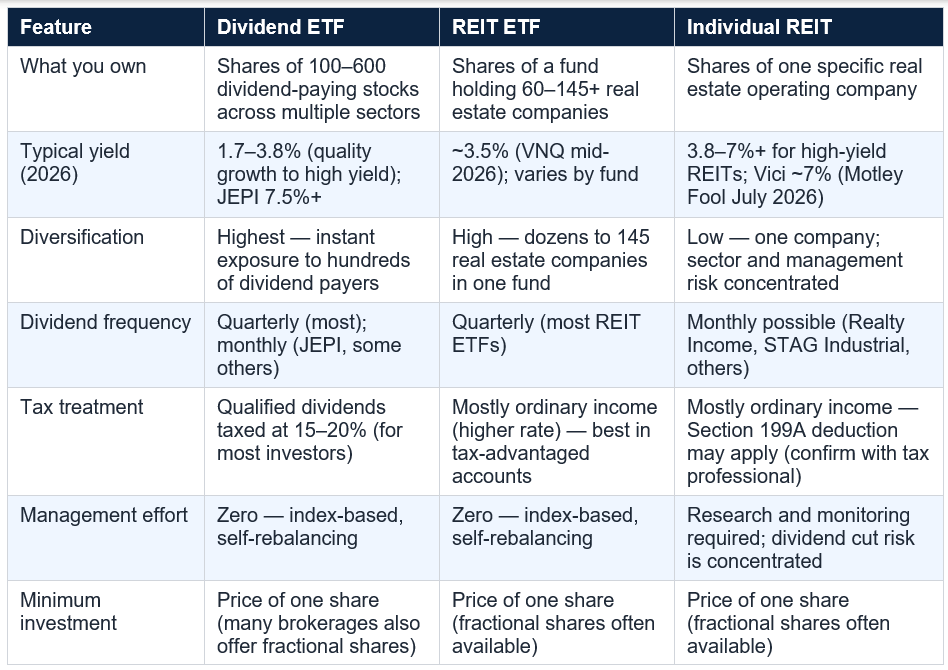

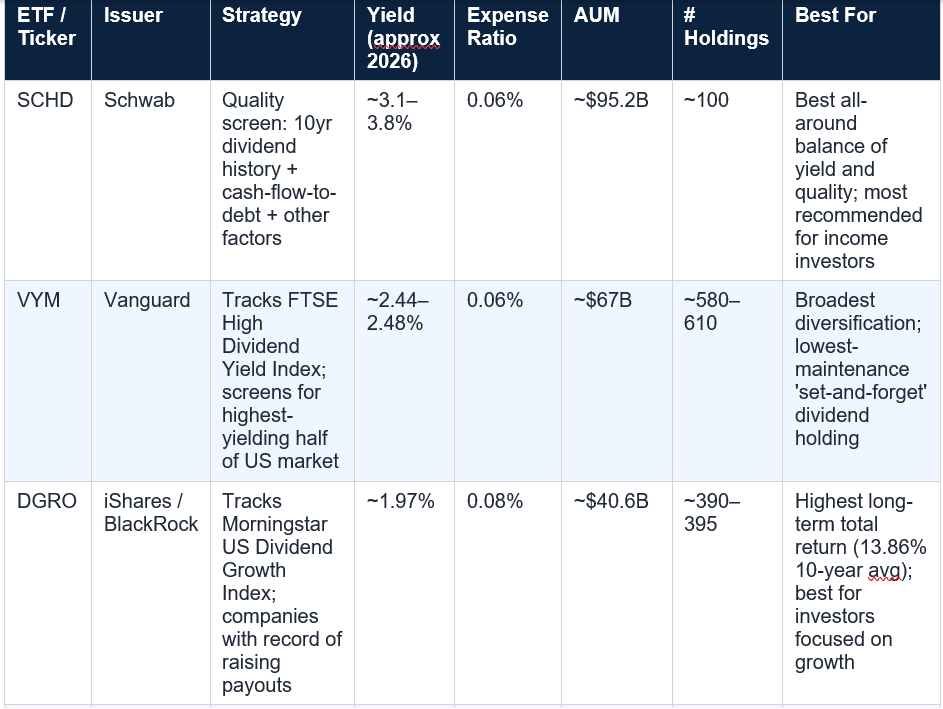
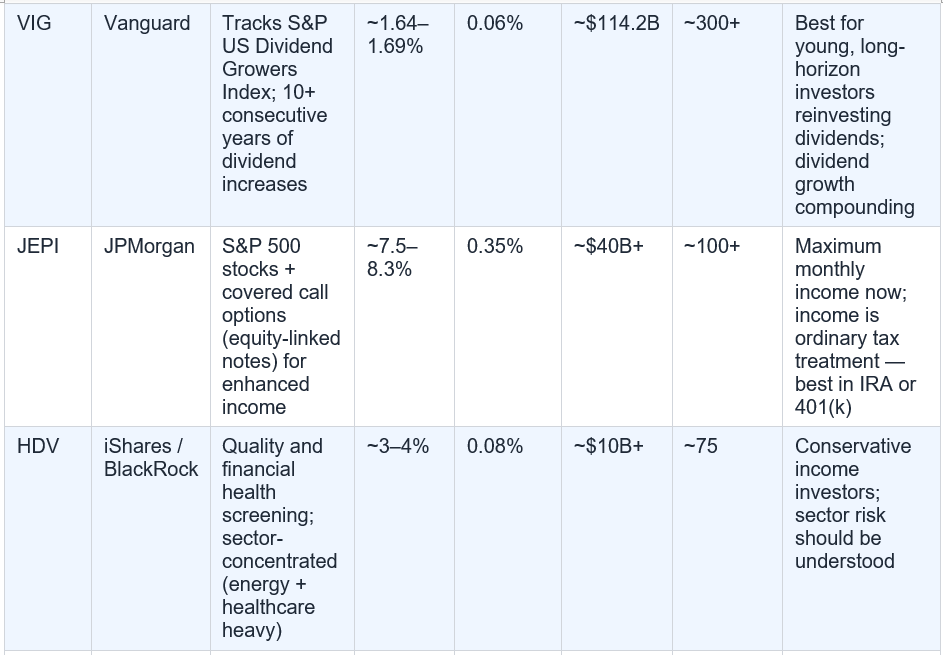

The most practical insight from this comparison, summarised by InvestSnips (June 2026): ‘Think of it this way: VIG for growth, VYM for safety, SCHD for the best balance of both.’ Many experienced dividend investors hold two of these alongside a core index fund — for example, SCHD for current income plus DGRO for dividend growth, giving both current cash flow and a rising payout trajectory.
Watch Out: Yield is the most visible number in a dividend ETF comparison and the most misleading. JEPI’s 7.5 to 8.3 percent yield is generated primarily from covered call options, which cap upside participation in bull markets and are subject to different tax treatment. An ETF with a 9 percent yield that loses 15 percent of its principal value annually is a losing trade. Always evaluate total return (income plus capital appreciation) rather than yield alone.

Roth IRA: contributions are made with after-tax dollars; all growth and withdrawals are tax-free in retirement. The ideal account for REIT income, which would otherwise be taxed as ordinary income annually.
Traditional IRA or 401(k): pre-tax contributions; tax-deferred growth; withdrawals taxed as ordinary income. REITs and high-yield dividend ETFs (especially JEPI) are well-suited here.
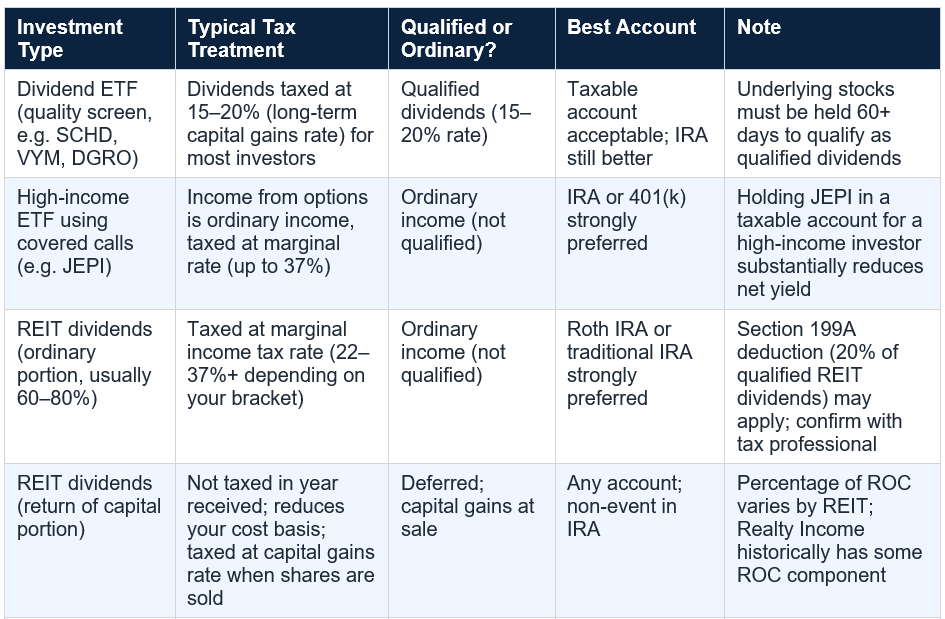

The REWD April 2026 tax guide for REIT investors provides a concrete illustration of the Section 199A benefit: if you receive $10,000 in REIT ordinary dividends, you can deduct $2,000 (20 percent), leaving only $8,000 subject to tax. At a 32 percent marginal rate, your tax bill drops from $3,200 to $2,560. However, the guide notes that this deduction was scheduled to expire after 2025 and its continuation into 2026 should be confirmed with a tax professional, as Congress’ action is uncertain.
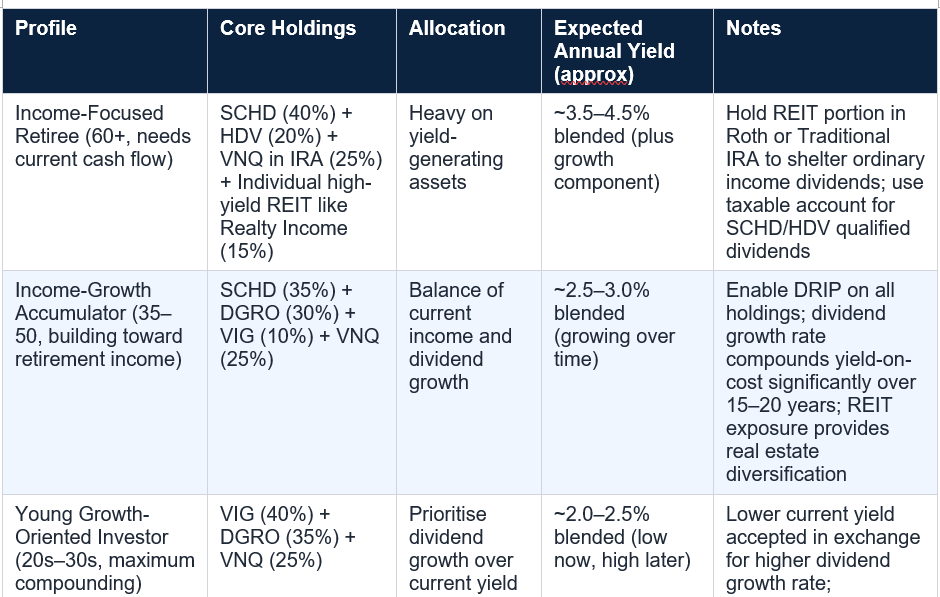
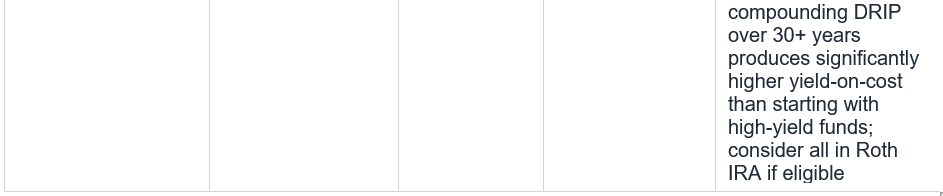
These are illustrative model allocations for educational purposes. Individual allocations should reflect specific financial goals, tax situations, income needs, and risk tolerance. A qualified financial adviser can build a personalised allocation from the components described above.
The compounding illustration: a $10,000 investment in SCHD at a 3.1 percent yield and a 7 percent assumed annual total return (dividends + capital appreciation) with DRIP enabled grows to approximately $55,000 to $60,000 over 25 years. The same $10,000 without DRIP, assuming dividends are spent rather than reinvested, produces meaningfully less wealth at the end of the same period because the dividend income does not participate in compound growth.
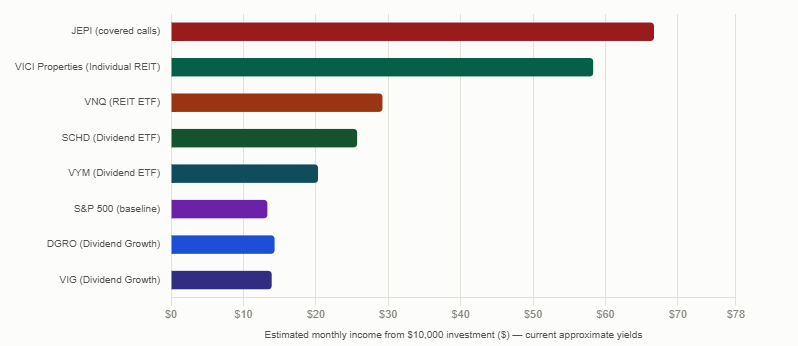
DividendVision’s July 2026 income projections provide a concrete baseline: $10,000 in SCHD at current yield generates approximately $25.67 per month ($308 per year). $10,000 in VYM generates approximately $20.33 per month ($244 per year). $10,000 in DGRO generates approximately $14.33 per month ($172 per year). These monthly amounts are modest on small positions — the compounding power of DRIP becomes transformative at larger invested amounts over longer periods.
The practical step: virtually every major brokerage (Fidelity, Schwab, Vanguard, TD Ameritrade, and others) allows DRIP to be enabled at the account or individual holding level. It is a one-time setting that requires no ongoing attention and no additional cost. Assetbar’s April 2026 guide explicitly states: ‘By 2026, the power of compounding is your greatest ally.’
The entry barriers are low in 2026. Most brokerages offer zero-commission trading and fractional shares, meaning an investor can start with any dollar amount. The Roth IRA contribution limit for 2026 provides a tax-advantaged framework ideally suited for REIT income. DRIP converts every dividend payment into automatic compounding without any additional input.
The starting point is not complicated: open a Roth IRA at a major brokerage, purchase shares of VNQ and SCHD or VYM, enable DRIP on both, and set up an automatic monthly contribution. The income begins with the first dividend payment and compounds with every reinvestment. That is the structure of a dividend portfolio. The time required to build it is measured in minutes, not years. The time required to benefit from it is measured in years, not minutes.
You can start with as little as the price of one share, and many major brokerages (Fidelity, Schwab, Vanguard) now offer fractional shares, allowing you to invest any dollar amount — even $25 or $50. SCHD, VYM, DGRO, and VNQ all trade at prices accessible to beginning investors. For a Roth IRA, the 2026 contribution limit is $7,000 per year ($8,000 if you are 50 or older). You do not need to invest the full limit to start; monthly automatic investments of whatever amount fits your budget allow you to begin immediately and build over time. The key is starting and enabling DRIP to compound dividends automatically from the first payment.
What is the difference between SCHD, VYM, and DGRO?
SCHD (Schwab, 0.06%, ~$95B AUM) screens 100 stocks for quality using cash-flow-to-debt ratios and dividend consistency; currently the highest yield of the three at ~3.1–3.8%; widely considered the best balance of yield and quality. VYM (Vanguard, 0.06%, ~$67B AUM) tracks the FTSE High Dividend Yield Index across 580–610 stocks; lower yield (~2.44%) than SCHD but broadest diversification; the 'set-and-forget' option. DGRO (iShares, 0.08%, ~$40.6B AUM) focuses on companies with a record of raising dividends; lower current yield (~1.97%) but the highest long-term total return of the three (13.86% 10-year average annual return per InvestLane April 2026) and a 10-year payout growth rate of 8.59%/year. Summary from InvestSnips (June 2026): 'VIG for growth, VYM for safety, SCHD for the best balance of both.' Many experienced dividend investors hold both SCHD and DGRO for current income plus a growing payout trajectory.
Are REIT dividends taxed differently than regular stock dividends?
Yes, significantly. Most stock dividends from major dividend ETFs (SCHD, VYM, DGRO) are 'qualified dividends,' taxed at the lower long-term capital gains rate of 0%, 15%, or 20% depending on your income. Most REIT dividends are classified as ordinary income, taxed at your marginal income tax rate (22%, 24%, 32%, 35%, or 37%). This difference can be substantial: at a 32% marginal rate, a 5% REIT yield in a taxable account becomes approximately 3.4% after federal tax. The Section 199A deduction (allowing deduction of up to 20% of qualified REIT dividends) may partially offset this, but its availability in 2026 should be confirmed with a tax professional (REWD April 2026 notes it was scheduled to expire after 2025). For most investors, REITs are best held in a Roth IRA or traditional IRA, while dividend ETFs with qualified dividends are more suitable for taxable brokerage accounts.
What is VNQ and why is it recommended for REIT beginners?
VNQ is the Vanguard Real Estate ETF — the largest REIT ETF in the US by assets under management at approximately $37 billion, more than three times its nearest competitor (Motley Fool, July 2026). It holds 145 real estate stocks and provides diversified exposure to virtually every major REIT property sector, including industrial, residential, data centres, healthcare, office, retail, and infrastructure. Its expense ratio of 0.13% is significantly below the industry average of 0.22% for similar funds. The dividend yield was approximately 3.5% in mid-2026. For a beginning investor who wants exposure to real estate without researching individual REITs, VNQ provides professional diversification at minimal cost in a single trade. It is the REIT equivalent of buying a broad-market index fund — except focused on real estate and generating above-market dividend income.
Should I use a DRIP with dividend ETFs and REITs?
Yes, for most long-term investors, enabling DRIP (Dividend Reinvestment Plan) is one of the most effective things you can do after purchasing a dividend ETF or REIT. DRIP automatically uses each dividend payment to purchase additional shares, compounding the income-generating base without any additional capital or decision-making. The compounding effect becomes significant over years: $10,000 in SCHD currently generates approximately $308/year in dividends. With DRIP, those dividends purchase more SCHD shares, which then generate more dividends, which purchase more shares, and so on. Most major brokerages offer DRIP as a free feature that can be enabled in account settings. The exception: investors in or near retirement who need the dividend income for living expenses should not use DRIP, since they need the cash rather than additional shares.
Which REIT sectors are the best investment in 2026?
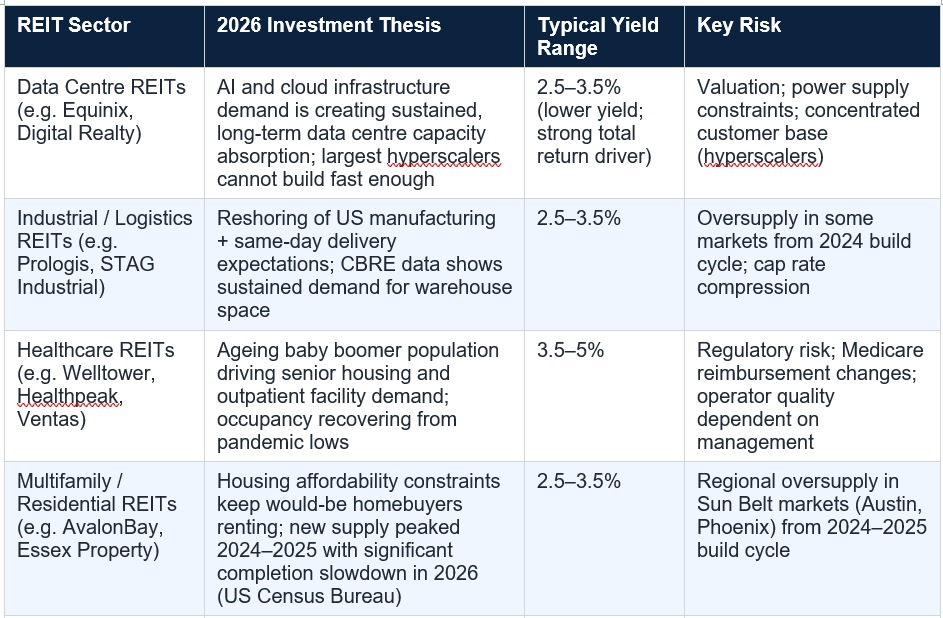
According to investor.creincomefund.com's May 2026 REIT guide, the five REIT sectors with the strongest 2026 fundamentals are: (1) Data centre REITs — AI and cloud infrastructure demand is creating sustained absorption of data centre capacity; (2) Industrial/logistics REITs — reshoring of US manufacturing and same-day delivery expectations drive warehouse demand (supported by CBRE data); (3) Healthcare REITs — ageing baby boomer demographics driving senior housing and outpatient facility demand; (4) Multifamily/residential REITs — housing affordability constraints keep would-be buyers renting; new supply peaked 2024–2025 with significant slowdown in 2026 per US Census Bureau; (5) Net lease REITs (e.g. Realty Income, NNN REIT, VICI Properties) — long-term triple-net leases provide predictable rent growth and high-quality tenants; VICI Properties yielding nearly 7% in mid-2026. For beginning investors, VNQ provides exposure to all of these sectors simultaneously.
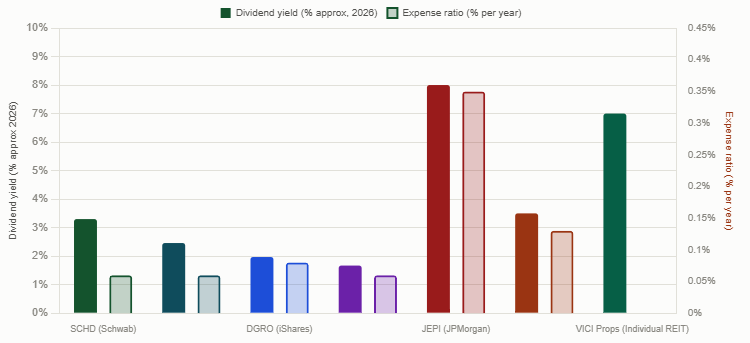
Yield vs Expense Ration Comparison
$10k Investment Monthly Income
Table of Contents
- Why Dividend ETFs and REITs in 2026?
- What Is a Dividend ETF? The Mechanics Explained
- What Is a REIT? The Real Estate Route to Passive Income
- Dividend ETF vs REIT: How They Are Different and Why You May Want Both
- The Top Dividend ETFs in 2026: A Complete Side-by-Side
- The Top REIT ETFs in 2026: VNQ, IYR, and Sector Plays
- REIT Sectors With the Strongest 2026 Fundamentals
- Step-by-Step: How to Buy Your First Dividend ETF or REIT
- The Tax Considerations You Must Understand Before You Buy
- Building a Dividend ETF + REIT Portfolio: Three Model Allocations
- The DRIP Strategy: How Dividend Reinvestment Compounds Over Time
- Common Mistakes Beginners Make With Dividend Investing
- Conclusion: Income That Does Not Require Your Time
- Frequently Asked Questions
Why Dividend ETFs and REITs?
Two facts define the opportunity in dividend and real estate investing in 2026. First, REIT dividend yields averaged 3.8 to 5.5 percent in 2025 depending on sector — compared to approximately 1.6 percent for the S&P 500 (Nareit data cited by investor.creincomefund.com, May 2026). Second, the Federal Reserve's rate cycle has shifted from the 2022–2023 rate-hiking period that suppressed real estate valuations into a more stable 2026 environment that Assetbar's editorial team describes as ‘a new era of stabilisation’ for REITs as an income vehicle.Dividend ETFs and REITs address the same fundamental investor need from two different directions: generating income from invested capital without requiring active management, time, or specialised expertise. A dividend ETF achieves this by holding a basket of 100 to 600 dividend-paying stocks, passing the combined dividends to shareholders quarterly or monthly. A REIT achieves this by collecting rent from institutional-grade real estate — apartment complexes, data centres, warehouses, hospitals, retail centres — and distributing at least 90 percent of that rental income as dividends, which is a legal requirement, not a choice.
For a beginning investor, the appeal is structural: a single ETF purchase gives you instant diversification across dozens to hundreds of income-generating assets, professional index-based screening, and low costs — all in a single trade through any major brokerage. This guide builds the knowledge needed to make that first purchase intelligently.
The Numbers: REIT dividend yields: 3.8–5.5% in 2025 vs ~1.6% S&P 500 (Nareit data). SCHD: $95.2B in AUM, yield ~3.1–3.8%, expense ratio 0.06%. VNQ: $37B in AUM, REIT ETF yield ~3.5% mid-2026. DGRO: 10-year average annual return 13.86% (highest of major dividend ETFs per InvestLane April 2026).
What Is a Dividend ETF? The Mechanics Explained
A dividend ETF is an exchange-traded fund that holds a basket of dividend-paying stocks, selected according to a predefined index or screening methodology, and passes those dividends to shareholders. Unlike individual stocks, where you must research and select each company yourself, a dividend ETF outsources the selection and weighting process to an index.The core mechanics:
- You buy shares of the ETF on a stock exchange just like buying a share of any individual company.
- The ETF holds dozens to hundreds of underlying stocks; when those companies pay dividends, the ETF collects them and distributes them to ETF shareholders, typically quarterly or monthly.
- The expense ratio is the annual fee charged for managing the fund, expressed as a percentage of your investment. The best dividend ETFs in 2026 charge 0.06 to 0.08 percent — meaning $6 to $8 per year on a $10,000 investment.
- Dividend ETFs are broadly divided into two categories: high-yield ETFs (designed for maximum current income, typically 3 to 8 percent yield) and dividend growth ETFs (designed for growing income over time, typically 1.5 to 2.5 percent current yield but with historically faster dividend growth rates).
What Is a REIT? The Real Estate Route to Passive Income
A Real Estate Investment Trust (REIT) is a company that owns and typically operates income-producing real estate. REITs were created by Congress in 1960 to give individual investors access to institutional-grade commercial real estate without requiring the capital, expertise, or management burden of direct property ownership. The legal structure requires REITs to distribute at least 90 percent of their taxable income to shareholders as dividends. This makes REITs among the highest dividend-paying investment structures available to retail investors.REITs exist in two primary forms:
- Public REITs: traded on major stock exchanges exactly like shares of stock. Liquid, transparent, and accessible through any brokerage account. About 190 publicly traded REITs exist across more than a dozen property sectors (Motley Fool, July 2026). You can buy and sell public REIT shares at any time during market hours.
- Private/non-traded REITs: not listed on exchanges. Less liquid, less transparent, often with higher minimum investments, but designed for income stability and lower correlation to public market volatility. Many investors use both for different purposes.
One structural advantage: many REITs pay dividends monthly rather than the quarterly standard for most stocks and ETFs. Realty Income (O) and STAG Industrial, for example, pay monthly. Since REITs collect rent monthly from tenants, the monthly distribution schedule matches their natural cash flow cycle, providing investors with a more consistent income stream.
Dividend ETF vs REIT: How They Are Different and Why You May Want Both
The Top Dividend ETFs in 2026: A Complete Side-by-Side
The dividend ETF landscape in 2026 is dominated by a small number of low-cost, highly liquid funds that have attracted the majority of investor assets. The comparison below reflects data from DividendVision (July 2026), DividendPro (May 2026), InvestSnips (June 2026), InvestLane (April 2026), and Fractional Investor (July 2026):The most practical insight from this comparison, summarised by InvestSnips (June 2026): ‘Think of it this way: VIG for growth, VYM for safety, SCHD for the best balance of both.’ Many experienced dividend investors hold two of these alongside a core index fund — for example, SCHD for current income plus DGRO for dividend growth, giving both current cash flow and a rising payout trajectory.
Watch Out: Yield is the most visible number in a dividend ETF comparison and the most misleading. JEPI’s 7.5 to 8.3 percent yield is generated primarily from covered call options, which cap upside participation in bull markets and are subject to different tax treatment. An ETF with a 9 percent yield that loses 15 percent of its principal value annually is a losing trade. Always evaluate total return (income plus capital appreciation) rather than yield alone.
The Top REIT ETFs in 2026: VNQ, IYR, and Sector Plays
The Motley Fool’s July 2026 REIT ETF guide identifies two primary broad-market REIT ETFs:- VNQ (Vanguard Real Estate ETF): the behemoth of REIT ETFs at approximately $37 billion in AUM — more than three times its nearest competitor. It holds 145 real estate stocks and pays a dividend yield of nearly 3.5 percent in mid-2026. Its expense ratio of 0.13 percent is far below the industry average of 0.22 percent for similar funds. Top holdings include Prologis (logistics/industrial), American Tower (cell towers/infrastructure), Equinix (data centres), Welltower (healthcare real estate), and Simon Property Group (retail). For beginning investors who want broad real estate exposure in a single, low-cost fund, VNQ is the default starting point.
- IYR (iShares US Real Estate ETF): approximately $4.7 billion in AUM across 61 real estate holdings. More concentrated than VNQ but with similar diversification across property types including industrial, data centres, healthcare, and retail. Managed by BlackRock.
- SCHW US REIT ETF: approximately $11 billion in AUM, the second-largest REIT ETF after VNQ (Motley Fool July 2026). Competitive option for investors in the Schwab ecosystem.
REIT Sectors With the Strongest 2026 Fundamentals
Not all REIT sectors perform equally. Investor.creincomefund.com’s May 2026 REIT guide identifies five property types with the strongest 2026 investment case:
Step-by-Step: How to Buy Your First Dividend ETF or REIT
The mechanical process of buying a dividend ETF or REIT is identical to buying any other stock. The steps:Step 1: Open a Brokerage Account
If you do not already have a brokerage account, open one at a major US broker (Fidelity, Schwab, Vanguard, or TD Ameritrade are consistently recommended for long-term dividend investors due to zero-commission trading and fractional share availability). For income investments, the account type matters: a Roth IRA or traditional IRA is particularly valuable for REITs because it shelters the ordinary income dividends from annual taxation. Taxable accounts work for dividend ETFs with qualified dividend treatment (lower tax rate) but are less optimal for REITs.Step 2: Choose Your Account Type
Taxable brokerage account: investment income is taxed in the year it is received. Most dividend ETFs pay qualified dividends (taxed at 15 to 20 percent for most investors), which is acceptable in a taxable account. REIT dividends are predominantly ordinary income (taxed at your marginal rate, potentially 22 to 37 percent), making REITs substantially more tax-efficient inside an IRA.Roth IRA: contributions are made with after-tax dollars; all growth and withdrawals are tax-free in retirement. The ideal account for REIT income, which would otherwise be taxed as ordinary income annually.
Traditional IRA or 401(k): pre-tax contributions; tax-deferred growth; withdrawals taxed as ordinary income. REITs and high-yield dividend ETFs (especially JEPI) are well-suited here.
Step 3: Research and Choose Your ETF or REIT
For a first investment: start with one broad-market dividend ETF (SCHD, VYM, or DGRO) and one broad REIT ETF (VNQ). This two-fund combination gives you diversified exposure to dividend-paying equities and diversified real estate income in two purchases. As your understanding deepens, you can add sector-specific ETFs or individual REITs.Step 4: Place the Order
Search the ticker symbol (e.g. SCHD, VNQ) in your brokerage’s trading platform. Decide on the dollar amount or number of shares. For initial investments, a market order during regular trading hours (9:30 AM to 4:00 PM ET) is the simplest approach. Limit orders allow you to specify the maximum price you will pay.Step 5: Set Up DRIP (Dividend Reinvestment Plan)
After purchasing, enable automatic dividend reinvestment (DRIP) at the brokerage level. DRIP automatically purchases additional shares when dividends are paid, compounding your investment over time without any action on your part. Assetbar’s April 2026 REIT guide describes DRIP as the mechanism by which ‘your paycheck grows every single quarter without you lifting a finger.’The Tax Considerations You Must Understand Before You Buy
Tax treatment is the single most important factor in deciding which accounts to hold dividend ETFs and REITs in:The REWD April 2026 tax guide for REIT investors provides a concrete illustration of the Section 199A benefit: if you receive $10,000 in REIT ordinary dividends, you can deduct $2,000 (20 percent), leaving only $8,000 subject to tax. At a 32 percent marginal rate, your tax bill drops from $3,200 to $2,560. However, the guide notes that this deduction was scheduled to expire after 2025 and its continuation into 2026 should be confirmed with a tax professional, as Congress’ action is uncertain.
Building a Dividend ETF + REIT Portfolio: Three Model Allocations
The right allocation between dividend ETFs and REITs depends on your investment timeline, income needs, and tax situation. Three illustrative approaches for 2026:These are illustrative model allocations for educational purposes. Individual allocations should reflect specific financial goals, tax situations, income needs, and risk tolerance. A qualified financial adviser can build a personalised allocation from the components described above.
The DRIP Strategy: How Dividend Reinvestment Compounds Over Time
The Dividend Reinvestment Plan (DRIP) is arguably the single most powerful mechanic in dividend ETF and REIT investing. It converts passive income into automatic additional share purchases, compounding the income base over time without any additional capital or decision-making.The compounding illustration: a $10,000 investment in SCHD at a 3.1 percent yield and a 7 percent assumed annual total return (dividends + capital appreciation) with DRIP enabled grows to approximately $55,000 to $60,000 over 25 years. The same $10,000 without DRIP, assuming dividends are spent rather than reinvested, produces meaningfully less wealth at the end of the same period because the dividend income does not participate in compound growth.
DividendVision’s July 2026 income projections provide a concrete baseline: $10,000 in SCHD at current yield generates approximately $25.67 per month ($308 per year). $10,000 in VYM generates approximately $20.33 per month ($244 per year). $10,000 in DGRO generates approximately $14.33 per month ($172 per year). These monthly amounts are modest on small positions — the compounding power of DRIP becomes transformative at larger invested amounts over longer periods.
The practical step: virtually every major brokerage (Fidelity, Schwab, Vanguard, TD Ameritrade, and others) allows DRIP to be enabled at the account or individual holding level. It is a one-time setting that requires no ongoing attention and no additional cost. Assetbar’s April 2026 guide explicitly states: ‘By 2026, the power of compounding is your greatest ally.’
Common Mistakes Beginners Make With Dividend Investing
The most common errors that reduce the long-term returns of beginning dividend investors:- • Chasing the highest yield: a very high yield (above 7 or 8 percent) often signals one of two things: a dividend that is about to be cut, or a product structure (like JEPI’s covered calls) with a different risk profile than a straightforward dividend payer. A yield trap is a high-yield investment whose dividend is subsequently cut, producing both an income loss and a capital loss simultaneously.
- • Holding REITs in taxable accounts: most REIT dividends are ordinary income. For an investor in the 32 percent marginal rate bracket, holding a 5 percent REIT yield in a taxable account means paying 32 percent annually on that income, reducing the effective after-tax yield to approximately 3.4 percent. The same REIT in a Roth IRA produces the full 5 percent tax-free.
- • Ignoring expense ratios: the difference between a 0.06 percent and a 0.65 percent expense ratio — compounded over 20 years on a $100,000 portfolio — represents thousands of dollars in foregone wealth (Mr-O Blog April 2026). Prefer funds below 0.15 percent expense ratio; the evidence does not support paying higher fees for most dividend strategies.
- • Overweighting a single REIT or sector ETF: individual REITs carry concentrated management, tenant, and property-type risk. A single tenant default or management misstep can cut the dividend of an individual REIT by 50 percent or more. Broad REIT ETFs (VNQ) distribute this risk across 145 holdings.
- • Treating dividend income as separate from total return: dividend income and capital appreciation are both components of total return. An ETF that pays 4 percent in dividends but declines 6 percent in value produces a negative 2 percent total return. Always evaluate total return, not just yield.
Conclusion
The combination of dividend ETFs and REITs represents the most accessible and well-diversified approach to building passive income available to retail investors in 2026. REIT dividend yields of 3.8 to 5.5 percent sit well above the market average. SCHD, VYM, DGRO, and VIG offer professionally screened, low-cost exposure to dividend-paying equities at expense ratios of 0.06 to 0.08 percent. VNQ provides immediate diversification across 145 real estate companies for 0.13 percent per year.The entry barriers are low in 2026. Most brokerages offer zero-commission trading and fractional shares, meaning an investor can start with any dollar amount. The Roth IRA contribution limit for 2026 provides a tax-advantaged framework ideally suited for REIT income. DRIP converts every dividend payment into automatic compounding without any additional input.
The starting point is not complicated: open a Roth IRA at a major brokerage, purchase shares of VNQ and SCHD or VYM, enable DRIP on both, and set up an automatic monthly contribution. The income begins with the first dividend payment and compounds with every reinvestment. That is the structure of a dividend portfolio. The time required to build it is measured in minutes, not years. The time required to benefit from it is measured in years, not minutes.
Frequently Asked Questions
How much money do I need to start investing in dividend ETFs and REITs?You can start with as little as the price of one share, and many major brokerages (Fidelity, Schwab, Vanguard) now offer fractional shares, allowing you to invest any dollar amount — even $25 or $50. SCHD, VYM, DGRO, and VNQ all trade at prices accessible to beginning investors. For a Roth IRA, the 2026 contribution limit is $7,000 per year ($8,000 if you are 50 or older). You do not need to invest the full limit to start; monthly automatic investments of whatever amount fits your budget allow you to begin immediately and build over time. The key is starting and enabling DRIP to compound dividends automatically from the first payment.
What is the difference between SCHD, VYM, and DGRO?
SCHD (Schwab, 0.06%, ~$95B AUM) screens 100 stocks for quality using cash-flow-to-debt ratios and dividend consistency; currently the highest yield of the three at ~3.1–3.8%; widely considered the best balance of yield and quality. VYM (Vanguard, 0.06%, ~$67B AUM) tracks the FTSE High Dividend Yield Index across 580–610 stocks; lower yield (~2.44%) than SCHD but broadest diversification; the 'set-and-forget' option. DGRO (iShares, 0.08%, ~$40.6B AUM) focuses on companies with a record of raising dividends; lower current yield (~1.97%) but the highest long-term total return of the three (13.86% 10-year average annual return per InvestLane April 2026) and a 10-year payout growth rate of 8.59%/year. Summary from InvestSnips (June 2026): 'VIG for growth, VYM for safety, SCHD for the best balance of both.' Many experienced dividend investors hold both SCHD and DGRO for current income plus a growing payout trajectory.
Are REIT dividends taxed differently than regular stock dividends?
Yes, significantly. Most stock dividends from major dividend ETFs (SCHD, VYM, DGRO) are 'qualified dividends,' taxed at the lower long-term capital gains rate of 0%, 15%, or 20% depending on your income. Most REIT dividends are classified as ordinary income, taxed at your marginal income tax rate (22%, 24%, 32%, 35%, or 37%). This difference can be substantial: at a 32% marginal rate, a 5% REIT yield in a taxable account becomes approximately 3.4% after federal tax. The Section 199A deduction (allowing deduction of up to 20% of qualified REIT dividends) may partially offset this, but its availability in 2026 should be confirmed with a tax professional (REWD April 2026 notes it was scheduled to expire after 2025). For most investors, REITs are best held in a Roth IRA or traditional IRA, while dividend ETFs with qualified dividends are more suitable for taxable brokerage accounts.
What is VNQ and why is it recommended for REIT beginners?
VNQ is the Vanguard Real Estate ETF — the largest REIT ETF in the US by assets under management at approximately $37 billion, more than three times its nearest competitor (Motley Fool, July 2026). It holds 145 real estate stocks and provides diversified exposure to virtually every major REIT property sector, including industrial, residential, data centres, healthcare, office, retail, and infrastructure. Its expense ratio of 0.13% is significantly below the industry average of 0.22% for similar funds. The dividend yield was approximately 3.5% in mid-2026. For a beginning investor who wants exposure to real estate without researching individual REITs, VNQ provides professional diversification at minimal cost in a single trade. It is the REIT equivalent of buying a broad-market index fund — except focused on real estate and generating above-market dividend income.
Should I use a DRIP with dividend ETFs and REITs?
Yes, for most long-term investors, enabling DRIP (Dividend Reinvestment Plan) is one of the most effective things you can do after purchasing a dividend ETF or REIT. DRIP automatically uses each dividend payment to purchase additional shares, compounding the income-generating base without any additional capital or decision-making. The compounding effect becomes significant over years: $10,000 in SCHD currently generates approximately $308/year in dividends. With DRIP, those dividends purchase more SCHD shares, which then generate more dividends, which purchase more shares, and so on. Most major brokerages offer DRIP as a free feature that can be enabled in account settings. The exception: investors in or near retirement who need the dividend income for living expenses should not use DRIP, since they need the cash rather than additional shares.
Which REIT sectors are the best investment in 2026?
According to investor.creincomefund.com's May 2026 REIT guide, the five REIT sectors with the strongest 2026 fundamentals are: (1) Data centre REITs — AI and cloud infrastructure demand is creating sustained absorption of data centre capacity; (2) Industrial/logistics REITs — reshoring of US manufacturing and same-day delivery expectations drive warehouse demand (supported by CBRE data); (3) Healthcare REITs — ageing baby boomer demographics driving senior housing and outpatient facility demand; (4) Multifamily/residential REITs — housing affordability constraints keep would-be buyers renting; new supply peaked 2024–2025 with significant slowdown in 2026 per US Census Bureau; (5) Net lease REITs (e.g. Realty Income, NNN REIT, VICI Properties) — long-term triple-net leases provide predictable rent growth and high-quality tenants; VICI Properties yielding nearly 7% in mid-2026. For beginning investors, VNQ provides exposure to all of these sectors simultaneously.
0 Comments
Be the first to share your thoughts on this article.