

Budgeting
Budget for Today’s Mortgage Rate, Not the One You Hope For

— First-time buyers waiting for rates to fall may find higher prices waiting for them when they arrive. Here’s why today’s rate is the only number that matters for your budget.
There is a version of the home-buying decision that millions of people are currently living. It goes like this: the mortgage rate feels too high, so the purchase is delayed until rates fall. A number is chosen — 5.5%, or 5%, or the sub-4% rates of 2021 that live permanently in the memory — and the plan is made against that number. When the rate reaches that number, the right home will be bought at a comfortable monthly payment, and the timing will have been good. This plan has a significant flaw: it does not exist in the market. Mortgage rates do not reliably fall to accommodate home-buyer timelines. Home prices do not pause while buyers wait. And the buyer who budgets for a hoped-for rate rather than today’s rate is constructing a financial plan around a number that may never arrive — or that, if it does arrive, will have been absorbed by higher home prices that make the overall affordability no better. A July 2026 article from Jewish Link put the principle directly: ‘The smarter approach is to start with your budget, define your payment comfort zone, and consider your time horizon. Only then should you plug in the rate.’ This article makes that case in full, with the payment numbers that show exactly what budgeting for today’s rate means in practice.
The trap has three components, each of which undermines the plan independently. First, the rate they are waiting for may not arrive on any useful timeline. Second, if it does arrive, a surge of waiting buyers will likely enter the market simultaneously, pushing home prices higher and potentially eliminating the monthly payment benefit of the lower rate. Third, and most critically: the budgeting plan they have constructed against a hoped-for rate does not correspond to what lenders will actually offer them today. Florida Realtors, citing a January 2026 Realtor report, described the situation directly: ‘Buyers who delay in hopes of lower mortgage rates may find that home prices and competition offset potential savings.’ And mortgage research firm mortgageresearch.com, citing Apollo’s chief economist, noted that the first-time buyers’ share of homes sold had declined from 50% in 2010 to only 24% as affordability constraints tightened.
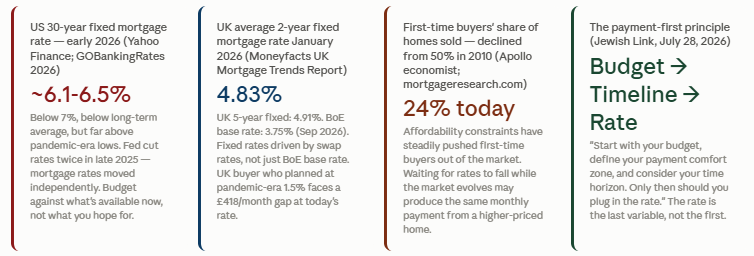
First-time buyers' share of homes sold: 50% in 2010 → 24% today (Apollo chief economist; mortgageresearch.com). US 30-year fixed rate: below 7% in early 2026; approximately 6.1% as of recent 2026 data (Yahoo Finance; GOBankingRates). UK average 2-year fixed: 4.83% (Moneyfacts January 2026). 19 US states have price-to-income ratios indicating lower affordability (Yahoo Finance 2026). Sources cited.
Yahoo Finance’s 2026 analysis, citing Loanfully CEO Kristina Morales, explained the mechanism: the data most closely linked to the 30-year US mortgage rate includes inflation expectations, the unemployment rate, and the 10-year US Treasury yield. For the 30-year mortgage to fall below 6%, Treasury yields would need to fall below 4% in the coming months — a condition that did not materialise on the expected timeline. GOBankingRates and Nasdaq both made the same structural point: many lenders price in expected rate cuts ahead of time, meaning that when Fed cuts are announced, they have already been incorporated into the rate environment. The announcement produces little immediate movement. Waiting for the Federal Reserve to act, and assuming mortgage rates will follow proportionally, is therefore based on a misunderstanding of how the mortgage market actually works.
Kristina Morales, CEO of Loanfully (Yahoo Finance 2026): 'The lesson, experts say, is to put down the crystal ball and focus on affordability. Stay within your budget and play the cards that are currently dealt.' GOBankingRates 2026: 'Since lenders tend to price in expected cuts ahead of time, Fed reductions could have little immediate impact on mortgage rates. Waiting for mortgage rates to catch up to Fed cuts could equal missed opportunities.' Sources: Yahoo Finance 2026; GOBankingRates 2026. Not mortgage advice.
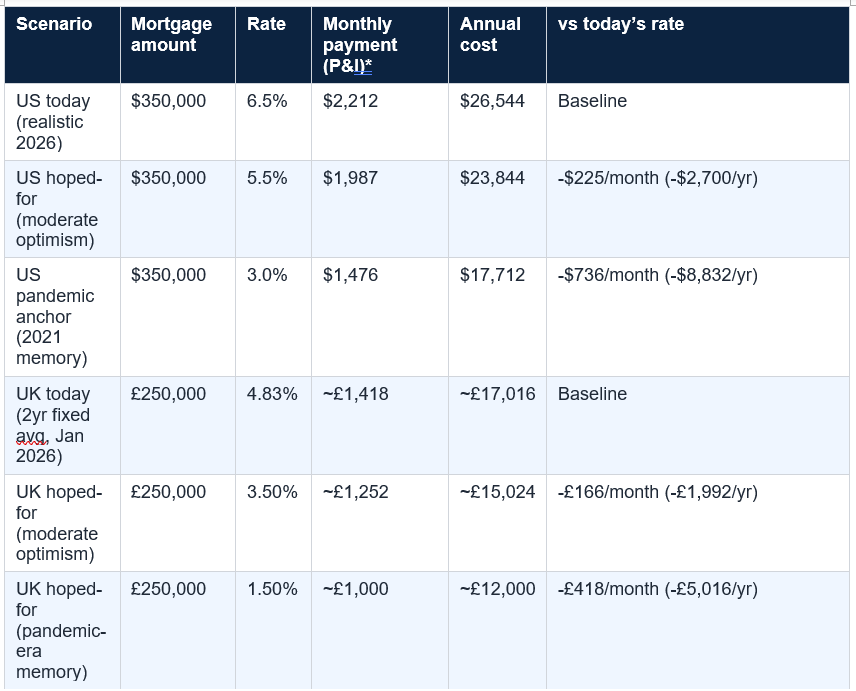
*P&I = principal and interest only. Does not include property tax, homeowners/buildings insurance, HOA fees, or maintenance reserve. True monthly housing cost is typically $400-$800/month higher than the P&I figure for US properties, and includes buildings insurance, ground rent/service charge (leasehold), or maintenance reserve. Source: illustrative calculations only. Verify with a lender.
The gap that matters: A US buyer who plans their budget at 5.5% (moderate hope) but faces today's 6.5% rate is $225/month short of their own budget. A buyer who planned at 3% (pandemic memory) faces a $736/month gap. A UK buyer who budgeted at 1.5% (pandemic-era memory) faces a £418/month gap from today's 4.83% average. These gaps are not covered by willpower. They require either earning more, buying a cheaper home, or going back to renting. Budgeting for today's rate removes all three outcomes from the risk set. Sources: illustrative calculations; Moneyfacts January 2026; Yahoo Finance 2026.
The full monthly housing cost for a typical US first-time buyer adds significantly to the mortgage payment. Property taxes vary widely by state and municipality but typically run 0.8-2.5% of property value per year — on a $350,000 home, $2,800-$8,750/year or $233-$729/month. Homeowners insurance adds typically $150-$300/month. HOA fees, if applicable, add $100-$500/month. A maintenance reserve of 1% of home value per year adds $292/month on a $350,000 home. The P&I payment of $2,212 at 6.5% on $350,000 can therefore represent only 60-70% of the true monthly housing cost. The buyer who budgets only against the rate is planning against a partial number.
Full monthly housing cost example (US, $350,000 home at 6.5%): Mortgage P&I: $2,212. Property taxes: ~$400/month (estimate; varies by state). Homeowners insurance: ~$175/month. Maintenance reserve (1% of value/yr): ~$292/month. Total true monthly housing cost: ~$3,079/month. The rate is only one variable in this total. A 1% rate reduction saves ~$140/month — valuable, but not transformative against a true monthly cost of $3,000+. Illustrative only.
The arithmetic is simple. A buyer waiting for rates to fall from 6.5% to 5.5% expects to save $225 per month on a $350,000 mortgage. But if the entry of millions of waiting buyers pushes the price of the same home from $350,000 to $380,000, the mortgage at 5.5% on $380,000 produces a payment of approximately $2,158/month — $54 less than today’s payment at 6.5% on $350,000, not $225 less. The rate fell 1%. The price rose 8.6%. The monthly payment improved by only $54, not $225. And the buyer has a 8.6% larger mortgage to service over the loan term.
The rate-price relationship: when rates fall, home prices tend to rise as more buyers enter the market with increased purchasing power. The monthly payment improvement from lower rates is frequently offset, partially or wholly, by higher home prices. The buyer who waits for the rate may face the same monthly cost from a more expensive home with a larger debt. Sources: mortgageresearch.com; Florida Realtors February 2026; Yahoo Finance 2026.
The payment-first approach works as follows. Step one: determine what monthly payment you can genuinely sustain — not what the bank will approve, which may be higher, but what leaves your finances stable, your emergency fund intact, and your life not dominated by the mortgage. Step two: work backwards from that payment to establish the maximum mortgage amount at today’s rate. This is your maximum budget for the home purchase. Step three: look at homes in that price range with your current available deposit. If no home you want is available at the price your budget permits at today’s rate, that is important and actionable information — it suggests you need either a larger deposit, a smaller home, a different location, or more time saving. Step four: only then consider what lower rates might do. If rates fall, your purchasing power increases. That is a bonus, not a plan. The Jewish Link article ends with a statement that encapsulates this: ‘Don’t let the lowest rate lure you into a payment that makes life stressful. A mortgage should be a tool for building stability, not a source of financial pressure.
The payment-first sequence: (1) Decide your sustainable monthly payment — not what a bank will approve, but what leaves your life intact. (2) Work backwards: at today's rate, what mortgage amount produces that payment? (3) Add your deposit: maximum home price = max mortgage + deposit. (4) Search within that budget. (5) If rates fall later, treat it as a bonus — not a plan. Source: Jewish Link July 2026; credit.org/CFPB.
For UK buyers, the budgeting reality means the following: a first-time buyer purchasing a £250,000 property with a £25,000 (10%) deposit takes on a £225,000 mortgage. At the January 2026 average 4.83% two-year fixed rate over 25 years, the monthly payment is approximately £1,275. If that buyer had budgeted against a hoped-for 3.5% rate, they planned for approximately £1,127/month — a shortfall of £148 every month. If they budgeted against the 1.5% pandemic-era memory, they planned for approximately £900/month — a shortfall of £375. The UK mortgage market’s stress-test standard — checking whether a borrower can afford the rate 3 percentage points higher — is designed precisely to prevent buyers from assuming rates will not rise. Buyers should apply the same principle to their own planning: stress test downwards too, and plan against the rate that actually exists.
GOBankingRates’ 2026 guidance on mortgage mistakes makes the point about full housing costs that US buyers most commonly underestimate: even at approved mortgage amounts, ‘high home prices and continued ownership costs can still strain your budget.’ Bankrate’s February 2026 first-time buyer guide warns directly that trying to time either the housing market or the mortgage market is ‘a bit of a fool’s errand.’ The typical down payment for first-time buyers in 2025 was 10% (National Association of Realtors; Bankrate), meaning most buyers are entering with a 90% LTV mortgage — at the higher end of the rate range available. Buyers with 20% deposits access materially better rates. Not mortgage advice.
The practical test: take the property you are considering and calculate the monthly mortgage payment at the current market rate for your deposit level. Then add the full housing costs — insurance, property tax (US), maintenance reserve. Compare that total to your after-tax monthly income. The conventional guidance is that total housing costs should not exceed 28-33% of gross income (US) or approximately 3-4.5x income for the mortgage amount (UK, though higher multiples are available). If the property passes this test at today’s rate, it is affordable. If it only passes at a hoped-for lower rate, it is not affordable today and the plan depends on a future that is not guaranteed.
The affordability test (illustrative): UK buyer, £60,000 income; 4.5x = £270,000 maximum mortgage. At 4.83% over 25 years: ~£1,528/month (P&I). UK average 2-year fixed: 4.83% (Moneyfacts Jan 2026). US buyer, $80,000 gross income; 28% of gross monthly = $1,867/month for all housing costs; at 6.5% on $250,000: ~$1,580 P&I + ~$500 taxes/insurance = $2,080/month. The 28% guideline suggests $250,000 mortgage may be at the limit. These are illustrative only.
Third: when you find a property you can afford at today’s rate, do not hesitate because you are waiting for a lower rate. The Florida Realtors citation from January 2026 noted: ‘Buyers who delay in hopes of lower mortgage rates may find that home prices and competition offset potential savings.’ Fourth: if rates fall after you buy, you can remortgage at the lower rate when your initial fix expires — and the improvement becomes a genuine saving rather than a plan that required future conditions to materialise. This is the asymmetry that makes budgeting for today’s rate the rational choice: if rates stay high, you can still afford the property. If rates fall, you can remortgage into the improvement. The strategy that requires rates to fall to work is the one that carries the risk.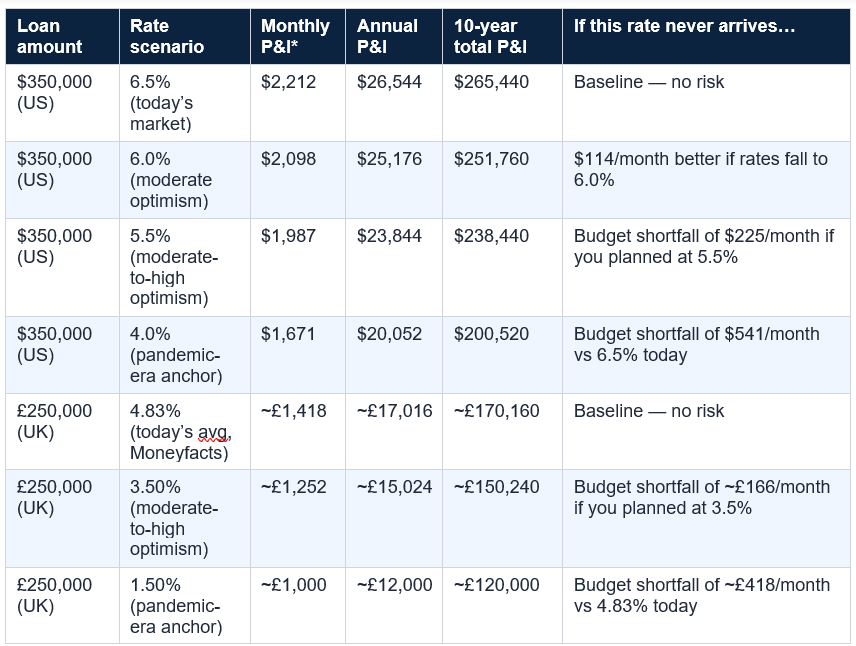
*P&I = principal and interest only. Does not include property tax, buildings insurance, HOA fees, or maintenance costs. US figures based on 30-year term; UK figures based on 25-year term. All figures are illustrative — verify with a lender. Not mortgage or financial advice. Actual rates depend on your specific circumstances, credit profile, deposit, and lender.
Kristina Morales of Loanfully said it most directly in Yahoo Finance’s 2026 analysis: ‘Put down the crystal ball and focus on affordability. Stay within your budget and play the cards that are currently dealt.’ The Jewish Link’s July 2026 article put the same principle in structural terms: start with your budget, define your payment comfort zone, consider your time horizon, and only then plug in the rate. The rate is the last variable, not the first. Budget for today’s rate. Search within that budget. Buy what you can afford. If rates fall, remortgage and enjoy the saving. If they do not fall, you can still afford where you live. That asymmetry — the ability to benefit from improvement without depending on it — is what makes the payment-first, today’s-rate approach the rational one. Not mortgage, financial, or property advice. Consult an FCA-regulated mortgage broker (UK) or licensed mortgage professional (US).
Most experts advise against budgeting on the assumption that rates will fall to a specific level. Florida Realtors, citing a January 2026 Realtor report, stated: 'Buyers who delay in hopes of lower mortgage rates may find that home prices and competition offset potential savings.' Mortgageresearch.com's analysis cited Apollo's chief economist on the risk that lower rates attract a wave of waiting buyers, pushing prices higher and potentially negating the monthly payment benefit of the lower rate. GOBankingRates (2026) notes that 'waiting for mortgage rates to catch up to Fed cuts could equal missed opportunities.' The practical guidance from multiple sources: plan your budget at today's rate, search within that budget, and treat any future rate reduction as a bonus that enables remortgaging — not as a prerequisite for buying. Sources: Florida Realtors February 2026; mortgageresearch.com; GOBankingRates 2026.
Do mortgage rates go down when the Federal Reserve cuts rates?
Not necessarily, and often not to the same degree or on the same timeline. The Federal Reserve cut its target rate twice in late 2025, bringing it to a range of 3.75%-4.00%. Mortgage rates in 2026 have continued to move independently, driven primarily by inflation expectations, the 10-year US Treasury yield, unemployment data, and lender competition — not just the Fed funds rate. Yahoo Finance's 2026 analysis noted that for the 30-year mortgage rate to fall below 6%, Treasury yields would need to fall below 4%. GOBankingRates and Nasdaq both noted that 'many lenders tend to include predicted rate cuts on their current rate offers' — meaning expected Fed cuts are already priced in when announced. Waiting for the Fed to cut and expecting mortgage rates to follow proportionally is based on a misunderstanding of mortgage rate mechanics. Sources: Yahoo Finance 2026; GOBankingRates 2026; Nasdaq 2026.
What does 'budgeting for today's rate' actually mean in practice?
It means constructing your home purchase budget entirely around the mortgage rate that is currently available to you from lenders — not around a rate you hope will be available in six months. The specific steps: (1) Get an agreement in principle or pre-approval at today's rates. (2) Use today's rate to calculate the maximum monthly mortgage payment you can sustainably afford. (3) Work backwards from that payment to the maximum mortgage amount. (4) Add your deposit to get your maximum property budget. (5) Search within that budget. (6) When you find a property that is affordable at today's rate, buy it — any future rate improvement can be captured at remortgage. The Jewish Link's July 2026 article described the sequence: 'Start with your budget, define your payment comfort zone, and consider your time horizon. Only then should you plug in the rate.' Sources: Jewish Link July 2026; credit.org/CFPB; GOBankingRates 2026.
What is the full monthly cost of a mortgage and why does it matter?
The monthly mortgage payment — principal and interest — is typically only 60-80% of the true monthly cost of homeownership. GOBankingRates (2026) emphasises that 'buyers should weigh the full monthly cost (including taxes, insurance and upkeep) when determining true affordability.' The full monthly housing cost includes: the mortgage P&I payment; property taxes (US — typically $200-$700/month depending on location and property value); homeowners/buildings insurance ($100-$300/month); HOA or service charge fees where applicable ($100-$500/month); and a maintenance reserve (a prudent 1% of property value per year = $291/month on a $350,000 home). Credit.org's CFPB-aligned guidance states: 'You must plan your budget based on your monthly mortgage payment, not just the total purchase price.' Only factoring in the mortgage payment and excluding all other housing costs is a common error that creates financial stress after purchase. Sources: GOBankingRates 2026; credit.org; Jewish Link July 2026.
What mortgage rate should I use when budgeting to buy a home?
Use the rate currently available to someone with your credit profile and deposit size, from a lender you could actually obtain a mortgage from. This is not the advertised 'headline rate' (which often applies to very low LTV mortgages with significant deposits) but the rate you would actually be offered, which depends on your loan-to-value ratio, credit history, income, and property type. In the UK, the average two-year fixed rate in January 2026 was 4.83% and the five-year fixed average was 4.91% (Moneyfacts). In the US, the 30-year fixed rate was approximately 6.1-6.5% for typical borrowers in 2026 (Yahoo Finance; GOBankingRates). First-time buyers with 10% deposits face higher rates than those with 20-25% deposits. The most accurate rate for your budget is the one a lender quotes you after a soft credit check or agreement in principle — not a comparison site headline or a forecast. Sources: Moneyfacts January 2026; Yahoo Finance 2026; GOBankingRates 2026. Not mortgage advice. Consult an FCA-regulated broker (UK) or licensed mortgage professional (US).
There is a version of the home-buying decision that millions of people are currently living. It goes like this: the mortgage rate feels too high, so the purchase is delayed until rates fall. A number is chosen — 5.5%, or 5%, or the sub-4% rates of 2021 that live permanently in the memory — and the plan is made against that number. When the rate reaches that number, the right home will be bought at a comfortable monthly payment, and the timing will have been good. This plan has a significant flaw: it does not exist in the market. Mortgage rates do not reliably fall to accommodate home-buyer timelines. Home prices do not pause while buyers wait. And the buyer who budgets for a hoped-for rate rather than today’s rate is constructing a financial plan around a number that may never arrive — or that, if it does arrive, will have been absorbed by higher home prices that make the overall affordability no better. A July 2026 article from Jewish Link put the principle directly: ‘The smarter approach is to start with your budget, define your payment comfort zone, and consider your time horizon. Only then should you plug in the rate.’ This article makes that case in full, with the payment numbers that show exactly what budgeting for today’s rate means in practice.
Table of Contents
- The Rate-Waiting Trap: How It Works and Why It Fails
- Why Mortgage Rates Don’t Simply Follow the Federal Reserve
- The Payment Calculations That Change the Conversation
- The Full Monthly Housing Cost — What ‘Affordability’ Actually Means
- Why Waiting for Lower Rates May Produce the Same Payment
- The Payment-First Principle: Budget, Timeline, Then Rate
- The UK Mortgage Budgeting Reality in 2026
- The US Mortgage Budgeting Reality in 2026
- The Stress Test You Should Apply Before Any Offer
- What Budgeting for Today’s Rate Looks Like in Practice
- The Rate Scenarios Table: What Changes at Each Rate Level
- Conclusion: The Rate You Hope For Is a Fantasy. Today’s Rate Is Reality.
- Frequently Asked Questions
The Rate-Waiting Trap: How It Works and Why It Fails
The rate-waiting trap is one of the most consistently documented first-time buyer mistakes in the 2025 and 2026 property market. It works like this: a buyer encounters a mortgage rate that feels higher than expected, higher than what they saw their parents get, or higher than the pandemic-era rates they read about. They decide to wait until rates fall to a level that feels right. They continue renting, continue saving, and continue monitoring mortgage rate headlines. When the number arrives, they will buy.The trap has three components, each of which undermines the plan independently. First, the rate they are waiting for may not arrive on any useful timeline. Second, if it does arrive, a surge of waiting buyers will likely enter the market simultaneously, pushing home prices higher and potentially eliminating the monthly payment benefit of the lower rate. Third, and most critically: the budgeting plan they have constructed against a hoped-for rate does not correspond to what lenders will actually offer them today. Florida Realtors, citing a January 2026 Realtor report, described the situation directly: ‘Buyers who delay in hopes of lower mortgage rates may find that home prices and competition offset potential savings.’ And mortgage research firm mortgageresearch.com, citing Apollo’s chief economist, noted that the first-time buyers’ share of homes sold had declined from 50% in 2010 to only 24% as affordability constraints tightened.
First-time buyers' share of homes sold: 50% in 2010 → 24% today (Apollo chief economist; mortgageresearch.com). US 30-year fixed rate: below 7% in early 2026; approximately 6.1% as of recent 2026 data (Yahoo Finance; GOBankingRates). UK average 2-year fixed: 4.83% (Moneyfacts January 2026). 19 US states have price-to-income ratios indicating lower affordability (Yahoo Finance 2026). Sources cited.
Why Mortgage Rates Don’t Simply Follow the Federal Reserve
One of the most persistent misconceptions among home buyers is that mortgage rates follow the Federal Reserve’s federal funds rate. The Federal Reserve cut its target rate twice in late 2025, bringing it to a range of 3.75%-4.00%. Many buyers expected equivalent reductions in mortgage rates. They did not come. Mortgage rates continued moving independently, for reasons that the Federal funds rate does not control.Yahoo Finance’s 2026 analysis, citing Loanfully CEO Kristina Morales, explained the mechanism: the data most closely linked to the 30-year US mortgage rate includes inflation expectations, the unemployment rate, and the 10-year US Treasury yield. For the 30-year mortgage to fall below 6%, Treasury yields would need to fall below 4% in the coming months — a condition that did not materialise on the expected timeline. GOBankingRates and Nasdaq both made the same structural point: many lenders price in expected rate cuts ahead of time, meaning that when Fed cuts are announced, they have already been incorporated into the rate environment. The announcement produces little immediate movement. Waiting for the Federal Reserve to act, and assuming mortgage rates will follow proportionally, is therefore based on a misunderstanding of how the mortgage market actually works.
Kristina Morales, CEO of Loanfully (Yahoo Finance 2026): 'The lesson, experts say, is to put down the crystal ball and focus on affordability. Stay within your budget and play the cards that are currently dealt.' GOBankingRates 2026: 'Since lenders tend to price in expected cuts ahead of time, Fed reductions could have little immediate impact on mortgage rates. Waiting for mortgage rates to catch up to Fed cuts could equal missed opportunities.' Sources: Yahoo Finance 2026; GOBankingRates 2026. Not mortgage advice.
The Payment Calculations That Change the Conversation
The argument for budgeting against today’s rate rather than a hoped-for rate becomes most concrete when you look at the actual monthly payment difference across rate scenarios. These calculations are illustrative — actual payments depend on your specific mortgage terms, lender, and loan structure — but they establish the order of magnitude of what rate assumptions cost.*P&I = principal and interest only. Does not include property tax, homeowners/buildings insurance, HOA fees, or maintenance reserve. True monthly housing cost is typically $400-$800/month higher than the P&I figure for US properties, and includes buildings insurance, ground rent/service charge (leasehold), or maintenance reserve. Source: illustrative calculations only. Verify with a lender.
The gap that matters: A US buyer who plans their budget at 5.5% (moderate hope) but faces today's 6.5% rate is $225/month short of their own budget. A buyer who planned at 3% (pandemic memory) faces a $736/month gap. A UK buyer who budgeted at 1.5% (pandemic-era memory) faces a £418/month gap from today's 4.83% average. These gaps are not covered by willpower. They require either earning more, buying a cheaper home, or going back to renting. Budgeting for today's rate removes all three outcomes from the risk set. Sources: illustrative calculations; Moneyfacts January 2026; Yahoo Finance 2026.
The Full Monthly Housing Cost — What ‘Affordability’ Actually Means
The payment-first approach requires calculating the full monthly housing cost, not just the principal and interest on the mortgage. GOBankingRates’ 2026 guidance is explicit on this: ‘Buyers should weigh the full monthly cost (including taxes, insurance and upkeep) when determining true affordability.’ The credit.org CFPB guide states: ‘You must plan your budget based on your monthly mortgage payment, not just the total purchase price.’ The Jewish Link article (July 2026) makes the same point with specific language: if the higher payment strains your budget, the shorter term isn’t the right choice. That is why payment comes first.The full monthly housing cost for a typical US first-time buyer adds significantly to the mortgage payment. Property taxes vary widely by state and municipality but typically run 0.8-2.5% of property value per year — on a $350,000 home, $2,800-$8,750/year or $233-$729/month. Homeowners insurance adds typically $150-$300/month. HOA fees, if applicable, add $100-$500/month. A maintenance reserve of 1% of home value per year adds $292/month on a $350,000 home. The P&I payment of $2,212 at 6.5% on $350,000 can therefore represent only 60-70% of the true monthly housing cost. The buyer who budgets only against the rate is planning against a partial number.
Full monthly housing cost example (US, $350,000 home at 6.5%): Mortgage P&I: $2,212. Property taxes: ~$400/month (estimate; varies by state). Homeowners insurance: ~$175/month. Maintenance reserve (1% of value/yr): ~$292/month. Total true monthly housing cost: ~$3,079/month. The rate is only one variable in this total. A 1% rate reduction saves ~$140/month — valuable, but not transformative against a true monthly cost of $3,000+. Illustrative only.
Why Waiting for Lower Rates May Produce the Same Payment
The most counterintuitive aspect of the rate-waiting strategy is that it may not actually reduce the monthly payment even when it succeeds. MortgageResearch.com’s analysis articulated this with precision: if mortgage rates fall, a ‘tsunami of first-time buyers swamping the market with insatiable pent-up demand’ would enter simultaneously, competing for a limited housing supply that has not expanded proportionally. That extra demand with limited supply would ‘likely push house prices sharply higher, perhaps wholly negating the affordability benefits of lower rates.’The arithmetic is simple. A buyer waiting for rates to fall from 6.5% to 5.5% expects to save $225 per month on a $350,000 mortgage. But if the entry of millions of waiting buyers pushes the price of the same home from $350,000 to $380,000, the mortgage at 5.5% on $380,000 produces a payment of approximately $2,158/month — $54 less than today’s payment at 6.5% on $350,000, not $225 less. The rate fell 1%. The price rose 8.6%. The monthly payment improved by only $54, not $225. And the buyer has a 8.6% larger mortgage to service over the loan term.
The rate-price relationship: when rates fall, home prices tend to rise as more buyers enter the market with increased purchasing power. The monthly payment improvement from lower rates is frequently offset, partially or wholly, by higher home prices. The buyer who waits for the rate may face the same monthly cost from a more expensive home with a larger debt. Sources: mortgageresearch.com; Florida Realtors February 2026; Yahoo Finance 2026.
The Payment-First Principle: Budget, Timeline, Then Rate
Jewish Link’s July 2026 mortgage article, titled ‘Payment First, Rate Second,’ provides the clearest articulation of the alternative approach: ‘When most people begin shopping for a mortgage, the first question they ask is, “What’s the interest rate?” It’s an understandable instinct — after all, the rate determines how much interest you’ll pay over time. But focusing on the rate alone can lead to a costly mistake. The smarter approach is to start with your budget, define your payment comfort zone, and consider your time horizon. Only then should you plug in the rate.’The payment-first approach works as follows. Step one: determine what monthly payment you can genuinely sustain — not what the bank will approve, which may be higher, but what leaves your finances stable, your emergency fund intact, and your life not dominated by the mortgage. Step two: work backwards from that payment to establish the maximum mortgage amount at today’s rate. This is your maximum budget for the home purchase. Step three: look at homes in that price range with your current available deposit. If no home you want is available at the price your budget permits at today’s rate, that is important and actionable information — it suggests you need either a larger deposit, a smaller home, a different location, or more time saving. Step four: only then consider what lower rates might do. If rates fall, your purchasing power increases. That is a bonus, not a plan. The Jewish Link article ends with a statement that encapsulates this: ‘Don’t let the lowest rate lure you into a payment that makes life stressful. A mortgage should be a tool for building stability, not a source of financial pressure.
The payment-first sequence: (1) Decide your sustainable monthly payment — not what a bank will approve, but what leaves your life intact. (2) Work backwards: at today's rate, what mortgage amount produces that payment? (3) Add your deposit: maximum home price = max mortgage + deposit. (4) Search within that budget. (5) If rates fall later, treat it as a bonus — not a plan. Source: Jewish Link July 2026; credit.org/CFPB.
The UK Mortgage Budgeting Reality in 2026
UK buyers in 2026 face a specific rate environment that is simultaneously better than the 2023 peak and significantly above the pandemic-era lows that shaped many buyers’ expectations. The average two-year fixed rate in January 2026 was 4.83%; the average five-year fixed was 4.91% (Moneyfacts). The Bank of England base rate stood at 3.75% in September 2026. Fixed mortgage rates in the UK are driven by swap rates in the money markets — not by the base rate directly — which is why rates can and do move independently of BoE decisions, as oportfolio.co.uk noted in its September 2026 mortgage market update.For UK buyers, the budgeting reality means the following: a first-time buyer purchasing a £250,000 property with a £25,000 (10%) deposit takes on a £225,000 mortgage. At the January 2026 average 4.83% two-year fixed rate over 25 years, the monthly payment is approximately £1,275. If that buyer had budgeted against a hoped-for 3.5% rate, they planned for approximately £1,127/month — a shortfall of £148 every month. If they budgeted against the 1.5% pandemic-era memory, they planned for approximately £900/month — a shortfall of £375. The UK mortgage market’s stress-test standard — checking whether a borrower can afford the rate 3 percentage points higher — is designed precisely to prevent buyers from assuming rates will not rise. Buyers should apply the same principle to their own planning: stress test downwards too, and plan against the rate that actually exists.
The US Mortgage Budgeting Reality in 2026
US buyers in 2026 are navigating a mortgage market where the 30-year fixed rate has declined from the 7%+ peaks of 2023 but remains meaningfully above the sub-3% rates of 2021. Yahoo Finance’s 2026 analysis quoted the current rate of approximately 6.1% as being ‘close to the lowest point seen in the last three years’ and noted it sits ‘below the long-term average’ in historical context. The challenge for buyers is that this historical framing conflicts with their experiential anchor: many first-time buyers in their 30s formed their expectation of ‘normal’ mortgage rates during the 2019-2022 period when rates were historically anomalous on the downside.GOBankingRates’ 2026 guidance on mortgage mistakes makes the point about full housing costs that US buyers most commonly underestimate: even at approved mortgage amounts, ‘high home prices and continued ownership costs can still strain your budget.’ Bankrate’s February 2026 first-time buyer guide warns directly that trying to time either the housing market or the mortgage market is ‘a bit of a fool’s errand.’ The typical down payment for first-time buyers in 2025 was 10% (National Association of Realtors; Bankrate), meaning most buyers are entering with a 90% LTV mortgage — at the higher end of the rate range available. Buyers with 20% deposits access materially better rates. Not mortgage advice.
The Stress Test You Should Apply Before Any Offer
Before making an offer on any property, apply the stress test to your budget. The UK mortgage industry’s stress test asks: can you afford this mortgage if rates rise 3 percentage points? The buyer budgeting test asks the mirror-image question: are you budgeting as if rates will fall 1-2 percentage points? If the answer is yes, you are building your budget on a number that does not exist yet.The practical test: take the property you are considering and calculate the monthly mortgage payment at the current market rate for your deposit level. Then add the full housing costs — insurance, property tax (US), maintenance reserve. Compare that total to your after-tax monthly income. The conventional guidance is that total housing costs should not exceed 28-33% of gross income (US) or approximately 3-4.5x income for the mortgage amount (UK, though higher multiples are available). If the property passes this test at today’s rate, it is affordable. If it only passes at a hoped-for lower rate, it is not affordable today and the plan depends on a future that is not guaranteed.
The affordability test (illustrative): UK buyer, £60,000 income; 4.5x = £270,000 maximum mortgage. At 4.83% over 25 years: ~£1,528/month (P&I). UK average 2-year fixed: 4.83% (Moneyfacts Jan 2026). US buyer, $80,000 gross income; 28% of gross monthly = $1,867/month for all housing costs; at 6.5% on $250,000: ~$1,580 P&I + ~$500 taxes/insurance = $2,080/month. The 28% guideline suggests $250,000 mortgage may be at the limit. These are illustrative only.
What Budgeting for Today’s Rate Looks Like in Practice
Budgeting for today’s rate means constructing the home search and the purchase decision entirely around what today’s market offers, not what tomorrow’s market might offer. In practice, this means the following specific steps. First: obtain an agreement in principle (UK) or pre-approval letter (US) from a lender at today’s rates. This is not a ceiling to stretch toward — it is an upper bound that defines the search space. Second: search only within the property price that the mortgage budget permits at today’s rate. If the maximum you can borrow at a sustainable monthly payment is £220,000 and your deposit is £25,000, your search is in the £245,000 and below range. Not £300,000 homes that you plan to ‘make work’ when rates fall.Third: when you find a property you can afford at today’s rate, do not hesitate because you are waiting for a lower rate. The Florida Realtors citation from January 2026 noted: ‘Buyers who delay in hopes of lower mortgage rates may find that home prices and competition offset potential savings.’ Fourth: if rates fall after you buy, you can remortgage at the lower rate when your initial fix expires — and the improvement becomes a genuine saving rather than a plan that required future conditions to materialise. This is the asymmetry that makes budgeting for today’s rate the rational choice: if rates stay high, you can still afford the property. If rates fall, you can remortgage into the improvement. The strategy that requires rates to fall to work is the one that carries the risk.
The Rate Scenarios Table: What Changes at Each Rate Level
*P&I = principal and interest only. Does not include property tax, buildings insurance, HOA fees, or maintenance costs. US figures based on 30-year term; UK figures based on 25-year term. All figures are illustrative — verify with a lender. Not mortgage or financial advice. Actual rates depend on your specific circumstances, credit profile, deposit, and lender.
Conclusion
The mortgage market in 2026 is not a market that rewards waiting. The buyer who waits for 5.5% may find that, when 5.5% arrives, the home that cost £250,000 today costs £270,000 — and the monthly payment barely changes. The buyer who budgeted for today’s 4.83% UK rate or 6.5% US rate has already bought the home, built some equity, and is positioned to remortgage into any improvement that materialises. The buyer who has been waiting is starting over in a more expensive market.Kristina Morales of Loanfully said it most directly in Yahoo Finance’s 2026 analysis: ‘Put down the crystal ball and focus on affordability. Stay within your budget and play the cards that are currently dealt.’ The Jewish Link’s July 2026 article put the same principle in structural terms: start with your budget, define your payment comfort zone, consider your time horizon, and only then plug in the rate. The rate is the last variable, not the first. Budget for today’s rate. Search within that budget. Buy what you can afford. If rates fall, remortgage and enjoy the saving. If they do not fall, you can still afford where you live. That asymmetry — the ability to benefit from improvement without depending on it — is what makes the payment-first, today’s-rate approach the rational one. Not mortgage, financial, or property advice. Consult an FCA-regulated mortgage broker (UK) or licensed mortgage professional (US).
Frequently Asked Questions
Should I wait for mortgage rates to fall before buying a home?Most experts advise against budgeting on the assumption that rates will fall to a specific level. Florida Realtors, citing a January 2026 Realtor report, stated: 'Buyers who delay in hopes of lower mortgage rates may find that home prices and competition offset potential savings.' Mortgageresearch.com's analysis cited Apollo's chief economist on the risk that lower rates attract a wave of waiting buyers, pushing prices higher and potentially negating the monthly payment benefit of the lower rate. GOBankingRates (2026) notes that 'waiting for mortgage rates to catch up to Fed cuts could equal missed opportunities.' The practical guidance from multiple sources: plan your budget at today's rate, search within that budget, and treat any future rate reduction as a bonus that enables remortgaging — not as a prerequisite for buying. Sources: Florida Realtors February 2026; mortgageresearch.com; GOBankingRates 2026.
Do mortgage rates go down when the Federal Reserve cuts rates?
Not necessarily, and often not to the same degree or on the same timeline. The Federal Reserve cut its target rate twice in late 2025, bringing it to a range of 3.75%-4.00%. Mortgage rates in 2026 have continued to move independently, driven primarily by inflation expectations, the 10-year US Treasury yield, unemployment data, and lender competition — not just the Fed funds rate. Yahoo Finance's 2026 analysis noted that for the 30-year mortgage rate to fall below 6%, Treasury yields would need to fall below 4%. GOBankingRates and Nasdaq both noted that 'many lenders tend to include predicted rate cuts on their current rate offers' — meaning expected Fed cuts are already priced in when announced. Waiting for the Fed to cut and expecting mortgage rates to follow proportionally is based on a misunderstanding of mortgage rate mechanics. Sources: Yahoo Finance 2026; GOBankingRates 2026; Nasdaq 2026.
What does 'budgeting for today's rate' actually mean in practice?
It means constructing your home purchase budget entirely around the mortgage rate that is currently available to you from lenders — not around a rate you hope will be available in six months. The specific steps: (1) Get an agreement in principle or pre-approval at today's rates. (2) Use today's rate to calculate the maximum monthly mortgage payment you can sustainably afford. (3) Work backwards from that payment to the maximum mortgage amount. (4) Add your deposit to get your maximum property budget. (5) Search within that budget. (6) When you find a property that is affordable at today's rate, buy it — any future rate improvement can be captured at remortgage. The Jewish Link's July 2026 article described the sequence: 'Start with your budget, define your payment comfort zone, and consider your time horizon. Only then should you plug in the rate.' Sources: Jewish Link July 2026; credit.org/CFPB; GOBankingRates 2026.
What is the full monthly cost of a mortgage and why does it matter?
The monthly mortgage payment — principal and interest — is typically only 60-80% of the true monthly cost of homeownership. GOBankingRates (2026) emphasises that 'buyers should weigh the full monthly cost (including taxes, insurance and upkeep) when determining true affordability.' The full monthly housing cost includes: the mortgage P&I payment; property taxes (US — typically $200-$700/month depending on location and property value); homeowners/buildings insurance ($100-$300/month); HOA or service charge fees where applicable ($100-$500/month); and a maintenance reserve (a prudent 1% of property value per year = $291/month on a $350,000 home). Credit.org's CFPB-aligned guidance states: 'You must plan your budget based on your monthly mortgage payment, not just the total purchase price.' Only factoring in the mortgage payment and excluding all other housing costs is a common error that creates financial stress after purchase. Sources: GOBankingRates 2026; credit.org; Jewish Link July 2026.
What mortgage rate should I use when budgeting to buy a home?
Use the rate currently available to someone with your credit profile and deposit size, from a lender you could actually obtain a mortgage from. This is not the advertised 'headline rate' (which often applies to very low LTV mortgages with significant deposits) but the rate you would actually be offered, which depends on your loan-to-value ratio, credit history, income, and property type. In the UK, the average two-year fixed rate in January 2026 was 4.83% and the five-year fixed average was 4.91% (Moneyfacts). In the US, the 30-year fixed rate was approximately 6.1-6.5% for typical borrowers in 2026 (Yahoo Finance; GOBankingRates). First-time buyers with 10% deposits face higher rates than those with 20-25% deposits. The most accurate rate for your budget is the one a lender quotes you after a soft credit check or agreement in principle — not a comparison site headline or a forecast. Sources: Moneyfacts January 2026; Yahoo Finance 2026; GOBankingRates 2026. Not mortgage advice. Consult an FCA-regulated broker (UK) or licensed mortgage professional (US).
0 Comments
Be the first to share your thoughts on this article.