

Budgeting
What Retirees Should Focus on When Creating a Budget

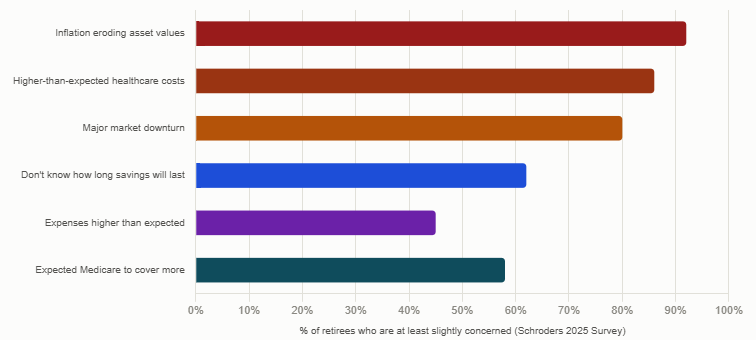
45% of retirees say their expenses are higher than expected. 62% don’t know how long their money will last. This is the complete 2026 guide to what actually belongs at the top of the retirement budget — and what most people miss.

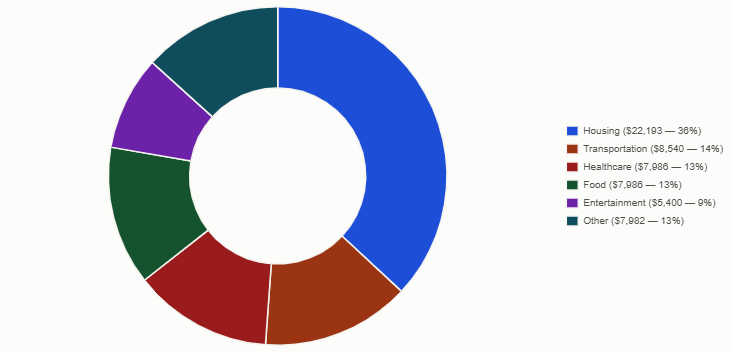
Retiree Spenindgs Breakdown
To Retiree Concerns 2025
The arithmetic of retirement budgeting is not complicated: estimate income, estimate expenses, identify the gap, build a withdrawal strategy to close it. The focus problem is what most retirees bring to that arithmetic: they budget based on what they spent while working, they underestimate the categories that grow fastest in retirement, they overestimate what Medicare covers, and they fail to account for the structural risks — healthcare cost inflation, sequence of returns risk, long-term care costs — that are specific to retirement and absent from the working-life budget.
GoBankingRates’ August 2026 retirement analysis, quoting Dennis Shirshikov, professor of finance at CUNY and head of growth at Growth Limit, articulates the core principle: a comfortable retirement budget in 2026 is less about a single number and more about coverage, flexibility, and predictability. This guide examines the seven focus areas that retirees must prioritise when building that structure, supported by the most current available data on what retirement actually costs.
The Numbers: 45% of retirees say expenses are higher than expected (Schroders 2025). 62% don’t know how long their savings will last. 92% worried about inflation eroding assets (up from 89%). Average retiree spending: $60,087/year, $5,007/month (BLS/Mercer Advisors January 2026). Average SS benefit: $2,071/month — covering less than half of typical monthly expenses.
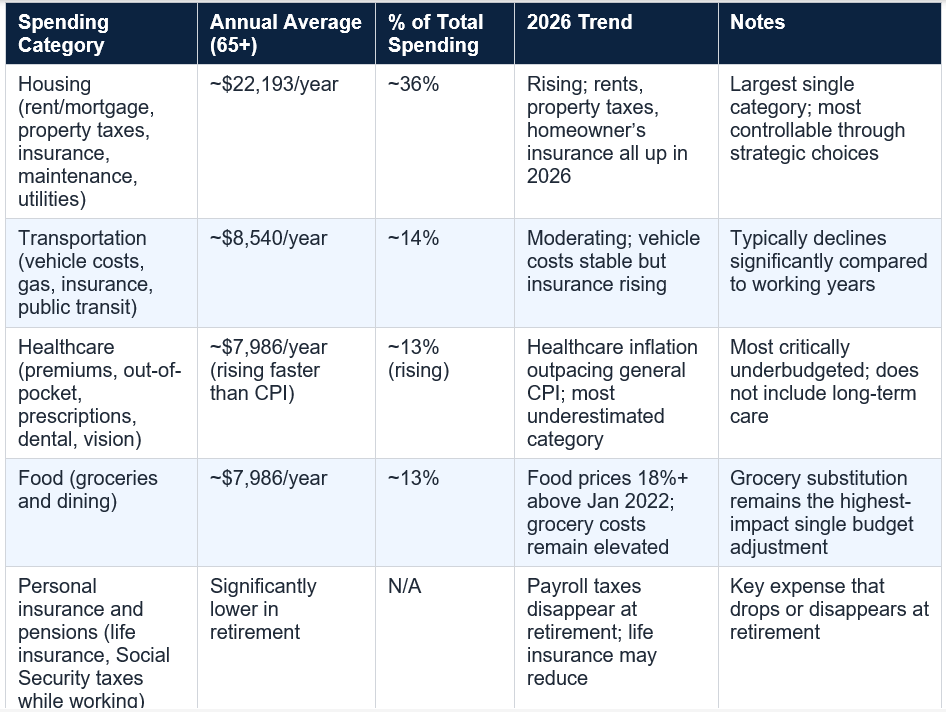
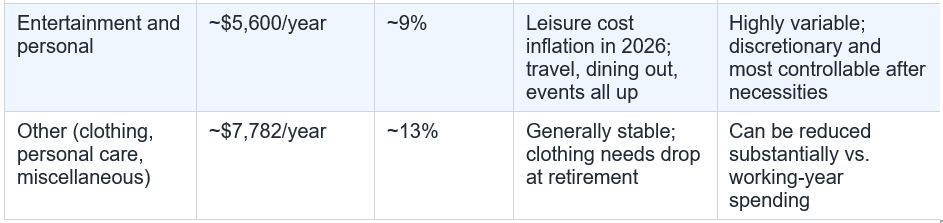
The immediate implication of this data for retirement budgeting: housing and healthcare together represent approximately half of total retirement spending. Transportation and food add another 27 percent. These four categories consume roughly 77 percent of the average retiree’s budget. Getting these four right — and understanding how they change and grow over a 20 to 30 year retirement — is the core challenge of retirement budgeting.
This shift creates three structural challenges that do not exist in working-life budgeting:
The most significant housing decisions in retirement budgeting:
The numbers are significant. Poinciana Advisors Group’s January 2026 analysis of Fidelity’s 2025 Retiree Healthcare Cost Estimate found that a 65-year-old retiring in 2025 needs approximately $172,500 to cover healthcare and medical expenses throughout retirement — not including long-term care. This represents a more than 4 percent increase over 2024. The structural driver: healthcare inflation has historically outpaced general inflation significantly. From 2000 to June 2024, medical care prices rose approximately 121 percent while all consumer prices rose approximately 86 percent (Peterson-KFF Health System Tracker).
What the 2026 budget must account for in healthcare:
The tax categories that require explicit retirement budgeting:
Schroders’ 2025 retirement survey found that 92 percent of retirees are at least slightly concerned about inflation lessening the value of their assets — the highest concern level in the survey, above even healthcare costs. The Free Financial Advisor’s May 2026 analysis of seven retirement budget categories rising faster than inflation notes that housing, healthcare, and food are all showing ‘especially aggressive increases that reshape long-term financial plans.’
The inflation-proofing tools available to retirees:
A simple illustration: a $500,000 retirement portfolio experiencing a 30 percent decline in year two of retirement, while the retiree is withdrawing $25,000 per year, produces a portfolio of approximately $325,000 that must grow back to sustainability. The same decline in year 15, with 13 years of compound growth already accumulated, is far more easily absorbed. The sequencing of bad years matters independently of the average return.
The budget responses to sequence of returns risk:
The budget focus areas for long-term care:
The income gap calculation is the core of retirement budget planning:
Two strategies specifically change the income gap calculation in the retiree’s favour:
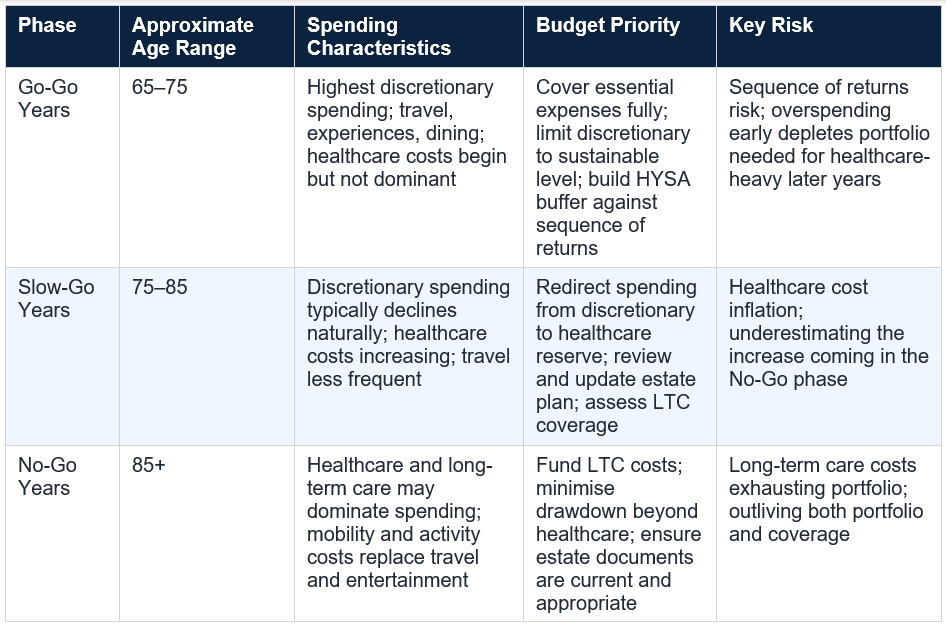
The retirement spending smile provides important practical guidance: the budget built at age 65 is not the right budget for age 80. The retirement budget should be reviewed and updated at each phase transition, with discretionary spending from the Go-Go years expected to decline and healthcare allocations expected to rise significantly. Planning for all three phases rather than extrapolating from the first phase is what distinguishes a sustainable retirement budget from one that encounters a crisis in its second decade.
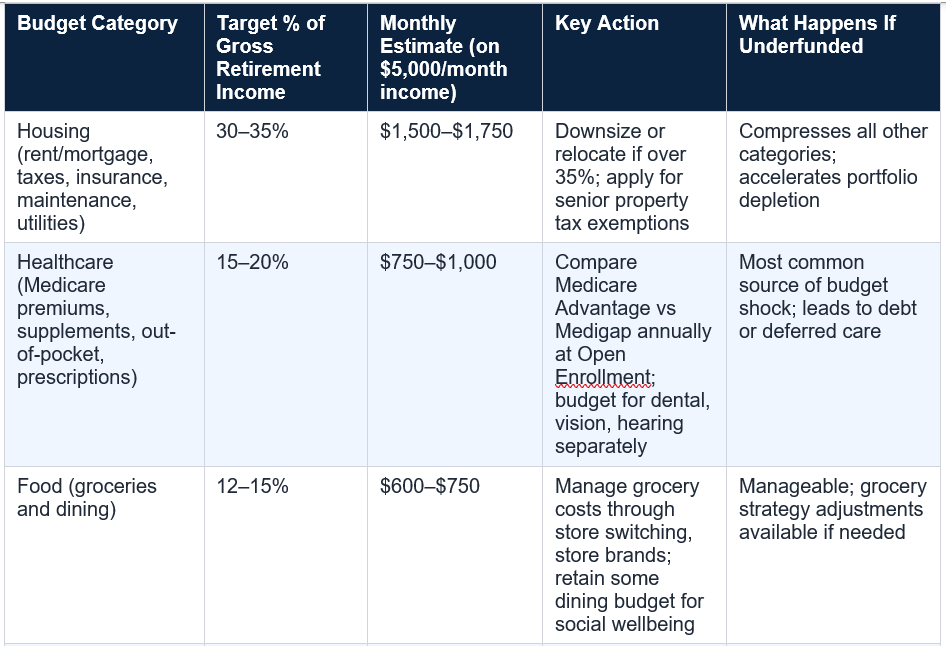
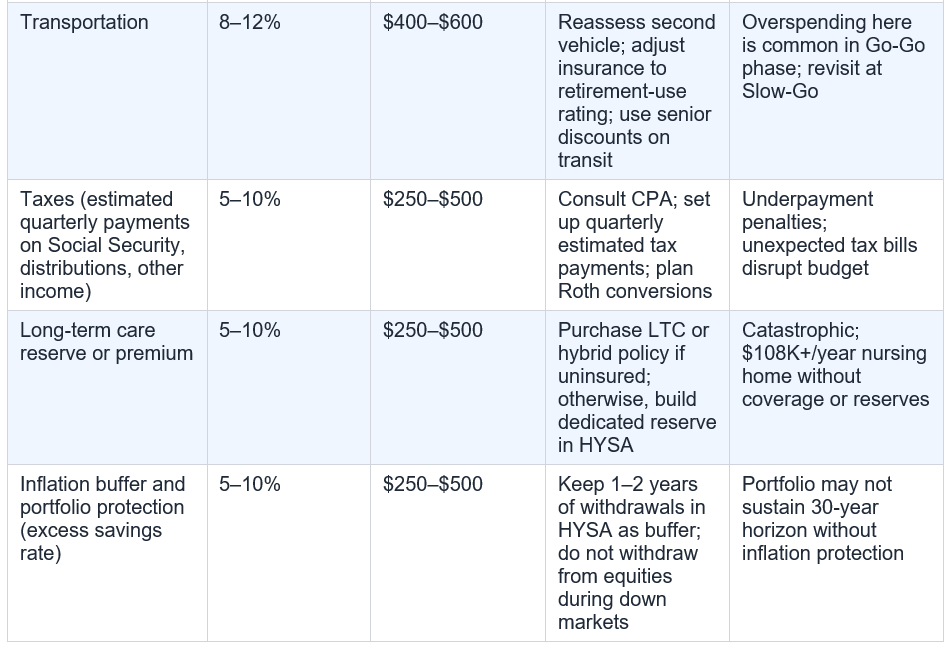
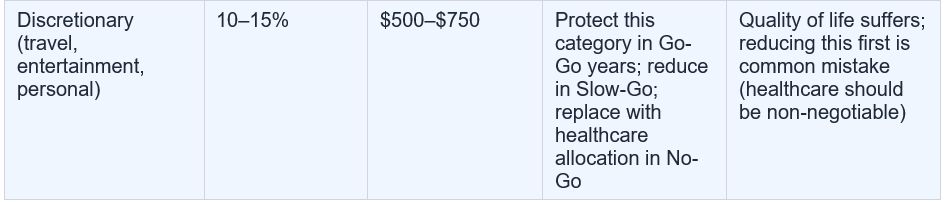
The seven focus areas in this guide — housing, healthcare, taxes, inflation, sequence of returns risk, long-term care, and the Social Security income gap — are the places where retirement budgets most commonly fail, most consistently surprise retirees in negative ways, and most reward deliberate advance planning. They are also the places where the specific financial decisions made in the first three to five years of retirement have the most profound effect on the financial trajectory of the remaining decades.
Forty-five percent of retirees say expenses were higher than expected. The retirees who end up in the other 55 percent are not the ones who happened to face lower costs. They are the ones who built their budget around the seven focus areas rather than around an extrapolation of their final salary and a vague hope that Medicare would handle the rest.
Bureau of Labor Statistics Consumer Expenditure Survey data, reported by Mercer Advisors in January 2026, shows individuals aged 65 and older spent an average of $60,087 per year, or approximately $5,007 per month. MoneyInc's July 2026 analysis puts the 2025 figure at $59,616 per year, or just under $5,000 per month. The four largest spending categories are housing, transportation, healthcare, and food. Housing alone represents approximately 36% of total spending ($22,193/year). These are averages; actual spending varies significantly by location, health status, lifestyle, and whether the retiree still carries a mortgage.
What is the most underestimated retirement expense?
Healthcare, consistently. GoBankingRates' August 2026 retirement analysis quotes Dennis Shirshikov of CUNY: 'Healthcare is the most underestimated line item, not just premiums but out-of-pocket costs that rise with age.' Schroders' 2025 US Retirement Survey found 86% of retirees are concerned about higher-than-expected healthcare costs, and 58% expected Medicare to cover more than it does. Fidelity's 2025 Retiree Healthcare Cost Estimate projects that a 65-year-old needs approximately $172,500 for healthcare through retirement (not including long-term care), more than 4% higher than 2024. Healthcare inflation has historically outpaced general CPI: medical care prices rose approximately 121% from 2000 to June 2024, while all consumer prices rose approximately 86% (Peterson-KFF Health System Tracker).
What is the 4% withdrawal rule and is it still valid in 2026?
The 4% withdrawal rule (originally from financial planner William Bengen in 1994) states that withdrawing 4% of a diversified retirement portfolio annually, adjusted for inflation each year, has historically sustained the portfolio for at least 30 years. For example, a $1 million portfolio would generate $40,000 in year-one withdrawals, adjusted for inflation in subsequent years. In 2026, most financial planners still cite 4% as a reasonable starting point for 30-year retirements, though some now recommend 3 to 3.5% for retirements expected to last 35+ years or for portfolios with high bond allocations in a variable interest rate environment. The 4% rule does not account for sequence of returns risk, which is why maintaining a 1–2 year cash buffer in a HYSA is recommended alongside the rule.
How much should retirees budget for healthcare?
Mercer Advisors' January 2026 guide, citing Fidelity Financial Solutions, recommends allocating approximately 15% of annual retirement expenses to healthcare. On a $60,000/year ($5,000/month) budget, that is $9,000/year or $750/month. This allocation covers Medicare Part B ($202.90/month, automatically deducted from Social Security), a Medicare supplement or Part D drug plan, dental, vision, and hearing expenses, and a reserve for out-of-pocket costs. It does not include long-term care costs, which should be budgeted separately through LTC insurance, a hybrid life/LTC policy, or a dedicated self-insurance reserve. Healthcare inflation of 5–7% annually should be assumed for long-term planning purposes.
What is sequence of returns risk and how does it affect the retirement budget?
Sequence of returns risk is the danger that a major market downturn in the early years of retirement can permanently damage the retirement portfolio's longevity, even if long-term average returns are acceptable. This happens because withdrawals during a declining portfolio lock in losses: a $500,000 portfolio that loses 30% while the retiree withdraws $25,000 falls to approximately $325,000, which must then grow back from a smaller base. The same decline in year 15, with 13 years of prior growth buffering the portfolio, is far less damaging. The primary budget mitigation strategy is maintaining a HYSA cash buffer of 1–2 years of planned portfolio withdrawals, which allows the retiree to fund living expenses from cash while markets recover rather than withdrawing from a declining equity portfolio.
Should retirees delay claiming Social Security benefits?
For most retirees who can manage the cash flow, delaying Social Security collection significantly improves long-term financial outcomes. For every year past 62 that a retiree delays claiming (up to age 70), the benefit increases by approximately 6–8% per year. Delaying from 62 to 70 can increase the monthly benefit by approximately 76%, and the higher base amount receives larger COLA increases each year. The break-even analysis (comparing total cumulative benefits at different claiming ages) typically favours delay for those in reasonable health who expect to live past 80. Because Social Security is an inflation-adjusted, longevity-protected income stream, maximising it reduces the income gap that portfolio withdrawals must close, directly improving portfolio longevity.
Table of Contents
- Why Most Retirement Budgets Miss the Point
- The Real Numbers: What Retirees Actually Spend in 2026
- The Retirement Budget Mindset Shift: From Paycheck to Portfolio
- Focus Area 1: Housing — The Largest and Most Controllable Cost
- Focus Area 2: Healthcare — The Most Underestimated Line Item
- Focus Area 3: Taxes — The Bill Most Retirees Forget to Budget For
- Focus Area 4: Inflation-Proofing the Budget — The Long Horizon Problem
- Focus Area 5: Sequence of Returns Risk — The Timing Problem No One Talks About
- Focus Area 6: Long-Term Care — The Budget Category That Destroys Plans
- Focus Area 7: The Income Gap — What Social Security Does and Does Not Cover
- The Retirement Spending Smile: How Expenses Change by Decade
- The Budget Retirees Should Actually Build: A Category-by-Category Framework
- What Most Retirees Get Wrong About Retirement Budgeting
- Conclusion: Comfort Is Less About a Number Than a Structure
- Frequently Asked Questions
Retiree Spenindgs Breakdown
To Retiree Concerns 2025
Why Most Retirement Budgets Miss the Point
Forty-five percent of retirees say their expenses in retirement are higher than they expected. Sixty-two percent say they have no idea how long their savings will last. And 92 percent are at least slightly concerned about inflation eroding the value of their assets — up from 89 percent the prior year. These are the findings of Schroders’ 2025 US Retirement Survey, and they describe a retirement budgeting problem that is more about focus than about arithmetic.The arithmetic of retirement budgeting is not complicated: estimate income, estimate expenses, identify the gap, build a withdrawal strategy to close it. The focus problem is what most retirees bring to that arithmetic: they budget based on what they spent while working, they underestimate the categories that grow fastest in retirement, they overestimate what Medicare covers, and they fail to account for the structural risks — healthcare cost inflation, sequence of returns risk, long-term care costs — that are specific to retirement and absent from the working-life budget.
GoBankingRates’ August 2026 retirement analysis, quoting Dennis Shirshikov, professor of finance at CUNY and head of growth at Growth Limit, articulates the core principle: a comfortable retirement budget in 2026 is less about a single number and more about coverage, flexibility, and predictability. This guide examines the seven focus areas that retirees must prioritise when building that structure, supported by the most current available data on what retirement actually costs.
The Numbers: 45% of retirees say expenses are higher than expected (Schroders 2025). 62% don’t know how long their savings will last. 92% worried about inflation eroding assets (up from 89%). Average retiree spending: $60,087/year, $5,007/month (BLS/Mercer Advisors January 2026). Average SS benefit: $2,071/month — covering less than half of typical monthly expenses.
The Real Numbers: What Retirees Actually Spend in 2026
The Bureau of Labor Statistics Consumer Expenditure Survey provides the most comprehensive picture of retiree spending. The most recent data, reported by Mercer Advisors in January 2026, shows that individuals aged 65 and older spent an average of $60,087 per year — slightly more than $5,000 per month. MoneyInc’s July 2026 analysis of BLS data puts the 2025 figure at $59,616 per year, or just under $5,000 monthly. The four largest spending categories are housing, transportation, healthcare, and food.The immediate implication of this data for retirement budgeting: housing and healthcare together represent approximately half of total retirement spending. Transportation and food add another 27 percent. These four categories consume roughly 77 percent of the average retiree’s budget. Getting these four right — and understanding how they change and grow over a 20 to 30 year retirement — is the core challenge of retirement budgeting.
The Retirement Budget Mindset Shift: From Paycheck to Portfolio
The most important change in retirement budgeting is not in the line items. It is in the relationship between income and expenses. During working years, income precedes spending: the paycheck arrives, and spending is allocated from it. In retirement, for most households, spending is funded from a combination of Social Security (a guaranteed, inflation-adjusted annuity), pension or defined benefit income if available, and withdrawals from an investment portfolio that can grow or shrink depending on markets.This shift creates three structural challenges that do not exist in working-life budgeting:
- Variable income from portfolio withdrawals: unlike a paycheck, portfolio withdrawals depend on account value, which changes with market performance. A budget built on a fixed portfolio withdrawal amount becomes strained when markets decline.
- Unknown duration: a working-life budget runs for as long as you are employed. A retirement budget must be designed to last for an unknown number of years — which could be 15 years or 35 years depending on health and longevity. Planning for the average life expectancy is not sufficient; planning for the possibility of living 10 to 15 years beyond average is.
- Asymmetric cost inflation: retirement spending faces faster inflation in its two largest categories (housing and healthcare) than in most other areas. A budget calibrated to today’s costs will be systematically underfunded in year 15 if it does not account for this.
Focus Area 1: Housing — The Largest and Most Controllable Cost
Housing is the single largest expense category for most retirees at approximately $22,193 per year or 36 percent of total spending (BLS Consumer Expenditure Survey, Vision Retirement January 2026). Unlike healthcare, whose trajectory is driven by biology and medical inflation rates outside the retiree’s control, housing is the most strategically controllable major retirement expense.The most significant housing decisions in retirement budgeting:
- Mortgage-free status: entering retirement without a mortgage eliminates what is often the single largest monthly obligation. The remaining housing costs — property taxes, homeowner’s insurance, maintenance, and utilities — are significant but substantially lower than a mortgage payment plus those costs combined. The Free Financial Advisor’s May 2026 analysis of retirement budget categories notes that financial advisers increasingly recommend stricter housing caps within retirement budgets to avoid long-term strain.
- Downsizing: Jordan Mangaliman, CEO of Goldline Financial Services, and other financial advisers consistently cite downsizing as one of the most impactful retirement financial decisions. Selling a larger home, purchasing a smaller property with cash from the proceeds, and investing the remaining equity produces both a lower ongoing housing cost and a larger invested portfolio generating additional passive income.
- Geographic arbitrage: housing costs vary enormously by geography. Retirees in high-cost coastal markets who relocate to lower-cost regions frequently reduce their housing costs by 30 to 60 percent, improving Social Security’s real purchasing power dramatically and potentially eliminating the need for portfolio withdrawals for housing.
- Property tax planning: 38 states offer some form of property tax relief for seniors, homestead exemptions, or freeze programs. Many retirees fail to apply for these programmes, effectively overpaying property taxes that are legally reducible.
Focus Area 2: Healthcare — The Most Underestimated Line Item
Healthcare is the retirement budget category that most consistently surprises retirees in a negative direction. Schroders’ 2025 survey found that 86 percent of retirees are concerned about higher-than-expected healthcare costs, and 58 percent expected Medicare to cover a greater portion of their expenses than it does. Mercer Advisors’ January 2026 guide notes that healthcare is one of the most unpredictable and potentially costly aspects of retirement, with expenses rising with age because of medical care, prescriptions, and possible long-term care needs.The numbers are significant. Poinciana Advisors Group’s January 2026 analysis of Fidelity’s 2025 Retiree Healthcare Cost Estimate found that a 65-year-old retiring in 2025 needs approximately $172,500 to cover healthcare and medical expenses throughout retirement — not including long-term care. This represents a more than 4 percent increase over 2024. The structural driver: healthcare inflation has historically outpaced general inflation significantly. From 2000 to June 2024, medical care prices rose approximately 121 percent while all consumer prices rose approximately 86 percent (Peterson-KFF Health System Tracker).
What the 2026 budget must account for in healthcare:
- • Medicare Part B premium: $202.90 per month in 2026, automatically deducted from Social Security. For higher-income retirees, IRMAA surcharges add $69.90 to $419.30 per month on top of the base premium.
- • Medicare Part D prescription drug coverage: typically $20 to $60 per month depending on the plan, plus the drugs' cost-sharing until the catastrophic coverage threshold is reached.
- • Medicare gap coverage: Original Medicare does not cover dental, vision, or hearing. Medigap or Medicare Advantage plans fill gaps but add cost. This is where Open Enrollment comparison is critical.
- • Out-of-pocket costs: copayments, deductibles, and coinsurance add up significantly. Fidelity’s allocation recommendation is approximately 15 percent of annual retirement expenses to healthcare.
- • Inflation buffer: healthcare cost increases of 5 to 7 percent per year should be assumed for long-term planning, not the general CPI rate.
Focus Area 3: Taxes — The Bill Most Retirees Forget to Budget For
Moneywise’s June 2026 expert analysis identifies housing, healthcare, and taxes as the three expenses experts say retirees must manage to protect savings. Taxes are the one that most retirees fail to explicitly budget for, because the paycheck withholding habit disappears at retirement and taxes on retirement income must be managed actively.The tax categories that require explicit retirement budgeting:
- Social Security benefit taxation: up to 85 percent of Social Security benefits can be taxable at the federal level for single filers with combined income above $34,000 and married filers above $44,000. The thresholds are not inflation-adjusted, meaning more retirees cross them every year. A retiree receiving $2,071 per month ($24,852 per year) in Social Security, plus $1,500 per month in required minimum distributions ($18,000 per year), has combined income of $30,426 — above the threshold where benefits become taxable.
- Required Minimum Distributions (RMDs): starting at age 73 under current law, traditional IRA and 401(k) account holders must take RMDs calculated as a percentage of the prior year-end balance. RMDs can push retirees into higher tax brackets, increase Medicare IRMAA exposure, and increase the taxable portion of Social Security benefits simultaneously.
- State income taxes on retirement income: some states tax Social Security benefits, some tax retirement account withdrawals, and some exempt both. The state tax treatment of retirement income is a significant factor in geographic arbitrage decisions.
- Property taxes: as noted in the housing section, property taxes are often reducible for seniors but only with active application.
Focus Area 4: Inflation-Proofing the Budget — The Long Horizon Problem
The most insidious retirement budget risk is not a single bad year. It is the cumulative erosion of purchasing power by inflation over 20 to 30 years. A 3 percent annual inflation rate — roughly the rate of late 2025 — reduces purchasing power by approximately 45 percent over 20 years. What costs $5,000 per month today will cost approximately $9,000 per month in today’s dollars by 2046, if the retiree is still living and inflation averages 3 percent annually.Schroders’ 2025 retirement survey found that 92 percent of retirees are at least slightly concerned about inflation lessening the value of their assets — the highest concern level in the survey, above even healthcare costs. The Free Financial Advisor’s May 2026 analysis of seven retirement budget categories rising faster than inflation notes that housing, healthcare, and food are all showing ‘especially aggressive increases that reshape long-term financial plans.’
The inflation-proofing tools available to retirees:
- Social Security COLA: Social Security benefits are automatically indexed to inflation through annual cost-of-living adjustments (2.8% in 2026). This is the most reliable inflation protection in the retirement income toolkit — and one of the strongest arguments for delaying Social Security collection to maximise the COLA-adjusted benefit.
- TIPS and I-bonds: Treasury Inflation-Protected Securities and I-Series Savings Bonds provide interest returns that adjust with inflation, protecting fixed income allocations from purchasing power erosion.
- Equity allocation in the portfolio: stocks have historically outpaced inflation over long periods. Maintaining an appropriate equity allocation in the retirement portfolio — rather than shifting entirely to fixed income at retirement — is the primary long-term inflation defense.
- Retirement spending categories audit: not all spending inflates at the same rate. Housing can be reduced by downsizing. Transportation can be reduced by going to one vehicle. Food can be managed through store-brand switching. Healthcare cannot easily be reduced but can be anticipated. The audit identifies which inflation exposures can be mitigated through behaviour and which require portfolio defense.
Focus Area 5: Sequence of Returns Risk — The Timing Problem
Sequence of returns risk is the most technically specific of the retirement budget focus areas — and the one most consistently absent from pre-retirement financial planning conversations. The risk is this: a major market downturn in the early years of retirement is significantly more damaging to long-term financial security than the same downturn occurring later, because withdrawals from a declining portfolio permanently reduce the base from which future growth occurs.A simple illustration: a $500,000 retirement portfolio experiencing a 30 percent decline in year two of retirement, while the retiree is withdrawing $25,000 per year, produces a portfolio of approximately $325,000 that must grow back to sustainability. The same decline in year 15, with 13 years of compound growth already accumulated, is far more easily absorbed. The sequencing of bad years matters independently of the average return.
The budget responses to sequence of returns risk:
- A cash buffer (one to two years of portfolio withdrawals in HYSA): eliminates the need to sell equities during market downturns by funding living expenses from the cash buffer while the equity portfolio recovers.
- A conservative initial withdrawal rate: the widely-cited 4 percent withdrawal rule (originally from Bengen, 1994) has been shown to historically sustain a diversified retirement portfolio for 30 years. Some financial planners now use 3 to 3.5 percent for very long retirements (35+ years) or high equity exposure uncertainty.
- Flexible withdrawal strategy: reducing discretionary spending during down markets (delaying a planned renovation, reducing travel that year) allows the portfolio to recover before full withdrawals resume.
Focus Area 6: Long-Term Care — The Budget Category That Destroys Plans
Long-term care is the retirement budget category most likely to be absent from a retiree’s financial plan and most likely to be catastrophic if unplanned. The costs are significant and growing. The median annual cost of a private nursing home room in 2024 was approximately $108,405 (Genworth/A Place for Mom, widely cited), and the median annual cost of assisted living was approximately $64,200. These costs are not covered by Medicare (which covers only short-term post-acute care), not covered by most standard health insurance, and typically only covered by Medicaid after most assets have been spent down.The budget focus areas for long-term care:
- Long-term care insurance: purchased before retirement at lower premiums, LTC insurance provides a daily or monthly benefit that offsets the cost of nursing home, assisted living, or in-home care. Traditional standalone LTC policies have become expensive and some insurers have exited the market; hybrid life/LTC policies (which provide either a death benefit or LTC coverage) have grown significantly in availability.
- Self-insurance through sufficient portfolio size: retirees with portfolios above $1.5 to $2 million may be able to self-insure for moderate LTC needs, using portfolio assets to fund care if needed. This strategy requires careful calculation of the portfolio’s longevity given the potential additional withdrawal.
- Family care planning: for some families, informal care by family members is a planned supplement to or replacement for formal LTC facilities. This requires explicit family discussion and planning, not assumption.
- Medicaid planning: retirees who may eventually need Medicaid to fund care should be aware of the Medicaid asset spend-down rules and the look-back period for asset transfers. An elder law attorney can provide specific guidance.
Focus Area 7: The Income Gap — What Social Security Does and Does Not Cover
The average Social Security retired-worker benefit is $2,071 per month in 2026 — covering less than half of the average monthly retirement spending of approximately $5,000. This income gap — the difference between guaranteed income from Social Security and pensions on one side, and total monthly expenses on the other — is what portfolio withdrawals must close.The income gap calculation is the core of retirement budget planning:
- Guaranteed monthly income: Social Security benefit + pension if any + annuity income if any.
- Total monthly expenses: from the budget built across all seven focus areas.
- Monthly gap: Total expenses minus Guaranteed income = the amount portfolio withdrawals must cover each month.
Two strategies specifically change the income gap calculation in the retiree’s favour:
- Delaying Social Security collection: for every year past 62 that a retiree delays claiming (up to age 70), the benefit increases by approximately 6 to 8 percent. Delaying from 62 to 70 increases the benefit by approximately 76 percent. The higher base also produces proportionally larger COLA increases each year. Delaying Social Security is often the single most impactful financial decision available to a pre-retiree.
- Reducing expenses in the first years of retirement: the income gap closes arithmetically if expenses fall. The retirement spending ‘smile’ (discussed in the next section) confirms that many retirees naturally spend less in their 70s and 80s than in their mid-60s, which reduces the portfolio withdrawal pressure precisely when the portfolio needs the most protection from sequence of returns risk.
The Retirement Spending Smile: How Expenses Change by Decade
Research on retirement spending patterns consistently identifies what financial planners call the retirement spending ‘smile’: spending is highest in the early years of retirement (the ‘Go-Go’ years, roughly 65 to 75), declines during the middle years (the ‘Slow-Go’ years, roughly 75 to 85) as activity levels and travel naturally decrease, then rises again in the later years (the ‘No-Go’ years, 85+) as healthcare and long-term care costs escalate.The retirement spending smile provides important practical guidance: the budget built at age 65 is not the right budget for age 80. The retirement budget should be reviewed and updated at each phase transition, with discretionary spending from the Go-Go years expected to decline and healthcare allocations expected to rise significantly. Planning for all three phases rather than extrapolating from the first phase is what distinguishes a sustainable retirement budget from one that encounters a crisis in its second decade.
The Budget Retirees Should Actually Build: A Category-by-Category Framework
With the seven focus areas in view, here is the practical budget structure for a new retiree in 2026:
What Most Retirees Get Wrong About Retirement Budgeting
The Schroders 2025 survey data identifies the gap between what retirees expected and what retirement actually delivered financially. The most consistent errors:- Building the retirement budget from current spending rather than retirement-specific categories: the working-life budget includes payroll taxes, commuting costs, work wardrobe, and professional memberships that disappear at retirement. But it does not include healthcare at retirement levels, long-term care reserves, or inflation buffers calibrated to a 25-year horizon. A budget transplanted from working life to retirement is systematically wrong in both directions.
- Assuming Medicare covers most healthcare costs: 58% of retirees expected Medicare to cover more than it does (Schroders 2025). Original Medicare covers hospitalisation and outpatient medical care but has significant gaps: no dental, vision, or hearing coverage; significant cost-sharing through deductibles and coinsurance; and zero long-term care coverage.
- Ignoring sequence of returns risk in the first withdrawal years: the households that experience the worst retirement outcomes are not primarily those with the lowest balances. They are those who withdraw heavily from declining portfolios in the first five years of retirement without a cash buffer.
- Treating retirement spending as fixed: the retirement spending smile confirms that spending naturally changes across the three retirement phases. A budget that does not evolve phase by phase will either leave money on the table in the Go-Go years or create a crisis in the No-Go years.
- Not accounting for RMD effects on taxes: starting at age 73, RMDs from traditional IRAs and 401(k)s add taxable income that can increase Social Security taxes, Medicare IRMAA surcharges, and marginal tax rates simultaneously. Pre-retirees who ignore this in their planning are frequently shocked by the tax consequences of their RMD years.
Conclusion
Dennis Shirshikov’s framing — that a comfortable retirement budget in 2026 is less about a single number and more about coverage, flexibility, and predictability — is the most useful guide to what retirees should really focus on when building their budget. The average retiree spends approximately $5,000 per month. Social Security covers approximately $2,071 of that. The gap is real and requires a portfolio of sufficient size and structure to close it over 25 to 30 years.The seven focus areas in this guide — housing, healthcare, taxes, inflation, sequence of returns risk, long-term care, and the Social Security income gap — are the places where retirement budgets most commonly fail, most consistently surprise retirees in negative ways, and most reward deliberate advance planning. They are also the places where the specific financial decisions made in the first three to five years of retirement have the most profound effect on the financial trajectory of the remaining decades.
Forty-five percent of retirees say expenses were higher than expected. The retirees who end up in the other 55 percent are not the ones who happened to face lower costs. They are the ones who built their budget around the seven focus areas rather than around an extrapolation of their final salary and a vague hope that Medicare would handle the rest.
Frequently Asked Questions
How much does the average retiree spend per month in 2026?Bureau of Labor Statistics Consumer Expenditure Survey data, reported by Mercer Advisors in January 2026, shows individuals aged 65 and older spent an average of $60,087 per year, or approximately $5,007 per month. MoneyInc's July 2026 analysis puts the 2025 figure at $59,616 per year, or just under $5,000 per month. The four largest spending categories are housing, transportation, healthcare, and food. Housing alone represents approximately 36% of total spending ($22,193/year). These are averages; actual spending varies significantly by location, health status, lifestyle, and whether the retiree still carries a mortgage.
What is the most underestimated retirement expense?
Healthcare, consistently. GoBankingRates' August 2026 retirement analysis quotes Dennis Shirshikov of CUNY: 'Healthcare is the most underestimated line item, not just premiums but out-of-pocket costs that rise with age.' Schroders' 2025 US Retirement Survey found 86% of retirees are concerned about higher-than-expected healthcare costs, and 58% expected Medicare to cover more than it does. Fidelity's 2025 Retiree Healthcare Cost Estimate projects that a 65-year-old needs approximately $172,500 for healthcare through retirement (not including long-term care), more than 4% higher than 2024. Healthcare inflation has historically outpaced general CPI: medical care prices rose approximately 121% from 2000 to June 2024, while all consumer prices rose approximately 86% (Peterson-KFF Health System Tracker).
What is the 4% withdrawal rule and is it still valid in 2026?
The 4% withdrawal rule (originally from financial planner William Bengen in 1994) states that withdrawing 4% of a diversified retirement portfolio annually, adjusted for inflation each year, has historically sustained the portfolio for at least 30 years. For example, a $1 million portfolio would generate $40,000 in year-one withdrawals, adjusted for inflation in subsequent years. In 2026, most financial planners still cite 4% as a reasonable starting point for 30-year retirements, though some now recommend 3 to 3.5% for retirements expected to last 35+ years or for portfolios with high bond allocations in a variable interest rate environment. The 4% rule does not account for sequence of returns risk, which is why maintaining a 1–2 year cash buffer in a HYSA is recommended alongside the rule.
How much should retirees budget for healthcare?
Mercer Advisors' January 2026 guide, citing Fidelity Financial Solutions, recommends allocating approximately 15% of annual retirement expenses to healthcare. On a $60,000/year ($5,000/month) budget, that is $9,000/year or $750/month. This allocation covers Medicare Part B ($202.90/month, automatically deducted from Social Security), a Medicare supplement or Part D drug plan, dental, vision, and hearing expenses, and a reserve for out-of-pocket costs. It does not include long-term care costs, which should be budgeted separately through LTC insurance, a hybrid life/LTC policy, or a dedicated self-insurance reserve. Healthcare inflation of 5–7% annually should be assumed for long-term planning purposes.
What is sequence of returns risk and how does it affect the retirement budget?
Sequence of returns risk is the danger that a major market downturn in the early years of retirement can permanently damage the retirement portfolio's longevity, even if long-term average returns are acceptable. This happens because withdrawals during a declining portfolio lock in losses: a $500,000 portfolio that loses 30% while the retiree withdraws $25,000 falls to approximately $325,000, which must then grow back from a smaller base. The same decline in year 15, with 13 years of prior growth buffering the portfolio, is far less damaging. The primary budget mitigation strategy is maintaining a HYSA cash buffer of 1–2 years of planned portfolio withdrawals, which allows the retiree to fund living expenses from cash while markets recover rather than withdrawing from a declining equity portfolio.
Should retirees delay claiming Social Security benefits?
For most retirees who can manage the cash flow, delaying Social Security collection significantly improves long-term financial outcomes. For every year past 62 that a retiree delays claiming (up to age 70), the benefit increases by approximately 6–8% per year. Delaying from 62 to 70 can increase the monthly benefit by approximately 76%, and the higher base amount receives larger COLA increases each year. The break-even analysis (comparing total cumulative benefits at different claiming ages) typically favours delay for those in reasonable health who expect to live past 80. Because Social Security is an inflation-adjusted, longevity-protected income stream, maximising it reduces the income gap that portfolio withdrawals must close, directly improving portfolio longevity.
0 Comments
Be the first to share your thoughts on this article.