
Budgeting
Priority-Based Budgeting: How Does It Work? Accountant Explains

The complete 2026 guide to aligning every dollar with what you actually value — and why 86% of Americans with a budget still live paycheck to paycheck

Intuit’s January 2026 Financial Wellness survey, which tracked the financial emotions and behaviours of American consumers entering 2026, found that 61 percent identify money as their primary life stressor, 53 percent reported an increase in financial stress over the past year, and 37 percent feel managing money is so overwhelming they do not know where to begin. And yet 93 percent plan to make changes to how they manage their money in 2026. There is no shortage of intention. There is a structural problem with how traditional budgeting approaches turn that intention into lasting behaviour.
The traditional budget is a list of categories with spending limits assigned to each. It is organised by expense type, not by importance. It treats a gym membership and a mortgage payment as equivalent line items — things to be constrained or cut as needed. Priority-based budgeting inverts this logic. It starts with what matters most to the specific person and builds the budget outward from there. The result is a budget that is not a restriction on the life you want to live but a map toward it.
The Numbers: 69% of Americans live paycheck to paycheck despite 86% having a budget (Debt.com 2025; PFCU January 2026). 93% plan financial changes in 2026 (Intuit). 61% say money is their top life stressor. 37% find money management too overwhelming to start.
The fundamental distinction from traditional budgeting is philosophical before it is mathematical. A traditional budget asks: how much do I spend on food, housing, entertainment, and savings? Priority-based budgeting asks: what do I actually care about most, and is my money going there? The spending categories emerge from the answers to those questions rather than from a generic template.
US Bank’s guide to budgeting strategies describes the values-based version as follows: you simply let your life’s priorities dictate where you spend your money. For example, you could value travel more than living in an expensive apartment, so you choose a more modest living situation to fund frequent travel. The point is not to spend less overall. It is to spend intentionally, in alignment with what generates genuine satisfaction rather than in response to default patterns, social comparison, or marketing.
PFCU’s January 2026 comprehensive money management guide makes the same point in more practical terms: budgets fail when they overlook what makes your life feel worthwhile. If you love having fresh flowers on your kitchen table, cutting that expense might save you $100 per month but cost you daily joy. Meanwhile, you might be paying $80 per month for a gym membership you have not used since February. Traditional budgeting treats these as equivalent line items. A budget that actually works recognises they are entirely different.
Key Insight: Priority-based budgeting is not about spending less. It is about spending deliberately — directing money toward what genuinely matters and away from what does not, based on your specific values rather than a universal rule.
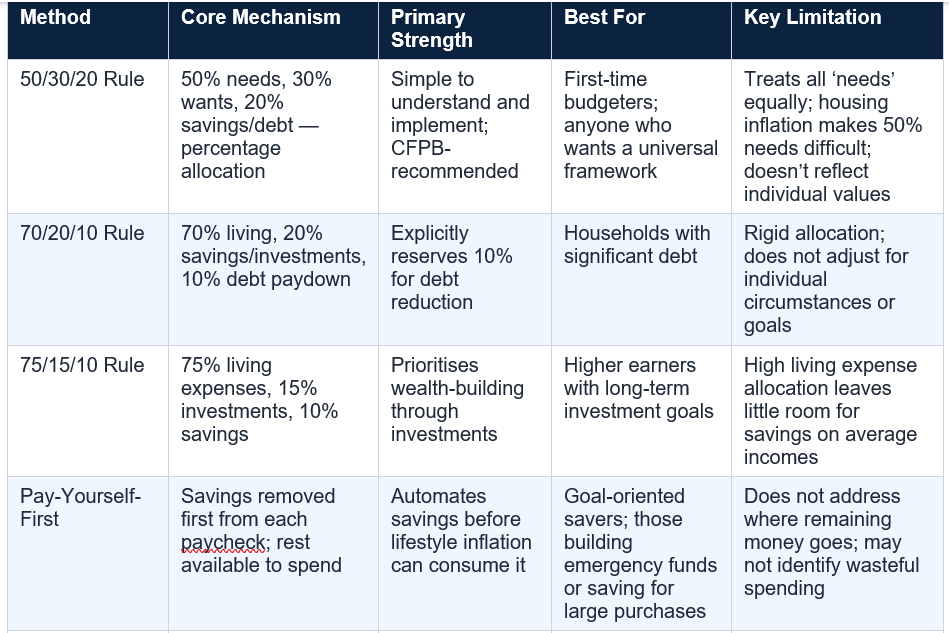
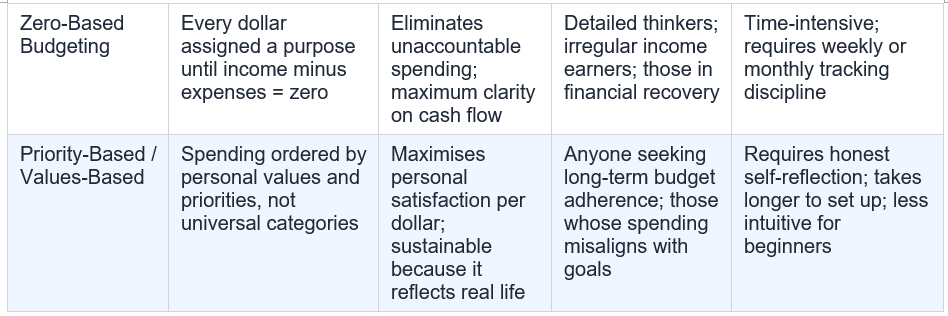
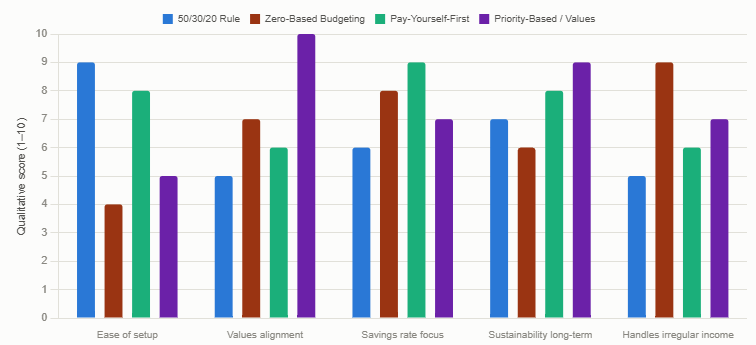
The priority-based approach works most effectively as a meta-framework that can incorporate the mechanics of other methods. For example, a priority-based budgeter might use pay-yourself-first mechanics to automate their top-priority savings goal, and zero-based budgeting to track every dollar within the lower-priority spending tiers. The philosophy of values-alignment governs what the structure looks like; the mechanics of other methods can support its execution.
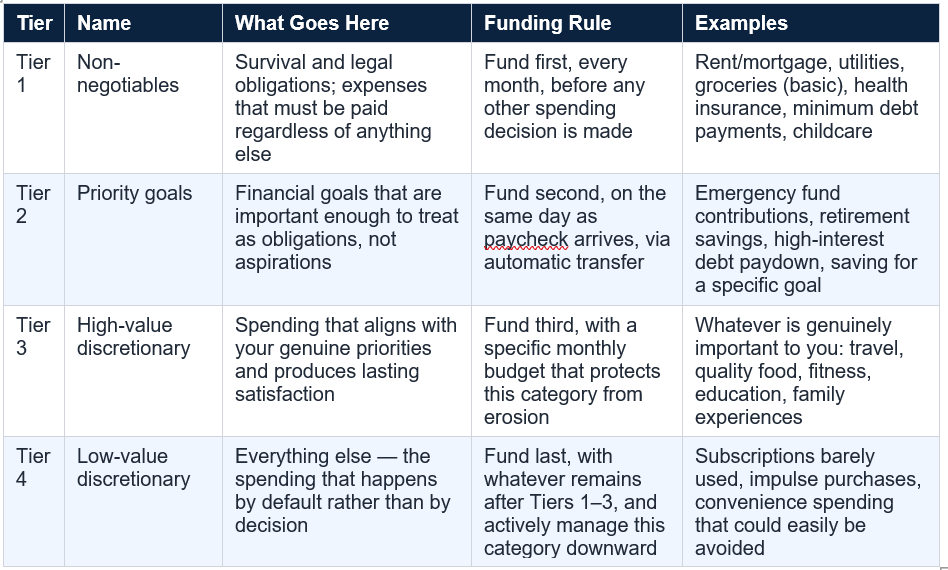
The tiering structure does the work that most budgets fail to do: it makes explicit which spending is chosen and which is defaulted into. Most budget problems exist in Tier 4 — not because people are spending too much on things they value, but because they are spending significant amounts on things that happened to be charged to a card rather than decided upon. Priority-based budgeting names and limits Tier 4 explicitly.
Key Insight: The most important budgeting move most households can make is shifting from an unmanaged Tier 4 to a managed one. This is where the gap between the 86% who have a budget and the 69% who still struggle is almost entirely located.
PFCU’s January 2026 guide gives the instruction directly: start your financial reset by identifying what genuinely matters to you. Not what should matter. What actually brings you satisfaction, comfort, or connection? This is harder than it sounds because most people carry a set of aspirational priorities (homeownership, travel, fitness, family time) that are not reflected in their actual spending patterns, and a set of habitual spending patterns (subscriptions, convenience food, retail browsing) that are not actually satisfying but continue anyway.
The practical exercise for Step 1:
Finance Monthly’s December 2025 budgeting guide and Midpenn Bank’s January 2026 guide both describe this category-mapping exercise as the essential foundation for any budget that will actually change behaviour. The key categories to examine in the audit:
The funding sequence on payday:
Alexa von Tobel, founder and managing director of Inspired Capital (CBS News, December 2025): Money management is becoming less about discipline and more about system design. Automate what you can, use tools that give you back time and clarity, and let your financial plan run even when your schedule gets chaotic.
Dollar-boundary setting principles for each tier:
What to automate in a priority-based budget:
Action: Open a separate high-yield savings account specifically for each Tier 2 goal. Label each account with its goal name: ‘Emergency Fund,’ ‘House Down Payment,’ ‘Retirement Bridge.’ Named accounts have been shown in behavioural economics research to increase the rate at which goals are funded and reduce the rate at which they are raided for non-purpose spending.
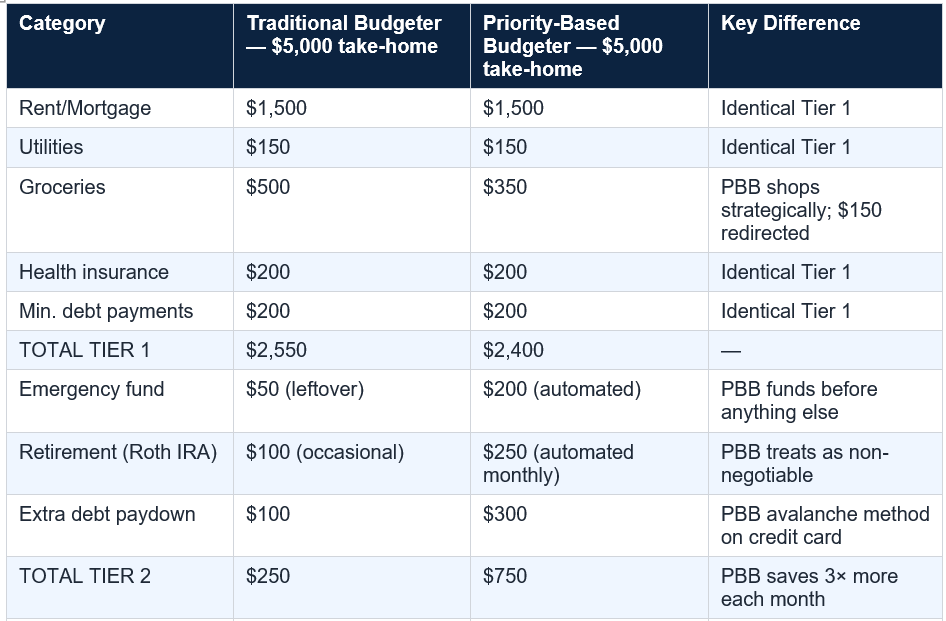
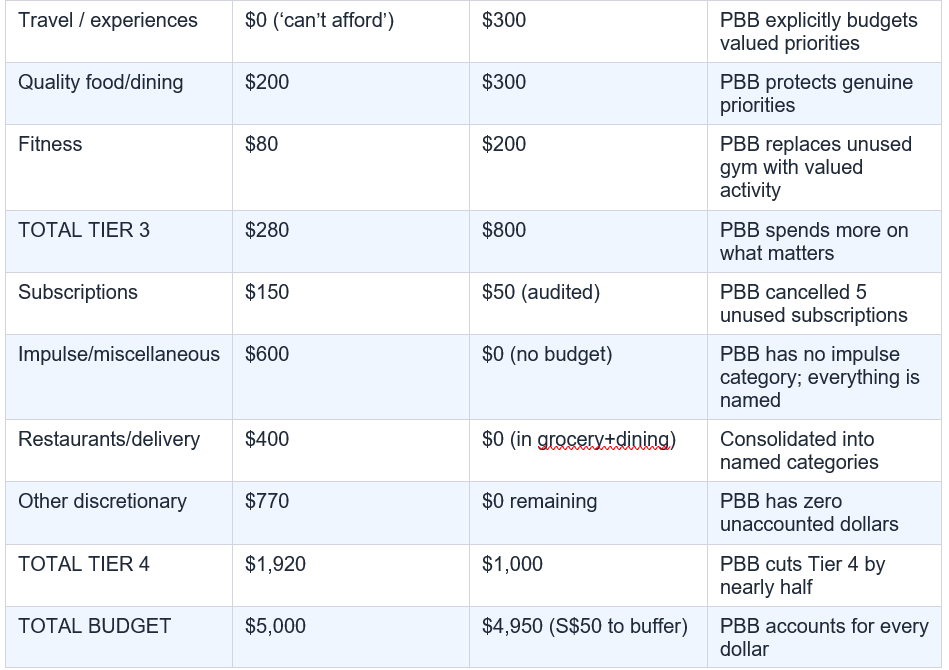
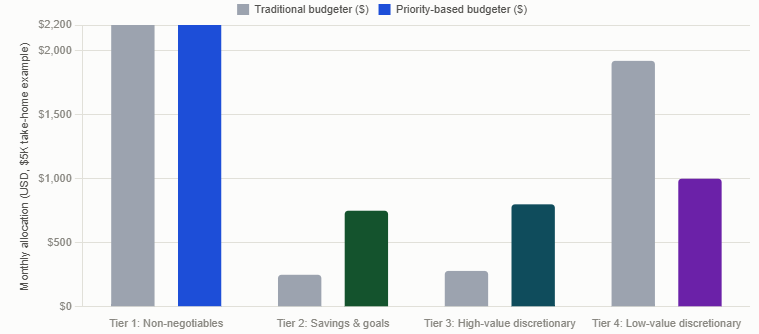
The traditional budgeter saves $250 per month and has $1,920 in unmanaged discretionary spending. The priority-based budgeter saves $750 per month, spends $800 on things genuinely valued, and has only $1,000 in managed, named discretionary spending. Same income. Dramatically different outcomes. The difference is not discipline — it is structure.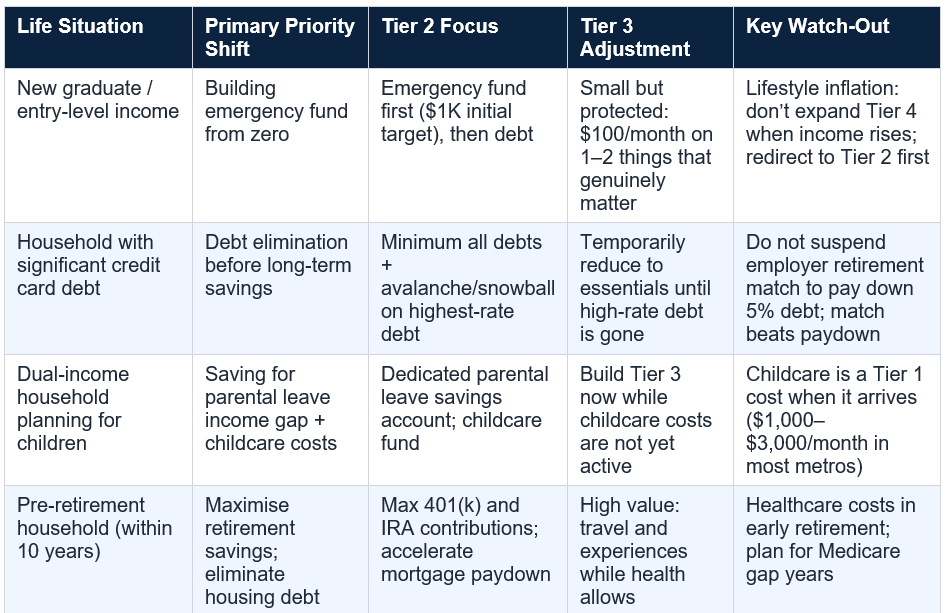

The five steps of priority-based budgeting — identifying real priorities, auditing current spending, funding tiers in order, setting dollar boundaries on every tier, and automating the non-negotiable tiers — are not complicated. But they are deliberate in a way that default budgeting is not. They require an honest look at the gap between what you say you value and where your money actually goes, and they require the structural discipline of funding what matters first, not last.
Ninety-three percent of Americans plan to change how they manage money in 2026. Most of those changes will involve better tracking, stricter category limits, and more optimistic projections. Priority-based budgeting is a different kind of change: it is the decision to let your life’s actual priorities be the architecture of the budget, rather than building a budget and hoping your life fits inside it. That shift — from budget as constraint to budget as map — is the one that makes the numbers sustainable.
Priority-based budgeting (also called values-based budgeting) aligns your spending with your actual values and goals rather than with a universal percentage template. Unlike the 50/30/20 rule, which assigns fixed percentages to needs, wants, and savings regardless of individual priorities, priority-based budgeting starts with a reflection exercise to identify what genuinely matters to you, then builds the budget outward from those priorities. US Bank’s budgeting strategies guide describes values-based budgeting as simply letting your life’s priorities dictate where you spend your money. The method differs from traditional budgeting in treating expenses as tiered by importance rather than as equal line items to be constrained.
Why do so many people with budgets still struggle financially?
According to Debt.com’s annual survey cited by PFCU’s January 2026 money management guide, 69% of Americans live paycheck to paycheck despite 86% claiming to have a budget. The core reason is that most traditional budgets are organisational tools — they categorise spending without addressing whether the spending aligns with what the person actually values. PFCU’s guide states that budgets fail when they overlook what makes your life feel worthwhile. Priority-based budgeting addresses this by treating values-alignment as the primary design criterion, making the budget sustainable because it reflects real life rather than an idealised template.
What are the four tiers in priority-based budgeting?
Tier 1: Non-negotiables — survival and legal obligations (rent, utilities, insurance, minimum debt payments, groceries). Fund first, every month. Tier 2: Priority goals — financial goals treated as obligations, not aspirations (emergency fund, retirement savings, debt paydown). Fund second, via automatic transfer on payday. Tier 3: High-value discretionary — spending that aligns with genuine personal priorities and produces lasting satisfaction. Fund third, with a protected monthly budget. Tier 4: Low-value discretionary — spending that happens by default rather than by decision (unused subscriptions, impulse purchases, convenience spending). Fund last with a firm ceiling from whatever remains after Tiers 1–3.
How do I identify my actual priorities for a priority-based budget?
PFCU’s January 2026 money management guide recommends starting by identifying what genuinely matters to you — not what should matter, but what actually brings satisfaction, comfort, or connection. The practical exercise: (1) Write down the five things that produce the most genuine satisfaction in your life. (2) Write down your three to five most important financial goals for the next one to five years. (3) Pull three months of bank and credit card statements and categorise every transaction. (4) Compare what you wrote in steps 1 and 2 against where your money actually went in step 3. The gap between these two lists is the priority-spending misalignment that priority-based budgeting is designed to close.
What is the correct order to fund financial priorities in 2026?
According to NerdWallet’s budgeting guide and CFPB guidance: (1) Tier 1 non-negotiables first: all essential living costs and minimum debt payments. (2) Emergency fund: initial target $1,000, then build to three to six months of expenses. (3) Employer-matched retirement contributions: the employer match is a 100% guaranteed return and should not be forfeited. (4) High-interest debt paydown: credit card and other high-APR debt (the CFPB recommends tackling highest-rate first — the avalanche method). (5) Additional retirement contributions. (6) Other savings goals. (7) Tier 3 and Tier 4 spending with remaining income.
How often should I review a priority-based budget?
Monthly reviews are recommended for the spending side: compare actual vs planned for each tier, identify overruns, and make conscious reallocations rather than allowing Tier 4 to absorb overruns from other tiers. Quarterly reviews are recommended for the priorities themselves: assess whether your stated Tier 3 priorities still reflect what genuinely matters, whether income has changed in ways that allow Tier 2 increases, and whether any Tier 2 goals have been achieved and can be replaced with new ones. Finance Monthly’s December 2025 guide and Midpenn Bank’s January 2026 guide both recommend quarterly reviews for lifestyle shifts and long-term progress assessment.
Traditional vs Priority Based Budgeting
Budget Method Break-down
Table of Contents
- Why Most Budgets Fail (and It’s Not the Math)
- What Is Priority-Based Budgeting?
- Priority-Based Budgeting vs Other Budget Methods
- The Core Framework: The Four Priority Tiers
- Step 1: Identify Your Actual Priorities (Not the Ones You Think You Have)
- Step 2: Audit Your Current Spending Against Your Stated Priorities
- Step 3: Fund the Tiers in Order
- Step 4: Set Dollar Boundaries on Every Tier
- Step 5: Automate the Non-Negotiable Tiers
- The Priority-Based Budget in Practice: A Worked Example
- How to Handle Competing Priorities
- Priority-Based Budgeting for Specific Life Situations
- Common Mistakes and How to Avoid Them
- The Tools That Support Priority-Based Budgeting in 2026
- Conclusion: Your Budget Should Reflect Your Life, Not a Spreadsheet Template
- Frequently Asked Questions
Why Most Budgets Fail (and It’s Not the Math)
Sixty-nine percent of Americans lived paycheck to paycheck in 2025. The figure that makes this particularly striking is the one alongside it: 86 percent of the same group claimed to have a budget. According to Debt.com’s annual survey and PFCU’s January 2026 money management guide, the problem is not the absence of budgeting. Most people who are struggling financially have a budget. The problem is the kind of budget they have.Intuit’s January 2026 Financial Wellness survey, which tracked the financial emotions and behaviours of American consumers entering 2026, found that 61 percent identify money as their primary life stressor, 53 percent reported an increase in financial stress over the past year, and 37 percent feel managing money is so overwhelming they do not know where to begin. And yet 93 percent plan to make changes to how they manage their money in 2026. There is no shortage of intention. There is a structural problem with how traditional budgeting approaches turn that intention into lasting behaviour.
The traditional budget is a list of categories with spending limits assigned to each. It is organised by expense type, not by importance. It treats a gym membership and a mortgage payment as equivalent line items — things to be constrained or cut as needed. Priority-based budgeting inverts this logic. It starts with what matters most to the specific person and builds the budget outward from there. The result is a budget that is not a restriction on the life you want to live but a map toward it.
The Numbers: 69% of Americans live paycheck to paycheck despite 86% having a budget (Debt.com 2025; PFCU January 2026). 93% plan financial changes in 2026 (Intuit). 61% say money is their top life stressor. 37% find money management too overwhelming to start.
What Is Priority-Based Budgeting?
Priority-based budgeting — also described as values-based budgeting in personal finance literature — is a method of managing personal finances that aligns spending with the individual’s actual values and goals rather than with a universal percentage template. FasterCapital’s guide to priority-based budgeting defines it as a method that helps you prioritise the things that matter most to you and cut out expenses that do not contribute to your happiness or well-being. It achieves a more balanced and fulfilling lifestyle while also saving money for your future.The fundamental distinction from traditional budgeting is philosophical before it is mathematical. A traditional budget asks: how much do I spend on food, housing, entertainment, and savings? Priority-based budgeting asks: what do I actually care about most, and is my money going there? The spending categories emerge from the answers to those questions rather than from a generic template.
US Bank’s guide to budgeting strategies describes the values-based version as follows: you simply let your life’s priorities dictate where you spend your money. For example, you could value travel more than living in an expensive apartment, so you choose a more modest living situation to fund frequent travel. The point is not to spend less overall. It is to spend intentionally, in alignment with what generates genuine satisfaction rather than in response to default patterns, social comparison, or marketing.
PFCU’s January 2026 comprehensive money management guide makes the same point in more practical terms: budgets fail when they overlook what makes your life feel worthwhile. If you love having fresh flowers on your kitchen table, cutting that expense might save you $100 per month but cost you daily joy. Meanwhile, you might be paying $80 per month for a gym membership you have not used since February. Traditional budgeting treats these as equivalent line items. A budget that actually works recognises they are entirely different.
Key Insight: Priority-based budgeting is not about spending less. It is about spending deliberately — directing money toward what genuinely matters and away from what does not, based on your specific values rather than a universal rule.
Priority-Based Budgeting vs Other Budget Methods
Before implementing priority-based budgeting, it is useful to understand where it sits relative to the other major personal budgeting frameworks. Each method has a different primary mechanism and suits different personality types and life situations:The priority-based approach works most effectively as a meta-framework that can incorporate the mechanics of other methods. For example, a priority-based budgeter might use pay-yourself-first mechanics to automate their top-priority savings goal, and zero-based budgeting to track every dollar within the lower-priority spending tiers. The philosophy of values-alignment governs what the structure looks like; the mechanics of other methods can support its execution.
The Core Framework: The Four Priority Tiers
Priority-based budgeting organises spending into tiers, funded in order of importance. The standard four-tier structure:The tiering structure does the work that most budgets fail to do: it makes explicit which spending is chosen and which is defaulted into. Most budget problems exist in Tier 4 — not because people are spending too much on things they value, but because they are spending significant amounts on things that happened to be charged to a card rather than decided upon. Priority-based budgeting names and limits Tier 4 explicitly.
Key Insight: The most important budgeting move most households can make is shifting from an unmanaged Tier 4 to a managed one. This is where the gap between the 86% who have a budget and the 69% who still struggle is almost entirely located.
Step 1: Identify Your Actual Priorities (Not the Ones You Think You Have)
The first step in priority-based budgeting is not pulling out a spreadsheet. It is an honest reflection exercise that most budgeting guides skip entirely. The question is not what you think you should prioritise — it is what you actually care about, revealed by the evidence of how you live.PFCU’s January 2026 guide gives the instruction directly: start your financial reset by identifying what genuinely matters to you. Not what should matter. What actually brings you satisfaction, comfort, or connection? This is harder than it sounds because most people carry a set of aspirational priorities (homeownership, travel, fitness, family time) that are not reflected in their actual spending patterns, and a set of habitual spending patterns (subscriptions, convenience food, retail browsing) that are not actually satisfying but continue anyway.
The practical exercise for Step 1:
- Write down the five things in your life that produce the most genuine satisfaction, connection, or progress toward who you want to be. These are your Tier 3 priorities.
- Write down your three to five most important financial goals for the next one to five years. These are your Tier 2 priorities.
- Pull three months of bank and credit card statements. Categorise every transaction. Note where the money is actually going without editing or defending any category.
- Compare the two lists. The gap between what you wrote on the first two lists and where the money has actually been going is the gap that priority-based budgeting closes.
Step 2: Audit Your Current Spending Against Your Stated Priorities
Once priorities are identified, the spending audit becomes a diagnostic rather than a punishment. The question is not ‘am I spending too much’ but ‘is what I am spending aligned with what I said I valued?’Finance Monthly’s December 2025 budgeting guide and Midpenn Bank’s January 2026 guide both describe this category-mapping exercise as the essential foundation for any budget that will actually change behaviour. The key categories to examine in the audit:
- • Non-negotiables: are any currently being underpaid or at risk of missed payment? Establish exact monthly totals for each.
- • Savings and goal funding: is any money being saved automatically, or is saving whatever happens to be left at the end of the month? The Nacca CPA January 2026 household budget guide notes that most families save what is left over at the end of the month — which often means nothing gets saved at all.
- • Tier 3 (high-value discretionary): are the categories you identified as genuinely valuable in Step 1 actually receiving money? Or are they perpetually ‘I’ll fund this next month’ categories?
- • Tier 4 (low-value discretionary): what is being spent here by default? Subscriptions, delivery, convenience purchases, impulse items. Intuit’s January 2026 Financial Wellness survey found that 45% of Americans admit impulse spending has derailed financial progress, and 59% plan to cut small daily purchases in 2026 — this is where those cuts belong.
Step 3: Fund the Tiers in Order
The priority-based budget is funded in strict tier order. This is the mechanical rule that makes the method work in practice. It is also the rule that most budgets violate — either by funding Tier 4 spending first (by default, before the month has been planned) or by treating Tier 2 savings as optional rather than obligatory.The funding sequence on payday:
- Tier 1 payments are confirmed or scheduled: rent, utilities, insurance, minimum debt payments, childcare. These leave the account first.
- Tier 2 transfers execute automatically: an automatic transfer on the same day as the paycheck moves the specified savings or debt paydown amount to its destination account. This happens before any discretionary spending is possible.
- Tier 3 budget is allocated: the total monthly budget for genuine priorities is set. This number is protected — it does not get raided when Tier 4 spending runs over.
- Tier 4 receives whatever remains, with a firm ceiling: after Tiers 1–3 are funded, Tier 4 has a specific, non-negotiable maximum. When it is gone, it is gone.
Alexa von Tobel, founder and managing director of Inspired Capital (CBS News, December 2025): Money management is becoming less about discipline and more about system design. Automate what you can, use tools that give you back time and clarity, and let your financial plan run even when your schedule gets chaotic.
Step 4: Set Dollar Boundaries on Every Tier
Once the funding order is established, specific dollar amounts must be assigned to each tier. This is where priority-based budgeting requires the most deliberate decision-making and where most people resist being specific. The discomfort of assigning a number is the point — a vague intention does not function as a constraint.Dollar-boundary setting principles for each tier:
- Tier 1: use the actual figures from the past three months for fixed expenses. Calculate the average for variable expenses (utilities, groceries) and add 10 percent as a buffer. These figures are not targets to be reduced — they are baselines to be covered.
- Tier 2: set savings and debt paydown amounts as percentages of take-home pay, not as fixed dollar amounts. This ensures they scale with income changes. NerdWallet’s budgeting guide recommends 10 to 15 percent of income before taxes for retirement, and the CFPB’s 50/30/20 guideline allocates 20 percent to savings and debt. The exact figure should reflect your specific goals.
- Tier 3: this is the most personal number in the entire budget. It is not derived from a guideline. It comes from the Step 1 priorities exercise. What does it cost, monthly, to actually do the things you said mattered to you? Budget for that number.
- Tier 4: whatever remains after Tiers 1–3. This is a ceiling, not a floor. Most households will find this number shrinks significantly when Tier 2 is funded first — and most will also find the reduction does not meaningfully affect their satisfaction, because Tier 4 was never the source of satisfaction in the first place.
Step 5: Automate the Non-Negotiable Tiers
Automation is the structural feature that makes priority-based budgeting durable rather than aspirational. CBS News’ December 2025 guide to money moves for 2026 identified automation as a central recommendation from financial experts: AI tools can remove the self-discipline part of the equation. Money management is becoming less about discipline and more about system design.What to automate in a priority-based budget:
- Tier 2 savings transfers: set up automatic transfers from the primary checking account to a designated savings account, Roth IRA, or debt paydown on the same day as each paycheck arrives. The money leaves before it can be spent.
- Tier 1 fixed bills: schedule all fixed recurring bills (rent, insurance, subscriptions that are genuinely Tier 3) for automatic payment. This eliminates late fees and reduces the number of active financial decisions required each month.
- Separate accounts for separate tiers: consider using a distinct bank account for Tier 3 spending with a monthly transfer on payday. When the Tier 3 account is empty, Tier 3 spending stops. This eliminates the bleed between tiers that undermines most budgets.
Action: Open a separate high-yield savings account specifically for each Tier 2 goal. Label each account with its goal name: ‘Emergency Fund,’ ‘House Down Payment,’ ‘Retirement Bridge.’ Named accounts have been shown in behavioural economics research to increase the rate at which goals are funded and reduce the rate at which they are raided for non-purpose spending.
The Priority-Based Budget in Practice: A Worked Example
To illustrate how the five steps combine into a functional budget, consider two households with identical incomes but different prioritisation patterns:The traditional budgeter saves $250 per month and has $1,920 in unmanaged discretionary spending. The priority-based budgeter saves $750 per month, spends $800 on things genuinely valued, and has only $1,000 in managed, named discretionary spending. Same income. Dramatically different outcomes. The difference is not discipline — it is structure.
How to Handle Competing Priorities
The most common practical challenge in priority-based budgeting is when Tier 2 goals compete with each other or with an urgent Tier 1 expense. The guidance for navigating competing priorities:- Establish a priority order within Tier 2: emergency fund first (until it reaches one to three months of expenses); then employer-matched retirement contributions (because the match is a 100 percent guaranteed return); then high-interest debt (typically credit card debt above 10 percent APR); then additional retirement contributions; then other savings goals. This ordering follows the NerdWallet and CFPB hierarchy documented in multiple 2026 financial guides.
- When a Tier 1 expense increases (rent rise, medical bill), reduce Tier 4 before reducing Tier 2: this is the anti-default rule. The natural response to a cost increase is to ‘pause’ savings or investment contributions. Priority-based budgeting inverts this: absorb the increase in Tier 4 first by reducing unmanaged discretionary spending, before touching the goals that are actually important.
- Build a small buffer within Tier 1: a $100 to $200 monthly buffer within the non-negotiables tier absorbs small variable cost increases (electricity spike, grocery price increase) without requiring the entire budget to be revisited.
Priority-Based Budgeting for Specific Life Situations
Common Mistakes and How to Avoid Them
- Listing priorities but not building them into the structure: writing down ‘travel’ as a priority but never creating a travel savings line in the budget means travel will never be funded. Every Tier 3 priority needs a specific monthly dollar allocation and, ideally, a dedicated savings account or envelope.
- Using Tier 4 as a flex account for Tier 3 overruns: when the travel fund is depleted, the natural response is to spend from general discretionary. This undermines the tier structure. Tier 3 categories have monthly ceilings; once reached, the priority waits until next month.
- Treating Tier 2 as optional: the most common reason priority-based budgeting fails in practice is treating savings and debt paydown as ‘if there’s anything left’ categories rather than as automated obligations funded immediately after Tier 1. Automation eliminates this failure mode.
- Over-engineering Tier 1: the desire to cut Tier 1 expenses to fund Tier 2 and 3 goals more aggressively is understandable but has limits. Housing in particular should be genuinely affordable at the lease-signing stage, not just technically affordable if every other category is minimised. Rent above 30 percent of gross income is a structural problem that priority-based budgeting alone cannot solve.
- Skipping the quarterly review: Finance Monthly’s December 2025 guide and Midpenn Bank’s January 2026 guide both recommend quarterly budget reviews to assess income changes, lifestyle shifts, and long-term progress. A priority-based budget set in January becomes misaligned with reality by March if not revisited.
The Tools That Support Priority-Based Budgeting in 2026
The 2026 landscape of budgeting tools is significantly more capable of supporting priority-based approaches than previous generations of personal finance software:- YNAB (You Need a Budget): the closest existing tool to a priority-based budgeting system. YNAB’s method assigns every dollar a job, which maps directly onto the tiered funding structure. Its ‘Age of Money’ metric measures how long money waits before being spent — a proxy for Tier 4 discipline.
- Monarch Money: a newer alternative to Mint (now discontinued) that allows custom categories and goal tracking. Its savings goals interface supports Tier 2 with named, dedicated goal accounts that show progress over time.
- Empower (formerly Personal Capital): particularly well-suited for households where Tier 2 includes significant investment goals. Its investment tracking integrates with the budget view to show the relationship between monthly savings and long-term portfolio growth.
- Multiple bank accounts as an analogue system: for households that prefer not to use a third-party app, maintaining separate bank accounts for each tier (Tier 1 bills account, Tier 2 savings, Tier 3 spending, Tier 4 discretionary) replicates the tier structure in the banking infrastructure itself. When the Tier 4 account hits zero, discretionary spending stops automatically.
- AI-powered tools: Intuit’s January 2026 forecast noted that AI tools embedded in financial apps are increasingly able to provide predictive insights — flagging when spending is trending toward a Tier 4 overrun before the month ends, and automatically categorising transactions to maintain tier visibility without manual entry.
Conclusion
Eighty-six percent of Americans who live paycheck to paycheck have a budget. The problem is not that they lack a financial plan. The problem is that most financial plans look the same: a list of spending categories with percentage caps derived from a universal rule that was written for someone else’s life. Priority-based budgeting offers a different premise: your budget should reflect your priorities, your goals, and your values — not a generic template.The five steps of priority-based budgeting — identifying real priorities, auditing current spending, funding tiers in order, setting dollar boundaries on every tier, and automating the non-negotiable tiers — are not complicated. But they are deliberate in a way that default budgeting is not. They require an honest look at the gap between what you say you value and where your money actually goes, and they require the structural discipline of funding what matters first, not last.
Ninety-three percent of Americans plan to change how they manage money in 2026. Most of those changes will involve better tracking, stricter category limits, and more optimistic projections. Priority-based budgeting is a different kind of change: it is the decision to let your life’s actual priorities be the architecture of the budget, rather than building a budget and hoping your life fits inside it. That shift — from budget as constraint to budget as map — is the one that makes the numbers sustainable.
Frequently Asked Questions
What is priority-based budgeting and how is it different from other methods?Priority-based budgeting (also called values-based budgeting) aligns your spending with your actual values and goals rather than with a universal percentage template. Unlike the 50/30/20 rule, which assigns fixed percentages to needs, wants, and savings regardless of individual priorities, priority-based budgeting starts with a reflection exercise to identify what genuinely matters to you, then builds the budget outward from those priorities. US Bank’s budgeting strategies guide describes values-based budgeting as simply letting your life’s priorities dictate where you spend your money. The method differs from traditional budgeting in treating expenses as tiered by importance rather than as equal line items to be constrained.
Why do so many people with budgets still struggle financially?
According to Debt.com’s annual survey cited by PFCU’s January 2026 money management guide, 69% of Americans live paycheck to paycheck despite 86% claiming to have a budget. The core reason is that most traditional budgets are organisational tools — they categorise spending without addressing whether the spending aligns with what the person actually values. PFCU’s guide states that budgets fail when they overlook what makes your life feel worthwhile. Priority-based budgeting addresses this by treating values-alignment as the primary design criterion, making the budget sustainable because it reflects real life rather than an idealised template.
What are the four tiers in priority-based budgeting?
Tier 1: Non-negotiables — survival and legal obligations (rent, utilities, insurance, minimum debt payments, groceries). Fund first, every month. Tier 2: Priority goals — financial goals treated as obligations, not aspirations (emergency fund, retirement savings, debt paydown). Fund second, via automatic transfer on payday. Tier 3: High-value discretionary — spending that aligns with genuine personal priorities and produces lasting satisfaction. Fund third, with a protected monthly budget. Tier 4: Low-value discretionary — spending that happens by default rather than by decision (unused subscriptions, impulse purchases, convenience spending). Fund last with a firm ceiling from whatever remains after Tiers 1–3.
How do I identify my actual priorities for a priority-based budget?
PFCU’s January 2026 money management guide recommends starting by identifying what genuinely matters to you — not what should matter, but what actually brings satisfaction, comfort, or connection. The practical exercise: (1) Write down the five things that produce the most genuine satisfaction in your life. (2) Write down your three to five most important financial goals for the next one to five years. (3) Pull three months of bank and credit card statements and categorise every transaction. (4) Compare what you wrote in steps 1 and 2 against where your money actually went in step 3. The gap between these two lists is the priority-spending misalignment that priority-based budgeting is designed to close.
What is the correct order to fund financial priorities in 2026?
According to NerdWallet’s budgeting guide and CFPB guidance: (1) Tier 1 non-negotiables first: all essential living costs and minimum debt payments. (2) Emergency fund: initial target $1,000, then build to three to six months of expenses. (3) Employer-matched retirement contributions: the employer match is a 100% guaranteed return and should not be forfeited. (4) High-interest debt paydown: credit card and other high-APR debt (the CFPB recommends tackling highest-rate first — the avalanche method). (5) Additional retirement contributions. (6) Other savings goals. (7) Tier 3 and Tier 4 spending with remaining income.
How often should I review a priority-based budget?
Monthly reviews are recommended for the spending side: compare actual vs planned for each tier, identify overruns, and make conscious reallocations rather than allowing Tier 4 to absorb overruns from other tiers. Quarterly reviews are recommended for the priorities themselves: assess whether your stated Tier 3 priorities still reflect what genuinely matters, whether income has changed in ways that allow Tier 2 increases, and whether any Tier 2 goals have been achieved and can be replaced with new ones. Finance Monthly’s December 2025 guide and Midpenn Bank’s January 2026 guide both recommend quarterly reviews for lifestyle shifts and long-term progress assessment.
0 Comments
Be the first to share your thoughts on this article.