
Investing
Buffett’s 1 Simple Rule for Bear Markets: History Backs Him!

Bear market history: 27 bear markets since 1928; average length 9.6 months vs 2.7 years for bulls; average loss 35% vs average bull gain 112%; S&P 500 higher five years later after each of the 18 biggest declines since the Great Depression; average 37% total return in the 12 months after a bear market low since 1950; 42% to 48% of the best days of the last 20 to 30 years occurred in bear markets. Buffett and Berkshire: his October 2008 op-ed came with the S&P 500 about 40% below its high, and it fell more than 30% further to March 2009; Berkshire’s cash hit a record $397.4 billion in Q1 2026 and was $365.5 billion by Q2 under CEO Greg Abel; Shiller CAPE above 41 in early October 2026. My arithmetic: a 35% decline needs a 53.8% gain to recover (50% needs 100%); in a stylized 35% bear market, investing $500 a month the whole way earned about 23% on $16,500 while a lump sum at the start broke even; missing the 10 best days over 20 years turned $10,000 into about $34,400 instead of about $75,000.
It is a good moment to test it. The S&P 500 is up about 11.4% this year, one valuation measure sits above 41, tech stocks sold off at the end of October on AI spending fears and a recent survey found 74% of Americans concerned about a correction. This guide asks whether history backs Buffett, what happened when he followed his own rule in 2008, where the rule can fail and what ordinary investors can do, without pretending to know where the market goes next.
Timing is the key detail. By the op-ed the S&P 500 was already down roughly 40% from its high, and until the March 2009 low it fell by more than 30% further, so anyone who bought on his word was early and underwater for months. That does not make the rule wrong. It shows the rule is about buying value at attractive prices over time, not catching the bottom, and that being greedy when others are fearful means accepting that prices may fall further first.
Bear markets are also more common than people remember, roughly every 3.5 years since 1928 and about every five since World War II. And they hide some of the best days: roughly 42% of the S&P 500’s strongest days over 20 years came in bear markets, and Hartford Funds found 48% over 30 years, with 28% in the first two months of a bull market. If you sell in a panic, you can miss the rebound that makes up the long-term return.
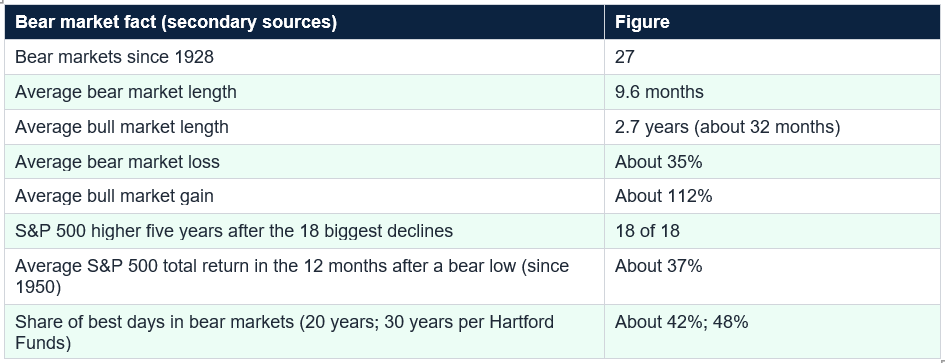
27 bear markets since 1928: average 9.6 months and 35% loss, versus bull markets of 2.7 years and 112% gain. S&P 500 higher five years later after each of the 18 biggest declines. About 42% (20 years) to 48% (30 years, Hartford Funds) of the best days occurred in bear markets.
The cost of giving in is large. DALBAR found the average investor earned about 6.8% a year over 30 years against 10.2% for the S&P 500, largely from badly timed trades, and JPMorgan found that missing just the 10 best days over 20 years cut the S&P 500’s annualized return from about 10.6% to about 6.4%, turning $10,000 into about $34,400 instead of about $75,000. Seven of those best days came within two weeks of one of the worst.
An honest note: those terms were negotiated by a buyer with billions and were not available to an ordinary investor, and his early buying in 2008 shows the rule can be uncomfortable for months. What you can copy is the mindset: pay attention to price relative to value, keep the ability to buy when others cannot and be prepared to be early. For most people, the practical way is to keep buying a broad index fund on a schedule.
The lesson is not that Buffett loves cash. He has said Berkshire would never prefer cash-equivalents to owning good businesses, so the cash was a reserve for when prices improved. Being fearful when others are greedy means slowing down and staying selective, not abandoning stocks. With the Shiller CAPE above 41 in early October, one measure shows how high prices are, which is not a prediction of a crash.

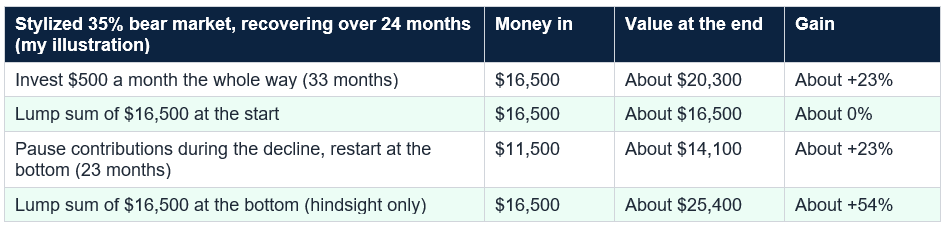
A nervous investor who stops contributing during the decline and restarts after the bottom invests $11,500 over the 23 months of recovery for a similar gain of about 23% but on less money, missing the cheapest prices, and one who sold at the bottom would lock in the loss. Real recoveries are messier, but the point is that buying through a decline lowers the average cost, and stopping or selling gives up the benefit.
Fourth, timing: Buffett’s 2008 buying was followed by a further 30% drop, which would have broken investors using borrowed money or close to retirement, and a retiree withdrawing from a falling portfolio faces what advisers call sequence risk (a general concept, not a retrieved figure). Fifth, price still matters: being greedy at any decline without regard to value is not following Buffett, whose rule rests on valuation.
Every US bear market so far has recovered, but that is not a law of nature, individual stocks can fail and the path can be long and painful. The rule rewards patience and preparation, not bravado.
During the decline, avoid checking daily, do not use leverage, do not sell to avoid more pain and keep your plan in front of you. Rebalancing, selling a little of what held up and buying what fell, is a mechanical way to be greedy when others are fearful. Afterwards, adjust the allocation if you could not stomach the drop: a plan you can follow beats a perfect plan you abandon.

Write down, today, what you will do if your portfolio falls 20% and again at 35%. If your answer is “sell,” lower your stock allocation until the answer is “keep buying.”
But the rule is a discipline, not a prediction. Buffett’s 2008 buying came with the market down 40% and was followed by a further 30% drop, so being greedy when others are fearful means being early and uncomfortable. It works best with an emergency fund, a long horizon and automatic contributions, and it can fail for individual stocks, other markets and people who must sell. Build your plan before fear arrives, write it down and keep buying.
His best-known rule, from a 2008 op-ed during the financial crisis, is to be fearful when others are greedy and greedy when others are fearful. In practice it means price discipline: buy good businesses when fear has pushed prices down and be cautious when optimism has pushed them up. It is not a promise to buy the exact bottom.
Has the S&P 500 always recovered from bear markets?
Every US bear market so far has eventually been followed by a new all-time high, according to Motley Fool coverage of the data, and the S&P 500 was higher five years later after each of the 18 biggest declines since the Great Depression. That is a record of one market, not a guarantee, and individual stocks and other countries’ markets have not always recovered.
Did Buffett time the 2008 bottom?
No. Coverage of his October 2008 op-ed notes the S&P 500 was already down roughly 40% from its high, and from then it fell by more than 30% further before the March 2009 low. He was not trying to pick the bottom, and buying early meant losses in the short run before the long-run gains.
How can an ordinary investor apply the rule?
Keep an emergency fund so you never have to sell, invest automatically so you keep buying through declines, rebalance rather than panic and decide in advance what you will do at declines of 20% or 30%. These are my practical suggestions, not Buffett’s, and they are general education rather than personal advice.
Is now a good time to be fearful or greedy?
I cannot say. The S&P 500 was up about 11.4% this year as of October 23, one measure, the Shiller CAPE, was above 41 in early October, and tech stocks sold off on AI spending fears at the end of the month, but markets can rise or fall from any level. Rather than guessing, build a plan that works in either case.
Table of Contents
- A Simple Rule That Is Not Easy
- The Short Answer
- What Buffett Actually Said, and When
- What History Says About Bear Markets
- Why It Is So Hard: The Math and the Mind
- How Buffett Put It Into Practice
- Berkshire’s Cash Pile Today
- A Stylized Example: Buying Through a Bear Market
- Where the Rule Can Fail
- A Practical Bear Market Plan
- Common Mistakes
- Conclusion
- Frequently Asked Questions
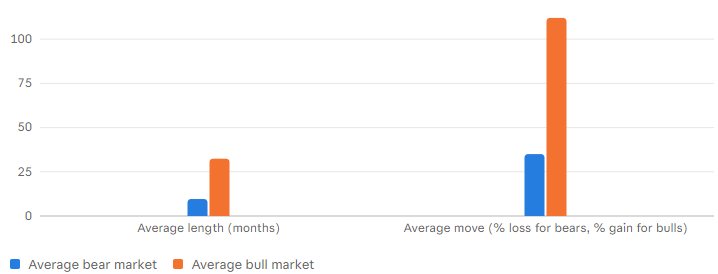
Bear vs. bull markets since 1928: length (months) and size of move (%)
Months or percent by Motley Fool coverage of historical data (Sept 29, 2026); bull length of 2.7 years converted to 32.4 months; secondary source; US market only
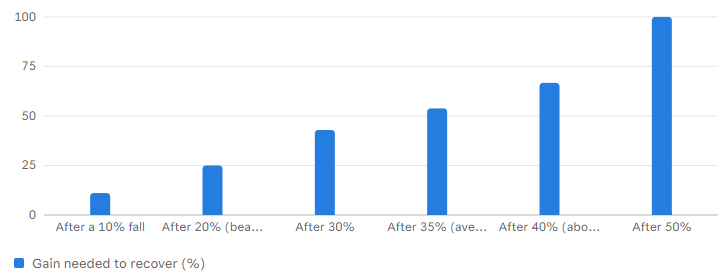
Why fear is rational: the gain needed to get back to even (%)
Gain needed (%) by Author's arithmetic: 1 / (1 - loss) - 1
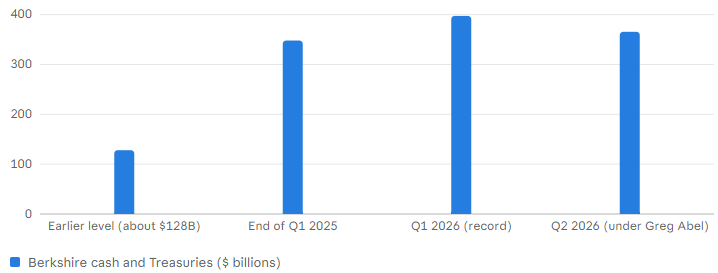
Buffett's other half of the rule: Berkshire's cash pile ($ billions)
Dollars (billions) by Motley Fool, AOL and Nasdaq coverage of Berkshire's filings; the earlier level is approximate; secondary sources
A Simple Rule That Is Not Easy
Warren Buffett has a rule for bear markets that fits on a sticky note: “Be fearful when others are greedy, and be greedy when others are fearful.” He wrote a version of it in his 1986 letter to shareholders and repeated it in a 2008 op-ed as the financial crisis deepened. It sounds obvious: buy when prices are low, be careful when they are high. Yet most people do the reverse, piling in near peaks and bailing near bottoms, which is why the rule is simple but not easy.It is a good moment to test it. The S&P 500 is up about 11.4% this year, one valuation measure sits above 41, tech stocks sold off at the end of October on AI spending fears and a recent survey found 74% of Americans concerned about a correction. This guide asks whether history backs Buffett, what happened when he followed his own rule in 2008, where the rule can fail and what ordinary investors can do, without pretending to know where the market goes next.
The Short Answer
History largely supports the idea behind the rule. Since 1928 there have been 27 US bear markets, averaging a 35% decline and 9.6 months, while the average bull market has lasted 2.7 years and gained 112%. The S&P 500 was higher five years later after each of the 18 biggest declines since the Great Depression, and many of the market’s best days arrive in bear markets. But the rule is about price and patience, not timing: Buffett’s 2008 call came with the market already down 40%, and it fell more than 30% further. It works best with cash on hand, a long horizon and the nerve to act.What Buffett Actually Said, and When
The idea comes from two places. In his 1986 letter, written during a long bull market, Buffett described a modest goal of being fearful when others are greedy and greedy only when others are fearful, according to Motley Fool coverage. In October 2008, with the financial crisis raging, he wrote an op-ed titled “Buy American. I Am.” explaining that he was buying US stocks with his personal money and that the rule dictated his buying. He did not claim to be calling the bottom, which was fortunate.Timing is the key detail. By the op-ed the S&P 500 was already down roughly 40% from its high, and until the March 2009 low it fell by more than 30% further, so anyone who bought on his word was early and underwater for months. That does not make the rule wrong. It shows the rule is about buying value at attractive prices over time, not catching the bottom, and that being greedy when others are fearful means accepting that prices may fall further first.
What History Says About Bear Markets
The history is on Buffett’s side if you stay long enough. According to Motley Fool coverage of the data, there have been 27 bear markets since 1928, lasting 9.6 months on average against 2.7 years for bull markets, with a 35% average loss against a 112% bull market gain. The S&P 500 was higher five years later after each of the 18 biggest declines since the Great Depression, has averaged a 37% total return in the 12 months after a bear low since 1950 and has so far always set a new high after a bear market.Bear markets are also more common than people remember, roughly every 3.5 years since 1928 and about every five since World War II. And they hide some of the best days: roughly 42% of the S&P 500’s strongest days over 20 years came in bear markets, and Hartford Funds found 48% over 30 years, with 28% in the first two months of a bull market. If you sell in a panic, you can miss the rebound that makes up the long-term return.
27 bear markets since 1928: average 9.6 months and 35% loss, versus bull markets of 2.7 years and 112% gain. S&P 500 higher five years later after each of the 18 biggest declines. About 42% (20 years) to 48% (30 years, Hartford Funds) of the best days occurred in bear markets.
Why It Is So Hard: The Math and the Mind
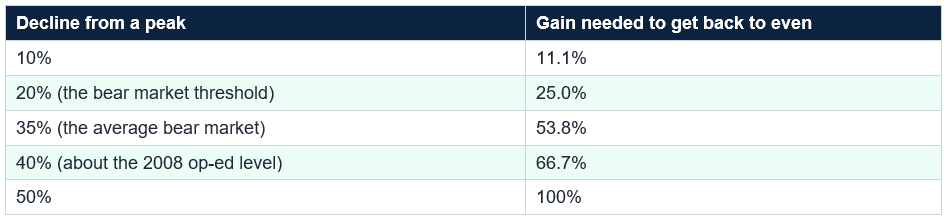
Investors fail at the rule partly because of math and partly because of psychology. The math is brutal: a 20% decline needs a 25% gain to recover, a 35% decline about 54% and a 50% decline 100%. Watching your balance drop by a third and being told it will come back is easy to say and hard to feel, and fear peaks when prices are lowest, exactly when the rule says to buy.The cost of giving in is large. DALBAR found the average investor earned about 6.8% a year over 30 years against 10.2% for the S&P 500, largely from badly timed trades, and JPMorgan found that missing just the 10 best days over 20 years cut the S&P 500’s annualized return from about 10.6% to about 6.4%, turning $10,000 into about $34,400 instead of about $75,000. Seven of those best days came within two weeks of one of the worst.
How Buffett Put It Into Practice
Buffett did not just talk about the rule. Berkshire put $3 billion into General Electric in 2008 and $5 billion into Bank of America in 2011, each with preferred shares and warrants, the latter at a discount of more than 60% to book value, according to Motley Fool coverage. When Berkshire exercised its Bank of America warrants in 2017, it had an on-paper gain of about $12 billion. These deals show the rule in action: supplying capital when others would not.An honest note: those terms were negotiated by a buyer with billions and were not available to an ordinary investor, and his early buying in 2008 shows the rule can be uncomfortable for months. What you can copy is the mindset: pay attention to price relative to value, keep the ability to buy when others cannot and be prepared to be early. For most people, the practical way is to keep buying a broad index fund on a schedule.
Berkshire’s Cash Pile Today
Berkshire’s balance sheet shows the other half of the rule. Under Buffett, its cash and Treasuries grew from about $128 billion to a record $397.4 billion in the first quarter of 2026, with a long stretch of net stock selling. Greg Abel became CEO on January 1, 2026 and reversed 14 straight quarters of net equity selling, completing the Taylor Morrison acquisition and lifting buybacks to $4.5 billion in one quarter, which brought the cash pile to $365.5 billion by the end of the second quarter.The lesson is not that Buffett loves cash. He has said Berkshire would never prefer cash-equivalents to owning good businesses, so the cash was a reserve for when prices improved. Being fearful when others are greedy means slowing down and staying selective, not abandoning stocks. With the Shiller CAPE above 41 in early October, one measure shows how high prices are, which is not a prediction of a crash.
A Stylized Example: Buying Through a Bear Market
In my deliberately simple illustration, an index falls 35% over nine months, from 100 to 65, then recovers over 24 months back to 100, and an investor puts $500 in at the start of each of 33 months, $16,500 in all. Because more units are bought when prices are low, the average cost is about $81 rather than $100, and when the index returns to 100 the money is worth about $20,300, a gain of about 23%. A lump sum of $16,500 at the start would simply break even.A nervous investor who stops contributing during the decline and restarts after the bottom invests $11,500 over the 23 months of recovery for a similar gain of about 23% but on less money, missing the cheapest prices, and one who sold at the bottom would lock in the loss. Real recoveries are messier, but the point is that buying through a decline lowers the average cost, and stopping or selling gives up the benefit.
Where the Rule Can Fail
Be honest about the rule’s limits. First, the history is of the US market, the world’s most successful, and survivors tell a rosier story: in my general knowledge, other markets, such as Japan after 1989, took decades to regain their peaks, which is not a retrieved statistic. Second, individual stocks are not indexes: a company can fall and never recover, so being greedy does not mean buying anything that has dropped. Third, the rule needs cash and a stable income: if you must sell stocks to pay bills, you cannot be greedy.Fourth, timing: Buffett’s 2008 buying was followed by a further 30% drop, which would have broken investors using borrowed money or close to retirement, and a retiree withdrawing from a falling portfolio faces what advisers call sequence risk (a general concept, not a retrieved figure). Fifth, price still matters: being greedy at any decline without regard to value is not following Buffett, whose rule rests on valuation.
Every US bear market so far has recovered, but that is not a law of nature, individual stocks can fail and the path can be long and painful. The rule rewards patience and preparation, not bravado.
A Practical Bear Market Plan
Before the bear market, build an emergency fund, since Bankrate found only 46% of Americans could cover three months of expenses, choose an allocation you can hold through a 35% decline and automate contributions so buying does not depend on courage. Write down what you will do at declines of 10%, 20% and 30%: keep contributing, rebalance to target and, with spare cash, add in stages. These tiers are my suggestion, not Buffett’s.During the decline, avoid checking daily, do not use leverage, do not sell to avoid more pain and keep your plan in front of you. Rebalancing, selling a little of what held up and buying what fell, is a mechanical way to be greedy when others are fearful. Afterwards, adjust the allocation if you could not stomach the drop: a plan you can follow beats a perfect plan you abandon.
Write down, today, what you will do if your portfolio falls 20% and again at 35%. If your answer is “sell,” lower your stock allocation until the answer is “keep buying.”
Common Mistakes
Common mistakes include waiting for a crash that does not come while sitting in cash, buying a single stock because it fell rather than because it is cheap relative to value, stopping contributions mid-decline, selling after a drop and buying back after the recovery, using borrowed money to buy dips and treating the rule as a market-timing signal. Buffett himself rarely tried to time short-term moves, as one coverage piece noted, and he was early in 2008.Conclusion
Is Buffett’s simple rule right? History says its logic holds: 27 US bear markets since 1928 averaged a 35% decline and 9.6 months, and the S&P 500 was higher five years later after each of the 18 biggest. Many of the best days, 42% to 48% in the data cited, arrive during bear markets, and missing the 10 best days over 20 years cut JPMorgan’s annualized return from about 10.6% to about 6.4%. And Berkshire practiced it, building a record $397.4 billion of cash before deploying it under Greg Abel.But the rule is a discipline, not a prediction. Buffett’s 2008 buying came with the market down 40% and was followed by a further 30% drop, so being greedy when others are fearful means being early and uncomfortable. It works best with an emergency fund, a long horizon and automatic contributions, and it can fail for individual stocks, other markets and people who must sell. Build your plan before fear arrives, write it down and keep buying.
Frequently Asked Questions
What is Warren Buffett’s simple rule for bear markets?His best-known rule, from a 2008 op-ed during the financial crisis, is to be fearful when others are greedy and greedy when others are fearful. In practice it means price discipline: buy good businesses when fear has pushed prices down and be cautious when optimism has pushed them up. It is not a promise to buy the exact bottom.
Has the S&P 500 always recovered from bear markets?
Every US bear market so far has eventually been followed by a new all-time high, according to Motley Fool coverage of the data, and the S&P 500 was higher five years later after each of the 18 biggest declines since the Great Depression. That is a record of one market, not a guarantee, and individual stocks and other countries’ markets have not always recovered.
Did Buffett time the 2008 bottom?
No. Coverage of his October 2008 op-ed notes the S&P 500 was already down roughly 40% from its high, and from then it fell by more than 30% further before the March 2009 low. He was not trying to pick the bottom, and buying early meant losses in the short run before the long-run gains.
How can an ordinary investor apply the rule?
Keep an emergency fund so you never have to sell, invest automatically so you keep buying through declines, rebalance rather than panic and decide in advance what you will do at declines of 20% or 30%. These are my practical suggestions, not Buffett’s, and they are general education rather than personal advice.
Is now a good time to be fearful or greedy?
I cannot say. The S&P 500 was up about 11.4% this year as of October 23, one measure, the Shiller CAPE, was above 41 in early October, and tech stocks sold off on AI spending fears at the end of the month, but markets can rise or fall from any level. Rather than guessing, build a plan that works in either case.
0 Comments
Be the first to share your thoughts on this article.