

Planning
Financial Planners: 7 Things Wealth Builders Spend More On
Table of Contents
- The Spending Pattern No One Talks About
- The Statistics: What the Data Shows About Wealth and Spending
- The 7 Things at a Glance
- Thing 1 — Health & Preventive Care
- Thing 2 — Professional Financial Advice
- Thing 3 — Lifelong Education & Skill Development
- Thing 4 — Time-Buying Services
- Thing 5 — Experiences Over Possessions
- Thing 6 — Quality Over Quantity
- Thing 7 — Strategic Giving & Philanthropy
- Side-by-Side: Wealth Builders vs Average Consumer
- How to Adopt These Habits at Any Income Level
- Conclusion
- Frequently Asked Questions (FAQ)
- External References & Links
The Spending Pattern No One Talks About
Ask most people what the wealthy spend their money on and the answers are predictable: luxury cars, designer clothes, expensive watches, first-class flights, beachfront properties. These answers are not entirely wrong — the ultra-wealthy do enjoy premium goods — but they miss the more interesting and more instructive story about how wealth builders actually allocate their spending.Financial planners who work with high-net-worth individuals consistently report the same observation: their wealthiest clients are often the most deliberate, even frugal, spenders in conventional consumption categories. They are not chasing status with their wallets. What they are doing — often invisibly — is systematically spending more in categories that compound over time: health, knowledge, professional guidance, time, experiences, quality, and giving.
Tom Corley, a financial planner and author of Rich Habits: The Daily Success Habits of Wealthy Individuals, spent five years studying 233 millionaires. His conclusion was blunt: “The wealthy spend differently.” Not necessarily more in total, but differently in kind — in ways that reinforce and accelerate wealth accumulation rather than erode it.
This article draws on Corley’s research, Bureau of Labor Statistics consumer expenditure data, Julius Baer’s Global Wealth and Lifestyle Report, and current financial planning practice to identify the seven specific spending categories where wealth builders consistently outspend their peers — and why each category matters for building lasting financial success.
The Statistics: What the Data Shows About Wealth and Spending
Before examining each of the seven categories, it helps to establish the statistical foundation that underlies them.
These numbers reveal the core pattern: wealth builders are not spending differently because they have more money. They developed spending habits oriented toward long-term compounding — in human capital, health capital, knowledge capital, and financial capital — that contributed to wealth accumulation. The direction of causality runs both ways: wealthy habits support wealth, and wealth enables habit.
The Bank of America Institute found that the top one-third of wealthiest Americans spent 4% more in November 2025 than November 2024 — the fastest increase in four years — and that this cohort drove more than half of all consumer spending throughout most of 2025. Where that spending goes matters enormously to the economy and to our understanding of what wealth-building behaviour looks like in practice.
"Wealth is not just about money. It is about having the freedom and the possibilities to live life as you want — in good health, with access to the best education, and in safety and security." — Christian Gattiker-Ericsson, Head of Research, Julius Baer (Global Wealth and Lifestyle Report, August 2025)
The 7 Things at a Glance
Here is a quick-reference summary of all seven categories before we examine each in depth.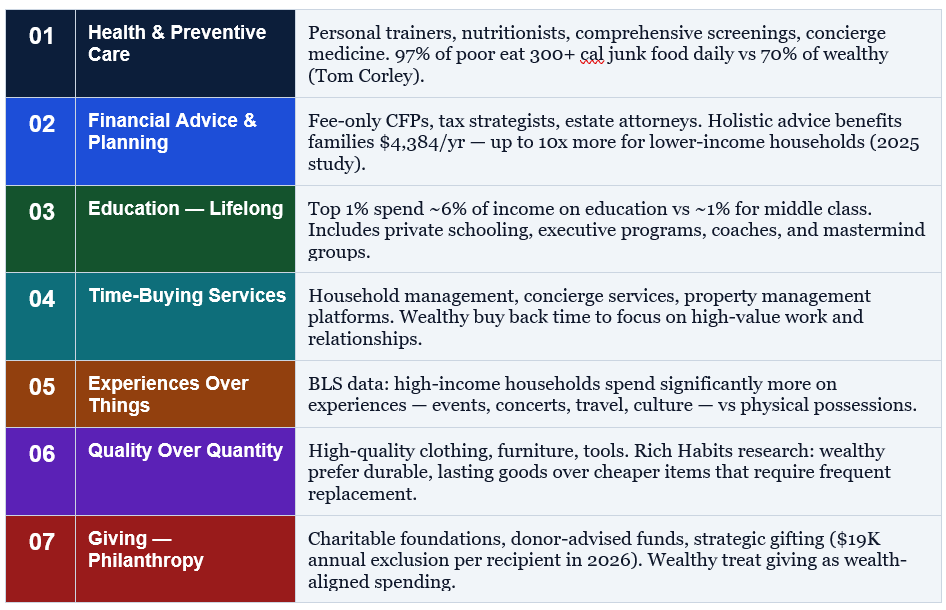 .
.Thing 1 — Health & Preventive Care
Wealth builders treat their body as the highest-returning asset they own. You cannot build or manage a business, an investment portfolio, or a career at peak capacity when your health is deteriorating. Preventive investment now reduces the dramatically more expensive reactive costs of illness later.Tom Corley’s research is striking: 97% of poor people eat more than 300 calories of junk food per day, while 70% of wealthy people stay under that threshold. Wealthy individuals are also significantly more likely to exercise regularly. Julius Baer’s 2025 Global Wealth and Lifestyle Report found that in Asia Pacific, all surveyed high-net-worth individuals are actively pursuing longevity strategies — from personalised diagnostics to preventive therapies and functional medicine.
The practical investments include personal trainers, nutritionists, annual comprehensive health screenings (including full-body MRI scans, advanced bloodwork panels, and genetic risk assessments), concierge primary care physicians, and mental health professionals. These costs, which can run $5,000–25,000+ annually, appear expensive in isolation. Against the alternative — reactive healthcare for preventable conditions, lost productive years, or early cognitive decline — they represent one of the highest-returning categories in the wealth-builder’s budget.
Thing 2 — Professional Financial Advice
This one might seem self-serving coming from financial planners — but the data is unambiguous. A 2025 study found that holistic financial advice benefits the typical family by $4,384 per year, or 7.5% of annual income. For lower-income households, the benefit is potentially 10 times larger. Yet nearly 1 in 4 Americans without a financial advisor say they believe they do not have enough money to need one, and 35% say they assume the cost is too high.Wealthy individuals build advisory teams — a fee-only Certified Financial Planner (CFP), a CPA or tax strategist, an estate planning attorney, and in many cases a fiduciary investment advisor. The combined cost of this team is typically $5,000–15,000+ per year. The value generated through tax optimisation, investment structure, estate planning, and behavioural coaching far exceeds that cost for most clients with meaningful assets.
Northwestern Mutual’s 2025 Planning & Progress Study found that even among millionaires, only a fraction feel their financial planning is in peak shape. The common thread among the most financially secure: consistent, ongoing professional guidance rather than sporadic check-ins or DIY strategies.
“‘$1 million is a lot of money but money alone doesn’t create confidence—financial advice and financial plans do.’”
— John Roberts, Chief Field Officer, Northwestern Mutual, 2025
Thing 3 — Lifelong Education & Skill Development
Consumer expenditure research shows that the top 1% of earners spend approximately 6% of their income on education, while the middle class spends just over 1%. This gap is often described by economists as “inconspicuous consumption” — spending that does not signal wealth outwardly but generates enormous returns over time.The investment goes far beyond university tuition for children. It includes executive education programs at business schools, specialised industry conferences, personal coaches (executive, performance, or life coaches), mastermind groups with peer accountability, books and premium content subscriptions, and professional certification programs. Each of these investments is expected to generate a return — in career advancement, business performance, decision quality, or expanded network.
Tom Corley found that 88% of wealthy individuals devote 30 or more minutes each day to self-education or reading, versus just 2% of those who struggle financially. The compounding effect of this knowledge investment over a 10 or 20-year career dwarfs the impact of almost any other discretionary spending decision.
Thing 4 — Time-Buying Services
Wealthy individuals understand something that most people do not internalise at a practical level: time is a non-renewable resource, and its value is determined by what you do with it. Buying time — by delegating tasks that can be done by someone else for less than your effective hourly value — is one of the clearest expressions of wealth-builder thinking.This shows up in household management services, property management platforms, concierge services for scheduling and logistics, personal assistants (in-person or virtual), meal delivery and preparation services, and increasingly in AI-powered tools and SaaS platforms that automate complex personal and business administration. Kevin Reed, Chief Revenue Officer of Aquilance, noted in a 2026 interview that wealthy clients are increasingly willing to invest in fully outsourced management for multiple properties, businesses, and staff — freeing time to focus on relationships and high-value work.
The arithmetic is straightforward: a professional who earns $300/hour and spends 5 hours per week on tasks that could be delegated for $30/hour is effectively losing $1,350 per week in opportunity cost. Time-buying services convert that lost time into productive or meaningful use.
Thing 5 — Experiences Over Possessions
Bureau of Labor Statistics consumer expenditure data consistently shows that higher-income households allocate significantly more of their discretionary spending to experiences — live events, travel, cultural activities, dining, memberships — relative to physical possessions. This is not simply because they can afford to. Research on happiness economics consistently finds that experiences generate more sustained life satisfaction than purchases of comparable cost.Wealth builders also treat experiences as investments in relationship capital and network expansion. A professional conference is not just education; it is access to a community of high-performing peers. A family travel experience is not just a vacation; it is shared memory capital that shapes family culture and values. Charity galas, cultural patronage, and professional events serve dual purposes: personal enrichment and strategic relationship building.
The Knight Frank Wealth Report found that ultra-high-net-worth individuals worldwide are increasingly choosing experience-based spending over trophy assets — a shift visible even in categories like superyachts, which are now justified less as status symbols and more as functional platforms for mobile living and business.
Thing 6 — Quality Over Quantity
Tom Corley’s millionaire research revealed a consistent pattern: wealthy individuals prefer to buy fewer, higher-quality items that last significantly longer over cheap alternatives that require frequent replacement. This manifests in clothing (investment pieces over fast fashion), furniture (heirloom-quality over flat-pack), tools and equipment (professional-grade over consumer-grade), and household goods (durable materials over price-optimised).This approach is often counterintuitive to observers who assume wealthy people simply buy more of everything. In practice, many wealth builders practise what might be called “value maximisation”: they pay more per item but buy far fewer items, and they calculate cost-per-use rather than purchase price. A $600 pair of shoes worn daily for 5 years costs $0.33 per day. A $60 pair replaced every 3 months costs $0.67 per day — more than double, plus the time cost of repeated purchasing decisions.
Beyond the economics, quality purchases tend to carry better warranties, require less maintenance, and perform more reliably — reducing the hidden costs of ownership that cheap goods accumulate over time.
Thing 7 — Strategic Giving & Philanthropy
High-net-worth individuals give more than average consumers in both absolute and proportional terms — and they give more strategically. Charitable giving among wealth builders is not primarily an afterthought or a reaction to solicitation. It is a planned, tax-optimised element of their overall financial strategy.The tools available in 2026 include donor-advised funds (DAFs), which allow an immediate tax deduction while distributing grants over time; charitable remainder trusts, which provide income streams while reducing estate tax exposure; and the annual gift exclusion of $19,000 per recipient, which enables tax-free wealth transfer to children and grandchildren. The federal estate tax exemption rose to $15 million per individual in 2026, but strategic lifetime giving remains valuable for tax planning, family values reinforcement, and personal fulfilment.
Wealth planners in 2026 are increasingly integrating ESG (Environmental, Social, Governance) analysis into portfolio construction alongside explicit philanthropy — reflecting a broader shift toward values-aligned spending that treats giving as part of a coherent life and wealth strategy, not an add-on.
Side-by-Side: Wealth Builders vs Average Consumer
The differences are clearest when placed directly next to each other.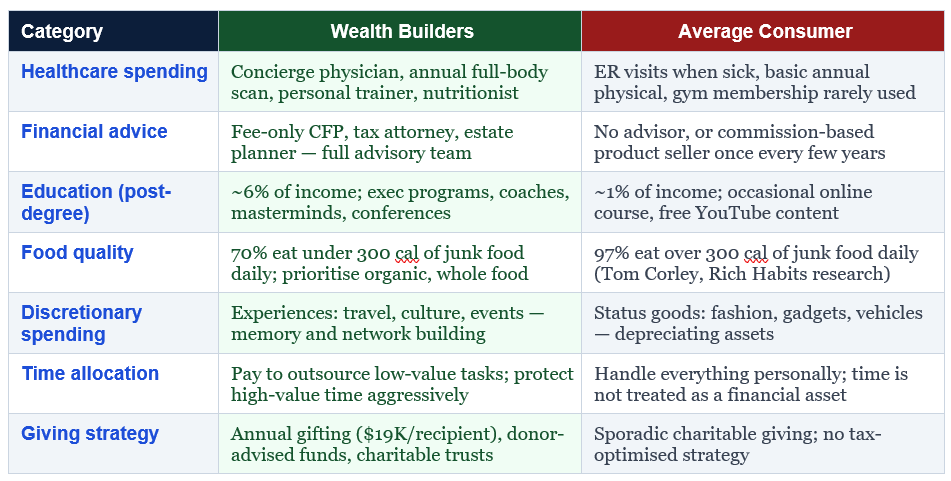
The pattern across all seven categories is the same: wealth builders invest in inputs that compound over time — health, knowledge, advice, time, relationships, durability, and legacy. Average consumers optimise for immediate satisfaction, social signalling, or short-term price minimisation. Both strategies feel rational in the moment; only one builds lasting financial security.
How to Adopt These Habits at Any Income Level
The most important insight from this research is that these spending habits are not exclusive to the already-wealthy. Many of them can be adopted — in scaled form — at any income level.- Health first, always. You do not need a personal trainer to start. A basic annual physical, a commitment to 7–8 hours of sleep, and 30 minutes of daily movement are free or near-free. Build the habit before you build the spending.
- Start with one financial advisor conversation. NAPFA.org lists fee-only financial planners who work with clients at all asset levels. A single planning session can identify the highest-value steps in your specific situation.
- Allocate 1% of income to education. Books, podcasts, and free online courses make this category accessible at every income level. The habit matters more than the dollar amount at the start.
- Identify your highest-value time. What is one recurring task in your life you could delegate for $20–30/hour that currently consumes time worth more than that to you? Start there.
- Shift one possession purchase to an experience. Next time you are about to buy something to fill a gap or signal status, ask whether an experience in the same category would serve you better.
- Buy quality in one category. Identify the category where you spend the most on cheap replacements, and buy quality once. Track the actual cost-per-use over time.
- Give intentionally, not reactively. Even a small monthly charitable transfer to one organisation you care about creates the habit of purposeful giving and often generates psychological benefits that reinforce positive financial behaviour.
CONCLUSION
Spend Like a Wealth Builder — At Any IncomeThe seven spending categories in this article share a single underlying logic: they all compound. Health invested in today creates productive decades later. Knowledge acquired now opens doors for years. Financial advice that costs $5,000 this year can save $50,000 in taxes and generate far more in avoided mistakes. Time bought back is time redirected to the highest-value activities in your life.
Wealthy people are not wealthy because they spend on these things. They are wealthy, in part, because spending in these categories — while spending less on status, impulse, and depreciation — is a pattern that produces compounding returns across every dimension of life: physical, intellectual, financial, social, and purposeful.
The research is consistent. The patterns are clear. The habits are learnable. The question is not whether you can afford to spend like a wealth builder. It is whether you can afford not to.
Frequently Asked Questions (FAQ)
Do wealthy people really spend differently, or do they just spend more?Both, but the “differently” is more important than the “more.” Tom Corley’s research on 233 millionaires found consistent qualitative differences in spending patterns independent of income level: more on health, education, and professional guidance; less on status goods, fast fashion, and impulse purchases. Bureau of Labor Statistics consumer expenditure data confirms that higher-income households allocate a larger share of discretionary spending to experiences and education, and a smaller share to clothing and consumer electronics relative to their total spend.
What does ‘inconspicuous consumption’ mean for wealth builders?
The term, coined by economists studying high-income spending, refers to the category of spending that does not visibly signal wealth but generates substantial private returns. Education spending — executive programs, coaching, masterminds, books — is the clearest example. A $3,000 leadership coaching engagement does not generate social status, but it may produce thousands of dollars in career advancement or business improvement. The top 1% spend roughly 6% of income on education; the middle class spends just over 1%. This gap is one of the most underappreciated drivers of wealth divergence.
Is professional financial advice worth the cost for average earners?
The 2025 research is clear: yes. A study on holistic financial advice found average annual benefit of $4,384 per year, or 7.5% of annual income, for typical families. For lower-income households, the benefit was potentially 10 times larger. The key is finding a fee-only, fiduciary financial planner — one who is legally required to act in your interest and is not compensated by commissions on products they sell you. NAPFA.org is the best directory for fee-only planners in the US.
Why do wealthy people prioritise experiences over possessions?
Multiple streams of research in happiness economics support this preference. Experiences generate more sustained life satisfaction than possessions of comparable cost, in part because they become part of your identity and create shared memories, while possessions rapidly adapt into the background of daily life. For wealth builders, experiences also serve double duty: professional conferences and travel often generate business relationships, ideas, and opportunities that possess meaningful financial return. The wealthy are not rejecting possessions — they are optimising for returns per dollar spent.
How do I start buying quality over quantity on a limited budget?
The most effective approach is category-by-category rather than wholesale change. Identify the one or two categories where you spend the most on cheap items that fail quickly — common candidates include shoes, kitchen equipment, tools, and everyday work bags. Research the quality alternative in one category, buy it once, and track cost-per-use over 12 months. Most people find the quality purchase is less expensive on a per-use basis within the first year, which creates the evidence base for expanding the habit.
What are the tax advantages of strategic giving?
In 2026, the annual gift exclusion is $19,000 per recipient, allowing tax-free wealth transfer without touching the lifetime estate exemption ($15 million per individual). Donor-advised funds (DAFs) allow an immediate tax deduction in the year of contribution while you distribute grants over time — useful for bunching deductions in high-income years. Charitable remainder trusts (CRTs) provide income streams while reducing estate tax. For those with significant equity holdings, donating appreciated securities directly avoids capital gains tax while generating a deduction at fair market value. A CPA or estate planner can identify the optimal structure for your specific situation.

0 Comments Comments