

Finance
Gift Tax: Give Your Child More Than $19K Tax-Free

There are ways to go beyond the $19,000 annual limit without being subject to the gift tax. Pay tuition directly to the school: unlimited, zero paperwork. Front-load a 529 plan with five years of gifts at once. Stack exclusions, split gifts with a spouse, and move money tax-free across generations. Here’s the complete 2026 playbook.

The $19,000 annual exclusion in 2026 is real, but it is one of several layered tools — and it is neither the most powerful nor the most overlooked. A grandparent can write a check directly to a university for $75,000 in tuition and the IRS will count zero of it as a gift. A married couple can collectively give $38,000 per child per year through gift splitting, with zero paperwork if they stay under the combined limit. And a parent can front-load five years of 529 contributions in a single year, writing a check for $95,000 or $190,000 as a couple, and elect to spread it over five years for gift tax purposes.
As Private Wealth Collective’s May 2026 guide explains: ‘The federal gift tax is one of the most misunderstood rules in personal finance. People hear “gift tax” and panic, convinced that writing a large check to a child or grandchild will trigger a massive tax bill. In reality, gift tax in 2026 is far more generous than most people think.’ This guide covers every tool available, the specific rules that govern each one, and the real-world scenarios where they matter most.
Annual exclusion 2026: $19,000 per recipient, per donor (Rev. Proc. 2025-32). Married couple gift-splitting: $38,000 per recipient. Lifetime exemption 2026: $15 million per person ($30M couple), permanent under OBBBA. Direct tuition/medical payments: unlimited, zero paperwork, outside the gift tax system entirely (IRC §2503(e)). 529 superfunding: $95,000 per donor per child ($190,000 per couple) in one year.
Three features of the annual exclusion that are frequently misunderstood:
The mechanics:
The rules, as stated in Treasury Regulation §25.2503-6:
The direct payment requirement is absolute. If the donor gives the money to the student, the parent, or anyone other than the educational institution directly, the §2503(e) exclusion is lost. The entire amount becomes a gift, subject to the $19,000 annual exclusion and then the lifetime exemption. There are no exceptions and no workarounds to the direct-payment rule.
If a family member faces significant medical bills or tuition costs, always structure the payment to go directly to the provider or institution rather than routing it through the individual. This is a one-sentence change in how the check is written — and the difference between zero gift tax exposure and a significant reportable gift that eats into the lifetime exemption.
The 2026 mechanics:
The SECURE 2.0 Act (effective 2024) created a significant new exit ramp: a 529 plan beneficiary can roll funds from the 529 into a Roth IRA, subject to specific conditions:
The lifetime exemption in 2026 is $15 million per individual ($30 million for a married couple), made permanent by the One Big Beautiful Bill Act signed in 2025 (Farther.com, July 2026; Country Tax Calc, June 2026; USTax Tools, April 2026). This supersedes the prior TCJA provisions that would have sunsetted the elevated exemption back to approximately $7 million.
What this means in practice:
Form 709 is due on April 15 of the year following the gift. An extension to file the individual income tax return (Form 4868) automatically extends the Form 709 deadline as well. The form is filed separately from Form 1040 and is sent to the IRS Service Center in Kansas City, Missouri.
As Taxstra’s July 2026 guide notes: ‘The 709 is how the IRS tracks your remaining exemption, and an unfiled return has no statute of limitations: the IRS can challenge the gift’s value decades later, including after your death, when your estate return is on the line. Adequate disclosure on a timely 709 starts the three-year clock.’ Timely, accurate filing of Form 709 — even when no tax is owed — protects the donor’s estate from later challenge.
An example: a parent owns stock purchased for $10,000, now worth $200,000. If gifted during life, the child receives the stock with a $10,000 basis. On later sale for $200,000, the child owes capital gains tax on $190,000 of appreciation. If the same stock is inherited after the parent’s death, the child receives it with a stepped-up basis of $200,000. On immediate sale for $200,000, capital gains tax is zero.
For highly appreciated assets, gifting during life may be significantly less tax-efficient than leaving the same assets to be inherited. The gift removes the asset from the taxable estate (helping with estate tax) but destroys the step-up in basis (increasing the capital gains tax). For families whose estates are well below the lifetime exemption threshold, there is no estate tax savings from the gift — only a capital gains tax cost. Always model the basis consequence before gifting appreciated property.
The basis trap does not apply to cash gifts or to 529 contributions (which invest in market funds and do not carry a specific basis issue in the same way). It is most relevant for large blocks of appreciated stock, real estate, or closely held business interests.
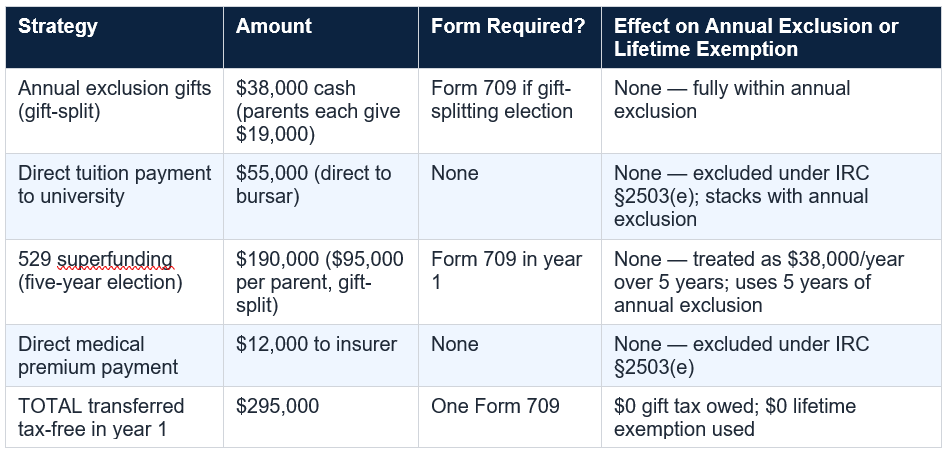
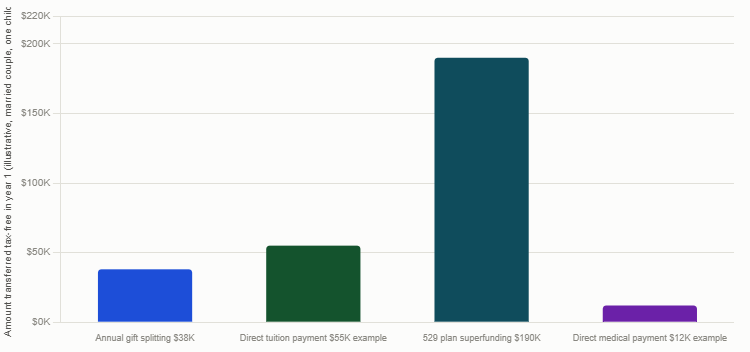
This scenario — $295,000 transferred in one year with zero gift tax and zero lifetime exemption usage — is not a loophole or an aggressive strategy. It is the straightforward application of the tax code as written, using four rules that have been in place for decades. The only requirements are: (a) the tuition and medical payments must go directly to the institution or provider; (b) the 529 superfunding election must be made on Form 709; (c) no additional annual exclusion gifts to the same child during the five-year election period.
And behind all of this sits a $15 million per person lifetime exemption, made permanent by OBBBA, that ensures actual gift tax is a concern for only the very largest estates.
Private Wealth Collective’s May 2026 assessment captures the practical reality: ‘Gift tax in 2026 is far more generous than most people think. The $19,000 annual exclusion, $15M lifetime exemption, unlimited direct-pay tuition/medical, and 529 superfunding — most families will never owe a dime of gift tax regardless of how generously they give.’
The most common missed opportunity is the simplest: paying tuition or medical bills directly to the institution rather than routing the money through the child. The difference is one line on the check. The tax consequence is the difference between zero and tens of thousands of dollars in reportable gifts. Use the tools the tax code has provided.
The annual gift tax exclusion for 2026 is $19,000 per recipient, per donor (Rev. Proc. 2025-32). This is the same as 2025. A married couple can give $38,000 per recipient per year by electing gift splitting on IRS Form 709. The exclusion applies per recipient: a grandparent with four grandchildren can give $19,000 to each — $76,000 in total — with no paperwork and no effect on the lifetime exemption. Gifts within the annual exclusion require no Form 709 filing. The exclusion is use-it-or-lose-it and resets on January 1 of each year.
Can I pay my grandchild's college tuition without it counting as a gift?
Yes, if you pay the tuition directly to the educational institution. Under IRC Section 2503(e), payments made directly to a qualifying educational institution for tuition are completely excluded from the gift tax system — no dollar limit, no Form 709 required, and the payment does not reduce your annual exclusion or lifetime exemption. The key requirement is that the payment must go directly from you to the school. If you give the money to your grandchild to forward to the school, it is a gift subject to the $19,000 annual exclusion. The exclusion covers tuition only — not room and board, books, or other fees, though the regular $19,000 annual exclusion can cover those amounts separately.
What is 529 superfunding and how much can I contribute in 2026?
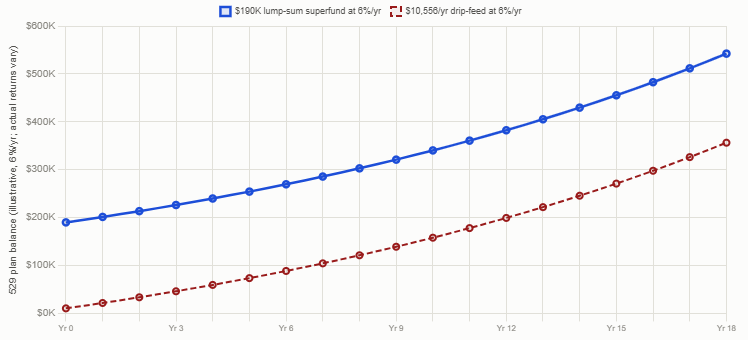
529 superfunding is a special IRS election that allows you to contribute up to five years' worth of annual exclusion gifts to a 529 college savings plan in a single year. In 2026, the maximum is $95,000 per donor per beneficiary (5 × $19,000). A married couple using gift splitting can contribute $190,000 per child in a single year. To make the election, you must file IRS Form 709 in the first year of the election, electing to spread the contribution over five years. During the five-year period, you cannot make additional annual exclusion gifts to the same beneficiary without using lifetime exemption. If you die during the five-year window, the unallocated portion returns to your taxable estate pro rata. The investment advantage of superfunding is significant: $190,000 compounding tax-free for 18 years at 6% grows to approximately $542,000.
What is the lifetime gift tax exemption in 2026?
The federal lifetime gift and estate tax exemption is $15 million per individual ($30 million for a married couple) in 2026. This was made permanent by the One Big Beautiful Bill Act (OBBBA) signed in 2025, which superseded the TCJA provisions that would have reduced the exemption to approximately $7 million per person. Gifts above the $19,000 annual exclusion are reportable on Form 709 and reduce the lifetime exemption, but generate no actual gift tax until the cumulative total of all taxable gifts exceeds $15 million per person. The vast majority of families will never approach this threshold. Actual gift tax at rates up to 40% (IRC §2502) only applies after the full lifetime exemption is exhausted.
Do I have to pay gift tax if I give my child more than $19,000?
Almost certainly not — at least not immediately. Gifts above $19,000 to a single recipient in one year require filing IRS Form 709, but filing is not paying. The excess amount above $19,000 reduces your lifetime gift and estate tax exemption ($15 million per person in 2026). Unless you have already made more than $14 million in taxable gifts over your lifetime, the gift generates no actual tax. For example: giving your child $100,000 in cash requires filing Form 709. The first $19,000 is exempt. The remaining $81,000 reduces your lifetime exemption from $15 million to $14.919 million. No tax is owed. Gift tax at 40% would only apply if the cumulative total of your lifetime taxable gifts exceeded $15 million.
Does paying someone's medical bills count as a gift?
Not if you pay the provider directly. Under IRC Section 2503(e), payments made directly to a medical provider, hospital, or insurer for someone else's qualifying medical expenses are completely excluded from gift tax — with no dollar limit, no Form 709 required, and no effect on the annual exclusion or lifetime exemption. Qualifying expenses include hospital bills, surgeries, diagnostic procedures, long-term care services, and qualifying health insurance premiums. The same direct-payment rule that applies to tuition applies here: the money must go straight from the donor to the provider or insurer. If you give the money to the patient first, the §2503(e) exclusion is lost and the payment becomes a reportable gift subject to the $19,000 annual exclusion.
Table of Contents
- The Gift Tax Is More Misunderstood Than Any Other Tax
- The $19,000 Annual Exclusion: What It Is and How It Works
- Gift Splitting: How Couples Can Double the Limit
- The Unlimited Exclusion Nobody Talks About: Direct Tuition Payment
- The Direct Medical Payment Exclusion: Another Unlimited Tool
- 529 Superfunding: Front-Load Five Years of Gifts at Once
- The 529 Plan’s Other Advantages: Tax-Free Growth and New 2026 Rules
- The Roth IRA Rollover from a 529: A Hidden Exit Ramp
- The Lifetime Gift Tax Exemption: $15 Million Per Person in 2026
- Form 709: When to File and What It Actually Means
- The Basis Trap: When Giving Is Less Efficient Than Inheriting
- A Real-World Scenario: Maximising Tax-Free Transfers for One Child
- Strategies That Look Useful But Have Limits
- Conclusion: The Gift Tax System Is Designed to Be Used
- Frequently Asked Questions
What a Couple Can Transfer in a Year (Stacked)
529 Superfunding: Lump sum vs Annual Dripp-Feed
The Gift Tax Is More Misunderstood Than Any Other Tax
Most parents and grandparents who want to transfer money to children operate under a version of the same misconception: that there is a hard annual limit of $19,000 on what they can give without triggering gift tax, and that crossing this threshold means owing the IRS money. Both parts of this belief are wrong.The $19,000 annual exclusion in 2026 is real, but it is one of several layered tools — and it is neither the most powerful nor the most overlooked. A grandparent can write a check directly to a university for $75,000 in tuition and the IRS will count zero of it as a gift. A married couple can collectively give $38,000 per child per year through gift splitting, with zero paperwork if they stay under the combined limit. And a parent can front-load five years of 529 contributions in a single year, writing a check for $95,000 or $190,000 as a couple, and elect to spread it over five years for gift tax purposes.
As Private Wealth Collective’s May 2026 guide explains: ‘The federal gift tax is one of the most misunderstood rules in personal finance. People hear “gift tax” and panic, convinced that writing a large check to a child or grandchild will trigger a massive tax bill. In reality, gift tax in 2026 is far more generous than most people think.’ This guide covers every tool available, the specific rules that govern each one, and the real-world scenarios where they matter most.
Annual exclusion 2026: $19,000 per recipient, per donor (Rev. Proc. 2025-32). Married couple gift-splitting: $38,000 per recipient. Lifetime exemption 2026: $15 million per person ($30M couple), permanent under OBBBA. Direct tuition/medical payments: unlimited, zero paperwork, outside the gift tax system entirely (IRC §2503(e)). 529 superfunding: $95,000 per donor per child ($190,000 per couple) in one year.
The $19,000 Annual Exclusion: What It Is and How It Works
The annual gift tax exclusion is the amount any individual can give to any other individual in a calendar year without filing a gift tax return or using any of the lifetime exemption. For 2026, this is $19,000 per recipient, per donor — unchanged from 2025 (Rev. Proc. 2025-32).Three features of the annual exclusion that are frequently misunderstood:
- It is per recipient: the $19,000 is not an annual cap on total giving. A grandparent with four grandchildren can give $19,000 to each — $76,000 in total — with no paperwork and no reduction in the lifetime exemption. The exclusion runs per person, per year, per donor.
- It is use-it-or-lose-it: the annual exclusion does not carry over. An individual who gives nothing in 2025 cannot give $38,000 in 2026 under the exclusion. Each calendar year resets.
- It resets on January 1: a gift given on December 31 uses that year's exclusion; a gift given on January 1 uses the next year's. For large planned gifts, timing around the calendar year allows two years' exclusions to be used within a short window.
Gift Splitting: How Couples Can Double the Limit
Married couples can elect to split gifts for gift tax purposes, effectively treating any gift made by either spouse as if it came equally from both. This doubles the annual exclusion to $38,000 per recipient per year. In 2026, a married couple can give $38,000 to each child, grandchild, or other recipient tax-free — $76,000 for two children, $152,000 for four.The mechanics:
- Gift splitting requires an election on IRS Form 709, even if the total gifts remain below the $38,000 threshold for a married couple. Both spouses must consent to splitting all gifts for the year.
- The election applies to all gifts made during the calendar year, not just selected ones. A couple cannot choose to split some gifts but not others.
- Both spouses must be US citizens or residents on the date of the gift. Gifts to a non-citizen spouse are subject to a separate annual exclusion limit ($190,000 in 2026, indexed annually).
The Unlimited Exclusion Nobody Talks About: Direct Tuition Payment
Under Internal Revenue Code Section 2503(e), certain payments are excluded from the gift tax entirely — not merely sheltered by the annual exclusion or the lifetime exemption, but fully outside the gift tax system. One of these is direct payment of tuition to a qualifying educational institution.The rules, as stated in Treasury Regulation §25.2503-6:
- The payment must be made directly to the qualifying educational institution. Writing a check to the grandchild or student to forward to the school does not qualify; the money must go directly from the donor to the school.
- The payment must be for tuition only. Room and board, books, fees, and other expenses do not qualify under the §2503(e) exclusion. The regular $19,000 annual exclusion can cover these separately.
- The educational institution must be a qualifying organization described in IRC §170(b)(1)(A)(ii) — this includes virtually all accredited colleges, universities, vocational schools, and most private elementary and secondary schools.
- There is no dollar limit. There is no Form 709 filing requirement for direct tuition payments. The payment does not reduce the annual exclusion or the lifetime exemption.
The direct payment requirement is absolute. If the donor gives the money to the student, the parent, or anyone other than the educational institution directly, the §2503(e) exclusion is lost. The entire amount becomes a gift, subject to the $19,000 annual exclusion and then the lifetime exemption. There are no exceptions and no workarounds to the direct-payment rule.
The Direct Medical Payment Exclusion: Another Unlimited Tool
The second unlimited exclusion under IRC §2503(e) is direct payment of medical expenses. Payments made directly to a medical provider, hospital, or insurance company for someone else's qualifying medical expenses are completely excluded from gift tax, with the same mechanics as the tuition exclusion:- The payment must go directly to the medical provider or insurer, not to the patient.
- Qualifying expenses include hospital bills, surgeries, diagnostic services, long-term care services, and qualifying health insurance premiums.
- There is no dollar limit. Paying $500,000 for a family member’s cancer treatment directly to the hospital is not a taxable gift (Country Tax Calc, June 2026).
- No Form 709 filing is required for direct medical payments covered by §2503(e).
If a family member faces significant medical bills or tuition costs, always structure the payment to go directly to the provider or institution rather than routing it through the individual. This is a one-sentence change in how the check is written — and the difference between zero gift tax exposure and a significant reportable gift that eats into the lifetime exemption.
529 Superfunding: Front-Load Five Years of Gifts at Once
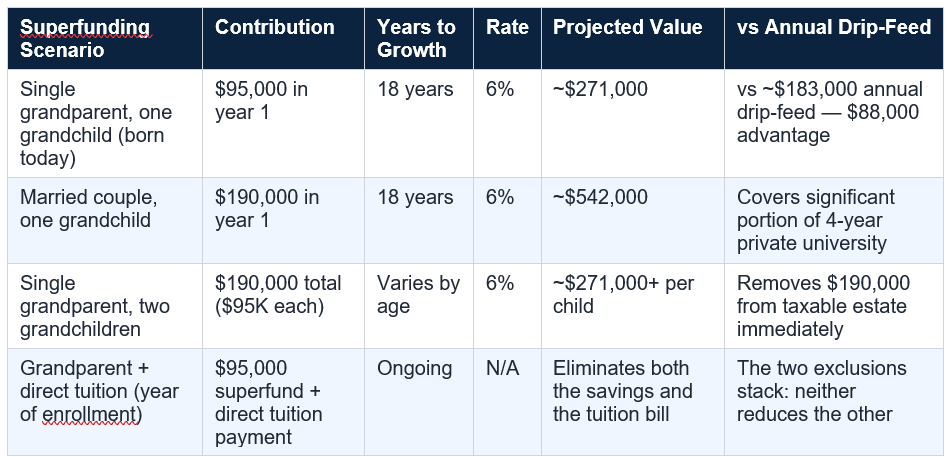
529 college savings plans have a special gift tax rule not available to any other savings vehicle. Under IRS rules applicable to qualified tuition programs (IRC §529), a donor can contribute up to five years’ worth of annual exclusion gifts in a single year and elect to treat them as if made ratably over five years. This is called superfunding or the five-year gift-tax averaging election.The 2026 mechanics:
- Maximum superfunding contribution per donor per beneficiary: 5 × $19,000 = $95,000.
- Maximum for a married couple using gift splitting: 5 × $38,000 = $190,000 per child.
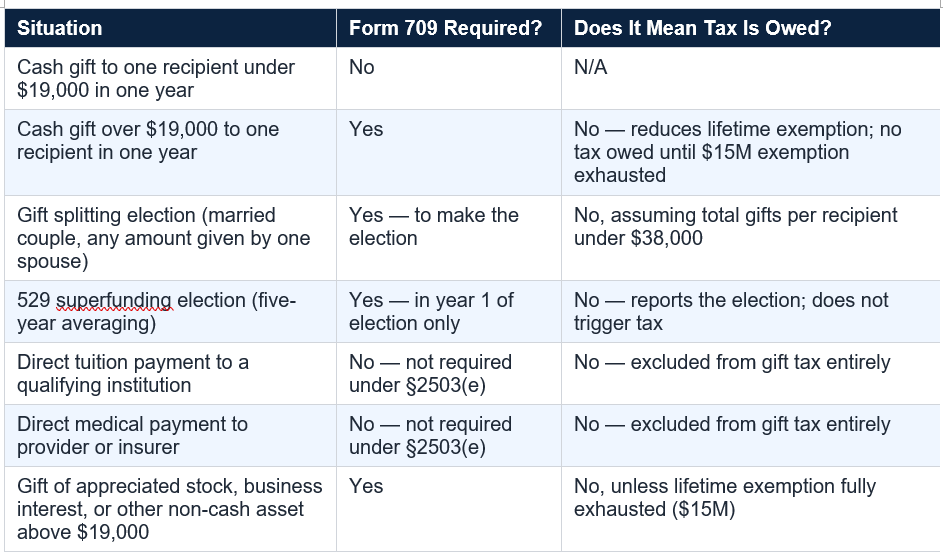
- The donor must file IRS Form 709 in the first year of the election to report the five-year spread. In subsequent years of the five-year period, no Form 709 is required unless other reportable gifts are made.
- During the five-year window, no additional annual exclusion gifts to the same beneficiary are allowed without using lifetime exemption. If the donor gives the child $19,000 in cash in year two of a five-year election, that $19,000 becomes a reportable gift that reduces the lifetime exemption.
- If the donor dies within the five-year period, the portion of the contribution not yet allocated to completed years returns to the taxable estate pro rata.
The 529 Plan’s Other Advantages: Tax-Free Growth and New 2026 Rules
Beyond the superfunding strategy, 529 plans offer structural advantages that make them one of the most effective intergenerational wealth-transfer vehicles in the US tax code:- Federal income tax-free growth: money contributed to a 529 plan grows without federal income tax on gains, dividends, or interest.
- Tax-free qualified withdrawals: distributions used for qualified education expenses are completely federal income tax-free. Qualified expenses include tuition, fees, required books, supplies, equipment, room and board (subject to the school’s cost-of-attendance allowance), and computers and related technology used for educational purposes.
- K-12 expanded under OBBBA 2026: the One Big Beautiful Bill Act doubled the annual cap for K-12 tuition expenses from $10,000 to $20,000 per beneficiary per year. Vocational credential expenses have also been added as qualified expenses (FinanceWonk, 2026).
- Beneficiary changes: the 529 account owner can change the beneficiary to any qualifying family member of the original beneficiary (siblings, cousins, parents, aunts, uncles) without triggering tax. If one child does not use the full account, it can roll to a sibling.
- Estate planning benefit: a 529 contribution removes money from the donor’s estate while the donor retains indirect control (as account owner) over the funds. This is an unusual planning feature — most gift strategies require full loss of control.
The Roth IRA Rollover from a 529: A Hidden Exit Ramp
A concern that has historically discouraged families from superfunding a 529 plan is the risk of over-funding: if the child receives a scholarship, changes educational plans, or simply does not use the full account, withdrawals for non-educational purposes were previously subject to income tax and a 10 percent penalty on earnings.The SECURE 2.0 Act (effective 2024) created a significant new exit ramp: a 529 plan beneficiary can roll funds from the 529 into a Roth IRA, subject to specific conditions:
- Annual rollover limit: up to the Roth IRA contribution limit for the year ($7,500 in 2026 for beneficiaries under 50; $8,600 for 50 and older), reduced by any other Roth IRA contributions made by the beneficiary that year.
- Lifetime cap: no more than $35,000 per beneficiary can be rolled from a 529 to a Roth IRA across all years, subject to future inflation adjustments.
- Account age requirement: the 529 account must have been open for at least 15 years.
- Contribution age requirement: contributions made within the five years immediately before the rollover date cannot be rolled over.
The Lifetime Gift Tax Exemption: $15 Million Per Person in 2026
Even after using all the annual exclusions, direct tuition and medical payment exclusions, and 529 superfunding strategies, there remains a final backstop for large wealth transfers: the federal lifetime gift and estate tax exemption.The lifetime exemption in 2026 is $15 million per individual ($30 million for a married couple), made permanent by the One Big Beautiful Bill Act signed in 2025 (Farther.com, July 2026; Country Tax Calc, June 2026; USTax Tools, April 2026). This supersedes the prior TCJA provisions that would have sunsetted the elevated exemption back to approximately $7 million.
What this means in practice:
- Gifts above the $19,000 annual exclusion that are reportable on Form 709 do not generate actual gift tax until the total of all such gifts across a lifetime exceeds $15 million per person.
- The vast majority of families — including high-net-worth families with multi-million-dollar estates — will never exceed the lifetime exemption and will never owe federal gift tax.
- Gifts above the annual exclusion reduce the remaining lifetime exemption dollar for dollar. They do not disappear. They are tracked cumulatively via Form 709 filings.
- The lifetime exemption is unified: the same pool covers both lifetime gifts and the taxable estate at death. Using $1 million of lifetime exemption on gifts leaves $14 million to shelter the estate.
Form 709: When to File and What It Actually Means
IRS Form 709 (the United States Gift and Generation-Skipping Transfer Tax Return) is required in specific circumstances. Understanding what it is — and is not — eliminates most of the anxiety around large gifts.Form 709 is due on April 15 of the year following the gift. An extension to file the individual income tax return (Form 4868) automatically extends the Form 709 deadline as well. The form is filed separately from Form 1040 and is sent to the IRS Service Center in Kansas City, Missouri.
As Taxstra’s July 2026 guide notes: ‘The 709 is how the IRS tracks your remaining exemption, and an unfiled return has no statute of limitations: the IRS can challenge the gift’s value decades later, including after your death, when your estate return is on the line. Adequate disclosure on a timely 709 starts the three-year clock.’ Timely, accurate filing of Form 709 — even when no tax is owed — protects the donor’s estate from later challenge.
The Basis Trap: When Giving Is Less Efficient Than Inheriting
One of the most important and frequently overlooked dimensions of gift planning is the basis consequence. When appreciated property (stocks, real estate, business interests) is given during life, the recipient inherits the donor’s original cost basis. When the same property is inherited at death, the beneficiary receives a step-up in basis to the fair market value at the date of death.An example: a parent owns stock purchased for $10,000, now worth $200,000. If gifted during life, the child receives the stock with a $10,000 basis. On later sale for $200,000, the child owes capital gains tax on $190,000 of appreciation. If the same stock is inherited after the parent’s death, the child receives it with a stepped-up basis of $200,000. On immediate sale for $200,000, capital gains tax is zero.
For highly appreciated assets, gifting during life may be significantly less tax-efficient than leaving the same assets to be inherited. The gift removes the asset from the taxable estate (helping with estate tax) but destroys the step-up in basis (increasing the capital gains tax). For families whose estates are well below the lifetime exemption threshold, there is no estate tax savings from the gift — only a capital gains tax cost. Always model the basis consequence before gifting appreciated property.
The basis trap does not apply to cash gifts or to 529 contributions (which invest in market funds and do not carry a specific basis issue in the same way). It is most relevant for large blocks of appreciated stock, real estate, or closely held business interests.
A Real-World Scenario: Maximising Tax-Free Transfers for One Child
The following illustrates how a married couple with one college-bound child can stack multiple exclusions in a single year:This scenario — $295,000 transferred in one year with zero gift tax and zero lifetime exemption usage — is not a loophole or an aggressive strategy. It is the straightforward application of the tax code as written, using four rules that have been in place for decades. The only requirements are: (a) the tuition and medical payments must go directly to the institution or provider; (b) the 529 superfunding election must be made on Form 709; (c) no additional annual exclusion gifts to the same child during the five-year election period.
Strategies That Look Useful But Have Limits
A few commonly discussed strategies warrant clarification:- Loans to children: an interest-free or below-market loan to a child may be treated as an implied gift under IRS rules. The IRS imputes an interest rate (the Applicable Federal Rate, published monthly) on family loans; the forgone interest may be treated as a gift. For loans above $10,000, market-rate interest documentation is important.
- Paying credit card bills: paying off a child's credit card debt (to the credit card company) may qualify as a direct payment, but this is not clearly within the §2503(e) exclusion (which covers educational and medical only). General debt payments above $19,000 are reportable gifts that reduce the lifetime exemption.
- Crummey trusts: irrevocable trusts with Crummey powers allow gifts to a trust to qualify for the annual exclusion by giving beneficiaries a temporary right of withdrawal. These require legal drafting and are typically used for larger estate planning purposes, not routine annual gifts.
- 529 rollovers between beneficiaries: changing the 529 beneficiary to a different person may constitute a taxable gift if the new beneficiary is in a younger generation, triggering generation-skipping transfer tax considerations.
Conclusion
The federal gift tax system in 2026 is structured to allow the vast majority of families to transfer significant wealth to children and grandchildren without owing a dollar of gift tax. The $19,000 annual exclusion is the starting point, not the ceiling. Direct tuition payments are unlimited and require no paperwork. Direct medical payments are unlimited and require no paperwork. Married couples can give $38,000 per recipient per year. A 529 superfunding election allows $95,000 per donor or $190,000 per couple to be contributed in a single year.And behind all of this sits a $15 million per person lifetime exemption, made permanent by OBBBA, that ensures actual gift tax is a concern for only the very largest estates.
Private Wealth Collective’s May 2026 assessment captures the practical reality: ‘Gift tax in 2026 is far more generous than most people think. The $19,000 annual exclusion, $15M lifetime exemption, unlimited direct-pay tuition/medical, and 529 superfunding — most families will never owe a dime of gift tax regardless of how generously they give.’
The most common missed opportunity is the simplest: paying tuition or medical bills directly to the institution rather than routing the money through the child. The difference is one line on the check. The tax consequence is the difference between zero and tens of thousands of dollars in reportable gifts. Use the tools the tax code has provided.
Frequently Asked Questions
What is the annual gift tax exclusion for 2026?The annual gift tax exclusion for 2026 is $19,000 per recipient, per donor (Rev. Proc. 2025-32). This is the same as 2025. A married couple can give $38,000 per recipient per year by electing gift splitting on IRS Form 709. The exclusion applies per recipient: a grandparent with four grandchildren can give $19,000 to each — $76,000 in total — with no paperwork and no effect on the lifetime exemption. Gifts within the annual exclusion require no Form 709 filing. The exclusion is use-it-or-lose-it and resets on January 1 of each year.
Can I pay my grandchild's college tuition without it counting as a gift?
Yes, if you pay the tuition directly to the educational institution. Under IRC Section 2503(e), payments made directly to a qualifying educational institution for tuition are completely excluded from the gift tax system — no dollar limit, no Form 709 required, and the payment does not reduce your annual exclusion or lifetime exemption. The key requirement is that the payment must go directly from you to the school. If you give the money to your grandchild to forward to the school, it is a gift subject to the $19,000 annual exclusion. The exclusion covers tuition only — not room and board, books, or other fees, though the regular $19,000 annual exclusion can cover those amounts separately.
What is 529 superfunding and how much can I contribute in 2026?
529 superfunding is a special IRS election that allows you to contribute up to five years' worth of annual exclusion gifts to a 529 college savings plan in a single year. In 2026, the maximum is $95,000 per donor per beneficiary (5 × $19,000). A married couple using gift splitting can contribute $190,000 per child in a single year. To make the election, you must file IRS Form 709 in the first year of the election, electing to spread the contribution over five years. During the five-year period, you cannot make additional annual exclusion gifts to the same beneficiary without using lifetime exemption. If you die during the five-year window, the unallocated portion returns to your taxable estate pro rata. The investment advantage of superfunding is significant: $190,000 compounding tax-free for 18 years at 6% grows to approximately $542,000.
What is the lifetime gift tax exemption in 2026?
The federal lifetime gift and estate tax exemption is $15 million per individual ($30 million for a married couple) in 2026. This was made permanent by the One Big Beautiful Bill Act (OBBBA) signed in 2025, which superseded the TCJA provisions that would have reduced the exemption to approximately $7 million per person. Gifts above the $19,000 annual exclusion are reportable on Form 709 and reduce the lifetime exemption, but generate no actual gift tax until the cumulative total of all taxable gifts exceeds $15 million per person. The vast majority of families will never approach this threshold. Actual gift tax at rates up to 40% (IRC §2502) only applies after the full lifetime exemption is exhausted.
Do I have to pay gift tax if I give my child more than $19,000?
Almost certainly not — at least not immediately. Gifts above $19,000 to a single recipient in one year require filing IRS Form 709, but filing is not paying. The excess amount above $19,000 reduces your lifetime gift and estate tax exemption ($15 million per person in 2026). Unless you have already made more than $14 million in taxable gifts over your lifetime, the gift generates no actual tax. For example: giving your child $100,000 in cash requires filing Form 709. The first $19,000 is exempt. The remaining $81,000 reduces your lifetime exemption from $15 million to $14.919 million. No tax is owed. Gift tax at 40% would only apply if the cumulative total of your lifetime taxable gifts exceeded $15 million.
Does paying someone's medical bills count as a gift?
Not if you pay the provider directly. Under IRC Section 2503(e), payments made directly to a medical provider, hospital, or insurer for someone else's qualifying medical expenses are completely excluded from gift tax — with no dollar limit, no Form 709 required, and no effect on the annual exclusion or lifetime exemption. Qualifying expenses include hospital bills, surgeries, diagnostic procedures, long-term care services, and qualifying health insurance premiums. The same direct-payment rule that applies to tuition applies here: the money must go straight from the donor to the provider or insurer. If you give the money to the patient first, the §2503(e) exclusion is lost and the payment becomes a reportable gift subject to the $19,000 annual exclusion.
0 Comments
Be the first to share your thoughts on this article.