

Investing
Hardest Part of Being a Fund Manager Nobody Talks About


Table of Contents
- The Career That Looks Like One Thing and Feels Like Another
- The Performance Paradox: Being Measured Against a Standard Most Cannot Meet
- The SPIVA Data: What the Performance Numbers Actually Show
- 7 Hardest Realities of Being a Fund Manager Nobody Talks About
- The Hidden Psychological Costs: Research Evidence
- What Nobody Tells Aspiring Fund Managers -- But Should
- What Actually Helps: Evidence-Based Strategies for Fund Managers
- Conclusion
- Frequently Asked Questions (FAQ)
The Career That Looks Like One Thing and Feels Like Another
The public image of the fund manager is a specific and glamorous one: Bloomberg terminals flickering with market data; confident calls on where the market is heading; management of billions in client capital; compensation structures that can produce extraordinary wealth in a single good year. The career attracts some of the most analytically gifted, academically credentialed, and professionally ambitious people in finance. And then the reality sets in.The reality is not primarily about market uncertainty, though that is real. It is not primarily about the difficulty of stock selection, though that is genuinely hard. The hardest part of being a fund manager -- the part that does not appear in any job description, career guide, or business school case study -- is the sustained psychological burden of a career in which: the statistical odds of beating your benchmark over any extended period are stacked significantly against you; your performance is measured publicly and continuously; the people whose capital you manage are watching; and the professional culture of finance actively discourages the acknowledgement of difficulty, vulnerability, or doubt.
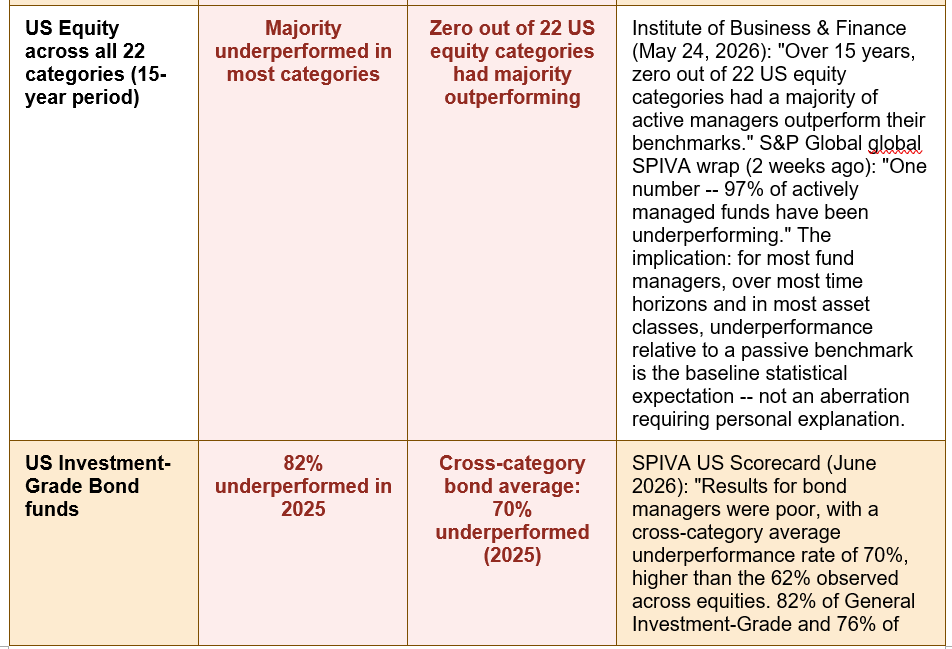
SPIVA US Scorecard (S&P Dow Jones Indices, May 2026): '79% of all active large-cap US equity funds underperformed the S&P 500 in 2025, worse than the 65% rate observed in 2024 and the fourth-worst year for active large-cap managers over the 25-year history of the SPIVA Scorecards.' Over 20 years, 92% of domestic funds underperformed their benchmarks. Over 15 years, zero out of 22 US equity categories had a majority of active managers outperform. These statistics describe the structural reality of the profession: most fund managers, most of the time, will not beat the index they are paid to beat. This is not a statement about individual competence. It is a statement about the mathematical difficulty of the task. And yet the professional environment, the client relationship, and the internal psychology of the high-achieving personalities drawn to this career collectively treat underperformance as if it were a personal failing. That gap -- between the statistical reality and the emotional experience -- is the hardest part of being a fund manager, and almost nobody talks about it.
The Performance Paradox: Being Measured Against a Standard Most Cannot Meet
Every fund manager is measured against a benchmark. For a US large-cap equity fund manager, that benchmark is almost always the S&P 500. For a UK equity manager, the FTSE All-Share or FTSE 100. For a bond manager, a relevant fixed-income index. The benchmark is what a client could achieve simply by buying a low-cost index fund. The fund manager's job -- their entire professional justification -- is to beat it, after fees.The SPIVA data is unambiguous on how often this happens: not very often, and less often over time. SPIVA (June 2026): 'The 500 outperformed the S&P MidCap 400 by 10% and the S&P SmallCap 600 by 12% in 2025, creating opportunities for mid- and small-cap managers to tilt toward the larger end of the capitalization range to generate greater relative outperformance.' Even in this relatively favourable environment for stock selection, 79% of large-cap managers failed to beat the index. S&P Global global SPIVA wrap (2 weeks ago): 'One number -- 97% of actively managed funds have been underperforming' -- referencing the long-term global aggregate picture. These numbers reflect a genuine mathematical challenge, not collective incompetence: the market's aggregate return is, by definition, the average of all market participants' returns, and active managers face this structural headwind on top of fees, trading costs, and the mechanics of managing redemptions.
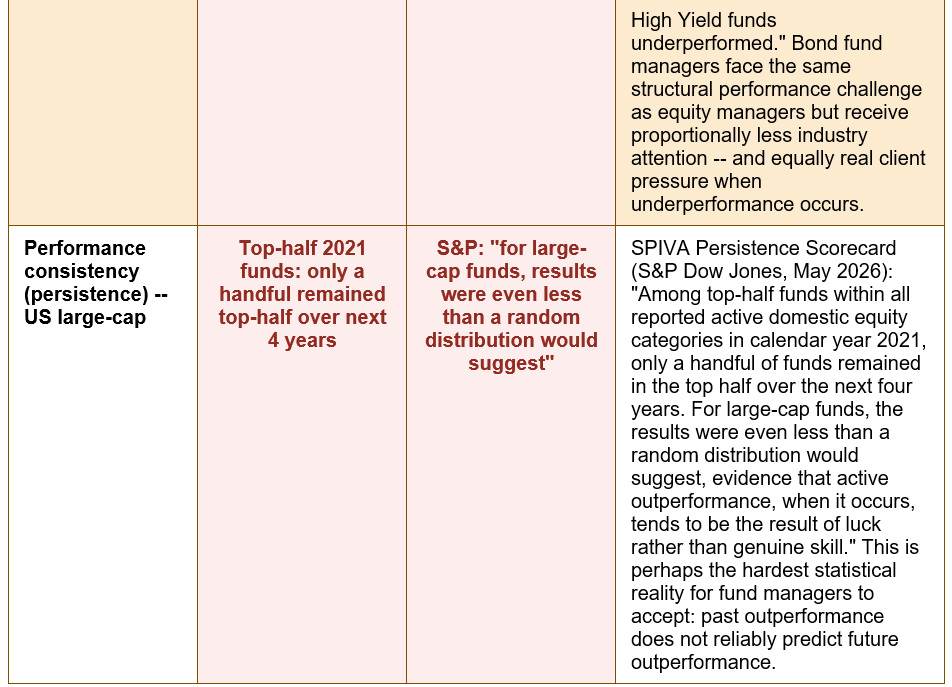
The persistence data is even more challenging. SPIVA Persistence Scorecard (S&P Dow Jones, May 2026): 'Among top-half funds within all reported active domestic equity categories in calendar year 2021, only a handful of funds remained in the top half over the next four years. For large-cap funds, the results were even less than a random distribution would suggest, evidence that active outperformance, when it occurs, tends to be the result of luck rather than genuine skill.' This is the deepest professional challenge for fund managers who did outperform: the evidence suggests they cannot rely on that outperformance to persist. The good run may end, and when it does, the narrative switches from 'skilled manager' to 'got lucky' -- often abruptly, and often in public.
The benchmark underperformance statistics -- the numbers every fund manager lives with: 79% of active US large-cap managers underperformed in 2025. 92% over 20 years. Zero of 22 US equity categories had majority outperformers over 15 years. — SPIVA US Scorecard (S&P Dow Jones, May 2026): '79% of all active large-cap US equity funds underperformed the S&P 500 in 2025, worse than 65% in 2024, the fourth-worst year in 25 years of SPIVA history.' Institute of Business & Finance (May 2026): 'Over 15 years, zero out of 22 US equity categories had a majority of active managers outperform their benchmarks.' Wealth Management (May 2026): 'Over the last 20 years, about 92% of domestic funds underperformed their benchmarks.' S&P Global (2 weeks ago): '97% of actively managed funds have been underperforming' in the global long-term aggregate.
The SPIVA Data: What the Performance Numbers Actually Show
The S&P Dow Jones SPIVA Scorecards are the most widely cited measurement of active manager performance, comparing actively managed funds against their benchmarks across equity and fixed-income categories. The following table maps the most current 2025-2026 data and its implications for fund managers: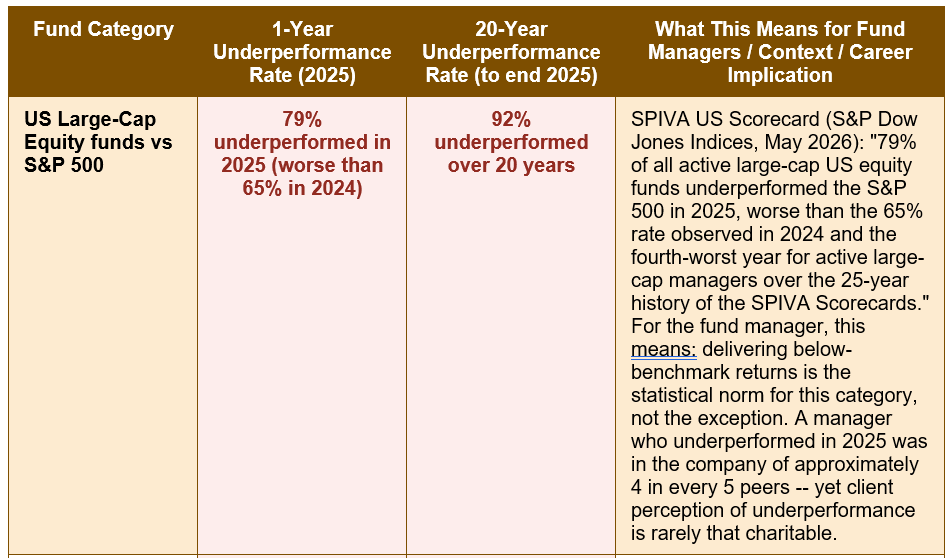
7 Hardest Realities of Being a Fund Manager Nobody Talks About
REALITY #1: Underperformance Is the Statistical Norm -- But You Still Own Every Bad Day | The gap between data and experience
The SPIVA data establishes that most active fund managers, in most time periods, will underperform their benchmark. This is not a secret -- it is publicly documented, widely cited, and increasingly familiar to sophisticated investors. But here is the psychological reality that the statistics do not capture: knowing that underperformance is structurally expected does nothing to reduce the emotional weight of the client call that follows a difficult quarter. Sharecafe (May 11, 2026): 'A psychologist noted that fund managers often internalise failure due to relentless self-imposed standards, leading to significant personal burden and guilt.' Former Fidelity fund manager Anthony Bolton -- one of the most successful active managers in European investment history -- acknowledged that 'underperformance is often unavoidable.' But the individual fund manager who is down 8% against an index up 12% is not thinking about population-level statistics when they sit down to write the quarterly letter to investors. They are thinking, whether they admit it or not, about what this says about them. And in a high-achieving professional environment where analytical superiority is the assumed baseline, the experience of being publicly, precisely, and continuously measured against a standard you are not meeting is a specific and sustained form of professional suffering that the industry almost never discusses directly.REALITY #2: You Cannot Discuss What Is Actually Happening -- With Anyone | Professional isolation as a structural feature
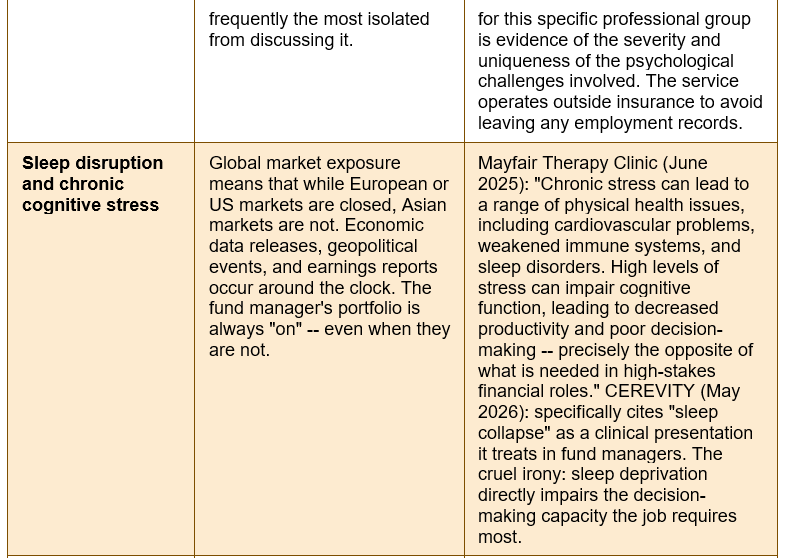
The professional obligations of fund management create a near-complete information blackout around the only topic that actually matters in the job: what you think about the portfolio. Fund managers cannot discuss specific positions with clients (market sensitive; potentially manipulative). They cannot voice strategy doubts publicly (client confidence; regulatory concerns). They cannot seek peer reassurance about holdings (front-running concerns; competitive intelligence). They cannot even acknowledge to colleagues in most organisations that they are struggling with a position or a conviction call without that acknowledgement becoming part of an internal performance narrative. CEREVITY (May 2026), a specialist mental health service for hedge fund managers, specifically cites 'drawdown stress, capacity-review anxiety, sleep collapse, and compensatory substance use' as the clinical presentations it treats in portfolio managers -- and deliberately operates outside insurance to ensure 'sessions do not generate EOBs or benefits records' to protect clients' careers. The existence and design of this service is itself evidence of the severity of the isolation problem. The fund manager who is losing conviction on a major holding, watching it move against them, and fielding investor inquiries -- all in the same week -- is carrying that load in an environment where the professional norms and legal obligations of the role make authentic discussion of the experience structurally impossible.REALITY #3: Sleep Becomes a Managed Resource, Not a Natural State | The always-on portfolio
Global markets do not observe a fund manager's time zone or sleep schedule. Economic data releases happen at 8:30 AM US Eastern -- which is 1:30 PM UK time, 9:30 PM Tokyo. A central bank decision in Japan, a flash crash in emerging market currencies, a geopolitical event in a country where you have a significant position: all of these can happen while the fund manager is asleep. Most fund managers develop a relationship with their phones that non-practitioners find difficult to understand: glancing at price screens before getting out of bed; checking futures markets at 2 AM after waking; monitoring overnight Asian session moves as a background process of consciousness. Mayfair Therapy Clinic (June 2025): 'Chronic stress can lead to a range of physical health issues, including cardiovascular problems, weakened immune systems, and sleep disorders. High levels of stress can impair cognitive function, leading to decreased productivity and poor decision-making -- precisely the opposite of what is needed in high-stakes financial roles.' CEREVITY (May 2026) specifically identifies 'sleep collapse' as a clinical presentation it treats in fund managers -- not just poor sleep, but a collapse of normal sleep architecture under sustained market stress. The cruel circularity: the job demands cognitive sharpness for the quality of decision-making it pays for; the job's structural characteristics systematically undermine the sleep that cognitive sharpness requires.REALITY #4: The Performance Review Is Continuous, Public, and Never Forgives Context | Daily Mark-to-Market as existential condition
The fund manager's performance is calculated every trading day. The NAV is published. The return relative to benchmark is computed. The absolute and relative performance for the week, month, quarter, and year-to-date is visible to every client, every investor relations contact, and every industry database. In virtually every other profession, performance is reviewed annually, quarterly, or at defined project milestones. In fund management, performance is reviewed daily, in public, by the people whose capital you manage. Most other high-stress professions have some structural protection against the continuous visibility of performance: a surgeon's case outcomes are not published daily; a lawyer's win rate is not updated in a public database every afternoon at market close. Fund managers operate without this protection. And the daily mark-to-market process does not accommodate context: the fund that is down 15% in a quarter when the market is down 18% has actually outperformed significantly, but the clients who see the -15% on their statements do not always appreciate the relative framing. Resume Genius (January 2026): 'Financial rewards often come at the cost of work-life balance. The people who thrive in these careers are those who pair technical expertise with emotional intelligence and know how to deliver results under pressure without letting stress take control.' The 'results under pressure' formulation understates the reality: the pressure is not intermittent. It is the permanent ambient condition of the role.REALITY #5: Client Redemptions During Difficult Periods Create a Vicious Cycle | When performance and AUM interact badly
When a fund underperforms, investors redeem. Redemptions force asset sales. Forced sales can move prices against the fund. Price moves create further underperformance. Further underperformance triggers more redemptions. This dynamic -- fund managers call it the 'death spiral' or the 'redemption vortex' -- is not a theoretical risk. It is a documented market dynamic that has ended careers and shut funds. The fund manager experiencing this cycle is required to manage the portfolio professionally, manage client communications honestly, manage their own conviction about the strategy, and manage their personal response to watching months of careful positioning being liquidated in sequence to meet investor exits -- often at the worst possible prices. The 2025 SPIVA data (S&P Global, May 2026) shows that following underperformance, past top-half performers frequently fell not just from the top half but completely out of the distribution, as the compounding effects of underperformance, redemptions, and forced positioning changes interact. Kaplan Financial (May 2026): 'In the advisory profession, when stress builds without adequate support, the result can include burnout, disengagement, and higher turnover.' In fund management, 'higher turnover' often means fund closure -- which is a specific and identifiable career outcome, not an HR abstraction.REALITY #6: Conviction and Doubt Must Be Managed Simultaneously -- Permanently | The intellectual contradiction at the heart of the role
Active fund management requires the fund manager to maintain, simultaneously: sufficient conviction in their investment thesis to hold concentrated positions through adverse price movements; and sufficient intellectual humility to recognise when the thesis is wrong and exit before losses become catastrophic. These two requirements exist in permanent tension. Too much conviction, held too long: catastrophic drawdowns. Too little conviction: constant position churning, poor risk-adjusted returns, inability to let good positions run. Anthony Bolton (Sharecafe, May 2026): 'maintained conviction with flexibility and avoiding rigid investment stances.' The description makes it sound like a temperamental choice. In practice, knowing when holding a losing position reflects justified conviction (thesis intact, price temporarily wrong) versus wishful thinking (thesis broken, refusing to admit it) is one of the hardest intellectual distinctions in professional investing -- and getting it wrong, in either direction, produces significant financial consequences for clients and career consequences for the manager. There is no formula for this distinction. It requires judgment, and judgment exists on a spectrum from brilliant to catastrophic, in the same person, on different days. The fund manager must somehow make this distinction reliably, under constant time pressure, with partial information, while managing client communications, monitoring risk, and not sleeping enough.REALITY #7: The Identity Problem: When Market Performance Becomes Self-Worth | The long-term psychological toll of performance-linked identity
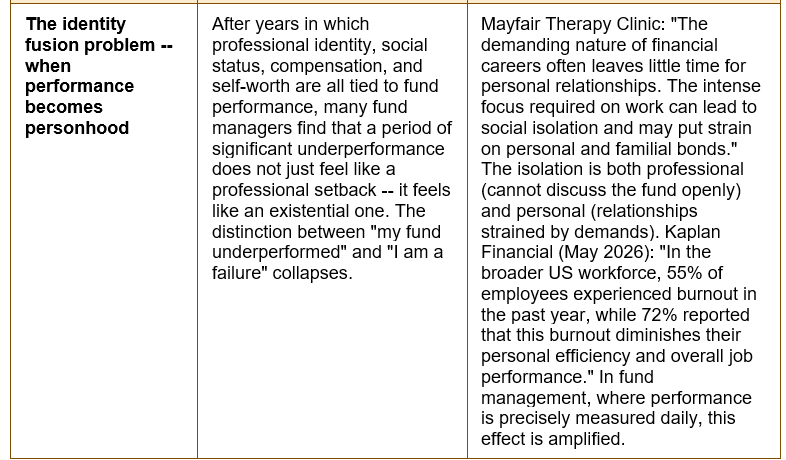
The fund management career, particularly at its most successful, tends to produce a specific pattern: a decade or more in which professional identity, social standing, compensation, peer recognition, and personal self-conception are all tightly linked to investment performance. When performance is strong, this fusion feels like integration. When performance turns -- and SPIVA data confirms that it almost inevitably will at some point for almost everyone -- the fusion becomes a liability. The fund manager who has spent fifteen years deriving identity primarily from investment performance has, in effect, outsourced their self-worth to market prices. When prices move against them for long enough, the psychological consequence is not just professional stress but something closer to an identity crisis. Mayfair Therapy Clinic: 'The demanding nature of financial careers often leaves little time for personal relationships. The intense focus required on work can lead to social isolation and may put strain on personal and familial bonds.' CEREVITY (May 2026): specialised for this specific clinical population because standard therapy providers often have 'no understanding of the structural reality of the seat' -- the specific pressures of drawdowns, capacity reviews, and investor communications that constitute the fund manager's unique professional context. Growtherapy (June 24, 2026, most current mental health data): '66% of US employees reported feeling burnout in some form in 2026.' For fund managers, the burnout is not background noise -- it is specific, measurable (your performance is literally visible), and career-threatening in a way that workplace burnout in most professions is not.The Hidden Psychological Costs: Research Evidence
The following table maps the specific psychological challenges identified in recent research and clinical literature on fund management, with the evidence base and context for each: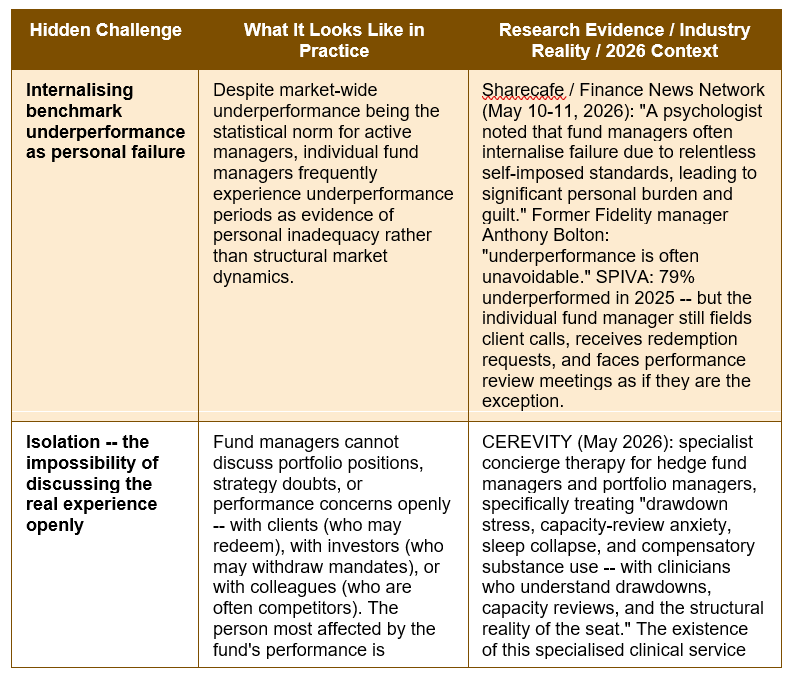
What Nobody Tells Aspiring Fund Managers -- But Should
The recruitment pitch for fund management focuses on intellectual challenge, market access, potential earnings, and the opportunity to demonstrate analytical superiority in a competitive environment. All of these are real. The following realities are equally real and almost never mentioned:- Your benchmark is managed by a machine that does not sleep, does not pay fees, and does not face redemptions: The S&P 500 index does not have operating costs, management fees, or the drag of holding cash to meet potential redemptions. It does not face the information constraints that market rules impose on active managers. It does not need to disclose its positions before moving them. The active fund manager is competing against a mechanically perfect, cost-free implementation of the market's aggregate return. This is not an excuse for underperformance -- it is a structural reality that deserves honest acknowledgement before choosing this career.
- Your best year will often be attributed to the market, and your worst year will often be attributed to you: The asymmetry of attribution in active fund management is one of its less-discussed features. When the market rises 30% and the fund rises 32%, the attribution is often: 'the market was strong.' When the market falls 5% and the fund falls 8%, the attribution is often: 'the manager underperformed.' The psychological asymmetry of receiving less credit for good relative performance than blame for bad relative performance is a sustained feature of the client relationship in active management.
- The longevity of your career may depend more on client relationship management than on investment performance: The fund managers with the longest careers in the industry are not always the ones with the best SPIVA rankings. They are often the ones who are most effective at communicating with clients during difficult periods, managing redemption risk through relationship quality, and building investor bases who stay with them through underperformance. The analytical skills that get you hired for the role are necessary but not sufficient for keeping it.
- Nobody will tell you when the conviction-versus-error distinction has become delusional: The professional environment of fund management does not provide reliable feedback on when confidence has become denial. Colleagues rarely challenge a senior manager's conviction calls directly. Clients rarely have the market knowledge to do so. And the manager's own psychology, particularly during high-stress periods, is not well-positioned to make this assessment objectively. The gap between confident and delusional is not always visible from inside it.
Anthony Bolton's honest assessment -- perhaps the most important thing a senior fund manager has ever said publicly about this career: Bolton managed the Fidelity Special Situations fund for 28 years, generating one of the strongest long-term track records in European active management history. Asked about the reality of the role, he specifically acknowledged that 'underperformance is often unavoidable' and advised 'maintaining conviction with flexibility and avoiding rigid investment stances.' The fact that one of the most successful fund managers in European history had to develop explicit strategies for managing the psychological reality of unavoidable underperformance -- and shared this advice as career wisdom rather than as a confession of inadequacy -- should tell aspiring fund managers something important about what the career actually requires beyond investment skill.
What Actually Helps: Evidence-Based Strategies for Fund Managers
The hardest realities above are not arguments against choosing fund management as a career. They are arguments for going in with clear eyes -- and for developing specific strategies for managing its unique psychological demands. The evidence-based approaches most consistently cited in research on high-performance financial professionals:- Process-focused rather than outcome-focused review: The distinction between a good process and a good outcome is one of the most important in investing. A good decision made on high-quality information and rigorous analysis can produce a bad outcome due to factors outside the manager's control. A bad decision can produce a good outcome due to luck. Reviewing investment decisions based on whether the process was sound -- independently of whether the outcome was positive -- provides a psychological anchor that protects against internalising poor outcomes that do not reflect poor process. This is easier to describe than to maintain consistently, particularly in the pressure of a difficult quarter.
- Explicit separation of professional identity from performance metrics: Mayfair Therapy Clinic: 'the stress that comes from the pressure to perform can actually hinder performance.' The psychological literature on high-performance professionals consistently shows that identity fusion with performance outcomes produces worse performance under stress. Deliberate cultivation of identity anchors outside investment performance -- relationships, interests, physical health, creative work -- is not a soft lifestyle choice. It is a risk management strategy for cognitive performance under pressure.
- Professional support from people who understand the role: CEREVITY (May 2026): specialist concierge therapy for hedge fund managers and portfolio managers, specifically because 'clinicians who understand drawdowns, capacity reviews, and the structural reality of the seat' produce more effective support than standard mental health provision. The fund manager seeking support from a therapist unfamiliar with this professional context may spend significant session time explaining what a drawdown is and why a capacity review creates existential anxiety -- time that would be better spent on the clinical work.
- Honest calibration of conviction -- the humility practice: The most consistently cited trait of long-tenured successful fund managers is not analytical brilliance -- it is the combination of analytical ability with a structured process for questioning their own convictions. Bolton's advice to maintain conviction with flexibility is a description of a specific psychological discipline: holding a position while simultaneously maintaining the capacity to hear evidence that the thesis is wrong. This is a skill that can be deliberately developed and is a significant differentiator between those who manage the role sustainably and those who do not.
FIVE THINGS THE INDUSTRY CONSENSUS ON FUND MANAGEMENT GETS WRONG: (1) 'PAST OUTPERFORMANCE IDENTIFIES SKILL.' SPIVA Persistence Scorecard (S&P Dow Jones, May 2026): 'For large-cap funds, the results were even less than a random distribution would suggest, evidence that active outperformance, when it occurs, tends to be the result of luck rather than genuine skill.' The attribution of past outperformance to skill rather than cycle, luck, or factor exposure is one of the most consequential errors in asset management evaluation -- for clients choosing funds, and for fund managers evaluating their own performance. (2) 'THE PSYCHOLOGICAL DEMANDS ARE JUST PART OF THE JOB.' Sharecafe (May 11, 2026): 'addressing the psychological toll is equally crucial' to addressing investment strategy. The framing of psychological demands as an unavoidable feature to be endured, rather than a specific challenge requiring specific management, produces worse outcomes for fund managers and their clients. (3) 'HIGH COMPENSATION OFFSETS THE STRESS.' The financial rewards of successful fund management are real. So are the cognitive impairments that chronic stress produces: Mayfair Therapy Clinic: 'high levels of stress can impair cognitive function, leading to decreased productivity and poor decision-making -- precisely the opposite of what is needed in high-stakes financial roles.' The compensation does not offset the stress; it is the stress that produces the cognitive impairments that undermine the performance the compensation is contingent on. (4) 'IF YOU CANNOT HANDLE THE PRESSURE, YOU DO NOT BELONG IN THE ROLE.' This framing prevents the honest acknowledgement and management of psychological challenges. CEREVITY (May 2026) exists because fund managers who cannot discuss their difficulties openly with colleagues or clients need a space where the structural reality of the role is understood. The problem is not individual weakness -- it is an industry culture that treats the acknowledgement of difficulty as a career liability. (5) 'THE GOAL IS JUST TO BEAT THE BENCHMARK.' The fund manager's primary obligation is to their clients' financial goals, which often involve absolute rather than relative return requirements. A client who needed 6% annual returns to meet their retirement funding needs and received -5% (while the index returned -8%) has technically outperformed but has not been adequately served. The framing of all performance as relative to benchmark obscures the more fundamental obligation to clients' actual financial objectives.
Conclusion
The hardest part of being a fund manager is not the market uncertainty, the analytical complexity, the long hours, or the competitive intensity -- though all of these are real. The hardest part is the sustained psychological burden of a career in which most practitioners, in most time periods, will not beat the benchmark they are paid to beat; in which performance is measured publicly and continuously with no accommodation for context; in which the professional culture makes authentic discussion of difficulty structurally impossible; and in which the high-achieving personality types drawn to the role are precisely those most likely to fuse professional identity with performance outcomes -- making the inevitable difficult periods feel like existential failures rather than statistical facts.SPIVA (S&P Dow Jones, May 2026) establishes the statistical context: 79% of active large-cap US equity fund managers underperformed in 2025; 92% over 20 years; zero of 22 US equity categories had a majority outperform over 15 years. Sharecafe (May 11, 2026) names the human consequence: fund managers often 'internalise failure due to relentless self-imposed standards, leading to significant personal burden and guilt.' The gap between these two statements -- the structural normality of underperformance and the personal weight it carries -- is the hardest part of the role and the part nobody in the industry talks about.
Anthony Bolton's advice to maintain conviction with flexibility and to acknowledge that underperformance is often unavoidable was not given as a confession. It was given as hard-won professional wisdom from one of the most successful fund managers in European history. The aspiring fund manager who internalises this wisdom before they need it -- who builds the process orientation, the identity anchors outside performance, and the honest professional relationships that make the difficult periods manageable -- has a significantly better chance of the career being sustainable, productive, and genuinely satisfying. The one who does not may find out the hard way what the hardest part of the job actually is.
Frequently Asked Questions (FAQ)
0 Comments
Be the first to share your thoughts on this article.