

Insurance
Home & Auto Insurance Costs Rising: How to Save

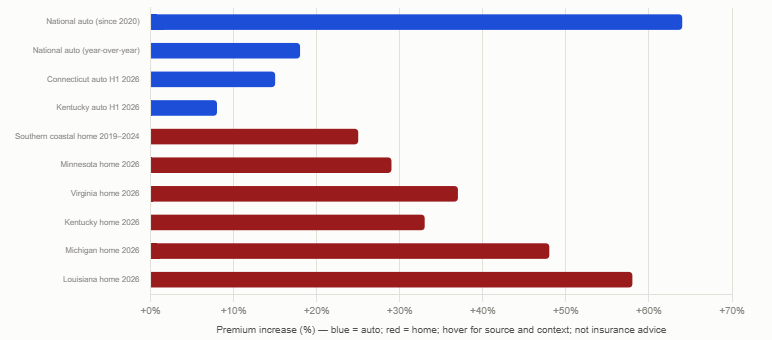
Auto insurance is up 64% since 2020. Homeowners insurance has risen 25% or more in southern coastal areas. Louisiana rates jumped 58% in 2026 alone. The national average driver is now paying $2,237 per year for full-coverage auto — and home insurance in high-risk states can easily clear $4,000. Premiums are not going back down on their own. Here is what is driving the increases, and the most effective steps available right now to reduce what you pay.

The drivers of these increases are structural, not cyclical, which means they are not going to reverse on their own:
Auto insurance up 64% since 2020 (BLS). National full-coverage auto average: $2,237/year in 2026 (Insurify); $1,162 for 6 months (~$194/month) per The Zebra July 2026. Home insurance national average: $1,428–$2,200/year (sources vary by coverage and methodology). Louisiana home insurance up 58% in 2026. GAO report (Feb 2026): southern coastal premiums up 25%+ from 2019 to 2024.
The rate environment in 2026 is not uniform. Insurify data shows 27 states saw rate increases in the first half of 2026, compared with only nine states in the second half of 2025. The states seeing the largest first-half 2026 increases are Connecticut (+15%), Kentucky (+8%), West Virginia (+8%), Illinois (+6%), and Nevada (+6%). Notably, several of the most expensive states for auto insurance — Washington DC, New York, and New Jersey — actually saw premiums fall at least 5% in the first half of 2026, suggesting insurers have recalibrated after prior-year catch-up increases in those markets.
Risk-based pricing is widening the gap between safe and high-risk drivers. AutoInsurance.com’s mid-2026 pricing trends analysis found that drivers with DUIs saw a 35% average rate increase, teen drivers saw a 17% increase, and those with low credit scores (in states where credit scoring in insurance pricing is permitted) faced above-average hikes. Meanwhile, drivers with clean records in many states saw modest relief as the broad rate surge of 2022–2024 stabilised.
Full-coverage auto average 2026: $2,237/year national (Insurify H1 2026). $1,162 per 6 months / ~$194/month (The Zebra, July 2026). Up 18% year-over-year. 64% cumulative increase since 2020 (BLS). Connecticut up 15% in H1 2026 alone. DUI: +35% premium. Teen driver: +17%. 27 states with rate increases in H1 2026 vs 9 in H2 2025 (Insurify).
The year 2025 provided partial relief. A quieter Atlantic hurricane season and fewer catastrophic losses allowed insurers in many markets to ease rate increases. Most regions are expected to see homeowners’ premium increases below 10% in 2026 (VIU by HUB). But the exceptions are significant. VIU by HUB specifically identifies wildfire zones, hurricane coastlines, and flood-prone areas as still experiencing double-digit hikes as insurers price true climate exposure into policies.
The 2025 California wildfires are the clearest recent example. The Palisades and Eaton fires at the start of 2025 generated billions in property damage and accelerated insurer exits from the California market. State Farm subsequently sought an additional 30% rate increase in California, which, if approved, would add approximately $600 per year to the average California homeowner’s policy (Insurance.com, February 2026). Even states far from coasts or wildfire zones are feeling the impact: severe convective storms (high winds, large hail) cause cumulative annual losses comparable to a major hurricane event, driving significant rate increases in Midwest states including Minnesota (+29% in 2026) and Wisconsin.
National homeowners average 2026: $1,428–$2,200/year (varies by source and coverage). GAO (Feb 2026): inflation-adjusted national premium up only 3% 2019–2024, but southern coastal areas up 25%+. California wildfires H1 2025: $40 billion covered damage = 50% of global insured nat-cat losses. Biggest 2026 state increases: Louisiana +58%, Michigan +48%, Virginia +37%, Kentucky +33%, Minnesota +29%.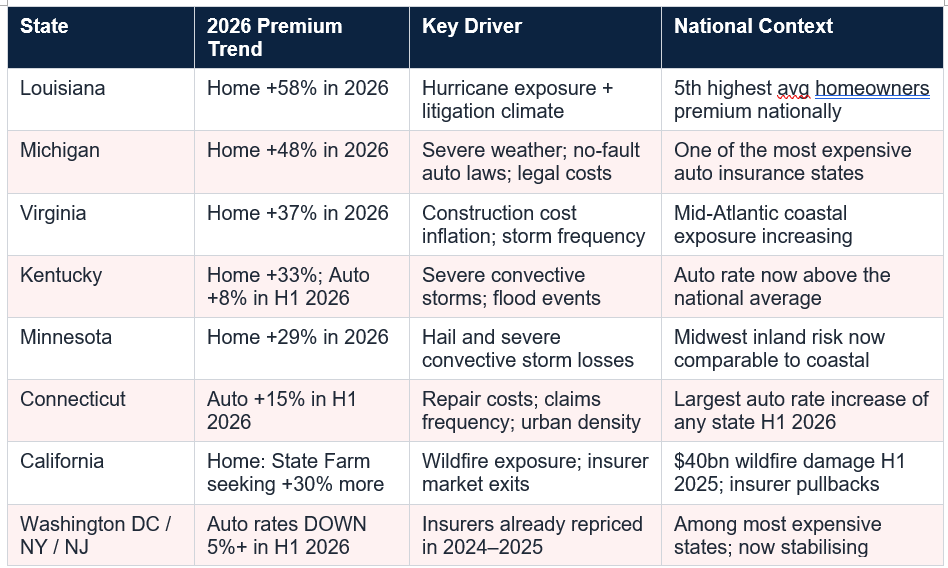
Why does regular shopping work? Because insurers use different rating algorithms. The same driver with the same vehicle and the same address can receive quotes that differ by hundreds of dollars per year from one carrier to another, because each insurer weights factors like age, credit score, driving record, vehicle make, and zip code differently. A price that was competitive 18 months ago may no longer be — either because your risk profile has changed (a violation dropped off your record, your vehicle aged) or because the insurer’s book of business has changed and they are now pricing your segment differently.
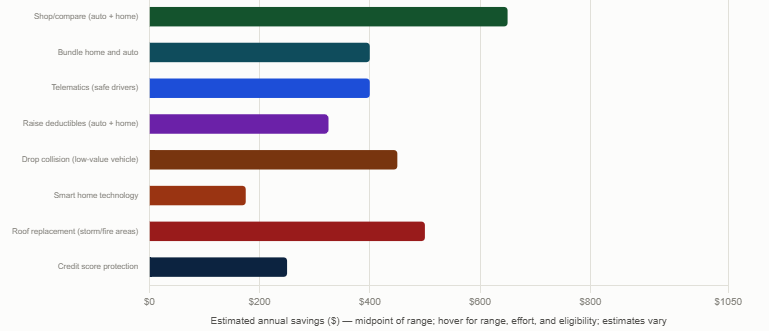
Get competing quotes from at least three insurers every 12–24 months. Use a combination of direct insurer websites (GEICO, Progressive, State Farm, USAA if eligible), comparison aggregators (The Zebra, NerdWallet, Insurify, Policygenius), and an independent broker. When you have a competing quote below your current premium, call your current insurer and ask for a review. Many will match or beat the competing price rather than lose a long-term, claim-free customer. The cost: 30–60 minutes of your time. Potential savings: $200–$600 per year.
Typical telematics discount ranges are 10 to 30 percent for participating in the programme, with some programmes offering up to 40 percent for the safest drivers. The factors monitored typically include hard braking, rapid acceleration, cornering speed, phone use while driving, time of day (night driving is statistically higher risk), and annual mileage. Most major insurers now offer telematics programmes: Progressive’s Snapshot, State Farm’s Drive Safe & Save, Allstate’s Drivewise, and GEICO’s DriveEasy are among the most widely available.
A critical consideration: telematics programmes can also increase premiums for drivers who turn out to be higher-risk than their statistical profile suggested. Before enrolling, assess your own driving habits honestly. If you frequently drive late at night, brake hard in urban traffic, or drive high annual mileage, the telematics result may not be favourable. If you are a low-mileage, smooth-driving daytime commuter, telematics is one of the highest-value available discounts.
If you drive fewer than 10,000–12,000 miles per year and consider yourself a smooth, safe driver, enrol in your current insurer's telematics programme or get a new quote from an insurer who offers telematics-based pricing. Safe drivers who participate typically save 10–30%; some programmes (Snapshot, Drivewise) start with a participation discount and adjust based on driving data. Try for 3–6 months to assess the actual premium impact before committing long-term.
Bundling home and auto insurance with the same carrier typically saves 5 to 25 percent on one or both policies, depending on the carrier and market. VIU by HUB, eInsurance.com, and FinanceNavigatorPro all identify bundling as among the first actions any homeowner should take when trying to reduce premiums. The savings are real and consistent: carriers prefer to hold multiple policies for one household, both because it reduces administration costs and because multi-policy holders are statistically less likely to shop elsewhere.
Deductible increases work identically to the auto insurance model. Raising the standard deductible from $1,000 to $2,500 typically reduces the annual premium by 10 to 25 percent. A homeowner paying $2,000 per year in premiums can save $200 to $500 per year with this change. The critical constraint: the higher deductible must be genuinely affordable if a claim occurs. An emergency fund of at least the deductible amount should exist before increasing it.
Other homeowner discounts available from most major carriers:
Call your current homeowners insurer before each renewal and ask two questions: (1) What discounts am I currently receiving? (2) What discounts am I not receiving that I might qualify for? Then get one competing quote from an independent broker or comparison site. Carriers respond to competition, and a lower competing quote is often enough to trigger a retention-motivated reduction from your current provider.
Conversely, given construction cost inflation of recent years, some homeowners are under-insured: their policy’s dwelling coverage was set before the sharp rise in material and labor costs and no longer covers a full rebuild. This is the more dangerous error: inadequate coverage results in an out-of-pocket shortfall after a major loss.
The correct dwelling coverage figure is the estimated replacement cost of the structure (not the land) at current construction prices. Most major insurers provide replacement cost estimator tools, or your agent can request a professional valuation. Review this figure at every annual renewal against current construction cost indices for your zip code. If the rebuild cost estimate has risen above your current dwelling coverage, increase the coverage. If the estimate has not kept pace with your premium increases, negotiate based on the actual rebuild cost.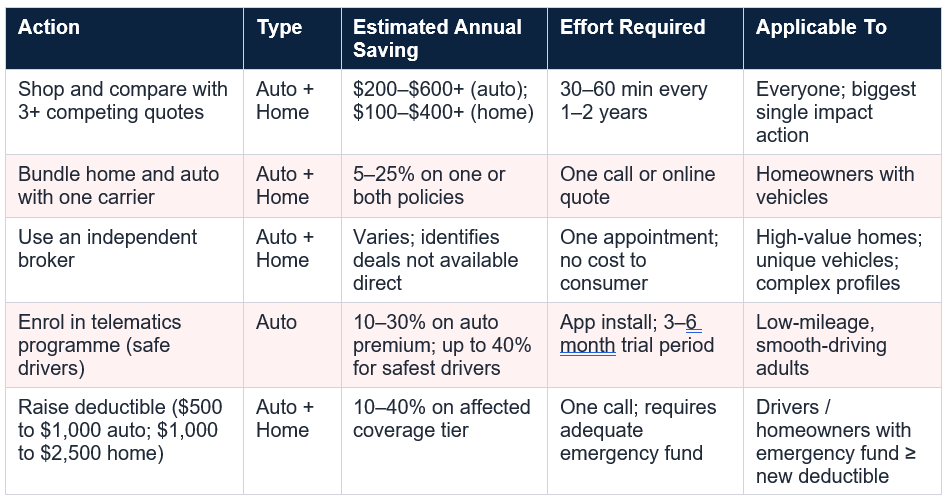
The households that will be least affected by these trends are those that treat insurance as an active, annually managed expense rather than a passive automatic renewal. Shopping every one to two years, using an independent broker, bundling where it makes sense, adjusting deductibles in line with the emergency fund, enrolling in telematics if the driving profile supports it, and making targeted home improvements in high-risk areas — these actions collectively can deliver $500 to $2,000 or more in annual savings for a typical household, without reducing the core protections that make insurance valuable in the first place.
The worst outcome is the one that happens by default: an annual renewal that is automatically accepted without comparison, year after year, as the premium climbs with each cycle. Insurance companies are not obligated to keep your premium competitive. That responsibility belongs to you, and it requires about an hour of attention per year.
Auto insurance increased 64% between September 2020 and September 2025 (Bureau of Labor Statistics data). The primary drivers are: (1) the rising cost of repairing or replacing vehicles, as new car prices peaked near $50,000 and auto maintenance/repair costs rose 45% in five years (BLS); (2) healthcare cost inflation, since auto insurers are responsible for covering medical bills when their policyholder is at fault in a collision; (3) elevated accident frequency and severity; and (4) supply chain disruptions that raised parts costs during 2021–2023. In 2026, tariff-related parts cost increases have not yet been fully priced into premiums but are expected to contribute to further increases. The average full-coverage premium is now $2,237 nationally per Insurify's first-half 2026 report.
Which states have the biggest home insurance increases in 2026?
The states with the largest 2026 homeowners’ insurance rate increases are Louisiana (+58%), Michigan (+48%), Virginia (+37%), Kentucky (+33%), and Minnesota (+29%), according to state-level rate change data compiled by PNWResidences.com (April 2026). California is experiencing insurer market exits and State Farm has sought an additional 30% rate increase; if approved, the average California homeowner’s premium would rise by approximately $600 per year. In southern coastal areas nationally, the US GAO found premiums rose 25% or more between 2019 and 2024. The five states with the highest average premiums overall are Nebraska, Louisiana, Florida, Oklahoma, and Kansas — all with high windstorm exposure.
What is the fastest way to lower my auto insurance premium right now?
The fastest way to lower your auto insurance premium is to get competing quotes from at least three insurers and ask your current insurer to match the best quote. Insurance premiums are not uniform across carriers — the same driver with the same vehicle can receive quotes that differ by hundreds of dollars annually because each insurer weights risk factors differently. Use comparison aggregators (The Zebra, Insurify, NerdWallet) alongside direct insurer quotes and an independent broker. If you are a low-mileage, safe driver, enrol in your current insurer's telematics programme (Progressive Snapshot, State Farm Drive Safe & Save, Allstate Drivewise) — the discount for safe drivers is typically 10–30%, with some programmes offering up to 40%. These two actions together can often reduce annual premiums by $300–$800.
Does bundling home and auto insurance actually save money?
Yes, consistently. Bundling home and auto with one carrier typically saves 5 to 25% on one or both policies. Most major carriers offer explicit bundling discounts, and even where they do not, having multiple policies with the same carrier tends to produce better retention pricing. VIU by HUB, eInsurance.com, and FinanceNavigatorPro all identify bundling as among the highest-value first actions for households with both policies. The important caveat: bundling should be confirmed against competing quotes. In some cases, the bundled price from one carrier may still be higher than two separate best-in-class quotes from different carriers. Run the comparison both ways before assuming bundling is cheaper.
What home improvements reduce homeowners’ insurance premiums?
The highest-impact home improvements for premium reduction are: (1) Roof replacement — especially with impact-resistant (Class 4) or fire-resistant materials. Savings range from 10–25% standard; up to 40% for Class 4 in storm-prone states. (2) Smart home technology — leak detectors, monitored security systems, smart smoke alarms. Savings: 2–15% per category; 5–15% overall for monitored alarm systems. (3) Wildfire mitigation — defensible space clearing, non-combustible materials within 5 feet of the structure, fire-resistant venting. Relevant in California, Colorado, western states. (4) Hurricane hardening — storm shutters, hurricane-rated garage doors, drainage improvements. Some states have inspection programmes that certify improvements for documented premium credits. Always confirm with your insurer which improvements qualify for credits and what documentation is required before undertaking the project.
Should I raise my insurance deductible to save money?
Raising your deductible can save 10–40% on the relevant coverage tier and is generally advisable when you have an emergency fund sufficient to cover the higher deductible. For auto insurance: raising from $500 to $1,000 typically saves 15–30% on comprehensive and collision combined. For home insurance: raising from $1,000 to $2,500 typically saves 10–25% on the policy. The decision should be driven by one question: can I comfortably absorb the higher deductible from savings without financial stress if I file a claim? If yes, the higher deductible is mathematically advantageous: the annual premium saving typically exceeds the additional risk within two to four years. If no — if a $2,500 out-of-pocket claim would cause financial hardship — maintain the lower deductible and find savings elsewhere.
Table of Contents
- Why Insurance Premiums Keep Going Up
- Auto Insurance in 2026: The 64% Rise Since 2020
- Homeowners Insurance in 2026: Climate Risk Meets Construction Inflation
- The States Feeling It Most
- Auto Insurance Savings #1: Shop and Compare Every 1–2 Years
- Auto Insurance Savings #2: Telematics and Usage-Based Insurance
- Auto Insurance Savings #3: Adjust Your Coverage and Deductibles
- Auto Insurance Savings #4: Protect Your Risk Profile
- Home Insurance Savings #1: Bundle, Raise Deductibles, and Ask for Discounts
- Home Insurance Savings #2: Home Hardening and Smart Technology
- Home Insurance Savings #3: Review Coverage Limits and Rebuild Costs
- The Combined Household Strategy: Bundling and the Independent Broker
- The Savings Comparison: What Each Action Can Save Per Year
- Conclusion: Premiums Will Keep Rising — Your Response Determines the Impact
- Frequently Asked Questions
Auto/ Home Increase By State / Trend
Estimated Annual Savings Per Action
Why Insurance Premiums Keep Going Up
American homeowners and drivers are facing an insurance cost environment that is fundamentally different from what existed even five years ago. Auto insurance surged 64 percent between September 2020 and September 2025 (Bureau of Labor Statistics data, cited ECIKS.org). National average homeowners’ insurance rose 25 percent or more in southern coastal areas between 2019 and 2024, according to the US Government Accountability Office’s most thorough federal analysis of the homeowner’s insurance market in years, published February 27, 2026. In 2026, Louisiana homeowners’ insurance rates jumped 58% in a single year. Connecticut drivers saw auto rates rise 15% in just the first half of 2026.The drivers of these increases are structural, not cyclical, which means they are not going to reverse on their own:
- Climate risk repricing: after years of catastrophic wildfire, hurricane, tornado, and severe convective storm losses, insurers are recalibrating premiums to reflect actual climate exposure. California wildfires caused $40 billion in covered property damage in the first half of 2025 alone — 50% of the world’s total insured natural catastrophe losses in that period.
- Construction and repair cost inflation: national auto maintenance and repair costs rose 45% in the five years to 2026, compared with 14% in the previous five years. Home rebuilding costs have risen sharply as labor and materials remain expensive. The more it costs to repair or rebuild, the higher claims costs become.
- Tariff uncertainty: Insurify’s February 2026 forecast identified tariff effects on auto parts as a ‘wildcard’ that had not yet been fully passed through to consumer premiums. This suggests further auto insurance increases as parts costs filter through to repair bills and claims.
- Litigation and legal costs: in states with elevated litigation rates against insurers, the cost of settling and defending claims rises, and those costs are reflected in premiums.
Auto insurance up 64% since 2020 (BLS). National full-coverage auto average: $2,237/year in 2026 (Insurify); $1,162 for 6 months (~$194/month) per The Zebra July 2026. Home insurance national average: $1,428–$2,200/year (sources vary by coverage and methodology). Louisiana home insurance up 58% in 2026. GAO report (Feb 2026): southern coastal premiums up 25%+ from 2019 to 2024.
Auto Insurance in 2026: The 64% Rise Since 2020
Auto insurance is now a significant and growing line item in most American household budgets. CNBC Select’s July 2026 data from The Zebra puts the national average at $1,162 for six months of coverage — approximately $194 per month, or $2,324 annualised. Insurify’s first-half 2026 report puts the annual average full-coverage premium at $2,237. These figures represent an 18% increase year-over-year according to The Zebra, and a 64% cumulative increase since 2020 per Bureau of Labor Statistics tracking.The rate environment in 2026 is not uniform. Insurify data shows 27 states saw rate increases in the first half of 2026, compared with only nine states in the second half of 2025. The states seeing the largest first-half 2026 increases are Connecticut (+15%), Kentucky (+8%), West Virginia (+8%), Illinois (+6%), and Nevada (+6%). Notably, several of the most expensive states for auto insurance — Washington DC, New York, and New Jersey — actually saw premiums fall at least 5% in the first half of 2026, suggesting insurers have recalibrated after prior-year catch-up increases in those markets.
Risk-based pricing is widening the gap between safe and high-risk drivers. AutoInsurance.com’s mid-2026 pricing trends analysis found that drivers with DUIs saw a 35% average rate increase, teen drivers saw a 17% increase, and those with low credit scores (in states where credit scoring in insurance pricing is permitted) faced above-average hikes. Meanwhile, drivers with clean records in many states saw modest relief as the broad rate surge of 2022–2024 stabilised.
Full-coverage auto average 2026: $2,237/year national (Insurify H1 2026). $1,162 per 6 months / ~$194/month (The Zebra, July 2026). Up 18% year-over-year. 64% cumulative increase since 2020 (BLS). Connecticut up 15% in H1 2026 alone. DUI: +35% premium. Teen driver: +17%. 27 states with rate increases in H1 2026 vs 9 in H2 2025 (Insurify).
Homeowners Insurance in 2026: Climate Risk Meets Construction Inflation
The homeowner’s insurance picture in 2026 is shaped primarily by two forces interacting: climate risk repricing and construction cost inflation. The US Government Accountability Office’s February 2026 report (GAO-26-107867) provides the most comprehensive federal analysis of the residential insurance market in years. Its headline finding is nuanced: nationally, inflation-adjusted premiums rose only 3% between 2019 and 2024 ($2,743 to $2,829 in 2024 dollars). But this national average obscure dramatic regional divergence. In southern coastal areas, premiums rose 25% or more over the same period.The year 2025 provided partial relief. A quieter Atlantic hurricane season and fewer catastrophic losses allowed insurers in many markets to ease rate increases. Most regions are expected to see homeowners’ premium increases below 10% in 2026 (VIU by HUB). But the exceptions are significant. VIU by HUB specifically identifies wildfire zones, hurricane coastlines, and flood-prone areas as still experiencing double-digit hikes as insurers price true climate exposure into policies.
The 2025 California wildfires are the clearest recent example. The Palisades and Eaton fires at the start of 2025 generated billions in property damage and accelerated insurer exits from the California market. State Farm subsequently sought an additional 30% rate increase in California, which, if approved, would add approximately $600 per year to the average California homeowner’s policy (Insurance.com, February 2026). Even states far from coasts or wildfire zones are feeling the impact: severe convective storms (high winds, large hail) cause cumulative annual losses comparable to a major hurricane event, driving significant rate increases in Midwest states including Minnesota (+29% in 2026) and Wisconsin.
National homeowners average 2026: $1,428–$2,200/year (varies by source and coverage). GAO (Feb 2026): inflation-adjusted national premium up only 3% 2019–2024, but southern coastal areas up 25%+. California wildfires H1 2025: $40 billion covered damage = 50% of global insured nat-cat losses. Biggest 2026 state increases: Louisiana +58%, Michigan +48%, Virginia +37%, Kentucky +33%, Minnesota +29%.
The States Feeling It Most
Auto Insurance Savings #1: Shop and Compare Every 1–2 Years
The most consistently recommended and most impactful single action for reducing auto insurance costs is to shop competing quotes regularly — not once, but at every annual or biennial renewal. FinanceNavigatorPro.com’s July 2026 comprehensive insurance cost guide makes the mechanism explicit: ‘You can’t negotiate individual rates like a car price, but you can effectively “negotiate” by shopping competitors and asking your current insurer to match or beat a competing quote. Many carriers will offer a retention discount to keep long-term, claim-free customers.’Why does regular shopping work? Because insurers use different rating algorithms. The same driver with the same vehicle and the same address can receive quotes that differ by hundreds of dollars per year from one carrier to another, because each insurer weights factors like age, credit score, driving record, vehicle make, and zip code differently. A price that was competitive 18 months ago may no longer be — either because your risk profile has changed (a violation dropped off your record, your vehicle aged) or because the insurer’s book of business has changed and they are now pricing your segment differently.
Get competing quotes from at least three insurers every 12–24 months. Use a combination of direct insurer websites (GEICO, Progressive, State Farm, USAA if eligible), comparison aggregators (The Zebra, NerdWallet, Insurify, Policygenius), and an independent broker. When you have a competing quote below your current premium, call your current insurer and ask for a review. Many will match or beat the competing price rather than lose a long-term, claim-free customer. The cost: 30–60 minutes of your time. Potential savings: $200–$600 per year.
Auto Insurance Savings #2: Telematics and Usage-Based Insurance
One of the most significant developments in auto insurance pricing in recent years is the widespread adoption of telematics — usage-based insurance programmes that monitor driving behaviour via a smartphone app or a plug-in device and price premiums based on actual driving patterns rather than statistical risk proxies. Safe, low-mileage drivers who would previously be lumped into demographic risk categories that do not reflect their actual behaviour can achieve significant premium reductions through telematics.Typical telematics discount ranges are 10 to 30 percent for participating in the programme, with some programmes offering up to 40 percent for the safest drivers. The factors monitored typically include hard braking, rapid acceleration, cornering speed, phone use while driving, time of day (night driving is statistically higher risk), and annual mileage. Most major insurers now offer telematics programmes: Progressive’s Snapshot, State Farm’s Drive Safe & Save, Allstate’s Drivewise, and GEICO’s DriveEasy are among the most widely available.
A critical consideration: telematics programmes can also increase premiums for drivers who turn out to be higher-risk than their statistical profile suggested. Before enrolling, assess your own driving habits honestly. If you frequently drive late at night, brake hard in urban traffic, or drive high annual mileage, the telematics result may not be favourable. If you are a low-mileage, smooth-driving daytime commuter, telematics is one of the highest-value available discounts.
If you drive fewer than 10,000–12,000 miles per year and consider yourself a smooth, safe driver, enrol in your current insurer's telematics programme or get a new quote from an insurer who offers telematics-based pricing. Safe drivers who participate typically save 10–30%; some programmes (Snapshot, Drivewise) start with a participation discount and adjust based on driving data. Try for 3–6 months to assess the actual premium impact before committing long-term.
Auto Insurance Savings #3: Adjust Your Coverage and Deductibles
The structure of your auto insurance policy contains several adjustable variables that directly affect the premium. Understanding each one allows targeted cost reduction without sacrificing essential protection:- Deductible increase: raising the comprehensive and collision deductible from $500 to $1,000 typically reduces the combined comprehensive and collision premium by 15 to 30 percent. On a $1,200/year full-coverage policy, this can save $180 to $360 per year. The trade-off: you pay more out of pocket if you file a claim. The right choice depends on your emergency fund: if you could absorb a $1,000 repair without financial stress, the higher deductible makes mathematical sense.
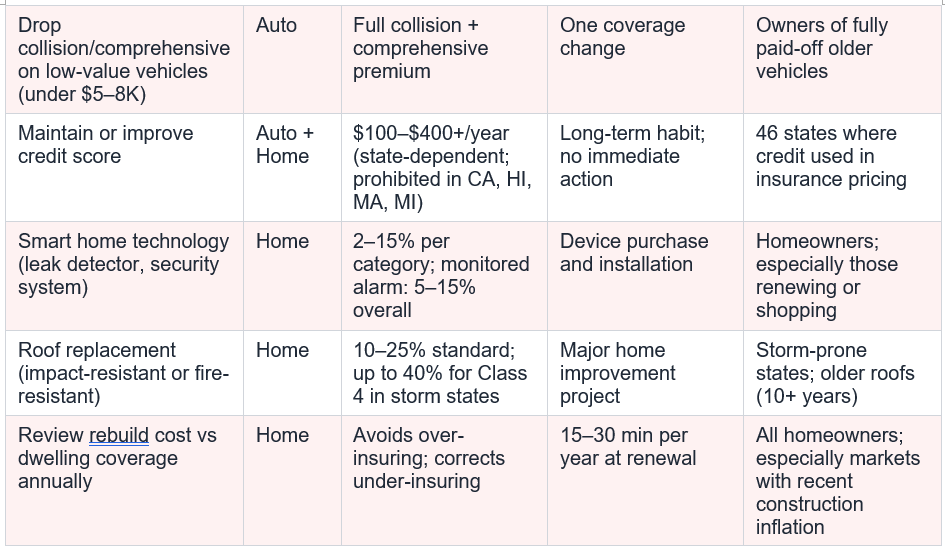
- Drop collision and comprehensive on older vehicles: for vehicles valued at less than $5,000 to $8,000 (check Kelley Blue Book for your vehicle’s current value), the cost of carrying comprehensive and collision coverage can approach or exceed what the insurer would pay in a total-loss claim after the deductible. When the annual collision premium plus deductible exceeds 10% of the vehicle’s value, consider dropping these coverages and self-insuring that risk.
- Adjust liability limits strategically: while minimum state liability limits are rarely adequate (they often do not cover medical costs from a serious accident), very high liability limits may be duplicative if you carry an umbrella policy. Review whether your liability limits are appropriate to your net worth and exposure, rather than defaulting to either minimum or maximum.
- Remove add-ons you do not use: roadside assistance, rental car reimbursement, and gap insurance are common add-ons that are valuable for some drivers and redundant for others. If you have roadside assistance through AAA or a credit card, you are paying twice. If your vehicle is owned outright (no loan), gap insurance is unnecessary.
Auto Insurance Savings #4: Protect Your Risk Profile
Insurance premiums are forward-looking assessments of risk, which means the single most powerful long-term lever for keeping premiums low is maintaining a clean risk profile. Several factors are within your direct control:- Driving record: at-fault accidents and moving violations are among the most significant premium drivers. A single at-fault accident can increase premiums by 20 to 50 percent for three to five years. Defensive driving courses (approved by your state) can sometimes offset a violation; ask your insurer whether it offers a discount for completion.
- Credit score (where applicable): in the 46 states where insurers are permitted to use credit-based insurance scores in auto pricing, maintaining a strong credit score (above 750) can save hundreds of dollars annually vs. a poor credit score. California, Hawaii, Massachusetts, and Michigan prohibit the use of credit scores in auto insurance pricing. In all other states, improving your credit score directly reduces your insurance premium over time.
- Vehicle choice: new vehicles and luxury vehicles generally cost more to insure because they are more expensive to repair or replace. Electric vehicles, despite lower fuel costs, frequently carry higher insurance premiums due to expensive battery repair costs. Before purchasing a vehicle, get an insurance quote for the specific make, model, and trim; the premium difference between two similarly-priced vehicles can be several hundred dollars per year.
- Multi-vehicle discounts: adding a second vehicle to the same policy typically generates a 10 to 25% discount on both vehicles compared with insuring each separately.
Home Insurance Savings #1: Bundle, Raise Deductibles, and Ask for Discounts
The fastest route to lower homeowners’ insurance premiums uses the same principles as auto insurance: compare regularly, adjust deductibles, and exploit every available discount. The single most widely available discount is bundling.Bundling home and auto insurance with the same carrier typically saves 5 to 25 percent on one or both policies, depending on the carrier and market. VIU by HUB, eInsurance.com, and FinanceNavigatorPro all identify bundling as among the first actions any homeowner should take when trying to reduce premiums. The savings are real and consistent: carriers prefer to hold multiple policies for one household, both because it reduces administration costs and because multi-policy holders are statistically less likely to shop elsewhere.
Deductible increases work identically to the auto insurance model. Raising the standard deductible from $1,000 to $2,500 typically reduces the annual premium by 10 to 25 percent. A homeowner paying $2,000 per year in premiums can save $200 to $500 per year with this change. The critical constraint: the higher deductible must be genuinely affordable if a claim occurs. An emergency fund of at least the deductible amount should exist before increasing it.
Other homeowner discounts available from most major carriers:
- New home / new roof discount: recently built homes and homes with new roofs (particularly impact-resistant or fire-resistant materials) attract significant discounts.
- Claims-free discount: homeowners who have not filed a claim in three to five years often qualify for loyalty discounts of 5 to 15 percent.
- Senior discount: homeowners over 55 who are retired or semi-retired (statistically spend more time at home, reducing risk of undetected damage) qualify with many carriers.
- Loyalty discount and retention: like auto insurance, long-term homeowner customers who have never filed claims are valuable to carriers. Ask directly for a loyalty review if your premium has jumped significantly at renewal.
Call your current homeowners insurer before each renewal and ask two questions: (1) What discounts am I currently receiving? (2) What discounts am I not receiving that I might qualify for? Then get one competing quote from an independent broker or comparison site. Carriers respond to competition, and a lower competing quote is often enough to trigger a retention-motivated reduction from your current provider.
Home Insurance Savings #2: Home Hardening and Smart Technology
Home hardening — physical upgrades to make the property more resistant to the perils it faces — is one of the most durable premium reduction strategies for homeowners in higher-risk areas, because the discount it generates is permanent as long as the upgrade is maintained, and the upgraded property is also genuinely safer. eInsurance.com (May 2026) identifies the highest-impact improvements:- Roof replacement: a new roof, particularly one made of impact-resistant or fire-resistant materials, is one of the largest single premium reduction triggers. Many insurers discount by 10 to 25% for a roof replaced within the past decade. A metal or Class 4 impact-resistant roof can produce discounts of 20 to 40% on wind and hail coverage in storm-prone states.
- Wildfire mitigation: for homes in wildfire-prone areas, landscape hardening (clearing defensible space, replacing combustible materials within five feet of the structure with non-combustible alternatives) and building material upgrades (fire-resistant exterior siding, enclosed eaves, ember-resistant vents) can meaningfully reduce wildfire risk ratings and associated premiums.
- Hurricane hardening storm shutters, hurricane-rated garage doors, and drainage improvements can reduce wind and water damage claims in coastal areas. Some states (Florida, Alabama) have mitigation inspection programmes that certify improvements and translate directly into documented premium discounts.
- Smart home technology: leak detectors, smart smoke alarms, monitored burglar alarms, and water shut-off systems qualify for premium discounts at most major carriers. The discount range is typically 2 to 15 percent per device category. A monitored home security system often qualifies for a 5 to 15% overall premium reduction.
Home Insurance Savings #3: Review Coverage Limits and Rebuild Costs
One of the least visible but most financially significant insurance errors is being over-insured or insured for the wrong value. Homeowners policies insure the cost of rebuilding the home, not its market value. In many markets, the market value of a home has risen far above what it would cost to rebuild the structure itself. Insuring for market value rather than rebuild cost results in overpaying premiums on unnecessary coverage.Conversely, given construction cost inflation of recent years, some homeowners are under-insured: their policy’s dwelling coverage was set before the sharp rise in material and labor costs and no longer covers a full rebuild. This is the more dangerous error: inadequate coverage results in an out-of-pocket shortfall after a major loss.
The correct dwelling coverage figure is the estimated replacement cost of the structure (not the land) at current construction prices. Most major insurers provide replacement cost estimator tools, or your agent can request a professional valuation. Review this figure at every annual renewal against current construction cost indices for your zip code. If the rebuild cost estimate has risen above your current dwelling coverage, increase the coverage. If the estimate has not kept pace with your premium increases, negotiate based on the actual rebuild cost.
- Personal property coverage: most standard policies cover personal property at 50 to 70 percent of the dwelling coverage. If your personal property value is significantly lower than this, you may be able to reduce this limit and save on premium.
- Liability coverage: $100,000 of liability coverage is standard in most base policies. For homeowners with meaningful assets, increasing to $300,000 or $500,000 is inexpensive (typically $20 to $50 per year additional) and highly advisable. An umbrella policy ($1 million or more) adds liability coverage for both home and auto at approximately $150 to $300 per year.
The Combined Household Strategy: Bundling and the Independent Broker
For households with both a home and one or more vehicles, the most effective combined insurance strategy involves two specific actions that are frequently underused:- Bundle home and auto with one carrier: the discount is real and typically ranges from 5 to 25 percent on one or both policies. More importantly, having one carrier managing both policies simplifies renewal reviews, claims processes, and discount tracking. When bundled, ask for a combined review of all discounts annually.
- Use an independent insurance broker for the annual comparison: an independent broker has no loyalty to any single carrier. They can simultaneously compare dozens of carriers for your specific risk profile at no cost to you — independent brokers are compensated by the insurer that wins the placement. FinanceNavigatorPro (July 2026) specifically recommends independent agents for ‘high-value homes, unique vehicles, business owners, or anyone who’s been declined by an insurer.’ For the vast majority of households, an independent broker will find comparable or better coverage at a lower price than staying with the same carrier year after year without reviewing alternatives.
The Savings Comparison: What Each Action Can Save Per Year
Conclusion
The structural drivers of rising auto and homeowners’ insurance premiums — climate risk repricing, construction and repair cost inflation, litigation costs, and tariff-related parts price pressure — are not going to resolve quickly. Auto insurance is already 64% higher than it was in 2020. Homeowners insurance in the highest-risk states has risen 25 to 58% in very recent years. The outlook for 2026 and beyond is for continued pressure, with the pace of increase easing in some markets but not reversing.The households that will be least affected by these trends are those that treat insurance as an active, annually managed expense rather than a passive automatic renewal. Shopping every one to two years, using an independent broker, bundling where it makes sense, adjusting deductibles in line with the emergency fund, enrolling in telematics if the driving profile supports it, and making targeted home improvements in high-risk areas — these actions collectively can deliver $500 to $2,000 or more in annual savings for a typical household, without reducing the core protections that make insurance valuable in the first place.
The worst outcome is the one that happens by default: an annual renewal that is automatically accepted without comparison, year after year, as the premium climbs with each cycle. Insurance companies are not obligated to keep your premium competitive. That responsibility belongs to you, and it requires about an hour of attention per year.
Frequently Asked Questions
Why has auto insurance increased so much since 2020?Auto insurance increased 64% between September 2020 and September 2025 (Bureau of Labor Statistics data). The primary drivers are: (1) the rising cost of repairing or replacing vehicles, as new car prices peaked near $50,000 and auto maintenance/repair costs rose 45% in five years (BLS); (2) healthcare cost inflation, since auto insurers are responsible for covering medical bills when their policyholder is at fault in a collision; (3) elevated accident frequency and severity; and (4) supply chain disruptions that raised parts costs during 2021–2023. In 2026, tariff-related parts cost increases have not yet been fully priced into premiums but are expected to contribute to further increases. The average full-coverage premium is now $2,237 nationally per Insurify's first-half 2026 report.
Which states have the biggest home insurance increases in 2026?
The states with the largest 2026 homeowners’ insurance rate increases are Louisiana (+58%), Michigan (+48%), Virginia (+37%), Kentucky (+33%), and Minnesota (+29%), according to state-level rate change data compiled by PNWResidences.com (April 2026). California is experiencing insurer market exits and State Farm has sought an additional 30% rate increase; if approved, the average California homeowner’s premium would rise by approximately $600 per year. In southern coastal areas nationally, the US GAO found premiums rose 25% or more between 2019 and 2024. The five states with the highest average premiums overall are Nebraska, Louisiana, Florida, Oklahoma, and Kansas — all with high windstorm exposure.
What is the fastest way to lower my auto insurance premium right now?
The fastest way to lower your auto insurance premium is to get competing quotes from at least three insurers and ask your current insurer to match the best quote. Insurance premiums are not uniform across carriers — the same driver with the same vehicle can receive quotes that differ by hundreds of dollars annually because each insurer weights risk factors differently. Use comparison aggregators (The Zebra, Insurify, NerdWallet) alongside direct insurer quotes and an independent broker. If you are a low-mileage, safe driver, enrol in your current insurer's telematics programme (Progressive Snapshot, State Farm Drive Safe & Save, Allstate Drivewise) — the discount for safe drivers is typically 10–30%, with some programmes offering up to 40%. These two actions together can often reduce annual premiums by $300–$800.
Does bundling home and auto insurance actually save money?
Yes, consistently. Bundling home and auto with one carrier typically saves 5 to 25% on one or both policies. Most major carriers offer explicit bundling discounts, and even where they do not, having multiple policies with the same carrier tends to produce better retention pricing. VIU by HUB, eInsurance.com, and FinanceNavigatorPro all identify bundling as among the highest-value first actions for households with both policies. The important caveat: bundling should be confirmed against competing quotes. In some cases, the bundled price from one carrier may still be higher than two separate best-in-class quotes from different carriers. Run the comparison both ways before assuming bundling is cheaper.
What home improvements reduce homeowners’ insurance premiums?
The highest-impact home improvements for premium reduction are: (1) Roof replacement — especially with impact-resistant (Class 4) or fire-resistant materials. Savings range from 10–25% standard; up to 40% for Class 4 in storm-prone states. (2) Smart home technology — leak detectors, monitored security systems, smart smoke alarms. Savings: 2–15% per category; 5–15% overall for monitored alarm systems. (3) Wildfire mitigation — defensible space clearing, non-combustible materials within 5 feet of the structure, fire-resistant venting. Relevant in California, Colorado, western states. (4) Hurricane hardening — storm shutters, hurricane-rated garage doors, drainage improvements. Some states have inspection programmes that certify improvements for documented premium credits. Always confirm with your insurer which improvements qualify for credits and what documentation is required before undertaking the project.
Should I raise my insurance deductible to save money?
Raising your deductible can save 10–40% on the relevant coverage tier and is generally advisable when you have an emergency fund sufficient to cover the higher deductible. For auto insurance: raising from $500 to $1,000 typically saves 15–30% on comprehensive and collision combined. For home insurance: raising from $1,000 to $2,500 typically saves 10–25% on the policy. The decision should be driven by one question: can I comfortably absorb the higher deductible from savings without financial stress if I file a claim? If yes, the higher deductible is mathematically advantageous: the annual premium saving typically exceeds the additional risk within two to four years. If no — if a $2,500 out-of-pocket claim would cause financial hardship — maintain the lower deductible and find savings elsewhere.
0 Comments
Be the first to share your thoughts on this article.