

Insurance
Should You Buy Life Insurance to Avoid Inheritance Tax?

UK IHT receipts hit a record £8.5 billion in 2025/26. The nil-rate band has been frozen at £325,000 since 2009. Thousands of ordinary homeowner estates are now caught in the IHT net. A whole-of-life policy written in trust is the most widely used mechanism for covering the bill. But it is not cheap, not always the right answer, and the trust structure is not optional. Here’s everything you need to know.

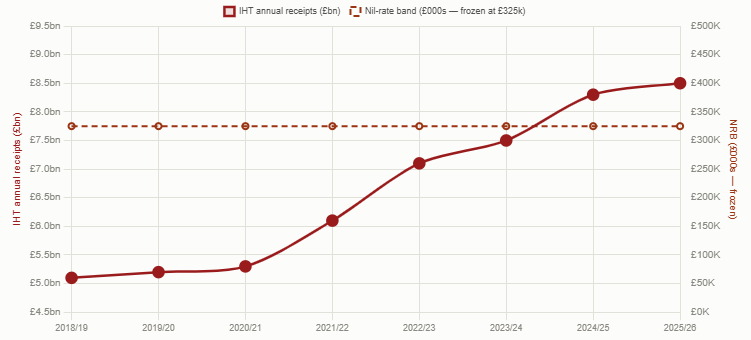
The result is that IHT is no longer a tax reserved for the wealthy. In 2025/26, approximately 32,000 estates paid IHT — up 5,000 since the nil-rate bands were last changed. For a growing number of ordinary homeowners, particularly in London and the South East, a single property can absorb most or all of the available nil-rate threshold. The average tax bill per taxpaying estate is approximately £212,000.
Against this backdrop, the use of whole-of-life insurance policies written in trust as an IHT planning mechanism has grown substantially. 121,000 new trusts were registered in 2024/25, bringing the total to 835,000 — the highest ever (Trust Registration Service data, 2026). This guide explains how life insurance interacts with IHT, when it makes sense to use it, what it actually costs, and what the trust structure means in practice.
IHT receipts: record £8.5bn in April 2025–March 2026 (5th consecutive annual record). NRB frozen at £325,000 since 2009; frozen until April 2031. ~32,000 estates liable for IHT in 2025/26. Average IHT bill per estate: ~£212,000 (2022/23). IHT rate: 40% above available thresholds (36% with 10%+ charitable gift).
The IHT bill must be paid — or at least substantially settled — before probate is granted and the estate can be distributed to beneficiaries. Probate typically takes 6 to 12 months. During this period, estate assets are frozen. For asset-rich, cash-poor estates (common where the main asset is a family home), finding the cash to pay the IHT bill before probate can be genuinely difficult. This liquidity problem is one of the primary drivers of IHT life insurance planning.
The IHT problem for most families is not just 'how do we reduce the bill?' It is also 'how do we pay a bill of £100,000–£400,000 at a moment's notice, before we can access any of the estate's assets?' Life insurance in trust solves the liquidity problem even when it does not reduce the bill.
Writing a policy in trust is generally a straightforward process and is offered free of charge by most major life insurance providers. The policy is assigned to the trust at outset using a standard deed provided by the insurer. Existing policies that are not in trust can also be assigned to a trust, though this may have gift-with-reservation-of-benefit implications if not handled correctly and specialist advice is needed.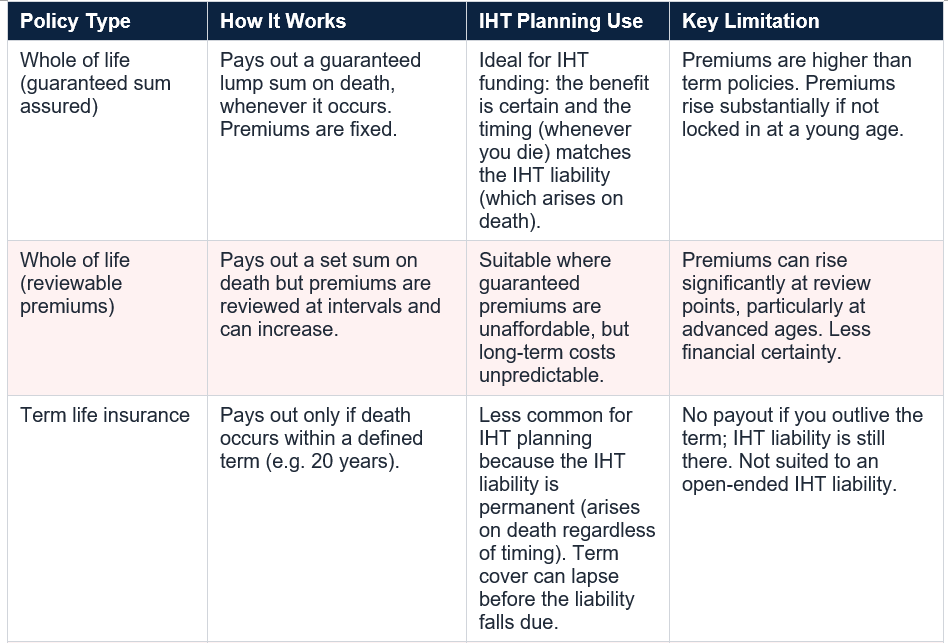
Under this exemption, gifts made from income that meet all three conditions are immediately exempt from IHT with no seven-year waiting period:
Document the normal expenditure out of income exemption annually. Complete and retain a HMRC Form IHT403 equivalent (or maintain a simple record of income, expenditure, and the surplus from which premiums are paid) each year. On death, the executors will need to demonstrate that the exemption applied; without good records, HMRC can and does challenge the claim. Keep records from the first premium payment.
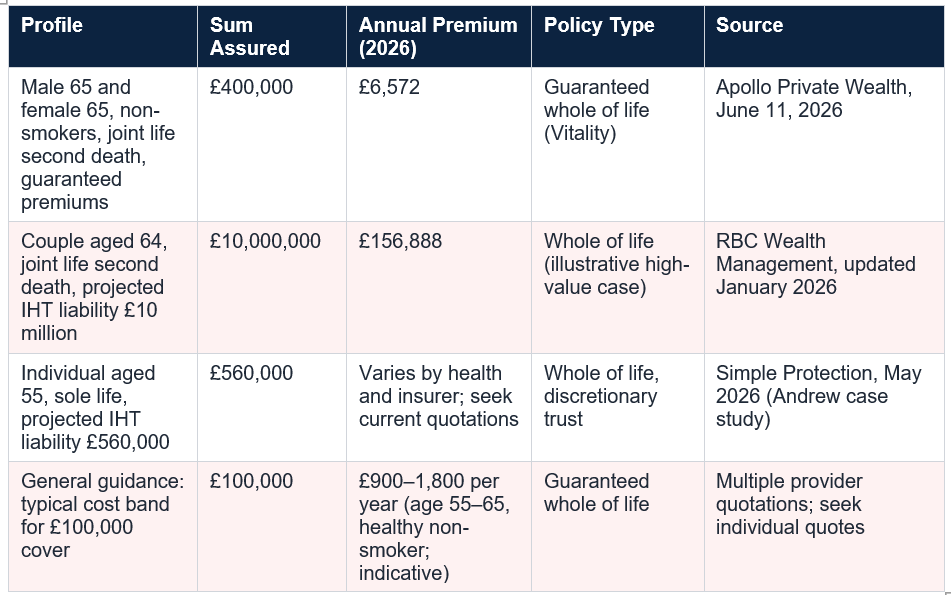
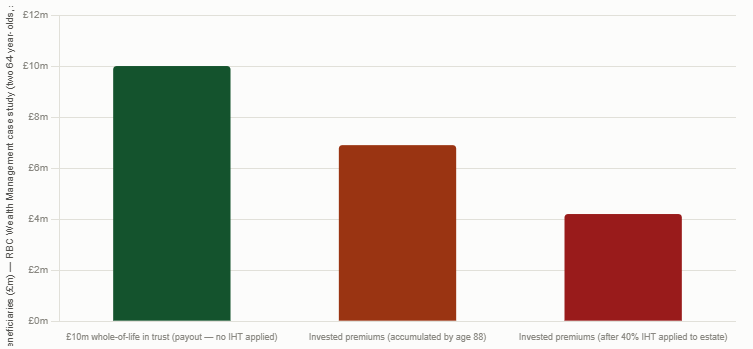
A critical point from the RBC Wealth Management analysis (January 2026): at advanced ages, the alternative of investing the premium amount rather than paying for insurance consistently underperforms after IHT is applied. For a 64-year-old couple with a £10 million liability paying £156,888 per year in premiums, the accumulated value of those invested premiums at average life expectancy of 88 reaches approximately £6.9 million. After a 40% IHT hit on that invested sum, the net benefit is only £4.2 million — substantially less than the £10 million policy payout (which is outside the estate). The insurance outperforms the self-insurance alternative precisely because the policy payout is IHT-exempt while the invested alternative is not.
The core financial logic of life insurance for IHT: you are effectively buying IHT-free pounds at a discount. Every £1 of whole-of-life premium placed in trust produces £1 of guaranteed tax-free payout. Every £1 of premium invested outside a trust produces only £0.60 of net-of-IHT value (at 40% IHT on the investment gains). The insurance win grows with the sum assured and the age of the insured.
After April 2027, this advantage disappears. Estates that had relied on pension IHT exemption to manage their overall exposure will face a larger taxable estate than previously expected. For estates where the pension was intended to cover the IHT bill on other assets (property, investments, business), this change requires a fresh look at the IHT planning structure.
Farrer & Co’s May 2026 estate planning guide identifies life insurance in trust as one of the most direct compensating mechanisms: ‘With more individuals paying IHT each year, life insurance is playing an increasing role in providing funding for paying IHT bills on death… From April 2027 pensions lose their IHT shelter, making trust-based life cover essential to offset the new exposure.’
Specifically: individuals who previously planned to use their pension to fund their estate’s IHT bill may now need a life insurance policy in trust to replace that source of liquidity. The switch requires planning before April 2027 — and ideally now, while health status and age make premiums more affordable.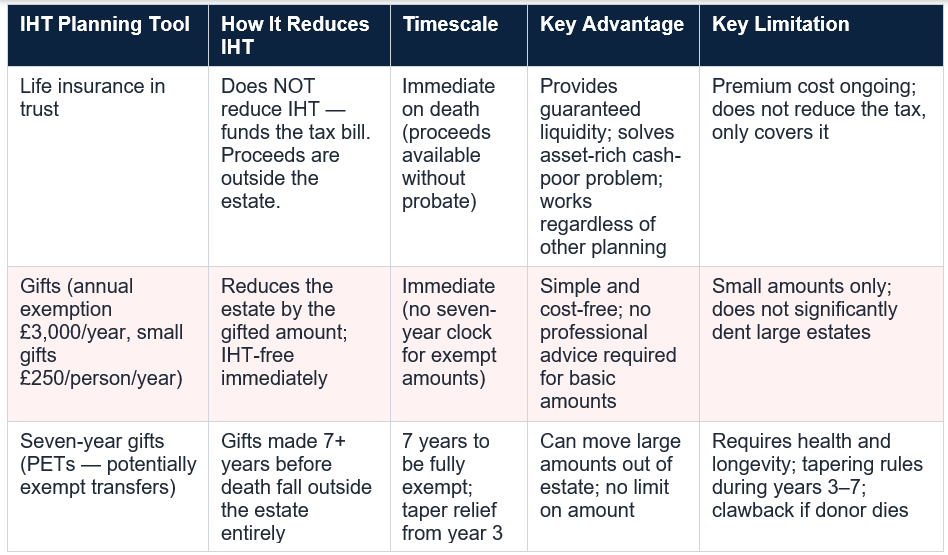
It is important to be clear about what it is and is not. It is not a way of reducing the IHT bill. It is a way of funding it. The tax is still owed; the policy pays it. Where the IHT bill can be reduced through gifting, trusts, BPR, or other reliefs, those approaches are typically more efficient. Life insurance in trust is the funding mechanism that makes the rest of the plan work — particularly for asset-rich estates that cannot liquidate assets quickly, and from April 2027, for estates that had relied on pension IHT exemption that is now being withdrawn.
The record £8.5 billion IHT take in 2025/26 — from 32,000 estates paying an average of approximately £212,000 each — represents a structural reality that will worsen as the nil-rate band freeze continues to April 2031 and as property and investment values continue to rise. The families caught in this net increasingly have estates that did not exist above the IHT threshold when their financial plans were made. Life insurance in trust, reviewed alongside a comprehensive estate plan, is the most practical available response to a bill that arrives at the worst possible moment and must be paid before the estate can be touched.
The critical first step: have the IHT conversation with a qualified IFA or estate planning solicitor before a health event changes the cost of cover. Whole-of-life premiums are substantially cheaper at 55 than at 70. The time to plan is while planning remains affordable.
Yes, if the policy is not written in trust. A life insurance policy that is owned by the policyholder and paid into the estate on death is treated as part of the estate for IHT purposes. The full payout is included in the estate value, and IHT at 40% applies on the amount above the available nil-rate bands. Additionally, it cannot be released until probate is granted (typically 6–12 months), meaning it cannot be used to pay the IHT bill when it falls due. The solution is to write the policy in trust at outset: trust-owned policy proceeds fall outside the estate, are not subject to IHT, and are accessible to the trustees immediately on death without waiting for probate.
What type of life insurance is used for IHT planning?
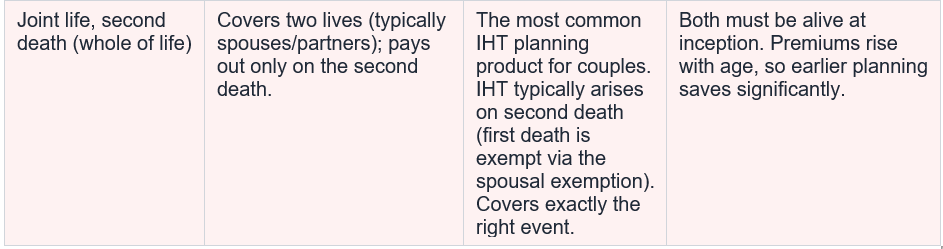
Whole-of-life insurance is used for IHT planning, not term life insurance. The key distinction: IHT arises on death regardless of when death occurs. A term policy expires before death in many cases, leaving the IHT liability uninsured. A whole-of-life policy pays out whenever death occurs, with no expiry date. For married couples and civil partners, a joint life, second death whole-of-life policy is the most common structure: it covers two lives, pays out only on the second death (when the IHT bill actually falls due, since the first death is typically IHT-exempt under the spousal exemption), and provides guaranteed proceeds for the trustees to pay the tax.
What does it cost to take out a whole-of-life policy for IHT planning?
Premiums depend on the insured's age, health, sum assured, and whether premiums are guaranteed or reviewable. A real 2026 example: a guaranteed whole-of-life joint life second death policy with a sum assured of £400,000 costs approximately £6,572 per year for a couple both aged 65, non-smokers (Vitality, cited by Apollo Private Wealth, June 2026). Premiums rise sharply with age and health conditions. A couple aged 55 in good health taking out the same cover would pay materially less. A couple in their 70s taking out the same cover would pay materially more. The financial analysis consistently shows that for large IHT liabilities, the cost of insuring is lower than the post-IHT value of the alternative (investing the same premium amount in the estate where it would be subject to 40% IHT).
What is a discretionary trust in the context of life insurance?
A discretionary trust is the most commonly used trust structure for holding a whole-of-life life insurance policy for IHT planning. The policyholder (settlor) places the policy into the trust, appoints trustees (at least two, not including the settlor as sole trustee), and defines a class of potential beneficiaries (e.g. 'my children, grandchildren, and their spouses'). The trustees have complete discretion over how the proceeds are distributed among the beneficiaries after the policyholder's death. This flexibility allows the trustees to respond to circumstances at the time of death — tax laws, beneficiaries' financial situations, and family circumstances — rather than being bound by rigid allocations made at the trust's creation. Most major life insurers offer standard discretionary trust deeds as part of the policy application process.
What happens to life insurance and IHT from April 2027?
The April 2027 pension IHT change (announced Autumn Budget 2024; confirmed in legislation) means that unspent DC pension pots will be included in the estate for IHT from 6 April 2027. Currently, most DC pensions sit outside the estate and can be passed to beneficiaries free of IHT. From April 2027, they will be taxable at 40% above the nil-rate bands. For estates that had relied on pension IHT exemption as part of their estate planning, this change creates a new and potentially significant IHT liability. Life insurance in trust is increasingly being recommended as a compensating mechanism: a whole-of-life policy in trust can replace the IHT-free liquidity that the pension previously provided, funding the new pension-derived IHT liability outside the estate. The earlier this is put in place, the lower the premium cost.
Can I use the 'normal expenditure out of income' exemption for life insurance premiums?
Yes, and this is one of the most valuable IHT exemptions available to policyholders paying regular whole-of-life premiums. The exemption allows gifts made from income that form part of a normal pattern of expenditure and do not reduce the donor's standard of living to be immediately exempt from IHT — no seven-year clock, no taper relief, no limit on the amount. Regular life insurance premiums paid from surplus income (salary, pension, investment income) meet these criteria if the payments are consistent, habitual, and funded from income rather than capital. The key requirement is documentation: keep annual records of income, total expenditure, and the surplus from which premiums are paid. On death, HMRC may challenge the exemption without adequate records. Use a simple spreadsheet or ask your IFA or accountant to help you maintain the necessary evidence annually from the first premium payment.
Table of Contents
- The IHT Problem Is Getting Bigger, Not Smaller
- How UK Inheritance Tax Works in 2026
- Why an Ordinary Life Insurance Policy Makes the Problem Worse
- The Solution: Writing a Life Insurance Policy in Trust
- The Types of Life Insurance Used for IHT Planning
- Joint Life, Second Death Policies: The Most Common Approach
- The Normal Expenditure Out of Income Exemption
- What It Costs: Real Premium Examples for 2026
- Who Benefits Most from Life Insurance IHT Planning?
- Who Should NOT Use Life Insurance for IHT?
- The April 2027 Pension IHT Change: A New Reason for Life Cover
- The Five Steps to Set Up IHT Life Insurance Correctly
- How This Compares to Other IHT Planning Tools
- Conclusion: A Powerful Tool, Used Correctly, for the Right People
- Frequently Asked Questions
IHT Receipts vs Frozen NRB
Insurance In Trust vs Investing Premiums In Estate
The IHT Problem Is Getting Bigger, Not Smaller
Inheritance Tax in the United Kingdom generated a record £8.5 billion in the financial year April 2025 to March 2026 — the fifth consecutive annual record (HMRC; Professional Adviser, April 2026). The growth has not come from new policy or deliberate expansion of the tax. It has come from a 17-year freeze on the nil-rate band (£325,000 per person since April 2009, now extended to April 2031) combined with rising property values and investment assets. As Winckworth Sherwood’s legal director Samantha Warner noted in March 2026: ‘The nil-rate band remaining at £325,000 since 2009, and rising property values, is drawing ever more estates above the tax-free limit.’The result is that IHT is no longer a tax reserved for the wealthy. In 2025/26, approximately 32,000 estates paid IHT — up 5,000 since the nil-rate bands were last changed. For a growing number of ordinary homeowners, particularly in London and the South East, a single property can absorb most or all of the available nil-rate threshold. The average tax bill per taxpaying estate is approximately £212,000.
Against this backdrop, the use of whole-of-life insurance policies written in trust as an IHT planning mechanism has grown substantially. 121,000 new trusts were registered in 2024/25, bringing the total to 835,000 — the highest ever (Trust Registration Service data, 2026). This guide explains how life insurance interacts with IHT, when it makes sense to use it, what it actually costs, and what the trust structure means in practice.
IHT receipts: record £8.5bn in April 2025–March 2026 (5th consecutive annual record). NRB frozen at £325,000 since 2009; frozen until April 2031. ~32,000 estates liable for IHT in 2025/26. Average IHT bill per estate: ~£212,000 (2022/23). IHT rate: 40% above available thresholds (36% with 10%+ charitable gift).
How UK Inheritance Tax Works in 2026
Inheritance Tax (IHT) is charged at 40 percent on the value of an estate above the available nil-rate bands at the time of death. The key thresholds in 2026/27:- Nil-rate band (NRB): £325,000 per person. Frozen since April 2009; frozen until April 2031 under the Autumn Budget 2025.
- Residence nil-rate band (RNRB): £175,000 per person, available when the main home is left to direct descendants (children, grandchildren). The RNRB tapers away for estates above £2 million (£1 for every £2 above the threshold).
- Transferable allowances: married couples and civil partners can transfer unused NRB and RNRB to the surviving spouse on first death, giving a combined maximum of £1,000,000 per couple (£650,000 NRB + £350,000 RNRB).
- Reduced rate: 36% applies if at least 10% of the net estate is left to qualifying charities.
The IHT bill must be paid — or at least substantially settled — before probate is granted and the estate can be distributed to beneficiaries. Probate typically takes 6 to 12 months. During this period, estate assets are frozen. For asset-rich, cash-poor estates (common where the main asset is a family home), finding the cash to pay the IHT bill before probate can be genuinely difficult. This liquidity problem is one of the primary drivers of IHT life insurance planning.
The IHT problem for most families is not just 'how do we reduce the bill?' It is also 'how do we pay a bill of £100,000–£400,000 at a moment's notice, before we can access any of the estate's assets?' Life insurance in trust solves the liquidity problem even when it does not reduce the bill.
Why an Ordinary Life Insurance Policy Makes the Problem Worse
A life insurance policy that is not written in trust is treated as part of the policyholder’s estate on death. This creates two compounding problems:- The payout is subject to IHT: a £500,000 whole-of-life policy left outside a trust increases the taxable estate by £500,000. At 40%, this generates an additional IHT bill of £200,000 on top of the tax already owed on the rest of the estate. As Pocketwise’s April 2026 guide states: ‘A couple with a £500,000 whole-of-life policy and an estate otherwise well above the nil-rate band could save £200,000 in IHT by simply writing the policy in trust.’
- The payout is frozen until probate: without a trust, the life insurance proceeds go into the estate and cannot be released until probate is granted. The IHT bill must be paid before probate. This means the insurance money that was intended to pay the tax cannot be accessed until after the tax is paid — a circular problem that forces the family to find the money from elsewhere (a bank loan against the estate, or in some cases a bridging loan).
The Solution: Writing a Life Insurance Policy in Trust
Placing a life insurance policy ‘in trust’ means legally separating the policy from the policyholder’s estate. The policy is owned by the trust rather than by the individual. This produces three decisive advantages:- The payout is outside the estate for IHT: trust-owned policy proceeds are not included in the deceased’s estate and are not subject to IHT. The full sum assured is available to the trustees.
- The payout is available immediately: trust assets do not require probate. On the death of the insured, the trustees can access the policy proceeds and pay the IHT bill to HMRC before or simultaneously with the probate process. This resolves the liquidity problem entirely.
- The proceeds can be used to pay the IHT bill directly: the trustees use the trust funds to pay HMRC and then distribute any remaining balance to beneficiaries as the trust deed specifies.
Writing a policy in trust is generally a straightforward process and is offered free of charge by most major life insurance providers. The policy is assigned to the trust at outset using a standard deed provided by the insurer. Existing policies that are not in trust can also be assigned to a trust, though this may have gift-with-reservation-of-benefit implications if not handled correctly and specialist advice is needed.
The Types of Life Insurance Used for IHT Planning
Joint Life, Second Death Policies: The Most Common Approach
For married couples and civil partners, the most frequently used IHT life insurance product is a joint life, second death (also called joint life, last survivor) whole-of-life policy. The rationale maps directly to how IHT applies to couples:- On the first death, the deceased’s estate typically passes to the surviving spouse or civil partner free of IHT (the spousal exemption). No IHT arises.
- On the second death, the full combined estate of both partners is assessed for IHT. The combined nil-rate bands and residence nil-rate bands of both partners (up to £1,000,000) are available, but any value above this is taxed at 40%.
- A joint life, second death policy pays out only on the second death — precisely when the IHT bill falls due. This timing alignment is what makes it the most efficient structure for most couples.
7. The Normal Expenditure Out of Income Exemption
One of the most powerful — and most underused — IHT exemptions for people paying life insurance premiums is the ‘normal expenditure out of income’ exemption (also called the ‘regular gifts from income’ exemption or NEOOI exemption).Under this exemption, gifts made from income that meet all three conditions are immediately exempt from IHT with no seven-year waiting period:
- Normal: the payment must form part of a regular pattern of giving (not a one-off). Regular premium payments to a life insurance policy in trust qualify if they are made consistently.
- Out of income: the payments must come from income (such as salary, pension, or investment income) rather than from capital. The policyholder’s overall capital or standard of living must not be reduced.
- Part of normal expenditure: the payments must be habitual and recurring — an established pattern, not an ad hoc series.
Document the normal expenditure out of income exemption annually. Complete and retain a HMRC Form IHT403 equivalent (or maintain a simple record of income, expenditure, and the surplus from which premiums are paid) each year. On death, the executors will need to demonstrate that the exemption applied; without good records, HMRC can and does challenge the claim. Keep records from the first premium payment.
8. What It Costs: Real Premium Examples for 2026
The cost of whole-of-life cover for IHT planning purposes depends primarily on the age and health of the insured at the time of application, the sum assured, and whether premiums are guaranteed or reviewable. Examples from 2026:A critical point from the RBC Wealth Management analysis (January 2026): at advanced ages, the alternative of investing the premium amount rather than paying for insurance consistently underperforms after IHT is applied. For a 64-year-old couple with a £10 million liability paying £156,888 per year in premiums, the accumulated value of those invested premiums at average life expectancy of 88 reaches approximately £6.9 million. After a 40% IHT hit on that invested sum, the net benefit is only £4.2 million — substantially less than the £10 million policy payout (which is outside the estate). The insurance outperforms the self-insurance alternative precisely because the policy payout is IHT-exempt while the invested alternative is not.
The core financial logic of life insurance for IHT: you are effectively buying IHT-free pounds at a discount. Every £1 of whole-of-life premium placed in trust produces £1 of guaranteed tax-free payout. Every £1 of premium invested outside a trust produces only £0.60 of net-of-IHT value (at 40% IHT on the investment gains). The insurance win grows with the sum assured and the age of the insured.
Who Benefits Most from Life Insurance IHT Planning?
Life insurance for IHT planning is not universally appropriate. It is most cost-effective and practical for the following profiles:- Couples with estates between £1 million and £5 million: the couple’s combined NRB and RNRB shields the first £1 million. The excess is taxable at 40%. A whole-of-life policy covering the expected IHT on the excess is a straightforward and cost-effective solution.
- Asset-rich, cash-poor estates: where the main asset is a family home (particularly in London and the South East) and there is limited liquid cash, life insurance in trust provides the cash to pay the IHT bill without the family needing to sell the house to do so.
- Individuals with BPR or APR assets above the £1 million threshold (from April 2026): business owners and farmers whose assets qualify for Business Property Relief or Agricultural Property Relief now face 20% effective IHT on the excess above the £1 million threshold. Life insurance in trust is a clean liquidity solution for the residual liability.
- Estates with large illiquid assets where time is needed: the proceeds from an in-trust policy are available immediately, allowing the estate to pay IHT while taking the time needed to arrange an orderly sale of property or business assets.
- Individuals in good health who apply early: whole-of-life premiums rise steeply with age and health deterioration. A 55-year-old in good health paying guaranteed premiums will pay substantially less over their lifetime than a 70-year-old taking out the same cover. Starting early is significantly more cost-effective.
Who Should NOT Use Life Insurance for IHT?
Life insurance for IHT is not appropriate in all cases:- Estates below the relevant thresholds: if the combined estate of a couple is below £1 million (or an individual’s estate is below £500,000 including the full NRB and RNRB), there is no IHT liability and no IHT planning need for life insurance.
- Individuals in poor health: whole-of-life insurance is underwritten based on health and lifestyle. Significant health conditions may make the policy unaffordable, unavailable, or subject to exclusions that reduce its IHT planning value.
- Where gifting and other strategies are more appropriate: for younger individuals with time to plan, a programme of gifts using the annual £3,000 exemption, the £250 small gifts exemption, the seven-year rule for larger gifts, and potentially trust structures may reduce the IHT liability more cost-effectively than insuring it.
- Where the premium cost is unaffordable without reducing capital: if premiums can only be funded by drawing down capital (rather than income), the normal expenditure out of income exemption does not apply, and the premium payments themselves become potentially exempt transfers requiring a seven-year clock. The financial benefit of the policy must be weighed against the premium cost and any reduction in capital available for spending.
The April 2027 Pension IHT Change: A New Reason for Life Cover
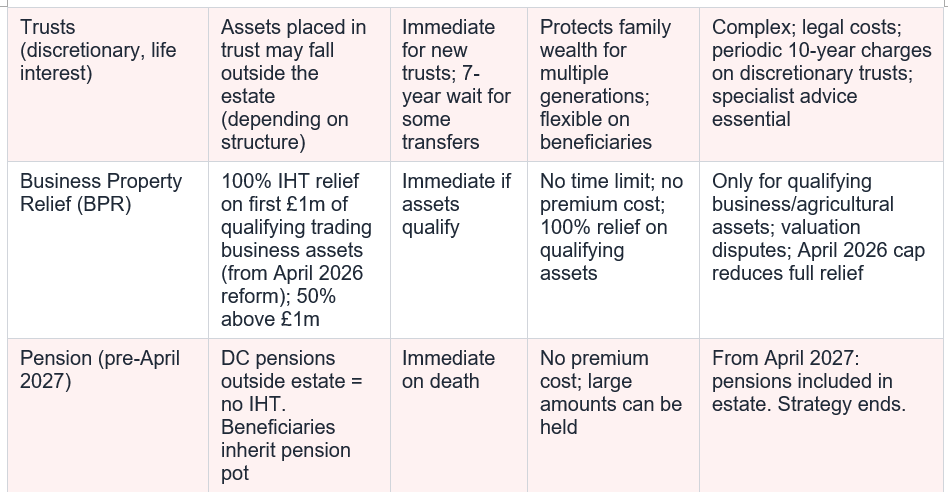
From 6 April 2027, unspent defined contribution (DC) pension pots will be included in the estate for Inheritance Tax purposes (Autumn Budget 2024; confirmed by Farrer & Co, May 2026; RBC Wealth Management, January 2026). Under current rules, most DC pensions sit outside the estate and can be passed to nominated beneficiaries free of IHT — a significant planning advantage that has led many high earners to maximise pension savings as an inheritance strategy.After April 2027, this advantage disappears. Estates that had relied on pension IHT exemption to manage their overall exposure will face a larger taxable estate than previously expected. For estates where the pension was intended to cover the IHT bill on other assets (property, investments, business), this change requires a fresh look at the IHT planning structure.
Farrer & Co’s May 2026 estate planning guide identifies life insurance in trust as one of the most direct compensating mechanisms: ‘With more individuals paying IHT each year, life insurance is playing an increasing role in providing funding for paying IHT bills on death… From April 2027 pensions lose their IHT shelter, making trust-based life cover essential to offset the new exposure.’
Specifically: individuals who previously planned to use their pension to fund their estate’s IHT bill may now need a life insurance policy in trust to replace that source of liquidity. The switch requires planning before April 2027 — and ideally now, while health status and age make premiums more affordable.
The Five Steps to Set Up IHT Life Insurance Correctly
Setting up a whole-of-life policy correctly for IHT planning involves five stages:- Step 1 — Calculate the IHT liability: work with a qualified IFA, accountant, or solicitor to estimate the expected IHT bill on second death (for couples) or on death (for singles). Include all assets, both partners’ NRBs and RNRBs, available reliefs (BPR, APR), and from April 2027, the pension. The estimated liability is the starting point for determining the sum assured.
- Step 2 — Get quotes and apply for underwriting: approach multiple insurers or use an independent protection adviser to compare guaranteed-premium whole-of-life quotations. The sum assured should cover the estimated IHT liability plus an administration buffer (legal fees, executor costs, valuation fees typically add 5 to 10% to the bill).
- Step 3 — Choose the trust structure: a discretionary trust (the most common) gives trustees maximum flexibility over distribution. An absolute trust or bare trust is simpler but inflexible once created. A specialist solicitor or the insurer’s trust team can draft the trust deed. Most major insurers offer standard trust deeds as part of the policy application process.
- Step 4 — Appoint trustees: at least two trustees (in addition to the settlor, who is typically excluded from acting as sole trustee). Trustees should be people who understand the responsibility and are trusted to act in the beneficiaries’ interests. Inform trustees of their role and provide them with a copy of the trust deed and policy details.
- Step 5 — Review annually: as asset values change, thresholds are updated, and the beneficiary situation evolves, the expected IHT liability changes. Review the policy sum assured and trust provisions annually or following any major change in the estate (significant gift, property purchase or sale, business valuation change, or major inheritance received).
How This Compares to Other IHT Planning Tools
Conclusion
Life insurance written in trust is one of the most widely used and most misunderstood IHT planning mechanisms available to UK families. Used correctly — the right policy structure, written in the right trust, for the right IHT exposure — it provides exactly what estate planning most commonly needs: guaranteed liquidity, at a certain moment, outside the estate, free of IHT and probate delay.It is important to be clear about what it is and is not. It is not a way of reducing the IHT bill. It is a way of funding it. The tax is still owed; the policy pays it. Where the IHT bill can be reduced through gifting, trusts, BPR, or other reliefs, those approaches are typically more efficient. Life insurance in trust is the funding mechanism that makes the rest of the plan work — particularly for asset-rich estates that cannot liquidate assets quickly, and from April 2027, for estates that had relied on pension IHT exemption that is now being withdrawn.
The record £8.5 billion IHT take in 2025/26 — from 32,000 estates paying an average of approximately £212,000 each — represents a structural reality that will worsen as the nil-rate band freeze continues to April 2031 and as property and investment values continue to rise. The families caught in this net increasingly have estates that did not exist above the IHT threshold when their financial plans were made. Life insurance in trust, reviewed alongside a comprehensive estate plan, is the most practical available response to a bill that arrives at the worst possible moment and must be paid before the estate can be touched.
The critical first step: have the IHT conversation with a qualified IFA or estate planning solicitor before a health event changes the cost of cover. Whole-of-life premiums are substantially cheaper at 55 than at 70. The time to plan is while planning remains affordable.
Frequently Asked Questions
Does a life insurance payout get taxed for inheritance tax?Yes, if the policy is not written in trust. A life insurance policy that is owned by the policyholder and paid into the estate on death is treated as part of the estate for IHT purposes. The full payout is included in the estate value, and IHT at 40% applies on the amount above the available nil-rate bands. Additionally, it cannot be released until probate is granted (typically 6–12 months), meaning it cannot be used to pay the IHT bill when it falls due. The solution is to write the policy in trust at outset: trust-owned policy proceeds fall outside the estate, are not subject to IHT, and are accessible to the trustees immediately on death without waiting for probate.
What type of life insurance is used for IHT planning?
Whole-of-life insurance is used for IHT planning, not term life insurance. The key distinction: IHT arises on death regardless of when death occurs. A term policy expires before death in many cases, leaving the IHT liability uninsured. A whole-of-life policy pays out whenever death occurs, with no expiry date. For married couples and civil partners, a joint life, second death whole-of-life policy is the most common structure: it covers two lives, pays out only on the second death (when the IHT bill actually falls due, since the first death is typically IHT-exempt under the spousal exemption), and provides guaranteed proceeds for the trustees to pay the tax.
What does it cost to take out a whole-of-life policy for IHT planning?
Premiums depend on the insured's age, health, sum assured, and whether premiums are guaranteed or reviewable. A real 2026 example: a guaranteed whole-of-life joint life second death policy with a sum assured of £400,000 costs approximately £6,572 per year for a couple both aged 65, non-smokers (Vitality, cited by Apollo Private Wealth, June 2026). Premiums rise sharply with age and health conditions. A couple aged 55 in good health taking out the same cover would pay materially less. A couple in their 70s taking out the same cover would pay materially more. The financial analysis consistently shows that for large IHT liabilities, the cost of insuring is lower than the post-IHT value of the alternative (investing the same premium amount in the estate where it would be subject to 40% IHT).
What is a discretionary trust in the context of life insurance?
A discretionary trust is the most commonly used trust structure for holding a whole-of-life life insurance policy for IHT planning. The policyholder (settlor) places the policy into the trust, appoints trustees (at least two, not including the settlor as sole trustee), and defines a class of potential beneficiaries (e.g. 'my children, grandchildren, and their spouses'). The trustees have complete discretion over how the proceeds are distributed among the beneficiaries after the policyholder's death. This flexibility allows the trustees to respond to circumstances at the time of death — tax laws, beneficiaries' financial situations, and family circumstances — rather than being bound by rigid allocations made at the trust's creation. Most major life insurers offer standard discretionary trust deeds as part of the policy application process.
What happens to life insurance and IHT from April 2027?
The April 2027 pension IHT change (announced Autumn Budget 2024; confirmed in legislation) means that unspent DC pension pots will be included in the estate for IHT from 6 April 2027. Currently, most DC pensions sit outside the estate and can be passed to beneficiaries free of IHT. From April 2027, they will be taxable at 40% above the nil-rate bands. For estates that had relied on pension IHT exemption as part of their estate planning, this change creates a new and potentially significant IHT liability. Life insurance in trust is increasingly being recommended as a compensating mechanism: a whole-of-life policy in trust can replace the IHT-free liquidity that the pension previously provided, funding the new pension-derived IHT liability outside the estate. The earlier this is put in place, the lower the premium cost.
Can I use the 'normal expenditure out of income' exemption for life insurance premiums?
Yes, and this is one of the most valuable IHT exemptions available to policyholders paying regular whole-of-life premiums. The exemption allows gifts made from income that form part of a normal pattern of expenditure and do not reduce the donor's standard of living to be immediately exempt from IHT — no seven-year clock, no taper relief, no limit on the amount. Regular life insurance premiums paid from surplus income (salary, pension, investment income) meet these criteria if the payments are consistent, habitual, and funded from income rather than capital. The key requirement is documentation: keep annual records of income, total expenditure, and the surplus from which premiums are paid. On death, HMRC may challenge the exemption without adequate records. Use a simple spreadsheet or ask your IFA or accountant to help you maintain the necessary evidence annually from the first premium payment.
0 Comments
Be the first to share your thoughts on this article.