

Insurance
UK Insurance Costs Rising 2026: Why and What To Do

Car premiums at £566 average, home insurance claims above £7,000 for the first time, and EV cover costing 25% more than petrol — the complete 2026 guide to why UK insurance costs are moving and what to do at renewal.

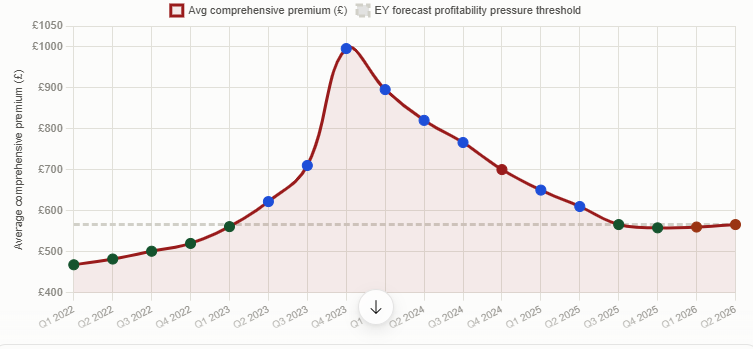
Car insurance premiums in the UK fell for five consecutive quarters following their record peak of £995 in Q4 2023. By Q2 2026, the ABI recorded an average comprehensive premium of £566 — still substantially above pre-crisis levels but meaningfully below the peak. However, Q2 2026 also marked the first quarterly rise in the Go.Compare median figure since Q4 2023, with premiums up 3.6 percent on the previous quarter. Confused.com’s average for new policies rose to £719 in Q2 2026. Go.Compare’s Steve Dukes warned that ‘prices have been increasing now for a few months, and drivers could soon start to see this when they shop around or renew.’
For home insurance, the ABI’s average combined buildings and contents premium rose to £383 in Q2 2026 — the first quarterly increase since early 2025. Average home insurance claims topped £7,000 for the first time in the same quarter. Understanding why these numbers are moving, and what your specific renewal depends on, is the foundation of an effective response.
The Numbers: ABI: average UK car insurance premium £566 in Q2 2026, with claims at a record £3.2bn (Which?/ABI, August 2026). Average home claim above £7,000 for first time in Q2 2026. Car premiums peaked at £995 in Q4 2023; now 43% below peak but rising again. Average price per motor claim rose 42% between 2020 and 2025 (Confused.com, June 2026).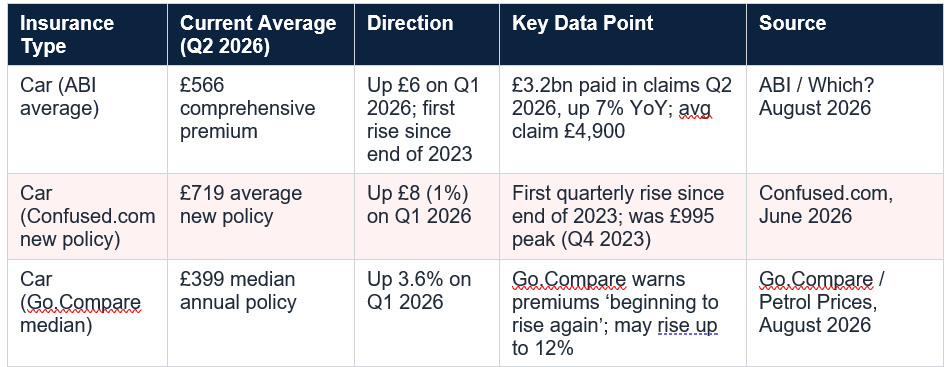
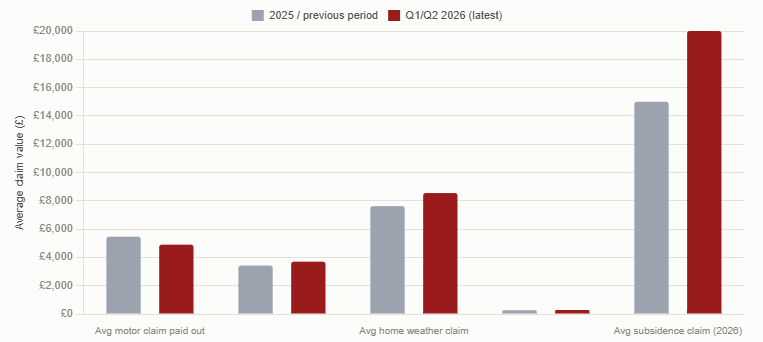
The average price per paid-out motor claim rose 42 percent between 2020 and 2025 — from £3,842 to £5,464, according to Confused.com’s June 2026 analysis. That 42 percent increase in cost per claim, while premiums rose and fell, is the structural driver of the insurer profitability squeeze. EY’s December 2025 forecast puts the UK motor market’s net combined ratio at 111 percent in 2026 — meaning insurers will pay out £1.11 for every £1 of premium collected. That is not sustainable, and premiums will eventually have to reflect it.
The Numbers: Average motor claim payout: £4,900 in Q2 2026 (up 4% QoQ). Average accidental damage claim: £3,699 in Q1 2026 (up 8% in one quarter). Average price per claim rose 42% between 2020 and 2025. EY: insurers paying £1.11 for every £1 premium in 2026. Average theft claim: £11,800 in 2025.
What To Do: Check when your buildings insurance sum insured was last reviewed. If it was set more than two years ago, it may no longer reflect the current rebuild cost for your property. The Building Cost Information Service (BCIS) provides a free rebuild cost calculator at rics.org. Underinsurance means a claim could be paid out proportionally, leaving you significantly out of pocket.
The mechanism:
The rule’s practical effect is that shopping around at renewal is now equally important for all policyholders, regardless of how long they have been with their current insurer. The premium at renewal should be the market price for your risk profile — not inflated to subsidise new customer deals. However, the rule does not mean your renewal is the cheapest available price. It means it is not unfairly elevated above what a new customer would pay for the same policy. Shopping around can still find a lower price because different insurers price the same risk differently.
Brumble’s February 2026 report found that 61 percent of drivers switched provider in 2025 — confirming that comparison shopping has become the norm for most motorists. The 39 percent who did not switch should consider whether their renewal quote reflects the market’s most competitive price for their profile.
The single most effective action is comparing quotes from the full market at every renewal, not just when premiums feel high. Comparison sites (Confused.com, Go.Compare, MoneySuperMarket, Compare the Market) cover the majority of the market but not all of it. An independent broker may surface options not available through comparison sites, particularly for drivers with unusual circumstances, older vehicles, or specialist requirements.
Practical steps for EV owners to reduce insurance costs: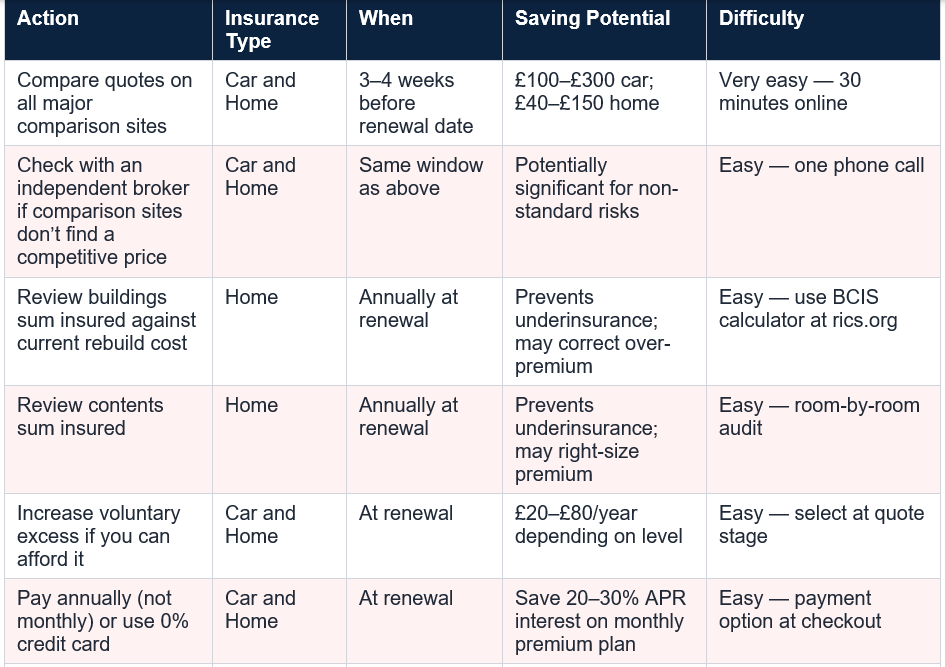
Your renewal notice is not a fixed bill. It is an opening offer from one insurer. The FCA’s loyalty pricing rules mean it should be priced fairly, but ‘fairly’ does not mean ‘cheapest available for your risk profile.’ Comparing quotes is still the most powerful tool available to any policyholder, and the window before renewal is the moment when that tool produces the most value. Sixty-one percent of UK drivers switched provider in 2025. The 39 percent who did not may have paid significantly more than they needed to.
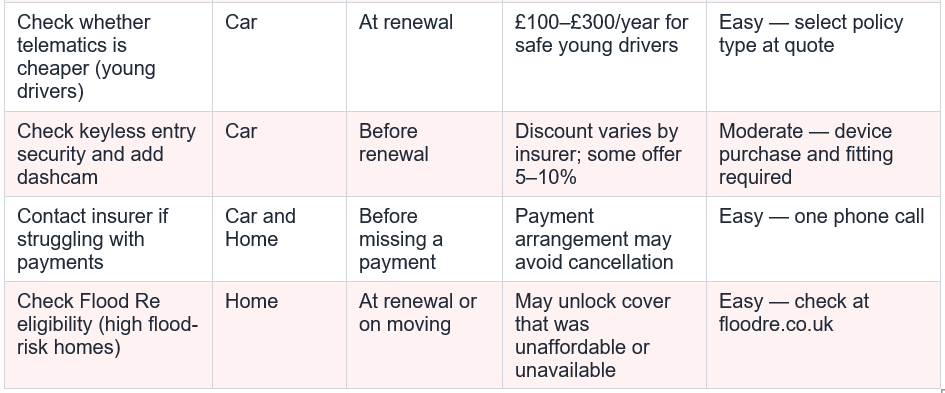
The practical response to rising insurance costs is not passive frustration at a market you cannot control. It is the twelve actions in the checklist above: compare at every renewal without exception, review sums insured annually, pay annually rather than monthly, increase security, and contact your insurer if affordability becomes an issue. None of these requires exceptional financial sophistication. They require one decision: to treat the insurance renewal as an active financial choice rather than a passive automatic payment.
The market average is not the same as your specific premium. The ABI average of £566 in Q2 2026 is a mean figure across all drivers, all vehicles, and all risk profiles. Your renewal is priced against your specific profile: your age, location, vehicle, claims history, and the cost of claims in your risk pool. If you are in Northern Ireland, driving a high-risk or EV vehicle, or based in a recently repriced postcode, your premium may be rising even as the headline average falls. The FCA’s loyalty pricing rules mean your renewal should not be priced above what a new customer would pay for the same cover at the same insurer, but it may still be above what a competitor would charge. Always compare at renewal.
What is driving home insurance premiums higher in 2026?
Three primary factors: (1) Extreme weather events and climate risk repricing. The average weather-related home claim was £8,548 in Q2 2026, up 12% on Q2 2025. The warmest spring on record produced a wave of subsidence claims averaging £20,000 each. Flood risk maps are updated regularly, and postcodes with recent significant weather claims see higher premiums regardless of individual property claims history. (2) Rebuild cost inflation. Post-pandemic construction cost increases mean the cost of rebuilding a typical UK home is substantially higher than it was three years ago, which flows into buildings insurance pricing. (3) Reinsurance cost increases. The insurers who insure UK insurers have priced extreme weather risk upward, increasing the underlying cost base for consumer policies.
Does the FCA loyalty pricing rule mean I can’t be overcharged at renewal?
The FCA’s General Insurance Pricing Practices rules, effective from January 2022, prohibit insurers from offering existing customers a price at renewal that is higher than the equivalent new-customer price for the same policy. This ended the loyalty penalty that had cost renewing policyholders significant sums annually. However, the rule does not mean your renewal is the cheapest available price in the market. Different insurers price the same risk differently, and comparing quotes at renewal can still identify cheaper policies from competitors. The FCA rule ensures your renewal is fair; comparison shopping ensures it is competitive.
How much more expensive is it to insure an electric vehicle in the UK?
Insuring an EV currently costs approximately 25% more than an equivalent petrol vehicle. Brumble’s 2026 data puts the average EV premium at around £707 compared to £558 for petrol equivalents. The reasons include the high cost of battery replacement (£5,000 to £20,000 for many models), the specialist repair infrastructure required, higher vehicle purchase prices, and limited actuarial data on EV claim patterns. The gap is expected to narrow as EV volumes grow, repair infrastructure develops, and insurers accumulate claims data. In the meantime, EV owners benefit from comparison-shopping across specialist providers and through independent brokers, who may find more competitive pricing than generalist comparison sites.
What should I do if I can no longer afford my insurance premium?
Contact your insurer before missing a payment. Under ABI Premium Finance Principles, insurers have committed to treating customers fairly in financial difficulty and should be willing to discuss payment arrangements. ThinkMoney’s June 2026 guide notes that driving without insurance is a criminal offence carrying six penalty points, a fine, and near-certain future premium increases. For households in high flood-risk areas struggling to find affordable buildings cover, Flood Re (floodre.co.uk) provides access to government-backed reinsurance that makes cover available through participating insurers at affordable prices. An independent insurance broker can also identify cover options that do not appear in standard comparison site results.
Is home insurance going up in 2026?
After falling for most of 2025, the ABI’s average combined buildings and contents premium rose to £383 in Q2 2026 — up from £375 in Q1 2026, the first quarterly increase since Q1 2025 (Which?, August 2026). Average home claims exceeded £7,000 for the first time in Q2 2026. The warmest spring on record in England and Wales drove a significant increase in subsidence claims (average £20,000) and weather-related damage claims (average £8,548, up 12% on Q2 2025). Insurers paid £72m in home claims in Q2 2026 alone. The modest premium rise follows a period of falls, but the underlying cost pressure from extreme weather and rebuild cost inflation means the downward trend may not resume without a significant reversal in claims costs.
Table of Contents
- Your Renewal Is Not the Market Average
- The State of UK Insurance Costs in 2026: Car and Home
- Why Car Insurance Costs Are Rising Again
- Why Home Insurance Costs Are Rising
- The Claims Cost Spiral: Why Insurers Are Under Pressure
- Who Is Paying the Most?
- The Loyalty Penalty Is Gone — But Are You Still Paying It?
- What You Can Do: Car Insurance
- What You Can Do: Home Insurance
- EV Owners: The 25% Premium Problem
- If You’re Struggling to Afford Cover
- The 2026 Renewal Checklist
- Conclusion: The Market Is Moving — Move With It
- Frequently Asked Questions
Car Insurance Trend
Claims Cost Drivers
Your Renewal Is Not the Market Average
The insurance market in 2026 has produced two contradictory headlines: premiums are falling overall, yet many households are receiving renewal notices higher than last year. Both statements are true. The resolution lies in understanding that the market average and your specific renewal are priced differently, and that the forces currently pressing on insurer costs mean the brief period of falling premiums may already be reversing.Car insurance premiums in the UK fell for five consecutive quarters following their record peak of £995 in Q4 2023. By Q2 2026, the ABI recorded an average comprehensive premium of £566 — still substantially above pre-crisis levels but meaningfully below the peak. However, Q2 2026 also marked the first quarterly rise in the Go.Compare median figure since Q4 2023, with premiums up 3.6 percent on the previous quarter. Confused.com’s average for new policies rose to £719 in Q2 2026. Go.Compare’s Steve Dukes warned that ‘prices have been increasing now for a few months, and drivers could soon start to see this when they shop around or renew.’
For home insurance, the ABI’s average combined buildings and contents premium rose to £383 in Q2 2026 — the first quarterly increase since early 2025. Average home insurance claims topped £7,000 for the first time in the same quarter. Understanding why these numbers are moving, and what your specific renewal depends on, is the foundation of an effective response.
The Numbers: ABI: average UK car insurance premium £566 in Q2 2026, with claims at a record £3.2bn (Which?/ABI, August 2026). Average home claim above £7,000 for first time in Q2 2026. Car premiums peaked at £995 in Q4 2023; now 43% below peak but rising again. Average price per motor claim rose 42% between 2020 and 2025 (Confused.com, June 2026).
The State of UK Insurance Costs in 2026: Car and Home
Why Car Insurance Costs Are Rising Again
The decline in premiums from the Q4 2023 peak was real, but the underlying cost pressures never resolved. ThinkMoney’s June 2026 analysis frames the current situation precisely: ‘The less welcome news is that the costs driving premiums are moving in the wrong direction again. When repair costs rise this sharply, premiums tend to follow.’Vehicle complexity and repair cost inflation
Modern cars are substantially more expensive to repair than the vehicles they replaced. Advanced driver assistance systems (ADAS), sensors, cameras, and complex electronics mean that even minor accidents trigger recalibration requirements that add hundreds of pounds to repair bills. The ABI’s data shows the average accidental damage claim reached £3,699 in Q1 2026 — up 8 percent in a single quarter. By Q2 2026, the average motor claim payout had risen to £4,900, up 4 percent on the previous quarter. Windscreen repairs, which have become significantly more complex due to embedded sensors and cameras, saw their average cost rise 7 percent in Q2 2026 to £283.The average price per paid-out motor claim rose 42 percent between 2020 and 2025 — from £3,842 to £5,464, according to Confused.com’s June 2026 analysis. That 42 percent increase in cost per claim, while premiums rose and fell, is the structural driver of the insurer profitability squeeze. EY’s December 2025 forecast puts the UK motor market’s net combined ratio at 111 percent in 2026 — meaning insurers will pay out £1.11 for every £1 of premium collected. That is not sustainable, and premiums will eventually have to reflect it.
Supply chain and geopolitical pressure
The Middle East conflict has pushed oil above $100 per barrel since late February 2026, according to Brumble’s analysis. This flows through directly into fuel costs for repair technicians, the cost of transporting parts, and the energy costs of running paint ovens and specialist equipment in body shops. The ABI notes that paint materials costs rose 16 percent in a year. Replacement vehicle costs (courtesy cars) rose approximately 30 percent as the cost of hiring a comparable vehicle while a car is being repaired has increased. Supply chain disruption from geopolitical factors is compounding what was already elevated repair cost inflation from post-pandemic manufacturing backlogs.Vehicle theft
Relay attacks targeting keyless entry systems have driven a sustained rise in vehicle theft. Theft has risen more than 75 percent over the past decade. The average theft claim in 2025 was £11,800 — a significant cost that affects premiums across all policy types because it raises the overall pool of claims that premium income must cover.The Numbers: Average motor claim payout: £4,900 in Q2 2026 (up 4% QoQ). Average accidental damage claim: £3,699 in Q1 2026 (up 8% in one quarter). Average price per claim rose 42% between 2020 and 2025. EY: insurers paying £1.11 for every £1 premium in 2026. Average theft claim: £11,800 in 2025.
Why Home Insurance Costs Are Rising
The headline home insurance average suggests stability: the ABI’s average combined premium of £383 in Q2 2026 is still £9 below the same period last year, and premiums peaked at £399 in Q3 2024. But Norton IB’s June 2026 analysis draws the critical distinction: ‘Your renewal is not priced against the market average. It is priced against your specific property, your history, and your postcode.’Extreme weather and climate risk repricing
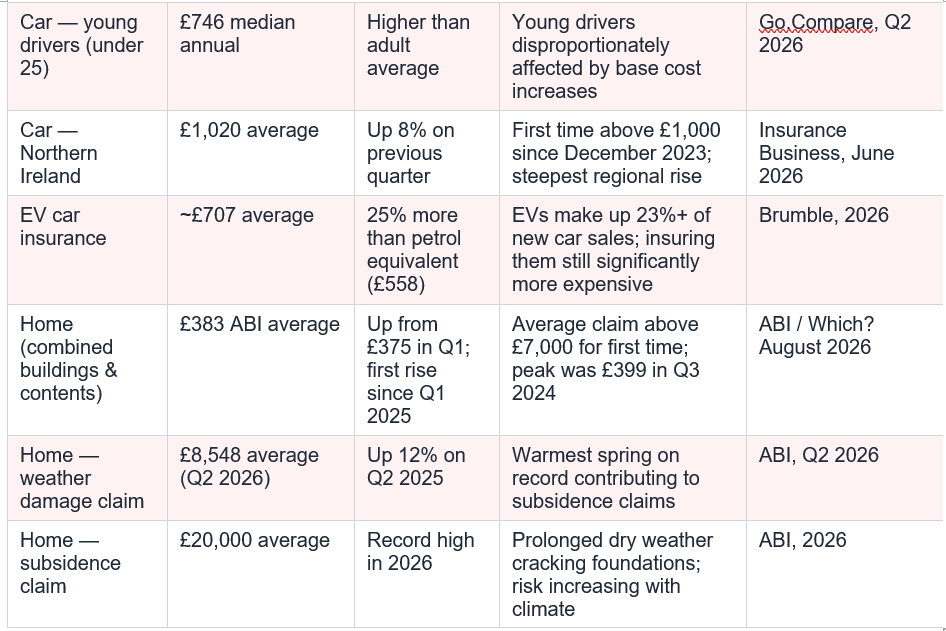
The warmest spring on record in England and Wales in 2026 drove a significant increase in subsidence claims, as prolonged dry weather causes ground movement and cracks foundations. The average subsidence claim reached a record £20,000. The average weather-related home claim was £8,548 in Q2 2026 — up 12 percent on the same period in 2025. Insurers paid out record £4.6 billion in property claims in the first three quarters of 2025 alone, driven largely by severe weather. Which?’s August 2026 report states that extreme weather ‘continues to be one of the main drivers behind the increase.’Postcode risk repricing
Flood risk mapping is updated regularly. If your area has seen significant weather claims in the last 12 to 18 months — even if your specific property was not affected — insurers may have repriced that postcode. This is one of the most common explanations for a renewal rising more than the market average would suggest. Your property sits in an insurance risk pool, and if your postcode pool has become more expensive to serve, your premium increases regardless of your own claims history.Rebuild cost inflation
Home insurance is priced partly against the cost of rebuilding the property if it were destroyed. Post-pandemic construction cost inflation has raised rebuild costs for most UK residential properties. Many homeowners are unknowingly underinsured because their sums insured reflect purchase prices or valuations that predate the construction cost increases of 2022 to 2024.Structural losses driving insurer behaviour
Here4Insurance’s February 2026 guide noted that many UK insurers have been operating at a combined operating ratio above 100 percent — spending more on claims and expenses than they collect in premiums. This structural loss is the reason the sharp price increases of 2023 and 2024 happened, and it means any significant new weather event could quickly reverse the modest easing of 2025 and early 2026.What To Do: Check when your buildings insurance sum insured was last reviewed. If it was set more than two years ago, it may no longer reflect the current rebuild cost for your property. The Building Cost Information Service (BCIS) provides a free rebuild cost calculator at rics.org. Underinsurance means a claim could be paid out proportionally, leaving you significantly out of pocket.
The Claims Cost Spiral: Why Insurers Are Under Pressure
The fundamental reason UK insurance costs remain elevated — even after the falls from the 2023 peak — is that insurers are paying more per claim than their premium income can comfortably cover. WTW’s Tim Rourke told Insurance Times in June 2026 that the market ‘may be approaching an inflection point’ after a prolonged period of price reductions, noting that ‘if these cost trends persist, market profitability will come under even greater strain without premium increases over the remainder of 2026.’The mechanism:
- Claims frequency has not dramatically increased, but claims severity — the cost of each individual claim — has risen sharply and consistently. A fender bender that cost £800 to repair in 2020 costs £1,800 to repair in 2026 because the bumper contains sensors that must be replaced and recalibrated.
- Credit hire costs have risen significantly. When a fault driver’s insurer must provide a replacement vehicle while repairs are underway, those hire costs have increased. The ABI and the Credit Hire Organisation are currently renegotiating the General Terms of Agreement governing replacement vehicle rates following the Motor Insurance Taskforce’s December 2025 recommendations.
- Weather claims have added a structural new cost category. The frequency and severity of weather events affecting UK properties has increased, and reinsurance markets — the insurers that insure insurers — have priced this risk upward, increasing the underlying cost for consumer insurers.
- Supply chain disruption from the Middle East conflict is adding claims cost pressure specifically for parts-intensive repairs. Oxbow Partners forecast claims severity inflation of 7 percent in 2026, citing the US-Iran war constricting supply chains and fuel and automotive parts availability into the UK.
Who Is Paying the Most?
The impact of rising insurance costs is not evenly distributed. Several groups face disproportionate pressure:- Young drivers (under 25): the median annual car insurance premium for drivers under 25 was £746 in Q2 2026 — nearly double the all-driver median of £399. For a young adult on an entry-level salary, insurance can represent a significant proportion of the total cost of running a vehicle.
- Northern Ireland residents: the average car insurance premium in Northern Ireland reached £1,020 in Q2 2026 — an 8 percent quarterly rise and the first time the region has crossed the £1,000 threshold since December 2023. Northern Ireland consistently records the highest average premiums in the UK.
- EV owners: insuring an electric vehicle costs approximately 25 percent more than an equivalent petrol car. The average EV premium stands at around £707 versus £558 for petrol, according to Brumble. As EV adoption grows (battery-electric cars made up more than 23 percent of new car sales in 2025), this premium affects a growing proportion of drivers.
- Lower-income households: ONS Family Spending data cited in Brumble’s February 2026 report found that the poorest fifth of UK households reduced their spending on vehicle insurance by 36 percent in real terms in the financial year ending March 2024. Some households are either reducing cover or going uninsured, which Brumble identifies as a growing underinsurance risk: 15 percent of drivers have reduced their cover, potentially leaving gaps if they need to claim.
- Properties in recently repriced postcodes: homeowners and renters in flood-risk areas, subsidence-prone zones, or postcodes where significant weather claims have been made in the past 18 months can find their premium rises substantially regardless of their own claims history.
The Loyalty Penalty Is Gone — But Are You Still Paying It?
The FCA’s loyalty pricing rules, which came into force in January 2022, prohibit insurers from charging existing customers at renewal more than they would charge equivalent new customers. This was a landmark intervention that ended the practice of rewarding new customer acquisition at the expense of loyal policyholders — a practice that had cost some renewing customers hundreds of pounds per year in excess premium.The rule’s practical effect is that shopping around at renewal is now equally important for all policyholders, regardless of how long they have been with their current insurer. The premium at renewal should be the market price for your risk profile — not inflated to subsidise new customer deals. However, the rule does not mean your renewal is the cheapest available price. It means it is not unfairly elevated above what a new customer would pay for the same policy. Shopping around can still find a lower price because different insurers price the same risk differently.
Brumble’s February 2026 report found that 61 percent of drivers switched provider in 2025 — confirming that comparison shopping has become the norm for most motorists. The 39 percent who did not switch should consider whether their renewal quote reflects the market’s most competitive price for their profile.
What You Can Do: Car Insurance
Compare quotes every year without exceptionThe single most effective action is comparing quotes from the full market at every renewal, not just when premiums feel high. Comparison sites (Confused.com, Go.Compare, MoneySuperMarket, Compare the Market) cover the majority of the market but not all of it. An independent broker may surface options not available through comparison sites, particularly for drivers with unusual circumstances, older vehicles, or specialist requirements.
Consider increasing your voluntary excess
Increasing your voluntary excess reduces the premium because you are agreeing to absorb a larger share of any small claim yourself. Set the excess at a level you could genuinely afford to pay in a worst-case scenario. A voluntary excess you cannot actually afford provides false economy.Pay annually rather than monthly
Monthly payment plans for insurance are a form of credit, typically at annual percentage rates of 20 to 30 percent. Paying your annual premium in one payment eliminates this charge. If paying annually is difficult, using a 0 percent purchase credit card and paying it off over the year is significantly cheaper than the insurer’s own monthly plan.Improve security and park off-road
Insurers price for the risk of theft and weather damage. A dashcam demonstrably reduces dispute costs and is rewarded with a premium discount by most insurers. Parking off-road overnight, adding a Thatcham-approved immobiliser or tracker, and addressing keyless entry relay attack vulnerability with signal-blocking pouches all reduce theft risk and can be reflected in the premium.Consider telematics for young drivers
For drivers under 25, a black box (telematics) policy offers the most significant route to a lower premium by replacing the statistical risk of youth with demonstrated driving behaviour. Safe young drivers frequently save 20 to 40 percent compared to a standard policy through telematics.What You Can Do: Home Insurance
Compare quotes at every renewal
The same logic applies as for motor: the renewal quote from your existing insurer should represent a fair market price for your risk profile, but it is not guaranteed to be the cheapest available. Which?’s August 2026 guide to home insurance identifies comparing quotes at renewal as the first and most important step.Review your sums insured
Both buildings and contents insurance should be reviewed annually for accuracy. Buildings insurance is typically based on rebuild cost, not market value. If your sum insured is outdated, you may be paying too much (rare) or be underinsured (common and costly). Use the BCIS rebuild cost calculator for buildings and a room-by-room contents audit for contents cover.Increase security
Installing approved locks, window bolts, an alarm system, or a smart doorbell can reduce the contents insurance premium, particularly for properties in higher-theft postcodes. Some insurers offer specific discounts for homes with professionally installed, Secured by Design-accredited security systems.Consider a higher voluntary excess
A higher voluntary excess reduces the premium on home insurance just as it does on motor. For households with a financial buffer, accepting a £500 or £750 voluntary excess rather than the default £100 or £250 can reduce the premium meaningfully. Do not set an excess you could not afford to pay in the event of a claim.EV Owners: The 25% Premium Problem
Electric vehicles cost approximately 25 percent more to insure than their petrol equivalents. The reasons are structural: EV batteries are expensive to replace (a full battery replacement for many models costs £5,000 to £20,000), the vehicles themselves cost more, there are fewer specialist EV repair technicians, and parts availability remains constrained. As Brumble’s 2026 analysis notes, battery-electric cars made up more than 23 percent of new car sales in 2025 — meaning the insurer market is adapting to a growing segment it does not yet fully price efficiently.Practical steps for EV owners to reduce insurance costs:
- Compare through specialist EV-aware providers: some insurers have developed specific EV expertise and may price the risk more competitively than generalist insurers who apply a flat EV surcharge. WeCovr’s May 2026 guide and Brumble’s report both identify specialist broker search as particularly valuable for EV owners.
- Check if your policy covers public charging cable theft: EV-specific risks, including portable charging cable theft (cables can cost £500+), are not automatically covered by standard policies. Confirming coverage avoids an unpleasant gap in the event of a claim.
- Consider gap insurance for a new EV: EVs depreciate rapidly and the insurer may pay market value rather than replacement cost in the event of a total loss. GAP insurance covers the difference.
If You’re Struggling to Afford Cover
For households for whom insurance costs have become genuinely unaffordable, several options exist:- • Contact your insurer before missing a payment: ThinkMoney’s June 2026 guide notes that under ABI Premium Finance Principles, insurers have committed to treating customers fairly if they are experiencing financial difficulty. If you contact your insurer and explain your situation, they may be able to discuss a payment arrangement or options to reduce the cost of your cover. Only 8 percent of those who missed payments or found them difficult actually sought support from their provider, according to Brumble’s report. Of those who did not seek help, 24 percent said they did not think their insurer would be helpful, and 17 percent were not aware that support was available.
- • Use an independent broker: ThinkMoney’s guide recommends that drivers in higher-risk categories struggling to find affordable cover through comparison sites speak to an independent broker, who can surface options that do not always appear in standard comparison results.
- • Reduce cover carefully: some reductions in cover are rational (reducing contents sums insured if they are set above actual replacement value), while others create genuine risk (reducing buildings cover below rebuild cost, or removing legal expenses cover). Any reduction should be made consciously, not by default. The 15 percent of drivers who have reduced cover without fully understanding the implications are the group most at risk of an underinsured claim.
- • Flood Re for high flood-risk properties: if your home is in a high flood-risk area and you are struggling to find affordable buildings insurance, Flood Re is a government-backed reinsurance scheme that allows participating insurers to offer affordable cover to eligible properties. Check eligibility at floodre.co.uk.
The 2026 Renewal Checklist
Conclusion
UK insurance costs in 2026 are at an inflection point. The falls from the 2023 and 2024 peaks are real and welcome. The cost pressures driving them upward again — repair cost inflation, EV complexity, extreme weather frequency, supply chain disruption, and credit hire costs — have not resolved. EY’s forecast of a 111 percent combined ratio for UK motor insurers in 2026 is a direct signal that premiums will follow costs higher in the months ahead.Your renewal notice is not a fixed bill. It is an opening offer from one insurer. The FCA’s loyalty pricing rules mean it should be priced fairly, but ‘fairly’ does not mean ‘cheapest available for your risk profile.’ Comparing quotes is still the most powerful tool available to any policyholder, and the window before renewal is the moment when that tool produces the most value. Sixty-one percent of UK drivers switched provider in 2025. The 39 percent who did not may have paid significantly more than they needed to.
The practical response to rising insurance costs is not passive frustration at a market you cannot control. It is the twelve actions in the checklist above: compare at every renewal without exception, review sums insured annually, pay annually rather than monthly, increase security, and contact your insurer if affordability becomes an issue. None of these requires exceptional financial sophistication. They require one decision: to treat the insurance renewal as an active financial choice rather than a passive automatic payment.
Frequently Asked Questions
Why is my car insurance renewal higher than last year when premiums are supposedly falling?The market average is not the same as your specific premium. The ABI average of £566 in Q2 2026 is a mean figure across all drivers, all vehicles, and all risk profiles. Your renewal is priced against your specific profile: your age, location, vehicle, claims history, and the cost of claims in your risk pool. If you are in Northern Ireland, driving a high-risk or EV vehicle, or based in a recently repriced postcode, your premium may be rising even as the headline average falls. The FCA’s loyalty pricing rules mean your renewal should not be priced above what a new customer would pay for the same cover at the same insurer, but it may still be above what a competitor would charge. Always compare at renewal.
What is driving home insurance premiums higher in 2026?
Three primary factors: (1) Extreme weather events and climate risk repricing. The average weather-related home claim was £8,548 in Q2 2026, up 12% on Q2 2025. The warmest spring on record produced a wave of subsidence claims averaging £20,000 each. Flood risk maps are updated regularly, and postcodes with recent significant weather claims see higher premiums regardless of individual property claims history. (2) Rebuild cost inflation. Post-pandemic construction cost increases mean the cost of rebuilding a typical UK home is substantially higher than it was three years ago, which flows into buildings insurance pricing. (3) Reinsurance cost increases. The insurers who insure UK insurers have priced extreme weather risk upward, increasing the underlying cost base for consumer policies.
Does the FCA loyalty pricing rule mean I can’t be overcharged at renewal?
The FCA’s General Insurance Pricing Practices rules, effective from January 2022, prohibit insurers from offering existing customers a price at renewal that is higher than the equivalent new-customer price for the same policy. This ended the loyalty penalty that had cost renewing policyholders significant sums annually. However, the rule does not mean your renewal is the cheapest available price in the market. Different insurers price the same risk differently, and comparing quotes at renewal can still identify cheaper policies from competitors. The FCA rule ensures your renewal is fair; comparison shopping ensures it is competitive.
How much more expensive is it to insure an electric vehicle in the UK?
Insuring an EV currently costs approximately 25% more than an equivalent petrol vehicle. Brumble’s 2026 data puts the average EV premium at around £707 compared to £558 for petrol equivalents. The reasons include the high cost of battery replacement (£5,000 to £20,000 for many models), the specialist repair infrastructure required, higher vehicle purchase prices, and limited actuarial data on EV claim patterns. The gap is expected to narrow as EV volumes grow, repair infrastructure develops, and insurers accumulate claims data. In the meantime, EV owners benefit from comparison-shopping across specialist providers and through independent brokers, who may find more competitive pricing than generalist comparison sites.
What should I do if I can no longer afford my insurance premium?
Contact your insurer before missing a payment. Under ABI Premium Finance Principles, insurers have committed to treating customers fairly in financial difficulty and should be willing to discuss payment arrangements. ThinkMoney’s June 2026 guide notes that driving without insurance is a criminal offence carrying six penalty points, a fine, and near-certain future premium increases. For households in high flood-risk areas struggling to find affordable buildings cover, Flood Re (floodre.co.uk) provides access to government-backed reinsurance that makes cover available through participating insurers at affordable prices. An independent insurance broker can also identify cover options that do not appear in standard comparison site results.
Is home insurance going up in 2026?
After falling for most of 2025, the ABI’s average combined buildings and contents premium rose to £383 in Q2 2026 — up from £375 in Q1 2026, the first quarterly increase since Q1 2025 (Which?, August 2026). Average home claims exceeded £7,000 for the first time in Q2 2026. The warmest spring on record in England and Wales drove a significant increase in subsidence claims (average £20,000) and weather-related damage claims (average £8,548, up 12% on Q2 2025). Insurers paid £72m in home claims in Q2 2026 alone. The modest premium rise follows a period of falls, but the underlying cost pressure from extreme weather and rebuild cost inflation means the downward trend may not resume without a significant reversal in claims costs.
0 Comments
Be the first to share your thoughts on this article.