

Business
How I Built My Business While Working 9–5: Full Guide

More than 44% of entrepreneurs who started a new business in 2023 did so while working another job — up from 27% in 2022. In 2024, over 5.2 million Americans filed new business applications. Over 40% of entrepreneurs who launched in 2025 did so while still employed or studying. These numbers reflect something I know from personal experience: you do not have to quit your job to build something real. In fact, for most people, you should not. I have been building businesses — and helping others understand money and entrepreneurship through Erneroy.com — while managing professional commitments, family responsibilities, and the same financial pressures that face everyone who has ever sat at a desk on a Monday morning wondering if this is all there is. This guide is not theory. It is the honest, step-by-step system I used, refined over time, and now share with the readers of Erneroy.com.
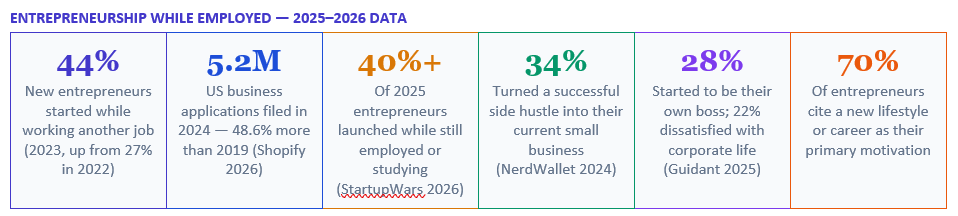
Over 40% of the entrepreneurs who launched in 2025 did so while still employed or studying, according to StartupWars' January 2026 analysis. The US saw 5.2 million new business applications in 2024 — a 48.6% increase over 2019, according to Shopify's 2026 entrepreneur facts report. More businesses than ever are being started as supplements to day jobs. And 34% of current small business owners told NerdWallet in their 2024 survey that they turned a successful side hustle into their current business. The path from employee to entrepreneur does not require a cliff jump. It requires a bridge — built deliberately, one plank at a time, while you are still standing on solid ground.
Your job isn't holding you back — it's your secret weapon. It gives you financial stability, skills, a network, and the time to test your idea without betting everything on it.
— LIFE HACK METHOD — HOW TO START A BUSINESS WHILE WORKING FULL TIME (MARCH 2025)
The productive mindset is one in which your job is the enabler of your business, not its competitor. Your salary is your runway. Your professional skills are your business's first product or service. Your colleagues are your first case studies and referrals. AllBusiness.com's guide to starting a business while working full-time frames it precisely: 'The second you decide to start a side hustle with the hopes of replacing your current full-time job, you need to start treating your life like a business. This means time becomes your most valuable resource and every waking minute becomes valuable.'
Luisa Zhou, a business coach who built a six-figure business in four months while still employed full-time, describes her approach: 'I worked on my business on the side. Over the next four months, I built a coaching business and made my first six figures. Then I quit my job.' She did not quit first and build second. She validated demand, made sales, and quit when the numbers justified it. NerdWallet found that 34% of current small business owners turned a successful side hustle into their current business — meaning the model of validating before committing is the norm among successful solo entrepreneurs, not the exception.
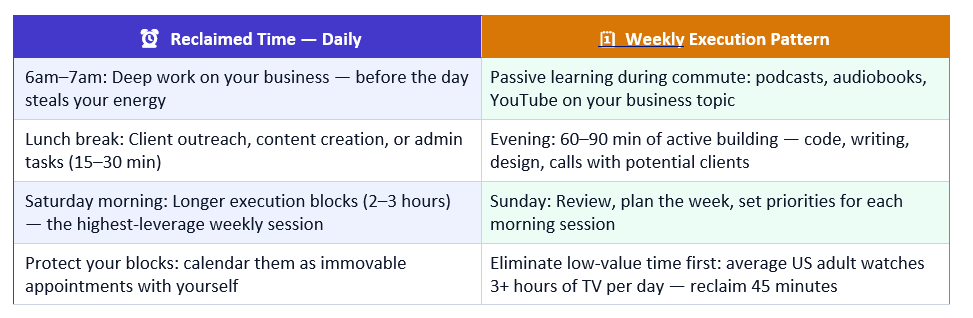
AllBusiness.com's guide identifies the passive vs active task distinction as the key leverage point: 'Learn to separate tasks that are passive from those that are active. When I had downtime at my day job, I watched YouTube videos on how to build a website, and when I got home I actively built my website for about 30 minutes to an hour a day after work.' This passive/active split turns dead time (commutes, lunch breaks, waiting rooms) into business education and turns protected home-time into business execution.
Lifehack Method's entrepreneur guide is clear: 'To ensure it's legal for you to start a side business, take a look at your employment contract to understand if your business conflicts with it.' If your contract is ambiguous, an hour with a solicitor or employment lawyer is money well spent — it protects both your job and your business from the start.
The foundation has four components: (1) A clear offer — one specific service or product for one specific type of person; (2) A simple way to be found — one page website or LinkedIn profile is enough to start; (3) A way to get paid — a business bank account, PayPal, Stripe, or equivalent; (4) A professional communication channel — a business email address separate from your personal account. Everything else comes later. Build these four things in your first four weeks, then spend every subsequent session on getting clients and delivering excellent results.
Nick Loper, founder of Side Hustle Nation and one of the most respected voices in the build-while-employed space, frames the transition criteria clearly: 'The key metric for me wasn't replacing my day job income — at least at the start — but I did want to see a track record of profit from the business that could at least cover my monthly expenses.' Start there. Your first goal is not six figures. It is one client. Then three. Then enough to cover a meaningful monthly expense. That milestone justifies the next investment of time and validates the business model before you go further.
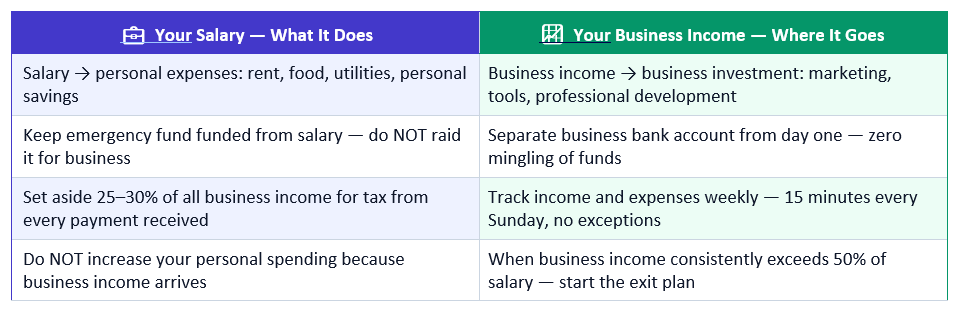
Erneroy.com's 21 years of accountancy experience distils into one simple rule for the early-stage business: salary funds life, business income funds growth. This means keeping a separate business bank account from day one, tracking every penny of business income and expense, and setting aside at least 25–30% of business earnings for tax — because as a self-employed earner, no employer is doing that for you. The moment you conflate business and personal money is the moment your business becomes financially opaque, tax-time becomes painful, and growth decisions become emotionally rather than analytically driven.
The data-backed benchmark comes from Nick Loper of Side Hustle Nation: 'I wanted to see a track record of profit from the business that could at least cover my monthly expenses.' Erika Kullberg, attorney and founder of Erika.com, adds a capital buffer requirement: 'Invest money into growing your side hustle. Before you quit, have at least three to six months of personal expenses in savings.' The combination of these two criteria — business revenue covering your monthly costs AND a financial cushion equivalent to three to six months of expenses — provides the dual protection of confirmed demand and personal resilience against early-stage revenue volatility.
Luisa Zhou's model is the cleanest template: she built her coaching business over four months while employed, reached six figures in revenue, and then resigned. She did not set a date and then try to hit a revenue target. She set a revenue target and then set a date once it was hit. The sequence matters: milestone first, timeline second.
The eight steps in this guide — mindset, validation, time management, legal checks, foundation-building, first client, financial discipline, and a clear transition criteria — are not a theoretical framework. They are the practical sequence that works, drawn from real examples, real data, and 21 years of accountancy and financial strategy experience. You do not need perfect conditions to start. You need a clear offer, a protected block of time, and the discipline to treat your business like a business from the first day. Start tonight. One hour. One idea. One conversation with a potential client. The gap between where you are and where you want to be is crossed in exactly that way — one deliberate step at a time.
Luisa Zhou — How to Start a 6-Figure Business While Working Full-Time in 2025 (November 2025) https://luisazhou.com/blog/business-while-working/
AllBusiness.com — How to Start a Business While Working Full Time (June 2025) https://www.allbusiness.com/how-to-start-a-business-while-working-full-time
Shopify — 24 Part-Time Business Ideas to Start in 2026: 30-Day Launch Plan https://www.shopify.com/blog/part-time-business-ideas
Shopify — 35+ Side Business Ideas to Make Extra Money (2026) https://www.shopify.com/blog/113274373-7-ways-to-start-a-business-without-quitting-your-day-job
Shopify — Entrepreneur Facts 2026: Statistics on Starting and Running a Business https://www.shopify.com/blog/entrepreneur-facts
StartupWars — Small Business Success: 7 Proven Steps to Start in 2026 and Thrive (January 2026) https://www.startupwars.com/how-to-start-a-small-business-in-2026/
NerdWallet — Entrepreneurs Keep Starting Businesses: What's Driving Them (2025) https://www.nerdwallet.com/business/learn/entrepreneurs-keep-starting-businesses
Yahoo Finance / GOBankingRates — 7 Ways to Turn Your Side Gig Into a Full-Time Job in 2026 https://finance.yahoo.com/news/scale-side-gig-full-time-151932457.html
Podbase — Entrepreneur Statistics 2026: Trends and Insights (April 2026) https://www.podbase.com/blogs/entrepreneur-statistics
Psychology Today — Should You Quit Your Job When You Start a New Business? https://www.psychologytoday.com/us/blog/the-science-behind-behavior/201609/should-you-quit-your-job-when-you-start-a-new-business
Erneroy.com — Personal Finance and Business Knowledge Hub by Ernest Robinson https://erneroy.com
Erneroy.com — Making Money Category: Side Hustle and Income Growth https://erneroy.com/category/making-money
Erneroy.com — Business Category: Entrepreneurship and Growth https://erneroy.com/category/business
TABLE OF CONTENTS
- Why Building a Business While Employed Is Not Just Possible — It Is Smarter
- Step 1: Get Your Mindset Right — Your Job Is the Fuel, Not the Enemy
- Step 2: Validate Your Business Idea Before You Build Anything
- Step 3: Carve Out Your Time — The Non-Negotiable Schedule
- Step 4: Check the Legal and Contractual Landscape
- Step 5: Build the Foundation — Not the Whole House
- Step 6: Get Your First Customer or Client
- Step 7: Manage Your Money — Two Incomes, Two Purposes
- Step 8: Know When — and How — to Make the Transition
- Common Mistakes That Kill 9-to-5 Businesses Before They Launch
- Conclusion
- Frequently Asked Questions
- References
Why Building a Business While Employed Is Not Just Possible — It Is Smarter
The prevailing myth about entrepreneurship is that it requires a dramatic leap — the resignation letter, the burned bridge, the all-in bet. The data does not support this narrative. A widely cited study in academic entrepreneurship research found that entrepreneurs who maintain employment while building their businesses have a 33% lower failure rate than those who quit their jobs first. The reason is not timidity — it is structural advantage. Your salary funds your experiments. Your benefits protect your family. Your professional network provides your early customers. Your day job is not your prison. It is your venture capital.Over 40% of the entrepreneurs who launched in 2025 did so while still employed or studying, according to StartupWars' January 2026 analysis. The US saw 5.2 million new business applications in 2024 — a 48.6% increase over 2019, according to Shopify's 2026 entrepreneur facts report. More businesses than ever are being started as supplements to day jobs. And 34% of current small business owners told NerdWallet in their 2024 survey that they turned a successful side hustle into their current business. The path from employee to entrepreneur does not require a cliff jump. It requires a bridge — built deliberately, one plank at a time, while you are still standing on solid ground.
Your job isn't holding you back — it's your secret weapon. It gives you financial stability, skills, a network, and the time to test your idea without betting everything on it.
— LIFE HACK METHOD — HOW TO START A BUSINESS WHILE WORKING FULL TIME (MARCH 2025)
Step 1: Get Your Mindset Right — Your Job Is the Fuel, Not the Enemy
The first shift required is psychological, not practical. Most employed entrepreneurs-in-waiting operate in one of two dysfunctional mental frameworks: they either resent their job so thoroughly that every hour at work feels like hours stolen from their business, or they treat their business idea as a fantasy they will pursue 'someday' when conditions are perfect. Both frameworks are traps. The resentment model leads to distraction, poor work performance, and eventual conflict with your employer. The 'someday' model leads to nothing, because someday never arrives.The productive mindset is one in which your job is the enabler of your business, not its competitor. Your salary is your runway. Your professional skills are your business's first product or service. Your colleagues are your first case studies and referrals. AllBusiness.com's guide to starting a business while working full-time frames it precisely: 'The second you decide to start a side hustle with the hopes of replacing your current full-time job, you need to start treating your life like a business. This means time becomes your most valuable resource and every waking minute becomes valuable.'
- Every hour you work your job without burning bridges is an hour your business operates without debt.
- Your professional experience is your first business offering — 22% of entrepreneurs started precisely because of skills built in corporate life (Guidant 2025).
- Resentment is energy. Redirect it: instead of resenting Monday morning, use it as fuel to work on your business for 45 minutes before you open your work laptop.
Step 2: Validate Your Business Idea Before You Build Anything
The most common and costly mistake made by employed entrepreneurs is spending months — and thousands of pounds or dollars — building a product, a website, or a service offering before confirming that anyone will pay for it. Validation does not require a finished product. It requires a conversation. Your goal in the first four to six weeks is not to build — it is to find ten people who would pay for what you are planning to offer, and ideally to collect payment or a commitment from at least one of them.Luisa Zhou, a business coach who built a six-figure business in four months while still employed full-time, describes her approach: 'I worked on my business on the side. Over the next four months, I built a coaching business and made my first six figures. Then I quit my job.' She did not quit first and build second. She validated demand, made sales, and quit when the numbers justified it. NerdWallet found that 34% of current small business owners turned a successful side hustle into their current business — meaning the model of validating before committing is the norm among successful solo entrepreneurs, not the exception.
- Identify a specific problem your skills, knowledge, or network position you to solve better than most.
- Have five conversations with potential customers this week — not pitches, conversations. Ask what they struggle with in the area you are targeting.
- Before building anything, pre-sell: offer your service or product at a discounted 'founding client' rate in exchange for a testimonial. If no one pays, the idea needs refinement before investment.
- Shopify's entrepreneur research found 28% of new business owners were motivated to be their own boss and 34% turned a hobby or side hustle into their business — both paths require proof of demand before full commitment.
Step 3: Carve Out Your Time — The Non-Negotiable Schedule
Time is the constraint that separates those who build businesses while employed from those who intend to. The secret is not finding more time — you will not find it. The secret is claiming time that already exists, before other obligations fill it, and protecting it with the same discipline you would protect a meeting with your most important client.AllBusiness.com's guide identifies the passive vs active task distinction as the key leverage point: 'Learn to separate tasks that are passive from those that are active. When I had downtime at my day job, I watched YouTube videos on how to build a website, and when I got home I actively built my website for about 30 minutes to an hour a day after work.' This passive/active split turns dead time (commutes, lunch breaks, waiting rooms) into business education and turns protected home-time into business execution.
Step 4: Check the Legal and Contractual Landscape
Before investing a single hour in building your business, read your employment contract. This is not optional — it is the single most overlooked step by employed entrepreneurs, and overlooking it can cost you your job, your business, and in some cases your professional reputation. Most employment contracts contain provisions covering intellectual property ownership, non-compete clauses, and conflicts of interest. You need to understand what yours says.WHAT TO CHECK IN YOUR EMPLOYMENT CONTRACT BEFORE STARTING A BUSINESS
- Non-compete clause: does your contract prohibit you from working in the same industry or for competitors during employment or for a defined period after leaving? Scope, geography, and duration matter — narrow clauses are often enforceable; overly broad ones frequently are not.
- IP ownership: does your employer own anything you create? Most clauses apply to work created using company time, equipment, or resources. If you build your business on your own time, on your own device, in your own space — most contracts do not apply.
- Conflict of interest: does your contract require disclosure of outside business interests? Some do. If so, disclosure is both legally required and the right thing to do — particularly if your business could conceivably compete with or create a perception of competing with your employer.
- Moonlighting policy: some employers explicitly prohibit other paid work without written approval. Know your policy before your first paid client engagement.
Lifehack Method's entrepreneur guide is clear: 'To ensure it's legal for you to start a side business, take a look at your employment contract to understand if your business conflicts with it.' If your contract is ambiguous, an hour with a solicitor or employment lawyer is money well spent — it protects both your job and your business from the start.
Step 5: Build the Foundation — Not the Whole House
The most valuable thing employed entrepreneurs learn is the discipline of building the minimum viable version of everything. Not the perfect website — the working website. Not the full product range — the single best offer. Not the professional brand identity — a clear description of who you serve and what you do for them. The Shopify research on part-time businesses found they 'typically require just 5–10 hours a week and can earn around £688 per month on average.' Five to ten hours per week is enough to build a real, revenue-generating business — but only if those hours go to the highest-leverage activities.The foundation has four components: (1) A clear offer — one specific service or product for one specific type of person; (2) A simple way to be found — one page website or LinkedIn profile is enough to start; (3) A way to get paid — a business bank account, PayPal, Stripe, or equivalent; (4) A professional communication channel — a business email address separate from your personal account. Everything else comes later. Build these four things in your first four weeks, then spend every subsequent session on getting clients and delivering excellent results.
Step 6: Get Your First Customer or Client
Nothing changes the psychological relationship with your business like the first payment from a customer who is not your mother. The first client makes the business real — to you, to your family, and to the part of your brain that has been quietly treating this as a hobby. Getting that first client is therefore the most important operational milestone, and it is achieved through one method: direct, personal outreach to people who might need what you offer.Nick Loper, founder of Side Hustle Nation and one of the most respected voices in the build-while-employed space, frames the transition criteria clearly: 'The key metric for me wasn't replacing my day job income — at least at the start — but I did want to see a track record of profit from the business that could at least cover my monthly expenses.' Start there. Your first goal is not six figures. It is one client. Then three. Then enough to cover a meaningful monthly expense. That milestone justifies the next investment of time and validates the business model before you go further.
- Tell everyone in your personal and professional network what you are building — specifically, who you serve and what problem you solve. Referrals from warm contacts are the fastest path to first clients.
- Offer your first three clients a discounted rate in exchange for a detailed testimonial — reviews and case studies become your most powerful marketing asset.
- Post one piece of genuinely useful content per week on LinkedIn or the platform where your target clients spend time — demonstrate expertise before you pitch anything.
Step 7: Manage Your Money — Two Incomes, Two Purposes
Once your business starts generating income alongside your salary, you have the most powerful financial position available to an aspiring entrepreneur — and the most dangerous if not managed deliberately. The instinctive response to extra income is lifestyle inflation: the new car, the upgraded holiday, the larger flat. The strategic response is investment: directing business income into the business itself (marketing, tools, professional development) while keeping personal expenses funded by your salary.Erneroy.com's 21 years of accountancy experience distils into one simple rule for the early-stage business: salary funds life, business income funds growth. This means keeping a separate business bank account from day one, tracking every penny of business income and expense, and setting aside at least 25–30% of business earnings for tax — because as a self-employed earner, no employer is doing that for you. The moment you conflate business and personal money is the moment your business becomes financially opaque, tax-time becomes painful, and growth decisions become emotionally rather than analytically driven.
Step 8: Know When — and How — to Make the Transition
The question of when to leave your job is the most emotionally charged decision in the employed-entrepreneur journey — and the one where the most damage is done by moving too early or waiting too long. Moving too early means trading your financial security for a business that is not yet stable enough to support you, creating debt and anxiety that impairs your judgement precisely when you need it most. Waiting too long means years of energy split between two demanding commitments, leading to neither getting what it deserves.The data-backed benchmark comes from Nick Loper of Side Hustle Nation: 'I wanted to see a track record of profit from the business that could at least cover my monthly expenses.' Erika Kullberg, attorney and founder of Erika.com, adds a capital buffer requirement: 'Invest money into growing your side hustle. Before you quit, have at least three to six months of personal expenses in savings.' The combination of these two criteria — business revenue covering your monthly costs AND a financial cushion equivalent to three to six months of expenses — provides the dual protection of confirmed demand and personal resilience against early-stage revenue volatility.
Luisa Zhou's model is the cleanest template: she built her coaching business over four months while employed, reached six figures in revenue, and then resigned. She did not set a date and then try to hit a revenue target. She set a revenue target and then set a date once it was hit. The sequence matters: milestone first, timeline second.
Common Mistakes That Kill 9-to-5 Businesses Before They Launch
The graveyard of businesses built while employed is full of ventures that died not from lack of talent or opportunity, but from entirely avoidable mistakes. These are the patterns most consistently identified by experienced entrepreneurs and business coaches.8 MISTAKES THAT KILL BUSINESSES BUILT WHILE WORKING 9–5
- Telling everyone your plan before testing the idea — talk produces validation feelings without actual validation. Test before announcing.
- Over-investing in branding and infrastructure before making a single sale — a business without customers is an expensive hobby.
- Using company time, equipment, or connections for your business — this is a legal, ethical, and professional risk that can cost you everything.
- Not reading your employment contract — non-compete and IP clauses can invalidate the work you have built.
- Treating your business income as personal income before it is stable — lifestyle inflation is the fastest way to lose your financial runway.
- Trying to build everything simultaneously — focus on one offer, one channel, one customer type until you have consistent revenue.
- Quitting too early — before the business can reliably cover monthly expenses and you have 3–6 months of savings as a buffer.
- Never quitting — staying in the 9–5 long after the business can support you, out of fear or habit, limits the business's growth ceiling indefinitely.
CONCLUSION
Building a business while working 9–5 is not a consolation prize for people who cannot make the full leap. It is the smarter, lower-risk, evidence-backed path that over 44% of new entrepreneurs are already walking. Your salary is your runway. Your skills are your first product. Your professional network is your first customer base. Your job is not the obstacle — it is the foundation you build on until the business no longer needs it.The eight steps in this guide — mindset, validation, time management, legal checks, foundation-building, first client, financial discipline, and a clear transition criteria — are not a theoretical framework. They are the practical sequence that works, drawn from real examples, real data, and 21 years of accountancy and financial strategy experience. You do not need perfect conditions to start. You need a clear offer, a protected block of time, and the discipline to treat your business like a business from the first day. Start tonight. One hour. One idea. One conversation with a potential client. The gap between where you are and where you want to be is crossed in exactly that way — one deliberate step at a time.
Frequently Asked Questions
Is it legal to build a business while working a full-time job?
In most cases, yes — but the specifics depend entirely on your employment contract. The key provisions to review are: non-compete clauses (which may restrict you from working in the same industry as your employer during or after employment), intellectual property ownership clauses (which may give your employer ownership of work created using company resources), and moonlighting or conflict of interest policies. Lifehack Method's entrepreneurship guide is clear: 'Take a look at your employment contract to understand if your business conflicts with it.' In most cases, if you build your business on your own time, using your own equipment, in your own space, and in an industry that does not directly compete with your employer, you are legally free to proceed. When in doubt, a one-hour consultation with an employment lawyer is money well spent.How much time do I realistically need to build a business alongside a 9–5?
Shopify's research on part-time businesses found they 'typically require just 5–10 hours a week.' That is manageable for almost anyone. The structure matters more than the volume: consistent daily sessions of 45–60 minutes in the early morning (before work fatigue sets in), plus one longer Saturday morning block of 2–3 hours, produces 7–10 hours of focused business work per week without burning out or neglecting your job. AllBusiness.com's guide recommends the passive/active split: use commute time and lunch breaks for passive learning (podcasts, research, content consumption) and protect dedicated home-time for active execution (building, writing, reaching out to clients). The average US adult watches over three hours of television per day — reclaiming 45 minutes of that each weekday evening is enough time to build a business over 12–18 months.How do I know when I am ready to quit my job and go full-time?
Two criteria must be met simultaneously, according to the evidence-backed guidance from Nick Loper (Side Hustle Nation) and Erika Kullberg (Erika.com). First: your business must have a consistent track record of generating enough revenue to cover your monthly personal expenses — not once, but for at least three consecutive months, showing that the income is reliable rather than a lucky spike. Second: you must have a financial cushion of three to six months of personal living expenses in savings — separate from your business capital — so that a slow month in the business does not immediately threaten your rent payment. Luisa Zhou's additional criterion is worth adding: make the decision based on hitting a revenue milestone, not a date. Set the target. When the target is hit consistently and the cushion is in place, the date follows from the data.What are the best types of businesses to build while working 9–5?
The most successful businesses built alongside employment share three characteristics: they leverage skills you already have (minimising the learning curve and maximising early revenue per hour invested), they can be delivered asynchronously (so client work does not require you to be available during working hours), and they have low startup costs (so your salary is not required to fund large upfront investments). Guidant Financial's 2025 small business survey found retail (15%), food and restaurants (13%), and health, beauty, and fitness (10%) are the most popular categories overall. For employed professionals specifically, service businesses (freelance writing, consulting, coaching, financial services, design, marketing, bookkeeping) are the fastest path to first revenue because they require only your time, knowledge, and a laptop — not inventory, premises, or significant capital outlay.How should I manage money when I have both a salary and business income?
Keep them entirely separate from day one. Open a dedicated business bank account before you receive your first payment — this is not optional. As a self-employed earner, no employer is withholding income tax from your business income, so you must do this yourself: set aside 25–30% of every business payment into a separate tax account immediately upon receipt, before you spend any of it. Erneroy.com's accountancy-backed framework for the early stage is: salary funds personal life (rent, food, savings, personal goals), business income funds the business (marketing, tools, professional development, reinvestment). Do not increase your personal spending because business income has arrived — the business needs capital to grow, and lifestyle inflation at this stage is the most reliable way to ensure you never have enough to make the transition.References
Lifehack Method — How to Start a Business While Working Full Time: 8 Steps (March 2025) https://lifehackmethod.com/blog/business-while-working-full-time/Luisa Zhou — How to Start a 6-Figure Business While Working Full-Time in 2025 (November 2025) https://luisazhou.com/blog/business-while-working/
AllBusiness.com — How to Start a Business While Working Full Time (June 2025) https://www.allbusiness.com/how-to-start-a-business-while-working-full-time
Shopify — 24 Part-Time Business Ideas to Start in 2026: 30-Day Launch Plan https://www.shopify.com/blog/part-time-business-ideas
Shopify — 35+ Side Business Ideas to Make Extra Money (2026) https://www.shopify.com/blog/113274373-7-ways-to-start-a-business-without-quitting-your-day-job
Shopify — Entrepreneur Facts 2026: Statistics on Starting and Running a Business https://www.shopify.com/blog/entrepreneur-facts
StartupWars — Small Business Success: 7 Proven Steps to Start in 2026 and Thrive (January 2026) https://www.startupwars.com/how-to-start-a-small-business-in-2026/
NerdWallet — Entrepreneurs Keep Starting Businesses: What's Driving Them (2025) https://www.nerdwallet.com/business/learn/entrepreneurs-keep-starting-businesses
Yahoo Finance / GOBankingRates — 7 Ways to Turn Your Side Gig Into a Full-Time Job in 2026 https://finance.yahoo.com/news/scale-side-gig-full-time-151932457.html
Podbase — Entrepreneur Statistics 2026: Trends and Insights (April 2026) https://www.podbase.com/blogs/entrepreneur-statistics
Psychology Today — Should You Quit Your Job When You Start a New Business? https://www.psychologytoday.com/us/blog/the-science-behind-behavior/201609/should-you-quit-your-job-when-you-start-a-new-business
Erneroy.com — Personal Finance and Business Knowledge Hub by Ernest Robinson https://erneroy.com
Erneroy.com — Making Money Category: Side Hustle and Income Growth https://erneroy.com/category/making-money
Erneroy.com — Business Category: Entrepreneurship and Growth https://erneroy.com/category/business
0 Comments
Be the first to share your thoughts on this article.