

Real Estate
How Much Home Can You Buy Without Slowing Your Wealth Goals?

Lenders will tell you the most you can borrow. This guide is about the amount you can borrow and still keep investing. Median existing home price $416,700; 30-year rate 7.11% (12 Nov); maintenance budget 1% to 4% of value; hidden ownership costs about $16,566 a year in one study; 34% to 38% of owners call themselves house-poor.
% rate by Source: Freddie Mac via Star-Advertiser, TheStreet, StockAnalysis
The honest answer to "how much home can I buy?" is that it depends on a number most calculators never ask for: how much you still want to invest after the house is paid for each month. A lender will approve you up to a debt limit. Your wealth-building plan needs a lower, quieter number.
The classic starting point is the 28/36 rule, which says to keep housing at or below 28% of gross income and total debt at or below 36%. With 30-year mortgage rates at 7.11% in the latest weekly reading I retrieved [8], even that cautious rule asks a lot. By my calculation, a median-priced home with 20% down needs about $115,000 of income to meet the 28% test.
My suggestion, which is a framework and not a promise, is to add a second test on top of the lender's rule: count maintenance, then check that you can still save what your plan calls for. If you can, the house fits your plan. If you can't, the house is competing with your future.
Key takeaway: Use the 28/36 rule as a ceiling, not a target. Then add maintenance and check that your savings rate survives.
It is a useful guardrail, but it has gaps. It uses gross income, so it ignores your tax bill. It leaves out maintenance and utilities. And it says nothing about retirement contributions, childcare or your emergency fund. One calculator site makes the point bluntly: the maximum a lender will approve is not the number you can pay each month without crowding out retirement, savings or your life .
Some lenders go further. One guide notes that certain calculators assume you are comfortable with a debt-to-income ratio of 45% or even 50%. That is allowed for many loans, but it is a long way from what a person trying to build wealth would normally choose.
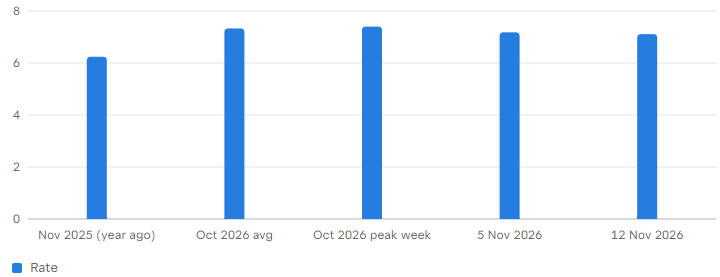
Rates are the main reason. Freddie Mac's 30-year average was 7.11% on 12 November, down from 7.18% the week before and up from 6.24% a year earlier [8]. It averaged 7.33% for October, with a weekly peak of 7.40% . StockAnalysis notes that the 10-year Treasury yield, which mortgage rates tend to follow, rose to 5.07% after a hot inflation report on 10 November, so the recent dip may not last.
One caution on data quality: a Stocktwits article gives 6.24% as the rate for the week ending 12 November. Several other sources show that figure is the rate from a year earlier, so I have ignored it. Prices also vary by source. Houzeo uses $429,100 for August, and Bankrate quoted $408,800 for March, so be careful comparing numbers from different months.
First-time buyers made up 29% of existing-home sales in October, down from 32% a year earlier. That tells you the people who most need an affordability check are the ones feeling squeezed.
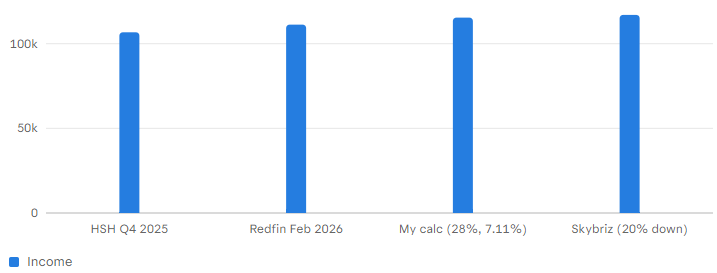
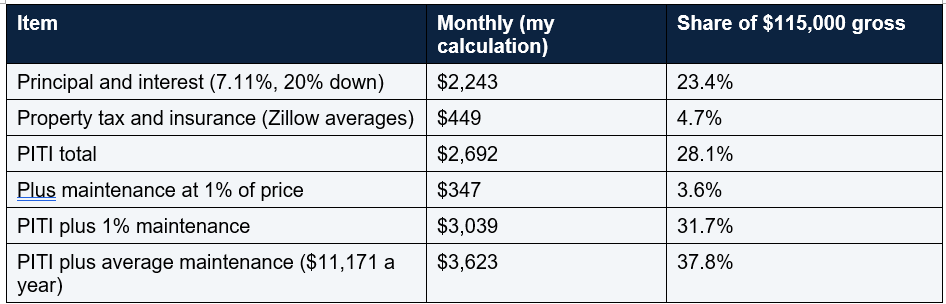
Now add taxes and insurance. Using the Zillow and Thumbtack averages of $3,129 for property taxes and $2,266 for insurance , I get about $449 a month more, so PITI is roughly $2,692. Divide by 0.28 and multiply by 12, and the income needed for the 28% test is about $115,400 (my calculation).
Other sources land nearby but not on the same number. Redfin's February 2026 report put the income needed for the median home at $111,252. A Q4 2025 analysis cited by FreeFinCalc says about $106,731. Skybriz estimates $117,000 with 20% down and $135,000 with 5% down. The differences come from dates, rates and assumptions, so treat any of them as a range, not a threshold.
Different studies give different totals, and I would not trust any single one. The Motley Fool cites $7,742 a year for taxes, insurance and utilities, plus $6,413 for maintenance. Amerisave cites Bankrate's 2025 study at $21,400 a year in hidden costs beyond the mortgage. The gaps come from what each study counts.
For planning, the usual rule of thumb is to budget 1% to 4% of the home's value each year for upkeep. Fannie Mae-style guidance quoted by Waterstone gives that range, Credible repeats it, and The Zebra suggests 1% as a floor, noting that older homes or deferred upkeep can easily cost more. On a $250,000 home, the Motley Fool says that works out to $2,500 to $10,000 a year. There is mildly good news. The Zillow and Thumbtack data found that annual increases in maintenance costs eased in each of the last five years, slowing from 9% in 2022 to 1% in 2026. Costs are still high, but they are no longer accelerating as fast.
My own example shows the scale. On the median-price loan above, the gap between 6.24% and 7.11% is about $193 a month. If that sum went into an investment account instead, over a year it would be roughly $2,300 (my calculation, ignoring growth). Meanwhile, a Waterstone guide notes that a payment that looks manageable on paper can still leave little room for savings goals, emergency funds and retirement contributions. You cannot control the rate, but you can control how much you borrow, your credit score and how long you shop. If rates fall later, refinancing may help, though that is never guaranteed, so do not buy a house that only works if rates drop.
Take the table above. At a $115,000 gross income, a savings plan of 15% would be about $1,440 a month before tax (an illustrative figure, not advice). PITI alone takes 28.1% of gross. Add a 1% maintenance reserve and housing is 31.7%. Add the higher Zillow average and it is 37.8%, which would likely leave little room for both the savings plan and everyday life.
That does not mean the house is out of reach. It means either the price, the down payment or the savings target has to flex, and it is much better to know that before the offer than after the move. If you must bend something, bend the house first, because it is the one thing you have not yet bought.
Warning signs to watch for: you are skipping retirement contributions to afford the payment, you cannot cover a $5,000 repair without a credit card, you are counting on a raise to make the budget work, or you are being approved for much more than your own numbers support. Any one of these is worth pausing over.
Before you make an offer, ask these questions. What is my all-in monthly cost, including a maintenance reserve? What savings rate does my plan need, and does the house leave room for it? How many months of expenses will I still hold after closing? What happens to the budget if rates, taxes or insurance rise? And would I still be comfortable with the payment if one income dropped?
If the answers are comfortable, great. If they are not, that is useful information too. A fee-only financial planner or a housing counsellor can pressure-test the numbers with your real income, which a blog post cannot do.
The 28/36 rule is a good ceiling, but your plan should set the floor. Run the numbers with real quotes, build a repair reserve, and treat any approval above your comfort level as an option and not an instruction. A slightly smaller house now can leave you far richer later.
It says to spend no more than 28% of gross monthly income on housing costs (PITI) and no more than 36% on total debt, including the mortgage.
How much should I budget for home maintenance?
Commonly 1% to 4% of the home's value a year. Older homes or deferred upkeep can cost more.
What is the median home price right now?
NAR put the median existing-home price at $416,700 for October 2026. Other sources quote different months, so check the date.
What are mortgage rates today?
Freddie Mac's 30-year average was 7.11% on 12 November, the latest reading I retrieved. It changes every Thursday, so check the current figure.
How do I know if I am house-poor?
If housing crowds out saving, emergencies or retirement contributions, you are likely stretched. Surveys suggest 34% to 38% of owners feel this way.
Table of Contents
- Start with the 28/36 rule, then question it
- Where prices and rates stand today
- Run the numbers on a median-priced home
- The costs the mortgage payment leaves out
- Why a small rate change matters so much
- Down payment: how much is enough?
- A wealth-first test for your budget
- Signs you may be house-poor
- Ways to buy less stress
- Questions to ask before you make an offer
- Conclusion
- FAQ
30-year mortgage rate: year ago vs now (%)
% rate by Source: Freddie Mac via Star-Advertiser, TheStreet, StockAnalysis
Income needed for the median home: estimates differ ($)
Gross annual income, $ by Sources: FreeFinCalc, Bankrate/Redfin, Skybriz; dates and assumptions differ
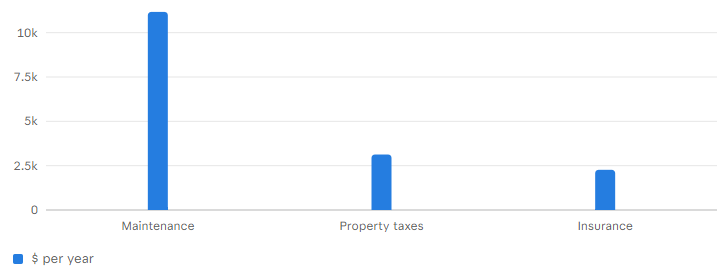
Typical annual ownership extras beyond the mortgage ($)
US dollars by Source: Zillow and Thumbtack analysis via Fox 7 Austin (total $16,566)The honest answer to "how much home can I buy?" is that it depends on a number most calculators never ask for: how much you still want to invest after the house is paid for each month. A lender will approve you up to a debt limit. Your wealth-building plan needs a lower, quieter number.
The classic starting point is the 28/36 rule, which says to keep housing at or below 28% of gross income and total debt at or below 36%. With 30-year mortgage rates at 7.11% in the latest weekly reading I retrieved [8], even that cautious rule asks a lot. By my calculation, a median-priced home with 20% down needs about $115,000 of income to meet the 28% test.
My suggestion, which is a framework and not a promise, is to add a second test on top of the lender's rule: count maintenance, then check that you can still save what your plan calls for. If you can, the house fits your plan. If you can't, the house is competing with your future.
Key takeaway: Use the 28/36 rule as a ceiling, not a target. Then add maintenance and check that your savings rate survives.
Start with the 28/36 rule, then question it
The rule is simple. Take your gross monthly income, multiply by 28%, and that is the most you should spend on housing. Bankrate's example is a $5,000 monthly income, which gives a $1,400 limit. The housing figure includes principal, interest, taxes and insurance, often written PITI, and total debts, including the mortgage, should stay within 36%.It is a useful guardrail, but it has gaps. It uses gross income, so it ignores your tax bill. It leaves out maintenance and utilities. And it says nothing about retirement contributions, childcare or your emergency fund. One calculator site makes the point bluntly: the maximum a lender will approve is not the number you can pay each month without crowding out retirement, savings or your life .
Some lenders go further. One guide notes that certain calculators assume you are comfortable with a debt-to-income ratio of 45% or even 50%. That is allowed for many loans, but it is a long way from what a person trying to build wealth would normally choose.
Where prices and rates stand today
The market is not easy for buyers right now. NAR reported that the median existing-home price for October was $416,700, up 0.4% from a year earlier and the 40th straight month of annual gains . Sales ran at a seasonally adjusted annual rate of 3.75 million, which the Honolulu Star-Advertiser says is the slowest since August 2010.Rates are the main reason. Freddie Mac's 30-year average was 7.11% on 12 November, down from 7.18% the week before and up from 6.24% a year earlier [8]. It averaged 7.33% for October, with a weekly peak of 7.40% . StockAnalysis notes that the 10-year Treasury yield, which mortgage rates tend to follow, rose to 5.07% after a hot inflation report on 10 November, so the recent dip may not last.
One caution on data quality: a Stocktwits article gives 6.24% as the rate for the week ending 12 November. Several other sources show that figure is the rate from a year earlier, so I have ignored it. Prices also vary by source. Houzeo uses $429,100 for August, and Bankrate quoted $408,800 for March, so be careful comparing numbers from different months.
First-time buyers made up 29% of existing-home sales in October, down from 32% a year earlier. That tells you the people who most need an affordability check are the ones feeling squeezed.
Run the numbers on a median-priced home
Let me run a worked example using the October median price of $416,700. With a 20% down payment of $83,340, the loan is $333,360. At 7.11%, my calculation puts principal and interest at about $2,243 a month. At last year's 6.24%, it would be about $2,050, so the higher rate costs roughly $193 a month, or about $2,300 a year.Now add taxes and insurance. Using the Zillow and Thumbtack averages of $3,129 for property taxes and $2,266 for insurance , I get about $449 a month more, so PITI is roughly $2,692. Divide by 0.28 and multiply by 12, and the income needed for the 28% test is about $115,400 (my calculation).
Other sources land nearby but not on the same number. Redfin's February 2026 report put the income needed for the median home at $111,252. A Q4 2025 analysis cited by FreeFinCalc says about $106,731. Skybriz estimates $117,000 with 20% down and $135,000 with 5% down. The differences come from dates, rates and assumptions, so treat any of them as a range, not a threshold.
The costs the mortgage payment leaves out
The cost that catches people out is maintenance. A Zillow and Thumbtack analysis reported by Fox 7 puts typical annual ownership extras at $16,566: about $11,171 for maintenance, $2,266 for insurance and $3,129 for property taxes. An earlier release of the same analysis showed nearly $16,000, with roughly $11,000 for maintenance, $2,003 for insurance and $3,030 for taxes. Both say the same thing: the extras add well over $1,300 a month.Different studies give different totals, and I would not trust any single one. The Motley Fool cites $7,742 a year for taxes, insurance and utilities, plus $6,413 for maintenance. Amerisave cites Bankrate's 2025 study at $21,400 a year in hidden costs beyond the mortgage. The gaps come from what each study counts.
For planning, the usual rule of thumb is to budget 1% to 4% of the home's value each year for upkeep. Fannie Mae-style guidance quoted by Waterstone gives that range, Credible repeats it, and The Zebra suggests 1% as a floor, noting that older homes or deferred upkeep can easily cost more. On a $250,000 home, the Motley Fool says that works out to $2,500 to $10,000 a year. There is mildly good news. The Zillow and Thumbtack data found that annual increases in maintenance costs eased in each of the last five years, slowing from 9% in 2022 to 1% in 2026. Costs are still high, but they are no longer accelerating as fast.
Why a small rate change matters so much
Rates deserve their own section, because they change how much house the same income buys. One guide estimates that, with mid-6% rates, the same income buys roughly 25% less house than it did in 2021, when rates were in the high 2% range. Direct Lender says a rate difference can change the price you can afford by $20,000 to $50,000.My own example shows the scale. On the median-price loan above, the gap between 6.24% and 7.11% is about $193 a month. If that sum went into an investment account instead, over a year it would be roughly $2,300 (my calculation, ignoring growth). Meanwhile, a Waterstone guide notes that a payment that looks manageable on paper can still leave little room for savings goals, emergency funds and retirement contributions. You cannot control the rate, but you can control how much you borrow, your credit score and how long you shop. If rates fall later, refinancing may help, though that is never guaranteed, so do not buy a house that only works if rates drop.
Down payment: how much is enough?
A bigger down payment means a smaller loan. Lower says it can also lower your rate and mortgage insurance cost, which raises the price you can afford at the same monthly payment. Direct Lender adds that putting 20% down eliminates private mortgage insurance, or PMI. But there is a trade-off for anyone building wealth. Draining your savings to reach 20% can leave you with no emergency fund and no money for repairs, and you now know repairs are not optional. A smaller down payment with PMI and a solid cash cushion is sometimes the safer choice. That is a judgment call that depends on your situation, and a licensed adviser or lender can run both versions for you. As a general principle, which is not a sourced fact, I would keep three buckets separate: the down payment, a reserve for repairs and moving costs, and your regular retirement and investment contributions. Buying a house should not require raiding the second or third.A wealth-first test for your budget
Here is the framework I mentioned at the start. It is my own, not an industry standard, so treat it as a starting point. Step one: work out the all-in monthly cost, meaning PITI plus a maintenance reserve of at least 1% of the price a year. Step two: subtract it from your take-home pay. Step three: check that what is left still covers your planned savings, your debts and your living costs.Take the table above. At a $115,000 gross income, a savings plan of 15% would be about $1,440 a month before tax (an illustrative figure, not advice). PITI alone takes 28.1% of gross. Add a 1% maintenance reserve and housing is 31.7%. Add the higher Zillow average and it is 37.8%, which would likely leave little room for both the savings plan and everyday life.
That does not mean the house is out of reach. It means either the price, the down payment or the savings target has to flex, and it is much better to know that before the offer than after the move. If you must bend something, bend the house first, because it is the one thing you have not yet bought.
Signs you may be house-poor
"House-poor" means most of your income goes to housing. Credible reports that 38% of homeowners consider themselves house-poor, while an ABC News 4 report puts it at 34% and says more than 60% found owning much more expensive than expected. Amerisave cites a survey in which 81% of owners said costs exceeded expectations. Those are survey results, not proof, but they point the same way.Warning signs to watch for: you are skipping retirement contributions to afford the payment, you cannot cover a $5,000 repair without a credit card, you are counting on a raise to make the budget work, or you are being approved for much more than your own numbers support. Any one of these is worth pausing over.
Ways to buy less stress
There are practical ways to lower the pressure. Buy below your approval limit, because the cheapest way to protect your plan is a smaller loan. Consider a condo, a townhouse or a less expensive suburb, an option Houzeo suggests when the median home is out of reach on a lower salary. Get inspections on older homes, since deferred upkeep is where the large bills hide. Compare insurance and tax rates before choosing a location. Keep a separate maintenance account and fund it monthly. And shop lenders, since a 100-point credit score difference can change the payment by $150 to $200 a month, according to one lender's guide.Before you make an offer, ask these questions. What is my all-in monthly cost, including a maintenance reserve? What savings rate does my plan need, and does the house leave room for it? How many months of expenses will I still hold after closing? What happens to the budget if rates, taxes or insurance rise? And would I still be comfortable with the payment if one income dropped?
If the answers are comfortable, great. If they are not, that is useful information too. A fee-only financial planner or a housing counsellor can pressure-test the numbers with your real income, which a blog post cannot do.
Conclusion
How much home can you buy without slowing your wealth-building? Enough that the all-in cost, including upkeep, leaves your savings plan intact. For a median-priced home at today's rates, my calculation suggests that takes an income somewhere around $115,000, give or take, and that is before the larger maintenance figures some studies report.The 28/36 rule is a good ceiling, but your plan should set the floor. Run the numbers with real quotes, build a repair reserve, and treat any approval above your comfort level as an option and not an instruction. A slightly smaller house now can leave you far richer later.
FAQ
What is the 28/36 rule?It says to spend no more than 28% of gross monthly income on housing costs (PITI) and no more than 36% on total debt, including the mortgage.
How much should I budget for home maintenance?
Commonly 1% to 4% of the home's value a year. Older homes or deferred upkeep can cost more.
What is the median home price right now?
NAR put the median existing-home price at $416,700 for October 2026. Other sources quote different months, so check the date.
What are mortgage rates today?
Freddie Mac's 30-year average was 7.11% on 12 November, the latest reading I retrieved. It changes every Thursday, so check the current figure.
How do I know if I am house-poor?
If housing crowds out saving, emergencies or retirement contributions, you are likely stretched. Surveys suggest 34% to 38% of owners feel this way.
0 Comments
Be the first to share your thoughts on this article.