
Real Estate
Value Income Needed for a $550,000 House at Today's Mortgage Rates

The honest answer is a range, and today’s 7%-plus mortgage rates push it toward the top. 30-year fixed rate 7.11% (Freddie Mac, 12 Nov 2026) vs 6.24% a year ago; 20% down payment on $550,000 is $110,000; my estimated monthly cost $3,602 and income about $154,000 at 28%.
Other guides give ranges that overlap with mine. TrueCostLab says roughly $155,903 to $180,425 a year at a 7% rate. DSLD Mortgage says $135,000 to $180,000 [8]. SoFi says $160,000 to $200,000 at about 7% [9]. The differences come from down payments, debts and assumptions, which I explain below.
Rates matter a lot. Freddie Mac's 30-year fixed average was 7.11% on 12 November, down from 7.18% the week before but well above 6.24% a year ago. By my calculation, that rise alone adds about $11,000 to the income you need at 20% down.
Key takeaway: Plan on roughly $150,000 to $195,000 of gross household income for a $550,000 house today, depending on your down payment, other debts and local taxes. Being approved for a loan is not the same as being comfortable, so I also cover what leaves breathing room.
Daily quotes run a little higher. Zillow data reported by Yahoo Finance had the 30-year purchase rate at 7.27% on 16 November, with 20-year loans at 7.15% and 15-year loans at 6.62%. The Mortgage Reports noted an average 30-year rate of about 7.28% at the time of publication. The gap between these numbers is mostly timing and method: Freddie Mac publishes a weekly survey, while the others show daily quotes. Lenders also differ from each other and from the averages, which is a good reminder to shop around.
The wider market is cooler. TheStreet reports that existing-home sales fell to their slowest annual pace in more than 16 years, that the average 30-year rate has stayed above 7%, and that Redfin's Dana Anderson said flattening prices could bring buyers some relief. For this post I use 7.11% as my base rate, and I show 6.5% and 7.5% for comparison.
Those are guidelines, not hard limits. AmeriSave notes that the 43% debt-to-income figure many people quote is outdated and that automated underwriting now allows more. Sum.money says FHA loans allow higher debt-to-income ratios, up to 43% to 50% with compensating factors. InvestorMint adds that a lender might approve a payment above $3,500, but approval does not mean it fits comfortably in your after-tax budget.
So think in two steps. First, what will a lender approve? Second, what can you afford comfortably after tax, other bills and saving? Most of the confusion online comes from mixing these up. A word on "gross" income: all the ratios use income before tax. Your take-home pay is lower, so a payment that is 28% of gross can feel like 35% or more of what lands in your account.
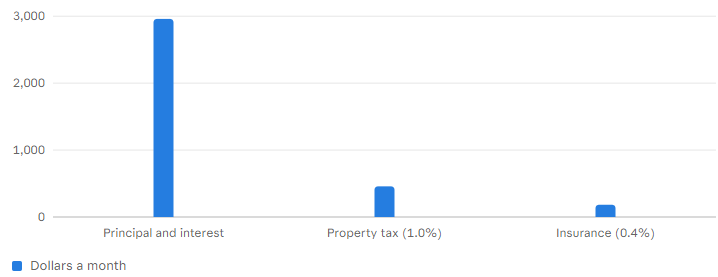
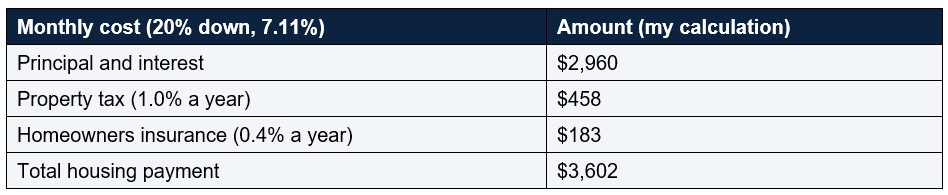
With 20% down ($110,000), the loan is $440,000. Principal and interest at 7.11% is about $2,960 a month (my calculation). Add property tax of about $458 and insurance of about $183, and the total comes to about $3,602 a month (my calculation). At the 28% limit, that payment needs a gross income of about $154,000 a year ($3,602 divided by 0.28, times 12, my calculation). For scale, Finger Lakes 1 says a $300,000 mortgage at 7.11% costs about $2,018 a month in principal and interest [6], and my $440,000 figure scales that correctly (about $2,960).
Over 30 years, you would pay about $626,000 in interest on that $440,000 loan if you kept it to term (my calculation). That is more than the loan itself, which is a good reminder of why the rate matters, and why extra payments or a lower rate later can help.

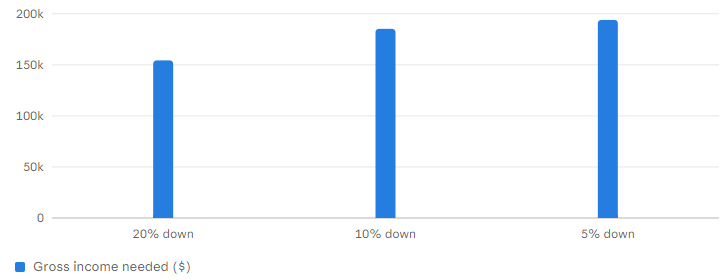
All are my calculations from the assumptions above. The difference between 20% and 5% down is about $40,000 of required income. That is why saving a bigger down payment can matter as much as earning more.
On the other hand, a larger down payment has a cost too: the cash is tied up in the house and not available for emergencies or moving costs. Lower notes that some loans allow 3% to 3.5% down, including HomeReady or Home Possible at 3% and FHA at 3.5, but those come with mortgage insurance and their own rules. If other debts are a constraint, the back-end ratio can bind instead. With 20% down, $500 a month of other debt and a 36% cap, I get about $137,000 of income (my calculation), which is lower than the 28% figure, so the housing ratio is the tighter one here. With larger car or student loan payments the back-end limit can become the one that bites. For example, with $1,000 of other monthly debt it is about $153,000, which nearly equals the 28% figure (my calculation).
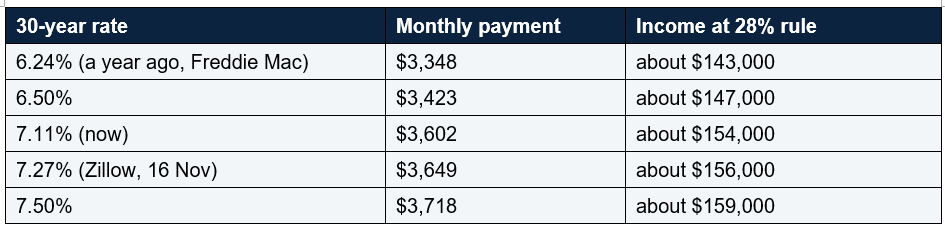
These are my calculations. Compared with a year ago, today's rate adds about $254 a month and about $11,000 of required income at 20% down (my calculation). Each full percentage point is worth roughly $12,000 to $13,000 of income (my calculation from the 6.50% and 7.50% rows), so shopping around for the best quote is worth the effort. Be careful with older guides. Several articles still use rates of about 6.5% to 6.65%, which give lower income figures than today's rates would.
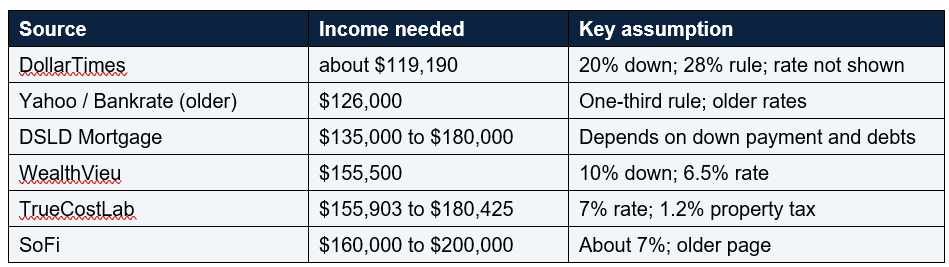
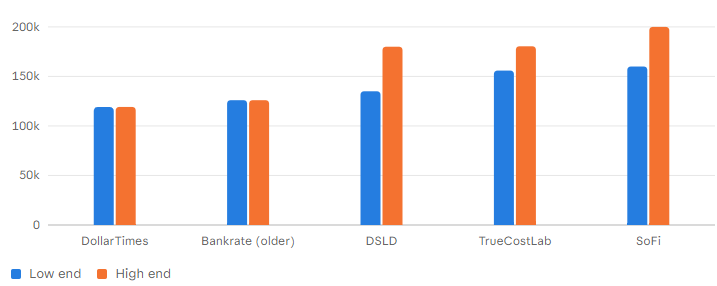
The spread comes from four things. The interest rate: lower rates give lower income. The down payment: 20% versus 5% is a big swing. The tax and insurance assumptions: TrueCostLab assumes 1.2% property tax and 0.35% insurance [7]. And the rule: the "one-third" rule used in the older Bankrate piece is looser than 28%.
The Bankrate-based article is over three years old and uses a mortgage payment of $3,500 a month, so I treat it as out of date. AmeriSave's more recent example puts an all-in payment of $3,400 to $3,700 at 20% down and reads that as gross income of about $144,000 to $158,000 on the 28% test , which sits very close to my $154,000. In short, if a guide gives a figure well below $140,000, check which rate it uses. Right now, the evidence points to the mid-$150,000s as a baseline for a 20% down payment.
Maintenance and repairs. A common rule of thumb is to set aside about 1% of the home's value a year, which would be about $5,500 (general knowledge, not from the sources).
HOA dues, utilities and furnishing. These sit on top of the payment. The Lower article lists HOA dues among the costs to include. Moving and furnishing. Bigger houses cost more to fill and heat. This is easy to forget. Property taxes and insurance can also rise. Lower notes that taxes and insurance have been moving higher in many areas.
To see what that does, take my 20% down example. If property tax were 2% instead of 1%, that adds about $458 a month, and the income needed rises by about $20,000 (my calculation: $458 divided by 0.28, times. If insurance were $5,300 a year instead of $2,200, that adds about $258 a month and about $11,000 of required income (my calculation).
So please use your own county's tax rate and a real insurance quote, not a national average. Lower makes the same recommendation: use neighbourhood-specific tax and insurance assumptions.
The practical trade-off is cash now versus cost later. A smaller down payment gets you in sooner but raises the monthly payment and the income you need, as my table showed. A bigger one cuts the payment but delays buying. Neither is right for everyone. I have not covered first-time buyer grants, local assistance programmes or VA benefits in detail, and these could change the numbers materially for you.
As an illustration, suppose your gross income is $154,000 and you pay roughly 22% to 25% in tax and deductions (an assumption of mine). Take-home pay would be about $115,000 to $120,000, or about $9,600 to $10,000 a month, and the $3,602 housing payment would be about 36% to 38% of that. That is manageable but leaves less room for saving, childcare or other costs.
A more cautious approach is to look for a payment closer to 25% of gross income or to a third of take-home pay. At $3,602, a 25% ratio needs about $173,000 of income (my calculation). The difference between the 28% figure and the comfortable figure is the cushion, and it matters most if your income might fall or your costs rise.
Mistakes to avoid: using the maximum you are approved for as your budget; leaving out taxes, insurance and PMI; relying on old articles with outdated rates; using national averages for tax and insurance; draining all your savings for the down payment; and forgetting maintenance and closing costs.
A short checklist, offered as education and not advice.
The bull case for buying: if you can comfortably afford it, rates have fallen four weeks in a row, prices are flattening, and a house can be a long-term home. You can also refinance later if rates fall, though that is not guaranteed. The bear case: rates are far above a year ago, sales are at multi-year lows, the payment is a big share of income, and hidden costs add up. Both hold. The right answer depends on your finances and plans, not just the market.
Treat these as starting points. Get real quotes, use your local taxes and insurance, and leave a cushion between what you can borrow and what you are happy to pay each month. This post is education only, not advice.
On my assumptions at 7.11% and 20% down, about $154,000 a year at the 28% rule. Other guides give $135,000 to $200,000 depending on rate and down payment .
What is the monthly payment on a $550,000 house?
With 20% down at 7.11%, I estimate about $3,602 including property tax and insurance (my calculation), of which about $2,960 is principal and interest.
What is the 28/36 rule?
Housing costs should be no more than 28% of gross monthly income, and total debts no more than 36%. Lenders may allow higher ratios in some cases.
Can I afford a $550,000 house with 5% down?
Possibly, but the loan is $522,500 and PMI applies, so my estimate of the income needed is about $194,000 at the 28% rule. Other loan types may have different rules.
What are mortgage rates today?
Freddie Mac's 30-year average was 7.11% as of 12 November 2026, and Zillow data showed 7.27% on 16 November.
Table of Contents
- The quick answer
- What mortgage rates are today
- How lenders decide what you can afford
- The payment maths, step by step
- Income needed by down payment
- How much rates matter
- What other guides say, and why they differ
- Costs beyond the mortgage payment
- Where you live changes the answer
- Other loan types and lower down payments
- Comfortable versus approved
- Ways to need less income
- Conclusion
- FAQ
Income needed for a $550,000 house by down payment
US dollars a year by My calculation: 7.11% rate, 28% rule, 1.0% tax, 0.4% insurance, 0.85% PMI
Monthly cost of a $550,000 house, 20% down at 7.11% ($)
US dollars a month by My calculation; total about $3,602 a month
Published estimates of income needed for a $550,000 house ($)
US dollars a year by Sources differ by rate, down payment and rules; single-figure sources show equal low and high
The quick answer
If you want one number, here is mine: with 20% down, at today's rates, you would need about $154,000 a year before tax to fit a $550,000 house under the common 28% rule (my calculation). With 10% down it is about $185,000, and with 5% down about $194,000 (my calculation, using assumptions I list below).Other guides give ranges that overlap with mine. TrueCostLab says roughly $155,903 to $180,425 a year at a 7% rate. DSLD Mortgage says $135,000 to $180,000 [8]. SoFi says $160,000 to $200,000 at about 7% [9]. The differences come from down payments, debts and assumptions, which I explain below.
Rates matter a lot. Freddie Mac's 30-year fixed average was 7.11% on 12 November, down from 7.18% the week before but well above 6.24% a year ago. By my calculation, that rise alone adds about $11,000 to the income you need at 20% down.
Key takeaway: Plan on roughly $150,000 to $195,000 of gross household income for a $550,000 house today, depending on your down payment, other debts and local taxes. Being approved for a loan is not the same as being comfortable, so I also cover what leaves breathing room.
What mortgage rates are today
Rates are the biggest swing factor, so let me start there. Freddie Mac's survey put the 30-year fixed average at 7.11% as of 12 November 2026, down from 7.18% the previous week and up from 6.24% a year earlier. Mortgage News Daily lists a 52-week range from a low of 5.98% to a high of 7.40%.Daily quotes run a little higher. Zillow data reported by Yahoo Finance had the 30-year purchase rate at 7.27% on 16 November, with 20-year loans at 7.15% and 15-year loans at 6.62%. The Mortgage Reports noted an average 30-year rate of about 7.28% at the time of publication. The gap between these numbers is mostly timing and method: Freddie Mac publishes a weekly survey, while the others show daily quotes. Lenders also differ from each other and from the averages, which is a good reminder to shop around.
The wider market is cooler. TheStreet reports that existing-home sales fell to their slowest annual pace in more than 16 years, that the average 30-year rate has stayed above 7%, and that Redfin's Dana Anderson said flattening prices could bring buyers some relief. For this post I use 7.11% as my base rate, and I show 6.5% and 7.5% for comparison.
How lenders decide what you can afford
Lenders look at two ratios. The 28/36 rule is the classic guide: housing costs should not exceed 28% of gross monthly income, and total debt payments should stay below 36%. Housing costs here mean the full payment: principal, interest, property taxes, homeowners insurance, and also PMI and any HOA dues.Those are guidelines, not hard limits. AmeriSave notes that the 43% debt-to-income figure many people quote is outdated and that automated underwriting now allows more. Sum.money says FHA loans allow higher debt-to-income ratios, up to 43% to 50% with compensating factors. InvestorMint adds that a lender might approve a payment above $3,500, but approval does not mean it fits comfortably in your after-tax budget.
So think in two steps. First, what will a lender approve? Second, what can you afford comfortably after tax, other bills and saving? Most of the confusion online comes from mixing these up. A word on "gross" income: all the ratios use income before tax. Your take-home pay is lower, so a payment that is 28% of gross can feel like 35% or more of what lands in your account.
The payment maths, step by step
Here is the maths using my stated assumptions. I assume a 30-year fixed loan at 7.11%, property tax of 1.0% of the price a year, homeowners insurance of 0.4% a year, and, where the down payment is below 20%, mortgage insurance of 0.85% of the loan a year. These are my assumptions, based on national averages, and your numbers will differ. Skybriz says the national effective property tax rate is a little under 1% [16], and Lower uses 0.85% for PMI in an example.With 20% down ($110,000), the loan is $440,000. Principal and interest at 7.11% is about $2,960 a month (my calculation). Add property tax of about $458 and insurance of about $183, and the total comes to about $3,602 a month (my calculation). At the 28% limit, that payment needs a gross income of about $154,000 a year ($3,602 divided by 0.28, times 12, my calculation). For scale, Finger Lakes 1 says a $300,000 mortgage at 7.11% costs about $2,018 a month in principal and interest [6], and my $440,000 figure scales that correctly (about $2,960).
Over 30 years, you would pay about $626,000 in interest on that $440,000 loan if you kept it to term (my calculation). That is more than the loan itself, which is a good reminder of why the rate matters, and why extra payments or a lower rate later can help.
Income needed by down payment
The down payment changes the answer more than most people expect, because a smaller down payment means a bigger loan and PMI. Here are my estimates at 7.11%, using the 28% front-end rule.All are my calculations from the assumptions above. The difference between 20% and 5% down is about $40,000 of required income. That is why saving a bigger down payment can matter as much as earning more.
On the other hand, a larger down payment has a cost too: the cash is tied up in the house and not available for emergencies or moving costs. Lower notes that some loans allow 3% to 3.5% down, including HomeReady or Home Possible at 3% and FHA at 3.5, but those come with mortgage insurance and their own rules. If other debts are a constraint, the back-end ratio can bind instead. With 20% down, $500 a month of other debt and a 36% cap, I get about $137,000 of income (my calculation), which is lower than the 28% figure, so the housing ratio is the tighter one here. With larger car or student loan payments the back-end limit can become the one that bites. For example, with $1,000 of other monthly debt it is about $153,000, which nearly equals the 28% figure (my calculation).
How much rates matter
Rates do a lot of work. Using my assumptions at 20% down, here is the income needed at different rates.These are my calculations. Compared with a year ago, today's rate adds about $254 a month and about $11,000 of required income at 20% down (my calculation). Each full percentage point is worth roughly $12,000 to $13,000 of income (my calculation from the 6.50% and 7.50% rows), so shopping around for the best quote is worth the effort. Be careful with older guides. Several articles still use rates of about 6.5% to 6.65%, which give lower income figures than today's rates would.
What other guides say, and why they differ
If you search for this question, you will find answers from $119,000 to $200,000, and it helps to know why.The spread comes from four things. The interest rate: lower rates give lower income. The down payment: 20% versus 5% is a big swing. The tax and insurance assumptions: TrueCostLab assumes 1.2% property tax and 0.35% insurance [7]. And the rule: the "one-third" rule used in the older Bankrate piece is looser than 28%.
The Bankrate-based article is over three years old and uses a mortgage payment of $3,500 a month, so I treat it as out of date. AmeriSave's more recent example puts an all-in payment of $3,400 to $3,700 at 20% down and reads that as gross income of about $144,000 to $158,000 on the 28% test , which sits very close to my $154,000. In short, if a guide gives a figure well below $140,000, check which rate it uses. Right now, the evidence points to the mid-$150,000s as a baseline for a 20% down payment.
Costs beyond the mortgage payment
The mortgage payment is not the whole bill. Here are the extras to budget for. Closing costs and escrow. Lenders usually require two to three months of property taxes and homeowners insurance to be funded at closing to seed the escrow account. Closing costs more generally are often quoted as a few percent of the price, which on $550,000 would be about $11,000 to $27,500 at 2% to 5% (a general rule of thumb of mine, not from the sources).Maintenance and repairs. A common rule of thumb is to set aside about 1% of the home's value a year, which would be about $5,500 (general knowledge, not from the sources).
HOA dues, utilities and furnishing. These sit on top of the payment. The Lower article lists HOA dues among the costs to include. Moving and furnishing. Bigger houses cost more to fill and heat. This is easy to forget. Property taxes and insurance can also rise. Lower notes that taxes and insurance have been moving higher in many areas.
Where you live changes the answer
National averages hide huge differences. Skybriz notes that the average effective property tax rate is a little under 1%, but the spread is huge, with New Jersey among the highest and Hawaii the lowest [16]. Insurance varies even more. Harbert Group, using Bankrate's May 2026 analysis, says the average annual homeowners insurance premium in Houston is $5,300 for $300,000 of dwelling coverage, which is 119% above the national average.To see what that does, take my 20% down example. If property tax were 2% instead of 1%, that adds about $458 a month, and the income needed rises by about $20,000 (my calculation: $458 divided by 0.28, times. If insurance were $5,300 a year instead of $2,200, that adds about $258 a month and about $11,000 of required income (my calculation).
So please use your own county's tax rate and a real insurance quote, not a national average. Lower makes the same recommendation: use neighbourhood-specific tax and insurance assumptions.
Other loan types and lower down payments
Not everyone puts 20% down. Options include conventional loans with PMI, FHA loans and VA loans. Sum.money lists conventional PMI at roughly 0.3% to 1.5% of the loan a year, automatic cancellation at 78% loan-to-value, and FHA mortgage insurance of 1.75% upfront plus 0.55% a year, which stays for the life of the loan in its example. It also lists a conforming loan limit of $832,750, so a $550,000 house is well within standard loan limits. AmeriSave makes the same point.The practical trade-off is cash now versus cost later. A smaller down payment gets you in sooner but raises the monthly payment and the income you need, as my table showed. A bigger one cuts the payment but delays buying. Neither is right for everyone. I have not covered first-time buyer grants, local assistance programmes or VA benefits in detail, and these could change the numbers materially for you.
Comfortable versus approved
There is a difference between what a lender will approve and what feels comfortable. A lender may be happy with a payment at 36% to 43% of gross income, but the money still comes out of your take-home pay.As an illustration, suppose your gross income is $154,000 and you pay roughly 22% to 25% in tax and deductions (an assumption of mine). Take-home pay would be about $115,000 to $120,000, or about $9,600 to $10,000 a month, and the $3,602 housing payment would be about 36% to 38% of that. That is manageable but leaves less room for saving, childcare or other costs.
A more cautious approach is to look for a payment closer to 25% of gross income or to a third of take-home pay. At $3,602, a 25% ratio needs about $173,000 of income (my calculation). The difference between the 28% figure and the comfortable figure is the cushion, and it matters most if your income might fall or your costs rise.
Ways to need less income
If $154,000 or more is out of reach, there are levers. Save a larger down payment, because 20% down cuts the required income by about $31,000 compared with 10% (my calculation: $185,000 less $154,000). Pay off other debts first, since they count in the back-end ratio. Improve your credit score, since a better score can mean a better rate. Shop several lenders, since quotes differ. Consider a lower price, or a different area with lower taxes and insurance. And consider a household with two incomes, if that applies, since lenders use combined income. You could also wait. TheStreet notes that flattening prices could bring some relief, but nobody can predict rates, so I would not base a decision on timing alone.Mistakes to avoid: using the maximum you are approved for as your budget; leaving out taxes, insurance and PMI; relying on old articles with outdated rates; using national averages for tax and insurance; draining all your savings for the down payment; and forgetting maintenance and closing costs.
A short checklist, offered as education and not advice.
- Get your gross monthly income and list all monthly debts.
- Get at least three written rate quotes from different lenders.
- Look up your county's property tax rate and get an insurance quote.
- Run the numbers at several down payments, 20%, 10% and 5%.
- Test the payment at a rate one point higher than your quote.
- Check what the payment is as a share of take-home pay, not just gross.
- Keep an emergency fund after the down payment and closing costs.
- Ask a lender for a pre-approval, then decide how much of it you want to use.
The bull case for buying: if you can comfortably afford it, rates have fallen four weeks in a row, prices are flattening, and a house can be a long-term home. You can also refinance later if rates fall, though that is not guaranteed. The bear case: rates are far above a year ago, sales are at multi-year lows, the payment is a big share of income, and hidden costs add up. Both hold. The right answer depends on your finances and plans, not just the market.
Conclusion
So how much income do you need for a $550,000 house? On my assumptions at 7.11%, about $154,000 with 20% down, about $185,000 with 10% down, and about $194,000 with 5% down, using the 28% front-end rule (my calculations). Other guides range from about $135,000 to $200,000, mostly because of different rates, down payments and assumptions.Treat these as starting points. Get real quotes, use your local taxes and insurance, and leave a cushion between what you can borrow and what you are happy to pay each month. This post is education only, not advice.
FAQ
How much income do I need for a $550,000 house?On my assumptions at 7.11% and 20% down, about $154,000 a year at the 28% rule. Other guides give $135,000 to $200,000 depending on rate and down payment .
What is the monthly payment on a $550,000 house?
With 20% down at 7.11%, I estimate about $3,602 including property tax and insurance (my calculation), of which about $2,960 is principal and interest.
What is the 28/36 rule?
Housing costs should be no more than 28% of gross monthly income, and total debts no more than 36%. Lenders may allow higher ratios in some cases.
Can I afford a $550,000 house with 5% down?
Possibly, but the loan is $522,500 and PMI applies, so my estimate of the income needed is about $194,000 at the 28% rule. Other loan types may have different rules.
What are mortgage rates today?
Freddie Mac's 30-year average was 7.11% as of 12 November 2026, and Zillow data showed 7.27% on 16 November.
0 Comments
Be the first to share your thoughts on this article.