

Travel & holidays
How Much Income Retirees Need to Travel Every Year


Table of Contents
- Retirees Are Travelling More Than Ever
- The Key Statistics: What the Data Really Shows
- How Much Income Do Retirement Experts Recommend?
- Travel Budget Tiers: What Each Income Level Can Afford
- Real Trip Costs: A Destination-by-Destination Breakdown
- Income Sources That Fund Retirement Travel
- Expert Strategies for Stretching Your Travel Budget
- The "Go-Go Years" Rule: Why Timing Matters
- Conclusion
- Frequently Asked Questions (FAQ)
- External References & Links
Retirees Are Travelling More Than Ever
If you are approaching retirement and picturing a quieter, slower life close to home, the data suggests you might be the exception. According to the AARP 2026 Travel Trends Survey, a remarkable 86% of adults aged 50 and older ranked travel as their number-one discretionary spending priority for 2026 — ahead of dining, entertainment, and every other category. And they are not just talking about it. They are booking it.70% of Americans aged 50 and older plan to travel in 2026, up from 65% in 2024, taking an average of 3.9 trips each. 44% now plan at least one international trip — sharply up from 32% the year before. Baby Boomers, the generation now aged 62–80, have increased their expected travel spending by 52% in a single year, with an average expected travel budget of $12,462.
The question this guide answers is the one that most retirement planning conversations skip: how much income do you actually need, at different lifestyle levels, to make meaningful travel a regular part of your retirement? And what do the experts say about funding it without jeopardising the rest of your financial security?
The Key Statistics: What the Data Really Shows
Before diving into recommendations, it helps to anchor the conversation in what retirees actually spend. The numbers are sometimes surprising.
The Bureau of Labor Statistics Consumer Expenditure Survey puts average annual travel spending for U.S. households headed by someone aged 65–74 at roughly $4,000 to $7,000 per year. That is the median reality — most retirees are not spending $11,000 or $15,000 on travel, though a significant minority does.
The overall average expected travel spend for 2025–2026 sits at $6,847 — nearly $200 more than in 2024 — reflecting modest inflation-adjusted increases rather than lavish spending. Cost remains the number-one obstacle cited by retirees who want to travel more.
The broader retirement spending picture: according to BLS data, retirees spent an average of $59,616 per year in 2025. Travel and leisure sits alongside healthcare, housing, food, and transportation as a major budget category. The average Social Security retirement benefit is approximately $2,071 per month in 2026 — covering less than half of typical retirement expenses, meaning portfolio withdrawals and other income sources must fill the gap.
KEY EXPERT STATISTIC
Fewer than 1 in 4 retirees (23%) had $500,000 or more saved when they retired, according to a Clever Real Estate survey. Yet retirees themselves say the comfortable retirement savings target for 2026 is $823,800 — a number driven largely by continued inflation and rising lifestyle expectations, including travel.
How Much Income Do Retirement Experts Recommend?
The answer depends on what kind of traveller you want to be. Financial planners and retirement experts generally frame travel income requirements against a baseline retirement income target, then layer travel as either a fixed budget line or a percentage of discretionary spending.The 75–85% Pre-Retirement Income Rule
Most retirement planners start with the rule that retirees typically need 75–85% of their final pre-retirement salary. At $90,000 pre-retirement income, that suggests a target of $67,500–76,500 per year. This baseline assumes housing costs fall (mortgage paid off), commuting ends, and work-related expenses disappear. Experts universally recommend adjusting this baseline upward if active travel is a priority.The 50/30/20 Framework Applied to Retirement
Christina Lynn, a behavioral financial counselor at Mariner Wealth Advisors, recommends applying the 50/30/20 rule even in retirement: 50% of take-home income for needs (housing, food, healthcare, insurance), 30% for wants (travel, dining, entertainment, hobbies), and 20% for savings or emergency reserves. On a $90,000 retirement income, that allocates $27,000 to discretionary spending — of which travel might take $10,000–15,000 annually.The 4% Withdrawal Rule and Travel
The 4% rule — withdrawing 4% of your portfolio annually as a sustainable baseline — is the most widely cited framework for retirement withdrawals. Morningstar’s updated 2026 safe starting withdrawal rate is 3.9%. On a $600,000 portfolio, this produces $23,400 per year from savings. Combined with Social Security, this may comfortably support $3,000–7,000 in annual travel.For retirees who want to travel more aggressively in early retirement, some planners suggest temporarily stretching the withdrawal rate to 5–6% in the “Go-Go Years” (early 60s to mid-70s), then reducing withdrawals as travel naturally decreases. The Motley Fool and Yahoo Finance both cite this approach as reasonable if finances are reviewed annually.
“It’s easier to travel in your 60s than your 70s and 80s. Withdrawing money from your nest egg to fund bucket-list trips makes sense if your long-term projections still work — but you shouldn’t rush to go on a vacation binge the moment you retire.” — Yahoo Finance / Motley Fool, 2026
4. Travel Budget Tiers: What Each Income Level Can Afford
The most useful planning framework is to match your travel ambitions to your realistic income level. Here is how retirement experts and travel advisors describe the four main tiers of retiree travel spending.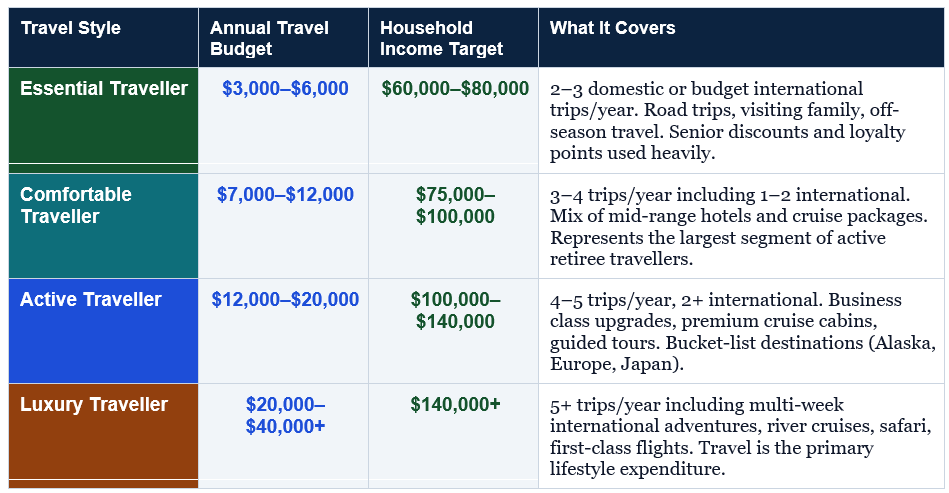
The most important takeaway from this table is that meaningful travel does not require $100,000+ in retirement income. The BLS data confirms that the majority of active retiree travellers operate in the $4,000–12,000 annual travel budget range — achievable on household incomes in the $60,000–$100,000 range when Social Security, modest portfolio withdrawals, and strategic booking are combined.
Real Trip Costs: A Destination-by-Destination Breakdown
Abstract budget ranges become much more useful when matched against real trip costs. Here is a data-driven breakdown of what specific trips actually cost, drawn from travel experts and current booking data.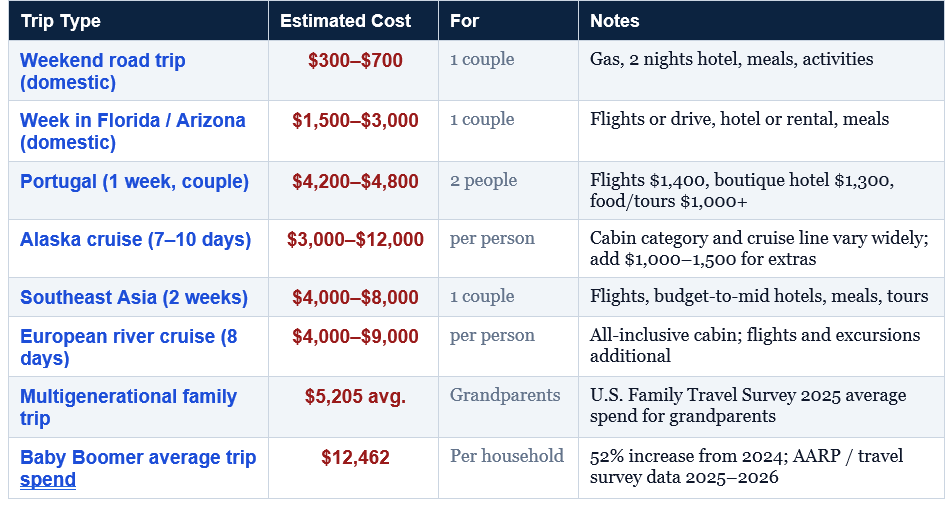
EXPERT PICK: PORTUGAL
Travel advisor Kara Simmons (Ready, Set, Booked) calls Portugal one of the top 2026 destinations for retired Baby Boomers: "Walkable, safe, and English-friendly — plus beautiful beaches, medieval towns, and golf. Similar to the Algarve but cheaper and with fewer crowds. Book in April or May and save 20–30% overall. Estimated budget for two people for one week: $4,200–$4,800."
Income Sources That Fund Retirement Travel
Understanding how much you need is only half the equation. The other half is knowing where the money comes from. Retirement travel is typically funded by a combination of sources, and the mix matters for planning purposes.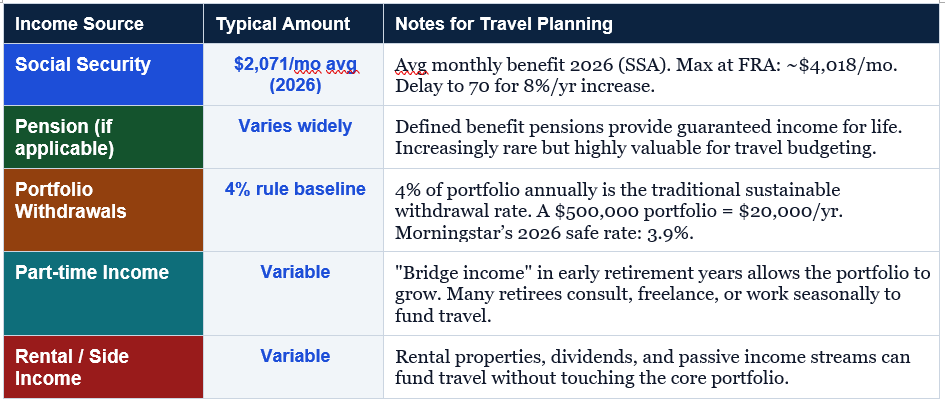
The median annual household income for Americans aged 65 and older is $56,680, according to the U.S. Census Bureau. At this income level, a $4,000–7,000 annual travel budget represents roughly 7–12% of total household income — ambitious but achievable with deliberate planning and strategic spending. The gap between Social Security ($24,852/year on average) and total retirement needs is the number that determines how aggressively you can fund travel from portfolio withdrawals.
Expert Strategies for Stretching Your Travel Budget
Retirement experts and experienced travel advisors consistently identify six strategies that allow retirees to travel more on the same income — or maintain their travel pace as costs rise.- Leverage the time advantage. Retirees can travel Tuesday to Thursday, book shoulder season (April–May and September–October in Europe), and access the 20–40% price savings that working adults cannot. Time flexibility is the single biggest financial asset retired travellers have.
- Stack senior discounts. Amtrak offers 10% off fares for seniors. A lifetime National Parks Senior Pass costs $80 and pays for itself quickly. Hotel chains, museums, rental car companies, and tour operators routinely offer 10–15% senior discounts that most travellers never ask for.
- Use cruises as a value vehicle. AAA projects that 65% of adult U.S. ocean cruise passengers in 2026 will be 55 or older — not by accident. Cruises bundle transportation, accommodation, and meals into a per-night cost that often beats the hotel-plus-meals equivalent in a port city. For solo travellers and those with health concerns, the logistics and medical staff on board add additional value.
- Choose a home-base travel model. Instead of expensive, jet-lagged multi-city itineraries, rent an apartment in Lisbon, Chiang Mai, or Oaxaca for 3–4 weeks and take day trips. This approach dramatically reduces per-day costs while deepening the travel experience.
- Build a dedicated travel fund. Rather than drawing travel money from the same account as living expenses — where it competes with rent and groceries — establish a separate travel account funded by dividend income, a set monthly transfer, or a portion of any part-time income. Visibility increases follow-through.
- Travel in early retirement. The data is consistent: health, mobility, and energy are highest in the early retirement years (60s to early 70s). Financial planners widely recommend front-loading bucket-list travel in these “Go-Go Years” while also ensuring that higher withdrawal rates in early retirement do not compromise the portfolio’s long-term sustainability.
The “Go-Go Years” Rule: Why Timing Matters
One of the most important — and underappreciated — concepts in retirement travel planning is the phase model of retirement spending. Financial gerontologists and retirement researchers have documented a consistent pattern: retirees tend to spend more in the early “Go-Go” years (approximately ages 62–72), gradually reduce spending in the “Slo-Go” years (73–82), and spend the least in the “No-Go” years (83+) as health and mobility decline.For travel planning, this means the window of peak travel activity is roughly a 10–15-year period beginning at retirement. Waiting to “save travel for later” is a statistically risky strategy: later often brings health complications, reduced stamina, and in some cases cognitive or mobility changes that make ambitious travel difficult or impossible.
This does not mean spending recklessly. It means that temporarily higher travel withdrawals in early retirement — budgeted carefully and reviewed annually against portfolio health — are a financially rational choice if they align with the retirement timeline and goals the retiree has actually planned for.
THE PLANNING PRINCIPLE
Every financial planner’s first question about retirement travel is the same as their first question about market volatility: "When do you actually need this money?" For bucket-list travel, the answer is almost always: in your 60s and early 70s, not later. Plan accordingly — and build the income structure to support it during that window.
CONCLUSION
The Real Number: It Depends on You — But Here’s the Framework
The honest answer to "how much income do retirees need to travel every year?" is: anywhere from $3,000 to $40,000, depending entirely on how you travel. The BLS data puts the real median for retirees at $4,000–7,000 per year. Baby Boomers planning actively in 2026 expect to spend $12,462. Luxury travellers spend $20,000–40,000 or more.What the retirement experts agree on is the framework: establish your baseline income from Social Security plus sustainable portfolio withdrawals, allocate roughly 30% of discretionary spending to travel and lifestyle, build a dedicated travel fund, and front-load your most ambitious travel in the Go-Go Years of your 60s and early 70s.
Most importantly: this is a planning problem, not a wishing problem. 86% of adults 50+ say travel is their number-one discretionary priority — but only a fraction build a travel fund into their retirement income plan with the same rigour they apply to housing, healthcare, or legacy goals. Build the plan. Pick the destinations. Book the trip. The Go-Go Years are shorter than you think.
Frequently Asked Questions (FAQ)
How much does the average retiree spend on travel per year?According to Bureau of Labor Statistics Consumer Expenditure Survey data, U.S. households headed by someone aged 65–74 spend roughly $4,000 to $7,000 per year on travel on average. The average expected travel spend for all Americans aged 50+ in 2025–2026 is $6,847. Baby Boomers, who tend to be more active travellers, expect to spend $12,462 — a 52% increase from 2024. These figures vary enormously based on lifestyle, health, income, and travel style.
What retirement income level do experts recommend for active travel?
Retirement experts generally recommend that active travellers — those planning 3–4 trips per year including at least one international trip — target a household retirement income of $75,000–$100,000 per year. This allows roughly $7,000–12,000 in annual travel spending without compromising core living expenses. For more modest travel (2–3 domestic trips), $60,000–80,000 in household income is typically sufficient.
How do retirees fund travel without running out of money?
Most retirement experts recommend a combination of approaches: applying the 4% withdrawal rule (or Morningstar’s updated 3.9% rate for 2026) to establish a sustainable annual draw from savings; maximising Social Security by delaying claiming to increase the monthly benefit; building a dedicated travel fund separate from core living expenses; and using bridge income (part-time work in early retirement) to fund travel without touching the long-term portfolio. Strategic spending — senior discounts, shoulder-season travel, home-base itineraries — also significantly stretches the budget.
When is the best time in retirement to travel?
Financial gerontologists and retirement planners widely recommend front-loading bucket-list travel in the “Go-Go Years” — roughly ages 62–72. Health, mobility, and energy are typically at their peak during this window, and the capacity for long-haul international travel is highest. Waiting until “later” in retirement risks health complications, reduced stamina, and missed opportunities. The financial planning corollary is that temporarily higher withdrawal rates in early retirement (5–6% vs. the standard 4%) can be justifiable if the long-term portfolio projections still work.
Is a cruise a good value for retirees?
For many retirees, yes. AAA projects that 65% of adult U.S. ocean cruise passengers in 2026 will be 55 or older — a reflection of the value proposition cruises offer this demographic. Cruises bundle transportation, accommodation, and meals into a per-night cost that often compares favourably with hotels plus meals in port cities. The logistics are handled, medical staff are on board, and the social environment is built in. For solo travellers and those managing health conditions, these advantages are particularly meaningful. Alaska cruises range from $600 to $10,000+ per person depending on cabin and itinerary; budget carefully for extras, which can add $1,000–1,500.
Can I travel internationally on a fixed retirement income?
Yes, with planning. Many of the world’s best travel destinations offer outstanding value for American retirees. Portugal is routinely cited by travel advisors as the top value destination for retirees in 2026: walkable, English-friendly, safe, and affordable, with a one-week couple’s trip available for $4,200–$4,800. Southeast Asia can be explored for $4,000–8,000 per couple for two weeks. Shoulder-season travel to Europe (April–May, September–October) cuts costs by 20–40%. The home-base model — staying 3–4 weeks in one affordable city and taking day trips — is a particularly effective strategy for retirees on fixed incomes.
External References & Links
1. Travelbinger — Retirees Are Travelling More Than Ever. Here’s How They Afford It. — August 2026. https://travelbinger.com/retirees-are-travelling-more-than-ever-heres-how-they-afford-it
2. Travelbinger — The Retirement Trip Fund: How Much You Actually Need — August 2026. https://travelbinger.com/the-retirement-trip-fund-how-much-you-actually-need
3. Boldin.com — Retirement Travel: 20 Ideas for Keeping It Affordable and Safe — June 24, 2026. https://www.boldin.com/retirement/20-retirement-travel-ideas/
4. TravelValueFinder — How to Travel in Retirement: The Complete 2026 Guide — May 2026. https://travelvaluefinder.com/travel-in-retirement/
5. MoneyInc — How Much Monthly Income Does the Average Retiree Need in 2026?. https://moneyinc.com/how-much-monthly-income-does-the-average-retiree-need-in-2026/
6. Annuity.org — Average Retirement Income (and How to Figure Out Your Own Gap) — Updated July 2026. https://www.annuity.org/retirement/planning/average-retirement-income/
7. Yahoo Finance / Motley Fool — Is 2026 the Year to Start Taking Income From Your Retirement Accounts?. https://finance.yahoo.com/news/2026-start-taking-income-retirement-203500091.html
8. Kiplinger — 15 Money-Saving Travel Tips for Retirees — February 2026. https://www.kiplinger.com/personal-finance/spending/leisure/travel/604132/a-penny-pinchers-guide-to-travel
2. Travelbinger — The Retirement Trip Fund: How Much You Actually Need — August 2026. https://travelbinger.com/the-retirement-trip-fund-how-much-you-actually-need
3. Boldin.com — Retirement Travel: 20 Ideas for Keeping It Affordable and Safe — June 24, 2026. https://www.boldin.com/retirement/20-retirement-travel-ideas/
4. TravelValueFinder — How to Travel in Retirement: The Complete 2026 Guide — May 2026. https://travelvaluefinder.com/travel-in-retirement/
5. MoneyInc — How Much Monthly Income Does the Average Retiree Need in 2026?. https://moneyinc.com/how-much-monthly-income-does-the-average-retiree-need-in-2026/
6. Annuity.org — Average Retirement Income (and How to Figure Out Your Own Gap) — Updated July 2026. https://www.annuity.org/retirement/planning/average-retirement-income/
7. Yahoo Finance / Motley Fool — Is 2026 the Year to Start Taking Income From Your Retirement Accounts?. https://finance.yahoo.com/news/2026-start-taking-income-retirement-203500091.html
8. Kiplinger — 15 Money-Saving Travel Tips for Retirees — February 2026. https://www.kiplinger.com/personal-finance/spending/leisure/travel/604132/a-penny-pinchers-guide-to-travel
0 Comments
Be the first to share your thoughts on this article.