

Finance
How to Build a Financial Plan Without Drowning in Advice
Nearly two-thirds of Americans avoid important financial decisions because of anxiety or overwhelm. Only 27% have a written financial plan. And 72% feel lost about where to even start. The advice is everywhere — Reddit threads, YouTube channels, financial influencers, conflicting rules of thumb — and the sheer volume is the problem as much as the gap. This guide cuts through it. One framework. Six ordered steps. Actionable at any income level.

The data from 2026 suggests the opposite problem is more prevalent. According to MassMutual's 2026 Financial Habits Report, published July 16, 2026, nearly two-thirds of Americans avoid important financial decisions because of anxiety or overwhelm. This is not a population that lacks access to financial advice. It is a population drowning in it. Reddit's r/personalfinance has over 20 million members. Financial TikTok and YouTube host thousands of creators offering frameworks, opinions, rules of thumb, and conviction-packed takes that frequently contradict each other.
The result of this information environment is not a financially informed population — it is a paralysed one. Only 27% of Americans have a written financial plan, according to wifitalents.com's February 2026 compilation of financial planning statistics. Seventy-two percent feel lost and believe they could benefit from planning but do not know where to start. And 48% reported feeling more financially stressed entering 2026 than entering 2025, according to Allianz Life's February 2026 research.
This guide does not add more advice to that pile. It provides a single, ordered framework — six steps, in sequence, applied to real income levels — that produces a working financial plan regardless of where a person starts. The plan does not require a financial adviser, though it explains when one becomes genuinely useful. It does not require high income, though it scales with income. And it does not require reading everything — it requires acting on a small number of things in the right order.
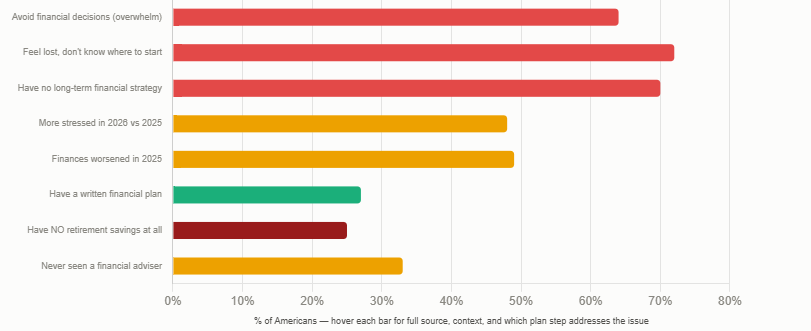
64% of Americans avoid important financial decisions due to anxiety or overwhelm (MassMutual 2026 Financial Habits Report, July 16, 2026 — 2 months ago). Only 27% of Americans have a written financial plan (wifitalents.com February 2026). 72% feel lost about where to start with financial planning (wifitalents.com February 2026). 48% feel more financially stressed entering 2026 than entering 2025 (Allianz Life February 2026). 49% say their financial situation worsened in 2025 (Intuit Credit Karma / Qualtrics December 2025). 24 million Americans — 24% — worry about money every single day (Ramsey Solutions Q2 2026, August 2026). 25% of Americans have no retirement savings whatsoever (wifitalents.com February 2026).
The Allianz Life February 2026 study adds the stress dimension: 48% of Americans reported feeling more financially stressed entering 2026 than entering 2025. The primary stressors were high daily expenses (54%), low income (46%), lack of emergency fund (39%), increasing debt (35%), high healthcare costs (34%), and job insecurity (33%). These stressors are real financial pressures — but the research also found that over 50% of Gen Zers and 63% of Millennials intended to keep their financial resolutions for 2026, compared to 43% of Gen Xers. The motivation to act is present. The mechanism for action is not.
The Ramsey Solutions Q2 2026 State of Personal Finance report, fielded June 10 to 16, 2026, with 1,004 US adults, found that 24% of Americans — approximately 62 million people — worry about money every single day. The Intuit Credit Karma December 2025 survey found that 49% said their financial situation worsened in 2025, with unexpected expenses (28%) as the most common cause. And yet, 45% felt confident in their ability to reach their 2026 financial goals, with making a budget and sticking to it (51%) as the most cited tactic.
The Paladin Advisor Group's July 3, 2026 analysis of the current state of American personal finances identifies the central tension precisely: 'The gap between what personal finance advice assumes and what most people's actual financial lives look like can feel enormous. Your coworker mentioned maxing out their 401(k). Meanwhile, you're looking at your own bank account wondering if you're the only one still carrying a credit card balance.' The advice that assumes a financially optimised starting position — max your 401(k), pay off your mortgage early, diversify into international equities — is both technically correct and completely inaccessible to the majority of people who encounter it. The framework in this guide starts where most people actually are.
The written plan also solves the advice overload problem structurally. When a person has a written financial plan, new advice has a context to be evaluated against. A viral personal finance post about maximising HSA contributions is useful or irrelevant depending on whether the emergency fund is already in place and the high-interest debt is already eliminated. Without the written plan, every piece of advice arrives with equal urgency and no framework for prioritisation. With the written plan, most advice either reinforces what is already being done or belongs to a later step in a defined sequence.
Only 27% of Americans have a written financial plan. The wifitalents.com February 2026 compilation notes that financial literacy is associated with a 15% increase in retirement wealth. A written plan is one of the most direct mechanisms for operationalising financial literacy — it translates knowledge into scheduled, trackable action. The sections that follow build that written plan, step by step, in an order that is not arbitrary. Each step is the foundation for the next. Skipping the sequence is the most common cause of the financial anxiety that MassMutual's 2026 report identifies: people who have invested in equities but have no emergency fund, or who are contributing to a Roth IRA while carrying 22% APR credit card debt, are experiencing the emotional cost of a plan built out of order.
Before reading the six steps: open a blank document, spreadsheet, or notebook. Title it: 'My Financial Plan — [Your Name] — [Month Year].' The act of creating the document matters. A plan that exists as a mental intention has no accountability mechanism. A document that can be opened, updated, and reviewed at a specific interval becomes the container for every decision in the sections that follow. Review it once per month. Every financial decision for the next 12 months is evaluated against what is in this document. Nothing more complex than this is required to begin.
A cash flow audit has two sides. On the income side: total monthly take-home income from all sources — employment, freelance, rental income, benefits. Not gross income — net, after tax and any deductions. On the expenditure side: every regular and irregular outflow categorised by type. Fixed costs (rent or mortgage, insurance premiums, loan payments, subscriptions) are mandatory obligations that cannot easily be changed in the short term. Variable costs (food, transport, utilities, personal spending) can be tracked but fluctuate. Irregular costs (car maintenance, medical, gifts, clothing) are often omitted from budgets and are the primary cause of budget failure.
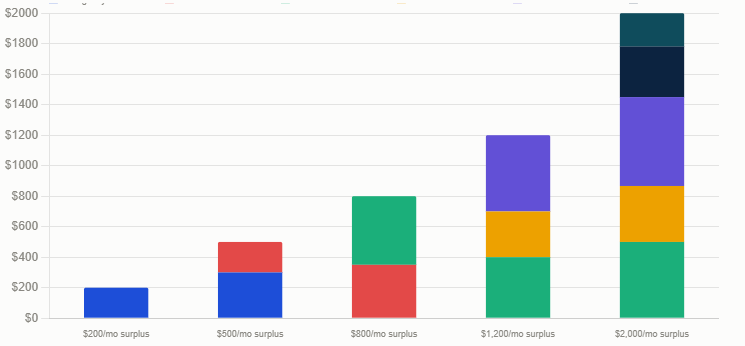
The cash flow surplus — income minus all outflows — is the only number that matters for the rest of the plan. A negative surplus means spending exceeds income; every other financial goal is on hold until this is addressed. A positive surplus of £50 per month is enough to begin Step 2. A positive surplus of £500 per month can address Steps 2 through 5 simultaneously. The size of the surplus determines the speed of the plan — but it does not change the direction.
Cash flow audit example. Monthly take-home income: $5,200. Fixed costs: rent $1,400; car payment $380; insurance (car + renters) $200; phone $65; streaming subscriptions $45; gym $30. Fixed total: $2,120. Variable costs (12-month average): groceries $450; fuel $180; dining out $220; personal care $80; clothing $100. Variable total: $1,030. Irregular costs (monthly average): medical $60; gifts $40; car maintenance $50; household items $70. Irregular total: $220. Total outflows: $3,370. Monthly surplus: $5,200 - $3,370 = $1,830. This surplus is the raw material for the plan. Note: most people estimate their surplus at 20-30% higher than their actual surplus because irregular costs are systematically underestimated. Not financial advice.
Cash flow audit process. Download 3 months of bank statements and credit card statements. Categorise every transaction into fixed, variable, and irregular. Calculate the true monthly average for each category across 3 months (not a single month, which may be unrepresentative). Identify the actual monthly surplus. If surplus is negative: identify which variable or irregular category is above a sustainable level. If surplus is positive: the surplus amount is the budget for Steps 2 through 6. Use a free tool (YNAB free trial, Copilot app, or a simple spreadsheet) to make this process repeatable monthly.
The emergency fund is not an investment. It is insurance against the specific scenario that derails most financial plans: an unexpected expense — medical bill, car repair, redundancy — that, in the absence of liquid cash, requires either high-interest debt (credit card at 22%+) or the liquidation of investments at potentially unfavourable prices. The 2025 Credit Karma survey found that unexpected expenses were the most common financial setback of 2025, cited by 28% of respondents. The Allianz February 2026 research found that lack of emergency fund was the third most-cited source of financial stress, affecting 39% of respondents.
The standard target is three to six months of essential living expenses in a liquid, accessible account — not the total cash flow from the Step 1 audit, but the floor: rent/mortgage, utilities, food, and minimum debt payments. At current high-yield savings account rates (4.21% APY as of September 2026, per NerdWallet), the emergency fund earns meaningful interest while held. It is not a penalty for keeping cash; it is a specifically purposed buffer that allows the rest of the financial plan to execute without being interrupted by life's predictable unpredictability.
The sequencing argument. Many financial content creators advocate for investing while building the emergency fund simultaneously. This is reasonable at large surpluses. For most people with a surplus of $200 to $500 per month, the correct sequence is emergency fund first, investments after. A $200 monthly investment begun before the emergency fund is in place will be liquidated when the emergency arrives, potentially at a loss, and the investment habit will be broken by the interruption. A $200 monthly emergency fund contribution that completes the target in 12 to 18 months, followed by the same $200 redirected to investments, produces a more durable financial structure than the theoretically optimal but practically fragile simultaneous approach.
The definition of 'high-interest' for prioritisation purposes is debt above approximately 6 to 7% APR — the approximate long-run real return threshold for diversified equity investing. Debt above this threshold costs more each year than it can realistically be offset by investment returns. Every dollar used to repay 22% APR credit card debt produces a guaranteed 22% after-tax return — better than any investment available in 2026. Debt below this threshold (mortgages at 6.76% in 2026, federal student loans at fixed low rates) can be managed alongside investing rather than prioritised above it.
The elimination method matters. The two most cited approaches are the debt avalanche (prioritise highest-interest debt first — mathematically optimal, saves the most money) and the debt snowball (prioritise smallest balance first — psychologically effective, produces early wins that sustain motivation). Dave Ramsey and the Baby Steps framework advocate the snowball; most mathematically-oriented personal finance sources advocate the avalanche. The correct method is the one that gets completed. For most people, the snowball's motivational benefit outweighs the avalanche's mathematical advantage — but only the person doing it can determine which approach they will actually sustain.
High-interest debt priority example. Credit card A: $4,200 balance at 22% APR. Monthly minimum payment: $126/month. Avalanche approach: add $300/month from surplus to the minimum payment = $426/month. Payoff time: approximately 11 months. Total interest at $426/month: approximately $420. Without acceleration (minimum only): payoff time: over 3 years. Total interest: approximately $1,450+. Interest saving from acceleration: approximately $1,030. The same $300 per month invested at 7% average annual return during that 11 months would have generated approximately $310 in growth. Paying off the 22% APR debt is 3x more valuable than investing the same money at 7% return. Not financial advice — individual interest rates, balances, and returns vary.
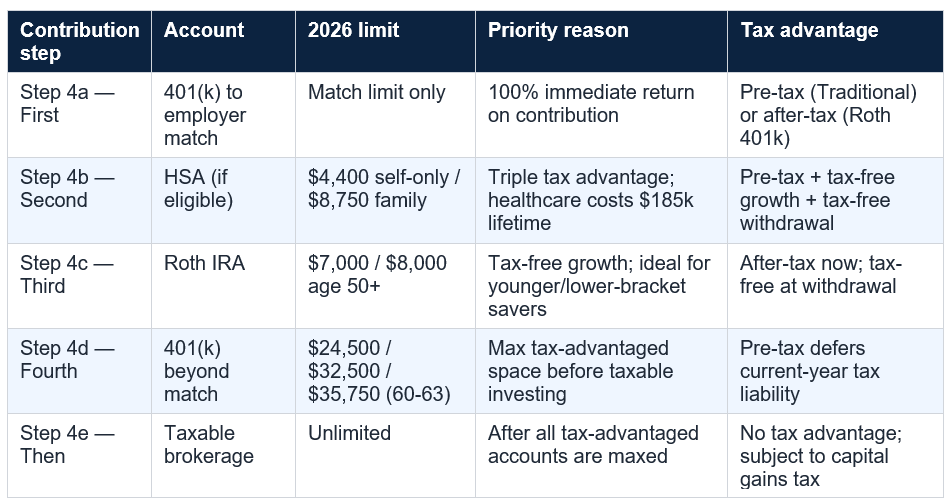
The standard contribution sequence recommended across multiple sources, including the 2026 IRS limits, is as follows. First: contribute to a 401(k) or workplace pension up to the employer match. This is free money — a 50% or 100% employer match is the highest guaranteed return available in any financial product. Forgoing the employer match to prioritise other uses of the surplus is the most common and most financially damaging sequencing error. Second: if high-interest debt has been eliminated and an HSA is available through a qualifying high-deductible health plan, maximise the HSA contribution — $4,400 for self-only or $8,750 for family coverage in 2026. The triple tax advantage of the HSA (pre-tax contributions, tax-free growth, tax-free withdrawals for medical expenses) makes it the most efficient savings vehicle available for healthcare costs, and Fidelity estimates lifetime retirement healthcare costs at $185,000 for a 65-year-old retiring in 2026. Third: contribute to a Roth IRA up to the 2026 limit of $7,000 ($8,000 age 50+). The Roth's tax-free growth and withdrawal structure makes it particularly valuable for younger savers who are likely to be in a higher tax bracket in retirement than today. Fourth: return to the 401(k) and contribute up to the 2026 standard limit of $24,500 ($32,500 age 50+; $35,750 ages 60-63 under the SECURE 2.0 super catch-up).
The Allianz February 2026 research notes that one-third of Americans report decreased confidence in hitting their retirement goals in 2026. The Ramsey Solutions framework, confirmed in its Q2 2026 State of Personal Finance, advocates investing 15% of household income in retirement. At a $70,000 household income, 15% is $10,500 per year — well within the contribution limits for a couple with even one workplace plan. The barrier is not the limit; it is the starting, the sequencing, and the sustainability.
The correct framing is the opposite. Insurance is the structural protection that allows every other component of the financial plan to survive an adverse event. The emergency fund covers three to six months of expenses. It does not cover a $150,000 medical bill, a long-term disability that removes an income stream for three years, or the financial impact on dependants of a premature death. The insurance layer covers these — not as a luxury add-on but as a precondition for the rest of the plan to remain viable under stress.
The minimum insurance audit for anyone building a financial plan covers four areas. First, health insurance: the gap between employment-based coverage and self-employment or unemployment is the most common driver of catastrophic personal financial events in the United States. In 2026, ACA marketplace plan premiums range from approximately $300 to $800 per month for individuals, depending on age, location, and plan tier. Second, income protection/disability insurance: the likelihood of a working-age person experiencing a disability lasting more than 90 days is statistically higher than the likelihood of premature death. Short-term and long-term disability policies replace 60-70% of income during qualifying incapacity periods. Third, life insurance: relevant for anyone with financial dependants. Term life insurance — a fixed death benefit for a defined period — is the appropriate product for most working-age people with dependants; the annual premium for a healthy 35-year-old for $500,000 of 20-year term coverage is approximately $300 to $500 per year. Fourth, property insurance: homeowners or renters insurance covers the replacement cost of possessions and liability exposure; renters insurance typically costs $15 to $30 per month.
Insurance audit process for the financial plan. List every current insurance policy with its monthly premium, coverage amount, and deductible. Identify gaps: if employed, confirm what health coverage continues and at what cost after employment ends. If self-employed or a contractor, confirm current disability coverage. If you have dependants, confirm life insurance coverage is sufficient to replace your income for a meaningful period (typically 10 to 12 times annual income for term life). If renting without renters insurance: this is an immediate gap to close — renters insurance is inexpensive and covers loss of all personal possessions in a fire, theft, or disaster. Add a line item for each confirmed or required insurance policy to the written financial plan.
Medium-term goals are typically defined as targets with a 2 to 10 year horizon. They include: a house purchase (down payment savings); further education (tuition saving or student loan elimination); a career change (runway capital for a period of lower income or business launch); a vehicle replacement; or a significant life event (wedding, international move, sabbatical). The reason these goals belong in step 6 rather than step 1 is sequencing: medium-term goal saving competes with emergency fund, debt elimination, and retirement contributions for the cash flow surplus. Those steps have higher financial priority. Medium-term goals become actionable once the structural foundations are in place.
Medium-term goal saving uses different vehicles than retirement saving. The time horizon is too short for equity investment volatility (a down payment needed in 3 years cannot tolerate a 30% market drawdown the year before it is needed). The vehicles are savings accounts, CDs, and short-term bonds: in September 2026, the best CD rate is 5.84% (Curinos) and top HYSA rates are 4.21% APY (NerdWallet). A 3-year CD ladder or a dedicated high-yield savings account is the appropriate container for medium-term goal savings.
The most common medium-term goal mistake in 2026: allocating saved money earmarked for a house deposit into equity investments because 'the market is up.' A 10% drawdown in a $60,000 deposit fund in the year before purchase eliminates $6,000 in purchasing power and potentially delays the purchase. Money with a specific, time-bounded purpose should be held in vehicles appropriate to the timeline, not the optimal long-run return. Keep medium-term goal money away from equity exposure if the timeline is under five years.
Most viral personal finance advice fails the first question. The advice to maximise an HSA is irrelevant until high-interest debt is eliminated. The advice to invest in real estate crowdfunding is premature until a Roth IRA is funded. The advice to optimise asset location across taxable and tax-advantaged accounts is a refinement for someone fully through Steps 1 to 5 — not a starting point for someone in Step 2. Recognising which step a piece of advice belongs to prevents the most common effect of advice overload: paralysis caused by simultaneously trying to act on advice designed for five different stages of the financial journey.
The second filter — does it improve efficiency or redirect resources — catches the high-quality advice that belongs to the current step but may be optimising around the edges rather than addressing the core. A person in Step 4 (retirement contributions) who is maxing out a Traditional 401(k) and encounters advice about Roth conversions is encountering genuinely relevant, potentially high-value advice. A person in Step 2 (emergency fund) who encounters advice about optimising their HSA investment allocations is encountering advice that belongs to a later step and should be bookmarked, not acted on now.
The distinction between fee-only fiduciary advisers and commission-based advisers is the most important piece of knowledge for anyone approaching professional financial guidance. A fee-only fiduciary earns money only from the client's fee — they have no financial incentive to recommend specific products. A commission-based adviser earns money from product sales — their recommendations are not legally required to be in the client's best interest (they must meet a 'suitability' standard, which is a lower bar). This distinction resolves the advice conflict problem that makes many people reluctant to seek professional help: a fee-only fiduciary is structurally aligned with the client's interest in a way that commission-based sales is not.
A professional financial adviser becomes specifically valuable in the following situations: tax planning that involves multiple variables simultaneously (Roth conversions timed against IRMAA thresholds, capital gains harvesting, estate planning interactions); approaching retirement within five years, when the sequence of decisions in the final working years is consequential and error-prone; a significant life event that changes the financial landscape (divorce, inheritance, business sale, death of a spouse); and income levels or financial complexity that exceed what a self-managed plan can address efficiently. For most people in Steps 1 through 4 of this framework, a well-structured self-managed plan — with an occasional one-off adviser consultation at key decision points — is both sufficient and appropriate.
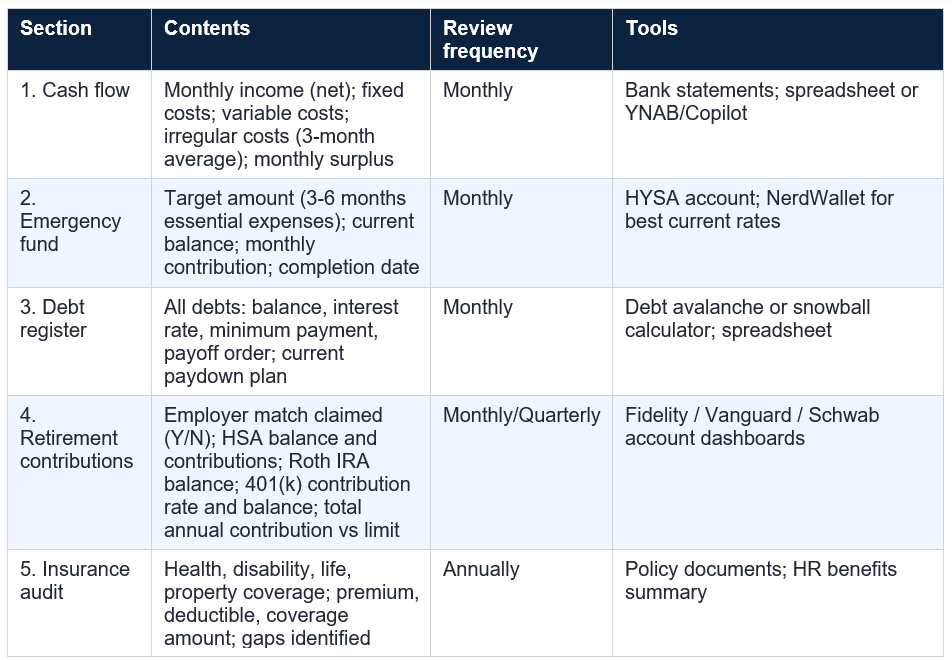

This template requires approximately 30 minutes to build initially and 15 minutes per month to maintain. It replaces the anxiety of undefined financial exposure with a specific, measurable picture of the financial position that can be evaluated and improved. Not financial advice — this template is a general framework; individual circumstances require individual assessment.
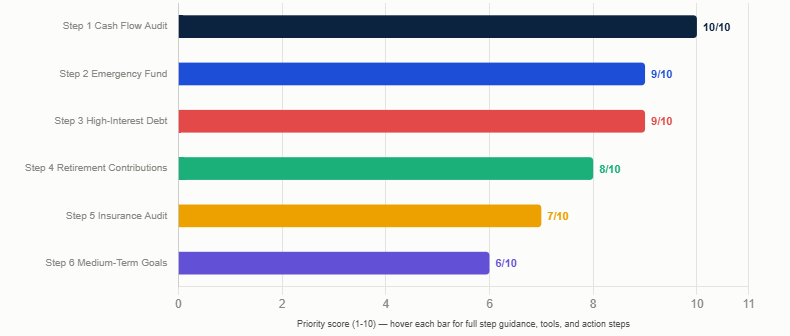
The six steps in this guide are not new. They reflect the consensus of evidence-based personal finance across decades: cash flow first, then emergency fund, then high-interest debt, then retirement contributions in order, then insurance, then medium-term goals. The sequence is the insight. Not because it maximises theoretical long-run wealth — there are academically superior orderings for specific situations — but because it produces a plan that works for real financial lives with real competing pressures, irregular expenses, and imperfect starting positions.
The Allianz Life guidance that accompanied its February 2026 stress survey was direct: 'Without a documented strategy for your finances, it can be tempting to spend now instead of saving for later. If you know why you are saving and what goals you are working toward, making those decisions can be simpler.' The written plan does not require perfection. It requires existence. The plan that is built, however imperfect, outperforms the plan that has been refined in theory and never executed. Start the document. Write down the numbers. Move through the six steps in order. The rest follows.
The MassMutual 2026 Financial Habits Report, published July 16, 2026, found that nearly two-thirds of Americans avoid important financial decisions due to anxiety or overwhelm — despite 8 in 10 agreeing that working with a financial adviser would help. Two structural forces drive this paradox. First, information volume: the personal finance content landscape in 2026 is enormous — Reddit's r/personalfinance has over 20 million members, financial TikTok and YouTube host thousands of creators, and the advice often contradicts itself. Rather than producing clarity, the volume produces a form of decision paralysis where the volume of options makes inaction feel safer than choosing the wrong one. Second, a persistent myth: 83% of Americans believe financial advisers require minimum investable assets of $50,000 or more, according to MassMutual. In practice, fee-only fiduciary advisers often charge hourly rates ($150 to $400 per hour) with no asset minimum. The combination of these two factors — too much unstructured advice and a perceived access barrier to professional guidance — explains why 72% of Americans feel lost about where to start, despite near-universal desire to improve.
What is the most important first step in building a financial plan?
The most important first step is a monthly cash flow audit — an accurate, documented accounting of income and all outflows (fixed, variable, and irregular) across a minimum of three months of actual transactions. The cash flow audit is foundational because every subsequent financial decision depends on knowing the actual monthly surplus available to direct toward financial goals. Most people systematically overestimate their surplus by omitting irregular costs (car maintenance, medical, gifts, clothing) that do not appear every month but average a consistent amount annually. The cash flow audit also identifies whether a surplus exists at all — a negative surplus requires immediate attention before any other financial priority can be addressed. Once the actual surplus is known, the remaining five steps can be resourced appropriately. Note: financial literacy is associated with a 15% increase in retirement wealth (wifitalents.com February 2026) — understanding the cash flow position is the foundational financial literacy exercise.
Should I build an emergency fund or start investing first?
For most people, the emergency fund should come first. The argument for investing first is mathematically valid in the long run — equity returns outperform HYSA rates over long horizons. But the emergency fund serves a specific protective function that investing cannot: it prevents a financial emergency from requiring either high-interest debt (credit card at 22%+ APR) or the liquidation of investments at potentially unfavourable prices. The Intuit Credit Karma survey (December 2025) found that unexpected expenses were the most common financial setback of 2025, affecting 28% of respondents. The Allianz Life February 2026 research found that lack of an emergency fund was the third most common source of financial stress, affecting 39% of respondents. The practical sequencing argument: a small monthly investment started before the emergency fund is complete will likely be liquidated when the emergency arrives, breaking the investment habit and potentially incurring a loss. An emergency fund completed first — then the same monthly amount redirected to investing — produces a more durable structure for most real financial situations. Target: 3 to 6 months of essential living expenses in a HYSA (current top rates: 4.21% APY, NerdWallet September 2026).
How much should I be saving for retirement in 2026?
Ramsey Solutions' Q2 2026 State of Personal Finance recommends investing 15% of household income in retirement savings. At a $70,000 household income, that is $10,500 per year — within reach using a 401(k) and Roth IRA combination. The Fidelity rule of thumb suggests having the equivalent of your annual salary saved for retirement by age 30, three times salary by age 40, six times by age 50, eight times by age 60, and ten times at retirement. The 2026 IRS contribution limits provide significant capacity: $24,500 in a 401(k) (plus $8,000 catch-up at age 50+, or $11,250 super catch-up at ages 60-63 under SECURE 2.0), $7,000 in a Roth IRA, and $4,400 in an HSA (self-only). The correct sequencing — employer match first, then HSA if eligible, then Roth IRA, then 401(k) beyond the match — optimises the tax efficiency of each contribution before moving to the next vehicle. The Allianz Life February 2026 research found that one-third of Americans report decreased confidence in hitting their retirement goals; contributing at all, even at sub-optimal amounts, is significantly better than deferring until the amount feels adequate.
Do I need a financial adviser to build a financial plan?
No — a solid self-managed financial plan, following the six-step framework in this guide, is both achievable and sufficient for most working adults in Steps 1 through 4 of the framework. The MassMutual 2026 Financial Habits Report found that 83% of Americans believe advisers require minimum investable assets, but fee-only fiduciary advisers often charge flat fees or hourly rates ($150 to $400 per hour) with no asset minimum. A professional adviser becomes specifically valuable in: complex tax planning (Roth conversions, estate planning, capital gains harvesting); the five years before retirement; a significant life event (divorce, inheritance, business sale); and income or asset levels that exceed what a self-managed approach can efficiently address. For most people building through the six steps, the highest-value use of professional guidance is a one-off annual or biannual consultation at key decision points, rather than a continuous advisory relationship. The CFP Board's Find a CFP Professional tool (cfp.net) and NAPFA's fee-only adviser finder allow anyone to identify fiduciary advisers in their area.
What is the right order for paying off debt versus investing?
The correct priority depends on the interest rate. As a general framework: high-interest debt (roughly above 6–7% APR) should be paid off before non-employer-matched investing, because the guaranteed return from eliminating 22% APR debt exceeds the expected return from any investment. Employer-matched 401(k) contributions should be made even while paying off high-interest debt — the match is a 50-100% immediate return that no debt payoff produces. Once high-interest debt is eliminated, investing takes priority over low-interest debt payoff (mortgages, federal student loans at low fixed rates). As quantified in Section 6 of this guide: paying off $4,200 at 22% APR accelerated over 11 months saves approximately $1,030 in interest — equivalent to earning 22% on $4,200 for a year, versus approximately $310 from investing the same money at 7% average annual return over the same period. The debt payoff produces 3 times more value per dollar than the investment in this scenario. Individual results depend on specific interest rates, investment returns, and tax circumstances. Not financial advice.
Table of Contents
- Why Good Advice Makes Financial Planning Harder
- The Data Behind the Paralysis: What Research Shows About Financial Overwhelm
- The One Thing That Solves Advice Overload: A Written Plan
- Step 1 — Know Your Numbers: A Monthly Cash Flow Audit
- Step 2 — Build the Floor: The Emergency Fund Before Everything Else
- Step 3 — Eliminate the Drag: High-Interest Debt as a Priority
- Step 4 — Build the Foundation: Retirement Contributions in Order
- Step 5 — Protect What You Have: Insurance as a Financial Plan Component
- Step 6 — Set Goals Beyond Retirement: Medium-Term Planning
- How to Filter Financial Advice Without Ignoring All of It
- When You Need a Financial Adviser — and When You Don't
- The Financial Plan Template: What a Written Plan Actually Contains
- Conclusion: The Plan That Gets Built Beats the Plan That Is Perfect
- Frequently Asked Questions
The six steps: what each one does and when to start it
Monthly surplus allocation: how $200–$2,000 flows through the plan
The planning gap: what the data shows about financial paralysis
Why Good Advice Makes Financial Planning Harder
There is a version of the financial advice problem that is easy to diagnose: people do not have enough information about how to manage their money. The solution, by that diagnosis, is more information. More articles. More podcasts. More YouTube videos. More Reddit threads. More influencers explaining compound interest with a whiteboard and an enthusiastic delivery.The data from 2026 suggests the opposite problem is more prevalent. According to MassMutual's 2026 Financial Habits Report, published July 16, 2026, nearly two-thirds of Americans avoid important financial decisions because of anxiety or overwhelm. This is not a population that lacks access to financial advice. It is a population drowning in it. Reddit's r/personalfinance has over 20 million members. Financial TikTok and YouTube host thousands of creators offering frameworks, opinions, rules of thumb, and conviction-packed takes that frequently contradict each other.
The result of this information environment is not a financially informed population — it is a paralysed one. Only 27% of Americans have a written financial plan, according to wifitalents.com's February 2026 compilation of financial planning statistics. Seventy-two percent feel lost and believe they could benefit from planning but do not know where to start. And 48% reported feeling more financially stressed entering 2026 than entering 2025, according to Allianz Life's February 2026 research.
This guide does not add more advice to that pile. It provides a single, ordered framework — six steps, in sequence, applied to real income levels — that produces a working financial plan regardless of where a person starts. The plan does not require a financial adviser, though it explains when one becomes genuinely useful. It does not require high income, though it scales with income. And it does not require reading everything — it requires acting on a small number of things in the right order.
64% of Americans avoid important financial decisions due to anxiety or overwhelm (MassMutual 2026 Financial Habits Report, July 16, 2026 — 2 months ago). Only 27% of Americans have a written financial plan (wifitalents.com February 2026). 72% feel lost about where to start with financial planning (wifitalents.com February 2026). 48% feel more financially stressed entering 2026 than entering 2025 (Allianz Life February 2026). 49% say their financial situation worsened in 2025 (Intuit Credit Karma / Qualtrics December 2025). 24 million Americans — 24% — worry about money every single day (Ramsey Solutions Q2 2026, August 2026). 25% of Americans have no retirement savings whatsoever (wifitalents.com February 2026).
The Data Behind the Paralysis: What Research Shows About Financial Overwhelm
The MassMutual 2026 Financial Habits Report is the most direct recent documentation of the financial advice paradox. Its survey of 1,500 nationally representative Americans aged 25 and older found that the desire for financial guidance is near-universal — 8 in 10 Americans agree that working with a financial adviser would help — but actual engagement with any form of structured financial planning remains low. The primary driver of this gap, MassMutual found, is a persistent myth: 83% of Americans believe financial advisers require minimum investable assets, and more than half put that threshold at $50,000 or more. Many fee-only fiduciary advisers have no asset minimum.The Allianz Life February 2026 study adds the stress dimension: 48% of Americans reported feeling more financially stressed entering 2026 than entering 2025. The primary stressors were high daily expenses (54%), low income (46%), lack of emergency fund (39%), increasing debt (35%), high healthcare costs (34%), and job insecurity (33%). These stressors are real financial pressures — but the research also found that over 50% of Gen Zers and 63% of Millennials intended to keep their financial resolutions for 2026, compared to 43% of Gen Xers. The motivation to act is present. The mechanism for action is not.
The Ramsey Solutions Q2 2026 State of Personal Finance report, fielded June 10 to 16, 2026, with 1,004 US adults, found that 24% of Americans — approximately 62 million people — worry about money every single day. The Intuit Credit Karma December 2025 survey found that 49% said their financial situation worsened in 2025, with unexpected expenses (28%) as the most common cause. And yet, 45% felt confident in their ability to reach their 2026 financial goals, with making a budget and sticking to it (51%) as the most cited tactic.
The Paladin Advisor Group's July 3, 2026 analysis of the current state of American personal finances identifies the central tension precisely: 'The gap between what personal finance advice assumes and what most people's actual financial lives look like can feel enormous. Your coworker mentioned maxing out their 401(k). Meanwhile, you're looking at your own bank account wondering if you're the only one still carrying a credit card balance.' The advice that assumes a financially optimised starting position — max your 401(k), pay off your mortgage early, diversify into international equities — is both technically correct and completely inaccessible to the majority of people who encounter it. The framework in this guide starts where most people actually are.
The One Thing That Solves Advice Overload: A Written Plan
The research on written financial plans is consistent and striking. A written plan changes financial behaviour in ways that good intentions, knowledge, and even motivation do not. The Allianz Life research notes that a documented financial strategy is valuable because 'without a documented strategy, it can be tempting to spend now instead of saving for later. If you know why you are saving and what goals you are working toward, making those decisions can be simpler.' Writing down the plan is not administrative box-ticking — it is the act that converts abstract financial intentions into specific decisions.The written plan also solves the advice overload problem structurally. When a person has a written financial plan, new advice has a context to be evaluated against. A viral personal finance post about maximising HSA contributions is useful or irrelevant depending on whether the emergency fund is already in place and the high-interest debt is already eliminated. Without the written plan, every piece of advice arrives with equal urgency and no framework for prioritisation. With the written plan, most advice either reinforces what is already being done or belongs to a later step in a defined sequence.
Only 27% of Americans have a written financial plan. The wifitalents.com February 2026 compilation notes that financial literacy is associated with a 15% increase in retirement wealth. A written plan is one of the most direct mechanisms for operationalising financial literacy — it translates knowledge into scheduled, trackable action. The sections that follow build that written plan, step by step, in an order that is not arbitrary. Each step is the foundation for the next. Skipping the sequence is the most common cause of the financial anxiety that MassMutual's 2026 report identifies: people who have invested in equities but have no emergency fund, or who are contributing to a Roth IRA while carrying 22% APR credit card debt, are experiencing the emotional cost of a plan built out of order.
Before reading the six steps: open a blank document, spreadsheet, or notebook. Title it: 'My Financial Plan — [Your Name] — [Month Year].' The act of creating the document matters. A plan that exists as a mental intention has no accountability mechanism. A document that can be opened, updated, and reviewed at a specific interval becomes the container for every decision in the sections that follow. Review it once per month. Every financial decision for the next 12 months is evaluated against what is in this document. Nothing more complex than this is required to begin.
Step 1 — Know Your Numbers: A Monthly Cash Flow Audit
Financial planning begins with cash flow, not goals. The aspiration to retire at 60, buy a house, or pay off debt is the destination. The cash flow audit is the map that shows where the vehicle is right now and how much fuel is available. Without this, every financial plan is built on estimated numbers that are consistently optimistic and consistently wrong.A cash flow audit has two sides. On the income side: total monthly take-home income from all sources — employment, freelance, rental income, benefits. Not gross income — net, after tax and any deductions. On the expenditure side: every regular and irregular outflow categorised by type. Fixed costs (rent or mortgage, insurance premiums, loan payments, subscriptions) are mandatory obligations that cannot easily be changed in the short term. Variable costs (food, transport, utilities, personal spending) can be tracked but fluctuate. Irregular costs (car maintenance, medical, gifts, clothing) are often omitted from budgets and are the primary cause of budget failure.
The cash flow surplus — income minus all outflows — is the only number that matters for the rest of the plan. A negative surplus means spending exceeds income; every other financial goal is on hold until this is addressed. A positive surplus of £50 per month is enough to begin Step 2. A positive surplus of £500 per month can address Steps 2 through 5 simultaneously. The size of the surplus determines the speed of the plan — but it does not change the direction.
Cash flow audit example. Monthly take-home income: $5,200. Fixed costs: rent $1,400; car payment $380; insurance (car + renters) $200; phone $65; streaming subscriptions $45; gym $30. Fixed total: $2,120. Variable costs (12-month average): groceries $450; fuel $180; dining out $220; personal care $80; clothing $100. Variable total: $1,030. Irregular costs (monthly average): medical $60; gifts $40; car maintenance $50; household items $70. Irregular total: $220. Total outflows: $3,370. Monthly surplus: $5,200 - $3,370 = $1,830. This surplus is the raw material for the plan. Note: most people estimate their surplus at 20-30% higher than their actual surplus because irregular costs are systematically underestimated. Not financial advice.
Cash flow audit process. Download 3 months of bank statements and credit card statements. Categorise every transaction into fixed, variable, and irregular. Calculate the true monthly average for each category across 3 months (not a single month, which may be unrepresentative). Identify the actual monthly surplus. If surplus is negative: identify which variable or irregular category is above a sustainable level. If surplus is positive: the surplus amount is the budget for Steps 2 through 6. Use a free tool (YNAB free trial, Copilot app, or a simple spreadsheet) to make this process repeatable monthly.
Step 2 — Build the Floor: The Emergency Fund Before Everything Else
The emergency fund is the most argued-about item in personal finance content, primarily because it exists in tension with the mathematically superior strategy of investing every available dollar immediately. The argument against the emergency fund goes: cash earning 4% in a HYSA underperforms a diversified equity portfolio over a 20-year horizon, so keeping $15,000 in cash is a drag on long-run wealth. This is mathematically correct and practically irrelevant for most people.The emergency fund is not an investment. It is insurance against the specific scenario that derails most financial plans: an unexpected expense — medical bill, car repair, redundancy — that, in the absence of liquid cash, requires either high-interest debt (credit card at 22%+) or the liquidation of investments at potentially unfavourable prices. The 2025 Credit Karma survey found that unexpected expenses were the most common financial setback of 2025, cited by 28% of respondents. The Allianz February 2026 research found that lack of emergency fund was the third most-cited source of financial stress, affecting 39% of respondents.
The standard target is three to six months of essential living expenses in a liquid, accessible account — not the total cash flow from the Step 1 audit, but the floor: rent/mortgage, utilities, food, and minimum debt payments. At current high-yield savings account rates (4.21% APY as of September 2026, per NerdWallet), the emergency fund earns meaningful interest while held. It is not a penalty for keeping cash; it is a specifically purposed buffer that allows the rest of the financial plan to execute without being interrupted by life's predictable unpredictability.
The sequencing argument. Many financial content creators advocate for investing while building the emergency fund simultaneously. This is reasonable at large surpluses. For most people with a surplus of $200 to $500 per month, the correct sequence is emergency fund first, investments after. A $200 monthly investment begun before the emergency fund is in place will be liquidated when the emergency arrives, potentially at a loss, and the investment habit will be broken by the interruption. A $200 monthly emergency fund contribution that completes the target in 12 to 18 months, followed by the same $200 redirected to investments, produces a more durable financial structure than the theoretically optimal but practically fragile simultaneous approach.
Step 3 — Eliminate the Drag: High-Interest Debt as a Priority
High-interest debt is the most reliably damaging force in any financial plan, because it compounds against the plan rather than for it. A 22% APR credit card balance growing at 22% per year is not neutralised by an equity portfolio growing at 7 to 10% per year. It is growing faster than any realistic investment return, consuming cash flow, and producing a guaranteed negative return that no market condition can reverse.The definition of 'high-interest' for prioritisation purposes is debt above approximately 6 to 7% APR — the approximate long-run real return threshold for diversified equity investing. Debt above this threshold costs more each year than it can realistically be offset by investment returns. Every dollar used to repay 22% APR credit card debt produces a guaranteed 22% after-tax return — better than any investment available in 2026. Debt below this threshold (mortgages at 6.76% in 2026, federal student loans at fixed low rates) can be managed alongside investing rather than prioritised above it.
The elimination method matters. The two most cited approaches are the debt avalanche (prioritise highest-interest debt first — mathematically optimal, saves the most money) and the debt snowball (prioritise smallest balance first — psychologically effective, produces early wins that sustain motivation). Dave Ramsey and the Baby Steps framework advocate the snowball; most mathematically-oriented personal finance sources advocate the avalanche. The correct method is the one that gets completed. For most people, the snowball's motivational benefit outweighs the avalanche's mathematical advantage — but only the person doing it can determine which approach they will actually sustain.
High-interest debt priority example. Credit card A: $4,200 balance at 22% APR. Monthly minimum payment: $126/month. Avalanche approach: add $300/month from surplus to the minimum payment = $426/month. Payoff time: approximately 11 months. Total interest at $426/month: approximately $420. Without acceleration (minimum only): payoff time: over 3 years. Total interest: approximately $1,450+. Interest saving from acceleration: approximately $1,030. The same $300 per month invested at 7% average annual return during that 11 months would have generated approximately $310 in growth. Paying off the 22% APR debt is 3x more valuable than investing the same money at 7% return. Not financial advice — individual interest rates, balances, and returns vary.
Step 4 — Build the Foundation: Retirement Contributions in Order
With the emergency fund in place and high-interest debt addressed, the cash flow surplus is available for its highest-leverage long-term use: tax-advantaged retirement savings. The order of contributions matters as much as the amount.The standard contribution sequence recommended across multiple sources, including the 2026 IRS limits, is as follows. First: contribute to a 401(k) or workplace pension up to the employer match. This is free money — a 50% or 100% employer match is the highest guaranteed return available in any financial product. Forgoing the employer match to prioritise other uses of the surplus is the most common and most financially damaging sequencing error. Second: if high-interest debt has been eliminated and an HSA is available through a qualifying high-deductible health plan, maximise the HSA contribution — $4,400 for self-only or $8,750 for family coverage in 2026. The triple tax advantage of the HSA (pre-tax contributions, tax-free growth, tax-free withdrawals for medical expenses) makes it the most efficient savings vehicle available for healthcare costs, and Fidelity estimates lifetime retirement healthcare costs at $185,000 for a 65-year-old retiring in 2026. Third: contribute to a Roth IRA up to the 2026 limit of $7,000 ($8,000 age 50+). The Roth's tax-free growth and withdrawal structure makes it particularly valuable for younger savers who are likely to be in a higher tax bracket in retirement than today. Fourth: return to the 401(k) and contribute up to the 2026 standard limit of $24,500 ($32,500 age 50+; $35,750 ages 60-63 under the SECURE 2.0 super catch-up).
The Allianz February 2026 research notes that one-third of Americans report decreased confidence in hitting their retirement goals in 2026. The Ramsey Solutions framework, confirmed in its Q2 2026 State of Personal Finance, advocates investing 15% of household income in retirement. At a $70,000 household income, 15% is $10,500 per year — well within the contribution limits for a couple with even one workplace plan. The barrier is not the limit; it is the starting, the sequencing, and the sustainability.
Step 5 — Protect What You Have: Insurance as a Financial Plan Component
Insurance is the financial plan component most commonly omitted from personal finance frameworks and most likely to be the reason a financial plan collapses. The logic of the omission is understandable: insurance premiums are a cost, not a return, and in a framework where every dollar is being directed toward specific goals, monthly insurance premiums feel like drag rather than progress.The correct framing is the opposite. Insurance is the structural protection that allows every other component of the financial plan to survive an adverse event. The emergency fund covers three to six months of expenses. It does not cover a $150,000 medical bill, a long-term disability that removes an income stream for three years, or the financial impact on dependants of a premature death. The insurance layer covers these — not as a luxury add-on but as a precondition for the rest of the plan to remain viable under stress.
The minimum insurance audit for anyone building a financial plan covers four areas. First, health insurance: the gap between employment-based coverage and self-employment or unemployment is the most common driver of catastrophic personal financial events in the United States. In 2026, ACA marketplace plan premiums range from approximately $300 to $800 per month for individuals, depending on age, location, and plan tier. Second, income protection/disability insurance: the likelihood of a working-age person experiencing a disability lasting more than 90 days is statistically higher than the likelihood of premature death. Short-term and long-term disability policies replace 60-70% of income during qualifying incapacity periods. Third, life insurance: relevant for anyone with financial dependants. Term life insurance — a fixed death benefit for a defined period — is the appropriate product for most working-age people with dependants; the annual premium for a healthy 35-year-old for $500,000 of 20-year term coverage is approximately $300 to $500 per year. Fourth, property insurance: homeowners or renters insurance covers the replacement cost of possessions and liability exposure; renters insurance typically costs $15 to $30 per month.
Insurance audit process for the financial plan. List every current insurance policy with its monthly premium, coverage amount, and deductible. Identify gaps: if employed, confirm what health coverage continues and at what cost after employment ends. If self-employed or a contractor, confirm current disability coverage. If you have dependants, confirm life insurance coverage is sufficient to replace your income for a meaningful period (typically 10 to 12 times annual income for term life). If renting without renters insurance: this is an immediate gap to close — renters insurance is inexpensive and covers loss of all personal possessions in a fire, theft, or disaster. Add a line item for each confirmed or required insurance policy to the written financial plan.
Step 6 — Set Goals Beyond Retirement: Medium-Term Planning
The first five steps produce a financial structure: a documented cash flow, a liquid emergency buffer, eliminated high-interest debt, a growing retirement base, and insurance protection. Step 6 adds direction: the medium-term goals that give the financial plan specificity and motivation beyond the abstract benchmark of 'financial security.'Medium-term goals are typically defined as targets with a 2 to 10 year horizon. They include: a house purchase (down payment savings); further education (tuition saving or student loan elimination); a career change (runway capital for a period of lower income or business launch); a vehicle replacement; or a significant life event (wedding, international move, sabbatical). The reason these goals belong in step 6 rather than step 1 is sequencing: medium-term goal saving competes with emergency fund, debt elimination, and retirement contributions for the cash flow surplus. Those steps have higher financial priority. Medium-term goals become actionable once the structural foundations are in place.
Medium-term goal saving uses different vehicles than retirement saving. The time horizon is too short for equity investment volatility (a down payment needed in 3 years cannot tolerate a 30% market drawdown the year before it is needed). The vehicles are savings accounts, CDs, and short-term bonds: in September 2026, the best CD rate is 5.84% (Curinos) and top HYSA rates are 4.21% APY (NerdWallet). A 3-year CD ladder or a dedicated high-yield savings account is the appropriate container for medium-term goal savings.
The most common medium-term goal mistake in 2026: allocating saved money earmarked for a house deposit into equity investments because 'the market is up.' A 10% drawdown in a $60,000 deposit fund in the year before purchase eliminates $6,000 in purchasing power and potentially delays the purchase. Money with a specific, time-bounded purpose should be held in vehicles appropriate to the timeline, not the optimal long-run return. Keep medium-term goal money away from equity exposure if the timeline is under five years.
How to Filter Financial Advice Without Ignoring All of It
Once a written financial plan exists, the advice filtering problem becomes structurally solvable. New advice can be assessed against a simple two-question test: does this advice apply to my current step in the framework? And does it improve the efficiency of what I am already doing, or does it redirect resources away from it?Most viral personal finance advice fails the first question. The advice to maximise an HSA is irrelevant until high-interest debt is eliminated. The advice to invest in real estate crowdfunding is premature until a Roth IRA is funded. The advice to optimise asset location across taxable and tax-advantaged accounts is a refinement for someone fully through Steps 1 to 5 — not a starting point for someone in Step 2. Recognising which step a piece of advice belongs to prevents the most common effect of advice overload: paralysis caused by simultaneously trying to act on advice designed for five different stages of the financial journey.
The second filter — does it improve efficiency or redirect resources — catches the high-quality advice that belongs to the current step but may be optimising around the edges rather than addressing the core. A person in Step 4 (retirement contributions) who is maxing out a Traditional 401(k) and encounters advice about Roth conversions is encountering genuinely relevant, potentially high-value advice. A person in Step 2 (emergency fund) who encounters advice about optimising their HSA investment allocations is encountering advice that belongs to a later step and should be bookmarked, not acted on now.
- Create a simple document: two columns, six rows, one for each step. When you encounter financial advice, note which step it belongs to. Act on it if it is in your current step; file it if it is in a future step.
- Limit your active information sources to two or three. Choose sources that are fiduciary-aligned (not product-selling), evidence-based (citing research rather than anecdote), and clear about the audience they are writing for (income level, life stage, country of residence).
- Apply a 48-hour rule to significant financial decisions influenced by new advice. If a piece of advice prompts a major action (moving significant savings, opening a new account, changing a contribution rate), wait 48 hours and re-evaluate against the written plan. Most advice-driven urgency dissipates in 48 hours. The decisions that still seem correct after that period are more likely to be grounded in the plan rather than the persuasiveness of the content.
- Separate entertainment from guidance. Personal finance content on social media is often entertainment first. A creator who makes visually compelling content about stock-picking, real estate deals, or dramatic debt payoff journeys may be producing content that is engaging without being applicable to a general audience. Consumption of this content for entertainment is harmless; acting on it as guidance for a personal financial plan requires the same two-question test as any other advice.
When You Need a Financial Adviser — and When You Don't
The MassMutual 2026 report identifies a myth that prevents most people from accessing professional financial guidance: 83% believe advisers require minimum investable assets, and more than half set that floor at $50,000 or more. In reality, fee-only fiduciary advisers — who charge a flat fee or hourly rate and are legally obligated to act in the client's interest — often have no asset minimum and charge $150 to $400 per hour for a one-off financial review.The distinction between fee-only fiduciary advisers and commission-based advisers is the most important piece of knowledge for anyone approaching professional financial guidance. A fee-only fiduciary earns money only from the client's fee — they have no financial incentive to recommend specific products. A commission-based adviser earns money from product sales — their recommendations are not legally required to be in the client's best interest (they must meet a 'suitability' standard, which is a lower bar). This distinction resolves the advice conflict problem that makes many people reluctant to seek professional help: a fee-only fiduciary is structurally aligned with the client's interest in a way that commission-based sales is not.
A professional financial adviser becomes specifically valuable in the following situations: tax planning that involves multiple variables simultaneously (Roth conversions timed against IRMAA thresholds, capital gains harvesting, estate planning interactions); approaching retirement within five years, when the sequence of decisions in the final working years is consequential and error-prone; a significant life event that changes the financial landscape (divorce, inheritance, business sale, death of a spouse); and income levels or financial complexity that exceed what a self-managed plan can address efficiently. For most people in Steps 1 through 4 of this framework, a well-structured self-managed plan — with an occasional one-off adviser consultation at key decision points — is both sufficient and appropriate.
The Financial Plan Template: What a Written Plan Actually Contains
A written financial plan does not require specialist software, expensive tools, or complex formatting. The six sections below, in this order, constitute a complete, functional personal financial plan. They can be maintained in a single document updated once per month.This template requires approximately 30 minutes to build initially and 15 minutes per month to maintain. It replaces the anxiety of undefined financial exposure with a specific, measurable picture of the financial position that can be evaluated and improved. Not financial advice — this template is a general framework; individual circumstances require individual assessment.
Conclusion
Nearly two-thirds of Americans are avoiding important financial decisions because the advice environment is overwhelming rather than clarifying. Only 27% have a written plan. And the paradox at the centre of the problem is that more advice — better advice, clearer advice, more accessible advice — does not reliably close the gap. What closes it is the act of writing things down, in order, and reviewing them once a month.The six steps in this guide are not new. They reflect the consensus of evidence-based personal finance across decades: cash flow first, then emergency fund, then high-interest debt, then retirement contributions in order, then insurance, then medium-term goals. The sequence is the insight. Not because it maximises theoretical long-run wealth — there are academically superior orderings for specific situations — but because it produces a plan that works for real financial lives with real competing pressures, irregular expenses, and imperfect starting positions.
The Allianz Life guidance that accompanied its February 2026 stress survey was direct: 'Without a documented strategy for your finances, it can be tempting to spend now instead of saving for later. If you know why you are saving and what goals you are working toward, making those decisions can be simpler.' The written plan does not require perfection. It requires existence. The plan that is built, however imperfect, outperforms the plan that has been refined in theory and never executed. Start the document. Write down the numbers. Move through the six steps in order. The rest follows.
Frequently Asked Questions
Why do so many Americans avoid financial planning even when they want to improve their finances?The MassMutual 2026 Financial Habits Report, published July 16, 2026, found that nearly two-thirds of Americans avoid important financial decisions due to anxiety or overwhelm — despite 8 in 10 agreeing that working with a financial adviser would help. Two structural forces drive this paradox. First, information volume: the personal finance content landscape in 2026 is enormous — Reddit's r/personalfinance has over 20 million members, financial TikTok and YouTube host thousands of creators, and the advice often contradicts itself. Rather than producing clarity, the volume produces a form of decision paralysis where the volume of options makes inaction feel safer than choosing the wrong one. Second, a persistent myth: 83% of Americans believe financial advisers require minimum investable assets of $50,000 or more, according to MassMutual. In practice, fee-only fiduciary advisers often charge hourly rates ($150 to $400 per hour) with no asset minimum. The combination of these two factors — too much unstructured advice and a perceived access barrier to professional guidance — explains why 72% of Americans feel lost about where to start, despite near-universal desire to improve.
What is the most important first step in building a financial plan?
The most important first step is a monthly cash flow audit — an accurate, documented accounting of income and all outflows (fixed, variable, and irregular) across a minimum of three months of actual transactions. The cash flow audit is foundational because every subsequent financial decision depends on knowing the actual monthly surplus available to direct toward financial goals. Most people systematically overestimate their surplus by omitting irregular costs (car maintenance, medical, gifts, clothing) that do not appear every month but average a consistent amount annually. The cash flow audit also identifies whether a surplus exists at all — a negative surplus requires immediate attention before any other financial priority can be addressed. Once the actual surplus is known, the remaining five steps can be resourced appropriately. Note: financial literacy is associated with a 15% increase in retirement wealth (wifitalents.com February 2026) — understanding the cash flow position is the foundational financial literacy exercise.
Should I build an emergency fund or start investing first?
For most people, the emergency fund should come first. The argument for investing first is mathematically valid in the long run — equity returns outperform HYSA rates over long horizons. But the emergency fund serves a specific protective function that investing cannot: it prevents a financial emergency from requiring either high-interest debt (credit card at 22%+ APR) or the liquidation of investments at potentially unfavourable prices. The Intuit Credit Karma survey (December 2025) found that unexpected expenses were the most common financial setback of 2025, affecting 28% of respondents. The Allianz Life February 2026 research found that lack of an emergency fund was the third most common source of financial stress, affecting 39% of respondents. The practical sequencing argument: a small monthly investment started before the emergency fund is complete will likely be liquidated when the emergency arrives, breaking the investment habit and potentially incurring a loss. An emergency fund completed first — then the same monthly amount redirected to investing — produces a more durable structure for most real financial situations. Target: 3 to 6 months of essential living expenses in a HYSA (current top rates: 4.21% APY, NerdWallet September 2026).
How much should I be saving for retirement in 2026?
Ramsey Solutions' Q2 2026 State of Personal Finance recommends investing 15% of household income in retirement savings. At a $70,000 household income, that is $10,500 per year — within reach using a 401(k) and Roth IRA combination. The Fidelity rule of thumb suggests having the equivalent of your annual salary saved for retirement by age 30, three times salary by age 40, six times by age 50, eight times by age 60, and ten times at retirement. The 2026 IRS contribution limits provide significant capacity: $24,500 in a 401(k) (plus $8,000 catch-up at age 50+, or $11,250 super catch-up at ages 60-63 under SECURE 2.0), $7,000 in a Roth IRA, and $4,400 in an HSA (self-only). The correct sequencing — employer match first, then HSA if eligible, then Roth IRA, then 401(k) beyond the match — optimises the tax efficiency of each contribution before moving to the next vehicle. The Allianz Life February 2026 research found that one-third of Americans report decreased confidence in hitting their retirement goals; contributing at all, even at sub-optimal amounts, is significantly better than deferring until the amount feels adequate.
Do I need a financial adviser to build a financial plan?
No — a solid self-managed financial plan, following the six-step framework in this guide, is both achievable and sufficient for most working adults in Steps 1 through 4 of the framework. The MassMutual 2026 Financial Habits Report found that 83% of Americans believe advisers require minimum investable assets, but fee-only fiduciary advisers often charge flat fees or hourly rates ($150 to $400 per hour) with no asset minimum. A professional adviser becomes specifically valuable in: complex tax planning (Roth conversions, estate planning, capital gains harvesting); the five years before retirement; a significant life event (divorce, inheritance, business sale); and income or asset levels that exceed what a self-managed approach can efficiently address. For most people building through the six steps, the highest-value use of professional guidance is a one-off annual or biannual consultation at key decision points, rather than a continuous advisory relationship. The CFP Board's Find a CFP Professional tool (cfp.net) and NAPFA's fee-only adviser finder allow anyone to identify fiduciary advisers in their area.
What is the right order for paying off debt versus investing?
The correct priority depends on the interest rate. As a general framework: high-interest debt (roughly above 6–7% APR) should be paid off before non-employer-matched investing, because the guaranteed return from eliminating 22% APR debt exceeds the expected return from any investment. Employer-matched 401(k) contributions should be made even while paying off high-interest debt — the match is a 50-100% immediate return that no debt payoff produces. Once high-interest debt is eliminated, investing takes priority over low-interest debt payoff (mortgages, federal student loans at low fixed rates). As quantified in Section 6 of this guide: paying off $4,200 at 22% APR accelerated over 11 months saves approximately $1,030 in interest — equivalent to earning 22% on $4,200 for a year, versus approximately $310 from investing the same money at 7% average annual return over the same period. The debt payoff produces 3 times more value per dollar than the investment in this scenario. Individual results depend on specific interest rates, investment returns, and tax circumstances. Not financial advice.

0 Comments Comments