
Finance
Why UK Borrowing Costs Are Rising: What It Means for You

UK government borrowing costs are at their highest since 1998. The 10-year gilt yield hit its highest since 2008. Three Bank of England rate-setters voted for an immediate rise on 30 July. Average two-year fixed mortgages are at 5.59%. UK households will pay an estimated £19.3 billion in credit card interest in 2026 alone. Here is what is driving all of this — and what every UK household should do about it.

The article arrived in the week after the Bank of England’s 30 July Monetary Policy Committee meeting, at which three of nine rate-setters voted for an immediate rise in the base rate to 4 percent. The base rate remained at 3.75 percent, but the closeness of the vote — and the publication of CPI inflation data showing a rise to 2.9 percent in July 2026, moving away from the Bank’s 2 percent target rather than toward it — produced a further round of upward pressure on gilt yields, swap rates, and fixed mortgage pricing.
For most UK households, the phrase ‘gilt yields’ sounds like something that happens in financial markets and is somebody else’s problem. This guide explains why it is not. The connection between a government bond yield, a 30-year mortgage, a credit card minimum payment, and the amount of money left over after essential bills each month is direct, quantifiable, and currently moving in an unhelpful direction. Here is the full picture, and what you can do about it.
10-year UK gilt yield: highest since 2008. 30-year UK gilt yield: highest since 1998 (BBC/Yahoo Finance, 2 Sep 2026). Bank of England base rate: 3.75% (held 30 Jul 2026, 6–3 vote). UK CPI inflation: 2.9% July 2026 (above 2% target, rising). Average 2-yr fixed mortgage: 5.59% (2 Sep 2026, Moneyfacts). Avg credit card APR: 24.4%. UK credit card interest payments forecast: £19.3bn in 2026 (£342/adult).
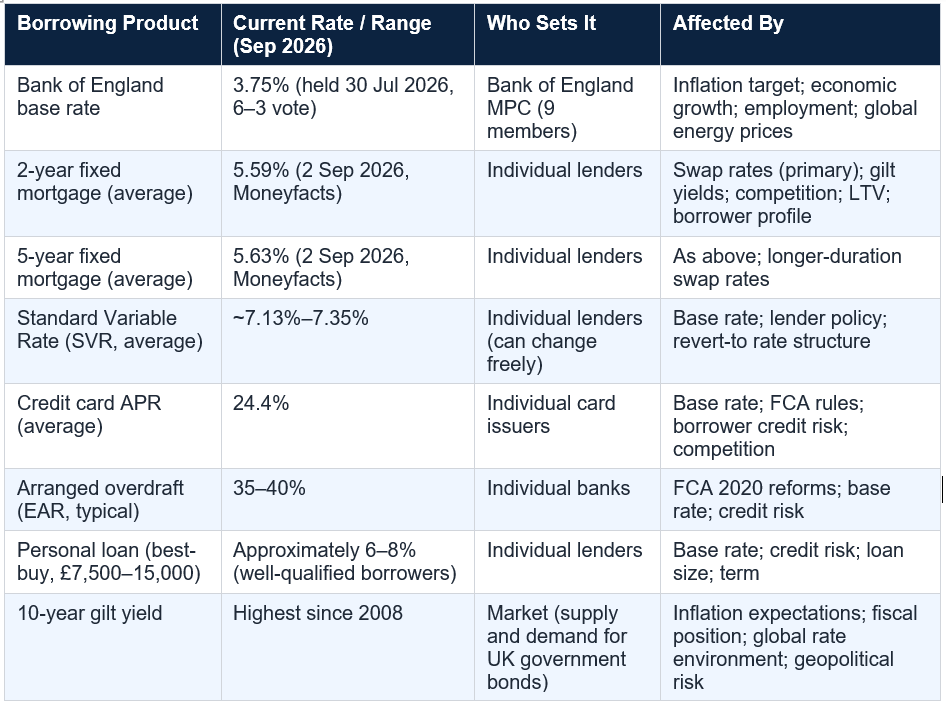
The key rates that govern UK consumer borrowing costs in September 2026:
The reason these rates cluster and move together is that they all draw from the same underlying financial infrastructure. When the cost of government borrowing rises — measured by gilt yields — the cost of everything built on top of government credit rises with it.
The ‘yield’ on a gilt is the effective interest rate — it reflects both the coupon payment and the price the investor paid for the bond. When gilt prices fall (because investors are less willing to hold them, perhaps because they expect inflation to erode the real value of future payments), the yield rises. Conversely, when demand for gilts is high, prices rise and yields fall. The BBC’s 2 September 2026 report explains this mechanism directly: ‘Interest rates — known as the yield — on government bonds have been going up.’
The reason gilt yields matter to the average household is transmission: fixed-rate mortgage pricing in the UK is primarily driven by swap rates, which move closely with gilt yields. When the 10-year gilt yield rises by 60 basis points in a single month — as it did in March 2026 — swap rates rise, lenders reprice their fixed-rate mortgage products upward, and within days the best-buy rates available to remortgaging homeowners increase. The household receives the consequence of a government bond market movement it never knew was happening.
The gilt yield is the interest rate the UK government pays to borrow. It is also, indirectly, the floor below which consumer borrowing rates cannot fall. When the government's own borrowing rate rises, the rates charged to households on mortgages, personal loans, and in some cases credit cards all rise too. A household's mortgage rate does not move in isolation from global and government financial markets — it moves with them, with a lag of days or weeks.
The 2026-specific sequence:
The relationship between the base rate and consumer borrowing costs is direct but not one-to-one:
The core fact: as of 2 September 2026, the average two-year fixed mortgage rate is 5.59% and the average five-year fixed rate is 5.63% (Moneyfacts data, Bright Savings UK). Both rose from 2025 lows of approximately 3.93% and 4.0% respectively — an increase of approximately 1.6 percentage points from the trough. On a £250,000 repayment mortgage with 25 years remaining, this increase in rate adds approximately £249 per month to the mortgage payment.
The OBR’s March 2026 forecast is sobering: average mortgage interest rates are expected to rise from approximately 4.1% in 2026 to approximately 4.5% in 2030. This projection was made before the full energy shock of 2026 was incorporated, and some analysts suggest the actual path will be higher.
For borrowers approaching the end of a fixed-rate deal — and 1.8 million fixed deals are expiring in 2026, many of them at rates of 1.5% to 2.5% agreed during the pandemic era — the payment increase is unavoidable. What is controllable is the rate at which the new deal is secured and the type of product chosen.
The SVR (standard variable rate) averages approximately 7.13%–7.35% in September 2026 — between 1.5 and 2 percentage points above the average fixed deal. Every month on the SVR that could be on a fixed rate is avoidable cost. For a borrower with a £200,000 mortgage, the SVR premium above a 5.59% fix costs approximately £170–£200 per month in extra interest. If you have lapsed onto the SVR, switch immediately.
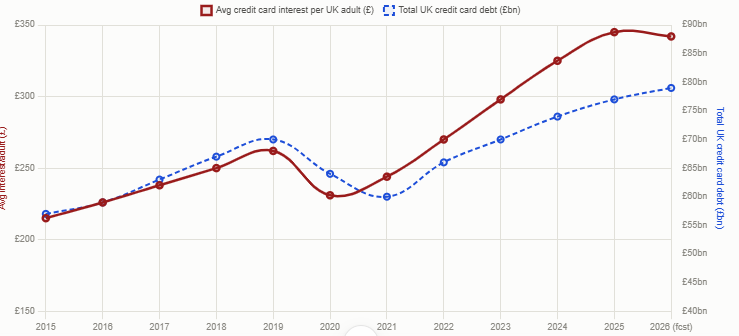
Updraft’s May 2026 research is striking in its scale. UK households are forecast to pay £19.3 billion in credit card interest in 2026 — equivalent to £342 per adult. Total UK credit card debt is on track to hit £79 billion by December 2026. None of the £19.3 billion in interest reduces the underlying balance. Every pound of it services debt rather than paying it down. The average credit card interest paid per adult has risen 60% since 2015 (£215 in 2015 versus £345 in 2025).
ThinkMoney’s May 2026 analysis documents what is driving the growth in consumer credit: ‘While inflation has eased on paper, spending pressures remain across essentials like food, rent and energy. For some, credit cards, loans and overdrafts are being used to cover shortfalls, as a last resort, alongside being called in for emergencies as families are forced to live with no safety margins.’ Unsecured borrowing is growing at its fastest pace in approximately two years as of May 2026.
A £1,400 average credit card balance at 24.4% APR costs approximately £342 per year in interest — and that is the average. Someone carrying £3,000 on a credit card at 25% APR pays approximately £750 per year in interest. For those only making minimum payments, the majority of the payment goes toward interest rather than reducing the balance. At minimum payments, a £3,000 balance at 25% takes over 20 years to clear and costs thousands more than the original debt.
If you are carrying a credit card balance: review whether you are eligible for a 0% balance transfer card. The best 0% purchase and balance transfer cards in September 2026 offer up to 24 months of zero interest, giving two years to clear the balance without adding interest. If 0% cards are not available at your credit score, look at a personal loan at 6–8% to consolidate card debt from 24%+. The interest saving on a £5,000 balance moved from 24.4% to 7% is approximately £875 per year.
However, personal loan rates in 2026 are higher than they were in 2021 or 2022, when rates below 4% were available for the same borrowing profiles. The base rate environment, the gilt yield environment, and tighter credit conditions have all pushed personal loan rates upward from their post-pandemic lows. Gilt-Edge.uk’s April 2026 guide to personal loans notes the representative APR structure: the headline rate advertised must be offered to at least 51% of successful applicants, but many borrowers pay a higher personalised rate based on their credit history, income, and existing debt load.
One practical insight from Gilt-Edge.uk’s April 2026 analysis: the ‘rate notch’. Most lenders offer significantly lower rates above £7,500 than below it, because the margin per pound lent is lower on smaller loans. Borrowing £7,500 often costs less in total interest than borrowing £7,499 — even though the amount is higher. For anyone needing to borrow just under this threshold, it is worth considering whether borrowing the slightly higher amount produces a meaningfully lower total interest cost.
The numbers are substantial. UK public sector net borrowing hit £18 billion in August 2025, well above forecasts of £12.8 billion — the highest for the month in five years. The first five months of the 2025/26 fiscal year produced borrowing of £83.8 billion, £11.4 billion above OBR projections. Rising gilt yields mean that the interest on that borrowing costs the government more than it budgeted, leaving less for other priorities.
The TradingEconomics report from March 23, 2026 noted that the spike in gilt yields was ‘straining the government’s fiscal targets,’ prompting Prime Minister Starmer to call an emergency meeting with Bank of England Governor Andrew Bailey. The OBR lowered its forecast for UK economic growth in 2026 to 1.1% (down from 1.4% in the November 2025 forecast), even before incorporating the full energy-price shock from the Middle East conflict.
For households, the government’s fiscal position translates into higher debt-servicing costs that reduce the money available for public services, benefits uprating, and tax relief. In a sustained high-yield environment, the government faces a difficult choice between higher taxation, reduced spending, or accepting a larger deficit that itself generates more gilt yield pressure. None of these outcomes is cost-free for households.
The practical reality for UK savers:
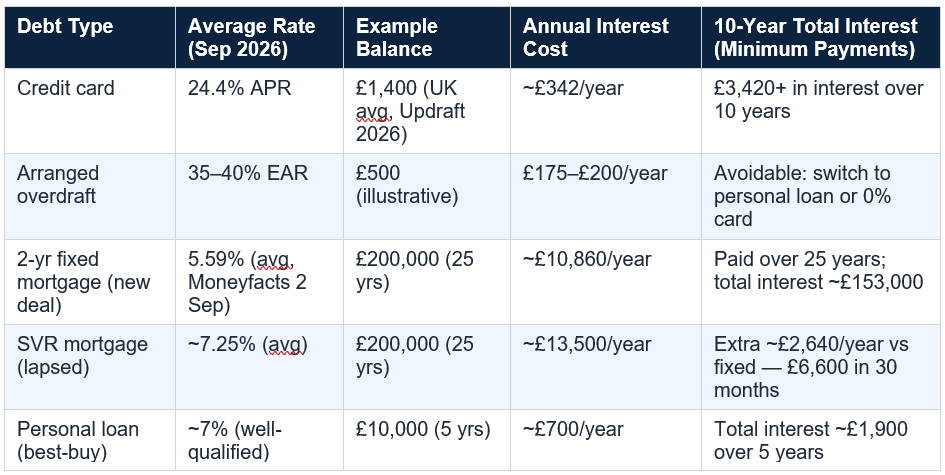
The household picture that emerges from the Updraft and ThinkMoney research is one of structural fragility: a significant proportion of UK households are carrying expensive consumer debt that is growing faster than incomes, in an environment where the cost of that debt is elevated and unlikely to fall quickly. Unsecured borrowing is growing at its fastest pace in approximately two years — suggesting that some households are using credit to bridge gaps in their essential spending rather than as a planned borrowing decision.
The appropriate response is not panic. None of these conditions is permanent. Gilt yields have risen and fallen in the past; the Bank of England’s rate-setting function exists precisely to manage inflationary episodes of the type that is currently under way. The appropriate response is action — specifically, the actions that reduce exposure to the most expensive forms of borrowing and maximise returns on savings while rates remain elevated.
Every month on a 7.25% SVR that could be on a 5.59% fixed deal costs money that cannot be recovered. Every credit card balance at 24.4% that could be on a 0% balance transfer card is producing interest that pays the bank rather than reducing the debt. Every cash savings account earning 2% that could be earning 4.5% is producing less than the market offers. The borrowing cost environment is difficult. The available tools for managing it are accessible and, in several cases, can be implemented today.
UK gilts are government bonds — IOUs issued by the UK government to borrow money from investors. The 'yield' is the effective interest rate on the bond, which moves inversely with the bond's price. When investors are less willing to hold gilts (perhaps because they expect inflation to erode the real value of future payments, or because they are uncertain about the UK's fiscal position), gilt prices fall and yields rise. Gilt yields matter to households because they directly influence swap rates, which are the primary benchmark for pricing fixed-rate mortgages in the UK. When gilt yields rise — as the 10-year yield did by 60 basis points in March 2026 alone — fixed mortgage rates follow within days. As of 2 September 2026, the 10-year gilt yield is at its highest since 2008 and the 30-year yield is at its highest since 1998 (BBC Business, 2 September 2026).
Why are UK mortgage rates so much higher than the Bank of England base rate?
The Bank of England base rate (3.75% in September 2026) is the rate at which the Bank lends to commercial banks overnight. Fixed-rate mortgages, however, are not primarily priced off the base rate — they are priced off swap rates, which incorporate market expectations of where the base rate will be over the fixed period (two or five years). When markets expect the base rate to rise — as they currently do, given the 6–3 MPC vote and rising inflation — swap rates rise in advance of the formal base rate change. Fixed mortgage rates rise with them. The average two-year fix (5.59%) is therefore not anomalously high relative to the 3.75% base rate; it reflects the market's expectation that the base rate will be meaningfully higher over the next two years than it is today.
What should I do if my mortgage deal is ending soon?
Contact an independent mortgage broker as soon as possible — ideally now, if your deal ends within six months. A mortgage offer from a lender is typically valid for six months, meaning you can secure a rate today without committing to it until your deal end date. If rates fall before completion, you can switch to the lower rate. If rates rise, your existing offer protects you. The practical sequence: (1) Check your deal end date on your mortgage statement. (2) Contact an independent broker who will compare 60+ lenders at no cost to you. (3) Apply for a formal offer on the best available deal. (4) Review before completion and switch if rates have improved. Do not wait for the 17 September Bank of England decision — lenders price changes before the Bank acts, and rates may move in advance of any formal announcement.
How worried should I be about credit card debt at current rates?
Very. The average UK credit card APR is 24.4% in 2026. On the UK average credit card balance of £1,400, that is approximately £342 per year in interest alone — none of which reduces the balance. UK households collectively will pay an estimated £19.3 billion in credit card interest in 2026 (Updraft). If you are carrying a balance at 24%+, the priority is to move it to a lower-cost product: a 0% balance transfer card (if eligible) offers up to 24 months at zero interest; a personal loan at 6–8% reduces the interest cost by two-thirds compared with the average credit card. The credit card minimum payment trap — where the minimum payment covers mainly interest and leaves the balance largely unchanged — can extend a £3,000 balance into a decade-long debt at 25% APR. Always pay more than the minimum.
What is the Bank of England likely to do on 17 September 2026?
The official position, based on the publicly available information at time of writing, is that most forecasters expect the Bank to hold the base rate at 3.75%, with a small but credible probability of a rise to 4.00%. Deutsche Bank has stated 'no change this year but rising odds of a rise.' JP Morgan has forecast a rise to 4.0% in late 2026. Oxford Economics expects a hold. The closeness of the July vote (6–3) means that a September rise cannot be ruled out, particularly if the July CPI data (2.9%) is followed by August CPI data showing further upward movement. Market pricing as of the Bank's July 2026 Monetary Policy Report implies the base rate rising to approximately 4.2% by the second half of 2027. What this means practically: plan for the cost of your variable-rate debt as if rates will rise by 0.25 to 0.5 percentage points from current levels within the next 6 to 12 months.
Is now a good time to fix savings rates?
Yes, for most savers. Easy-access rates of 4.5% to 5% are available from challenger banks and online savings platforms in September 2026 — significantly better than the standard high-street accounts that most savers currently use. For those who are comfortable locking money away, fixed-rate cash ISAs and bonds offer rates above 4.5% to 5.5% for one- to three-year terms. The risk of fixing: if the Bank of England cuts rates significantly from current levels (as the Bank's own survey participants expect, projecting 3.25% at the two-to-three-year horizon), rates available on new easy-access accounts in 2028 or 2029 may be lower than today's fixed rates. This makes fixing attractive for the portion of savings a household does not need immediate access to.
Table of Contents
- The Week That Focused Minds
- What Are ‘Borrowing Costs’? A Plain-English Explanation
- Gilt Yields: The Number Most People Have Never Heard of — But Should Know
- Why Are UK Gilt Yields Rising Right Now?
- How the Bank of England Base Rate Fits In
- What This Means for Your Mortgage
- What This Means for Credit Cards and Overdrafts
- What This Means for Personal Loans
- What This Means for the Government — and Ultimately for You
- What This Means for Savers
- The UK’s Debt Problem: The Household Picture
- Practical Steps: How to Protect Yourself
- Should You Pay Off Debt or Save First?
- Conclusion: The Right Response to an Uncertain Borrowing Environment
- Frequently Asked Questions
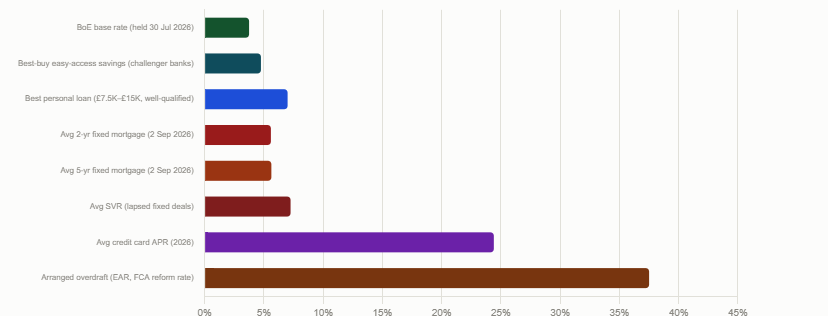
UK Borrowing Rate By Product: the Full Spectrum
Consumer Debt Picture: What Rising Rates Cost UK Homeholds
The Week That Focused Minds
On Wednesday 2 September 2026, BBC business reporter Shanaz Musafer and cost-of-living correspondent Kevin Peachey published a joint report with a headline that landed for many readers like a late arrival of news they should have been paying attention to sooner: UK government borrowing costs have been rising, with some now at their highest level since 1998, as investors around the world worry about inflation.The article arrived in the week after the Bank of England’s 30 July Monetary Policy Committee meeting, at which three of nine rate-setters voted for an immediate rise in the base rate to 4 percent. The base rate remained at 3.75 percent, but the closeness of the vote — and the publication of CPI inflation data showing a rise to 2.9 percent in July 2026, moving away from the Bank’s 2 percent target rather than toward it — produced a further round of upward pressure on gilt yields, swap rates, and fixed mortgage pricing.
For most UK households, the phrase ‘gilt yields’ sounds like something that happens in financial markets and is somebody else’s problem. This guide explains why it is not. The connection between a government bond yield, a 30-year mortgage, a credit card minimum payment, and the amount of money left over after essential bills each month is direct, quantifiable, and currently moving in an unhelpful direction. Here is the full picture, and what you can do about it.
10-year UK gilt yield: highest since 2008. 30-year UK gilt yield: highest since 1998 (BBC/Yahoo Finance, 2 Sep 2026). Bank of England base rate: 3.75% (held 30 Jul 2026, 6–3 vote). UK CPI inflation: 2.9% July 2026 (above 2% target, rising). Average 2-yr fixed mortgage: 5.59% (2 Sep 2026, Moneyfacts). Avg credit card APR: 24.4%. UK credit card interest payments forecast: £19.3bn in 2026 (£342/adult).
What Are ‘Borrowing Costs’? A Plain-English Explanation
Borrowing costs are the interest charges — and any associated fees — you pay when you borrow money. They apply whether the borrower is an individual taking out a personal loan, a homeowner with a mortgage, a business with a commercial line of credit, or the UK government issuing bonds to fund public spending. In each case, the cost of borrowing is expressed as an interest rate, and that rate is affected by a cluster of factors that operate simultaneously and in the same direction when the economic environment becomes uncertain.The key rates that govern UK consumer borrowing costs in September 2026:
The reason these rates cluster and move together is that they all draw from the same underlying financial infrastructure. When the cost of government borrowing rises — measured by gilt yields — the cost of everything built on top of government credit rises with it.
Gilt Yields: The Number Most People Have Never Heard of — But Should Know
A gilt is a UK government bond — effectively an IOU issued by the government to borrow money from investors. The government sells gilts to raise money to fund spending that exceeds tax revenues. In return, it pays regular interest (the ‘coupon’) and eventually repays the principal when the gilt matures.The ‘yield’ on a gilt is the effective interest rate — it reflects both the coupon payment and the price the investor paid for the bond. When gilt prices fall (because investors are less willing to hold them, perhaps because they expect inflation to erode the real value of future payments), the yield rises. Conversely, when demand for gilts is high, prices rise and yields fall. The BBC’s 2 September 2026 report explains this mechanism directly: ‘Interest rates — known as the yield — on government bonds have been going up.’
The reason gilt yields matter to the average household is transmission: fixed-rate mortgage pricing in the UK is primarily driven by swap rates, which move closely with gilt yields. When the 10-year gilt yield rises by 60 basis points in a single month — as it did in March 2026 — swap rates rise, lenders reprice their fixed-rate mortgage products upward, and within days the best-buy rates available to remortgaging homeowners increase. The household receives the consequence of a government bond market movement it never knew was happening.
The gilt yield is the interest rate the UK government pays to borrow. It is also, indirectly, the floor below which consumer borrowing rates cannot fall. When the government's own borrowing rate rises, the rates charged to households on mortgages, personal loans, and in some cases credit cards all rise too. A household's mortgage rate does not move in isolation from global and government financial markets — it moves with them, with a lag of days or weeks.
Why Are UK Gilt Yields Rising Right Now?
The September 2026 environment of elevated UK gilt yields is the product of a specific sequence of events that began in early 2026 and has persisted, compounding existing fiscal pressures with a new geopolitical shock. The FHP Accounting analysis (May 2026) describes the causes: ‘When gilt yields rise, it usually means investors are demanding a higher return to hold UK government debt. This can happen for several reasons, including concerns about inflation, public borrowing, political uncertainty, global energy prices, overseas events or expectations that interest rates may stay higher for longer.’The 2026-specific sequence:
- December 2025: the Bank of England cut the base rate to 3.75% — its fifth consecutive cut from the 5.25% peak. Gilt yields and fixed mortgage rates fell. There was growing optimism for continued cuts in 2026.
- Early March 2026: conflict in the Middle East disrupted energy supply through the Strait of Hormuz — a chokepoint for approximately one-fifth of the world’s oil and gas supply. Energy prices surged globally. The UK, as a net energy importer, is particularly exposed to Strait of Hormuz supply disruptions.
- March 2026: UK gilt yields surged. By 23 March, the 10-year yield had risen above 5% — its highest since July 2008 — and the 30-year yield reached 5.6%. The 10-year yield closed March up 60 basis points, described by TradingEconomics as ‘one of the steepest monthly increases among European bonds.’
- April 2026: Prime Minister Keir Starmer called an emergency meeting with Bank of England Governor Andrew Bailey to address the gilt yield crisis. The spike was described as ‘straining the government’s fiscal targets’ (TradingEconomics).
- July 2026: UK CPI inflation rose to 2.9%. The Bank of England held its base rate at 3.75% on 30 July, but three of nine MPC members voted for an immediate rise. Markets began pricing a base rate rise to 4% or above.
- September 2026: gilt yields remain at historically elevated levels. The BBC’s 2 September report confirms the 10-year yield at its highest since 2008 and the 30-year yield at its highest since 1998. The next MPC decision is due 17 September 2026.
How the Bank of England Base Rate Fits In
The Bank of England base rate (Bank Rate) is the interest rate at which the Bank lends to commercial banks overnight. It is the most visible signal of the cost of money in the UK economy and directly influences a broad range of consumer and business borrowing rates.The relationship between the base rate and consumer borrowing costs is direct but not one-to-one:
- Variable-rate products (tracker mortgages, SVRs, some personal loans and credit cards): these move in near lock-step with the base rate. A 0.25 percentage point rise in Bank Rate typically produces an equivalent or near-equivalent rise in the rate on these products within weeks.
- Fixed-rate mortgages: primarily driven by swap rates, which incorporate market expectations of where Bank Rate will be over the fixed period. A widely anticipated rate rise may already be priced into fixed mortgage rates before the Bank formally acts.
- Credit card rates: credit card APRs are influenced by the base rate but move less directly, because credit card pricing also reflects the credit risk of the borrower pool and competition between card issuers. The FCA’s interest rate cap rules also affect how far rates can move.
What This Means for Your Mortgage
The mortgage is the largest borrowing commitment for most UK households, and it is the borrowing product most directly and dramatically affected by rising gilt yields and the current rate environment.The core fact: as of 2 September 2026, the average two-year fixed mortgage rate is 5.59% and the average five-year fixed rate is 5.63% (Moneyfacts data, Bright Savings UK). Both rose from 2025 lows of approximately 3.93% and 4.0% respectively — an increase of approximately 1.6 percentage points from the trough. On a £250,000 repayment mortgage with 25 years remaining, this increase in rate adds approximately £249 per month to the mortgage payment.
The OBR’s March 2026 forecast is sobering: average mortgage interest rates are expected to rise from approximately 4.1% in 2026 to approximately 4.5% in 2030. This projection was made before the full energy shock of 2026 was incorporated, and some analysts suggest the actual path will be higher.
For borrowers approaching the end of a fixed-rate deal — and 1.8 million fixed deals are expiring in 2026, many of them at rates of 1.5% to 2.5% agreed during the pandemic era — the payment increase is unavoidable. What is controllable is the rate at which the new deal is secured and the type of product chosen.
The SVR (standard variable rate) averages approximately 7.13%–7.35% in September 2026 — between 1.5 and 2 percentage points above the average fixed deal. Every month on the SVR that could be on a fixed rate is avoidable cost. For a borrower with a £200,000 mortgage, the SVR premium above a 5.59% fix costs approximately £170–£200 per month in extra interest. If you have lapsed onto the SVR, switch immediately.
What This Means for Credit Cards and Overdrafts
Credit card and overdraft debt is where rising borrowing costs hurt the most, because the rates on these products are already extreme by any historical or international comparison. The UK’s average credit card APR is 24.4% in 2026 (Updraft, May 2026). Arranged overdrafts typically charge 35 to 40% EAR following the FCA’s 2020 reforms that banned the old fixed daily fee structure.Updraft’s May 2026 research is striking in its scale. UK households are forecast to pay £19.3 billion in credit card interest in 2026 — equivalent to £342 per adult. Total UK credit card debt is on track to hit £79 billion by December 2026. None of the £19.3 billion in interest reduces the underlying balance. Every pound of it services debt rather than paying it down. The average credit card interest paid per adult has risen 60% since 2015 (£215 in 2015 versus £345 in 2025).
ThinkMoney’s May 2026 analysis documents what is driving the growth in consumer credit: ‘While inflation has eased on paper, spending pressures remain across essentials like food, rent and energy. For some, credit cards, loans and overdrafts are being used to cover shortfalls, as a last resort, alongside being called in for emergencies as families are forced to live with no safety margins.’ Unsecured borrowing is growing at its fastest pace in approximately two years as of May 2026.
A £1,400 average credit card balance at 24.4% APR costs approximately £342 per year in interest — and that is the average. Someone carrying £3,000 on a credit card at 25% APR pays approximately £750 per year in interest. For those only making minimum payments, the majority of the payment goes toward interest rather than reducing the balance. At minimum payments, a £3,000 balance at 25% takes over 20 years to clear and costs thousands more than the original debt.
If you are carrying a credit card balance: review whether you are eligible for a 0% balance transfer card. The best 0% purchase and balance transfer cards in September 2026 offer up to 24 months of zero interest, giving two years to clear the balance without adding interest. If 0% cards are not available at your credit score, look at a personal loan at 6–8% to consolidate card debt from 24%+. The interest saving on a £5,000 balance moved from 24.4% to 7% is approximately £875 per year.
What This Means for Personal Loans
Personal loans are generally the most cost-effective form of unsecured borrowing in the UK for medium-sized amounts (£5,000 to £25,000 over one to seven years). The best available rates for well-qualified borrowers in the £7,500 to £15,000 range are approximately 6 to 8% in 2026 (Gilt-Edge.uk, April 2026; Pocketwise.co.uk). At these rates, a personal loan is significantly cheaper than a credit card (24.4%), an overdraft (35 to 40%), or a payday-style product.However, personal loan rates in 2026 are higher than they were in 2021 or 2022, when rates below 4% were available for the same borrowing profiles. The base rate environment, the gilt yield environment, and tighter credit conditions have all pushed personal loan rates upward from their post-pandemic lows. Gilt-Edge.uk’s April 2026 guide to personal loans notes the representative APR structure: the headline rate advertised must be offered to at least 51% of successful applicants, but many borrowers pay a higher personalised rate based on their credit history, income, and existing debt load.
One practical insight from Gilt-Edge.uk’s April 2026 analysis: the ‘rate notch’. Most lenders offer significantly lower rates above £7,500 than below it, because the margin per pound lent is lower on smaller loans. Borrowing £7,500 often costs less in total interest than borrowing £7,499 — even though the amount is higher. For anyone needing to borrow just under this threshold, it is worth considering whether borrowing the slightly higher amount produces a meaningfully lower total interest cost.
What This Means for the Government — and Ultimately for You
The UK government borrows by selling gilts. When gilt yields rise, the government pays more in interest to attract investors to buy those gilts. This directly increases the cost of servicing the UK’s existing and new debt, which in turn squeezes the fiscal space available for public spending or tax reductions.The numbers are substantial. UK public sector net borrowing hit £18 billion in August 2025, well above forecasts of £12.8 billion — the highest for the month in five years. The first five months of the 2025/26 fiscal year produced borrowing of £83.8 billion, £11.4 billion above OBR projections. Rising gilt yields mean that the interest on that borrowing costs the government more than it budgeted, leaving less for other priorities.
The TradingEconomics report from March 23, 2026 noted that the spike in gilt yields was ‘straining the government’s fiscal targets,’ prompting Prime Minister Starmer to call an emergency meeting with Bank of England Governor Andrew Bailey. The OBR lowered its forecast for UK economic growth in 2026 to 1.1% (down from 1.4% in the November 2025 forecast), even before incorporating the full energy-price shock from the Middle East conflict.
For households, the government’s fiscal position translates into higher debt-servicing costs that reduce the money available for public services, benefits uprating, and tax relief. In a sustained high-yield environment, the government faces a difficult choice between higher taxation, reduced spending, or accepting a larger deficit that itself generates more gilt yield pressure. None of these outcomes is cost-free for households.
What This Means for Savers
The corollary of higher borrowing costs is better returns for savers. This is the one population that benefits from the environment described in this guide. In September 2026, high-yield savings accounts, cash ISAs, and fixed-rate bonds offer meaningfully better returns than they did during the pandemic era of near-zero rates.The practical reality for UK savers:
- Easy-access savings accounts: the best easy-access rates in September 2026 are available at 4.5% to 5% for new accounts at challenger banks and online savings platforms, significantly above the base rate of 3.75%, reflecting competition among providers for retail deposits.
- Fixed-rate cash ISAs and bonds: locking in for one to three years can secure rates above 4.5% to 5.5%, protecting against future base rate falls if the current elevated rate environment does not persist.
- Premium Bonds: the current Premium Bond prize rate of approximately 4.4% (tax-free, equivalent) remains competitive for savers with balances up to £50,000 in the tax-free prize pool.
The UK’s Debt Problem: The Household Picture
The macroeconomic environment of rising gilt yields and base rate uncertainty lands unevenly on UK households, depending on their existing level of debt. For households carrying significant variable-rate consumer debt, the current environment is particularly costly:The household picture that emerges from the Updraft and ThinkMoney research is one of structural fragility: a significant proportion of UK households are carrying expensive consumer debt that is growing faster than incomes, in an environment where the cost of that debt is elevated and unlikely to fall quickly. Unsecured borrowing is growing at its fastest pace in approximately two years — suggesting that some households are using credit to bridge gaps in their essential spending rather than as a planned borrowing decision.
Practical Steps: How to Protect Yourself
The borrowing cost environment of September 2026 is not one that households can resolve by waiting for it to improve. It is one that rewards specific, deliberate actions taken now. The most impactful steps, ranked by typical financial value to a UK household:- Remortgage before your deal expires: if your fixed deal ends within six months, engage an independent mortgage broker immediately and secure a rate offer. The six-month offer validity means you can lock in today and switch to a lower rate if the market improves. The downside of acting early is minimal; the downside of acting late — if rates rise further before your deal ends — could be £200 to £500 per month in higher payments.
- Get off the SVR: if your fixed deal has already expired and you are on the SVR (approximately 7.13 to 7.35%), switching to a fixed or tracker deal is the highest-priority single action. There are no early repayment charges on the SVR. You are paying a premium of approximately 1.5 to 2 percentage points versus an available fixed deal, every month you remain.
- Transfer high-rate card balances to 0%: if you are carrying a credit card balance at 24%+, a 0% balance transfer card at your credit score provides up to 24 months of zero interest to clear the balance. The balance transfer fee (typically 2 to 3%) is paid once and is far less than the ongoing interest cost.
- Avoid the overdraft as a borrowing tool: arranged overdrafts at 35 to 40% EAR are among the most expensive available forms of consumer credit. If you regularly use your arranged overdraft, the cheapest replacement is a personal loan or a 0% credit card for smaller amounts.
- Maximise savings rates: move savings out of low-rate accounts into competitive easy-access or fixed-rate products. The best easy-access rates in September 2026 are around 4.5 to 5%, versus typical high-street bank rates of 2 to 2.5%.
- Budget for further rate rises: the MPC vote on 17 September 2026 could produce the first base rate rise since the cutting cycle began. Households with variable-rate debt (trackers, SVRs, credit cards) should model the effect of a 0.25 to 0.5 percentage point rise in their current monthly payments and ensure their budget can absorb it.
Should You Pay Off Debt or Save First?
In the current environment, the hierarchy of financial priorities is clear for most UK households. The general principle: the higher the interest rate on a debt, the higher the priority for repayment relative to saving.- Step 1: Pay at least the minimum on all debts to avoid penalty interest and credit score damage.
- Step 2: Capture any employer pension match. Pension employer match is typically a 50 to 100% immediate return on the matched contribution — always higher than the interest cost of any debt except payday-level products.
- Step 3: Build a minimum £1,000 emergency buffer in a savings account. Without this, any unexpected expense goes straight to the most expensive credit available.
- Step 4: Pay off the highest-rate debts first — in September 2026, that means: overdrafts (35 to 40% EAR), then credit card balances (24.4% average APR), then personal loans. Any debt above 7% should be prioritised over general savings.
- Step 5: Once high-rate debts are cleared, build savings in the highest-available ISA or savings account. At current rates (4.5 to 5% easy access), the difference between a no-rate account and a competitive one is meaningful.
Conclusion
The UK’s borrowing cost environment in September 2026 is the product of a sequence of shocks that landed on a fiscal position already under strain. The 2025 hopes for a steady decline in mortgage rates toward 3.5% or below have been replaced by a reality of gilt yields at 28-year highs, an MPC that came within one vote of raising rates in July, and a consumer debt stock growing at its fastest pace in two years as households use credit to cover spending gaps.The appropriate response is not panic. None of these conditions is permanent. Gilt yields have risen and fallen in the past; the Bank of England’s rate-setting function exists precisely to manage inflationary episodes of the type that is currently under way. The appropriate response is action — specifically, the actions that reduce exposure to the most expensive forms of borrowing and maximise returns on savings while rates remain elevated.
Every month on a 7.25% SVR that could be on a 5.59% fixed deal costs money that cannot be recovered. Every credit card balance at 24.4% that could be on a 0% balance transfer card is producing interest that pays the bank rather than reducing the debt. Every cash savings account earning 2% that could be earning 4.5% is producing less than the market offers. The borrowing cost environment is difficult. The available tools for managing it are accessible and, in several cases, can be implemented today.
Frequently Asked Questions
What are UK gilt yields and why do they matter?UK gilts are government bonds — IOUs issued by the UK government to borrow money from investors. The 'yield' is the effective interest rate on the bond, which moves inversely with the bond's price. When investors are less willing to hold gilts (perhaps because they expect inflation to erode the real value of future payments, or because they are uncertain about the UK's fiscal position), gilt prices fall and yields rise. Gilt yields matter to households because they directly influence swap rates, which are the primary benchmark for pricing fixed-rate mortgages in the UK. When gilt yields rise — as the 10-year yield did by 60 basis points in March 2026 alone — fixed mortgage rates follow within days. As of 2 September 2026, the 10-year gilt yield is at its highest since 2008 and the 30-year yield is at its highest since 1998 (BBC Business, 2 September 2026).
Why are UK mortgage rates so much higher than the Bank of England base rate?
The Bank of England base rate (3.75% in September 2026) is the rate at which the Bank lends to commercial banks overnight. Fixed-rate mortgages, however, are not primarily priced off the base rate — they are priced off swap rates, which incorporate market expectations of where the base rate will be over the fixed period (two or five years). When markets expect the base rate to rise — as they currently do, given the 6–3 MPC vote and rising inflation — swap rates rise in advance of the formal base rate change. Fixed mortgage rates rise with them. The average two-year fix (5.59%) is therefore not anomalously high relative to the 3.75% base rate; it reflects the market's expectation that the base rate will be meaningfully higher over the next two years than it is today.
What should I do if my mortgage deal is ending soon?
Contact an independent mortgage broker as soon as possible — ideally now, if your deal ends within six months. A mortgage offer from a lender is typically valid for six months, meaning you can secure a rate today without committing to it until your deal end date. If rates fall before completion, you can switch to the lower rate. If rates rise, your existing offer protects you. The practical sequence: (1) Check your deal end date on your mortgage statement. (2) Contact an independent broker who will compare 60+ lenders at no cost to you. (3) Apply for a formal offer on the best available deal. (4) Review before completion and switch if rates have improved. Do not wait for the 17 September Bank of England decision — lenders price changes before the Bank acts, and rates may move in advance of any formal announcement.
How worried should I be about credit card debt at current rates?
Very. The average UK credit card APR is 24.4% in 2026. On the UK average credit card balance of £1,400, that is approximately £342 per year in interest alone — none of which reduces the balance. UK households collectively will pay an estimated £19.3 billion in credit card interest in 2026 (Updraft). If you are carrying a balance at 24%+, the priority is to move it to a lower-cost product: a 0% balance transfer card (if eligible) offers up to 24 months at zero interest; a personal loan at 6–8% reduces the interest cost by two-thirds compared with the average credit card. The credit card minimum payment trap — where the minimum payment covers mainly interest and leaves the balance largely unchanged — can extend a £3,000 balance into a decade-long debt at 25% APR. Always pay more than the minimum.
What is the Bank of England likely to do on 17 September 2026?
The official position, based on the publicly available information at time of writing, is that most forecasters expect the Bank to hold the base rate at 3.75%, with a small but credible probability of a rise to 4.00%. Deutsche Bank has stated 'no change this year but rising odds of a rise.' JP Morgan has forecast a rise to 4.0% in late 2026. Oxford Economics expects a hold. The closeness of the July vote (6–3) means that a September rise cannot be ruled out, particularly if the July CPI data (2.9%) is followed by August CPI data showing further upward movement. Market pricing as of the Bank's July 2026 Monetary Policy Report implies the base rate rising to approximately 4.2% by the second half of 2027. What this means practically: plan for the cost of your variable-rate debt as if rates will rise by 0.25 to 0.5 percentage points from current levels within the next 6 to 12 months.
Is now a good time to fix savings rates?
Yes, for most savers. Easy-access rates of 4.5% to 5% are available from challenger banks and online savings platforms in September 2026 — significantly better than the standard high-street accounts that most savers currently use. For those who are comfortable locking money away, fixed-rate cash ISAs and bonds offer rates above 4.5% to 5.5% for one- to three-year terms. The risk of fixing: if the Bank of England cuts rates significantly from current levels (as the Bank's own survey participants expect, projecting 3.25% at the two-to-three-year horizon), rates available on new easy-access accounts in 2028 or 2029 may be lower than today's fixed rates. This makes fixing attractive for the portion of savings a household does not need immediate access to.
0 Comments
Be the first to share your thoughts on this article.