

Finance
What Is Causing the Rise in Financial Fraud?

Americans lost a record $15.9 billion to fraud in 2025 — a 430% increase since 2020. Global losses hit $579.4 billion. AI-enabled fraud is now 4.5 times more lucrative than conventional attacks. Here is what is driving it — and how to protect yourself.

These are reported losses. Every major authority on fraud — the FTC, the FBI, the CFPB — acknowledges that reported losses represent a small fraction of actual losses, because most fraud victims do not report. The real scale is substantially larger than any figure in any annual report.
What is causing this rise? The answer is not a single factor. It is a convergence of seven specific structural drivers — technological, economic, behavioral, and institutional — that are simultaneously expanding the scale of fraud, increasing its success rate, reducing the cost of executing attacks, and limiting the accountability that would otherwise deter perpetrators. Understanding these drivers is not just academic; it is the prerequisite for effective personal protection.
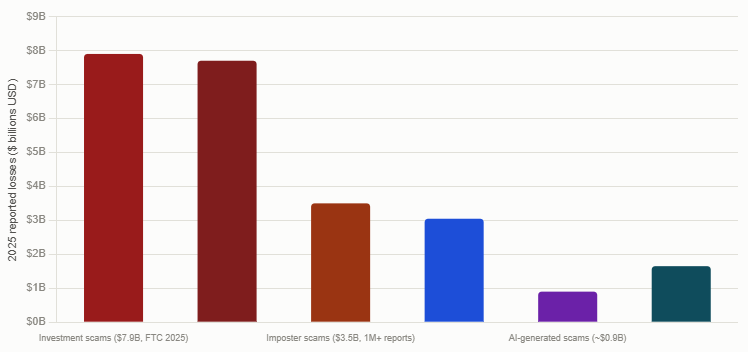
The Numbers: Americans lost a record $15.9 billion to fraud in 2025 (FTC, April 2026) — a 430% increase since 2020. Global fraud and scam losses: $579.4 billion (Nasdaq Verafin 2026 Global Financial Crime Report). FBI IC3 reports $20.9 billion in US internet crime losses in 2025. AI-generated scams alone cost consumers nearly $900 million in 2025 (FBI; Signifyd 2026 State of Fraud Report).
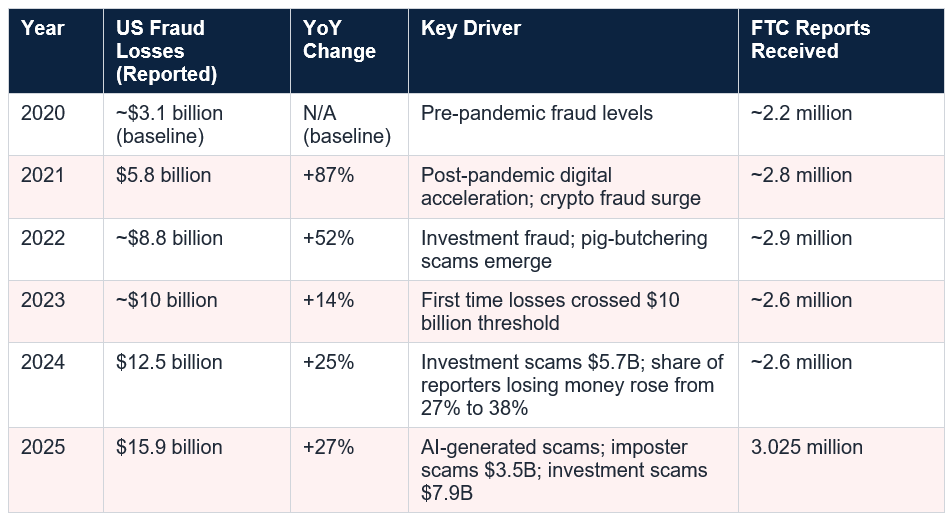
The most revealing data point in this trajectory is not the dollar figure. It is the conversion rate. In 2023, 27 percent of people who reported a fraud said they lost money. In 2024, that figure jumped to 38 percent — a 40 percent increase in the proportion of victims who were successfully defrauded, in just one year. This means scams are not just growing in volume; they are becoming dramatically more effective at completing the conversion from contact to loss.
FTC Official Lois Greisman (testimony before Joint Economic Committee, March 2026): The increase in fraud losses is not being driven by an increase in fraud reports, which remained relatively stable. What changed is the percentage of people who reported losing money — that figure jumped significantly, suggesting scammers are converting contacts into losses far more efficiently than before.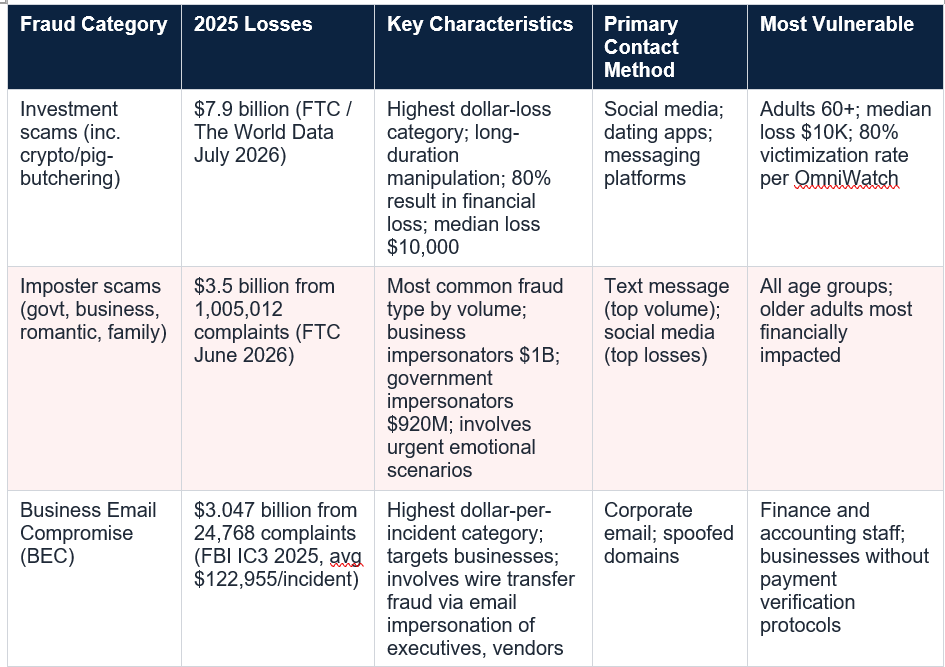
The specific ways AI has transformed fraud economics:
The most notorious example crystallises the risk: an Arup engineering firm employee in Hong Kong lost $25.6 million when a finance worker was convinced to authorise wire transfers during a video call featuring what appeared to be the company’s CFO and other colleagues. Every person on that call was a deepfake. The worker had no reason to doubt what he saw and heard. His senses provided no warning because the deception was technologically indistinguishable from reality in real time.
The dominant deepfake fraud type globally is celebrity and government impersonation in investment scams — accounting for $1.13 billion, or 52 percent of all deepfake fraud losses, through March 2026 (Surfshark/The World Data). These scams feature AI-generated video of recognisable public figures — politicians, billionaires, sports stars — appearing to endorse fraudulent investment platforms. The familiar face creates a false sense of credibility that bypasses normal scepticism.
The problem is expected to intensify. Predictions for 2026 highlight stolen biometric data as a new vector for synthetic identity creation (BIIA, January 2026). As biometric verification — face ID, voice recognition — becomes more common as an authentication method, deepfake technology targeting those biometric signatures represents the next frontier of fraud risk.
Red Flag: Seeing someone on a video call is no longer reliable verification that the person is who they appear to be. Hearing a familiar voice is no longer reliable verification. Any unexpected request involving money, credentials, or sensitive information — regardless of how convincing the verification appears — should be verified through an independently initiated contact using a number or method you control, not one provided in the suspicious interaction.
BIIA’s January 2026 synthetic identity fraud analysis found that 8.3 percent of digital onboarding attempts were flagged as suspicious in early 2025. Fraudulent activity in financial services rose approximately 21 percent between 2024 and 2025 (BIIA). The specific digital friction points that fraudsters exploit:
Social media enables fraud in several specific ways:
The job scam data illustrates this dynamic clearly. OmniWatch’s 2025 analysis found that job scams continue to soar amid economic uncertainty, with scam exposure and victimisation significantly higher among active job seekers. While 25 percent of Americans report personal scam experience generally, that figure rises to 28 percent among LinkedIn users — identifying job-search platforms as a concentrated risk environment. People who are financially stressed and actively seeking employment are more willing to take opportunities that require upfront payments, personal information, or non-standard hiring processes.
The investment fraud connection is equally clear. The FTC found that nearly half of all money lost in 2025 was tied to investment scams. Eighty percent of investment scams result in financial loss, with a median loss of $10,000 per victim (OmniWatch). People who feel their financial trajectory is not adequate to their retirement or lifestyle goals are more susceptible to fraudulent investments that promise above-market returns. The pig-butchering scam specifically exploits this by developing a genuine romantic or friendship relationship before pivoting to investment.
The downstream fraud enabled by data breaches includes:
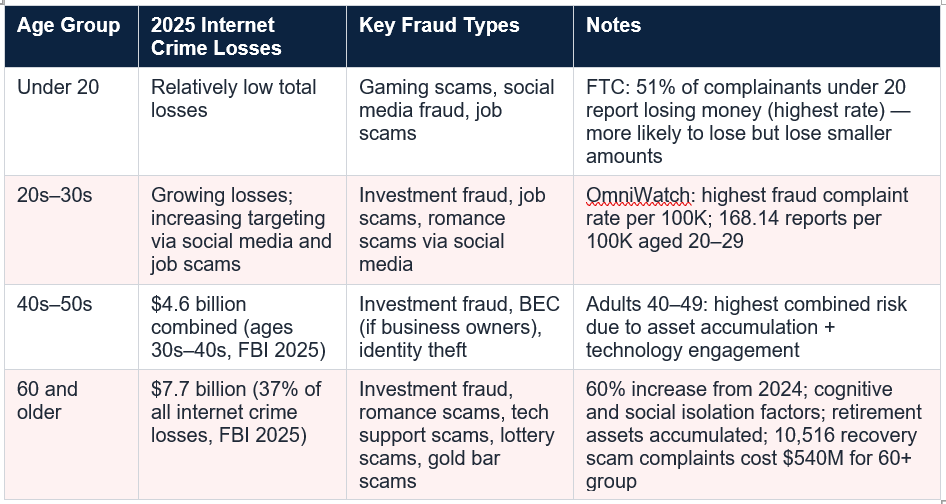
The older adult vulnerability data is particularly striking: adults 60 and older lost $7.7 billion in 2025, approximately 60 percent more than in 2024. This group faces multiple compounding risk factors: accumulated retirement assets that represent large potential fraud proceeds; social isolation that makes fraudulent relationship offers more appealing; cognitive changes that can make sophisticated manipulation harder to detect; and the ‘gold courier’ and similar scams that specifically instruct victims to keep transactions secret from family members who might intervene.
The mechanics of a typical BEC attack:
The FTC’s trajectory from $3.1 billion in 2020 to $15.9 billion in 2025 is not an anomaly. It is a trend line. Javelin Strategy & Research and AiPrise project that AI-facilitated fraud losses in the United States alone will reach $40 billion by 2027. The arms race between fraud capabilities and fraud defences is accelerating, and the current trajectory favours the attackers.
The individual response to this environment is not to become paralysed but to become systematically more sceptical, more layered in protection, and more rapid in reporting when suspected fraud occurs. The collective response requires regulators, financial institutions, technology platforms, and law enforcement to treat AI-enabled fraud as the structural national financial security threat that it has become. The $579.4 billion lost globally to bank fraud and scams in 2025 is not a consumer protection statistic. It is an economic emergency.
Americans lost a record $15.9 billion to fraud in 2025, according to FTC data (KHQ/AP, April 2026; FTC June 2026 press release). This was up from $12.5 billion in 2024 and represents a 430% increase since 2020. Additionally, the FBI's 2025 Internet Crime Complaint Center Annual Report placed total internet crime losses at $20.9 billion, a figure that includes crimes not captured by the FTC's Consumer Sentinel Network. Global bank fraud and scam losses totalled $579.4 billion in 2025, according to Nasdaq Verafin's 2026 Global Financial Crime Report. Reported losses represent only a fraction of actual losses, as the majority of fraud victims do not file official reports.
What is the most common type of financial fraud in 2026?
By volume of complaints, imposter scams were the most commonly reported fraud type in 2025 (the most recent full year of FTC data as of August 2026), with more than 1,005,012 complaints — a 19% increase from 2024 and $3.5 billion in losses (FTC, June 2026). These scams involve criminals impersonating trusted organisations (government agencies, businesses, banks) or trusted individuals (family members, romantic partners) to trick victims into transferring money or disclosing personal information. By dollar losses, investment scams (including cryptocurrency and pig-butchering scams) were the largest category, generating $7.9 billion in losses in 2025 alone.
How is AI being used in financial fraud?
AI is being used in financial fraud in multiple ways: (1) AI-powered phishing generates grammatically perfect, personalised fraudulent messages at scale in seconds. (2) Voice cloning replicates a specific person's voice from as little as three seconds of audio, enabling convincing impersonation in phone calls. (3) Deepfakes generate realistic video calls featuring fabricated participants, used to authorise wire transfers (as in the $25.6 million Arup case). (4) Automated social engineering allows fraudsters to conduct thousands of simultaneous personalised manipulation conversations. (5) AI-assisted document forgery creates convincing fake identity documents. Interpol estimates AI-powered fraud schemes are 4.5 times more lucrative than conventional attacks. AI-generated scams cost consumers nearly $900 million in 2025 — the first year the FBI dedicated a section to AI-generated fraud in its annual report.
Who is most at risk from financial fraud?
Different demographic groups face different fraud risks. Adults aged 60 and older lost $7.7 billion to internet crimes in 2025 — approximately 37% of all reported internet crime losses and a 60% increase from 2024 (FBI IC3, AARP April 2026). This group is disproportionately targeted for investment fraud, romance scams, tech support scams, and lottery scams. However, younger adults are not immune: FTC data shows 51% of complainants under age 20 who report a fraud say they lost money — the highest loss rate of any age group. Adults aged 40-49 face the highest combined risk due to asset accumulation combined with high digital engagement. Job seekers face elevated risk: scam exposure is higher among LinkedIn users (28% report personal scam experience vs 25% generally).
What should I do immediately if I think I have been scammed?
Act within 72 hours for the best recovery chance: (1) Contact your bank or financial institution immediately. Ask them to reverse the transfer and flag the receiving account. The FBI's Financial Fraud Kill Chain operates through coordinated bank-to-bank freezes. (2) Report to the FBI at IC3.gov — include all transaction details, dates, amounts, receiving accounts, and all communication with the fraudster. (3) Report to the FTC at ReportFraud.ftc.gov. (4) File a local police report. (5) Contact all three credit bureaus (Equifax, Experian, TransUnion) to place a fraud alert or credit freeze if personal information was compromised. (6) Change all passwords for affected accounts and enable multi-factor authentication. The FBI's Financial Fraud Kill Chain handled 3,900 incidents in 2025, freezing $679 million. Speed is essential — cryptocurrency and wire transfer fraud proceeds are typically moved within hours of receipt.
What is pig-butchering fraud?
Pig-butchering (also called SHA ZHU PAN or 'romance investment scam') is a sophisticated long-duration fraud that combines relationship manipulation with cryptocurrency investment fraud. The fraudster develops a genuine-seeming romantic or friendship relationship with the target over weeks or months — building trust before pivoting to introduce a 'high-return' cryptocurrency investment opportunity. The victim invests increasing amounts, sometimes seeing apparent returns, until the fraudster disappears with all accumulated funds. The name refers to 'fattening the pig before slaughter.' Investment scams, of which pig-butchering is a major component, generated $7.9 billion in losses in 2025 (The World Data/FTC). The median loss is $10,000 per victim, and 80% of investment scam contacts result in financial loss (OmniWatch 2025).
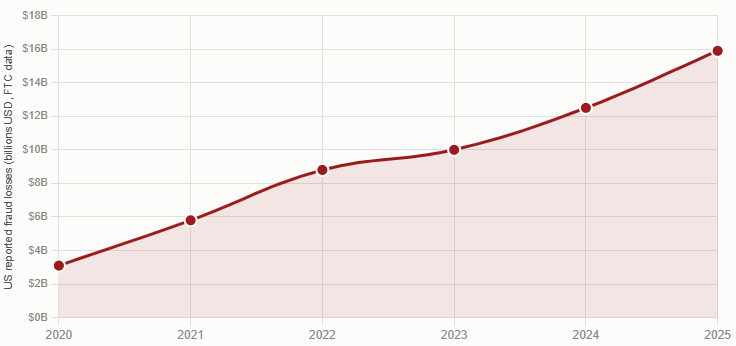
Fraud Losses Trajectory 2020 to 2025
Losses By Fraud Category 2025
Table of Contents
- The Fraud Tsunami and Its Scale
- The Fraud Loss Trajectory: From $5.8 Billion to $15.9 Billion in Four Years
- The Major Fraud Categories Driving Losses in 2025–2026
- Cause #1: Artificial Intelligence Has Made Fraud Exponentially Easier
- Cause #2: Deepfakes Have Eliminated the ‘Trust Your Senses’ Defence
- Cause #3: The Digital Economy Has Created More Entry Points
- Cause #4: Social Media Has Become the Primary Fraud Distribution Channel
- Cause #5: Economic Pressure Has Increased Both Fraud Attempts and Victim Vulnerability
- Cause #6: Identity Data Breaches Provide Ready-Made Fraud Kits
- Cause #7: Under-Reporting Means Fraudsters Face Lower Accountability
- Who Is Being Targeted Most: The Demographics of Fraud
- Business Email Compromise: The Enterprise Fraud Epidemic
- How to Protect Yourself: The Anti-Fraud Action Plan
- What to Do If You Have Already Been Targeted
- Conclusion: The Arms Race Between Fraud and Defence
- Frequently Asked Questions
The Fraud Tsunami and Its Scale
Something structurally different is happening in financial fraud. The Federal Trade Commission received more than 3 million fraud reports in 2025, with total reported losses reaching a record $15.9 billion — up from $12.5 billion in 2024 and $5.8 billion in 2021. That four-year trajectory represents a 174 percent increase in reported losses. From 2020 to 2025, the FTC recorded a 430 percent increase in fraud losses. The FBI’s 2025 Internet Crime Complaint Center Annual Report placed Americans’ reported internet crime losses at $20.9 billion. Nasdaq Verafin’s 2026 Global Financial Crime Report found $579.4 billion lost globally to bank fraud and scams in 2025.These are reported losses. Every major authority on fraud — the FTC, the FBI, the CFPB — acknowledges that reported losses represent a small fraction of actual losses, because most fraud victims do not report. The real scale is substantially larger than any figure in any annual report.
What is causing this rise? The answer is not a single factor. It is a convergence of seven specific structural drivers — technological, economic, behavioral, and institutional — that are simultaneously expanding the scale of fraud, increasing its success rate, reducing the cost of executing attacks, and limiting the accountability that would otherwise deter perpetrators. Understanding these drivers is not just academic; it is the prerequisite for effective personal protection.
The Numbers: Americans lost a record $15.9 billion to fraud in 2025 (FTC, April 2026) — a 430% increase since 2020. Global fraud and scam losses: $579.4 billion (Nasdaq Verafin 2026 Global Financial Crime Report). FBI IC3 reports $20.9 billion in US internet crime losses in 2025. AI-generated scams alone cost consumers nearly $900 million in 2025 (FBI; Signifyd 2026 State of Fraud Report).
The Fraud Loss Trajectory: From $5.8 Billion to $15.9 Billion in Four Years
The FTC’s Consumer Sentinel Network — which has collected consumer fraud reports since 1997 — shows an acceleration that is not a temporary spike but a structural escalation:The most revealing data point in this trajectory is not the dollar figure. It is the conversion rate. In 2023, 27 percent of people who reported a fraud said they lost money. In 2024, that figure jumped to 38 percent — a 40 percent increase in the proportion of victims who were successfully defrauded, in just one year. This means scams are not just growing in volume; they are becoming dramatically more effective at completing the conversion from contact to loss.
FTC Official Lois Greisman (testimony before Joint Economic Committee, March 2026): The increase in fraud losses is not being driven by an increase in fraud reports, which remained relatively stable. What changed is the percentage of people who reported losing money — that figure jumped significantly, suggesting scammers are converting contacts into losses far more efficiently than before.
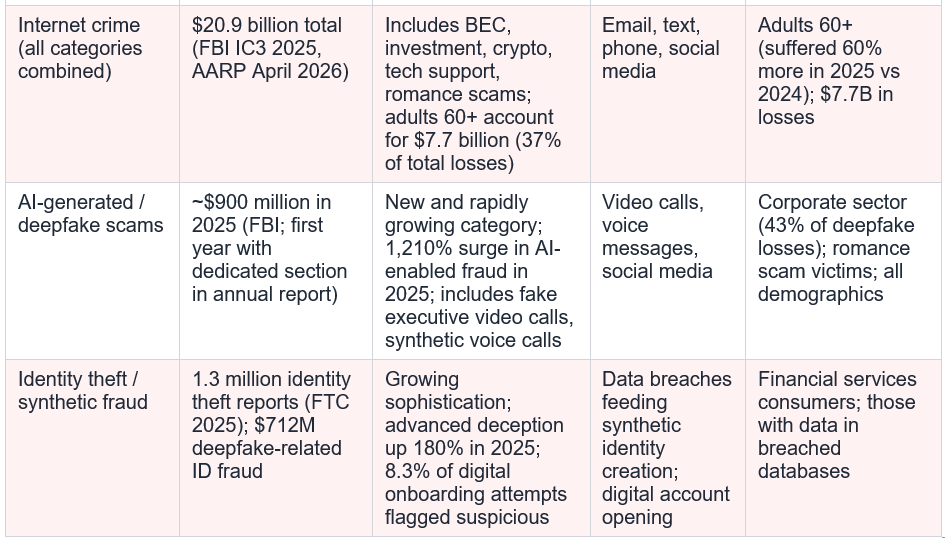
The Major Fraud Categories Driving Losses in 2025–2026
Cause #1: Artificial Intelligence Has Made Fraud Exponentially Easier
Cause #1: AI Has Made Fraud Faster, Cheaper, Smarter, and More Scalable
The first and most significant driver of rising financial fraud is the democratisation of artificial intelligence as a fraud tool. Interpol estimates that AI-powered fraud schemes are 4.5 times more lucrative than conventional attacks (Signifyd 2026 State of Fraud Report). Generative AI-enabled fraud surged 1,210 percent in 2025, per Vectra AI’s March 2026 analysis. For the first time in its 26-year history, the FBI’s annual cybercrime report included a dedicated section on AI-generated scams, which cost consumers nearly $900 million in 2025 alone.The specific ways AI has transformed fraud economics:
- Phishing at scale: traditionally, phishing required manually crafted emails that native English speakers often found easy to identify by their grammatical errors and implausible scenarios. AI now generates grammatically perfect, contextually sophisticated phishing messages in seconds, in any language, personalised to the target using information scraped from public social media profiles. The barrier to executing a convincing phishing attack has collapsed.
- Voice cloning: AI voice synthesis tools can replicate a specific person’s voice from as little as three seconds of audio. Fraudsters use this to impersonate family members, executives, or authority figures in phone calls, creating urgent scenarios (‘I’ve been arrested, I need bail money immediately’) that would previously have required an actual person on the phone.
- Automated social engineering at scale: AI allows fraudsters to conduct thousands of simultaneous personalised social engineering conversations, where before a human fraudster could only manage one or a few at a time. The Signifyd 2026 State of Fraud Report describes this as ‘automated social engineering’ that has made people the latest attack surface, with each link in the fraud supply chain working at a scale and speed never before possible.
- Document forgery: AI-assisted forgery rose to 2 percent of fake documents from zero a year earlier (Sumsub/Security Briefing May 2026). AI can generate convincing fake passports, identity documents, pay stubs, and financial statements that defeat traditional identity verification systems.
Cause #2: Deepfakes Have Eliminated the ‘Trust Your Senses’ Defence
Cause #2: Deepfakes Have Made ‘Seeing and Hearing’ No Longer Reliable as Verification
Total global deepfake fraud losses between January 2019 and March 2026 reached $2.19 billion, with $1.65 billion of that occurring in 2025 alone, according to Surfshark’s April 2026 deepfake study cited by The World Data. US losses reached $712 million in total, with 43 percent hitting the corporate sector through executive impersonation scams.The most notorious example crystallises the risk: an Arup engineering firm employee in Hong Kong lost $25.6 million when a finance worker was convinced to authorise wire transfers during a video call featuring what appeared to be the company’s CFO and other colleagues. Every person on that call was a deepfake. The worker had no reason to doubt what he saw and heard. His senses provided no warning because the deception was technologically indistinguishable from reality in real time.
The dominant deepfake fraud type globally is celebrity and government impersonation in investment scams — accounting for $1.13 billion, or 52 percent of all deepfake fraud losses, through March 2026 (Surfshark/The World Data). These scams feature AI-generated video of recognisable public figures — politicians, billionaires, sports stars — appearing to endorse fraudulent investment platforms. The familiar face creates a false sense of credibility that bypasses normal scepticism.
The problem is expected to intensify. Predictions for 2026 highlight stolen biometric data as a new vector for synthetic identity creation (BIIA, January 2026). As biometric verification — face ID, voice recognition — becomes more common as an authentication method, deepfake technology targeting those biometric signatures represents the next frontier of fraud risk.
Red Flag: Seeing someone on a video call is no longer reliable verification that the person is who they appear to be. Hearing a familiar voice is no longer reliable verification. Any unexpected request involving money, credentials, or sensitive information — regardless of how convincing the verification appears — should be verified through an independently initiated contact using a number or method you control, not one provided in the suspicious interaction.
Cause #3: The Digital Economy Has Created More Entry Points
Cause #3: Digitalisation Has Multiplied the Attack Surface for Financial Fraud
The rapid expansion of digital financial services — mobile banking, instant payment systems, cryptocurrency exchanges, digital wallets, buy-now-pay-later platforms, and online investment accounts — has created an exponentially larger attack surface than existed a decade ago. Each new financial product or platform represents a potential entry point for fraud.BIIA’s January 2026 synthetic identity fraud analysis found that 8.3 percent of digital onboarding attempts were flagged as suspicious in early 2025. Fraudulent activity in financial services rose approximately 21 percent between 2024 and 2025 (BIIA). The specific digital friction points that fraudsters exploit:
- Digital account opening: the same friction reduction that makes it easy for legitimate customers to open accounts also makes it easy for fraudsters using synthetic identities. Synthetic identity fraud — combining real data elements (like a real Social Security number) with fabricated information to create a new, non-existent person — is the fastest-growing fraud category in banking.
- Instant payment systems: the speed that makes instant payments attractive to consumers also makes fraud recovery nearly impossible. Bank transfers and cryptocurrency transactions — the payment methods preferred by fraudsters (as reported by the FTC) — are frequently irreversible once completed. The FTC found that consumers reported losing more money to bank transfers and cryptocurrency combined than to all other payment methods in 2024.
- Authorised Push Payment (APP) fraud: APP fraud accounts for 17 percent of fraud incidents and 16 percent of overall losses (BIIA). It is particularly insidious because the victim authorises the payment themselves, believing it to be legitimate — making reversal difficult and placing legal responsibility on the consumer rather than the bank in many jurisdictions.
- Crypto platforms: the combination of irreversibility, pseudonymity, and limited regulation makes cryptocurrency the preferred exit channel for fraud proceeds. Investment fraud — specifically cryptocurrency investment fraud — generated $7.9 billion in losses in 2025, the largest single fraud category by dollar amount.
Cause #4: Social Media Has Become the Primary Fraud Distribution Channel
Cause #4: Social Media Is Now the Primary Channel for High-Value Fraud Contact
Text message was the top fraud contact method by volume in 2025 — but social media was the top contact method by dollar losses, with consumers reporting more than $2 billion in losses from scams that started on social media (FTC, 2025 data). This combination — text for volume, social media for high-value targeting — reflects fraudsters’ sophisticated use of different channels for different purposes.Social media enables fraud in several specific ways:
- Intelligence gathering: public social media profiles provide fraudsters with the detailed personal information needed to personalise attacks — names of family members, employers, recent events, relationship statuses, financial interests. A fraudster who knows a target recently attended a specific university, has a grandson named Jack, and is interested in cryptocurrency has everything needed to craft a highly convincing imposter or investment scam.
- Romantic and relationship fraud: the FTC noted that the most common scam type in 2025 involved someone pretending to be someone else. Romantic scams that begin on social media or dating apps lead victims through weeks or months of relationship-building before the financial request arrives. The OmniWatch analysis found this category is now so prominent that social media has become a primary vector for both initiation and trust-building.
- Fake investment groups and communities: fraudsters create convincing investment communities, groups, and pages that appear to offer legitimate market insights. These serve as the incubation environment for pig-butchering scams — long-duration investment frauds where victims are gradually persuaded to invest increasing amounts into fraudulent platforms before the perpetrator disappears with the funds.
- Platform advertising gaps: fraudulent investment ads featuring deepfake celebrities can appear on major social media platforms before detection systems remove them. The period between posting and removal is sufficient for significant victim contact and persuasion.
Cause #5: Economic Pressure Has Increased Both Fraud Attempts and Victim Vulnerability
Cause #5: Economic Stress Simultaneously Increases Fraud Supply and Demand
Financial fraud operates in a market with a supply side (fraudsters) and a demand side (people susceptible to fraud offers). Economic pressure increases both simultaneously. On the supply side: financial stress and unemployment increase the pool of people willing to commit fraud. On the demand side: financial stress increases the number of people who are desperate enough to take risks with ‘too-good-to-be-true’ investment opportunities, job offers, or loan relief programmes that turn out to be fraud.The job scam data illustrates this dynamic clearly. OmniWatch’s 2025 analysis found that job scams continue to soar amid economic uncertainty, with scam exposure and victimisation significantly higher among active job seekers. While 25 percent of Americans report personal scam experience generally, that figure rises to 28 percent among LinkedIn users — identifying job-search platforms as a concentrated risk environment. People who are financially stressed and actively seeking employment are more willing to take opportunities that require upfront payments, personal information, or non-standard hiring processes.
The investment fraud connection is equally clear. The FTC found that nearly half of all money lost in 2025 was tied to investment scams. Eighty percent of investment scams result in financial loss, with a median loss of $10,000 per victim (OmniWatch). People who feel their financial trajectory is not adequate to their retirement or lifestyle goals are more susceptible to fraudulent investments that promise above-market returns. The pig-butchering scam specifically exploits this by developing a genuine romantic or friendship relationship before pivoting to investment.
Cause #6: Identity Data Breaches Provide Ready-Made Fraud Kits
Cause #6: Billions of Stolen Records Power Sophisticated Identity and Account Takeover Fraud
Every major data breach — and there have been thousands in the past decade — releases personal information that fraudsters use immediately or save for future attacks. Names, Social Security numbers, dates of birth, addresses, email addresses, passwords, and financial account details are bought and sold on dark web marketplaces, often within hours of a breach being exploited.The downstream fraud enabled by data breaches includes:
- Synthetic identity fraud: combining a real Social Security number (from a breach) with a fabricated name, date of birth, and address to create a non-existent person who can open credit accounts, apply for loans, and build a fraudulent credit history over months before ‘busting out’ — maxing out all credit and disappearing. Bust-out fraud accounts for 21 percent of all fraud cases (BIIA), the most frequent type.
- Account takeover (ATO): using breached credential pairs (email and password combinations) to access financial accounts whose owners reused passwords across multiple services. Account takeover fraud accounts for 13 percent of fraud occurrences and 12 percent of financial losses (BIIA).
- Credential stuffing: automated mass-testing of stolen username/password pairs against financial institution login systems. Fraudsters run millions of credential pairs against bank and brokerage login portals until a percentage succeed.
- Phishing pre-population: using breached personal data to personalise phishing emails with the target’s name, partial account number, address, or other data that makes the fraudulent communication appear genuine and institution-specific.
Cause #7: Under-Reporting Means Fraudsters Face Lower Accountability
Cause #7: Under-Reporting Creates a Low-Accountability Environment for Fraudsters
The FTC explicitly acknowledges that reported fraud losses are a small fraction of actual losses. Multiple factors keep the majority of fraud victims from reporting:- Embarrassment and shame: fraud victims frequently feel embarrassed that they were deceived, particularly when the fraud involved a romantic relationship or a sophisticated impersonation. This shame prevents reporting and makes it less likely that family members or communities will become informed about the fraud’s tactics.
- Hopelessness about recovery: many victims believe, often correctly, that reporting will not result in recovery of their money, particularly for cryptocurrency fraud or international fraud operations. This perception — whether accurate or not — reduces reporting incentives.
- Unawareness that it was fraud: the FBI’s Operation Level Up found that 78 percent of identified cryptocurrency investment fraud victims were unaware they were being scammed at the time of FBI contact. If a victim does not know they were defrauded, they cannot report it.
- Complexity of reporting: the multiple agencies to which fraud should be reported (FTC, FBI IC3, CFPB, state attorney general, local police) creates confusion about where to start, leading many victims to report nowhere.
Who Is Being Targeted Most: The Demographics of Fraud
Fraud targets are not evenly distributed across the population. The FBI’s 2025 IC3 report reveals stark demographic patterns:The older adult vulnerability data is particularly striking: adults 60 and older lost $7.7 billion in 2025, approximately 60 percent more than in 2024. This group faces multiple compounding risk factors: accumulated retirement assets that represent large potential fraud proceeds; social isolation that makes fraudulent relationship offers more appealing; cognitive changes that can make sophisticated manipulation harder to detect; and the ‘gold courier’ and similar scams that specifically instruct victims to keep transactions secret from family members who might intervene.
Business Email Compromise: The Enterprise Fraud Epidemic
Business Email Compromise (BEC) deserves special attention as the highest-dollar-per-incident fraud category in 2025: $3.047 billion in losses from only 24,768 complaints — an average of $122,955 per incident, and the second-highest loss category overall in the FBI’s IC3 report. BEC specifically targets businesses, government agencies, and non-profits by impersonating trusted email senders — executives, vendors, attorneys, or IT staff — to induce the finance team to authorise a wire transfer to a fraudulent account.The mechanics of a typical BEC attack:
- The fraudster compromises or spoofs the email account of a CEO, CFO, or trusted vendor.
- They monitor the account to understand payment processes, pending deals, and key personnel.
- At a strategically timed moment (approaching a deal close, when the target’s supervisor is travelling), they send an urgent payment instruction to the finance team.
- The instruction appears to come from a legitimate, trusted source. The finance team processes the wire transfer.
- The money enters an account controlled by the fraudsters and is typically moved rapidly through multiple accounts or converted to cryptocurrency within hours.
How to Protect Yourself: The Anti-Fraud Action Plan
Given the seven causes above, effective fraud protection in 2026 requires a layered, updated approach:- Verify independently: any unexpected request for money, credentials, or personal information — regardless of how convincing the source appears — should be verified by independently initiating contact through a known, verified method. Do not call back on a number provided in the suspicious communication.
- Assume AI involvement: voice calls, video calls, and personalised messages that create urgency around money or credentials may involve AI-generated content. The fact that you recognise the voice or face is no longer sufficient verification.
- Freeze your credit: placing a credit freeze at all three major bureaus (Equifax, Experian, TransUnion) prevents new credit accounts from being opened in your name without your explicit release of the freeze. It is free, reversible, and the single most effective protection against synthetic identity and new account fraud.
- Use unique, complex passwords with a password manager: credential stuffing attacks succeed because people reuse passwords. A different, complex password for every financial account — managed by a reputable password manager — eliminates this vulnerability.
- Enable multi-factor authentication (MFA) on all financial accounts: MFA means that a breached password alone is insufficient to access your account. Use an authenticator app rather than SMS-based MFA where possible, as SMS codes can be intercepted through SIM-swapping attacks.
- Monitor financial accounts and credit reports regularly: AnnualCreditReport.com provides free weekly access to reports from all three bureaus. Review each report for accounts, inquiries, and addresses you do not recognise.
- Be especially cautious about investment opportunities: 80 percent of investment scams result in financial loss (OmniWatch). Any investment opportunity that promises above-market returns, requires urgency, cannot be verified through independent research, or comes from an unsolicited contact should be treated as likely fraud.
- Report all suspected fraud immediately: FTC at ReportFraud.ftc.gov; FBI at IC3.gov; CFPB at consumerfinance.gov. Contact your bank or financial institution immediately if funds have been sent. The FBI’s Financial Fraud Kill Chain can freeze funds if contacted quickly.
14. What to Do If You Have Already Been Targeted
If you believe you have been a victim of financial fraud:- Contact your bank or payment provider immediately: if a wire transfer, ACH payment, or bank transfer was involved, contact your financial institution within 72 hours. The FBI recommends acting within 72 hours for the best recovery chance via the Financial Fraud Kill Chain. Ask them to reverse or recall the transaction and flag the receiving account.
- Report to the FBI at IC3.gov: include complete transaction details — amounts, dates, receiving accounts, and all communication with the fraudster. The FBI’s Recovery Asset Team (RAT) coordinates with financial institutions to freeze fraudulent transfers.
- Report to the FTC at ReportFraud.ftc.gov: the FTC uses these reports in law enforcement investigations and shares them with state and federal law enforcement partners.
- File a local police report: some financial institutions and insurance providers require a police report as part of a fraud recovery or claim process.
- Place a fraud alert or credit freeze immediately: if personal information was compromised, contact all three credit bureaus to place a fraud alert (which requires verification before new credit is issued) or a full credit freeze.
- Change all affected passwords and enable MFA: if credentials were compromised, assume those credentials are now for sale. Change passwords for all financial accounts immediately.
Conclusion
Financial fraud is not rising because consumers have become more careless or criminals have become luckier. It is rising because the structural conditions for fraud have been fundamentally transformed: AI has collapsed the cost and expanded the scale of fraud execution; deepfakes have neutralised the sensory verification that historically protected people; the digital economy has multiplied entry points; social media has created the ideal distribution and intelligence-gathering infrastructure for fraud; economic pressure has expanded both the supply and demand side of the fraud market; stolen data from billions of breached records provides ready raw material for sophisticated attacks; and under-reporting sustains the low-accountability environment in which fraud operations thrive.The FTC’s trajectory from $3.1 billion in 2020 to $15.9 billion in 2025 is not an anomaly. It is a trend line. Javelin Strategy & Research and AiPrise project that AI-facilitated fraud losses in the United States alone will reach $40 billion by 2027. The arms race between fraud capabilities and fraud defences is accelerating, and the current trajectory favours the attackers.
The individual response to this environment is not to become paralysed but to become systematically more sceptical, more layered in protection, and more rapid in reporting when suspected fraud occurs. The collective response requires regulators, financial institutions, technology platforms, and law enforcement to treat AI-enabled fraud as the structural national financial security threat that it has become. The $579.4 billion lost globally to bank fraud and scams in 2025 is not a consumer protection statistic. It is an economic emergency.
Frequently Asked Questions
How much did Americans lose to fraud in 2025?Americans lost a record $15.9 billion to fraud in 2025, according to FTC data (KHQ/AP, April 2026; FTC June 2026 press release). This was up from $12.5 billion in 2024 and represents a 430% increase since 2020. Additionally, the FBI's 2025 Internet Crime Complaint Center Annual Report placed total internet crime losses at $20.9 billion, a figure that includes crimes not captured by the FTC's Consumer Sentinel Network. Global bank fraud and scam losses totalled $579.4 billion in 2025, according to Nasdaq Verafin's 2026 Global Financial Crime Report. Reported losses represent only a fraction of actual losses, as the majority of fraud victims do not file official reports.
What is the most common type of financial fraud in 2026?
By volume of complaints, imposter scams were the most commonly reported fraud type in 2025 (the most recent full year of FTC data as of August 2026), with more than 1,005,012 complaints — a 19% increase from 2024 and $3.5 billion in losses (FTC, June 2026). These scams involve criminals impersonating trusted organisations (government agencies, businesses, banks) or trusted individuals (family members, romantic partners) to trick victims into transferring money or disclosing personal information. By dollar losses, investment scams (including cryptocurrency and pig-butchering scams) were the largest category, generating $7.9 billion in losses in 2025 alone.
How is AI being used in financial fraud?
AI is being used in financial fraud in multiple ways: (1) AI-powered phishing generates grammatically perfect, personalised fraudulent messages at scale in seconds. (2) Voice cloning replicates a specific person's voice from as little as three seconds of audio, enabling convincing impersonation in phone calls. (3) Deepfakes generate realistic video calls featuring fabricated participants, used to authorise wire transfers (as in the $25.6 million Arup case). (4) Automated social engineering allows fraudsters to conduct thousands of simultaneous personalised manipulation conversations. (5) AI-assisted document forgery creates convincing fake identity documents. Interpol estimates AI-powered fraud schemes are 4.5 times more lucrative than conventional attacks. AI-generated scams cost consumers nearly $900 million in 2025 — the first year the FBI dedicated a section to AI-generated fraud in its annual report.
Who is most at risk from financial fraud?
Different demographic groups face different fraud risks. Adults aged 60 and older lost $7.7 billion to internet crimes in 2025 — approximately 37% of all reported internet crime losses and a 60% increase from 2024 (FBI IC3, AARP April 2026). This group is disproportionately targeted for investment fraud, romance scams, tech support scams, and lottery scams. However, younger adults are not immune: FTC data shows 51% of complainants under age 20 who report a fraud say they lost money — the highest loss rate of any age group. Adults aged 40-49 face the highest combined risk due to asset accumulation combined with high digital engagement. Job seekers face elevated risk: scam exposure is higher among LinkedIn users (28% report personal scam experience vs 25% generally).
What should I do immediately if I think I have been scammed?
Act within 72 hours for the best recovery chance: (1) Contact your bank or financial institution immediately. Ask them to reverse the transfer and flag the receiving account. The FBI's Financial Fraud Kill Chain operates through coordinated bank-to-bank freezes. (2) Report to the FBI at IC3.gov — include all transaction details, dates, amounts, receiving accounts, and all communication with the fraudster. (3) Report to the FTC at ReportFraud.ftc.gov. (4) File a local police report. (5) Contact all three credit bureaus (Equifax, Experian, TransUnion) to place a fraud alert or credit freeze if personal information was compromised. (6) Change all passwords for affected accounts and enable multi-factor authentication. The FBI's Financial Fraud Kill Chain handled 3,900 incidents in 2025, freezing $679 million. Speed is essential — cryptocurrency and wire transfer fraud proceeds are typically moved within hours of receipt.
What is pig-butchering fraud?
Pig-butchering (also called SHA ZHU PAN or 'romance investment scam') is a sophisticated long-duration fraud that combines relationship manipulation with cryptocurrency investment fraud. The fraudster develops a genuine-seeming romantic or friendship relationship with the target over weeks or months — building trust before pivoting to introduce a 'high-return' cryptocurrency investment opportunity. The victim invests increasing amounts, sometimes seeing apparent returns, until the fraudster disappears with all accumulated funds. The name refers to 'fattening the pig before slaughter.' Investment scams, of which pig-butchering is a major component, generated $7.9 billion in losses in 2025 (The World Data/FTC). The median loss is $10,000 per victim, and 80% of investment scam contacts result in financial loss (OmniWatch 2025).
0 Comments
Be the first to share your thoughts on this article.