

AI for Personal Finance
How to Fact-Check AI Financial Advice in 8 Steps

AI chatbots gave incorrect financial answers 57% of the time in the largest study conducted. 66% of Americans use them for financial advice. Here is exactly how to verify what you are told before you act on it.
AI financial tools have become one of the most widely used sources of financial guidance in 2026. A Credit Karma survey cited by CBS News in March 2026 found that 66% of US adults and 82% of Gen Z and millennials have used generative AI for financial advice. The confidence with which AI chatbots answer financial questions is part of what makes them useful and part of what makes them dangerous. The Saturn research, published in September 2026, tested 18 major AI models including ChatGPT, Claude, Copilot, Gemini, and Grok against 121 financial questions. Across more than 10,000 queries, 57% of answers were incorrect on average. Errors included calculation mistakes, omission of critical risk warnings, failure to account for tax changes, and the invention of financial rules that do not exist. Over half of people who acted on AI financial advice in a separate study made a poor financial decision as a result. The eight steps in this article are a systematic framework for verifying AI financial output before it influences any real-world decision.
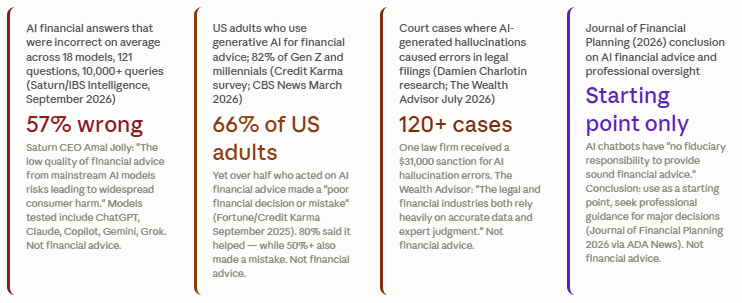
The Saturn study, the largest of its kind, tested 18 major AI models across 10,000+ queries and found 57% of answers were incorrect on average. The Fortune report on Credit Karma’s survey found that over half of those who acted on AI financial advice made a poor financial decision or mistake. The mismatch between the 80% who said AI helped them and the 50%+ who made poor decisions from following it may reflect the partial accuracy of AI responses: it can be correct enough to sound helpful while wrong in the specific factual detail that determines the outcome. .
Saturn / IBS Intelligence (September 2026): 57% of AI financial answers incorrect on average across 18 models, 10,000+ queries. Fortune / Credit Karma: 82% of Gen Z/millennials use AI for financial advice; 50%+ who acted on it made a poor decision. FCA: 26% of UK adults trust chatbots for financial advice. Sources cited.
Amal Jolly, CEO of Saturn (IBS Intelligence September 2026): 'The low quality of financial advice from mainstream AI models risks leading to widespread consumer harm.' Expert Braz (The Intermediary January 2025): 'Where the subject matter is as serious as personal finances, overuse of AI can have a significant negative impact.' Journal of Financial Planning (2026): AI chatbots have 'no fiduciary responsibility to provide sound financial advice.
Before fact-checking, write down: (a) what type of claim it is — fact, principle, personalised, or regulatory; (b) which jurisdiction it applies to; (c) what the financial consequence would be if the claim is wrong. The higher the consequence, the more thorough the verification.
For any rate, limit, threshold, or rule: identify the primary source (IRS.gov for US tax, Gov.uk/HMRC for UK tax, FINRA for US investment rules, FCA for UK), go directly to it, and verify the specific figure. Do not use AI to verify AI.
Bookmark five primary sources for your jurisdiction: for US — IRS.gov, SEC.gov, FINRA.org; for UK — Gov.uk/HMRC, FCA.org.uk, Pension-regulator.gov.uk. For any AI financial figure, spend 2 minutes finding it at the primary source before acting on it.
After receiving an AI financial response: ask 'What are your sources for this?' Then manually search for each source independently (not via AI-provided links). Open each source and find the exact claim. If you cannot find it in the source cited, treat the claim as unverified.
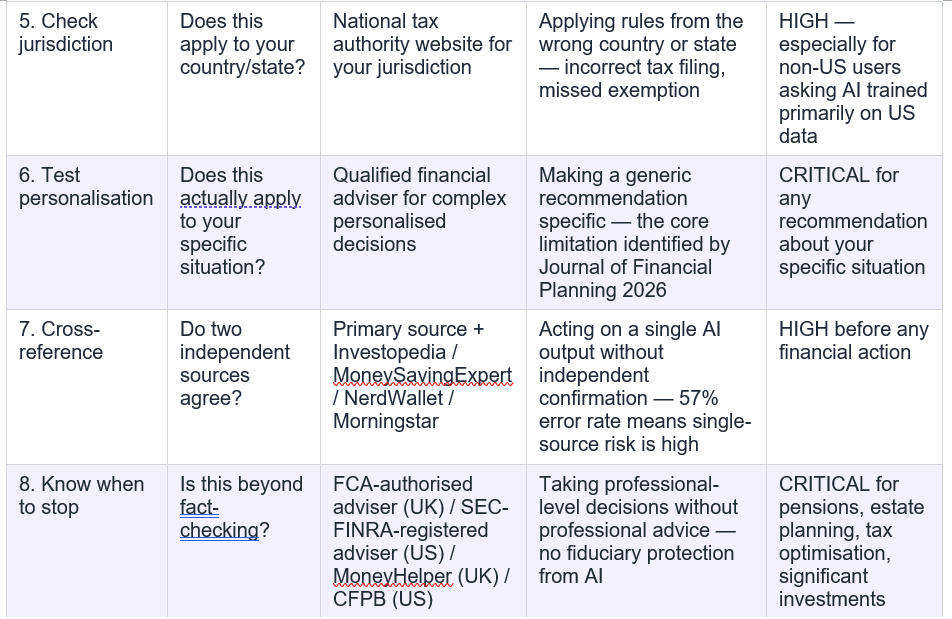
Explicitly state your jurisdiction in any financial question to an AI: 'In the UK...' or 'For a US resident...' or 'Under California state tax rules...' Then verify the specific rule cited at the relevant national or regional authority's website.
For any AI recommendation about what you specifically should do with your money: write down the three most important facts about your situation (income level, existing debts, jurisdiction). Ask whether the recommendation would change if those facts were different. If yes: take the AI output as a starting point only and verify with a qualified professional.
For any AI financial claim before acting on it: check the primary source (IRS, FCA, HMRC, SEC for jurisdiction-specific rules) AND one established financial education source (Investopedia, MoneySavingExpert, NerdWallet, or equivalent). Both must support the claim. If they diverge: treat the AI output as unverified.
For any financial decision involving: pension transfers; estate planning; tax-optimisation for significant sums; property; or business finance — stop verifying AI output and consult a regulated, qualified professional. In the UK: FCA authorised adviser. In the US: SEC/FINRA registered adviser. Free resources: MoneyHelper (UK), CFPB (US), SHIP (Medicare, US).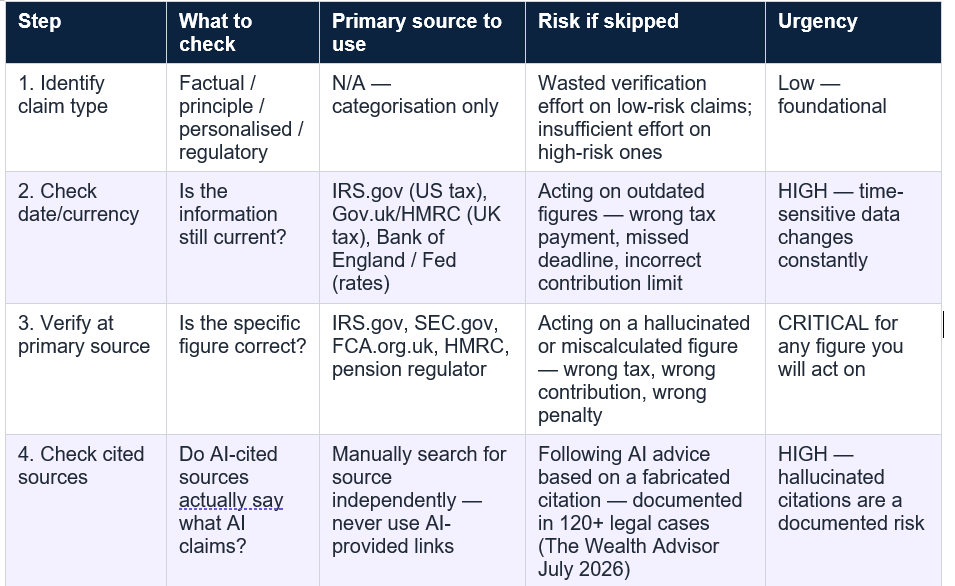
The eight steps in this article are the bridge between those two positions. They allow you to use AI’s genuine strengths — fast explanations of financial concepts, identification of relevant topics to research, quick orientation to complex rules — while applying a systematic filter to everything it tells you before it influences a real-world financial decision. The Saturn study’s 57% error rate and the Credit Karma finding that over half of AI-advised users made poor decisions are not arguments for avoiding AI financial tools entirely. They are arguments for never accepting AI financial output without the eight verification steps. Not financial advice. For decisions with significant financial consequences, consult a regulated financial adviser. In the UK: MoneyHelper (moneyhelper.org.uk) or FCA register (register.fca.org.uk). In the US: CFPB (consumerfinance.gov) or FINRA’s BrokerCheck (brokercheck.finra.org).
Significantly less accurate than most users assume. The Saturn research, published September 2026, tested 18 major AI models (ChatGPT, Claude, Copilot, Gemini, Grok and others) across 121 financial questions repeated 5 times each — more than 10,000 total queries. The result: 57% of answers were incorrect on average. Error types included calculation errors, omission of critical risk warnings, failure to account for upcoming tax changes, and the invention of financial rules that do not exist. A separate study by Investing in the Web (reported by The Intermediary) found ChatGPT gave incorrect answers to 35% of finance questions, with 29% incomplete or misleading and 6% outright wrong. A Credit Karma survey (September 2025, n=1,000+) found that over half of those who used AI for financial advice and acted on it made a poor financial decision or mistake. Sources: Saturn / IBS Intelligence September 2026; The Intermediary January 2025; Fortune / Credit Karma September 2025.
Can AI give personalised financial advice?
No — not in a meaningful sense. The Journal of Financial Planning's 2026 study examined seven generative AI chatbots across core planning domains including emergency savings, asset allocation, investment portfolios and retirement withdrawals. The conclusion: AI chatbots were capable of offering broad overviews of financial topics and principles, but were incapable of providing appropriate recommendations according to personal financial situations. This limitation is structural, not fixable by better prompting: AI does not know your full financial picture — your actual income, tax status, existing debts, pension entitlements, insurance, family dependants, risk tolerance, or country-specific rules — unless you tell it all of that in a single conversation, which most users do not. Critically, the Journal of Financial Planning study noted that generative AI chatbots have no fiduciary responsibility to provide sound financial advice — meaning no legal obligation to act in your interest. Source: Journal of Financial Planning 2026 via ADA News 2026.
What are AI hallucinations in financial advice?
AI hallucinations in financial advice are instances where the AI generates specific, confident-sounding information — a figure, a rule, a regulation, a citation — that does not correspond to anything real. The Saturn research found AI models 'invented rules that did not exist' in their financial answers. The Investing in the Web study found that one in three ChatGPT finance answers involved hallucinations (Fortune September 2025). In the professional context, The Wealth Advisor (July 2026) documented at least 120 court cases where AI-generated hallucinations caused errors in legal filings, with one firm receiving a $31,000 sanction. In financial advice, hallucinations are particularly dangerous because they are indistinguishable in style from accurate information — AI presents invented rules with the same confidence as accurate ones. The fact-checking steps most relevant to hallucinations are Step 3 (verify at primary source), Step 4 (check cited sources independently), and Step 7 (cross-reference with two independent sources). Sources: Saturn/Silicon.co.uk; The Wealth Advisor July 2026; Fortune September 2025.
Should I use AI for financial advice at all?
The consensus from multiple research studies and expert commentators is nuanced: yes for education and orientation, no as a substitute for professional advice. The Journal of Financial Planning (2026) concluded that individuals can use AI as a starting point for assessing financial matters but should seek professional guidance for major decisions. CBS News analyst Jill Schlesinger (March 2026) advised using AI for basic education but consulting regulated professionals for actual decisions. Expert Braz, quoted by The Intermediary (January 2025), recommended using AI 'early in the research process, to help clarify terms or shed light on a general topic.' The areas where AI financial tools carry the most risk — pension planning, estate planning, tax optimisation, investment portfolios — are exactly the areas where professional advice is most valuable and most accessible. In the UK: MoneyHelper (free guidance service). In the US: CFPB consumer resources. Neither AI tools nor these articles are substitutes for a regulated financial adviser. Sources: Journal of Financial Planning 2026; The Intermediary January 2025; CBS News March 2026.
How do I find a trustworthy financial adviser to verify AI outputs?
In the UK: The Financial Conduct Authority's financial services register at register.fca.org.uk allows you to verify whether any adviser is authorised. MoneyHelper (moneyhelper.org.uk) provides free financial guidance and a directory of regulated advisers. UNBIASED.co.uk provides a directory of Independent Financial Advisers (IFAs). In the US: FINRA's BrokerCheck (brokercheck.finra.org) allows you to verify whether a broker or investment adviser is registered. The SEC's Investment Adviser Public Disclosure database (adviserinfo.sec.gov) covers registered investment advisers. The CFPB (consumerfinance.gov) provides free consumer guidance. For pensions specifically in the US: SHIP (State Health Insurance Assistance Program) provides free Medicare counselling. The key distinction: a regulated adviser has a legal duty (fiduciary or suitability standard) to act in your interest. An AI has no such duty. Sources: FCA; FINRA; SEC; MoneyHelper.
AI financial tools have become one of the most widely used sources of financial guidance in 2026. A Credit Karma survey cited by CBS News in March 2026 found that 66% of US adults and 82% of Gen Z and millennials have used generative AI for financial advice. The confidence with which AI chatbots answer financial questions is part of what makes them useful and part of what makes them dangerous. The Saturn research, published in September 2026, tested 18 major AI models including ChatGPT, Claude, Copilot, Gemini, and Grok against 121 financial questions. Across more than 10,000 queries, 57% of answers were incorrect on average. Errors included calculation mistakes, omission of critical risk warnings, failure to account for tax changes, and the invention of financial rules that do not exist. Over half of people who acted on AI financial advice in a separate study made a poor financial decision as a result. The eight steps in this article are a systematic framework for verifying AI financial output before it influences any real-world decision.
Table of Contents
- Why This Problem Is Bigger Than Most People Realise
- What AI Gets Wrong: The Main Failure Types
- Step 1: Identify What Type of Claim You Are Being Given
- Step 2: Check the Date — AI Has a Knowledge Cutoff
- Step 3: Verify Every Figure Against the Primary Source
- Step 4: Ask the AI for Its Sources — Then Actually Check Them
- Step 5: Check Whether the Advice Accounts for Your Jurisdiction
- Step 6: Test for Personalisation — Does This Apply to Your Specific Situation?
- Step 7: Cross-Reference With at Least Two Independent Sources
- Step 8: Know When to Stop and Consult a Regulated Professional
- The Fact-Checking Reference Table
- Conclusion: Use AI as a Starting Point, Not a Final Answer
- Frequently Asked Questions
Why This Problem Is Bigger Than Most People Realise
The scale of AI adoption for financial guidance in 2026 has outpaced both public awareness of its limitations and any regulatory framework to manage them. A Credit Karma survey cited by CBS News in March 2026 found that 66% of US adults and 82% of Gen Z and millennials had used generative AI for financial advice. The Financial Conduct Authority’s own research, published shortly before the Saturn study, found that 26% of UK adults trusted general-purpose chatbots such as ChatGPT and Claude for financial advice. The FCA’s response — saying it is considering whether financial advice from chatbots should be regulated — reveals the regulatory gap: at present, there is no requirement for AI financial tools to be accurate, no fiduciary duty, and no redress mechanism if AI financial advice leads to financial harm.The Saturn study, the largest of its kind, tested 18 major AI models across 10,000+ queries and found 57% of answers were incorrect on average. The Fortune report on Credit Karma’s survey found that over half of those who acted on AI financial advice made a poor financial decision or mistake. The mismatch between the 80% who said AI helped them and the 50%+ who made poor decisions from following it may reflect the partial accuracy of AI responses: it can be correct enough to sound helpful while wrong in the specific factual detail that determines the outcome. .
Saturn / IBS Intelligence (September 2026): 57% of AI financial answers incorrect on average across 18 models, 10,000+ queries. Fortune / Credit Karma: 82% of Gen Z/millennials use AI for financial advice; 50%+ who acted on it made a poor decision. FCA: 26% of UK adults trust chatbots for financial advice. Sources cited.
What AI Gets Wrong: The Main Failure Types
Understanding the failure categories makes it easier to know what to check. The Saturn research and the Investing in the Web study between them identified the following systematic failure types in AI financial advice:- Calculation errors — incorrect figures for tax owed, compound interest, investment returns, or pension contributions.
- Outdated information — interest rates, tax bands, contribution limits, and regulatory thresholds that have changed since the AI’s training data.
- Hallucinated rules — financial regulations, tax treatments, or product rules invented by the AI that do not exist in any jurisdiction.
- Missing risk warnings — omission of important caveats about investment risk, suitability, or regulatory requirements.
- No personalisation — generic advice that does not account for the user’s income, tax status, jurisdiction, or circumstances.
- No fiduciary duty — AI has no legal obligation to act in the user’s best interest, unlike a regulated financial adviser.
- Jurisdiction errors — applying the rules or rates of one country to a question asked in another context.
- Fabricated citations — citing real-sounding sources that do not exist or misattributing claims to real sources.
Amal Jolly, CEO of Saturn (IBS Intelligence September 2026): 'The low quality of financial advice from mainstream AI models risks leading to widespread consumer harm.' Expert Braz (The Intermediary January 2025): 'Where the subject matter is as serious as personal finances, overuse of AI can have a significant negative impact.' Journal of Financial Planning (2026): AI chatbots have 'no fiduciary responsibility to provide sound financial advice.
Step 1: Identify What Type of Claim You Are Being Given
Not all AI financial output carries the same risk. Before checking anything, it helps to categorise what you have been told. There are four types of AI financial claim, each with a different verification priority. First, factual claims: specific figures, rates, limits, or rules (‘the ISA allowance is £20,000’; ‘the standard deduction for 2026 is $14,600’). These are verifiable and should always be checked against the primary source. Second, general principles: broad descriptions of how financial instruments work (‘a Roth IRA grows tax-free’; ‘diversification reduces unsystematic risk’). These are lower risk but can still be oversimplified or jurisdiction-specific. Third, personalised recommendations: any advice that says what you specifically should do (‘you should contribute more to your 401k’; ‘you would benefit from remortgaging’). These require a regulated adviser because they depend on your specific circumstances, and the Journal of Financial Planning’s 2026 study found AI chatbots ‘incapable of providing appropriate recommendations according to personal financial situations.’ Fourth, regulatory or tax information: anything involving current rules, thresholds, penalties, or deadlines. The Saturn research found AI models frequently ‘ignored upcoming tax changes or invented rules that did not exist.’ Step one is to put the claim in the right bucket before choosing the right verification approach.Before fact-checking, write down: (a) what type of claim it is — fact, principle, personalised, or regulatory; (b) which jurisdiction it applies to; (c) what the financial consequence would be if the claim is wrong. The higher the consequence, the more thorough the verification.
Step 2: Check the Date — AI Has a Knowledge Cutoff
The single most common source of AI financial inaccuracy is not hallucination — it is temporal decay. AI models are trained on data up to a specific date and do not automatically update when rules, rates, or limits change. Tax bands change annually. Contribution limits change with inflation adjustments. Interest rates change with central bank decisions. Regulation changes with new legislation. The Investing in the Web study expert Braz, quoted by The Intermediary in January 2025, made this point precisely: ‘For information and data that is subject to change such as interest rates, the current performance of specific stocks, or the average pension, it is usually best to go to the very source of the information, rather than asking AI chatbots for data, as ChatGPT has well-recognised issues with up-to-date information.’ The Saturn research confirmed that among the errors identified across 10,000+ queries, AI models failing to account for upcoming tax changes was a systematic failure type, not an isolated one. The practical check: for any factual claim about a rate, limit, threshold, date, or percentage, ask ‘when was this information last correct?’ and then go to the primary source to verify the current figure.For any rate, limit, threshold, or rule: identify the primary source (IRS.gov for US tax, Gov.uk/HMRC for UK tax, FINRA for US investment rules, FCA for UK), go directly to it, and verify the specific figure. Do not use AI to verify AI.
Step 3: Verify Every Figure Against the Primary Source
Primary sources are the original publishers of financial data, rules, and regulation. They are the only fully reliable endpoint for verifying specific financial figures. The Saturn study found calculation errors were one of the most frequent failure types across 10,000+ AI financial queries. The Investing in the Web study found that 29% of ChatGPT’s financial answers were incomplete or misleading even when not outright wrong — a category that includes presenting a correct headline figure alongside an incorrect calculation or context. The Intermediary expert guidance was direct: cross-reference with trusted sites, especially for significant financial decisions. For US tax information, the primary source is IRS.gov. For UK tax and pension rules, it is Gov.uk and HMRC. For investment and securities rules in the US, it is SEC.gov and FINRA.org. For UK investment regulation, it is FCA.org.uk. For specific fund costs and holdings, it is the fund provider’s factsheet. For interest rates, it is the Bank of England or Federal Reserve directly. Never use one AI answer to verify another AI answer. Never use a financial news article as the primary verification — check the original source the article cites.Bookmark five primary sources for your jurisdiction: for US — IRS.gov, SEC.gov, FINRA.org; for UK — Gov.uk/HMRC, FCA.org.uk, Pension-regulator.gov.uk. For any AI financial figure, spend 2 minutes finding it at the primary source before acting on it.
Step 4: Ask the AI for Its Sources — Then Actually Check Them
If you are using an AI that can cite sources (which includes most current models), asking for sources is a necessary but not sufficient step in fact-checking. The Investing in the Web expert recommended: ‘It is always advisable to ask for and check the listed sources from ChatGPT’s answers.’ The key phrase is ‘and check.’ The Wealth Advisor’s July 2026 warning about AI hallucinations in professional contexts is relevant here: its research documented at least 120 court cases where AI-generated hallucinations included fabricated citations — real-sounding document names, real-looking URLs, or citations to real publications with incorrect claims attributed to them. Legal analysts noted that a $31,000 sanction was imposed on a law firm specifically because AI-generated citations proved fictitious. The financial parallel is direct. An AI that tells you ‘according to HMRC guidance published in January 2026...’ may be citing a document that does not exist, citing a real document incorrectly, or accurately citing a document that has since been superseded. The verification step: take the cited source, search for it independently, open it, and find the specific claim within it. If the claim is not findable in the source cited, it is either hallucinated or misattributed.After receiving an AI financial response: ask 'What are your sources for this?' Then manually search for each source independently (not via AI-provided links). Open each source and find the exact claim. If you cannot find it in the source cited, treat the claim as unverified.
Step 5: Check Whether the Advice Accounts for Your Jurisdiction
One of the most systematically missed failure modes in AI financial advice is jurisdiction error: the AI applies the rules, rates, or regulations of one country to a question asked in a different country’s context. Tax rules in the US are completely different from tax rules in the UK, Canada, Australia, or any other country. ISAs are a UK product. 401ks are a US product. Even within the US, state tax rules vary significantly. The Saturn study found that AI models ‘invented rules that did not exist’ — in some cases this may be a jurisdiction error rather than pure hallucination: applying a real rule from the wrong jurisdiction. The Journal of Financial Planning’s 2026 study identified that AI chatbots were ‘incapable of providing appropriate recommendations according to personal financial situations’ — and jurisdiction is a core component of personal financial situations. A practical check: whenever AI provides a specific tax rule, rate, or financial regulation, ask explicitly: ‘Does this apply in [my country/state/province]?’ and then verify it at the local primary source. Do not assume that a confident-sounding answer has correctly identified the applicable jurisdiction.Explicitly state your jurisdiction in any financial question to an AI: 'In the UK...' or 'For a US resident...' or 'Under California state tax rules...' Then verify the specific rule cited at the relevant national or regional authority's website.
Step 6: Test for Personalisation — Does This Apply to Your Specific Situation?
The Journal of Financial Planning’s 2026 study reached a finding that should be read by every person who has asked an AI financial question: the chatbots ‘were incapable of providing appropriate recommendations according to personal financial situations.’ This is not a criticism of their general knowledge — it is a description of a structural limitation. AI does not know your income, your tax status, your existing portfolio, your pension entitlements, your liabilities, your dependants, your risk tolerance, or your financial goals. It knows what you have told it in the current conversation. The advice it gives is therefore necessarily generic, even when phrased personally. CBS News analyst Jill Schlesinger, reporting on Credit Karma’s survey data in March 2026, advised using AI for education but consulting regulated professionals for actual decision-making. The ADA News 2026 summary of the Journal of Financial Planning study put it directly: ‘Investigators stressed that generative AI responses can be based on incorrect, incomplete or outdated information, creating limitations that can lead to poor financial strategies. Generative AI chatbots have no fiduciary responsibility to provide sound financial advice.’ The personalisation test: for any AI-generated financial recommendation, ask ‘would this advice change if my income were different? If I had different debts? If I lived in a different country? If my tax status were different?’ If the answer to any of those questions is yes, the advice requires personalisation that an AI cannot provide.For any AI recommendation about what you specifically should do with your money: write down the three most important facts about your situation (income level, existing debts, jurisdiction). Ask whether the recommendation would change if those facts were different. If yes: take the AI output as a starting point only and verify with a qualified professional.
Step 7: Cross-Reference With at Least Two Independent Sources
The Investing in the Web study expert’s guidance, quoted by The Intermediary, was specific: ‘cross-reference its main points with other trusted sites, especially when dealing with financial inquiries that may have a significant impact on our lives.’ The standard verification principle in journalism, academic research, and professional practice is convergence: if two or three independent sources report the same figure or rule, confidence increases substantially. In the context of AI financial fact-checking, the cross-reference rule has a specific requirement: the sources must be genuinely independent. Using a different AI model to verify the first is not independent verification — they may have been trained on the same data and share the same errors. Using a financial news article that itself cites an AI summary is not independent. The two categories of independent sources that provide genuine cross-verification are: primary regulatory sources (IRS, FCA, HMRC, SEC) and reputable established financial education sources (Investopedia, MoneySavingExpert, NerdWallet, Morningstar). Both should align with the AI’s claim before the claim can be considered reliably verified. The Fortune report on the Credit Karma study found that over half of those who used AI for financial advice ‘made a poor financial decision or mistake’ — independent cross-referencing addresses the mechanism that produces those mistakes.For any AI financial claim before acting on it: check the primary source (IRS, FCA, HMRC, SEC for jurisdiction-specific rules) AND one established financial education source (Investopedia, MoneySavingExpert, NerdWallet, or equivalent). Both must support the claim. If they diverge: treat the AI output as unverified.
Step 8: Know When to Stop and Consult a Regulated Professional
The eighth and most important step in fact-checking AI financial advice is recognising when fact-checking is not sufficient — when the decision is complex enough, personalised enough, or consequential enough that it requires a human expert with a fiduciary duty. The Journal of Financial Planning’s 2026 study conclusion was clear: ‘Individuals can use generative AI chatbots as a starting point when assessing financial matters but should seek professional guidance when making major financial decisions.’ CBS News analyst Jill Schlesinger, citing the Stanford study and Credit Karma survey data, was equally direct: use AI for education but consult regulated professionals for actual decisions. The categories that consistently require professional advice rather than AI verification include: pension transfers and retirement planning; tax optimisation for significant assets; inheritance and estate planning; remortgaging or significant property decisions; business financial planning; and any investment involving amounts that would materially affect your financial security. Saturn CEO Amal Jolly’s comment to IBS Intelligence in September 2026 captures the structural issue: ‘The low quality of financial advice from mainstream AI models risks leading to widespread consumer harm.’ Fact-checking mitigates some of that risk. It does not eliminate it. A regulated adviser — FCA-authorised in the UK, SEC/FINRA-registered in the US — has a legal duty to provide advice suitable for your specific circumstances. No AI has this.For any financial decision involving: pension transfers; estate planning; tax-optimisation for significant sums; property; or business finance — stop verifying AI output and consult a regulated, qualified professional. In the UK: FCA authorised adviser. In the US: SEC/FINRA registered adviser. Free resources: MoneyHelper (UK), CFPB (US), SHIP (Medicare, US).
The Fact-Checking Reference Table
Conclusion
The Journal of Financial Planning’s 2026 study reached a conclusion that balances both sides of the AI financial advice question: individuals can use AI chatbots as a starting point when assessing financial matters, but should seek professional guidance when making major financial decisions. CBS News analyst Jill Schlesinger offered the same framework: use AI for education, consult regulated professionals for decisions.The eight steps in this article are the bridge between those two positions. They allow you to use AI’s genuine strengths — fast explanations of financial concepts, identification of relevant topics to research, quick orientation to complex rules — while applying a systematic filter to everything it tells you before it influences a real-world financial decision. The Saturn study’s 57% error rate and the Credit Karma finding that over half of AI-advised users made poor decisions are not arguments for avoiding AI financial tools entirely. They are arguments for never accepting AI financial output without the eight verification steps. Not financial advice. For decisions with significant financial consequences, consult a regulated financial adviser. In the UK: MoneyHelper (moneyhelper.org.uk) or FCA register (register.fca.org.uk). In the US: CFPB (consumerfinance.gov) or FINRA’s BrokerCheck (brokercheck.finra.org).
Frequently Asked Questions
How accurate is AI financial advice in 2026?Significantly less accurate than most users assume. The Saturn research, published September 2026, tested 18 major AI models (ChatGPT, Claude, Copilot, Gemini, Grok and others) across 121 financial questions repeated 5 times each — more than 10,000 total queries. The result: 57% of answers were incorrect on average. Error types included calculation errors, omission of critical risk warnings, failure to account for upcoming tax changes, and the invention of financial rules that do not exist. A separate study by Investing in the Web (reported by The Intermediary) found ChatGPT gave incorrect answers to 35% of finance questions, with 29% incomplete or misleading and 6% outright wrong. A Credit Karma survey (September 2025, n=1,000+) found that over half of those who used AI for financial advice and acted on it made a poor financial decision or mistake. Sources: Saturn / IBS Intelligence September 2026; The Intermediary January 2025; Fortune / Credit Karma September 2025.
Can AI give personalised financial advice?
No — not in a meaningful sense. The Journal of Financial Planning's 2026 study examined seven generative AI chatbots across core planning domains including emergency savings, asset allocation, investment portfolios and retirement withdrawals. The conclusion: AI chatbots were capable of offering broad overviews of financial topics and principles, but were incapable of providing appropriate recommendations according to personal financial situations. This limitation is structural, not fixable by better prompting: AI does not know your full financial picture — your actual income, tax status, existing debts, pension entitlements, insurance, family dependants, risk tolerance, or country-specific rules — unless you tell it all of that in a single conversation, which most users do not. Critically, the Journal of Financial Planning study noted that generative AI chatbots have no fiduciary responsibility to provide sound financial advice — meaning no legal obligation to act in your interest. Source: Journal of Financial Planning 2026 via ADA News 2026.
What are AI hallucinations in financial advice?
AI hallucinations in financial advice are instances where the AI generates specific, confident-sounding information — a figure, a rule, a regulation, a citation — that does not correspond to anything real. The Saturn research found AI models 'invented rules that did not exist' in their financial answers. The Investing in the Web study found that one in three ChatGPT finance answers involved hallucinations (Fortune September 2025). In the professional context, The Wealth Advisor (July 2026) documented at least 120 court cases where AI-generated hallucinations caused errors in legal filings, with one firm receiving a $31,000 sanction. In financial advice, hallucinations are particularly dangerous because they are indistinguishable in style from accurate information — AI presents invented rules with the same confidence as accurate ones. The fact-checking steps most relevant to hallucinations are Step 3 (verify at primary source), Step 4 (check cited sources independently), and Step 7 (cross-reference with two independent sources). Sources: Saturn/Silicon.co.uk; The Wealth Advisor July 2026; Fortune September 2025.
Should I use AI for financial advice at all?
The consensus from multiple research studies and expert commentators is nuanced: yes for education and orientation, no as a substitute for professional advice. The Journal of Financial Planning (2026) concluded that individuals can use AI as a starting point for assessing financial matters but should seek professional guidance for major decisions. CBS News analyst Jill Schlesinger (March 2026) advised using AI for basic education but consulting regulated professionals for actual decisions. Expert Braz, quoted by The Intermediary (January 2025), recommended using AI 'early in the research process, to help clarify terms or shed light on a general topic.' The areas where AI financial tools carry the most risk — pension planning, estate planning, tax optimisation, investment portfolios — are exactly the areas where professional advice is most valuable and most accessible. In the UK: MoneyHelper (free guidance service). In the US: CFPB consumer resources. Neither AI tools nor these articles are substitutes for a regulated financial adviser. Sources: Journal of Financial Planning 2026; The Intermediary January 2025; CBS News March 2026.
How do I find a trustworthy financial adviser to verify AI outputs?
In the UK: The Financial Conduct Authority's financial services register at register.fca.org.uk allows you to verify whether any adviser is authorised. MoneyHelper (moneyhelper.org.uk) provides free financial guidance and a directory of regulated advisers. UNBIASED.co.uk provides a directory of Independent Financial Advisers (IFAs). In the US: FINRA's BrokerCheck (brokercheck.finra.org) allows you to verify whether a broker or investment adviser is registered. The SEC's Investment Adviser Public Disclosure database (adviserinfo.sec.gov) covers registered investment advisers. The CFPB (consumerfinance.gov) provides free consumer guidance. For pensions specifically in the US: SHIP (State Health Insurance Assistance Program) provides free Medicare counselling. The key distinction: a regulated adviser has a legal duty (fiduciary or suitability standard) to act in your interest. An AI has no such duty. Sources: FCA; FINRA; SEC; MoneyHelper.
0 Comments
Be the first to share your thoughts on this article.