

Spending
How to Find Best Bargains Online and Save on Shopping

With UK consumer prices roughly 25% higher than 2020, every pound you can save on shopping matters more than it did five years ago. This guide covers 15 tools, techniques, and habits — from cashback sites and price alert tools to browser extensions and timing strategies — that can save a typical household hundreds of pounds every year.

The good news is that the tools available to savvy online shoppers in 2026 are significantly more powerful than they were five years ago. Artificial intelligence is being used by price comparison engines and cashback networks to identify the best available deals faster and more comprehensively than any human could manually. Browser extensions automatically apply the best voucher code at checkout without the user needing to search. Cashback networks negotiate bulk rates with major retailers and pass those savings directly to consumers. Price history tools expose whether a claimed 'sale price' is genuinely a discount or a manufactured markdown.
The average active UK user of a major cashback site earns over £200 per year in cashback on purchases they were going to make regardless — without changing where they shop or what they buy, simply by clicking through a cashback portal first. The average household that switches from a major supermarket to Aldi or Lidl for their main grocery shop saves approximately £100 to £500 per year depending on family size and current spending. The tools in this guide are not about denying yourself things you want. They are about paying less for the things you were already going to buy.
Every purchase you make online without checking for a cashback link, a voucher code, or a price alert is money left on the table. The tools are free, the savings are real, and the only thing required is five minutes of habit formation.
— MONEYSAVINGEXPERT — ONLINE SHOPPING DEALS GUIDE
Tip: Install the TopCashback (UK) or Rakuten (US) browser reminder and activate it every time you shop online. Insurance renewals, broadband switching, and energy switching often pay the highest cashback rates — sometimes £50 to £150 for a single sign-up.
Tip: Do not assume the first retailer you find is the cheapest. Even for well-known products from well-known brands, a two-minute comparison search frequently finds the same item 10% to 30% cheaper elsewhere — often including free delivery.
Tip: Before buying anything labelled 'sale' or 'limited offer' on Amazon or a major retailer, check CamelCamelCamel or Keepa to see the full price history. You will be surprised how often the 'sale price' is actually the regular price or even higher than it was two months ago.
Tip: Search 'retailer name + discount code' before any online purchase. Even for large retailers where you assume no codes exist, you will find valid codes surprisingly often. Check the code's expiry date and read any minimum spend conditions before applying.
Tip: Install Honey and add products you are considering buying to your Honey 'Droplist'. You will receive an email notification when the price drops to your target level, removing the need to check prices manually.
Tip: Set price alerts for any purchase you are not in a hurry to make. Many products go on sale predictably — electronics drop around Prime Day in July and Black Friday in November; clothing discounts to 30–50% off at the start of January and end of summer. Patience and a price alert together are a powerful combination.
Tip: Test the Aldi or Lidl version of your ten most frequently purchased branded items. Most households find that 7 or 8 out of 10 are indistinguishable from the branded equivalent, and the savings on the full basket are immediately significant.
Tip: Keep a simple list of planned purchases and their expected sale period. Buying a winter coat in August and Christmas gifts in January are among the highest-saving timing strategies available to any shopper.
Tip: If you or anyone in your household is a student, NHS worker, or emergency services personnel, sign up for the relevant discount scheme immediately. Some of the best discount rates are with major retailers, insurance companies, and restaurants, and the annual savings can significantly exceed the small registration fee some schemes charge.
Tip: Always buy certified refurbished rather than unverified secondhand for electronics. Apple Refurbished in particular offers products with 1-year warranty and full cosmetic restoration at discounts of 15–25%. For large appliances, check the ex-display section of Currys and AO.com — savings of £100–£300 are common.
Tip: Maintain a simple note or calendar of all trial start dates and set a reminder two days before each trial ends. This habit converts free trials from a risk (forgetting to cancel) into a reliable source of genuine free or discounted product access.
Tip: Before your weekly online supermarket order, spend two minutes on Trolley.co.uk (UK) to check whether your basket would be significantly cheaper at a different supermarket. Over the course of a year, following the data rather than shopping on autopilot can save a meaningful amount.
Tip: Only use a rewards credit card if you have a track record of paying your balance in full every month without fail. If there is any risk of carrying a balance, a standard debit card is safer. If you do have that discipline, a cashback credit card for everyday spending is one of the highest return-for-effort money-saving tools available.
Tip: Set up saved searches on Vinted and Facebook Marketplace for categories you regularly buy. New listings appear constantly, and popular items sell quickly — saved searches with notifications mean you see new listings as soon as they appear. Check seller reviews and ask for extra photos before buying anything significant.
Tip: Make price-per-unit comparison a reflex: whenever you are choosing between two sizes or brands of the same product, check the price per 100g, per litre, or per unit. The larger size is not always cheaper per unit — sometimes it is more expensive — but checking takes seconds and saves money consistently over time.
A practical example: buying a £150 pair of trainers online. Check the price history (confirm this is not a fake sale). Activate cashback (3% = £4.50). Apply a voucher code (10% off = £15). Pay with a cashback card (1% = £1.50). Total saving on a £150 purchase: £21 — a 14% reduction — in under three minutes.
Start today: install TopCashback (UK) or Rakuten (US) and the Honey browser extension. These two tools alone will begin generating savings immediately and passively on purchases you were already making. Add the price history habit for any purchase above £30, and set up annual billing reminders for your insurance and utilities. The rest you can add gradually. Small, consistent actions compound — and in a cost of living environment where prices are permanently 25% higher than they were five years ago, every saving matters.
TopCashback UK — Cashback Shopping Portal https://www.topcashback.co.uk
Quidco UK — Cashback and Discount Codes https://www.quidco.com
Rakuten US — Cashback Shopping Portal https://www.rakuten.com
CamelCamelCamel — Amazon Price History Tracker https://camelcamelcamel.com
Honey (PayPal) — Automatic Voucher Codes and Price Tracking Browser Extension https://www.joinhoney.com
VoucherCodes.co.uk — UK Discount Codes and Vouchers https://www.vouchercodes.co.uk
PriceRunner UK — Price Comparison Across Hundreds of Retailers https://www.pricerunner.co.uk
Trolley.co.uk — UK Supermarket Price Comparison https://www.trolley.co.uk
Which? — Online Shopping Consumer Rights and Best Deals Guide https://www.which.co.uk/money/shopping/online-shopping
TABLE OF CONTENTS
- Why Finding Bargains Online Matters More in 2026
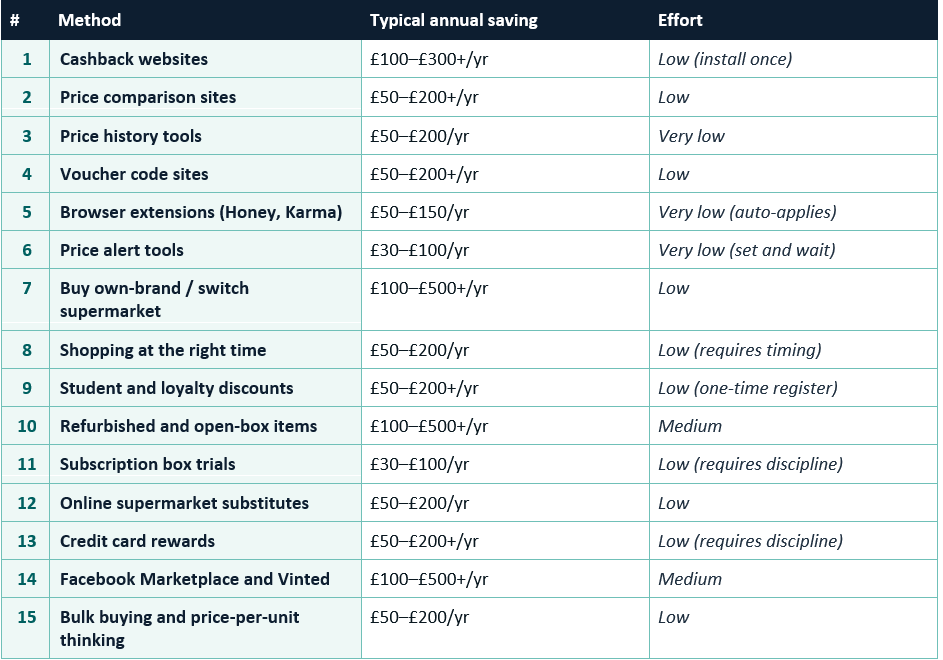
- The 15 Best Ways to Find Online Bargains Explained
- How to Stack Savings for Maximum Effect
- Avoiding the Traps: What to Watch Out For
- Your Monthly Savings Routine
- Conclusion
- Frequently Asked Questions
- References
Why Finding Bargains Online Matters More in 2026
With UK consumer prices approximately 25% higher than they were in 2020 and US cumulative inflation at a similar level, the value of money-saving habits has never been greater. Every pound or dollar saved on a purchase you were going to make anyway is a pound or dollar you do not have to earn. And unlike earning extra income — which takes time, skill, and energy — the most effective money-saving tools available online today require very little ongoing effort once set up.The good news is that the tools available to savvy online shoppers in 2026 are significantly more powerful than they were five years ago. Artificial intelligence is being used by price comparison engines and cashback networks to identify the best available deals faster and more comprehensively than any human could manually. Browser extensions automatically apply the best voucher code at checkout without the user needing to search. Cashback networks negotiate bulk rates with major retailers and pass those savings directly to consumers. Price history tools expose whether a claimed 'sale price' is genuinely a discount or a manufactured markdown.
The average active UK user of a major cashback site earns over £200 per year in cashback on purchases they were going to make regardless — without changing where they shop or what they buy, simply by clicking through a cashback portal first. The average household that switches from a major supermarket to Aldi or Lidl for their main grocery shop saves approximately £100 to £500 per year depending on family size and current spending. The tools in this guide are not about denying yourself things you want. They are about paying less for the things you were already going to buy.
Every purchase you make online without checking for a cashback link, a voucher code, or a price alert is money left on the table. The tools are free, the savings are real, and the only thing required is five minutes of habit formation.
— MONEYSAVINGEXPERT — ONLINE SHOPPING DEALS GUIDE
The 15 Best Ways to Find Online Bargains Explained
Cashback Websites £100–£300+ per year Effort: Very Low
Cashback websites — TopCashback and Quidco in the UK; Rakuten and BeFrugal in the US — work by earning a commission from retailers when you click through their site to make a purchase, and sharing most of that commission with you as cashback. You install a browser reminder tool (typically a free browser extension), and whenever you visit a participating retailer the tool prompts you to activate cashback before you shop. The cashback is paid to you weeks or months later once the retailer confirms your purchase. Over a year, active users typically earn £150 to £300 or more — on purchases they were going to make anyway, at prices identical to going direct. Categories with the best cashback rates include insurance, utilities switching, travel booking, and financial products.Tip: Install the TopCashback (UK) or Rakuten (US) browser reminder and activate it every time you shop online. Insurance renewals, broadband switching, and energy switching often pay the highest cashback rates — sometimes £50 to £150 for a single sign-up.
Price Comparison Sites £50–£200+ per year Effort: Low
Price comparison sites search across hundreds of retailers simultaneously to find the cheapest available price for a specific product. For electronics, Google Shopping, PriceRunner, and PriceSpy (UK) are the most comprehensive. For insurance, energy, broadband, and financial products, comparison sites including MoneySuperMarket, Compare the Market, and Go.Compare (UK) or The Zebra and NerdWallet (US) can surface significantly cheaper options than going direct to any single provider. For groceries, MySupermarket and Trolley.co.uk (UK) compare prices across the major supermarkets. Running any significant purchase through a comparison engine before buying takes two minutes and can save a material amount.Tip: Do not assume the first retailer you find is the cheapest. Even for well-known products from well-known brands, a two-minute comparison search frequently finds the same item 10% to 30% cheaper elsewhere — often including free delivery.
Price History Tools £50–£200 per year Effort: Very Low
Price history tools are browser extensions or websites that show you the historical price of any product on Amazon, and increasingly on other major retailers, so you can see whether a current price is genuinely a discount or simply a manufactured sale price. CamelCamelCamel is the most comprehensive free tool for Amazon price history in both the UK and US. Keepa is an alternative with additional features. The Honey browser extension (now owned by PayPal) tracks price history on Amazon and other retailers automatically. These tools are invaluable during major sale events such as Amazon Prime Day, Black Friday, and Cyber Monday, when many products are presented as heavily discounted when their actual price has been at or below the 'sale' price for months.Tip: Before buying anything labelled 'sale' or 'limited offer' on Amazon or a major retailer, check CamelCamelCamel or Keepa to see the full price history. You will be surprised how often the 'sale price' is actually the regular price or even higher than it was two months ago.
Voucher Code Sites £50–£200+ per year Effort: Low
Voucher code websites aggregate discount codes, promotional offers, and free delivery offers from thousands of retailers in one place. VoucherCodes.co.uk and MyVoucherCodes.co.uk are the largest UK sites; RetailMeNot and Coupons.com serve the US market. Before completing any online purchase, taking 60 seconds to check a voucher code site frequently produces a discount code worth 10% to 25% off the purchase price, free delivery, or a bonus gift with purchase. Some codes are generic and widely available; others are personalised to email lists, so it is worth being on retailers' email lists to receive exclusive codes.Tip: Search 'retailer name + discount code' before any online purchase. Even for large retailers where you assume no codes exist, you will find valid codes surprisingly often. Check the code's expiry date and read any minimum spend conditions before applying.
Browser Extensions: Honey and Karma £50–£150 per year Effort: Very Low — automatic
Browser extensions like Honey (PayPal) and Karma automatically apply the best available voucher codes at checkout without you needing to search for them manually. When you reach the checkout page of a participating retailer, the extension activates automatically, tests all known codes for that retailer, and applies whichever provides the biggest saving. Honey also tracks price drops across Amazon and other retailers and alerts you when something in your saved items falls in price. Karma focuses on price drop alerts and responsible spending nudges. Both are free to install and require no ongoing management once set up.Tip: Install Honey and add products you are considering buying to your Honey 'Droplist'. You will receive an email notification when the price drops to your target level, removing the need to check prices manually.
Price Alert Tools £30–£100 per year Effort: Very Low — set and forget
Price alert tools allow you to set a target price for any product and receive an email notification when the price falls to that level. CamelCamelCamel allows price alerts for any Amazon product. PriceRunner and Google Shopping also offer alert functionality. For non-Amazon products, many retailers' own websites allow you to register for a back-in-stock or price drop notification. Price alerts are particularly useful for large purchases — a television, laptop, appliance, or piece of furniture — where waiting a few weeks for a price drop can save tens or hundreds of pounds without any effort.Tip: Set price alerts for any purchase you are not in a hurry to make. Many products go on sale predictably — electronics drop around Prime Day in July and Black Friday in November; clothing discounts to 30–50% off at the start of January and end of summer. Patience and a price alert together are a powerful combination.
Switch Supermarket / Buy Own-Brand £100–£500+ per year Effort: Low
For the typical UK household, the single highest-impact change in shopping behaviour is switching from a major supermarket to Aldi or Lidl for the majority of the weekly grocery shop. Consumer research consistently shows savings of 20% to 30% on a like-for-like basket. Buying own-brand or store-brand products within any supermarket instead of branded equivalents saves a further 20% to 40% on staple categories including pasta, rice, tinned goods, cereals, and cleaning products, with no meaningful difference in quality for most items. In the US, shopping at Aldi, WinCo, or Save-A-Lot versus a full-service supermarket produces similar savings.Tip: Test the Aldi or Lidl version of your ten most frequently purchased branded items. Most households find that 7 or 8 out of 10 are indistinguishable from the branded equivalent, and the savings on the full basket are immediately significant.
Buy at the Right Time £50–£200 per year Effort: Low — requires timing
Major retailers have predictable sale calendars, and buying at the right time can produce savings of 30% to 80% on specific categories. Electronics and appliances are typically cheapest in the last two weeks of November (Black Friday and Cyber Monday) and in January (post-Christmas clearance). Clothing is typically cheapest in early January (end-of-season winter sale) and early August (end-of-season summer sale). Holidays and travel are typically cheapest when booked 8 to 12 weeks in advance for short-haul and 3 to 5 months in advance for long-haul. Christmas decorations and seasonal homeware cost a fraction of their peak price in the first two weeks of January.Tip: Keep a simple list of planned purchases and their expected sale period. Buying a winter coat in August and Christmas gifts in January are among the highest-saving timing strategies available to any shopper.
Student, NHS, and Loyalty Discounts £50–£200+ per year Effort: Low — register once
Many retailers offer significant discounts to students, NHS workers, emergency services, and military personnel that are not widely advertised. The Student Beans and UNiDAYS platforms aggregate hundreds of student discounts in one place. The Blue Light Card provides discounts for NHS staff, emergency services, and armed forces personnel (UK), with over 15,000 participating retailers. TOTUM (formerly NUS Extra) provides student discounts. Loyalty programmes including Tesco Clubcard, Sainsbury's Nectar, and Boots Advantage Card accumulate points that translate into meaningful savings when redeemed strategically — particularly during bonus point events.Tip: If you or anyone in your household is a student, NHS worker, or emergency services personnel, sign up for the relevant discount scheme immediately. Some of the best discount rates are with major retailers, insurance companies, and restaurants, and the annual savings can significantly exceed the small registration fee some schemes charge.
Refurbished, Open-Box and Ex-Demo Products £100–£500+ per year Effort: Medium
Certified refurbished electronics from manufacturers — Apple Refurbished, Amazon Renewed, Samsung Certified Re-Newed, and the manufacturer-refurbished sections of major retailers — typically sell at 15% to 40% below the new price, carry a warranty (often the same as new), and are tested to the same functional standard as new products. Open-box items (customer returns that have been checked and repackaged) offer similar savings with minimal risk. Ex-demonstration models from Currys, John Lewis, and similar retailers are often sold at significant discounts, particularly on large appliances and televisions.Tip: Always buy certified refurbished rather than unverified secondhand for electronics. Apple Refurbished in particular offers products with 1-year warranty and full cosmetic restoration at discounts of 15–25%. For large appliances, check the ex-display section of Currys and AO.com — savings of £100–£300 are common.
Free Trials and Subscription Box Strategies £30–£100 per year Effort: Low — requires discipline
Many subscription services — Amazon Prime, streaming platforms, meal kit boxes, beauty boxes, and software tools — offer free trials of 14 to 30 days that can be used to access genuine value at no cost. The key is to set a calendar reminder to cancel before the free trial ends, making this a purely value-adding exercise rather than a source of unexpected charges. Some subscription boxes (HelloFresh, Gousto, and similar meal kit services) offer heavily discounted or free introductory offers on their first three or four deliveries — these can provide genuinely useful and high-quality food at well below the regular price.Tip: Maintain a simple note or calendar of all trial start dates and set a reminder two days before each trial ends. This habit converts free trials from a risk (forgetting to cancel) into a reliable source of genuine free or discounted product access.
Online Supermarket Substitutes and Deals £50–£200 per year Effort: Low
Online grocery shopping provides money-saving advantages that in-store shopping does not. You can see the price per unit for every product simultaneously, making genuine value comparisons straightforward. You can avoid the impulse buys triggered by physical store layouts. You can use comparison sites like Trolley.co.uk (UK) to identify which supermarket is cheapest for your specific basket before booking a delivery. Online supermarkets also run exclusive web-only offers, loyalty bonus events, and new customer discounts that are not available in-store. In the US, grocery delivery apps including Instacart and Walmart Grocery frequently run promotional codes for new customers or first orders.Tip: Before your weekly online supermarket order, spend two minutes on Trolley.co.uk (UK) to check whether your basket would be significantly cheaper at a different supermarket. Over the course of a year, following the data rather than shopping on autopilot can save a meaningful amount.
Credit Card Rewards on Everyday Spending £50–£200+ per year Effort: Low — requires discipline
Rewards credit cards — the American Express Platinum Cashback Everyday (UK) and the Chase Freedom Unlimited (US) are among the most popular — pay you cash or points on every pound or dollar you spend. When used correctly — that is, paying the full balance every month so no interest is ever charged — a rewards card essentially gives you a 1% to 2% discount on everything you buy. The key discipline is never carrying a balance: the interest charges on unpaid balances will immediately and substantially exceed any rewards earned. Used as a debit card substitute for planned spending, a rewards credit card is a straightforward way to earn £50 to £200 per year with no additional effort.Tip: Only use a rewards credit card if you have a track record of paying your balance in full every month without fail. If there is any risk of carrying a balance, a standard debit card is safer. If you do have that discipline, a cashback credit card for everyday spending is one of the highest return-for-effort money-saving tools available.
Facebook Marketplace, Vinted and eBay £100–£500+ per year Effort: Medium
For many categories of purchase — clothing, furniture, children's items, books, sports equipment, tools, garden furniture, and small appliances — the secondhand market on Facebook Marketplace, Vinted, or eBay offers excellent quality at a fraction of new prices. Vinted in particular has transformed the secondhand clothing market in the UK and Europe, with millions of items listed at prices 50% to 90% below new retail. Facebook Marketplace offers local collection, avoiding postage costs. For children's items especially — car seats, pushchairs, nursery furniture, children's clothing — the secondhand market offers exceptional value because items are frequently used for such a short period before being sold on.Tip: Set up saved searches on Vinted and Facebook Marketplace for categories you regularly buy. New listings appear constantly, and popular items sell quickly — saved searches with notifications mean you see new listings as soon as they appear. Check seller reviews and ask for extra photos before buying anything significant.
Bulk Buying and Price-Per-Unit Thinking £50–£200 per year Effort: Low
Many consumable household products — toilet paper, washing powder, cleaning products, tinned food, coffee, and toiletries — are significantly cheaper per unit when bought in larger quantities or in bulk. Price-per-unit labels (pence per gram, per 100ml, per sheet, etc.) are displayed on supermarket shelf labels and on most online grocery listings — the habit of always comparing price per unit rather than headline price is one of the most reliably value-creating changes any shopper can make. Subscription-and-save options on Amazon, for example, allow you to set up regular deliveries of consumables at a 5% to 10% discount versus one-off purchase prices.Tip: Make price-per-unit comparison a reflex: whenever you are choosing between two sizes or brands of the same product, check the price per 100g, per litre, or per unit. The larger size is not always cheaper per unit — sometimes it is more expensive — but checking takes seconds and saves money consistently over time.
How to Stack Savings for Maximum Effect
The most powerful saving strategy is not any single tool — it is the combination of multiple tools applied to the same purchase simultaneously. Experienced bargain hunters use a consistent stacking approach that takes less than two minutes per online purchase and can reduce the effective price of almost any item by 15% to 40% compared with buying at the first price found.The five-step savings stack for any online purchase
- Step 1 — Check the price history: Use CamelCamelCamel or Keepa for Amazon; check PriceRunner or Google Shopping for other retailers. Confirm that the current price is genuinely competitive and not inflated above recent norms.
- Step 2 — Activate cashback: Open TopCashback or Quidco (UK) / Rakuten (US) and navigate to the retailer from the cashback site. This takes 30 seconds and earns cashback on the purchase automatically.
- Step 3 — Apply a voucher code: Check VoucherCodes.co.uk or let your Honey/Karma browser extension test codes automatically at checkout. Even a 5% code on a £200 purchase saves £10 in seconds.
- Step 4 — Pay with a rewards credit card: If you have a cashback or rewards credit card that you pay in full monthly, using it adds a further 1–2% back on top of any other savings.
- Step 5 — Check if waiting is worth it: If the purchase is not urgent, set a price alert at 10–15% below the current price and check the sale calendar. A week's wait during a sale period can save 20–30% on the right categories.
A practical example: buying a £150 pair of trainers online. Check the price history (confirm this is not a fake sale). Activate cashback (3% = £4.50). Apply a voucher code (10% off = £15). Pay with a cashback card (1% = £1.50). Total saving on a £150 purchase: £21 — a 14% reduction — in under three minutes.
Avoiding the Traps: What to Watch Out For
The tools in this guide are genuinely effective, but there are several ways that online bargain hunting can go wrong — and being aware of them is as important as knowing the techniques.Common traps that undermine online savings — and how to avoid them
- Fake discounts on Black Friday and Prime Day: Price history tools consistently reveal that a significant proportion of 'sale' prices on these events are not genuine discounts — the price was raised in the weeks before the sale and then 'cut' back to the normal price. Always check price history before buying anything presented as a sale item.
- Subscribing to things you do not use: Browser extensions and cashback sites offer cash rewards for signing up to subscription services. Only sign up for services you genuinely want, and set calendar reminders to cancel free trials before they roll into paid subscriptions.
- Buying things you do not need because they are cheap: A 70% discount on something you did not intend to buy is not a saving — it is a spend. Genuine bargain hunting means paying less for things you were already going to buy, not buying more things because they are discounted.
- Using buy now pay later without a repayment plan: BNPL (Klarna, Clearpay, Laybuy) allows splitting purchases into interest-free instalments, which can be useful for managing cash flow — but only if payments are made on time. Missed payments on BNPL schemes can trigger interest charges, fees, and credit file damage that far exceed any price saving.
- Unverified sellers on marketplaces: Amazon Marketplace, eBay, and Facebook Marketplace all host fraudulent sellers. Always check seller ratings and review counts before buying, prefer sellers with fulfilment by Amazon for returns protection, and use PayPal Goods and Services or a credit card for any secondhand purchase to ensure buyer protection.
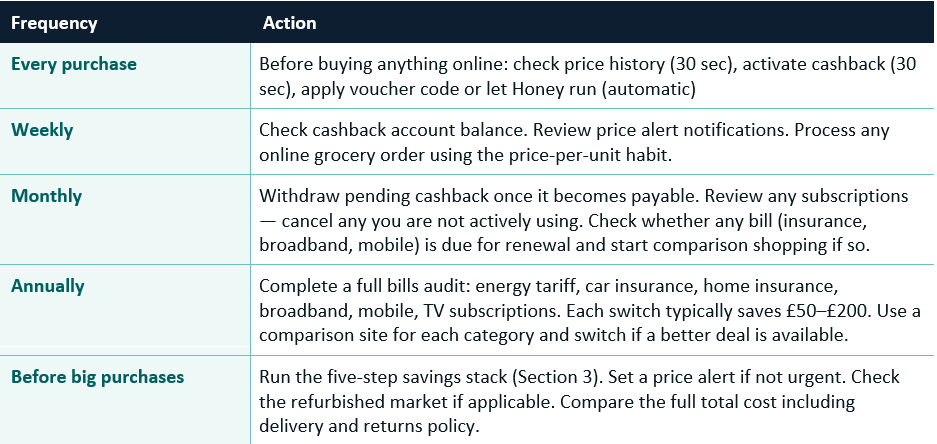
Your Monthly Savings Routine
The households that consistently save the most money on shopping are not doing something dramatically different from everyone else — they have simply turned a set of efficient habits into a routine that takes very little ongoing time. Here is a practical monthly routine that captures most of the available savings with minimal effort.
CONCLUSION
Finding the best bargains online in 2026 is not about being obsessive or spending hours hunting for deals. It is about installing three or four free tools once, adopting a handful of two-minute habits at the checkout, and making a small number of strategic switching decisions once a year. Done consistently, these habits can save a typical household £300 to £1,000 or more per year — without changing anything you buy, without sacrificing quality, and without significant ongoing time investment.Start today: install TopCashback (UK) or Rakuten (US) and the Honey browser extension. These two tools alone will begin generating savings immediately and passively on purchases you were already making. Add the price history habit for any purchase above £30, and set up annual billing reminders for your insurance and utilities. The rest you can add gradually. Small, consistent actions compound — and in a cost of living environment where prices are permanently 25% higher than they were five years ago, every saving matters.
Frequently Asked Questions
What is the single best way to save money on online shopping?
If you only do one thing, sign up for a cashback website — TopCashback or Quidco in the UK, Rakuten or BeFrugal in the US. Active users earn £150 to £300 or more per year in cashback on purchases they were already making, at prices identical to going directly to the retailer, simply by clicking through the cashback portal first. It takes about ten minutes to set up and generates savings automatically thereafter.Are browser extensions like Honey safe to use?
Honey (now owned by PayPal) and similar extensions are widely used and generally considered safe for their core function of applying voucher codes and tracking prices. They do, however, read browsing data related to shopping activity — this is how they identify when you are checking out and which codes to apply. If data privacy is a concern, review the extension's privacy policy before installing. The alternative is to check voucher code sites manually, which takes slightly more effort but achieves the same result without a browser extension.Is cashback money really free?
Yes, in practical terms. Retailers pay cashback sites a commission for referring customers, and the cashback site shares most of that commission with you. The retailer has budgeted for this marketing cost regardless, so you are not paying more to receive cashback — the price is the same whether you go direct or through a cashback portal. The only practical limitations are: cashback is typically paid weeks or months after purchase (once the retailer confirms no return was made), and there is a small risk of cashback not tracking correctly if cookies are blocked or the session is interrupted.What are the best times of year to buy specific items cheaply online?
Electronics and appliances: late November (Black Friday/Cyber Monday) and January. Clothing: early January (winter clearance) and early August (summer clearance). Christmas decorations and seasonal items: first two weeks of January. Holiday travel: 8 to 12 weeks ahead for short-haul, 3 to 5 months for long-haul. Furniture: Bank Holiday sale events and January. Toys: late January (post-Christmas clearance). Always verify with a price history tool that the 'sale' price is genuinely lower than the product's recent normal price before buying.How do I check whether a sale price is genuinely a discount?
Use CamelCamelCamel (camelcamelcamel.com) for Amazon products — it shows the full price history so you can see exactly what the product has sold for over the past 12 months. For non-Amazon retailers, the Honey browser extension tracks price history, and PriceRunner shows current and historical pricing across multiple retailers. If the 'sale' price is the same as or higher than the product's average selling price over the past 90 days, it is not a genuine discount.Is it worth buying refurbished products online?
For the right categories, yes — particularly electronics, Apple products, major appliances, and power tools. Certified refurbished products from manufacturer-authorised sellers (Apple Refurbished, Amazon Renewed, manufacturer-direct refurbished stores) are tested to functional equivalence with new products and typically carry a one-year warranty. Savings of 15% to 40% below new prices are common, and for products like iPhones, MacBooks, or high-end headphones, the saving can be substantial. Avoid unverified 'refurbished' listings from unknown sellers — always buy from manufacturer-certified sources or highly rated Amazon Renewed sellers.References
MoneySavingExpert — Vouchers, Cashback and Online Shopping Deals https://www.moneysavingexpert.com/shopping/TopCashback UK — Cashback Shopping Portal https://www.topcashback.co.uk
Quidco UK — Cashback and Discount Codes https://www.quidco.com
Rakuten US — Cashback Shopping Portal https://www.rakuten.com
CamelCamelCamel — Amazon Price History Tracker https://camelcamelcamel.com
Honey (PayPal) — Automatic Voucher Codes and Price Tracking Browser Extension https://www.joinhoney.com
VoucherCodes.co.uk — UK Discount Codes and Vouchers https://www.vouchercodes.co.uk
PriceRunner UK — Price Comparison Across Hundreds of Retailers https://www.pricerunner.co.uk
Trolley.co.uk — UK Supermarket Price Comparison https://www.trolley.co.uk
Which? — Online Shopping Consumer Rights and Best Deals Guide https://www.which.co.uk/money/shopping/online-shopping
0 Comments
Be the first to share your thoughts on this article.