
How to Stay Active Without Equipment: Simple Daily Tips

You can keep your fitness goals on track even when you don’t have gym gear. Clear a small area in your home and use yoga poses and bodyweight moves to build strength, balance, and aerobic fitness. Bodyweight workouts can increase muscle, boost endurance, and help manage body fat. They scale from beginner to advanced by adding more reps, longer holds, slower tempo, or harder variations. Safety matters: focus on form, joint comfort, and steady breathing. Stop
if you feel dizzy or unusually short of breath, then rest and resume when you recover.
This guide is organized so you can get started today: space setup, movement patterns, clear exercise options with cues, routines by level, circuit ideas, and yoga for mobility. You’ll also see weekly activity targets for overall health, like aiming toward 150 minutes of moderate activity, framed for small spaces and little
time.
Key Takeaways
- Bodyweight exercise can build strength and aerobic fitness without gym access.
- Progressive overload is simple: more reps, longer holds, or harder variations.
- Prioritize form, breathing, and joint comfort for safe progress.
- You can set up in any small space and fit routines into limited time.
- Aim for weekly activity goals (about 150 minutes) for overall health.
How to Stay Active Without Equipment in Any Space
Begin by clearing a compact space so movement feels easy and safe. Pick a flat floor area that gives you room for basic position changes. If the surface is hard, place a mat for cushioning so your knees and hands stay comfortable.
Your body is the tool. Use body weight and simple levers—change range, tempo, or single-leg holds—to create resistance. Start in an easier position, then progress as your strength and balance improve.
- Prep the room in under two minutes: clear the floor, remove slip hazards, and choose a stable spot where your feet won’t slide.
- Scale moves with common swaps: knee pushup before a full pushup, chair squat before a deep squat, and paused reps for more challenge.
- Warm up for 3–5 minutes: march in place, arm circles, hip hinges, and gentle squats to raise heart rate and loosen joints.
- Place a chair against a wall for a target or extra support during balance work.
Keep sessions simple and repeatable. Make sure your form stays consistent and rest 30–60 seconds between moves when you get started.
Build Your No-Equipment Workout Around Key Movement Patterns
Design your routine around key movement patterns and you’ll cover the main muscle groups without tracking dozens of exercises.
Squat pattern: legs and glutes
Start each leg session with squats. Use a hip hinge first, keep a neutral spine, and let your knees track over your toes. This position loads the legs and glutes while protecting your knees.
Hinge and bridge: posterior chain and back
Hinges and bridges train the posterior chain. Squeeze the glutes at full hip extension and brace your core. This builds muscle that supports your lower back and improves posture.
Push and press: chest, shoulders, arms
Pushups scale easily from knees to full. Keep a straight line through your body, control the descent, and keep elbows near 45 degrees for solid form and shoulder safety.
Lunge pattern: balance and stability
Use split stance lunges with a vertical torso and controlled depth. This movement strengthens legs while training single-leg balance and joint-friendly control.
Core stability: planks and controlled reps
Practice anti-extension and anti-rotation moves like planks, bird dog, and dead bug. These exercises build core strength that carries over to everyday tasks.
| Pattern | Main targets | Key cue |
| Squat | Quads, glutes, hamstrings | Hinge then lower; knees track toes |
| Hinge/Bridge | Glutes, hamstrings, lower back | Squeeze glutes at lockout; brace core |
| Push/Press | Chest, shoulders, triceps | Straight body line; controlled reps |
| Lunge | Quads, glutes, balance | Vertical torso; steady step |
| Core Stability | Transverse abdominis, obliques | Prevent rotation; steady breathing |
Bodyweight Exercises You Can Do Today (With Form Cues)
Pick five practical moves that together build strength, stability, and everyday function. Use these selections based on your goals: strength, balance, or core control.
Chair squat and bodyweight squat
Stand shoulder-width, hinge at the hips, and lower until you lightly touch the chair. Drive through your heels and keep weight on your feet, not the toes. For a full
squat, sit back and keep chest upright; wrists and arms stay relaxed.
Bridge and bridge march
Lie on your back with knees bent and feet flat. Push through your feet, brace your core, and lift hips until full extension; squeeze glutes at the top. For bridge march, lift one foot and hold briefly, alternating slowly for single-leg work.
Knee pushup to standard pushup
Keep a straight line from head to knees on a knee pushup, elbows ~45 degrees. Lower with control and press up. Build range of motion before moving to a full pushup from the toes.
Lunge, plank, and core drills
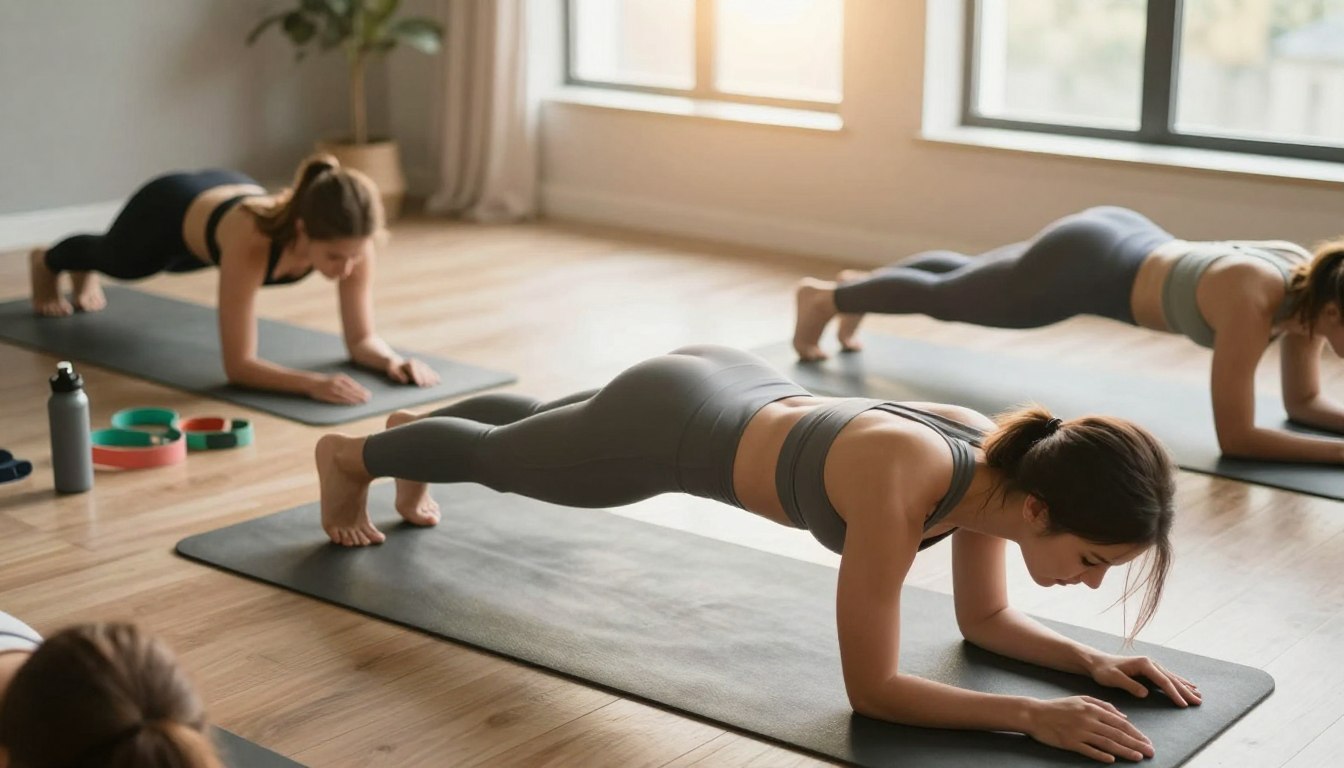
For lunges, keep the front thigh near parallel and push through the front foot to stand. Forearm plank should form a straight line head-to-feet; avoid sagging hips and hold 30–60 seconds. Add alternating leg lifts for extra challenge.
Side plank, bird dog, dead bug, and superman
Side plank with hip abduction targets obliques and hips—stack hips and use a knee-down option if needed. Bird dog promotes spinal control; pause two seconds each rep. Dead bug and bicycle crunches focus on slow, controlled reps on the floor. Finish with superman holds to strengthen the posterior chain. Quick pick: choose 5–8 of these bodyweight exercises for a single workout and cycle through 2–4 rounds with short rests. For a sample full-body session that uses no gear, see this practical routine.
Follow a Simple No-Equipment Routine Based on Your Fitness Level
Match your workout plan to your current level and build small, measurable gains each week. This keeps training consistent and reduces injury risk.
Beginner full-body circuit
Complete 2 sets of 10–15 reps per exercise with 30–60 seconds rest between moves. Total time is about 15–20 minutes.
- Squat (or chair squat) — 10–15 reps
- Knee pushup — 10–15 reps
- Bridge — 10–15 reps
- Forearm plank — hold 20–40 seconds
Intermediate option (timed rounds)
Do 1-minute rounds per station and repeat the circuit twice. Rest ~60 seconds between rounds if needed.
- Round example: 1 minute squats, 1 minute push variations, 1 minute plank, 1 minute lunges.
Advanced progressions
Try single-leg bridge, overhead squat variation, jumping lunges, and one-leg forearm plank holds. Use these when you keep solid form through
higher volume or longer holds.
Choosing reps, seconds, and rest
Use a form-first rule: stop a set when alignment slips. Then add or extend rest so the next set is clean.
Increase challenge by adding range of motion, slowing tempo (3–4 seconds down), adding pauses, or raising total training time rather than adding weight.
| Level | Format | Typical rest | Goal |
| Beginner | 2 sets of 10–15 reps | 30–60 sec | Build base strength and solid form |
| Intermediate | Timed rounds (60 sec) × 2 | 60 sec between rounds | Increase intensity and endurance |
| Advanced | Progressions and longer holds | 30–60 sec, adjust by exercise | Maximize strength and stability without added weight |
Joint-friendly note: if knees or shoulders feel irritated, swap jumping moves for slower single-leg or low-impact progressions and reduce range until pain-free.
For a printable plan and sample progressions, see this at-home strength plan.
Use Circuit and Interval Training to Boost Cardio Without a Gym
Move through short stations that keep your pulse up while you work multiple muscle groups. Circuit training blends strength and cardio by rotating exercises with minimal rest, which keeps your heart rate elevated and builds muscular endurance.
Sample at-home cadence you can follow
Try 8 stations with about 30–45 seconds of work each and ~20 seconds rest between stations. If you repeat the full set, take roughly 1 minute rest between sets.
| Stations | Work | Short rest |
| 8 | 30 seconds | 20 seconds |
| Repeat | 2–3 sets | 1 minute between sets |
| Focus | mix push, hinge, leg, core | control intensity |
Interval training vs. circuit training
Interval training often uses near-max effort bursts with full recovery. Circuit training lets you control intensity across many stations while still challenging your heart and lungs.
Low-impact swaps and optional load
Protect knees and feet by replacing jump lunges with reverse lunges, using step-back burpees without the hop, or doing incline pushups on a counter. A loaded backpack or light dumbbells can add weight, but the circuit works well with bodyweight only.
Add Yoga and Mobility for Recovery, Posture, and Consistent Movement
A few minutes of targeted mobility work can reduce sitting-related stiffness and improve posture. Yoga complements bodyweight training by opening tight areas and calming the nervous system. It helps balance flexibility, balance, and sleep, which supports overall health and fitness.
Quick mobility flow (5–8 minutes)
Try this short sequence after long sitting or before a workout:
- Cat–cow, 6 slow breaths — wake the thoracic spine.
- Plank to downward dog, 5 repeats — lengthen the posterior chain and test shoulder stability.
- Lunge with chest opener, 30 sec each side — free hip flexors and improve position for squats.
- Ankle circles and seated calf stretch, 30 sec each — ease stiffness for better squat depth.
Pairing and cueing
Pair 2–3 strength sessions weekly with 1–2 yoga or mobility days, or add brief micro-sessions after training. This mix helps your muscles recover and keeps movement patterns efficient.
Practical cue: breathe slowly, move with control, and make sure you feel stable without pinching pain. For more guided drills, use a short mobility routine like this mobility guide.
Conclusion
Pick a short list of exercises and focus on quality over quantity every session. Choose three to five moves that cover push, hinge, squat, lunge, and core. Schedule a brief workout window and follow the beginner, intermediate, or advanced template that fits your level. Consistency matters: small sessions add up. Clear a little floor space, set a timer, and make the plan repeatable so you keep progress week after week. Prioritize form-first work and progress with time, tempo, range, or harder variations. Use circuits for cardio and conditioning, and add yoga or mobility for recovery and posture. Ready to get started? Find a short indoor plan at stay active indoors this winter and make a simple routine your habit.
0 Comments
Be the first to share your thoughts on this article.