

Business
Marketing Spend Founders Regret Most in Year One
Marketers waste 26% of their total budget on average. Up to 60% of SME marketing spend is misdirected. Only 36% of marketers can accurately measure their ROI. And yet 61% of small businesses fail to break even within their first three years — with poor marketing execution consistently among the leading causes. The most expensive marketing mistakes aren't the big, visible ones. They're the ones that felt like smart investments at the time. This guide names them, quantifies them, and tells you what to do instead.
The question matters because the first year of a business is when the marketing decisions are made with the least information, the most hope, and the highest emotional investment. It is when a founder orders a logo because it feels like progress. It is when they boost a Facebook post because it is quick. It is when they hire a PR firm because that is what big companies do. And it is when they look at the bank account six months later and realise that the money is gone, the customers have not arrived, and none of it was measurable enough to learn from.
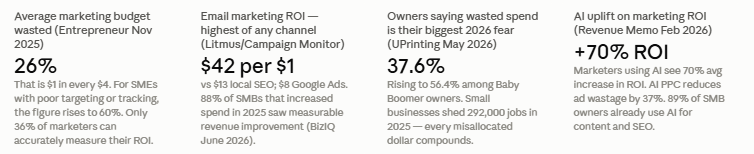
The data behind these experiences is not reassuring. Marketers waste 26% of their total budget on average — a figure from research cited in Entrepreneur magazine in November 2025 and confirmed by multiple sources heading into 2026. For SMEs specifically, the waste figure can reach 60% when poor targeting, tracking, or alignment is involved (Proxima, cited mediafuel.net November 2025). Only 36% of marketers can accurately measure their marketing ROI, meaning the majority have no reliable way to know which spend is working and which is disappearing. And 23% of small businesses fail in their first year — with poor marketing execution consistently cited as a contributing factor.
This article is built on the patterns that emerge from those first-year experiences — the categories of spend that founders, across industries and business types, most consistently describe as regrets. Each has a structural reason it fails in year one. Each has a higher-ROI alternative that the same budget could have funded. And each is more common than the founders who experience it realise at the time.
26% of total marketing budgets wasted on average (Entrepreneur Nov 2025; beancount.io March 2026). Up to 60% of SME marketing wasted due to poor targeting, tracking or alignment (Proxima 2023; mediafuel.net Nov 2025). Only 36% of marketers can accurately measure ROI (Klutch Growth April 2026). $37 billion wasted annually on ads that fail to reach or engage the right audience (Marketing Evolution 2025). 23% of small businesses fail in their first year (US BLS 2025). 61% fail to break even within first 3 years (Women Conquer Business, updated May 2026). 37.6% of small business owners say wasting money with no return is their biggest 2026 marketing fear (UPrinting survey May 2026).
The UPrinting May 2026 survey of 1,000 US small business professionals is the most current snapshot of the anxiety behind these decisions. It found that 37.6% of owners say wasting money with no return is their biggest 2026 marketing fear — rising to 56.4% among Baby Boomer owners. It also found that firms with fewer than 10 employees shed 292,000 jobs in 2025 alone, nearly 4.5 times the losses during the pandemic. The backdrop is a small business environment under real pressure, where every marketing dollar that does not produce a return is felt in a way that a large corporate marketing budget would never register.
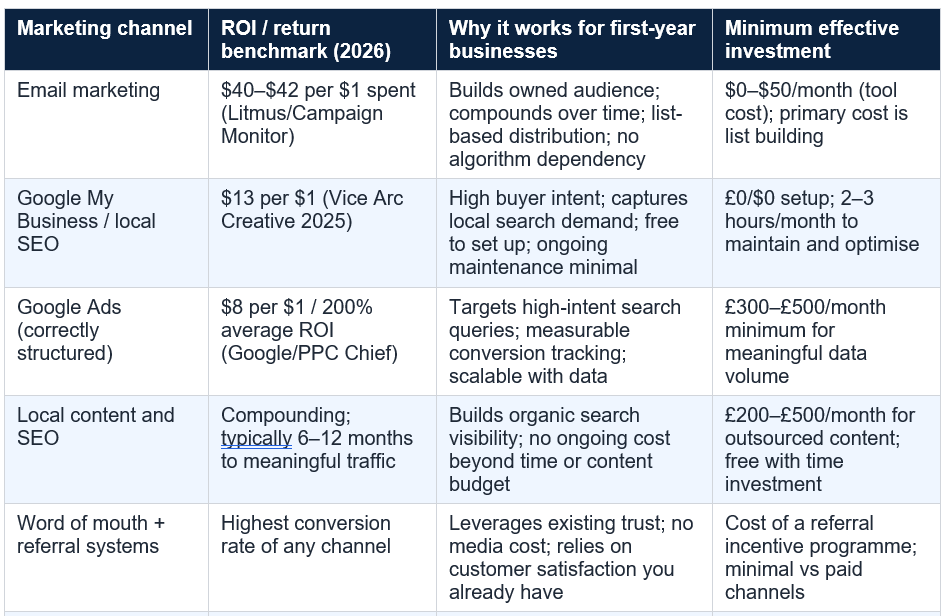
The channel ROI data from 2026 shows what does work — and the contrast with what first-year founders typically spend on is striking. Email marketing returns $40 to $42 for every dollar spent — the highest ROI of any marketing channel (Litmus/Campaign Monitor, cited PPC Chief February 2026 and BizIQ June 2026). Local SEO returns $13 per dollar invested. Google Ads, correctly structured, returns $8 per dollar and delivers 200% average ROI. Yet first-year founders frequently spend on logo design, boosted social posts, PR agencies, and website aesthetics — none of which appear in the high-ROI list. The gap between where the ROI is and where the spend goes in year one is the structural source of almost every regret.
The Crestmont Capital April 2026 marketing benchmark guide identifies a pattern that explains many first-year regrets: spreading a $20,000 annual budget across six channels often produces zero traction on any of them. The problem is not the budget size — it is the distribution. A $20,000 annual marketing budget concentrated entirely on email marketing and local SEO, in a business with a defined local market, would outperform the same budget spread across six platforms every time. The first-year lesson that most founders learn the hard way: concentration beats distribution, and measurable beats visible.
The regret arrives when the founder realises that the professional logo served an audience that did not yet exist — or that the business pivoted six months later, making the visual identity irrelevant. In the early months of a business, the product offer, the target customer, the pricing, and the messaging are all subject to change as real market feedback arrives. An expensive visual identity built on pre-validation assumptions can lock in a brand direction before the business knows what it actually is.
The Regret: The premium brand identity regret is especially acute when the spend displaces early customer acquisition budget. A $5,000 logo commission in month one is $5,000 unavailable for the email marketing, Google My Business optimisation, or local SEO that could have brought the first paying customers. Customers buy what you do, not what your logo looks like. In year one, the logo that a founder agonises over for weeks is invisible to the customers they have not yet acquired.
What to do instead in year one: use a tool like Canva or an AI logo generator ($0–$100) to create a workable visual identity that is good enough to operate professionally. Invest the remaining budget in customer acquisition channels. Revisit branding once the business has validated its offer, found its target market, and has 50 to 100 customers whose feedback has shaped what the brand actually represents. Branding done after validation is branding built on truth, not hope.
Jen McFarland's marketing research (Women Conquer Business, updated May 2026) quantifies the alternative value: 'Poor Audience Research: Marketing to everyone wastes up to 60% of budgets. Build clear customer profiles to boost conversions by 35%.' Every dollar spent building customer profiles and testing messaging in year one produces compounding returns. Every dollar spent on visual polish before that work is done produces a sunk cost and a decision to reverse later.
The structural problem is that social media advertising requires targeting precision, creative iteration, and conversion tracking to produce measurable returns. All three are learning curves. A first-year founder running a Facebook ad campaign with broad targeting, no pixel, and a general creative is not running a marketing campaign 2014 they are generating engagement data they cannot act on. The Klutch Growth April 2026 guide captures the core issue: founders run ads or post on social media because everyone else does it, not because they have mapped out what success looks like or how to measure it.
Social media ad spend is projected to hit $219 billion globally in 2026. The platforms have become more competitive, CPMs have risen, and the performance gap between advertisers who know what they are doing and those who are learning on live budget has widened. The global invalid traffic rate of 20.64% — roughly one in five impressions showing characteristics of fraudulent or non-human activity — means that even correctly structured campaigns lose meaningful portions of their budget to non-human traffic (Deep Marketing March 2026).
The Regret: The specific version of this regret that appears most often: boosting individual social media posts rather than running structured campaign objectives. A boosted post optimises for engagement (likes, shares, comments) — not for website clicks, form submissions, or purchases. A founder who boosts ten posts at $50 each over three months and generates thousands of likes has spent $500 producing engagement from people who may never buy anything. The platform's algorithm delivered exactly what it was asked to deliver. The founder asked for the wrong thing.
What to do instead: before spending any money on social ads, install the relevant tracking pixel on your website and set up conversion events (purchase, enquiry form, phone call). Define a specific objective for each campaign — not 'reach people' but 'generate enquiries from local homeowners within 10 miles.' Set a test budget of $10 per day for 14 days on a single, tightly targeted campaign with a specific conversion objective. Evaluate based on cost per conversion, not cost per click or impression. Scale only what converts. Abandon what does not within 14 days.
A PR agency retained in month two of a business's existence is a PR agency working with a client who has no data, no customers, no case studies, no track record, no differentiation story proven by market behaviour, and no newsworthy moment beyond the fact of their own existence. Journalists receive hundreds of pitches a day; 'local business launches new service' is not a story. The PR agency collects its monthly retainer — typically £2,000–£5,000 per month for a small firm in the UK, or $3,000–$8,000 in the US — and produces activity reports rather than coverage.
This is not a criticism of PR as a discipline. PR is highly effective when a business has something genuinely worth telling: a proven product, a compelling customer story, a unique data point, a social mission, a controversy overcome, or a demonstrable market impact. All of these require time to develop. A PR agency engaged in year one, before any of these ingredients exist, is paying for potential placement in a year when there is nothing to place.
The regret, described consistently by founders who lived it: 'We paid a PR agency for six months, got one small local newspaper mention, and couldn't trace a single sale back to it. We should have spent that budget on the email list we kept putting off building.' The email list they deferred would have returned $40 for every dollar spent once built. The PR retainer returned a mention that no customer ever cited as the reason they found the business.
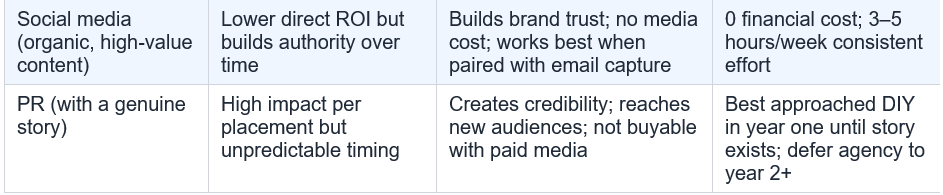
What to do instead: defer formal PR investment until the business has a provable story. The natural PR moment for a first-year business is the first significant milestone: first 100 customers, first evidence of a problem solved at scale, first notable partnership or customer outcome, first piece of data that is genuinely interesting to the audience of the media you want to reach. Build that evidence first. Then approach journalists with a story, not a launch announcement. In year one, spend the PR budget on email marketing infrastructure — it will compound from the first subscriber.
Directory listings made sense in a pre-Google world where customers actually used printed directories or category pages to find suppliers. Most commercial directory sites in 2026 receive negligible organic traffic from genuine buyers, rank poorly in search results, and exist primarily as a renewal income model. The paid listing delivers a backlink of limited value and an appearance on a page that the target customer has no way of finding. The exception: genuine vertical-specific directories with authentic buyer traffic in niche sectors, or Google Business Profile (which is free and essential).
Awards are a variant of the same problem. Many industry awards are pay-to-enter competitions where the prize is the right to use an 'award winner' badge that a first-year founder believes will open doors. The badge rarely changes customer behaviour — customers who do not already know the business do not search for award winners; they search for the service they need. The exception: awards with genuine editorial selection and meaningful brand association that customers actually recognise as validation. These are rare, rarely open to first-year businesses, and typically do not require a fee.
Directory and sponsorship waste — a typical first-year scenario. Yellow Pages or equivalent commercial directory: £300–£600/year. Two industry directory listings: £400–£800 total. Local football club sponsorship: £500–£1,000. Award entry fees (2–3 awards): £200–£500. Total spend: £1,400–£2,900. Measurable new customers traceable to any of the above: typically zero. The same budget invested in Google My Business optimisation ($0), a structured email capture on the website, and a 3-month local Google Ads campaign with proper conversion tracking would produce measurable returns from the same investment. Not financial advice — individual results vary.
Joy Gendusa, founder of a $119 million business, identified this pattern explicitly in Entrepreneur magazine (November 2025): 'investing in a beautiful website that doesn't convert' is one of the four most common marketing budget mistakes. The problem is not the aesthetics — it is the sequence. A beautiful website built around assumptions about what customers want is a beautiful website that does not convert, because the assumptions have not been tested. A simpler, faster site built after three months of talking to customers, testing messaging, and understanding the actual decision journey would outperform the premium build every time.
The Joy Gendusa framework names the specific failure mode: measuring engagement instead of conversion. A website that generates 5,000 visits per month but converts at 0.5% is generating 25 enquiries. A website with 1,500 visits per month that converts at 3% is generating 45 enquiries — on a third of the traffic. The website's job is conversion. Everything that does not contribute to conversion is decoration. In year one, the budget for decoration could have funded the conversion testing that makes the eventual premium site actually worth building.
What to do instead: build a simple, fast website using a template-based platform (Squarespace, Wix, or WordPress with a clean theme) in month one. Keep it narrow: clear offer, clear target customer, one primary call to action, and a way to capture contact details. Spend three months watching how real visitors behave — use free tools (Hotjar, Microsoft Clarity, Google Analytics 4) to understand where people drop off, what they read, and what they ignore. Build the premium site when you know what you are building for. The data from the simple site is worth more than the design of the expensive one.
A production company hired in month three to produce a brand video for £2,000 to £5,000 delivers a polished two-minute film. The film goes on the homepage (where most visitors do not watch it), gets shared on LinkedIn (where it generates 200 views from existing connections, not prospective customers), and sits on a YouTube channel with 47 subscribers. The founder spent four days in production, £3,000 in fees, and the video has generated zero attributed sales. The problem was never the video — it was the absence of a distribution audience to receive it.
Video content works when it is distributed to an existing audience through a channel that the target customer already uses to find information. A business with 5,000 email subscribers can send a video to people who already know and trust them. A business with strong YouTube SEO can rank a specific, how-to-oriented video in search results where intent is high. A business with a paid amplification budget can target a video to a precise audience on YouTube or connected TV. Without one of these mechanisms, video is a production cost, not a marketing investment.
The Regret: The specific variant of this regret that appears most often in service businesses: the animated explainer video. These videos, typically £1,500–£4,000, explain what the business does in 60–90 seconds using motion graphics and a voice-over. They are produced for a homepage that most visitors do not fully explore, watched to completion by fewer than 20% of those who start them, and never found by customers who are not already on the site. The budget would produce significantly more return as an email marketing campaign or as text-based content optimised for the specific search queries that prospective customers actually type into Google.
The three most common first-year Google Ads errors, based on the collective guidance of the sources reviewed for this article. First: running campaigns without conversion tracking installed. If the platform does not know what a 'conversion' looks like, it cannot optimise toward it — and the founder has no data to make decisions from. Only 36% of marketers can accurately measure their ROI; the majority of first-year Google Ads accounts have no conversion tracking at all. Second: running campaigns without a negative keyword list. A plumber who runs Google Ads for 'plumber near me' without adding negative keywords will pay for clicks from people searching for plumbing apprenticeships, plumbing textbooks, plumbing history, and every other variation on the word that is not a service request.
Third: sending paid traffic to the homepage rather than a dedicated landing page. The homepage of a first-year business typically has navigation, multiple sections, and multiple possible actions. A paid traffic visitor who arrives at a homepage has too many choices and too little direction. A dedicated landing page with a single offer, a single call to action, and no navigation distractions consistently converts at 2–5 times the rate of a homepage for the same paid traffic.
What to do instead before spending on Google Ads. Step 1: install Google Analytics 4 and set up conversion tracking for the specific actions that represent a lead or sale (form submission, phone call, purchase confirmation). Step 2: build a dedicated landing page for each campaign theme — single offer, single CTA, no navigation. Step 3: build a negative keyword list before launch, and add to it weekly for the first month. Step 4: start with exact and phrase match keywords only — avoid broad match until the account has enough conversion data to use smart bidding. Step 5: set a daily budget floor of £10–£20 / $15–$25 for a minimum of 30 days before evaluating performance. Step 6: evaluate by cost per conversion, not cost per click.
The pattern is structural. Marketing consultants and agencies operate a discovery, strategy, and planning phase that can consume months of retainer before any implementation occurs. For a first-year business, the value of the strategy phase is limited because the business has insufficient market data to ground the strategy. A strategy built on assumed customer profiles, unvalidated positioning, and theoretical competitive analysis is a strategy built on the same information the founder already had — it has just been formatted professionally.
The alternative is not to forgo external expertise — it is to engage it differently. A fractional marketing director, an implementer rather than a strategist, or a specific-channel specialist engaged to execute rather than advise produces measurable output from week one. The test is whether the engagement produces trackable activity (emails sent, ads running, content published, conversations started) before the invoice arrives — not whether it produces documents that describe what should happen.
The founder reflection that captures this regret precisely: 'We paid a consultant £3,000 a month for four months, got a 40-page brand strategy document and a social media plan, and then realised we had to implement all of it ourselves anyway because we couldn't afford the implementation fees on top. We could have hired a part-time marketing coordinator for the same money, had someone actually sending the emails and running the ads, and learned more in four months than the document taught us.' The document was not wrong. The problem was that no document closes a sale.
The foundation principle, confirmed by the Klutch Growth April 2026 guide, is to complete the groundwork before spending on media: 'They pay for ads before their website is optimised, or they chase social media followers while their Google Business Profile sits unclaimed.' The sequence matters. A Google My Business profile fully optimised with photos, reviews, and accurate information is free, takes four hours to complete, and drives buyer-intent local search traffic. It should exist before any paid advertising is launched.
The Revenue Memo February 2026 analysis introduces an additional lever that changes the economics of first-year marketing dramatically: AI tools. Marketers who use AI see an average 70% increase in ROI. AI-powered PPC bid management reduces ad spend wastage by 37%. AI copywriting tools improve ad click-through rates by 38% and reduce cost-per-click by 32%. For a first-year business watching every pound and dollar, these efficiency gains mean that the same budget goes further — or that a smaller budget produces comparable returns to what a larger pre-AI budget would have generated.
The structural problem is not individual decisions — it is the sequence. Marketing spend in year one should follow validation, not precede it. The logo comes after you know what the business stands for. The PR comes after you have something worth telling. The video comes after you have a distribution channel to put it on. The consultant comes after you know what you need implemented. The paid ads come after the tracking is in place to measure what they produce.
The good news embedded in the research: 88% of SMBs that increased their marketing spend in 2025 saw measurable revenue improvements (BizIQ June 2026). Marketing is not the problem. The sequence, the measurement, and the channel selection are the problems — and all three can be corrected by any business that is willing to follow the data rather than the emotion of what spending money on marketing is supposed to feel like. The regret from year one is the education that makes year two work.
The US Small Business Administration recommends 7–8% of gross annual revenue for businesses under $5 million revenue, according to BizIQ (June 2026). Gartner's 2025 CMO Spend Survey places corporate marketing budgets at 7.7% of overall revenue on average. For a first-year business, the percentage matters less than the sequencing: spend on the channels you can measure first (email marketing, Google My Business, Google Ads with conversion tracking), and defer spend on channels where ROI is difficult to attribute (PR, brand identity, social media for awareness). The Crestmont Capital April 2026 guide notes that spreading a $20,000 annual budget across six channels often produces zero traction on any of them — concentration in fewer, higher-ROI channels is the correct first-year approach. Many first-year businesses produce strong growth on as little as 3–5% of revenue when that budget is applied to high-intent search marketing and email, rather than distributed across six platforms simultaneously.
What is the highest-ROI marketing channel for a small business in 2026?
Email marketing consistently delivers the highest ROI of any marketing channel: $40 to $42 for every dollar spent, according to data from Litmus and Campaign Monitor cited in PPC Chief (February 2026) and BizIQ (June 2026). The second-highest is local SEO: $13 return per dollar invested (Vice Arc Creative 2025, cited BizIQ). Google Ads, correctly structured, returns $8 per dollar and delivers a 200% average ROI (Google economic impact research; PPC Chief February 2026). Among SMBs that increased marketing spend in 2025, 88% saw measurable revenue improvements (BizIQ June 2026). The pattern across all high-ROI channels: they are measurable (results are trackable to specific campaigns), intent-based (they reach people actively looking for what the business offers), and compounding (email lists and SEO authority grow over time with no additional media cost).
Why do social media ads fail so often for first-year businesses?
Social media advertising fails for first-year businesses primarily because of three missing elements: precise targeting, conversion tracking, and a conversion-optimised destination. Without precise targeting, ad spend reaches a broad audience that includes many people who will never buy the product or service. Without conversion tracking (via a pixel installed on the website with conversion events set up), the platform cannot optimise toward sales — it optimises toward whichever metric it can measure, typically engagement. Without a dedicated landing page, paid traffic arrives at a homepage with multiple navigation options and no single directive, reducing conversion rates significantly. The global invalid traffic rate of 20.64% — meaning roughly one in five impressions is fraudulent or non-human (Deep Marketing March 2026) — compounds the problem for advertisers without strong negative targeting or audience exclusions. The Klutch Growth April 2026 guide summarises it: most small business social media ad failures result from running campaigns 'because everyone else does it' rather than because a clear objective, measurement framework, and optimised funnel are in place.
Is PR worth investing in during the first year of a business?
For most first-year businesses: no, not as a retained agency engagement. PR works when there is a genuine story to tell — a proven product, compelling customer outcomes, unique data, or a newsworthy moment. First-year businesses typically lack all of these ingredients, and PR agencies retained before these elements exist spend client budget producing activity reports rather than coverage. The structural issue: journalists receive hundreds of pitches per day; a 'business launches' announcement is not a story in 2026. PR as a DIY activity — reaching out to relevant journalists or publications directly, with a specific data point or customer story, when a genuine news moment exists — can be highly effective and costs nothing but time. A retained PR agency makes economic sense once the business has a story to tell and the coverage would reach a meaningful segment of the target customer base. For most businesses, this point arrives in year two or three, not year one.
What marketing spend should be prioritised in the first 90 days?
The first 90 days of marketing spend should focus exclusively on what is measurable, free or low-cost to start, and directly connected to customer acquisition. In priority order: First, claim and fully optimise a Google Business Profile (free; drives local buyer-intent search traffic). Second, set up Google Analytics 4 with conversion tracking on the website (free; provides the data to evaluate every future spend decision). Third, create an email capture on the website and begin collecting subscriber emails from every customer interaction. Fourth, conduct direct outreach to the first 10 to 20 potential customers in the target market — phone calls, LinkedIn messages, or in-person conversations. Fifth, ask every satisfied customer for a review on Google (free; improves local search visibility and conversion rates). Only after these five foundations are in place should any paid media budget be introduced. The return on free, correctly executed foundations consistently exceeds the return on paid media run without them.
How important is AI for marketing in a first-year business in 2026?
AI is increasingly significant for first-year businesses because it reduces the resource cost of marketing execution dramatically. The Revenue Memo (February 2026) reports that marketers using AI see an average 70% increase in ROI; AI-powered PPC bid management reduces ad spend wastage by 37%; AI copywriting tools improve click-through rates by 38% and reduce cost-per-click by 32%. For a first-year business with limited budget and no marketing team, AI tools replace what would otherwise require a specialist hire: 89% of small business owners already use AI for content marketing and SEO (Revenue Memo February 2026), and 51% report they incur no extra costs on content marketing because AI handles the volume. The practical applications in year one: AI copywriting for ad creative (reduces testing time), AI-assisted keyword research (replaces a PPC consultant for basic campaigns), AI email subject line testing (improves open rates), and AI-powered scheduling tools (reduces social media management time). AI does not replace the strategy, the customer understanding, or the conversion tracking — but it meaningfully reduces the execution cost of implementing them correctly.
Table of Contents
- The Marketing Tax Every New Business Pays
- The Numbers Behind the Regret: What Research Shows About Wasted Spend
- Regret #1 — The Premium Logo and Brand Identity Ordered Before Validation
- Regret #2 — Paid Social Ads That Bought Engagement, Not Customers
- Regret #3 — The PR Agency Retained Before There Was a Story to Tell
- Regret #4 — Directories, Awards, and Sponsorships That Left No Trace
- Regret #5 — The Premium Website Built Before Confirming What Converts
- Regret #6 — Video Content Produced Without a Distribution Plan
- Regret #7 — Google Ads Run Without Tracking, Negatives, or a Landing Page
- Regret #8 — The Consultant Who Delivered a Document, Not Results
- The ROI Reality: What Actually Works in 2026
- The First-Year Marketing Framework That Changes the Equation
- Conclusion: The Regret Is the Education
- Frequently Asked Questions
The Marketing Tax Every New Business Pays
There is a question that travels through every startup community, every founder support group, and every after-hours conversation between business owners who have survived their first year: 'What's the marketing spend you most regret?'The question matters because the first year of a business is when the marketing decisions are made with the least information, the most hope, and the highest emotional investment. It is when a founder orders a logo because it feels like progress. It is when they boost a Facebook post because it is quick. It is when they hire a PR firm because that is what big companies do. And it is when they look at the bank account six months later and realise that the money is gone, the customers have not arrived, and none of it was measurable enough to learn from.
The data behind these experiences is not reassuring. Marketers waste 26% of their total budget on average — a figure from research cited in Entrepreneur magazine in November 2025 and confirmed by multiple sources heading into 2026. For SMEs specifically, the waste figure can reach 60% when poor targeting, tracking, or alignment is involved (Proxima, cited mediafuel.net November 2025). Only 36% of marketers can accurately measure their marketing ROI, meaning the majority have no reliable way to know which spend is working and which is disappearing. And 23% of small businesses fail in their first year — with poor marketing execution consistently cited as a contributing factor.
This article is built on the patterns that emerge from those first-year experiences — the categories of spend that founders, across industries and business types, most consistently describe as regrets. Each has a structural reason it fails in year one. Each has a higher-ROI alternative that the same budget could have funded. And each is more common than the founders who experience it realise at the time.
26% of total marketing budgets wasted on average (Entrepreneur Nov 2025; beancount.io March 2026). Up to 60% of SME marketing wasted due to poor targeting, tracking or alignment (Proxima 2023; mediafuel.net Nov 2025). Only 36% of marketers can accurately measure ROI (Klutch Growth April 2026). $37 billion wasted annually on ads that fail to reach or engage the right audience (Marketing Evolution 2025). 23% of small businesses fail in their first year (US BLS 2025). 61% fail to break even within first 3 years (Women Conquer Business, updated May 2026). 37.6% of small business owners say wasting money with no return is their biggest 2026 marketing fear (UPrinting survey May 2026).
The Numbers Behind the Regret: What Research Shows About Wasted Spend
Before naming the specific regrets, it is worth understanding the structural conditions that produce them. First-year business owners are making marketing decisions in an environment characterised by low data, high uncertainty, and powerful social proof from whatever seems to be working for visible companies nearby or online. The mistakes that emerge are not irrational in isolation — they are predictable responses to incomplete information.The UPrinting May 2026 survey of 1,000 US small business professionals is the most current snapshot of the anxiety behind these decisions. It found that 37.6% of owners say wasting money with no return is their biggest 2026 marketing fear — rising to 56.4% among Baby Boomer owners. It also found that firms with fewer than 10 employees shed 292,000 jobs in 2025 alone, nearly 4.5 times the losses during the pandemic. The backdrop is a small business environment under real pressure, where every marketing dollar that does not produce a return is felt in a way that a large corporate marketing budget would never register.
The channel ROI data from 2026 shows what does work — and the contrast with what first-year founders typically spend on is striking. Email marketing returns $40 to $42 for every dollar spent — the highest ROI of any marketing channel (Litmus/Campaign Monitor, cited PPC Chief February 2026 and BizIQ June 2026). Local SEO returns $13 per dollar invested. Google Ads, correctly structured, returns $8 per dollar and delivers 200% average ROI. Yet first-year founders frequently spend on logo design, boosted social posts, PR agencies, and website aesthetics — none of which appear in the high-ROI list. The gap between where the ROI is and where the spend goes in year one is the structural source of almost every regret.
The Crestmont Capital April 2026 marketing benchmark guide identifies a pattern that explains many first-year regrets: spreading a $20,000 annual budget across six channels often produces zero traction on any of them. The problem is not the budget size — it is the distribution. A $20,000 annual marketing budget concentrated entirely on email marketing and local SEO, in a business with a defined local market, would outperform the same budget spread across six platforms every time. The first-year lesson that most founders learn the hard way: concentration beats distribution, and measurable beats visible.
Regret #1 — The Premium Logo and Brand Identity Ordered Before Validation
The premium logo and visual identity package is the marketing spend that looks the most like a business decision and is the least connected to revenue generation in year one. The logic feels sound: if you are going to present your business to the world, it should look professional. A polished brand identity signals credibility. It is the first thing people see.The regret arrives when the founder realises that the professional logo served an audience that did not yet exist — or that the business pivoted six months later, making the visual identity irrelevant. In the early months of a business, the product offer, the target customer, the pricing, and the messaging are all subject to change as real market feedback arrives. An expensive visual identity built on pre-validation assumptions can lock in a brand direction before the business knows what it actually is.
The Regret: The premium brand identity regret is especially acute when the spend displaces early customer acquisition budget. A $5,000 logo commission in month one is $5,000 unavailable for the email marketing, Google My Business optimisation, or local SEO that could have brought the first paying customers. Customers buy what you do, not what your logo looks like. In year one, the logo that a founder agonises over for weeks is invisible to the customers they have not yet acquired.
What to do instead in year one: use a tool like Canva or an AI logo generator ($0–$100) to create a workable visual identity that is good enough to operate professionally. Invest the remaining budget in customer acquisition channels. Revisit branding once the business has validated its offer, found its target market, and has 50 to 100 customers whose feedback has shaped what the brand actually represents. Branding done after validation is branding built on truth, not hope.
Jen McFarland's marketing research (Women Conquer Business, updated May 2026) quantifies the alternative value: 'Poor Audience Research: Marketing to everyone wastes up to 60% of budgets. Build clear customer profiles to boost conversions by 35%.' Every dollar spent building customer profiles and testing messaging in year one produces compounding returns. Every dollar spent on visual polish before that work is done produces a sunk cost and a decision to reverse later.
Regret #2 — Paid Social Ads That Bought Engagement, Not Customers
Social media advertising is the most common first-year marketing regret across every founder community. The mechanics are accessible, the ad platforms are designed to be easy to start, and the early engagement metrics — likes, reach, impressions — feel like evidence of success. The regret arrives when the monthly business bank statement is reviewed and the correlation between social ad spend and paying customers is not there.The structural problem is that social media advertising requires targeting precision, creative iteration, and conversion tracking to produce measurable returns. All three are learning curves. A first-year founder running a Facebook ad campaign with broad targeting, no pixel, and a general creative is not running a marketing campaign 2014 they are generating engagement data they cannot act on. The Klutch Growth April 2026 guide captures the core issue: founders run ads or post on social media because everyone else does it, not because they have mapped out what success looks like or how to measure it.
Social media ad spend is projected to hit $219 billion globally in 2026. The platforms have become more competitive, CPMs have risen, and the performance gap between advertisers who know what they are doing and those who are learning on live budget has widened. The global invalid traffic rate of 20.64% — roughly one in five impressions showing characteristics of fraudulent or non-human activity — means that even correctly structured campaigns lose meaningful portions of their budget to non-human traffic (Deep Marketing March 2026).
The Regret: The specific version of this regret that appears most often: boosting individual social media posts rather than running structured campaign objectives. A boosted post optimises for engagement (likes, shares, comments) — not for website clicks, form submissions, or purchases. A founder who boosts ten posts at $50 each over three months and generates thousands of likes has spent $500 producing engagement from people who may never buy anything. The platform's algorithm delivered exactly what it was asked to deliver. The founder asked for the wrong thing.
What to do instead: before spending any money on social ads, install the relevant tracking pixel on your website and set up conversion events (purchase, enquiry form, phone call). Define a specific objective for each campaign — not 'reach people' but 'generate enquiries from local homeowners within 10 miles.' Set a test budget of $10 per day for 14 days on a single, tightly targeted campaign with a specific conversion objective. Evaluate based on cost per conversion, not cost per click or impression. Scale only what converts. Abandon what does not within 14 days.
Regret #3 — The PR Agency Retained Before There Was a Story to Tell
The PR agency is the first-year marketing spend that carries the highest air of professionalism and the most opaque return on investment. The appeal is understandable: press coverage legitimises a new business, reaches large audiences, and creates credibility that advertising cannot buy. The regret is structural: PR requires a story, and in year one most businesses do not yet have one worth telling.A PR agency retained in month two of a business's existence is a PR agency working with a client who has no data, no customers, no case studies, no track record, no differentiation story proven by market behaviour, and no newsworthy moment beyond the fact of their own existence. Journalists receive hundreds of pitches a day; 'local business launches new service' is not a story. The PR agency collects its monthly retainer — typically £2,000–£5,000 per month for a small firm in the UK, or $3,000–$8,000 in the US — and produces activity reports rather than coverage.
This is not a criticism of PR as a discipline. PR is highly effective when a business has something genuinely worth telling: a proven product, a compelling customer story, a unique data point, a social mission, a controversy overcome, or a demonstrable market impact. All of these require time to develop. A PR agency engaged in year one, before any of these ingredients exist, is paying for potential placement in a year when there is nothing to place.
The regret, described consistently by founders who lived it: 'We paid a PR agency for six months, got one small local newspaper mention, and couldn't trace a single sale back to it. We should have spent that budget on the email list we kept putting off building.' The email list they deferred would have returned $40 for every dollar spent once built. The PR retainer returned a mention that no customer ever cited as the reason they found the business.
What to do instead: defer formal PR investment until the business has a provable story. The natural PR moment for a first-year business is the first significant milestone: first 100 customers, first evidence of a problem solved at scale, first notable partnership or customer outcome, first piece of data that is genuinely interesting to the audience of the media you want to reach. Build that evidence first. Then approach journalists with a story, not a launch announcement. In year one, spend the PR budget on email marketing infrastructure — it will compound from the first subscriber.
Regret #4 — Directories, Awards, and Sponsorships That Left No Trace
Directory listings, industry award entries, and local sponsorships share a common feature: they feel like marketing because they involve spending money and having the business name appear somewhere public. They are the category of spend where the invoice arrives, the listing goes live or the banner goes up, and then nothing happens. No calls. No enquiries. No new customers who cite the directory, the award nomination, or the sponsorship as their reason for contacting the business.Directory listings made sense in a pre-Google world where customers actually used printed directories or category pages to find suppliers. Most commercial directory sites in 2026 receive negligible organic traffic from genuine buyers, rank poorly in search results, and exist primarily as a renewal income model. The paid listing delivers a backlink of limited value and an appearance on a page that the target customer has no way of finding. The exception: genuine vertical-specific directories with authentic buyer traffic in niche sectors, or Google Business Profile (which is free and essential).
Awards are a variant of the same problem. Many industry awards are pay-to-enter competitions where the prize is the right to use an 'award winner' badge that a first-year founder believes will open doors. The badge rarely changes customer behaviour — customers who do not already know the business do not search for award winners; they search for the service they need. The exception: awards with genuine editorial selection and meaningful brand association that customers actually recognise as validation. These are rare, rarely open to first-year businesses, and typically do not require a fee.
Directory and sponsorship waste — a typical first-year scenario. Yellow Pages or equivalent commercial directory: £300–£600/year. Two industry directory listings: £400–£800 total. Local football club sponsorship: £500–£1,000. Award entry fees (2–3 awards): £200–£500. Total spend: £1,400–£2,900. Measurable new customers traceable to any of the above: typically zero. The same budget invested in Google My Business optimisation ($0), a structured email capture on the website, and a 3-month local Google Ads campaign with proper conversion tracking would produce measurable returns from the same investment. Not financial advice — individual results vary.
Regret #5 — The Premium Website Built Before Confirming What Converts
The premium website is the first-year marketing spend that is hardest to argue against, because a professional online presence is genuinely important. The regret is not the website itself — it is the version of the website: the £5,000 to £15,000 custom-designed, agency-built site ordered before the business knows what messaging converts, who the actual customer is, or what the customer journey from first contact to purchase actually looks like.Joy Gendusa, founder of a $119 million business, identified this pattern explicitly in Entrepreneur magazine (November 2025): 'investing in a beautiful website that doesn't convert' is one of the four most common marketing budget mistakes. The problem is not the aesthetics — it is the sequence. A beautiful website built around assumptions about what customers want is a beautiful website that does not convert, because the assumptions have not been tested. A simpler, faster site built after three months of talking to customers, testing messaging, and understanding the actual decision journey would outperform the premium build every time.
The Joy Gendusa framework names the specific failure mode: measuring engagement instead of conversion. A website that generates 5,000 visits per month but converts at 0.5% is generating 25 enquiries. A website with 1,500 visits per month that converts at 3% is generating 45 enquiries — on a third of the traffic. The website's job is conversion. Everything that does not contribute to conversion is decoration. In year one, the budget for decoration could have funded the conversion testing that makes the eventual premium site actually worth building.
What to do instead: build a simple, fast website using a template-based platform (Squarespace, Wix, or WordPress with a clean theme) in month one. Keep it narrow: clear offer, clear target customer, one primary call to action, and a way to capture contact details. Spend three months watching how real visitors behave — use free tools (Hotjar, Microsoft Clarity, Google Analytics 4) to understand where people drop off, what they read, and what they ignore. Build the premium site when you know what you are building for. The data from the simple site is worth more than the design of the expensive one.
Regret #6 — Video Content Produced Without a Distribution Plan
Video content is the marketing format that generates the most conviction in first-year founders and the most regret in retrospect. The quality of production has become a credibility signal — particularly in sectors where competitors have invested in video — and the advice to 'create video content' is everywhere. The gap between creating video and distributing it to an audience that will convert into customers is where the budget disappears.A production company hired in month three to produce a brand video for £2,000 to £5,000 delivers a polished two-minute film. The film goes on the homepage (where most visitors do not watch it), gets shared on LinkedIn (where it generates 200 views from existing connections, not prospective customers), and sits on a YouTube channel with 47 subscribers. The founder spent four days in production, £3,000 in fees, and the video has generated zero attributed sales. The problem was never the video — it was the absence of a distribution audience to receive it.
Video content works when it is distributed to an existing audience through a channel that the target customer already uses to find information. A business with 5,000 email subscribers can send a video to people who already know and trust them. A business with strong YouTube SEO can rank a specific, how-to-oriented video in search results where intent is high. A business with a paid amplification budget can target a video to a precise audience on YouTube or connected TV. Without one of these mechanisms, video is a production cost, not a marketing investment.
The Regret: The specific variant of this regret that appears most often in service businesses: the animated explainer video. These videos, typically £1,500–£4,000, explain what the business does in 60–90 seconds using motion graphics and a voice-over. They are produced for a homepage that most visitors do not fully explore, watched to completion by fewer than 20% of those who start them, and never found by customers who are not already on the site. The budget would produce significantly more return as an email marketing campaign or as text-based content optimised for the specific search queries that prospective customers actually type into Google.
Regret #7 — Google Ads Run Without Tracking, Negatives, or a Landing Page
Google Ads is not a first-year marketing regret because it does not work. It is a regret because it is operated incorrectly by most first-year founders — and the platform is designed to spend money efficiently on behalf of Google's revenue model, not the advertiser's conversion goals. The correctly structured Google Ads campaign returns $8 for every $1 spent, according to Google's own economic impact research, and PPC Chief (February 2026) places the average ROI at 200%. The incorrectly structured campaign burns budget on irrelevant clicks, unmeasured traffic, and conversions that happen but are never attributed.The three most common first-year Google Ads errors, based on the collective guidance of the sources reviewed for this article. First: running campaigns without conversion tracking installed. If the platform does not know what a 'conversion' looks like, it cannot optimise toward it — and the founder has no data to make decisions from. Only 36% of marketers can accurately measure their ROI; the majority of first-year Google Ads accounts have no conversion tracking at all. Second: running campaigns without a negative keyword list. A plumber who runs Google Ads for 'plumber near me' without adding negative keywords will pay for clicks from people searching for plumbing apprenticeships, plumbing textbooks, plumbing history, and every other variation on the word that is not a service request.
Third: sending paid traffic to the homepage rather than a dedicated landing page. The homepage of a first-year business typically has navigation, multiple sections, and multiple possible actions. A paid traffic visitor who arrives at a homepage has too many choices and too little direction. A dedicated landing page with a single offer, a single call to action, and no navigation distractions consistently converts at 2–5 times the rate of a homepage for the same paid traffic.
What to do instead before spending on Google Ads. Step 1: install Google Analytics 4 and set up conversion tracking for the specific actions that represent a lead or sale (form submission, phone call, purchase confirmation). Step 2: build a dedicated landing page for each campaign theme — single offer, single CTA, no navigation. Step 3: build a negative keyword list before launch, and add to it weekly for the first month. Step 4: start with exact and phrase match keywords only — avoid broad match until the account has enough conversion data to use smart bidding. Step 5: set a daily budget floor of £10–£20 / $15–$25 for a minimum of 30 days before evaluating performance. Step 6: evaluate by cost per conversion, not cost per click.
Regret #8 — The Consultant Who Delivered a Document, Not Results
The marketing consultant — or the marketing agency retained on a monthly basis — is the final first-year regret category, and it is the most emotionally expensive. It is the spend that was meant to solve all the other problems. The founder who does not know where to start, does not have time to learn, and cannot afford to keep getting it wrong hires an expert to take the problem away. Six months later, they have a strategy document, a brand audit, a social media content calendar, and no more customers than they had before the engagement started.The pattern is structural. Marketing consultants and agencies operate a discovery, strategy, and planning phase that can consume months of retainer before any implementation occurs. For a first-year business, the value of the strategy phase is limited because the business has insufficient market data to ground the strategy. A strategy built on assumed customer profiles, unvalidated positioning, and theoretical competitive analysis is a strategy built on the same information the founder already had — it has just been formatted professionally.
The alternative is not to forgo external expertise — it is to engage it differently. A fractional marketing director, an implementer rather than a strategist, or a specific-channel specialist engaged to execute rather than advise produces measurable output from week one. The test is whether the engagement produces trackable activity (emails sent, ads running, content published, conversations started) before the invoice arrives — not whether it produces documents that describe what should happen.
The founder reflection that captures this regret precisely: 'We paid a consultant £3,000 a month for four months, got a 40-page brand strategy document and a social media plan, and then realised we had to implement all of it ourselves anyway because we couldn't afford the implementation fees on top. We could have hired a part-time marketing coordinator for the same money, had someone actually sending the emails and running the ads, and learned more in four months than the document taught us.' The document was not wrong. The problem was that no document closes a sale.
The ROI Reality: What Actually Works in 2026
Every regret category has a counterpart — a marketing channel or approach where the data consistently shows strong returns, particularly for small businesses with limited budgets. The research from 2026 is specific about what these are.
The First-Year Marketing Framework That Changes the Equation
The common thread through every regret category in this guide is the same: spending before validating, and measuring activity rather than conversion. The alternative framework inverts both of those sequences.The foundation principle, confirmed by the Klutch Growth April 2026 guide, is to complete the groundwork before spending on media: 'They pay for ads before their website is optimised, or they chase social media followers while their Google Business Profile sits unclaimed.' The sequence matters. A Google My Business profile fully optimised with photos, reviews, and accurate information is free, takes four hours to complete, and drives buyer-intent local search traffic. It should exist before any paid advertising is launched.
The Revenue Memo February 2026 analysis introduces an additional lever that changes the economics of first-year marketing dramatically: AI tools. Marketers who use AI see an average 70% increase in ROI. AI-powered PPC bid management reduces ad spend wastage by 37%. AI copywriting tools improve ad click-through rates by 38% and reduce cost-per-click by 32%. For a first-year business watching every pound and dollar, these efficiency gains mean that the same budget goes further — or that a smaller budget produces comparable returns to what a larger pre-AI budget would have generated.
- Before spending any money: claim and optimise Google My Business, set up Google Analytics 4 with conversion tracking, and create a simple email capture on your website.
- Month 1–2: focus entirely on the first 10 paying customers through direct outreach, not paid media. The feedback from 10 real customers is worth more than any amount of market research or brand strategy.
- Month 2–3: build an email list from every customer and interested prospect. Start a simple weekly or bi-weekly email. This is the asset that will compound longest and with the highest ROI.
- Month 3–6: introduce one paid channel, correctly structured. If local: Google Ads with conversion tracking, negative keywords, and a dedicated landing page. If e-commerce: Google Shopping or Meta with a proper funnel. One channel, properly executed, beats six channels poorly managed.
- Year 2: revisit branding, PR, video, and channel expansion from a position of market knowledge. By year two, the business knows who the customer is, what message converts them, which channel reaches them most efficiently, and what a conversion costs. That information is the foundation of a marketing strategy worth building. In year one, it is the information still being gathered.
Conclusion
Every founder who has been through a first year and come out the other side with an honest retrospective on their marketing spend arrives at the same observation: the wasted spend was not irrational at the time. The logo felt important. The PR agency felt like professional leverage. The social media campaign felt like modern marketing. The premium website felt like a business statement.The structural problem is not individual decisions — it is the sequence. Marketing spend in year one should follow validation, not precede it. The logo comes after you know what the business stands for. The PR comes after you have something worth telling. The video comes after you have a distribution channel to put it on. The consultant comes after you know what you need implemented. The paid ads come after the tracking is in place to measure what they produce.
The good news embedded in the research: 88% of SMBs that increased their marketing spend in 2025 saw measurable revenue improvements (BizIQ June 2026). Marketing is not the problem. The sequence, the measurement, and the channel selection are the problems — and all three can be corrected by any business that is willing to follow the data rather than the emotion of what spending money on marketing is supposed to feel like. The regret from year one is the education that makes year two work.
Frequently Asked Questions
How much should a first-year business spend on marketing?The US Small Business Administration recommends 7–8% of gross annual revenue for businesses under $5 million revenue, according to BizIQ (June 2026). Gartner's 2025 CMO Spend Survey places corporate marketing budgets at 7.7% of overall revenue on average. For a first-year business, the percentage matters less than the sequencing: spend on the channels you can measure first (email marketing, Google My Business, Google Ads with conversion tracking), and defer spend on channels where ROI is difficult to attribute (PR, brand identity, social media for awareness). The Crestmont Capital April 2026 guide notes that spreading a $20,000 annual budget across six channels often produces zero traction on any of them — concentration in fewer, higher-ROI channels is the correct first-year approach. Many first-year businesses produce strong growth on as little as 3–5% of revenue when that budget is applied to high-intent search marketing and email, rather than distributed across six platforms simultaneously.
What is the highest-ROI marketing channel for a small business in 2026?
Email marketing consistently delivers the highest ROI of any marketing channel: $40 to $42 for every dollar spent, according to data from Litmus and Campaign Monitor cited in PPC Chief (February 2026) and BizIQ (June 2026). The second-highest is local SEO: $13 return per dollar invested (Vice Arc Creative 2025, cited BizIQ). Google Ads, correctly structured, returns $8 per dollar and delivers a 200% average ROI (Google economic impact research; PPC Chief February 2026). Among SMBs that increased marketing spend in 2025, 88% saw measurable revenue improvements (BizIQ June 2026). The pattern across all high-ROI channels: they are measurable (results are trackable to specific campaigns), intent-based (they reach people actively looking for what the business offers), and compounding (email lists and SEO authority grow over time with no additional media cost).
Why do social media ads fail so often for first-year businesses?
Social media advertising fails for first-year businesses primarily because of three missing elements: precise targeting, conversion tracking, and a conversion-optimised destination. Without precise targeting, ad spend reaches a broad audience that includes many people who will never buy the product or service. Without conversion tracking (via a pixel installed on the website with conversion events set up), the platform cannot optimise toward sales — it optimises toward whichever metric it can measure, typically engagement. Without a dedicated landing page, paid traffic arrives at a homepage with multiple navigation options and no single directive, reducing conversion rates significantly. The global invalid traffic rate of 20.64% — meaning roughly one in five impressions is fraudulent or non-human (Deep Marketing March 2026) — compounds the problem for advertisers without strong negative targeting or audience exclusions. The Klutch Growth April 2026 guide summarises it: most small business social media ad failures result from running campaigns 'because everyone else does it' rather than because a clear objective, measurement framework, and optimised funnel are in place.
Is PR worth investing in during the first year of a business?
For most first-year businesses: no, not as a retained agency engagement. PR works when there is a genuine story to tell — a proven product, compelling customer outcomes, unique data, or a newsworthy moment. First-year businesses typically lack all of these ingredients, and PR agencies retained before these elements exist spend client budget producing activity reports rather than coverage. The structural issue: journalists receive hundreds of pitches per day; a 'business launches' announcement is not a story in 2026. PR as a DIY activity — reaching out to relevant journalists or publications directly, with a specific data point or customer story, when a genuine news moment exists — can be highly effective and costs nothing but time. A retained PR agency makes economic sense once the business has a story to tell and the coverage would reach a meaningful segment of the target customer base. For most businesses, this point arrives in year two or three, not year one.
What marketing spend should be prioritised in the first 90 days?
The first 90 days of marketing spend should focus exclusively on what is measurable, free or low-cost to start, and directly connected to customer acquisition. In priority order: First, claim and fully optimise a Google Business Profile (free; drives local buyer-intent search traffic). Second, set up Google Analytics 4 with conversion tracking on the website (free; provides the data to evaluate every future spend decision). Third, create an email capture on the website and begin collecting subscriber emails from every customer interaction. Fourth, conduct direct outreach to the first 10 to 20 potential customers in the target market — phone calls, LinkedIn messages, or in-person conversations. Fifth, ask every satisfied customer for a review on Google (free; improves local search visibility and conversion rates). Only after these five foundations are in place should any paid media budget be introduced. The return on free, correctly executed foundations consistently exceeds the return on paid media run without them.
How important is AI for marketing in a first-year business in 2026?
AI is increasingly significant for first-year businesses because it reduces the resource cost of marketing execution dramatically. The Revenue Memo (February 2026) reports that marketers using AI see an average 70% increase in ROI; AI-powered PPC bid management reduces ad spend wastage by 37%; AI copywriting tools improve click-through rates by 38% and reduce cost-per-click by 32%. For a first-year business with limited budget and no marketing team, AI tools replace what would otherwise require a specialist hire: 89% of small business owners already use AI for content marketing and SEO (Revenue Memo February 2026), and 51% report they incur no extra costs on content marketing because AI handles the volume. The practical applications in year one: AI copywriting for ad creative (reduces testing time), AI-assisted keyword research (replaces a PPC consultant for basic campaigns), AI email subject line testing (improves open rates), and AI-powered scheduling tools (reduces social media management time). AI does not replace the strategy, the customer understanding, or the conversion tracking — but it meaningfully reduces the execution cost of implementing them correctly.

0 Comments Comments