

Business
Your 7 Ways to Avoid Burnout in Your Small Business

Table of Contents
- The Hidden Crisis in Small Business
- What Is Burnout? Understanding the Difference Between Stress and Burnout
- Recognise the Warning Signs Before Burnout Takes Hold
- 7 Ways to Avoid Burnout in Your Small Business
- The Burnout Prevention Framework: Quick Reference
- When You Are Already Burning Out: Recovery Steps
- Conclusion
- Frequently Asked Questions (FAQ)
The Hidden Crisis in Small Business
There is a health crisis running quietly through the small business community that rarely makes headlines. It does not look like a business failure on paper -- the sales figures may still be reasonable, the customers still served, the invoices still going out. But the person running the business is running on empty. They are sleeping poorly, snapping at the people they care about, finding it impossible to remember why they started the business in the first place, and making decisions they later cannot explain. This is burnout -- and it is far more common among small business owners than most people realise.The data from 2026 makes the scale of this invisible crisis impossible to ignore. A survey by Founder Reports (updated January 2026) of 227 entrepreneurs across 46 countries found that 87.7% struggle with at least one mental health issue, with anxiety, high stress, financial worries, and burnout each impacting more than 30% of survey participants. VistaPrint's 2026 Small Business Happiness Report found that 41% of small business owners say income uncertainty is one of the most difficult parts of the job, 40% point to poor work/life balance, and 38% say keeping up with constantly evolving trends adds to the load. Bluevine's 2026 BOSS Report found that 71% of small business owners experience financial stress that affects their sleep, decisions, and personal income.
VistaPrint (April 2026) frames the clinical stakes precisely: 'Unlike stress, burnout lingers, clouding decision-making and diminishing leadership ability, making recovery harder without action.' The World Health Organisation classifies burnout as a syndrome resulting from chronic workplace stress -- not merely tiredness, but a clinical condition with primary characteristics of exhaustion, mental detachment from work, and decreased professional efficiency. The good news: The Conversation (May 8, 2026): 'Although the entrepreneurial journey is inherently demanding, burnout is not inevitable.' The seven strategies in this guide address burnout at every level -- from structural business changes to daily habits -- all grounded in current 2026 research and practical guidance from entrepreneurs who have navigated this challenge.
What Is Burnout? Understanding the Difference Between Stress and Burnout
Before prevention strategies can be applied effectively, it is important to understand what burnout actually is -- and critically, how it differs from the ordinary stress that is an unavoidable part of running a business. Entrepreneur.com: 'The World Health Organisation classifies burnout as a syndrome resulting from chronic workplace stress. Its primary characteristics are feelings of exhaustion, mental detachment from work, and decreased professional efficiency.'The difference between stress and burnout is the difference between acute and chronic. Stress is situational -- it peaks around a specific challenge (a big client deadline, a cash flow crunch, a difficult negotiation) and subsides when the challenge resolves. Burnout is chronic -- it does not peak and subside; it accumulates over months of unrelieved pressure until the individual's capacity to cope, engage, and perform is significantly diminished. VistaPrint (April 2026): 'Unlike stress, burnout lingers, clouding decision-making and diminishing leadership ability, making recovery harder without action.'
For small business owners, the conditions that create burnout are structural, not situational. PensionBee (February 2026): 'When you are self-employed, it is easy for work and home life to blur. When work seeps into every part of your day, it becomes harder to rest. Challenges and problems to solve can arrive at any moment, even when you are trying to relax.' The self-employed owner has no formal working hours, no manager to report to, and no HR department to flag when they are over-stretched. The business is always there, always demanding, and always the owner's personal responsibility. This structural exposure to work without boundary is the primary driver of the burnout rates seen in 2026 data -- and it is exactly what the seven strategies below are designed to address.
Small business burnout in 2026 -- the data: 87.7% of entrepreneurs struggle with mental health issues. 62% experience burnout monthly. 61% take just 5 days off per year. — Founder Reports (January 17, 2026): survey of 227 entrepreneurs across 46 countries -- 87.7% struggle with at least one mental health issue; 34.4% experience burnout; 50.2% struggle with anxiety; 45.8% struggle with high stress. Walmart Business survey: 62% of 500 small business owners experienced burnout at least once a month; primary reason was difficulty disconnecting from work. US Chamber/OnDeck: 61% of small business owners take just five business days off per year vs 10 days for corporate workers. VistaPrint 2026 Small Business Happiness Report: 41% cite income uncertainty; 40% cite poor work/life balance; 38% cite keeping up with evolving trends.
Recognise the Warning Signs Before Burnout Takes Hold
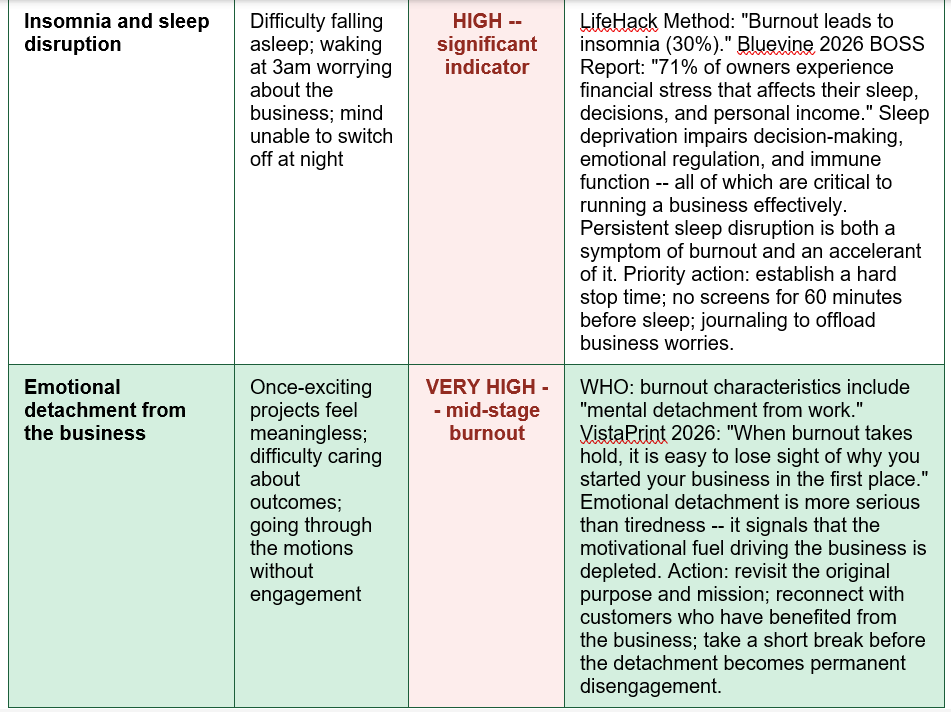
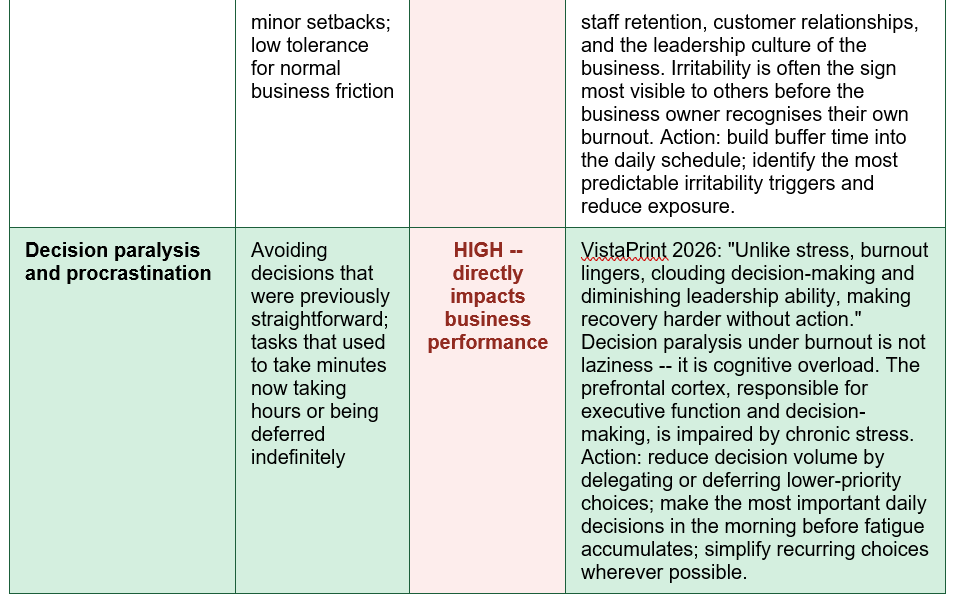
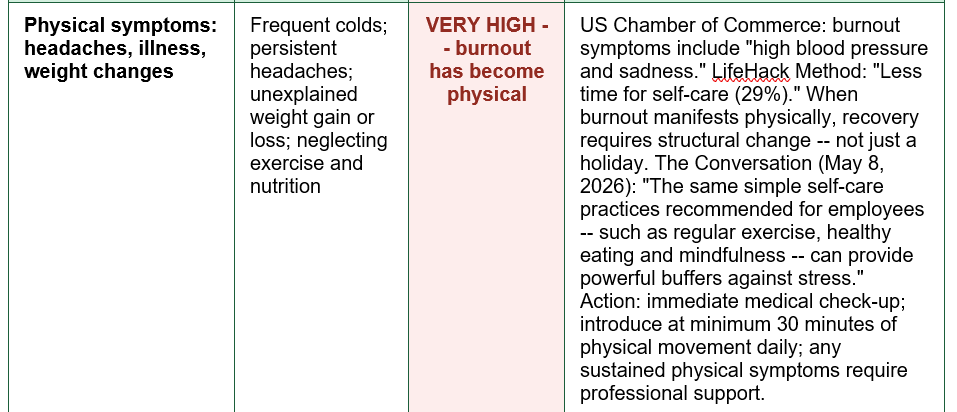
The most effective burnout prevention starts with early recognition. VistaPrint (April 2026): 'When burnout takes hold, it is easy to lose sight of why you started your business in the first place. Reconnecting with your purpose can help reset your priorities and ignite your passion again.' But the earlier burnout is recognised, the more easily it is reversed. The following table maps the six most common warning signs of small business owner burnout -- from early-stage signals to the point where professional support is necessary: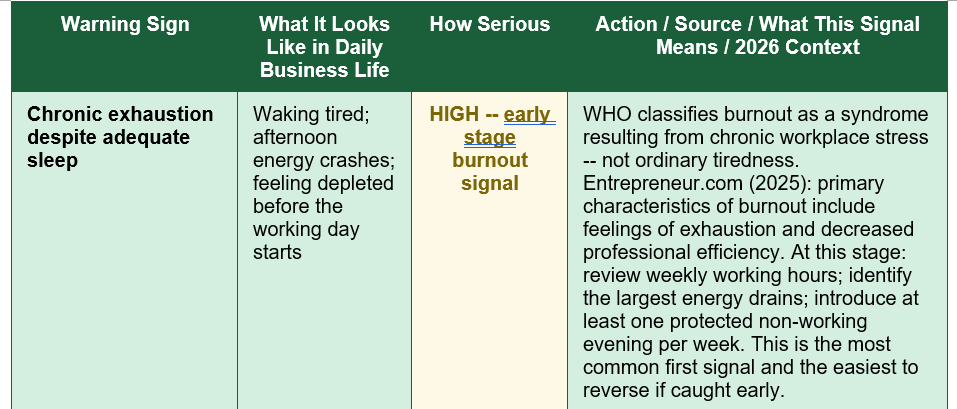

7 Ways to Avoid Burnout in Your Small Business
WAY 1: Set Clear Boundaries Between Work and Life | The Foundation of Everything
The single most effective structural change a small business owner can make to prevent burnout is establishing clear, enforced boundaries between working time and personal time. PensionBee (February 2026): 'When you are self-employed, it is easy for work and home life to blur. At first, that can feel like a benefit. Answering emails while cooking dinner, or opening your laptop in bed, may seem productive. But the downside is that you are never fully switched off. When work seeps into every part of your day, it becomes harder to rest.' The Walmart Business survey found that the primary reason 62% of small business owners experience burnout at least once a month is the difficulty in disconnecting from work, often due to blurred lines between personal and professional life. Practical boundary setting in 2026: define your working hours and communicate them to customers, suppliers, and employees; remove business email and messaging apps from your personal phone (or set specific notification-free windows); create a physical boundary between work and home if working from home (a dedicated workspace that you can physically leave at the end of the working day); and -- the most powerful boundary of all -- designate at least one full non-working day per week where no business communication is checked or responded to. US Chamber: 'If you are uncomfortable not working for an entire day, then respond during a specific time, say 2pm.' Start where you can and build the boundary progressively.WAY 2: Delegate Ruthlessly -- Stop Doing Everything Yourself | The Business Owner's Hardest and Most Important Skill
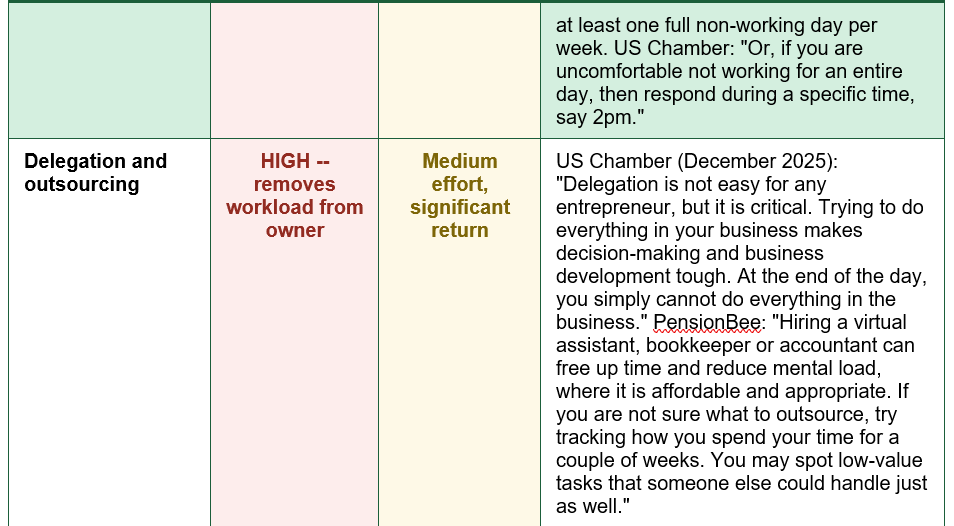
The inability or unwillingness to delegate is one of the most consistently cited drivers of small business owner burnout -- and one of the most correctable. US Chamber of Commerce (December 2025): 'Delegation is not easy for any entrepreneur, but it is critical. Trying to do everything in your business makes decision-making and business development tough. At the end of the day, you simply cannot do everything in the business. Delegating some things to the employees, or outsourcing if you do not have employees, can really help with preventing burnout.' PensionBee (February 2026): 'Hiring a virtual assistant, bookkeeper or accountant can free up time and reduce mental load, where it is affordable and appropriate. If you are not sure what to outsource, try tracking how you spend your time for a couple of weeks. You may spot low-value tasks that someone else could handle just as well.' The starting point for delegation is a two-week time audit: track every task you do in 15-minute blocks and identify which tasks: (a) only you can do (strategic decisions, key client relationships, creative direction); (b) could be done by an employee or trained team member; (c) could be outsourced to a specialist (bookkeeping, social media, customer service, IT support); and (d) do not need to be done at all (unnecessary meetings, reporting no one reads, administrative processes that exist by inertia). Most business owners find that categories (b), (c), and (d) account for 40-60% of their working week -- time that could be freed for higher-value work, rest, or both.WAY 3: Protect Your Rest -- Take Actual Time Off | The Non-Negotiable Your Business Cannot Survive Without
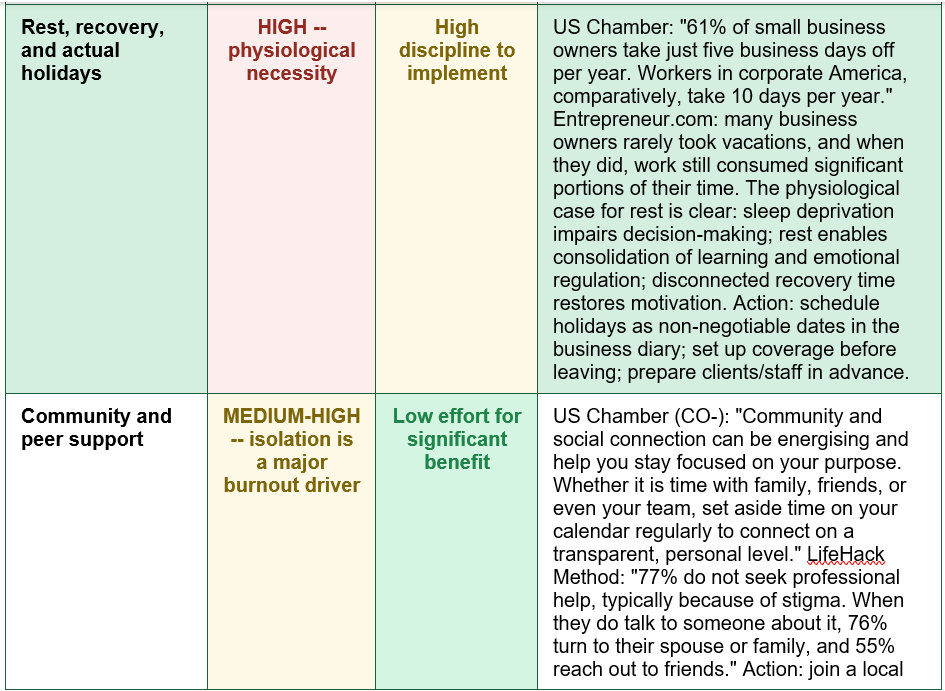
Rest is not a reward for finishing everything -- because in a small business, you never finish everything. Rest is a physiological and psychological requirement for sustained performance, and its absence is the most direct path to burnout. US Chamber of Commerce (CO-): 'According to an OnDeck survey, 61% of small business owners take just five business days off per year. Workers in corporate America, comparatively, take 10 days per year.' Entrepreneur.com: 'Many business owners rarely took vacations, and when they did, work still consumed significant portions of their time.' The consequence of this under-resting is predictable: chronic fatigue, impaired decision-making, reduced creativity, and eventually the full clinical burnout that requires far more recovery time than a proper holiday would have cost. Taking time off is not an indulgence -- it is a business investment. A rested business owner makes better decisions, treats people better, and generates more ideas in an hour than an exhausted one does in a day. Practical approach: schedule holidays as business-critical diary entries, not as events that happen when work allows; prepare clients, suppliers, and team members two weeks in advance; set up an out-of-office response; establish coverage for any time-sensitive responsibilities; and -- critically -- when you are off, be off. US Chamber suggests 'taking a workcation or Sunday afternoons off, at the bare minimum' for those who find full breaks difficult to sustain.WAY 4: Build Your Support Network -- Break the Isolation | Community Prevents the Loneliness That Amplifies Burnout
Running a small business is one of the most isolating professional experiences available. Unlike employees who have colleagues to share challenges with, business owners often carry their biggest concerns alone -- unwilling to show uncertainty to staff, unable to discuss strategy with competitors, and finding that friends and family, however supportive, cannot fully appreciate the specific demands of entrepreneurship. This isolation is a major driver of burnout. US Chamber: 'Especially when you first start out, running a small business can feel isolating and lonely. Community and social connection can be energising and help you stay focused on your purpose.' VistaPrint's 2026 Small Business Happiness Report specifically identifies connection as a central factor in business owner wellbeing: 'Many small business owners who say they feel happier today point to internal, day-to-day factors they can control as the main reason' -- and peer connection is among the most frequently cited. LifeHack Method: '77% of entrepreneurs do not seek professional help, typically because of stigma. When they do talk to someone about it, 76% turn to their spouse or family, and 55% reach out to friends.' Building a deliberate support network means: joining a business owners association, industry body, or local chamber of commerce; attending entrepreneurship meetups or networking events regularly; finding a peer accountability group of two to four other business owners at a similar stage; engaging with online entrepreneur communities (Federation of Small Businesses in the UK; SCORE in the US); and considering a business mentor or professional coach.WAY 5: Prioritise Physical and Mental Self-Care | Your Business Needs You to Function
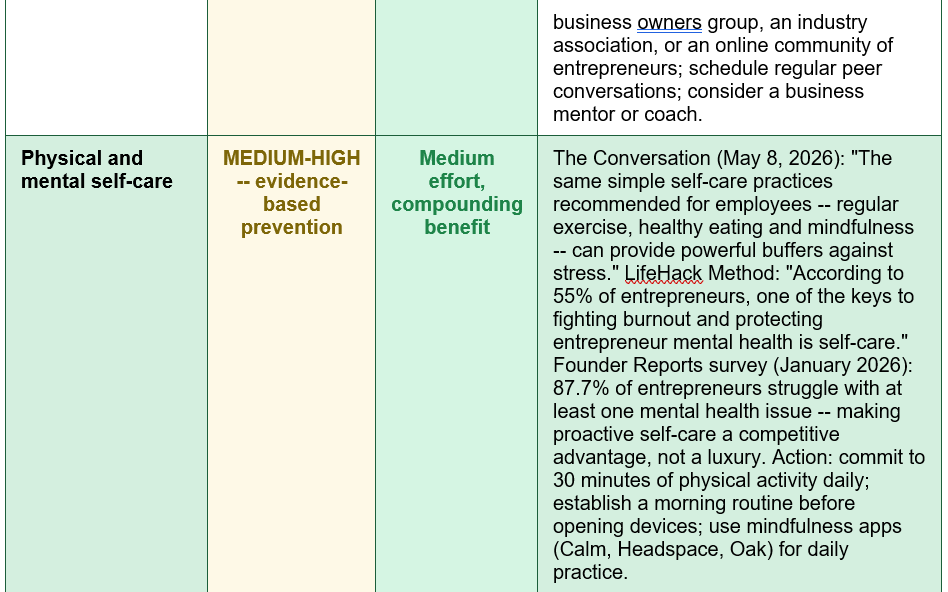
The research is unambiguous: physical and mental self-care are not optional extras for entrepreneurs -- they are productivity tools and burnout prevention mechanisms with measurable impact on business performance. The Conversation (May 8, 2026): 'The same simple self-care practices that are recommended for employees -- such as regular exercise, healthy eating and mindfulness -- can provide powerful buffers against stress.' LifeHack Method: 'According to 55% of entrepreneurs, one of the keys to fighting burnout and protecting entrepreneur mental health is self-care.' The physical basics: regular exercise (minimum 150 minutes moderate activity per week, per NHS and CDC guidelines) reduces cortisol levels, improves sleep quality, and significantly reduces the risk of anxiety and depression -- all of which feed into burnout vulnerability. Adequate nutrition and hydration, particularly during high-pressure periods, directly affect cognitive performance and emotional regulation. The mental basics: mindfulness practice (even 10 minutes daily using apps like Calm, Headspace, or the NHS-approved Oak) is evidence-based for reducing anxiety and improving stress resilience. Journaling -- spending 10 minutes at the end of each working day writing down three things that went well and one thing to improve -- creates a positive review habit that counteracts the negativity bias that burnout amplifies. VistaPrint (April 2026): 'Consider therapy, counselling or coaching tailored to entrepreneurs. Speaking to a professional can provide clarity and give you tools to navigate your emotions and stress. Having someone to talk to, particularly someone who understands the unique challenges of running a business, can make all the difference.'WAY 6: Reconnect With Your Purpose and Manage Financial Stress | Remember Why You Started -- and Get Financial Clarity
VistaPrint (April 2026): 'When burnout takes hold, it is easy to lose sight of why you started your business in the first place. Reconnecting with your purpose can help reset your priorities and ignite your passion again. Small business owners who say they feel happier today point to internal, day-to-day factors they can control.' Alongside purpose reconnection, financial stress is the single largest driver of burnout in the 2026 data. Bluevine's 2026 BOSS Report: 71% of owners experience financial stress that affects their sleep, decisions, and personal income; 41% say their top stressor is bringing in money in time to pay bills. VistaPrint 2026: 41% say income uncertainty is one of the most difficult parts of the job. Financial stress and burnout operate in a vicious cycle: financial worry creates stress; stress impairs decision-making; poor decisions worsen the financial position; the worsened financial position creates more stress. Breaking this cycle requires two separate actions. First, reconnect with purpose: schedule a quarterly 'why review' -- an hour alone (or with a trusted advisor) to articulate what the business means, what it has achieved, and what the next three months are for. This exercise regularly reverses early-stage emotional detachment before it becomes serious. Second, address financial stress directly rather than avoiding it. PensionBee (February 2026): 'If money worries are adding pressure, it is important to ask for help. You could start by speaking to your bank, funder or broker. If debt is a concern, a free debt helpline or financial advice line can help you understand your options. What matters most is not trying to handle everything on your own.' UK resources: Business Debtline (0800 197 6026); British Business Bank (access to finance guidance); HMRC Time to Pay arrangements.WAY 7: Build a Business That Does Not Depend Only on You | Long-Term Structural Burnout Prevention
The deepest cause of small business owner burnout is not a bad week -- it is a business structure that requires the owner to be involved in everything, all the time, indefinitely. Every way above addresses a symptom of this structure; this final way addresses the structure itself. US Chamber: 'Founder of Coffee Cracked, Mellina Joseph: one of the main reasons entrepreneurs burn out is because they grind too hard without taking a rest. That is why it is important to organise both your professional and personal life so you can take more time for yourself.' The structural changes that prevent burnout long-term are: documenting processes so that key activities can be performed by someone other than the owner; building a team (even one or two part-time people) that can manage day-to-day operations without constant owner input; creating systems for customer communication, financial management, and operational delivery that run semi-independently; diversifying revenue streams so that no single client or project creates existential dependency; and building a financial buffer (3-6 months of operating costs) that removes the constant pressure of month-to-month cash survival. The Conversation (May 8, 2026): 'Entrepreneurs can take steps to protect their mental health by setting clear boundaries between work and personal life, establishing dedicated time for rest, avoiding the always-on mindset, and delegating tasks and outsourcing non-core activities to reduce workloads.' These are structural changes to the business, not just personal habits -- and they are what transforms burnout prevention from a temporary measure into a permanent feature of how the business operates.The Burnout Prevention Framework: Quick Reference
The following table maps the five most important burnout prevention areas with their priority level, implementation effort, and key actions for 2026: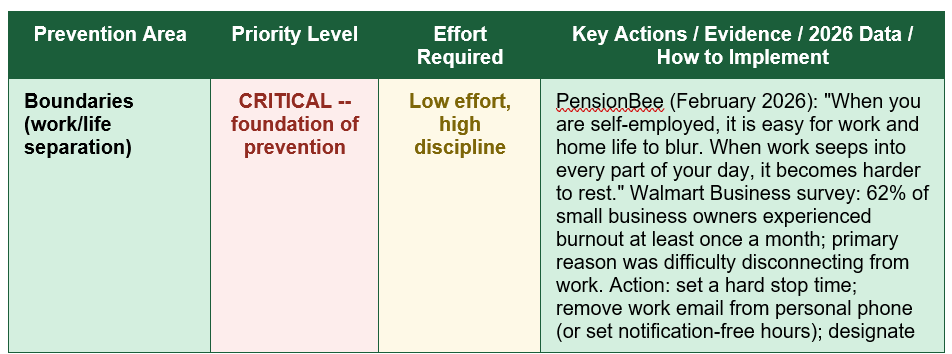
When You Are Already Burning Out: Recovery Steps
If you recognise the warning signs in yourself right now -- not as abstract information but as a personal description -- the following steps are the most direct path to recovery:- Acknowledge it honestly: The first and hardest step. VistaPrint (April 2026): 'If you have reached the point where burnout is affecting your mental and physical health, it is time to step back.' Most business owners minimise their burnout because acknowledging it feels like acknowledging failure. It is not. It is acknowledging a physiological and psychological condition that affects 34-48% of business owners. Naming it clearly is the beginning of addressing it.
- Take an immediate, non-negotiable break: Even two to three days of genuine disconnection from the business -- no email, no phone, no checking in -- begins the physiological recovery process. This requires practical planning: informing key contacts, setting up coverage, setting an out-of-office. The business will not collapse in three days. Your ability to run it well requires that you step back.
- Seek professional support: VistaPrint: 'Consider therapy, counselling or coaching tailored to entrepreneurs. Speaking to a professional can provide clarity and give you tools to navigate your emotions and stress. Having someone to talk to, particularly someone who understands the unique challenges of running a business, can make all the difference.' UK: your GP is the first port of call; ask for referral to talking therapies through IAPT (Improving Access to Psychological Therapies). US: contact your health insurance provider for mental health coverage; NAMI (1-800-950-6264) can provide referrals. Online therapy platforms (BetterHelp, BACP-registered therapists in the UK) can be accessed quickly without waiting lists.
- Restructure the business systemically: Recovery from burnout that returns you to the same structure that caused it produces the same burnout again. PensionBee: 'By prioritising your wellbeing and making a few simple changes, you may be able to protect your mental health and build a business that feels more sustainable.' Recovery is the opportunity to implement the structural changes -- delegation, boundaries, financial management, team building -- that prevent recurrence.
The 2026 data point every business owner needs to see: VistaPrint 2026 Small Business Happiness Report found that despite the scale of stress described above, 78% of small business owners in the Bluevine BOSS Report remain optimistic about their profitability outlook for the year ahead. The goal of avoiding burnout is not just survival -- it is preserving access to the genuine satisfaction that running your own business can deliver. VistaPrint: 'Reconnecting with your purpose can help reset your priorities and ignite your passion again.' The business you built deserves a leader who is present, energised, and motivated -- and so do you.
YOUR WEEKLY BURNOUT PREVENTION CHECKLIST: DAILY: (1) Hard stop at your defined finish time -- no exceptions. (2) At least one screen-free meal. (3) 30 minutes of physical movement. (4) Five minutes of journaling or reflection before closing the working day. WEEKLY: (5) At least one full non-working day. (6) Peer connection -- a call with another business owner, a mentor, or a trusted colleague. (7) Review your energy levels and mood -- are they stable or declining? (8) Check: is one person (you) carrying the full operational weight of the business, or is load being distributed appropriately? MONTHLY: (9) Review financial position to reduce financial uncertainty -- knowing the numbers is less stressful than not knowing them. (10) Schedule your next holiday or extended break before the end of the month. (11) Ask: what task could I delegate, outsource, or eliminate this month? (12) Reconnect with your purpose -- write one sentence describing what the business achieved this month and why it matters. IF YOU NOTICE THREE OR MORE BURNOUT WARNING SIGNS: speak to your GP or a mental health professional immediately. Do not wait for a crisis.
THE FOUR BURNOUT TRAPS THAT KEEP BUSINESS OWNERS STUCK: (1) 'I CAN SLEEP WHEN THE BUSINESS IS STABLE.' The business never reaches a stable point that earns rest -- that stability arrives only after the owner has invested in building a structure that enables it. Chronic sleep deprivation impairs the decision-making that creates stability. Rest is not a reward; it is a prerequisite. (2) 'ASKING FOR HELP IS A SIGN OF WEAKNESS.' LifeHack Method: 77% of entrepreneurs do not seek professional help because of stigma. The business owners who avoid burnout most successfully are typically those who build the strongest support networks earliest -- mentors, advisers, peers, and professional coaches. Asking for help is what experienced entrepreneurs do; suffering alone is what beginners believe they must do. (3) 'I AM NOT BURNED OUT, JUST TIRED.' The distinction between ordinary tiredness (which resolves with a night of good sleep) and early-stage burnout (which does not) is the difference between catching a problem early and managing it while it is still manageable. If you have been 'just tired' for three months, that is not tiredness. (4) 'ONCE THIS PROJECT IS FINISHED, I WILL SLOW DOWN.' There is always another project. The permission to slow down, rest, delegate, and reconnect does not come from the business -- it comes from you. Every business owner in the history of entrepreneurship has had a pending reason not to take a holiday. Schedule the break anyway.
Conclusion
Burnout among small business owners is not a marginal problem affecting a small minority. The 2026 data shows that 87.7% of entrepreneurs struggle with at least one mental health issue, 62% experience burnout symptoms monthly, and 61% take fewer than five days off per year. These are not the statistics of a sustainable industry culture. They are the statistics of a community that has normalised chronic overwork to the point where the warning signs of burnout are treated as the expected experience of running a business. They are not.The seven ways in this guide -- setting work/life boundaries, delegating ruthlessly, protecting rest, building peer support, prioritising self-care, reconnecting with purpose and managing financial stress, and restructuring the business to not depend solely on the owner -- address burnout at every level from daily habit to business strategy. The Conversation (May 8, 2026): 'Although the entrepreneurial journey is inherently demanding, burnout is not inevitable. Entrepreneurs can take steps to protect their mental health by setting clear boundaries between work and personal life, establishing dedicated time for rest, and delegating tasks and outsourcing non-core activities to reduce workloads.' The business benefits from an owner who is well-rested, emotionally regulated, and motivated. The burnout prevention strategies in this guide are not a concession to weakness -- they are the operational infrastructure of a business that is built to last.
If the content of this guide describes where you already are rather than where you are headed, please use the resources in the disclaimer at the top of this article: Samaritans (UK: 116 123), Mind (UK: 0300 123 3393), NAMI (US: 1-800-950-6264). Your wellbeing is not separate from your business success -- it is its foundation.

0 Comments Comments