

Business
Profit vs Cash: What Is the Difference? Accountant Explains


Table of Contents
- The Question That Has Confused Business Owners for Centuries
- What Is Profit?
- What Is Cash Flow?
- Profit vs Cash Flow: The Complete Side-by-Side Comparison
- Worked Examples: When Profit and Cash Tell Different Stories
- Example 1 — THP's Jeremy: Profit £12,000 but Bank Overdrawn £6,000
- Example 2 — Depreciation: The Non-Cash Profit Charge
- Why Profitable Businesses Run Out of Cash: The Six Causes
- The Financial Statements That Track Each: P&L vs Cash Flow Statement
- The Profit and Loss Statement (Income Statement)
- The Cash Flow Statement
- How to Improve Cash Flow Without Increasing Profit
- Conclusion
- Frequently Asked Questions (FAQ)
The Question That Has Confused Business Owners for Centuries
'Where have my profits gone?' It is one of the most common questions accountants hear from clients — usually triggered by a year-end meeting where the accounts show a healthy profit, but the business owner knows all too well that the bank account tells a very different story. The business looks profitable on paper. The expenses are covered. The margins are reasonable. So why is the bank account running on fumes?The answer lies in one of the most important and most frequently misunderstood distinctions in business finance: profit and cash are not the same thing. They measure different aspects of a business's financial health, they are calculated differently, they appear on different financial statements, and they can tell completely contradictory stories at exactly the same moment in time. A business can be profitable and cash-poor. A business can have strong cash inflows and be loss-making simultaneously. Understanding why requires understanding the mechanics that separate the two.
FD Capital's April 2026 case study makes the real-world stakes concrete: a UK technology services business with a £6 million turnover and a reported year-to-date profit of £680,000 approached FD Capital in October 2025 with a deteriorating bank position, an overdraft facility fully absorbed, and an approaching covenant breach. The profit was real by accounting standards. The cash crisis was equally real. The two figures existed in the same business at the same time, and the gap between them nearly ended the company. This guide explains everything: the definitions of profit and cash flow, why they diverge, the six most common causes of cash crises in profitable businesses, the three types of cash flow, the critical financial statements that track each, and the practical steps to monitor and manage both.
What Is Profit?
Profit is the financial surplus that remains after all costs of running a business are deducted from its revenues. THP Accountants' guide (November 2025) provides the clearest baseline definition: 'Basically, profits is the price of what you sell less the costs associated with making those sales and all your other business expenses.' It is calculated on an accrual accounting basis — meaning revenue is recognised when it is earned (when the goods are delivered or the service is performed and the invoice is raised), and expenses are recognised when they are incurred (when the cost is committed, not necessarily when it is paid).Profit exists in three main forms within the Profit and Loss Statement (P&L, also called the Income Statement): gross profit is revenue minus the direct costs of producing goods or services (cost of goods sold or cost of sales). Operating profit (EBIT — Earnings Before Interest and Tax) is gross profit minus operating expenses such as rent, salaries, marketing, and administration. Net profit (the bottom line) is operating profit minus interest charges and corporation tax — the final surplus available to the business owner or shareholders.
The accrual accounting basis that underpins profit calculation creates an immediate and permanent gap between profit and actual cash. A sale made and invoiced in December is December revenue on the P&L — it contributes to December profit — regardless of whether the customer pays in December, January, or March. An expense committed to in November (a consultant booked, a supply order placed) is a November cost — reducing November's profit — whether payment is due in December or February. Profit, in other words, records economic activity when it happens. Cash records the financial transactions when money physically moves.
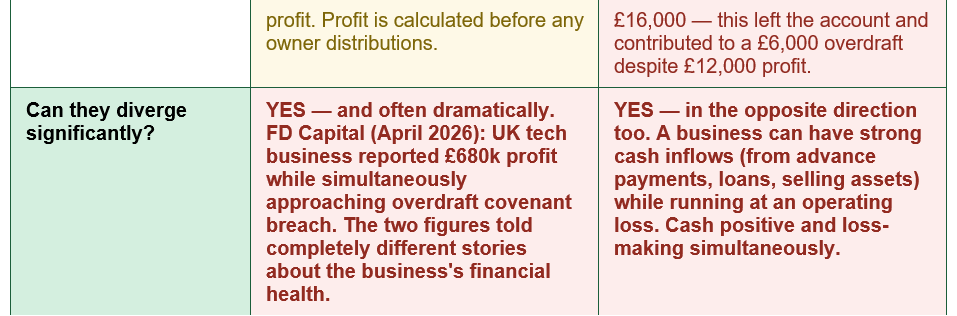
Profit without cash — the real 2026 UK example: £680,000 reported profit. Overdraft covenant breach. Debtor days stretched 38 to 67, absorbing £620,000 in cash. — FD Capital's case study (published April 28, 2026): a £6m turnover UK technology services business had genuine, correctly calculated profit of £680k year-to-date — and simultaneously faced a banking crisis. The fractional CFO engagement identified three causes: debtor days stretching from 38 to 67 days (£620k cash absorption), inventory build of £180k for a confirmed Q1 2026 contract, and a £140k capex programme depreciated rather than shown as a cash cost. Reducing debtor days to 47 released £380k and resolved the immediate crisis
What Is Cash Flow?
Cash flow is the actual movement of money in and out of a business's bank account during a specific period — recording when cash physically arrives and when it physically leaves. Nav's April 2026 guide defines it simply: 'Cash flow refers to the money that flows in and out of your business. Income and expenses. What you're bringing in and spending.' Unlike profit, which records transactions when they occur economically, cash flow only counts money when it actually crosses the bank account threshold.Cash flow is categorised into three distinct types, each appearing as a separate section on the Cash Flow Statement — the financial document that tracks cash movements independently from the P&L:
- Operating cash flow: Cash generated from — or consumed by — the core business operations. This includes cash receipts from customers (when they pay their invoices), cash payments to suppliers (when bills are settled), payroll, rent, utilities, and all other day-to-day running costs paid in cash. Operating cash flow is the most important type for assessing business health — a consistently cash-generative operation can sustain itself without relying on financing.
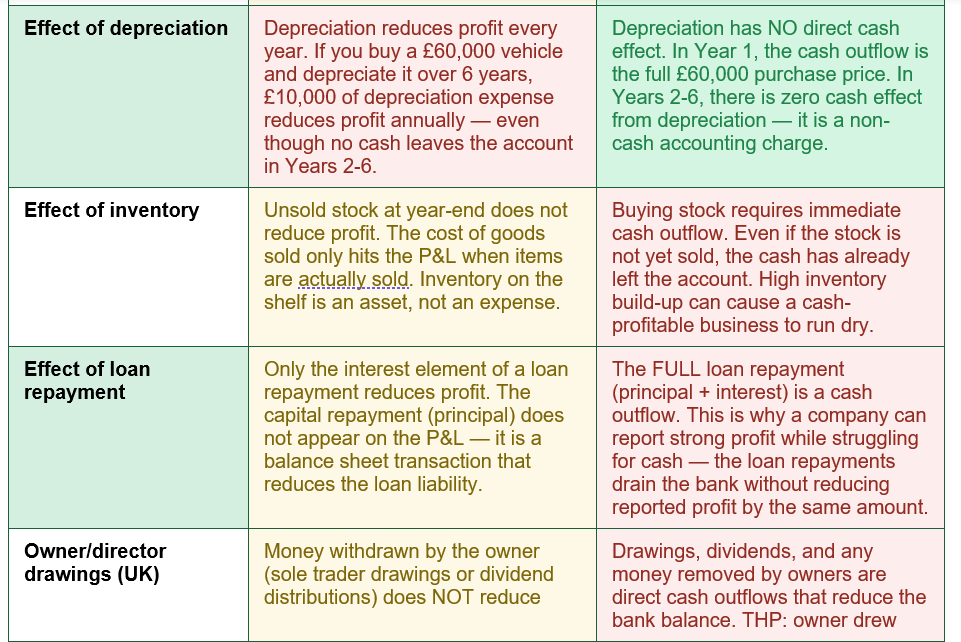
- Investing cash flow: Cash spent on or received from long-term investments. Purchasing equipment, vehicles, property, technology infrastructure, or intangible assets produces cash outflows in this section. Selling assets, receiving dividends from investments, or receiving returns from business disposals produces inflows. This is where capital expenditure appears — explaining why buying a £60,000 van creates a £60,000 investing cash outflow while only generating £10,000/year in depreciation expense on the P&L.
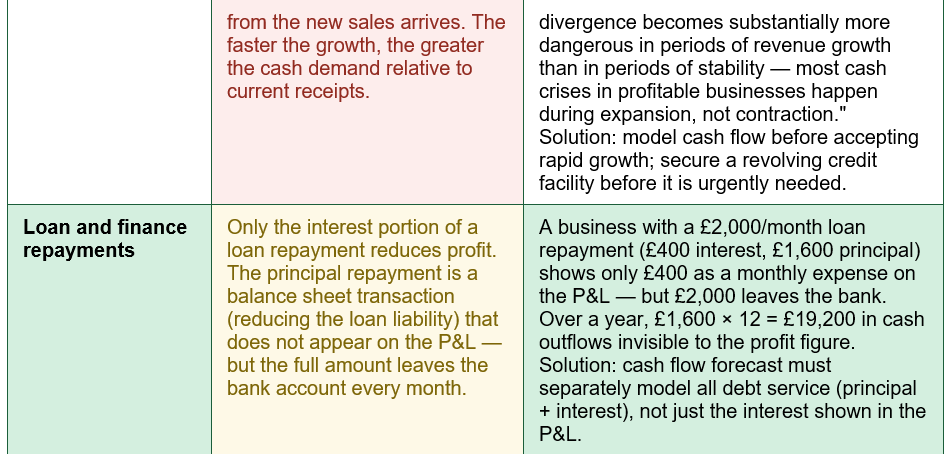
- Financing cash flow: Cash received from or repaid to lenders and investors. Taking out a new business loan generates a cash inflow; repaying principal on an existing loan is a cash outflow. Issuing shares produces inflows; paying dividends to shareholders produces outflows. Critically, the full loan repayment (capital and interest) appears here — only the interest element reduces profit on the P&L.
Positive cash flow — more cash coming in than going out across all three categories — means the business has the liquidity to pay its obligations as they fall due. Negative cash flow means more is leaving than arriving, which may require drawing on overdraft facilities, bank loans, or investor capital to remain solvent. A business can sustain short periods of negative cash flow if it has reserves or financing available, but sustained cash-negative operations — regardless of profitability — will eventually exhaust available liquidity.
Profit vs Cash Flow: The Complete Side-by-Side Comparison
The table below maps every key dimension of the profit vs cash flow distinction — definition, accounting basis, financial statement, timing, and the specific treatments of depreciation, inventory, loan repayments, and owner drawings: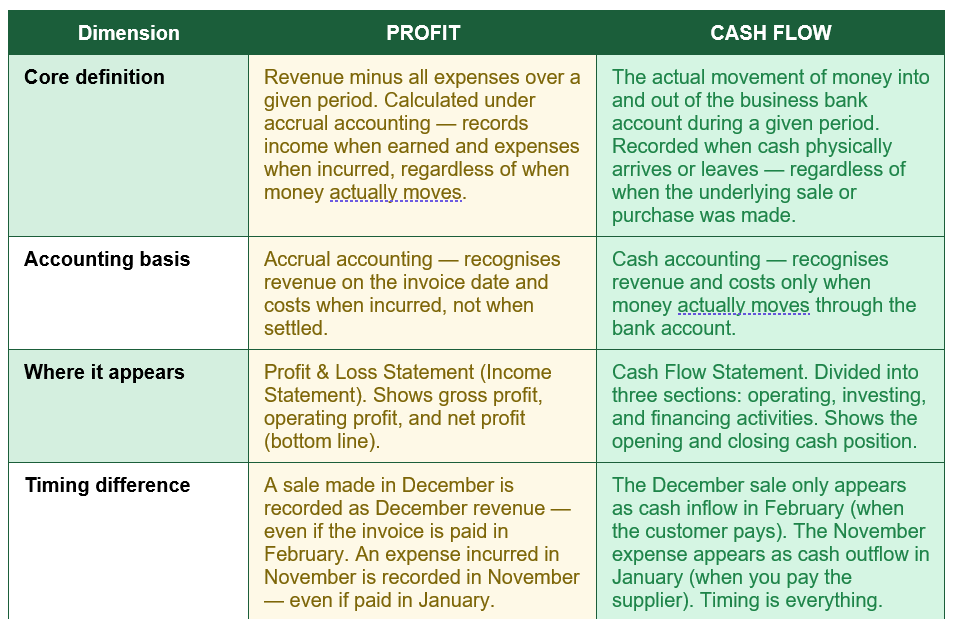
Worked Examples: When Profit and Cash Tell Different Stories
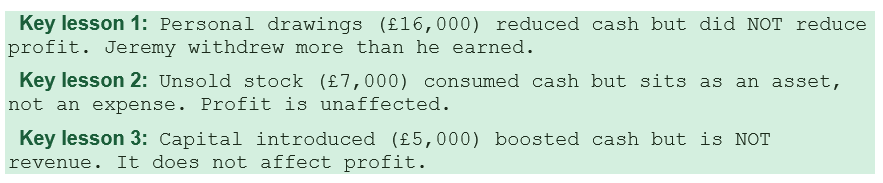
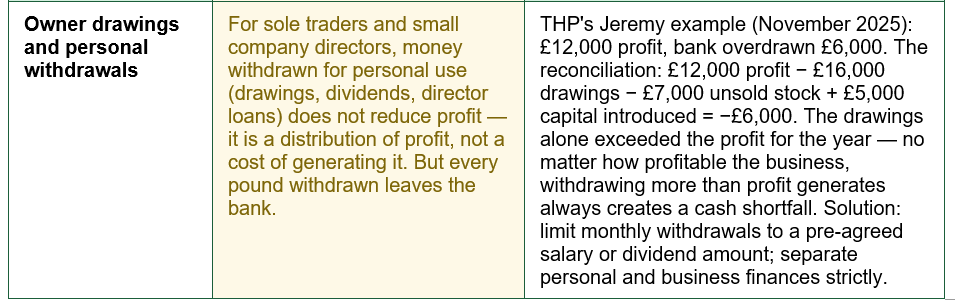
Example 1 — THP's Jeremy: Profit £12,000 but Bank Overdrawn £6,000
THP Accountants' November 2025 guide presents the clearest illustrative worked example of the profit-cash gap. Jeremy is not VAT-registered and runs a small widget shop. His year-end accounts show a profit of £12,000. But his bank account is £6,000 overdrawn. Where did the profits go?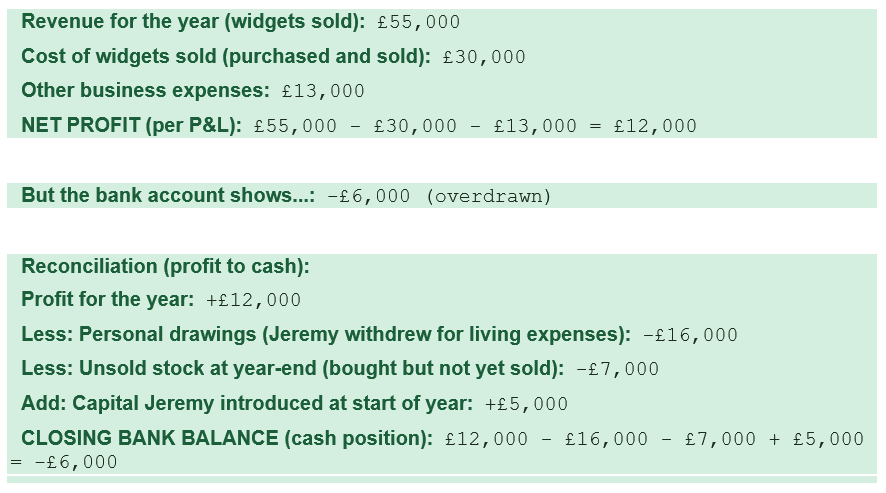
Example 2 — Depreciation: The Non-Cash Profit Charge
A business buys a delivery van for £60,000 cash and depreciates it over 6 years. How do the P&L and cash flow diverge?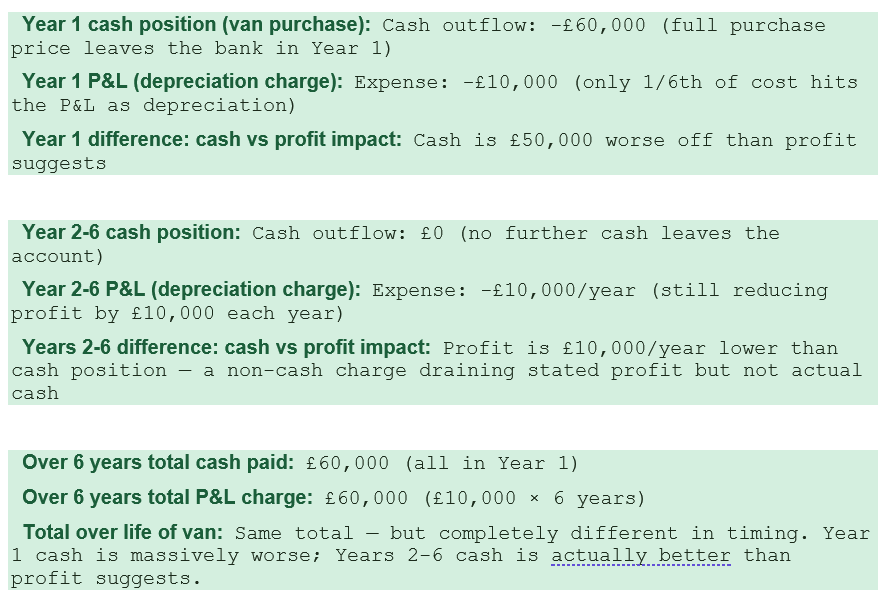
The Miranda Marquit lesson — profit on paper, overdraft in reality: Nav's April 2026 feature profiles freelance writer Miranda Marquit, who learned the profit-cash distinction the hard way in her own business: 'In the early days of my business, I emphasised profit and was surprised when I still ran out of money or fell behind. I expected profit at the end of the month, but in the meantime, I was overdrawing my account while I waited for clients to pay because of when the bills were coming out.' This is the accrual accounting gap in its purest personal form: profit recorded when work is done; cash only arriving when clients pay. The two can be weeks or months apart — and in those weeks, the bills still need to be paid. Monitoring only profit and ignoring cash flow timing is the single most common financial management mistake among freelancers and early-stage businesses.
Why Profitable Businesses Run Out of Cash: The Six Causes
The profit-cash gap is not random — it is driven by specific, identifiable mechanisms. Understanding each one enables business owners and managers to monitor and manage the gap proactively rather than discovering it in a banking crisis. The table below maps all six causes with 2026 real-world examples: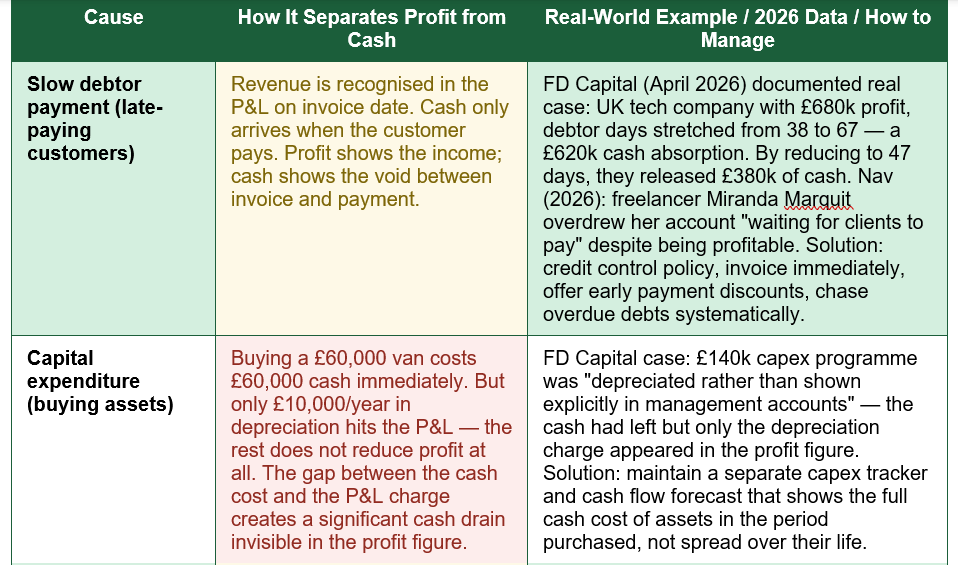
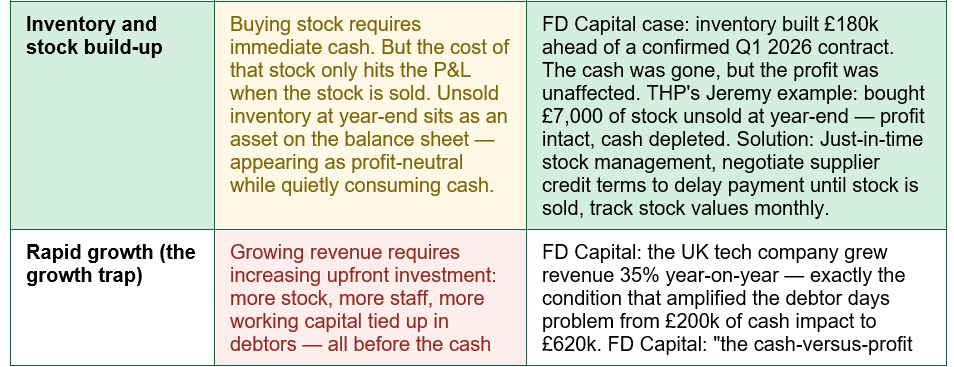
The Financial Statements That Track Each: P&L vs Cash Flow Statement
Profit and cash flow each have their dedicated financial statement, and reading both — not just one — is essential for a complete picture of business financial health:The Profit and Loss Statement (Income Statement)
The P&L shows revenue, costs, and profit over a defined period — typically a month, a quarter, or a financial year. It begins with revenue at the top, deducts the cost of goods sold to arrive at gross profit, then deducts operating expenses to give operating profit, and finally deducts interest and tax to produce net profit at the bottom. The P&L answers the question: did this business earn more than it spent in this period? It is calculated on an accrual basis — recording economic events when they occur, not when cash moves.The P&L is the statement most commonly reviewed by business owners because it shows the bottom line — profit or loss. But Xero UK's April 2026 guide on cash flow management emphasises its limitation: 'Looking at your P&L alone doesn't tell you whether you'll have the cash available to pay your bills when they're due.' The P&L tells you what you earned; it does not tell you when you will receive it.
The Cash Flow Statement
The Cash Flow Statement tracks the actual movement of cash in and out of the business during the same period, divided into three sections: operating activities (day-to-day business), investing activities (capital expenditure and asset disposals), and financing activities (loans, repayments, and equity). It begins with the opening cash balance, adds all cash inflows, subtracts all outflows, and arrives at the closing cash balance. The Cash Flow Statement answers the question: how much actual cash did this business have at the start and end of the period, and what happened to it?The reconciliation between profit and cash flow is produced by the indirect method Cash Flow Statement — which starts with net profit and then adjusts for: non-cash items (adding back depreciation), changes in working capital (increasing debtors reduces cash; increasing creditors increases cash temporarily), capital expenditure (full cash cost in the period of purchase), and financing flows (loan drawdowns and repayments). Understanding this reconciliation — the bridge from profit to cash — is the single most powerful analytical tool for diagnosing why profit and cash have diverged.
THE MONTHLY CASH BRIDGE — FD CAPITAL'S RECOMMENDATION: FD Capital's April 2026 guide recommends that all businesses implement a "monthly cash bridge" — a simple table that starts with opening cash, adds projected receipts (when customers are expected to pay), subtracts planned payments (when supplier and staff payments fall due), and arrives at the projected closing cash balance for each future month. This forward-looking cash flow forecast is fundamentally different from the P&L — it answers not "are we profitable?" but "will we have cash to pay our bills next week, next month, and next quarter?" FD Capital: "Management accounts that show profit without showing working capital movement are essentially incomplete and warrant immediate fixing regardless of other priorities."
How to Improve Cash Flow Without Increasing Profit
The most powerful insight from understanding the profit-cash distinction is that you can improve cash flow significantly without necessarily increasing revenue or profit — by managing the timing and structure of cash movements more effectively. FD Capital reduced a client company's debtor days from 67 to 47 — releasing £380,000 in cash without changing a single revenue line or cost structure. These are purely working capital management improvements: operational changes that accelerate the conversion of profit into cash:- Accelerate debtor collection: Invoice immediately upon delivery. Send payment reminders 7 days before due date and the day of due date. Introduce a late payment fee (UK late payment legislation allows 8% above Bank Rate plus compensation charges). Offer a 1-2% early payment discount for settlement within 7 days. Use automated invoicing software (Xero, QuickBooks, FreeAgent) that sends reminders automatically. Every day reduced in average debtor days releases cash equal to one day's average sales.
- Extend creditor payment terms: Negotiate longer payment terms with suppliers — from 30 days to 60 days — where relationships and supplier dependence allow. This does not reduce costs or improve profit but delays cash outflows, improving the cash cycle. Be careful not to damage supplier relationships or miss early payment discounts that may exceed the cash benefit of delayed payment.
- Reduce inventory: Review stock levels and reduce where possible. Negotiate just-in-time delivery arrangements with key suppliers. Any reduction in average inventory holding releases cash equal to the reduction in stock value. Be careful not to reduce stock so far that it creates supply failures and lost sales.
- Invoice in advance for large contracts: Where market norms allow, request a deposit (25-50%) on contract signature rather than invoicing in arrears. Subscription and retainer models that invoice monthly in advance produce consistent, predictable cash inflows that are structurally superior to project-based invoicing in arrears.
- Use asset finance rather than cash purchase: For capital expenditure, spreading the cost over a finance lease or hire purchase agreement converts a large one-off cash outflow into manageable monthly payments. The total cost may be higher (finance charges apply), but the cash flow impact is dramatically different from a lump-sum purchase.
- Build a cash flow forecast: Money.co.uk's April 2026 guide recommends a rolling 13-week cash flow forecast as the most practical tool for staying ahead of cash timing problems: 'Stay on top of cash flow to cover bills and keep your business moving without the stress.' A 13-week forecast (updated weekly with actual results and revised future projections) gives enough lead time to arrange financing or reduce outflows before a crisis, rather than discovering the problem at the moment of crisis.
THE PROFITABLE INSOLVENCY WARNING: A business can legally trade while insolvent in the short term, but directors who allow a company to continue trading when they knew or should have known it could not meet its debts may face personal liability for wrongful trading under the Insolvency Act 1986 (UK) or equivalent legislation. Profit does not protect a business from insolvency — only cash can pay creditors when bills fall due. A business that consistently reports profit but struggles to pay supplier invoices, HMRC liabilities, or payroll on time is exhibiting the early warning signs of a cash crisis that, if left unmanaged, can lead to administration or liquidation. Never confuse a profitable trading position with a financially secure one. The P&L is not the measure of solvency; cash is.
Conclusion
Profit and cash are not the same — and the gap between them is one of the most consequential and most frequently misunderstood concepts in business finance. Profit is calculated under accrual accounting: it recognises revenue when earned and expenses when incurred, regardless of when money actually moves. Cash flow tracks the actual movement of money in and out of the bank account when it physically arrives or departs. The two can diverge dramatically — as FD Capital's April 2026 case study demonstrates with a UK business simultaneously reporting £680,000 profit and facing overdraft covenant breach.Six specific mechanisms create the gap between profit and cash: slow debtor collection (revenue earned but not yet received), capital expenditure (full cash cost immediate but profit charge spread via depreciation), inventory build-up (cash spent on stock not yet sold), rapid growth (more working capital required before new revenues are collected), loan principal repayments (full cash cost not fully reflected in P&L interest charge), and owner drawings (cash withdrawn that does not reduce profit). Every one of these is identifiable, measurable, and manageable — but only if the business owner is monitoring both the P&L and the cash flow statement, not just the bottom line.
The practical imperative from this distinction is to implement a rolling cash flow forecast alongside monthly management accounts. FD Capital is unambiguous: 'Management accounts that show profit without showing working capital movement are essentially incomplete.' Understanding both statements — the P&L for measuring whether the business is generating economic surplus, the cash flow statement for measuring whether it can pay its bills — is the foundation of sound business financial management. A business can survive a period of losses if it has cash reserves. A business cannot survive without cash, regardless of what the profit figure says.
0 Comments
Be the first to share your thoughts on this article.