

Business
What Is Overhead in Business? Complete UK & US Guide
Table of Contents
- The Costs That Never Stop Running
- What Is Overhead in Business?
- Types of Overhead: Fixed, Variable, Semi-Variable, and Beyond
- Overhead vs Direct Costs: The Definitive Distinction
- How to Calculate Overhead Rate and Overhead Ratio
- The Overhead Rate (per unit or per hour)
- The Overhead Ratio (Overhead Percentage of Revenue)
- Overhead by Business Type: Benchmarks and Characteristics
- How to Reduce Overhead Costs: Practical Strategies for 2026
- Conclusion
- Frequently Asked Questions (FAQ)

The Costs That Never Stop Running
Every business has two categories of costs. The first are direct costs -- expenses that exist because of a specific product, project, or sale. The raw materials in a product, the delivery of a specific order, the freelance designer hired for one campaign. Remove the product or sale and these costs disappear. The second category never disappears. It runs whether business is booming or barely ticking over. Whether ten products ship or a thousand. Whether the calendar is full or the phone does not ring. These are overhead costs -- and every business, regardless of size, sector, or model, carries them.Xero UK defines them precisely: 'Overhead costs are indirect business expenses that keep your business running but are not tied to producing specific goods or services.' SelfEmployed.com (updated 3 weeks ago) puts it in even plainer terms: 'Overhead in business is the ongoing cost of running your operation that is not tied to any single project or sale. In plain terms, it is everything you pay for just to keep the lights on, from your software subscriptions to your phone bill. For the self-employed, overhead is the quiet number that determines how much of your revenue you actually get to keep.'
The stakes of understanding overhead are high: Xero UK states that 'without knowing your true overhead costs, you might set prices too low and lose money on every sale.' This is one of the most common financial mistakes small businesses make -- pricing based on direct costs alone, not accounting for the overhead that every sale must contribute to. FreshBooks' certified CPA Sandra Habiger provides the benchmark: 'In general, anything less than 35% is considered a good overhead percentage. However, this varies depending upon the size of your company and what industry you work in.' This guide explains what overhead is, its three types, how it differs from direct costs, how to calculate it, the overhead rate, what a good overhead ratio looks like by industry, and the most effective strategies for reducing it -- all grounded in current 2026 sources.
What Is Overhead in Business?
Overhead costs are all the indirect expenses a business incurs that cannot be directly linked to a specific product, service, project, or customer. They are the costs of keeping the business operational -- the infrastructure, administration, and support costs that enable the business to exist and function, regardless of what it produces or sells. Beancount.io (April 2026) makes the distinction concrete with a bakery example: 'A bakery's flour and sugar are direct costs -- they go straight into the product. But the bakery's rent, the electricity that powers the ovens during off-hours, and the accountant's salary are all overhead.'This illustrates the defining characteristic of overhead: it is not caused by any single sale or product and does not disappear when a sale does not happen. Debitam UK (April 2026): 'Overhead costs are the ongoing expenses required to run a business that are not directly tied to producing goods or services. You have to pay them whether you sell one loaf or a thousand.' The bakery pays the same rent in a quiet January as in a busy December. The accountant's salary does not change based on how many loaves sold that month. These are overhead costs.
The opposite of overhead is the direct cost -- sometimes called the cost of goods sold (COGS) or the cost of sales. FreshBooks: 'Cost of Goods Sold, or COGS, are costs directly associated with producing your goods or service, while overhead costs are all other costs associated with running your business. COGS includes materials and direct labour needed to produce your profit-generating goods or service, while overhead costs include administration, rent, and other indirect costs.' The total cost of operating any business = direct costs + overhead costs. Profit = revenue minus both. Understanding the split between these two cost categories is the foundation of sound business financial management.
Business overhead in 2026 -- key benchmark: Under 35% overhead ratio = generally good. Retailer overhead: 40-60%. Freelancer overhead: 10-20%. SaaS/tech overhead: 15-35%. — FreshBooks (certified CPA Sandra Habiger): 'In general, anything less than 35% is considered a good overhead percentage. However, this varies depending upon the size of your company and what industry you work in -- companies that require a warehouse and storefront will have higher overhead than a freelancer working from home.' Xero UK: 'Overhead costs affect your business in three key ways: pricing decisions, cash flow management, and profitability.' Debitam UK (April 2026): 'Understanding these vital expenses is a cornerstone of sound financial management, enabling you to set accurate prices, forecast profitability, and make informed business decisions.'
Types of Overhead: Fixed, Variable, Semi-Variable, and Beyond
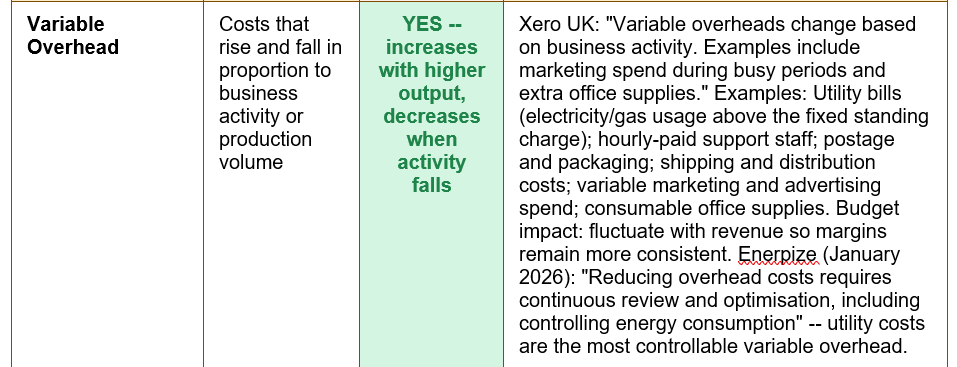
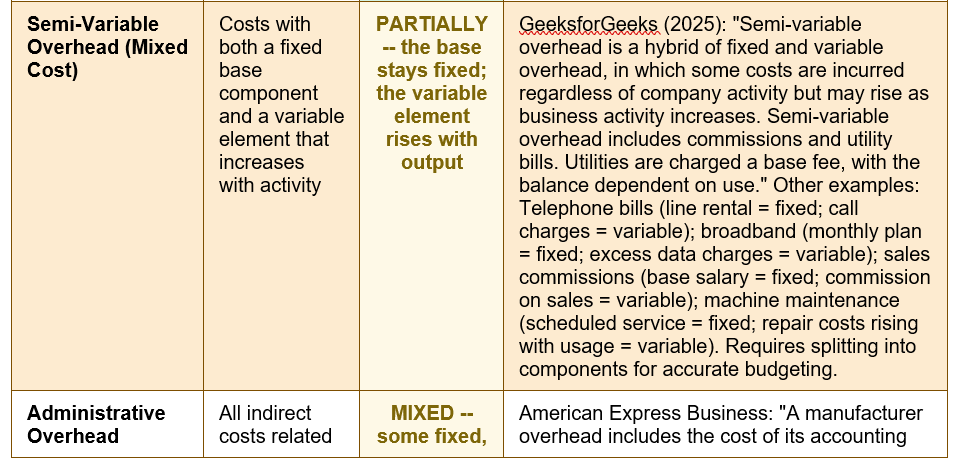
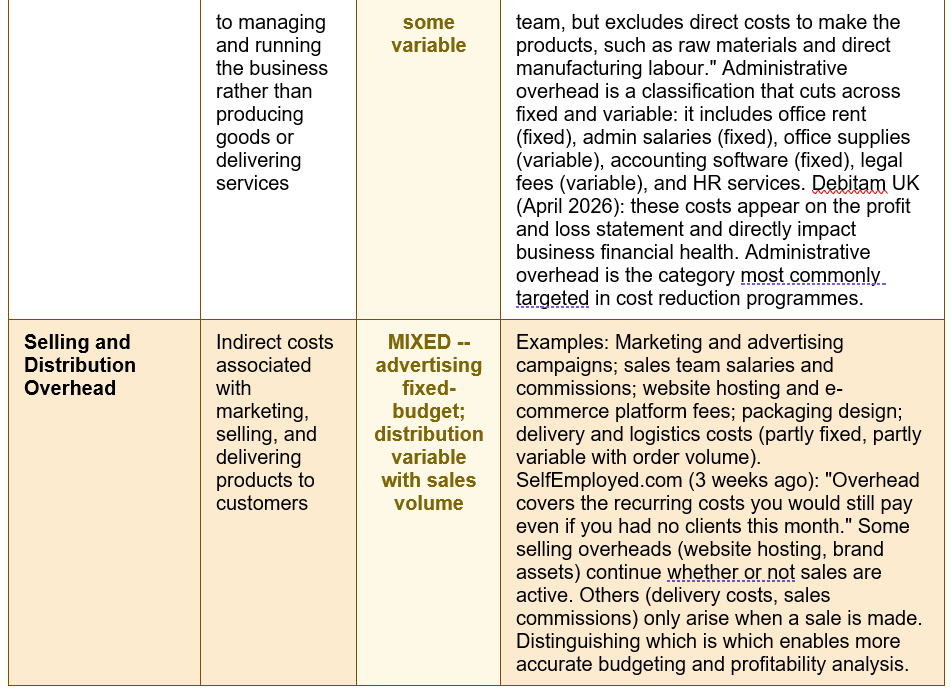
Not all overhead behaves the same way. Beancount.io (April 2026): 'Understanding the three categories helps you forecast more accurately and identify where you have flexibility to cut back.' The following table maps every major overhead type with its behaviour, examples, and management implications: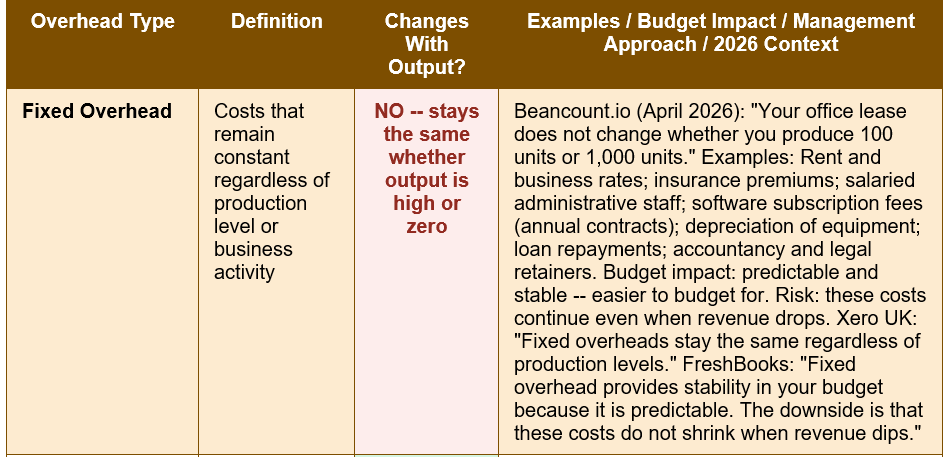
Overhead vs Direct Costs: The Definitive Distinction
The distinction between overhead (indirect costs) and direct costs (COGS) is one of the most fundamental in business accounting. Getting it right matters for: pricing (products must cover both direct costs and their share of overhead); profitability analysis (gross profit = revenue minus direct costs; operating profit = revenue minus direct costs AND overhead); tax accounting (some overhead costs are deductible business expenses; direct costs are also deductible); and product/service costing (understanding the true cost of each unit or service).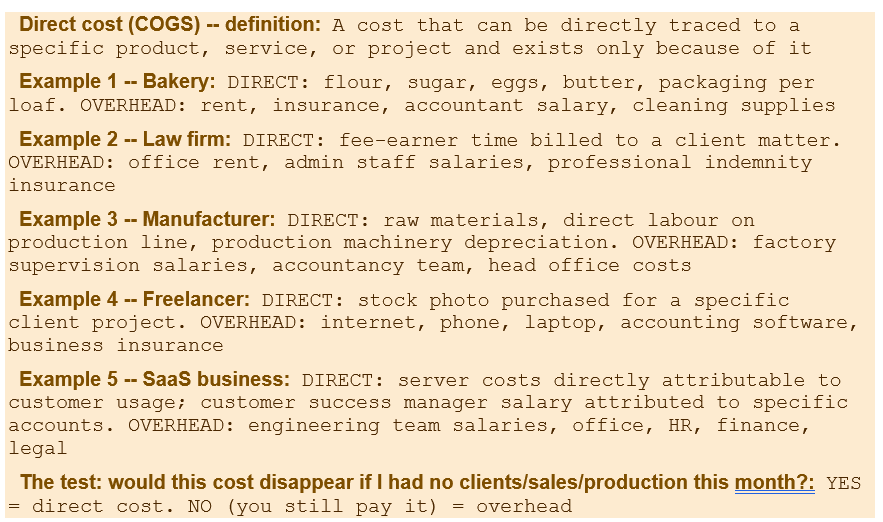
The overhead allocation challenge: While the direct vs overhead distinction seems straightforward, it is often genuinely difficult to apply. Some costs are partially direct and partially overhead -- a production manager who spends 60% of their time on the production floor and 40% on administration has a salary that is 60% direct cost and 40% overhead. American Express: 'At a professional services firm, the salaries of the accountants themselves are direct costs (they generate billable revenue), but the salaries of administrative staff are overhead.' The allocation method matters because: incorrect allocation understates or overstates product/service profitability; pricing based on incorrect cost allocation leads to underpricing or overpricing; and tax returns must correctly classify costs. When in doubt, consult a qualified accountant for your specific classification.
How to Calculate Overhead Rate and Overhead Ratio
Calculating overhead is not just about knowing the total cost -- it is about understanding what proportion of revenue or output is consumed by overhead. Two key calculations are used in most businesses:The Overhead Rate (per unit or per hour)
The overhead rate allocates total overhead costs across units of output or hours of work. Xero UK: 'Calculate your overhead rate by dividing your total indirect costs by an allocation measure such as direct labour costs, so you can set prices that cover all your expenses and protect your profit margins.' FreshBooks: 'You can calculate overhead cost per unit produced or per hour worked. Calculate the total amount of overhead costs incurred during a period, including fixed, variable, and semi-variable costs, and then divide it by the total number of units produced or hours worked to get per unit or per hour overhead.'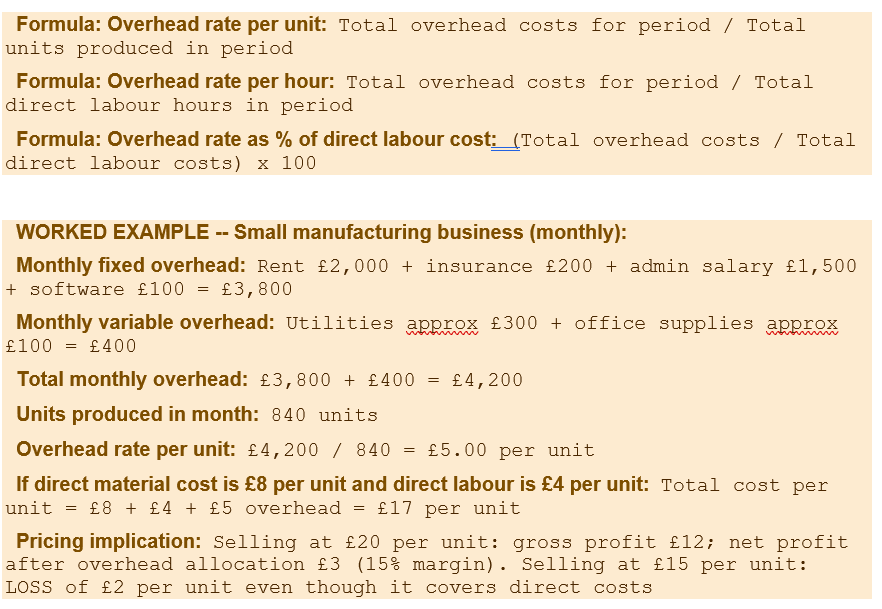
The Overhead Ratio (Overhead Percentage of Revenue)
The overhead ratio expresses total overhead as a percentage of total revenue. It tells you how much of every pound/dollar of revenue is consumed by overhead before any profit is generated. FreshBooks (CPA Sandra Habiger): 'In general, anything less than 35% is considered a good overhead percentage. However, this varies depending upon the size of your company and what industry you work in.'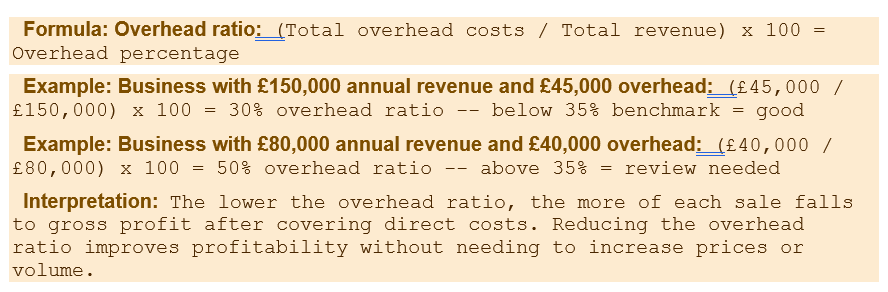
Overhead by Business Type: Benchmarks and Characteristics
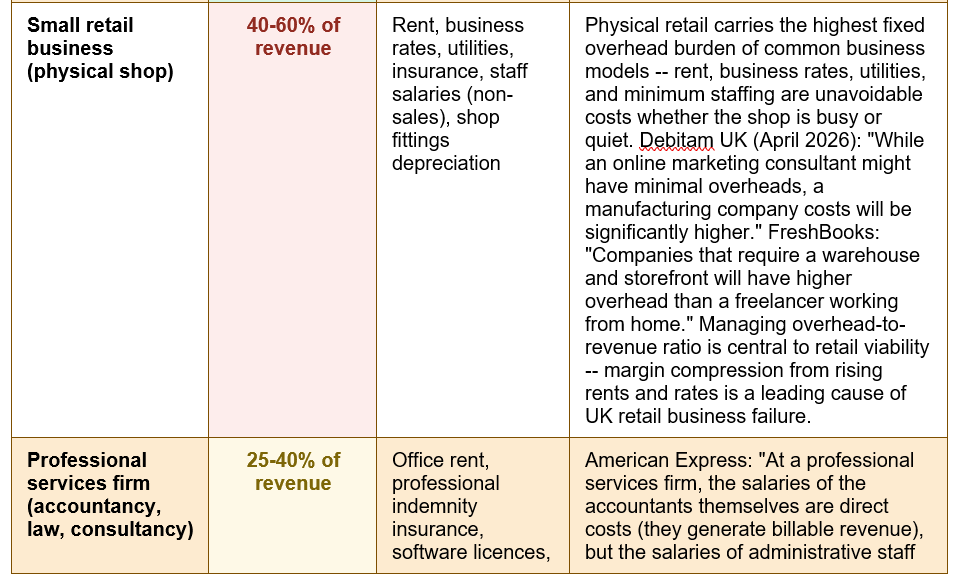
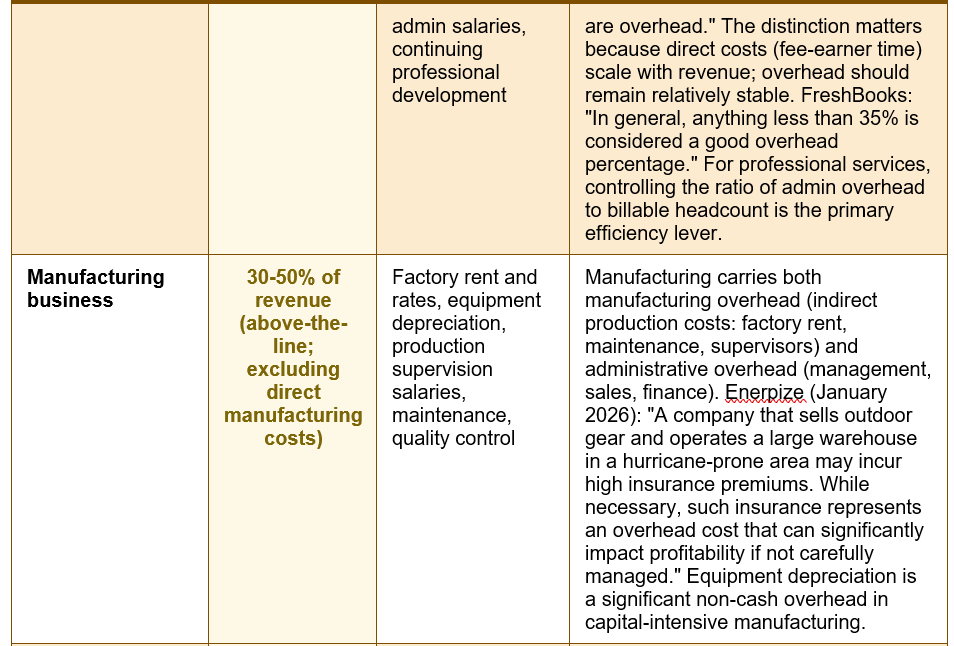
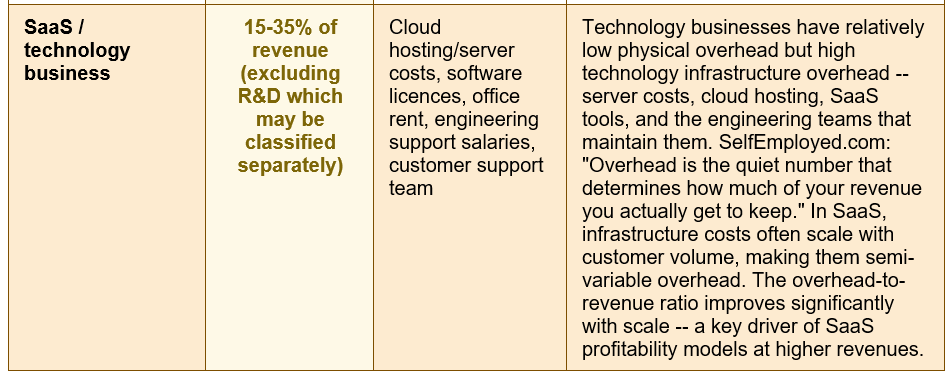
What constitutes a high or low overhead ratio varies significantly by industry and business model. The following table maps the typical overhead range, largest cost categories, and management approach for five common business types in 2026: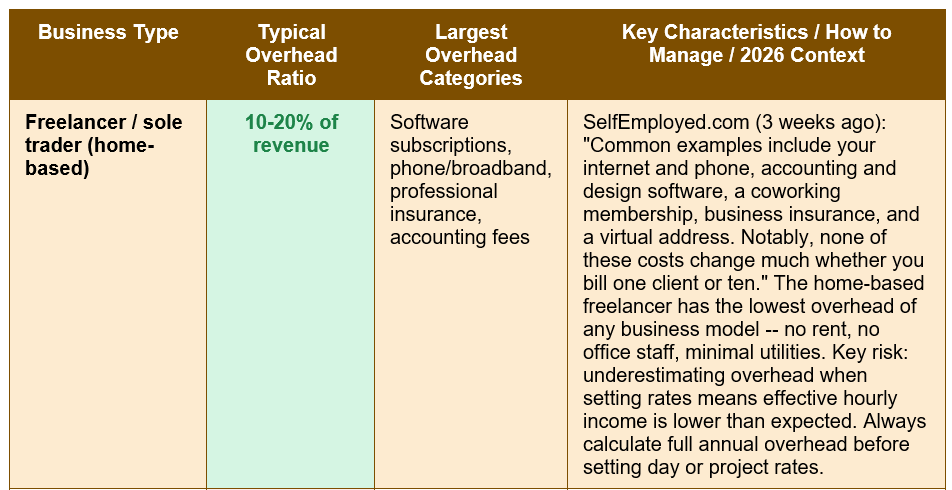
How to Reduce Overhead Costs: Practical Strategies for 2026
Enerpize (January 2026): 'Reducing overhead costs requires continuous review and optimisation, including improving workflows, managing subscriptions, negotiating supplier terms, optimising workspace usage, and controlling energy consumption.' The following strategies are the most consistently effective:- Conduct a full subscription audit quarterly: SelfEmployed.com (3 weeks ago): 'Overhead covers the recurring costs you would still pay even if you had no clients this month.' Software subscriptions, streaming services, trade memberships, and SaaS tools accumulate invisibly over time. Review every recurring charge in bank statements quarterly. Cancel any subscription not actively used in the past 30 days. Renegotiate annual contracts before auto-renewal. The average UK business is estimated to be paying for three to five unused or underutilised software subscriptions at any given time.
- Renegotiate fixed costs at renewal: Most fixed overhead costs have a renewal date -- lease, insurance, professional retainers, software. These are the optimal points at which competitive quotes and renegotiation can reduce the fixed cost base. Enerpize: 'Negotiating supplier terms.' Compare multiple insurance providers at renewal; negotiate rent reviews with commercial landlords; seek competitive quotes on accountancy and legal retainers. Even a 10-15% reduction in fixed overhead significantly improves annual profitability with no impact on operations.
- Optimise workspace usage: Enerpize: 'Optimising workspace usage.' Unused desk space in a commercial office is pure overhead waste. Options: flexible working arrangements that reduce physical space requirements; sharing offices with compatible businesses (co-working arrangements or office shares); downgrading to a smaller premises on lease renewal; using virtual office services for address and meeting rooms on demand rather than a full-time physical office. Beancount.io: 'Your office lease does not change whether you produce 100 units or 1,000 units' -- this makes it the highest-leverage fixed overhead to reduce.
- Control energy costs actively: Enerpize: 'Controlling energy consumption.' For businesses with physical premises, energy is a significant and controllable semi-variable overhead. Actions: switch to a competitive business energy tariff; install smart meters and energy monitors; implement energy-saving measures (LED lighting, automated heating/cooling controls, equipment switch-off policies); and consider renewable energy options where appropriate. UK business energy costs have moderated from 2022-2023 peak levels but remain above 2021 levels -- active management continues to generate meaningful savings.
- Automate administrative processes: Enerpize: 'Improving workflows.' Administrative overhead includes significant costs in manual processes -- data entry, invoice processing, reconciliation, payroll calculations. Automating these with appropriate software reduces both the time and cost of administrative overhead. Tools: cloud accounting software (Xero, QuickBooks, FreeAgent); automated invoicing and payment collection; digital expense management; payroll automation. The payback period on automation investment is typically measured in months.
- Review staffing models: Administrative salaries are typically the single largest component of fixed overhead. Options for managing staffing overhead include: using outsourced or fractional service providers rather than full-time employees for non-core functions (HR, bookkeeping, IT support, marketing); converting some fixed salaries to variable performance-related pay; using freelancers or contractors for variable workload peaks rather than permanent staff. Any staffing change must comply with employment law -- consult an HR specialist before restructuring employment arrangements.
- Include overhead in pricing from day one: The most impactful overhead management action for many small businesses is not reducing overhead -- it is ensuring pricing fully reflects it. Xero UK: 'You must include overhead in your pricing to avoid losing money on every sale.' Use the overhead rate per unit calculation to understand the overhead contribution required from each product or service, and ensure the selling price covers direct costs, overhead allocation, and the target profit margin. Underpriced products do not become profitable with volume -- they become more loss-making.
OVERHEAD MONITORING CHECKLIST -- EVERY QUARTER IN 2026: REVIEW: (1) Total overhead costs this quarter vs same quarter last year -- are they rising faster than revenue? (2) Overhead ratio (overhead / revenue x 100) -- is it above 35% and trending upward? (3) Full subscription and software audit -- are all recurring charges still active and used? (4) Are all fixed cost renewals (insurance, lease, retainers) being reviewed competitively? (5) Are variable overheads in line with revenue (utility costs, marketing spend, supplies)? CALCULATE: (6) Overhead rate per unit or per hour -- has it changed, and if so, does pricing reflect the change? (7) Gross profit margin -- are direct costs plus overhead allocation leaving the target net margin? ACT ON: (8) Cancel at least one unused subscription per quarter. (9) Renegotiate at least one fixed cost at its next renewal date. (10) If overhead ratio is above 35%, identify the largest three overhead lines and create a reduction plan for each.
THE FOUR OVERHEAD MISTAKES THAT DAMAGE BUSINESS PROFITABILITY: (1) NOT INCLUDING OVERHEAD IN PRICING. Xero UK: 'Without knowing your true overhead costs, you might set prices too low and lose money on every sale.' Pricing on direct costs alone means every sale contributes zero toward overhead -- the business trades profitably in gross terms but loses money in net terms. Always include an overhead allocation in every product or service price. (2) TREATING ALL OVERHEAD AS FIXED AND UNCONTROLLABLE. Beancount.io (April 2026): 'Understanding the three categories (fixed, variable, semi-variable) helps you forecast more accurately and identify where you have flexibility to cut back.' Variable and semi-variable overheads can be reduced with activity. Even fixed overheads can be renegotiated at renewal. No overhead is truly untouchable. (3) ALLOWING SUBSCRIPTION CREEP TO INFLATE OVERHEAD INVISIBLY. SaaS subscriptions and software tools accumulate incrementally -- each addition seems minor but the cumulative annual cost can reach thousands of pounds/dollars. Set a calendar reminder for a quarterly subscription audit. (4) CONFUSING OVERHEAD REDUCTION WITH COST-CUTTING THAT DAMAGES CAPABILITY. Some overhead is productive -- quality accounting software, professional indemnity insurance, good IT infrastructure. Cutting these to reduce the overhead ratio can damage the business capability that generates revenue. The goal is optimising overhead, not minimising it at any cost. Review each overhead line for its business value before cutting.
Conclusion
Overhead is not an accounting abstraction -- it is the foundation of business profitability analysis and the number that most directly determines how much of each sale a business actually keeps. Xero UK captures the stakes: 'Understanding your overheads helps you price correctly, protect your profits, and manage cash flow. Without knowing your true overhead costs, you might set prices too low and lose money on every sale.' Every business decision about pricing, expansion, staffing, and cost management ultimately rests on a clear understanding of what the business's overhead costs are and how they behave.The three overhead types -- fixed (stays constant regardless of activity), variable (rises and falls with business volume), and semi-variable (has a fixed base plus a variable element) -- each require different management approaches. Fixed overhead should be minimised and renegotiated at every renewal opportunity. Variable overhead should be monitored relative to revenue to ensure it is not growing disproportionately. Semi-variable overhead should be split into its components for accurate budgeting and forecasting. The overhead ratio -- total overhead divided by total revenue, expressed as a percentage -- is the key metric, with under 35% as the general benchmark for a well-managed business across most industries.
The practical actions from this guide are clear: conduct a quarterly overhead audit starting with subscriptions and recurring charges; calculate the overhead rate per unit or per hour and ensure it is reflected in pricing; renegotiate fixed costs at every renewal date; automate administrative processes to reduce the time and cost of admin overhead; and above all, ensure that every price charged to every customer covers direct costs, an overhead allocation, and a profit margin. A business that knows its overhead numbers is a business that controls its financial destiny.

0 Comments Comments