

Business
How To Retire From Your Career to Start a Business: Entrepreneur Guide

Table of Contents
- The Career That Prepared You for This Moment
- Why a Long Career Is the Best Possible Foundation for a Business
- What the Data Shows: Career-to-Business Transition Statistics
- Your Career Assets: How They Translate Into Business Advantages
- The 8-Step Framework for Transitioning From Career to Business
- Financial Planning for the Transition: The Numbers You Must Know
- UK vs US: What's Different About This Transition in Each Country
- UK-Specific Considerations
- US-Specific Considerations
- Conclusion
- Frequently Asked Questions (FAQ)
The Career That Prepared You for This Moment
There is a moment that many experienced professionals recognise. It arrives at different ages and different circumstances -- after 15 years, 25 years, sometimes 35 years in the same industry or the same corporate structure. It is not always dissatisfaction, though sometimes it is. It is more often a specific kind of clarity: the sense that you have accumulated something -- knowledge, contacts, credibility, financial reserves, perspective -- that belongs to you rather than your employer. And the growing realisation that the most interesting and potentially the most rewarding thing you could do with that accumulation is build something of your own.The data on this transition is more encouraging than the anxiety around it suggests. Embroker (March 2025): 'A 50-year-old startup founder is 2.8 times more likely to found a successful startup as a 25-year-old founder.' That figure comes from a Harvard Business Review study of 2.7 million business founders. Whop (January 2026): 73% of those who went into entrepreneurship to make more money were successful in doing so; 68% went on to earn more than their previous role within 2 years. And Embroker again: 96% of self-employed people have no desire to return to a regular job once the transition is made.
This guide is written for the experienced professional who is considering this transition -- whether the aim is to start a new business from scratch, to take a side project that has been running alongside a full-time career and make it the main event, or to turn decades of expertise into a consulting or advisory practice. It covers the financial preparation required, how to translate career assets into business advantages, the legal and structural steps for both the UK and US, the eight-step transition framework, and the most common mistakes experienced professionals make when they finally take the leap they have been thinking about for years.
Why a Long Career Is the Best Possible Foundation for a Business
The narrative around entrepreneurship has long skewed young. The mythology of the 24-year-old dropout building the next technology giant has become the dominant cultural image of entrepreneurship, despite being statistically unrepresentative of how most successful businesses are actually built. The research tells a very different story.Hostinger (June 18, 2026): 'Service-based businesses are twice as likely to survive as product-based ones. The average age of successful entrepreneurs is 42, with peak success often coming in the 40s and 50s.' Dr Bozward (September 2025): 'Older founders bring strengths that money cannot buy: domain expertise, networks, credibility, and a clear sense of what they do not want their work to be.' These are precisely the attributes developed by a long professional career -- not by youth and a business plan.
Podbase (April 30, 2026): '70% of entrepreneurs cite lifestyle or career change as their primary reason for starting a business.' This is the most honest description of what motivates the career-to-business transition: not primarily a bet on a product idea or a get-rich calculation, but a decision to restructure working life around autonomy, purpose, and the direct relationship between effort and reward. After 20 or 30 years of building value for organisations that own it, the pull toward building something that belongs to you is both understandable and, the data suggests, well-timed.
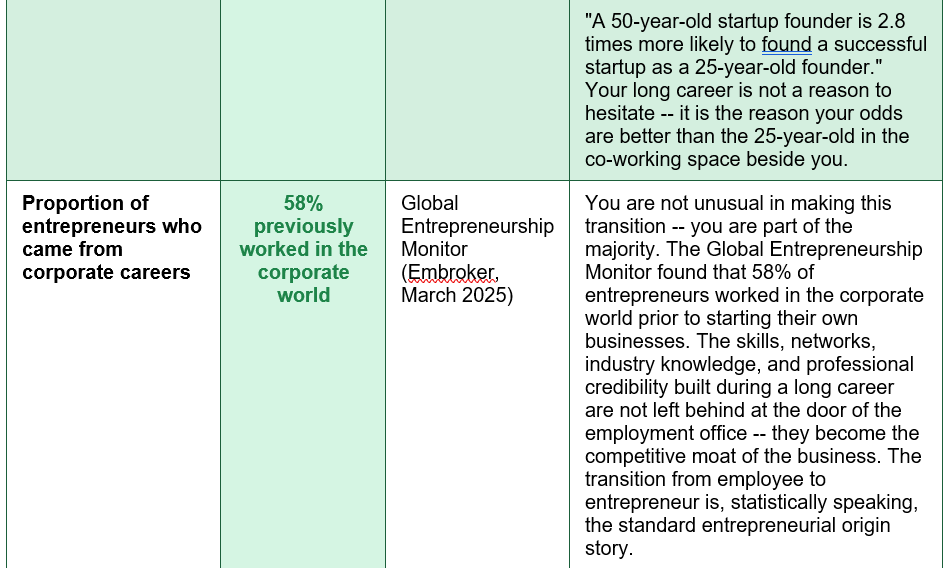
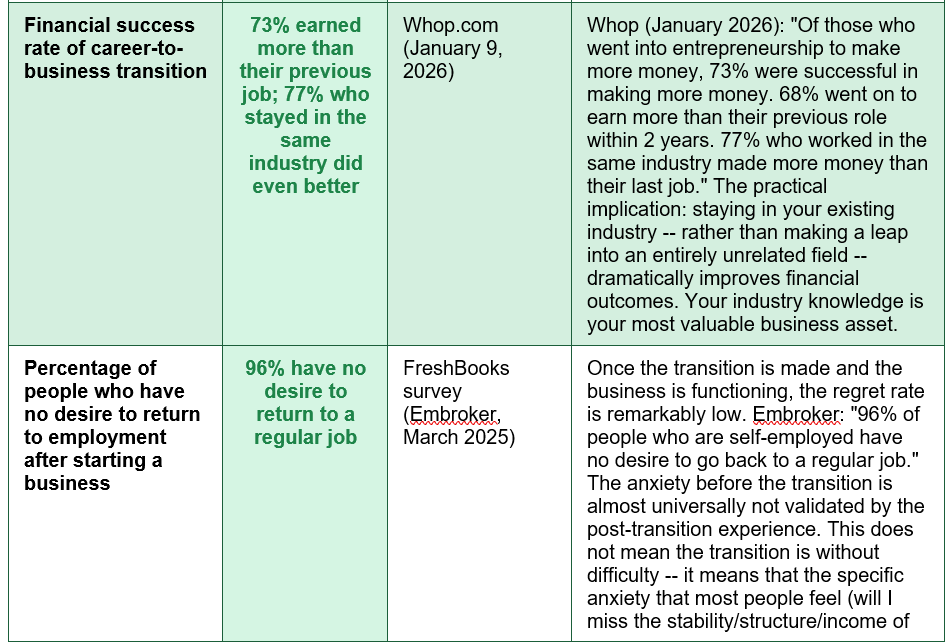
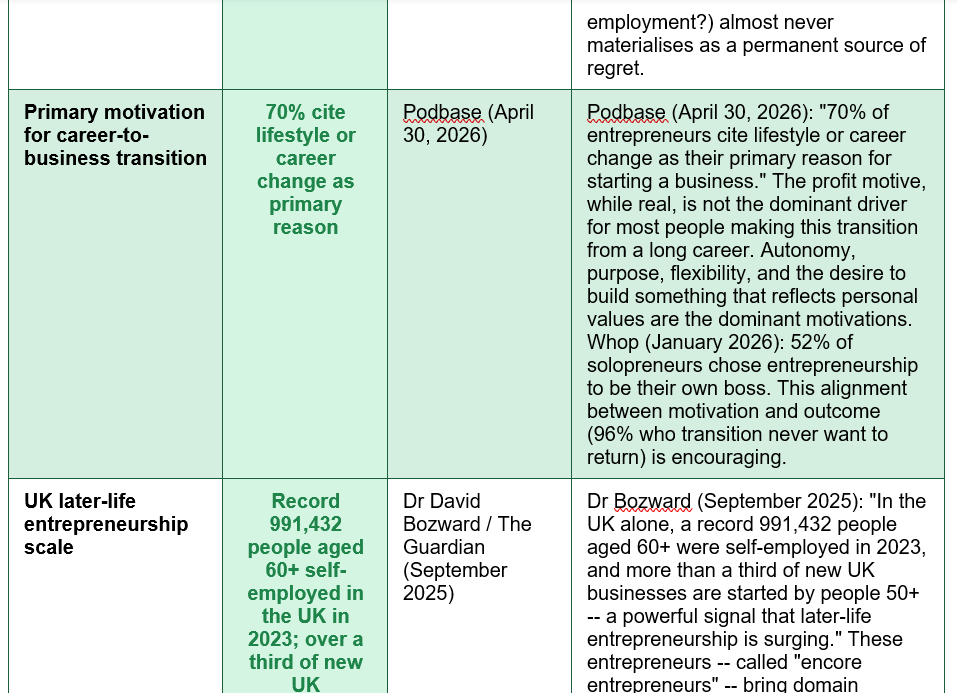
Career-to-business transition in 2026 -- the data case: 2.8x success advantage for 50-year-old founders vs 25-year-olds. 73% of career transitioners earned more. 96% never want to return to employment. — Embroker (March 2025): '50-year-old startup founder is 2.8 times more likely to succeed than a 25-year-old; 96% of self-employed people have no desire to return to a regular job; 58% of entrepreneurs previously worked in the corporate world.' Whop (January 9, 2026): '73% of those who went into entrepreneurship to make more money were successful; 68% earned more than their previous role within 2 years; 77% who worked in the same industry made more money than their last job.' Dr Bozward (September 2025): 'Record 991,432 people aged 60+ self-employed in the UK in 2023; more than a third of new UK businesses started by people 50+.'
What the Data Shows: Career-to-Business Transition Statistics
The following table maps the key research findings on career-to-business transitions, with the practical implication of each data point for someone considering this move: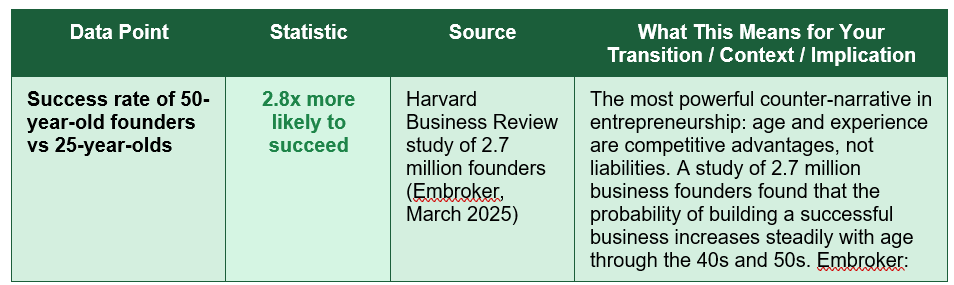

Your Career Assets: How They Translate Into Business Advantages
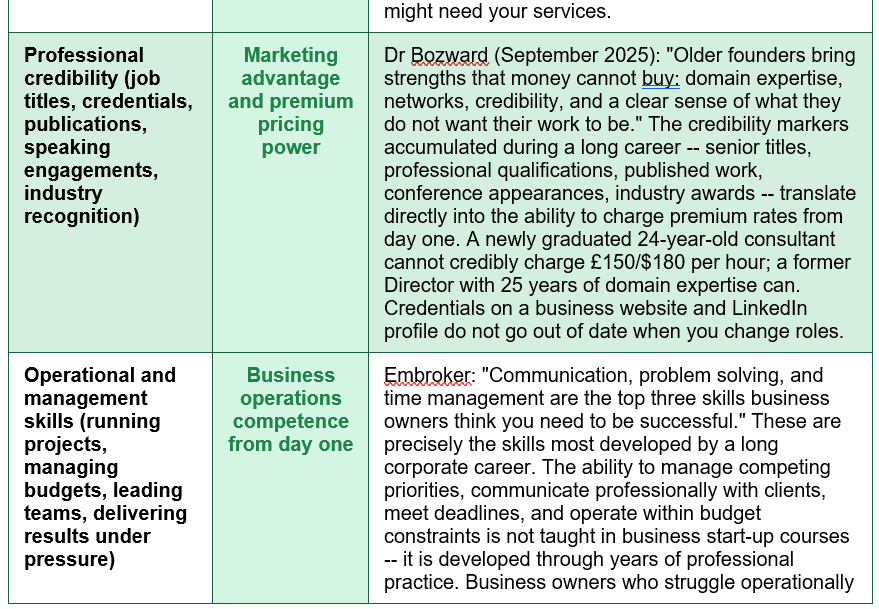
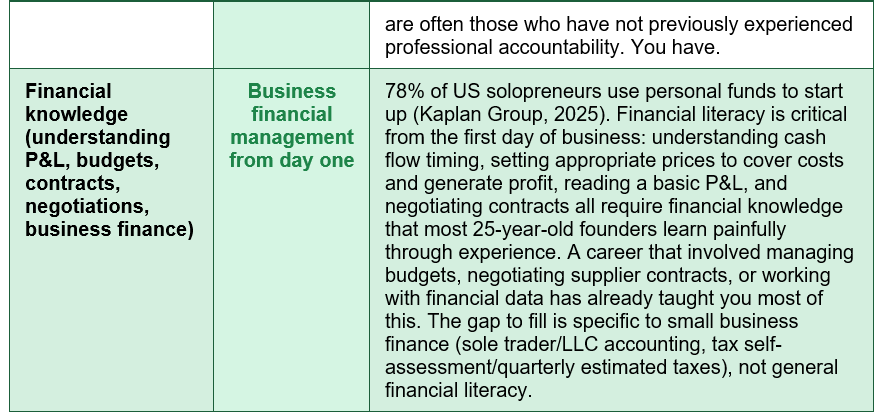
The instinct when leaving a long career to start a business is often to downplay what has been accumulated and focus on what is being started from scratch. This is almost always the wrong frame. The following table maps the five most valuable career assets and shows exactly how they translate into competitive business advantages: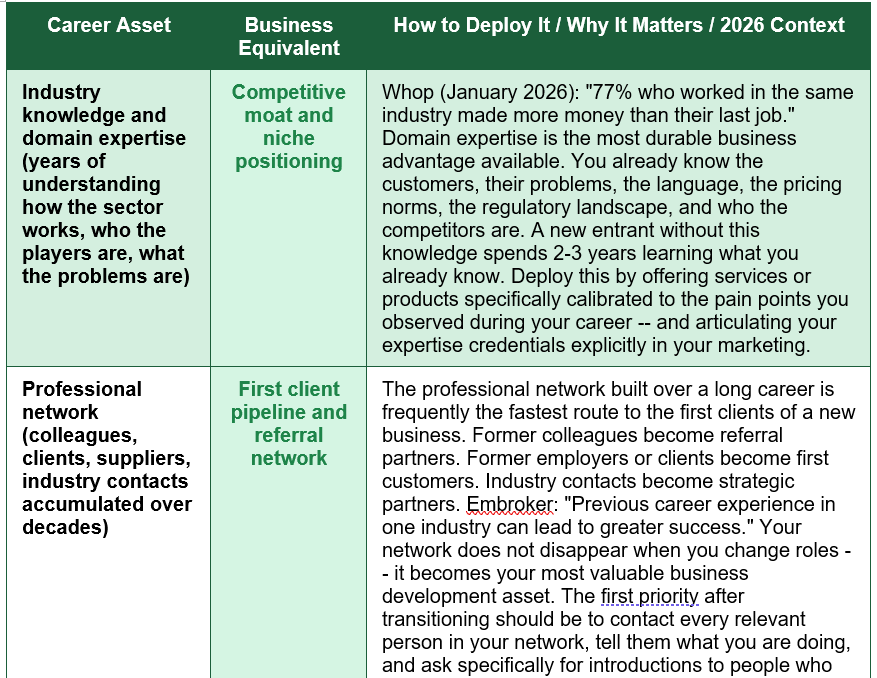
The 8-Step Framework for Transitioning From Career to Business
STEP 1: Define What the Business Actually Is | Clarity Before Structure
The most common mistake experienced professionals make at this stage is rushing to register the company, design the logo, and build the website before they have genuinely defined what the business does, who it serves, and why those people would choose it over alternatives. The definition must answer three questions with precision: What specific problem does this business solve? Who, specifically, experiences that problem badly enough to pay for a solution? And why are you the person best placed to solve it? The most successful career-to-business transitions are those where the answer to the third question draws directly on career history. A former NHS Chief Operating Officer who builds a healthcare management consultancy is not starting from zero -- they are commercialising expertise they already possess. A retired solicitor who builds a legal document preparation service for small businesses is not starting a new career -- they are redistributing their expertise to a different market. Define the business specifically before doing anything else.STEP 2: Audit Your Finances Before You Leave Employment | The Number That Determines Everything
The financial audit before leaving employment is the most practically important step in the entire transition. It must answer: What are your total monthly personal expenses? How many months of expenses do you have in accessible cash savings? What pension or retirement savings do you have and when can they be accessed? What is the realistic revenue timeline for the business -- specifically, when is the first invoice likely to be paid? The difference between these two dates -- when income stops and when business revenue arrives -- is the financial runway the savings must cover. Whop (January 2026): '28% of aspiring entrepreneurs do not have cash to invest, or need to pay down debt before they take the plunge into self-employment.' The ideal financial position before transitioning: 12 months of personal living expenses in accessible savings; no high-interest consumer debt; and a clear, conservative estimate of when the business will generate enough revenue to cover those personal expenses. If the savings runway is shorter than 12 months, consider a phased transition -- reducing employment to part-time or consulting basis while building the business -- rather than a sudden full exit.STEP 3: Choose the Right Business Structure | The Legal Foundation That Protects Your Assets
UK: The primary choice is between operating as a sole trader (simpler, immediate, no registration fee, but unlimited personal liability) or forming a limited company via Companies House (£12 online, provides liability protection, more professional for B2B clients, potential tax efficiency through director salary plus dividends structure). Most professionals transitioning from a corporate career are better served by a limited company from the outset -- it provides the liability protection appropriate for a business delivering professional services, and it signals seriousness to prospective clients. Register for VAT voluntarily if targeting VAT-registered business clients (it makes no cost difference to them and enables you to reclaim VAT on business expenses); register mandatorily when turnover exceeds £90,000 (2026 threshold). US: Form an LLC in your state (provides liability protection, typically $50-$500 depending on state). An S-Corporation election may provide tax efficiency once business income is established -- consult a CPA before making this election. In both countries: open a dedicated business bank account immediately; never mix personal and business finances; engage an accountant or bookkeeper from the first month, not the first HMRC or IRS filing deadline.STEP 4: Activate Your Professional Network | Your First Clients Are Already in Your Phone
Whop (January 2026): '77% who worked in the same industry made more money than their last job' -- versus 57% who moved into a different industry. The network is the most immediate, most reliable, and most underutilised route to first business revenue. Before the business has a website, before it has any marketing collateral, and before the first formal client approach: contact every relevant person in your professional network. Not to sell -- to inform. Tell them what you are doing, what your business offers, and who your ideal client is. Ask specifically whether they know anyone who might benefit from an introduction. A single referral from a former senior colleague can be worth months of cold outreach. The activation sequence: LinkedIn announcement (professional, specific, no generic 'excited to announce' language -- describe specifically what you now offer and to whom); direct personal messages to the 20-30 most relevant contacts; and a brief email to your professional network with the same specific message. Do this before the business generates any other marketing activity.STEP 5: Validate the Business Concept With a Paying Client Before Full Commitment | Revenue Is the Only True Validation
The most reliable validation of a business concept is a paying customer. Not a survey, not a market research report, not encouraging conversations at a networking event -- but a real person or organisation that has agreed to pay real money for what the business offers. Hostinger (June 18, 2026): 'Service-based businesses are twice as likely to survive as product-based ones.' For most career-to-business transitioners, the business will be service-based -- consulting, advisory, professional services, creative services, coaching -- which is both the most viable model and the one most amenable to pre-launch validation. The recommended approach: before formally leaving employment (or during the first month of full-time business focus), close one paying client at the rate you intend to charge. This does two things: it validates that someone is willing to pay your rate for your service; and it generates early cash flow that extends the financial runway. A business with one paid client before it formally opens is categorically better positioned than a business with a polished website and no revenue.STEP 6: Price From Your Career Value, Not From Fear | The Most Common and Most Costly Transition Mistake
The instinct when first pricing a new business, particularly among people transitioning from employment, is to undercharge. The logic feels sound: I am new to this, I do not have a track record as a business owner, I need to attract clients. The problem: underpricing undermines the very credentials that justify the premium. A former Senior Manager who offers consulting at £30/$40 per hour signals to prospective clients that their expertise is not particularly valuable. The same person at £150/$200 per hour signals that they are a specialist with rare knowledge worth paying for. Embroker: 'A 50-year-old startup founder is 2.8 times more likely to found a successful startup as a 25-year-old founder.' The Harvard Business Review data supporting this finding is based on outcomes, not on founders underpricing themselves into viability. Research the going rate for comparable services in your industry (professional body surveys, sector-specific job boards converted to day rates, competitor research). Price at or above the median for someone with your experience level. Raise rates at every contract renewal until you meet price resistance. You will likely need to raise rates more than once in the first year.STEP 7: Build Repeatable Systems Before You Are Too Busy to Build Them | The Infrastructure That Enables Scale
The pattern for many new business owners from corporate careers: they close 2-3 clients, immediately become consumed by delivery, and discover 6 months later that they have no time to market or sell because they are flat out delivering. The clients are well-served; the pipeline is empty; the feast-and-famine cycle begins. The antidote is to build basic operational systems during the early months when activity is lighter. These do not need to be sophisticated: a client onboarding document (what happens in the first week of any client engagement); a standard service agreement template (reviewed by a solicitor/attorney once and reused); a simple invoicing process (FreshBooks, QuickBooks, Xero); a monthly reporting template (what you send to clients to demonstrate value); and a basic CRM (even a spreadsheet with every prospect contact and the next action). Hostinger (June 18, 2026): 'Service-based businesses are twice as likely to survive as product-based.' Service businesses survive through operational reliability and client retention -- both of which depend on systems, not just talent.STEP 8: Plan the First 12 Months With Milestones, Not Just Aspirations | The Plan That Keeps You Accountable
Podbase (April 30, 2026): '20% of US ventures fail in year one and only 25% survive past 15 years. Top failure reasons: no market need (42%), running out of cash (29%), and weak team or execution (19%).' The 12-month plan for a career-to-business transition does not need to be a business plan document (though one is valuable) -- it needs to be a specific, monthly timeline of financial milestones. Month 1: first client signed. Month 3: monthly revenue covering at least 50% of personal expenses. Month 6: monthly revenue covering 100% of personal expenses. Month 9: revenue allowing discretionary business reinvestment. Month 12: assessment of whether the business model requires adjustment. These milestones create accountability without rigidity. If month 3 arrives and revenue is at 20% of expenses rather than 50%, this is data -- not failure. It signals a need to adjust pricing, pipeline activity, or positioning. The plan is not a prediction; it is a feedback mechanism. Review it monthly and adjust accordingly.Financial Planning for the Transition: The Numbers You Must Know
The financial planning for a career-to-business transition is more detailed than most people complete before making the move. The following framework captures every number that matters:Monthly personal expenses (your runway denominator): Total all monthly personal outgoings: mortgage/rent, utilities, food, transport, insurance, debt repayments, entertainment, holidays, pension contributions. This is your monthly cost of living -- the number your business revenue must eventually exceed.
Available cash savings (your runway): Money in accessible savings (not pension funds, not investments you would have to sell). Divide by monthly personal expenses. This is your runway in months. Minimum target before full transition: 12 months. Ideal: 18-24 months.
Business startup costs: UK: company formation £12; professional indemnity insurance £300-£800/year; website and branding £500-£2,000; accounting software £20-£50/month; business bank account (many free UK options). US: LLC formation $50-$500; business insurance $200-$600/year; similar software and setup costs. Total first-year startup costs for a professional services business: typically £1,500-£5,000 UK / $2,000-$6,000 US.
Revenue target calculation (what the business must generate): Monthly personal expenses PLUS monthly business costs PLUS target profit/savings contribution = minimum monthly revenue needed. Example: £3,500 personal expenses + £500 business costs + £500 savings = £4,500/month minimum revenue target. At £150/hour: 30 billable hours per month. At £750/day: 6 billable days per month. This is achievable with 2-3 retained clients.
Pension and retirement asset inventory: List all pension pots, when they can be accessed (UK: typically age 57 from 2028; US: 59.5 for most retirement accounts without penalty), and their approximate current value. These are NOT part of the runway calculation but inform the long-term financial security picture. UK: if transitioning before state pension age, obtain a state pension forecast from gov.uk.
Tax planning for the transition year: The year of leaving employment and starting a business has complex tax implications. UK: you may have both PAYE income and self-employment income in the same tax year; a limited company adds further complexity; IR35 rules may apply if working through a company for former employer. US: estimated quarterly tax payments become your responsibility immediately; self-employment tax (15.3% on net earnings up to the threshold) is a common surprise. Engage an accountant BEFORE the transition, not after.
The phased transition option -- the risk-managed alternative to a full exit. Not every career-to-business transition needs to be immediate or total. A phased approach involves: (1) Building the business alongside employment (evenings, weekends, holidays) until it generates 30-50% of your salary; (2) Moving to part-time employment (3-4 days per week) to free time for business development while maintaining income; (3) Exiting employment fully once the business generates sufficient income to replace the salary. This approach extends the timeline but dramatically reduces the financial risk. Many successful businesses begin as genuine side projects -- the transition to full-time happens when the business, not the anxiety, is ready. Whop (January 2026): 33% of solopreneurs in 2024 used entrepreneurship to supplement their salaries -- demonstrating that hybrid employment-entrepreneurship is a recognised and viable intermediate state.
UK vs US: What's Different About This Transition in Each Country
UK-Specific Considerations
- State pension impact: Leaving employment affects National Insurance contributions. UK state pension requires 35 qualifying years of NI contributions for the full new state pension (£221.20 per week in 2024/25, rising annually). If you have not yet achieved 35 qualifying years, you can make voluntary NI contributions (Class 3) to fill gaps -- check your NI record and state pension forecast on gov.uk/check-state-pension before transitioning. Running a limited company: you can make NI contributions through the company payroll.
- IR35 and off-payroll working rules: If your new business will primarily serve your former employer or one client through a personal service company, HMRC's IR35 rules may classify you as a 'disguised employee' and require income tax and NI to be paid as if you were employed. This is a complex area -- get specialist advice from an accountant familiar with IR35 if your transition involves consulting back to a former employer.
- Making Tax Digital (MTD): From April 2026, sole traders and landlords with qualifying income above £50,000 must keep digital records and submit quarterly updates to HMRC. If your new business will generate above this threshold, MTD compliance is required from your first full tax year above the threshold.
- Business support ecosystem: UK start-up support includes: Start Up Loans (government-backed loans from £500-£25,000 at 6% fixed; apply at startuploans.co.uk); local Growth Hubs (gov.uk/guidance/find-your-local-growth-hub); HMRC's New Employer Helpline if taking on staff; and the British Business Bank for later-stage growth finance.
US-Specific Considerations
- Health insurance: One of the most significant practical differences between employee and self-employed status in the US is health insurance. Employment-based health insurance ends when employment ends. Options: COBRA continuation coverage (maintains current plan for up to 18 months, but the employer's contribution stops -- costs can be $500-$1,500+/month for a family); Marketplace plans through healthcare.gov (may qualify for subsidies depending on income); spouse's employer plan if applicable. Health insurance cost must be included in the monthly personal expense calculation.
- Quarterly estimated taxes: Self-employed individuals in the US must pay estimated income taxes and self-employment tax (15.3% on net earnings up to the annual threshold, then 2.9% above) quarterly: April 15, June 15, September 15, and January 15. Failure to pay adequate estimated taxes results in an underpayment penalty. Open a separate tax savings account and set aside 25-30% of every business payment received.
- Business support ecosystem: US support for career transitioners starting businesses includes: SCORE mentoring (free one-on-one mentorship from retired executives -- score.org); Small Business Development Centers (SBDCs -- free business advising at over 1,000 locations -- americassbdc.org); Small Business Administration (SBA) loan programmes for start-up capital. These are specifically designed to support experienced professionals building new ventures.
CAREER-TO-BUSINESS TRANSITION CHECKLIST: BEFORE LEAVING EMPLOYMENT: (1) Complete the financial audit: monthly expenses / savings runway / startup costs / revenue target calculation. Minimum target: 12 months of savings. (2) Define the business precisely: what problem / who / why you. (3) Engage an accountant BEFORE the transition year for tax planning. (4) Identify your first 5 potential clients from your professional network. (5) Research and select business structure: UK limited company or sole trader / US LLC. (6) Check NI record and state pension forecast (UK) or Social Security projection (US). IN THE FIRST MONTH: (7) Register the business (UK: Companies House / US: LLC in your state). (8) Open dedicated business bank account. (9) Set up business email on your own domain. (10) Activate your professional network: LinkedIn announcement + personal messages to 20-30 relevant contacts. (11) Set a price for your first service or product -- based on your career value, not on fear. (12) Close or begin negotiating your first paying client. IN THE FIRST 90 DAYS: (13) Build the basic operational systems: client onboarding document / standard contract template / invoicing process / simple prospect tracker. (14) Set your 12-month revenue milestones. (15) Review financial position monthly against milestones -- adjust approach if milestones are significantly missed.
FIVE MISTAKES EXPERIENCED PROFESSIONALS MAKE WHEN TRANSITIONING TO BUSINESS: (1) UNDERPRICING OUT OF FEAR RATHER THAN MARKET RESEARCH. Embroker: 50-year-old founders are 2.8x more likely to succeed than 25-year-olds. That success premium reflects the value of accumulated expertise. Charging below-market rates undermines the same credentials that create the advantage. Research what peers with equivalent experience charge; start at the median; raise rates at every renewal until you find resistance. (2) LEAVING EMPLOYMENT WITHOUT ADEQUATE FINANCIAL RUNWAY. The anxiety of the transition is highest in months 4-8, when savings are reducing but the business is not yet at full revenue. Many people abandon viable businesses during this period because the financial pressure becomes intolerable. A minimum of 12 months of savings runway -- ideally 18-24 months -- keeps decisions business-led rather than fear-led during this critical period. (3) TRYING TO BUILD OUTSIDE YOUR EXISTING INDUSTRY. Whop (January 2026): '77% who worked in the same industry made more money than their last job' vs 57% who worked in a different industry. The urge to break entirely free from a long career by starting something completely unrelated is understandable but financially risky. Your network, expertise, and credibility are all industry-specific. Use them. (4) BUILDING A BEAUTIFUL BUSINESS BEFORE CLOSING THE FIRST CLIENT. A professional website, a polished logo, and a comprehensive service menu are not a business -- they are a preparation for a business. The actual business begins when a client agrees to pay. Close a paying client before spending significant time or money on brand and marketing materials. (5) NEGLECTING TAX OBLIGATIONS IN THE FIRST YEAR. The transition from PAYE/W-2 employment to self-employment is the single biggest tax administration change most people will ever experience. UK: Self Assessment for the first time; potential for tax on business income AND any employment income in the same year. US: quarterly estimated taxes from day one; self-employment tax on net earnings. Engage an accountant before the transition or in the first month -- not at filing time.
Conclusion
The transition from a long career to founding or focusing on a business is one of the most financially and personally significant decisions an experienced professional will make. The data is consistently and encouragingly clear on the fundamentals: a 50-year-old founder is 2.8 times more likely to succeed than a 25-year-old (Harvard Business Review study of 2.7 million founders); 73% of career transitioners earn more after making the move; and 96% of self-employed people never want to return to employment. The long career that feels like a constraint is, in the research, the primary source of competitive advantage.The keys to a successful transition are financial preparation (a minimum of 12 months of savings runway), business concept clarity (the specific problem, the specific client, the specific reason you), network activation (your first clients are already in your phone), and pricing courage (charge what your experience is worth, not what fear says is safe). The phased transition option -- building the business alongside employment before making a full exit -- is an underused and highly effective risk management approach for those whose savings runway is shorter than ideal.
In the UK, more than a third of new businesses are now started by people over 50 (Dr Bozward, September 2025). In the US, 34 million entrepreneurs represent a historic high in business formation, with the average successful entrepreneur's age at 42 (Hostinger, June 18, 2026). Podbase (April 30, 2026): '70% of entrepreneurs cite lifestyle or career change as their primary reason for starting a business.' You are not alone in considering this move. You are, if the data is any guide, extremely well-placed to make it successfully.
Frequently Asked Questions (FAQ)
Is it too late to start a business after a long career?No -- and the data says the opposite. The most rigorous research on this question comes from a Harvard Business Review study of 2.7 million business founders, cited by Embroker (March 2025): 'A 50-year-old startup founder is 2.8 times more likely to found a successful startup as a 25-year-old founder.' Business Initiative, summarising the same research: '60-year-old founders have higher success rates than 20-something entrepreneurs.' The advantages accumulated during a long career -- domain expertise, professional networks, financial resources, operational skills, and hard-won judgment about what works and what does not -- are precisely the resources that drive business success. The narrative that entrepreneurship is a young person's game is not supported by the outcome data. Dr Bozward (September 2025): 'In the UK alone, a record 991,432 people aged 60+ were self-employed in 2023, and more than a third of new UK businesses are started by people 50+.' The best time to start a business after a long career is when the financial preparation, the concept clarity, and the motivation align -- not at any particular age.
How much money do I need to save before leaving employment to start a business?
The minimum target is 12 months of personal living expenses in accessible cash savings (not pension funds or investments requiring a lengthy redemption process). The ideal target is 18-24 months. This runway serves as the financial cushion that keeps decisions business-led rather than fear-led during the critical early months when revenue is building but not yet stable. To calculate your specific number: total all monthly personal outgoings (mortgage/rent, utilities, food, transport, insurance, debt repayments, entertainment) and multiply by 12-24. A typical UK professional household with monthly expenses of £3,500 should target £42,000-£84,000 in accessible savings before a full transition. A US equivalent at $4,500/month should target $54,000-$108,000. Additionally, budget for first-year business startup costs: typically £1,500-£5,000 (UK) or $2,000-$6,000 (US) for a professional services business. If savings are below the minimum target, a phased transition -- building the business alongside employment -- is a more financially prudent approach. Whop (January 2026): '28% of aspiring entrepreneurs do not have cash to invest, or need to pay down debt before they take the plunge.' For that group, the right move is to build the savings first, then make the transition.
Should I start a business in the same industry as my career?
The data strongly favours staying in or adjacent to your existing industry, particularly in the early years of the business. Whop (January 2026): '77% who worked in the same industry made more money than their last job, compared to 57% who worked in a different industry.' The 20-percentage-point advantage in financial outcomes from staying in your industry reflects what you bring from a long career in that sector: your network (colleagues, clients, suppliers, and contacts who already know and trust you); your domain expertise (the nuanced understanding of how the sector works that a newcomer spends years acquiring); your credibility (the professional track record that enables premium pricing from day one); and your specific knowledge of customer pain points (the problems you observed for years that a new entrant must discover through trial and error). The desire to break entirely free of a long career by starting something completely unrelated is psychologically understandable but financially costly. The most effective use of a long career is to commercialise its expertise for a new audience or in a new format -- not to abandon it entirely. After the business is established and financially stable, expansion into adjacent or unrelated areas becomes a more viable option.
What type of business is most likely to succeed for a career transitioner?
For the majority of experienced professionals transitioning from a long career, a service-based business is both the most accessible and the most likely to succeed. Hostinger (June 18, 2026): 'Service-based businesses are twice as likely to survive as product-based ones.' Service businesses typically require minimal startup capital (compared to product businesses requiring inventory, manufacturing, or platform development); generate revenue quickly (first client can generate income within weeks); have low ongoing fixed costs; and draw most directly on the expertise and credentials built during a long career. The specific service formats most commonly adopted by career transitioners include: consulting or advisory work (providing the expertise accumulated during a career to organisations who need it without employing a full-time specialist); coaching (particularly executive, business, or career coaching drawing on professional experience); training and facilitation (structured knowledge transfer in a subject of expertise); freelance professional services (legal, financial, marketing, HR, technology, creative work on a project or retainer basis); and speaking and thought leadership (commercial engagement based on professional expertise and industry profile). Each of these formats allows the business to start generating revenue from the existing network before any significant marketing investment is required.
What are the biggest tax differences between employment and self-employment?
The tax administration change from employment to self-employment is one of the most significant practical adjustments in this transition. In the UK: under PAYE employment, income tax and National Insurance are deducted automatically by the employer before pay is received. As a self-employed individual (sole trader) or limited company director, you become responsible for your own tax administration through Self Assessment for sole traders or HMRC's Corporation Tax and PAYE systems for limited companies. Key changes: you must register for Self Assessment with HMRC within three months of starting self-employment; you pay tax on profits rather than income, which means allowable business expenses (equipment, software, professional fees, a proportion of home working costs) reduce the taxable amount; the tax is paid in arrears (31 January and 31 July) rather than in real-time through payroll; and National Insurance changes structure (Class 2 is being abolished; Class 4 applies to profits above the threshold). From April 2026, Making Tax Digital requires quarterly digital submissions for those with income above £50,000. In the US: the transition from W-2 employment to self-employment (Schedule C or LLC taxation) means: income tax and self-employment tax (15.3% on net earnings) are your responsibility, payable as quarterly estimated taxes in April, June, September, and January; no employer is withholding anything; and you must budget for the tax liability from every business payment received. Set aside 25-30% of every payment into a dedicated tax savings account immediately. Engage a CPA or accountant before the transition in both countries -- the first year of self-employment has complex, overlapping income sources that a professional can plan for and minimise far better than self-management.

0 Comments Comments