

Hustle
Passive Income Ideas You Can Start Building on Holiday Break

72% of US workers rely on at least one secondary income source; only 9% earn passive income such as rentals or royalties (MyPerfectResume, 2026, 1,000 respondents). Average side hustle income was $442.76 a month in 2025, down from $688 in 2022; the most common range was $51–$250 (Self Financial survey). 47% of Americans earned side hustle income in 2025; 40% plan to start one in 2026 (Intuit QuickBooks, 3,000 adults, December 2025). To earn $500 a month ($6,000 a year): about $134,500 at 4.46%, or about $209,100 at 2.87% (illustrative arithmetic). FTC cases cited: Click Profit (at least $14 million), FBA Machine/Passive Scaling (more than $15.9 million), Ascend Ecom (at least $25 million per SelfEmployed.com).
The short version is that "passive" almost never means "effortless." It means the work comes first and the money comes later, sometimes much later. A holiday is a good time to do the first part. It is not a time to expect the second part by January.
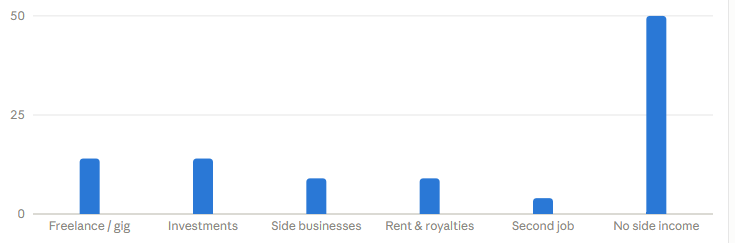
Here is the reality check. In the MyPerfectResume breakdown, only 9% earned from passive sources such as rentals or royalties, the same share as side businesses. And side hustles in general are not lucrative for most people. A Self Financial survey put the average side hustle at $442.76 a month in 2025, down from $688 in 2022, with the most common range sitting at just $51 to $250 a month. Surveys define things differently, so treat these as a picture of the terrain, not a prediction for you.
The numbers: 72% rely on secondary income (MyPerfectResume, 2026). Only 9% earn from passive sources such as rent and royalties. Average side hustle: $442.76 a month in 2025, most commonly $51–$250 (Self Financial).
That arithmetic ignores tax, fees and changing rates. But it explains why people turn to businesses and content: they hope to earn from work what they cannot yet earn from capital. It also explains why the first idea below is boring, and still worth doing.
Rule of thumb from this math: every $100,000 at 4.46% throws off about $4,460 a year, or roughly $372 a month, before tax.
On $10,000, moving from near zero to 4.46% is about $446 a year. It is not life-changing, but it requires no skill, no inventory and no content. Hold it in insured accounts or government products, and confirm the details first, since rates, minimums and penalties vary. The October survey also advises caution about fintech apps for cash because of record-keeping risks.
That also means the price can fall, and dividends are not guaranteed. A holiday week is a perfectly good time to open an account and set up an automatic monthly contribution. But think of this as a slow, long-term build rather than something that pays the bills soon. In the pot-size math above, a 2.87% yield needs about 55% more capital than a 4.46% Treasury bill to produce the same income.
What tends to separate products that sell from those that do not is a specific audience and a problem you understand. A budget tracker for freelancers, or a lesson plan pack for a subject you teach, has a better shot than a generic planner. No dependable earnings figure exists for this category, so the average side hustle numbers above are the honest backdrop. A holiday break is enough time to make a first product. It is not enough to know whether it will sell.
Treat it as a proof that the model can work, not as a typical outcome. A physical product needs design, suppliers, inventory money and customer service, none of which fit neatly into a holiday weekend. If the idea appeals, a sensible holiday task is research: look for a real, repeated complaint, and check whether existing products already solve it.
The pattern is consistent: big earnings claims, a pricey course or done-for-you store, and pressure to buy now. SelfEmployed.com offers practical checks. Treat any guaranteed-income or automated AI business as a red flag, especially with high upfront cost and urgency. Ask for earnings claims in writing, and search the company name together with words like complaint and FTC. If a coach needs an answer today, walk away.
Watch out: Real businesses can also fail. The difference is that honest ones do not guarantee results, and do not need you to pay thousands before you can see how they work.
Finish with a one-page note: what you did, what it cost, what you expect, and a review date in February or March. Most ideas look different after a few weeks of real feedback, and that is useful information.
So use the break for what it does well: setting things up. Start with the boring win, choose one build idea, avoid anyone selling certainty, and review in a few months. If it turns into something, wonderful. If not, you will have lost little and learned a lot. A tax or financial professional can help you with your own situation.
Rarely, at least at the start. Most ideas need real setup effort, and many need occasional upkeep afterwards. Greg Keogh, who runs an online product business, now spends about two hours a month on it, but he started seven years ago. Treat "passive" as a spectrum, from nearly hands-off (interest on cash) to front-loaded work that pays off slowly.
How much money do I need to earn $500 a month from investments?
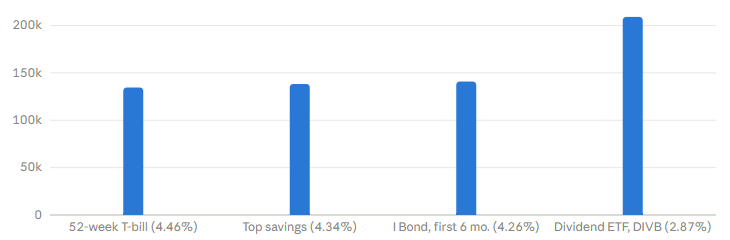
It depends on the yield. At 4.46%, roughly the 52-week T-bill yield on October 9, you would need about $134,500 to throw off $6,000 a year. At a 2.87% dividend ETF yield, closer to $209,000. These are simple illustrations that ignore tax, fees and changing rates.
What is the fastest idea to start over a holiday break?
Moving idle cash to a better-paying savings account, T-bill or I Bond can be done in an afternoon. The payoff is modest, but it is real and nearly hands-off. Anything that involves creating a product or content takes longer to earn.
How can I tell if a passive income offer is a scam?
Treat guaranteed income, automated AI businesses, high upfront fees and pressure to decide today as red flags. Ask for earnings claims in writing, and search the company name with words like complaint and FTC. The FTC has taken action against several schemes that promised passive income.
Do I have to pay tax on passive income?
Generally yes, interest, dividends, rental income and sales proceeds are usually taxable, though the rules vary by income type and place. Keep records from day one. This is general information, so check with a tax professional about your situation.
Capital needed to earn $500 a month ($6,000 a year) at different yields
Where Americans' extra income comes from (Bankrate 2025, as reported)
% of US adults by Source of extra income
Table of Contents
- The Holiday Promise and the Fine Print
- What the Numbers Say About Passive Income
- How Big a Pot Do You Need?
- Idea One: Put Idle Cash to Work
- Idea Two: Dividend and Index Funds
- Idea Three: Digital Products
- Idea Four: A Small Physical Product
- Idea Five: Rent Out Something You Own
- Idea Six: Content and Royalties
- Side by Side: The Six Ideas Compared
- The Scam Filter
- A Realistic Holiday Plan
- Conclusion
- Frequently Asked Questions
The Holiday Promise and the Fine Print
Every year around now, a daydream shows up. You will have a few days off, the house will be quiet, and somewhere between the leftovers and the lights you will finally set up something that pays you while you sleep. It is half true, and the false half is where people lose time and money. This post covers the true half: ideas you can genuinely start over a holiday break, what each realistically pays, and how to avoid the people selling the other half.The short version is that "passive" almost never means "effortless." It means the work comes first and the money comes later, sometimes much later. A holiday is a good time to do the first part. It is not a time to expect the second part by January.
What the Numbers Say About Passive Income
Side income is now ordinary. A 2026 report from MyPerfectResume, based on 1,000 US workers, found that 72% rely on at least one secondary income source, up from 71% the year before, and 38% said inflation had significantly raised their need for extra income. Intuit QuickBooks surveyed 3,000 adults in December 2025 and found that 47% earned side hustle income that year, while 40% planned to start a new business or side hustle in 2026. A Dub survey, cited by Entrepreneur, found more than half of Americans, and about 60% of Gen Z, doubt a standard 9-to-5 will reach their financial goals.Here is the reality check. In the MyPerfectResume breakdown, only 9% earned from passive sources such as rentals or royalties, the same share as side businesses. And side hustles in general are not lucrative for most people. A Self Financial survey put the average side hustle at $442.76 a month in 2025, down from $688 in 2022, with the most common range sitting at just $51 to $250 a month. Surveys define things differently, so treat these as a picture of the terrain, not a prediction for you.
The numbers: 72% rely on secondary income (MyPerfectResume, 2026). Only 9% earn from passive sources such as rent and royalties. Average side hustle: $442.76 a month in 2025, most commonly $51–$250 (Self Financial).
How Big a Pot Do You Need?
Before choosing an idea, it helps to feel the scale. Suppose your target is a modest $500 a month, which is $6,000 a year. If that has to come from interest or dividends, the size of the pot depends entirely on the yield. At the 4.46% a 52-week Treasury bill paid on October 9, you would need about $134,500. At the 4.34% of a top online savings account, about $138,200. At the 4.26% first-six-month rate on I Bonds, about $140,800. At the 2.87% yield on a dividend ETF such as DIVB, about $209,100.That arithmetic ignores tax, fees and changing rates. But it explains why people turn to businesses and content: they hope to earn from work what they cannot yet earn from capital. It also explains why the first idea below is boring, and still worth doing.
Rule of thumb from this math: every $100,000 at 4.46% throws off about $4,460 a year, or roughly $372 a month, before tax.
Idea One: Put Idle Cash to Work
This is the closest thing to truly passive income, and it takes an afternoon. The October 12 rate survey from MyMoneyBlog found the best savings rates at 4.50% APY (a Hyperion Bank promotion needing $10,000 of new money, guaranteed through June 30, 2027) and 4.34% (Elevault), a 4-week T-bill at 4.03% and a 52-week bill at 4.46%. I Bonds bought through October earn 4.26% for the first six months. Meanwhile, the survey notes the big megabanks still pay essentially zero.On $10,000, moving from near zero to 4.46% is about $446 a year. It is not life-changing, but it requires no skill, no inventory and no content. Hold it in insured accounts or government products, and confirm the details first, since rates, minimums and penalties vary. The October survey also advises caution about fintech apps for cash because of record-keeping risks.
Idea Two: Dividend and Index Funds
Funds that hold many companies and pay out dividends are the classic hands-off investment. The iShares Core Dividend ETF, DIVB, for example, showed a 2.87% yield and a 0.05% expense ratio on September 18, 2026, according to Robinhood. Notice that 2.87% is lower than what cash pays right now. The attraction is not the income alone but the chance of growth in the share price over a long period.That also means the price can fall, and dividends are not guaranteed. A holiday week is a perfectly good time to open an account and set up an automatic monthly contribution. But think of this as a slow, long-term build rather than something that pays the bills soon. In the pot-size math above, a 2.87% yield needs about 55% more capital than a 4.46% Treasury bill to produce the same income.
Idea Three: Digital Products
Templates, planners, guides, spreadsheets, printable packs and short courses are popular because you make them once and can sell them repeatedly, and because AI tools have made the creating part faster. The Wall Street Journal, as summarized by Herald Corp in June 2026, reported more Americans using chatbots for money-making ideas and using AI to produce e-books, videos, courses and PDFs. The catch is obvious: if it is easy for you, it is easy for everyone, so the market can fill with similar products.What tends to separate products that sell from those that do not is a specific audience and a problem you understand. A budget tracker for freelancers, or a lesson plan pack for a subject you teach, has a better shot than a generic planner. No dependable earnings figure exists for this category, so the average side hustle numbers above are the honest backdrop. A holiday break is enough time to make a first product. It is not enough to know whether it will sell.
Idea Four: A Small Physical Product
Entrepreneur’s June 2026 profile of Greg Keogh is the dream version. He designed an oversized lint roller after a dog owner described the problem, launched it on Amazon, and now spends no more than two hours a month on it while it earns between $50,000 and $115,000 a year, depending on performance. It is a real story, and it is also the success side of a lottery. He started seven years earlier and kept the business deliberately lean.Treat it as a proof that the model can work, not as a typical outcome. A physical product needs design, suppliers, inventory money and customer service, none of which fit neatly into a holiday weekend. If the idea appeals, a sensible holiday task is research: look for a real, repeated complaint, and check whether existing products already solve it.
Idea Five: Rent Out Something You Own
Renting does not have to mean owning a second home. Spare storage space, a parking spot, camera gear or tools you rarely use can be rented to neighbors through local marketplaces. The appeal is that the asset already exists. The tradeoffs are wear and tear, scheduling, liability and whatever your lease, insurance or local rules allow. Check those before listing anything, and keep records of what you earn.Idea Six: Content and Royalties
Writing, photography, music, a niche blog, a video channel: these are the slow compounders. Each piece you publish can keep earning, but the first months often produce close to nothing, and platforms change their rules. A holiday is a good time to create a first batch and set a posting rhythm. Expect this to be closer to a part-time creative job than a mailbox full of checks.Side by Side: The Six Ideas Compared
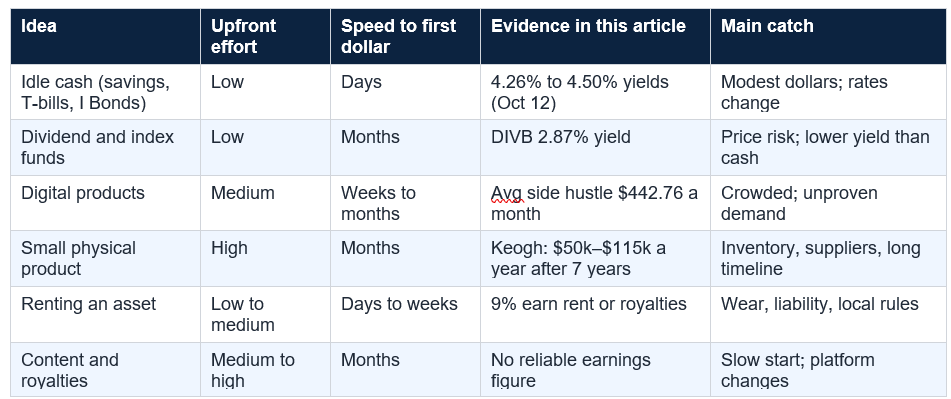
This table summarizes the ideas using the figures above. Effort and speed are my own judgment, not measured data.
The Scam Filter
Anyone promising effortless money in a holiday week deserves suspicion, and the FTC has the receipts. It took action against Click Profit, which allegedly promised large "passive income" from an AI system and cost consumers at least $14 million. It pursued FBA Machine, also called Passive Scaling, which allegedly guaranteed income from AI-powered online storefronts and cost consumers more than $15.9 million. A SelfEmployed.com roundup says Ascend Ecom took at least $25 million. In another case, DK Automation promised passive income "on autopilot" when, the FTC alleged, few consumers made money.The pattern is consistent: big earnings claims, a pricey course or done-for-you store, and pressure to buy now. SelfEmployed.com offers practical checks. Treat any guaranteed-income or automated AI business as a red flag, especially with high upfront cost and urgency. Ask for earnings claims in writing, and search the company name together with words like complaint and FTC. If a coach needs an answer today, walk away.
Watch out: Real businesses can also fail. The difference is that honest ones do not guarantee results, and do not need you to pay thousands before you can see how they work.
A Realistic Holiday Plan
Here is how I would use a long break, as a suggestion rather than a prescription. On day one, do the cash audit: list where your money sits, what it earns, and move whatever you do not need into the best insured option you can verify. On day two, pick one build idea, not three, and write down who it serves and what problem it solves. On day three, make a small first version: a one-page product, a single listing, a first post. Then spend nothing beyond small tool costs until something sells.Finish with a one-page note: what you did, what it cost, what you expect, and a review date in February or March. Most ideas look different after a few weeks of real feedback, and that is useful information.
Conclusion
Passive income is real, but it is slower and more modest than the holiday daydream suggests. The easiest ideas, like moving idle cash, pay a little and require almost nothing. The ambitious ones, like products and content, can pay more but ask for work first and patience after. The survey numbers are a good antidote to hype: most side hustles earn a few hundred dollars a month at most, and only a small share of people earn from truly passive sources.So use the break for what it does well: setting things up. Start with the boring win, choose one build idea, avoid anyone selling certainty, and review in a few months. If it turns into something, wonderful. If not, you will have lost little and learned a lot. A tax or financial professional can help you with your own situation.
Frequently Asked Questions
Is passive income really passive?Rarely, at least at the start. Most ideas need real setup effort, and many need occasional upkeep afterwards. Greg Keogh, who runs an online product business, now spends about two hours a month on it, but he started seven years ago. Treat "passive" as a spectrum, from nearly hands-off (interest on cash) to front-loaded work that pays off slowly.
How much money do I need to earn $500 a month from investments?
It depends on the yield. At 4.46%, roughly the 52-week T-bill yield on October 9, you would need about $134,500 to throw off $6,000 a year. At a 2.87% dividend ETF yield, closer to $209,000. These are simple illustrations that ignore tax, fees and changing rates.
What is the fastest idea to start over a holiday break?
Moving idle cash to a better-paying savings account, T-bill or I Bond can be done in an afternoon. The payoff is modest, but it is real and nearly hands-off. Anything that involves creating a product or content takes longer to earn.
How can I tell if a passive income offer is a scam?
Treat guaranteed income, automated AI businesses, high upfront fees and pressure to decide today as red flags. Ask for earnings claims in writing, and search the company name with words like complaint and FTC. The FTC has taken action against several schemes that promised passive income.
Do I have to pay tax on passive income?
Generally yes, interest, dividends, rental income and sales proceeds are usually taxable, though the rules vary by income type and place. Keep records from day one. This is general information, so check with a tax professional about your situation.
0 Comments
Be the first to share your thoughts on this article.