

Investing
Signs You're Ready to Invest Beyond Your 401(k)
Only 14% of 401(k) participants ever max out their contributions. Among those who do, the next question is almost never asked: what comes after the 401(k)? The answer — Roth IRA, HSA, taxable brokerage, backdoor Roth, mega backdoor Roth — depends on a specific set of financial readiness signals that tell you when you have genuinely cleared the runway for broader investing. This guide identifies eight concrete signs that you are ready, explains what each one means, and maps the next investment move for every situation.
There is a specific moment in a financially disciplined person's life when the question shifts. For years, the advice is the same: contribute enough to get the employer match, then increase contributions over time, then eventually push toward the limit. The 401(k) is the starting point, the default retirement vehicle, the first account everyone opens and the one that gets the most consistent attention. Then one day — through a raise, a bonus, a promotion, or simply years of systematic increases — the 401(k) is maxed. And the financial content that guided you to that point largely stops.
Only 14% of 401(k) participants ever reach that point, according to Vanguard's How America Saves 2025 report, covering Vanguard-managed defined contribution plans. Among those who do, the next move is rarely obvious. The financial industry builds extensive infrastructure around helping people save more in their 401(k). It builds far less around what comes after. The result is that many disciplined savers who have done everything right within their employer's retirement plan are either leaving money in low-yield savings, inadvertently over-concentrating their tax exposure in pre-tax accounts, or simply not investing the surplus that their savings discipline has created.
This guide identifies eight specific signs that you are genuinely ready to invest beyond the 401(k) — signs that indicate the prerequisite financial foundations are in place and that additional investment dollars will actually reach their growth potential rather than being needed for something more urgent. It then maps the specific accounts and strategies available once those prerequisites are confirmed, in priority order, with the 2026 contribution limits and tax rules that determine which options are most valuable for your situation.
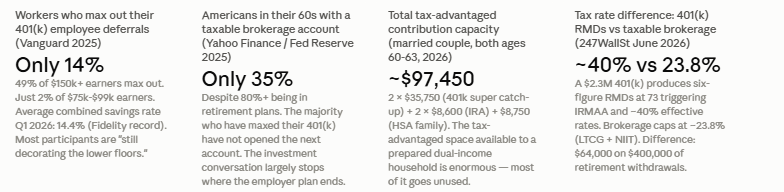
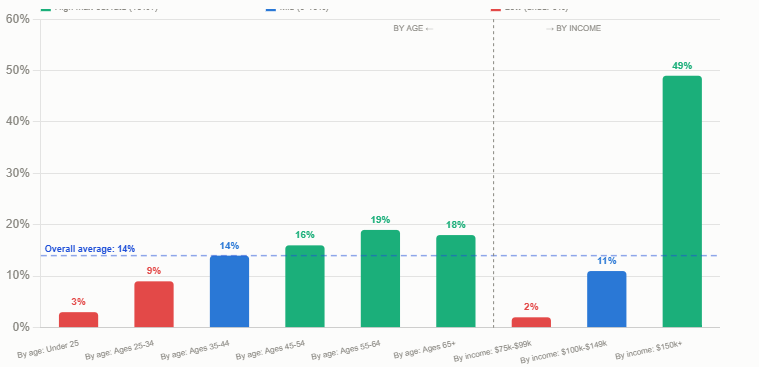
Only 14% of 401(k) participants maxed out employee deferrals in 2024 (Vanguard 2025 report; Yahoo Finance 2026). By income: 49% of $150k+ earners max out; just 2% of $75k-$99k earners (Vanguard 2025). By age: under 25 = 3%; ages 25-34 = 9%; ages 35-44 = 14%; ages 45-54 = 16%; ages 55-64 = 19%; ages 65+ = 18% (Apollo / Vanguard 2025). Average combined 401(k) savings rate Q1 2026: 14.4% (employee 9.6% + employer 4.8%) — Fidelity all-time record. Total 401(k) assets: $9.9 trillion (ICI March 2026). Only ~35% of Americans in their 60s hold a taxable brokerage account despite 80%+ in retirement plans (Yahoo Finance / Fed Reserve 2025). 2026 IRA limit: $7,500. 2026 HSA limit: $4,400 self-only / $8,750 family.
The contribution ceiling is the most visible constraint. In 2026, the employee deferral limit is $24,500 (up from $23,500 in 2025), with catch-up contributions of $8,000 available for those aged 50 and over and a super catch-up of $11,250 for those aged 60-63. Citizens Bank's 2026 analysis of the new limits notes: 'Reaching these numbers is a laudable goal and an impressive milestone. Yet it's uncommon: only 14% of participants hit the maximum, according to Vanguard's How America Saves 2025 report.'
Beyond the contribution limit, the 401(k) creates a tax concentration problem. Every dollar contributed to a traditional (pre-tax) 401(k) reduces taxable income now and grows tax-deferred, but is taxed as ordinary income at withdrawal. A large traditional 401(k) balance generates large required minimum distributions (RMDs) beginning at age 73 — distributions that must be taken regardless of need, can push income into higher brackets, trigger Social Security taxability, and activate Medicare IRMAA surcharges. Citizens Bank's 2026 analysis, citing 247WallSt/Marc Guberti, quantifies the exposure: 'A $2.3M 401(k) growing at 6% produces six-figure RMDs at 73, stacking with Social Security to trigger IRMAA surcharges and approximately 40% effective rates.'
The access constraint is the third limitation. Penalty-free withdrawals from a 401(k) are not available until age 59½ (with specific exceptions). Money invested in a taxable brokerage account is accessible at any time, for any reason, with only capital gains tax consequences. For those pursuing early retirement, bridging to a second career, or simply wanting flexibility before 59½, the taxable account is an essential complement that the 401(k) cannot provide. This is why the sequence matters: 401(k) first, then the accounts that provide tax diversification and flexibility.
The goal of investing beyond the 401(k) is not to replace it — it is to complement it. A well-structured retirement portfolio combines pre-tax accounts (traditional 401(k), traditional IRA) that provide tax deferral now; Roth accounts (Roth IRA, Roth 401(k)) that provide tax-free growth and withdrawals; HSAs that provide triple tax benefits for healthcare costs; and taxable brokerage accounts that provide unlimited contributions, full flexibility, and preferential capital gains tax treatment. This mix creates options in retirement that a 401(k)-only approach does not. Not financial advice.
Experian's investing readiness guide states this directly: 'Without this, you're at risk of using money to invest that would be better put to use ensuring your financial security.' The emergency fund is not an investment — it is insurance. Its purpose is to keep investment accounts untouched through the events that are not emergencies in retrospect but felt like them at the time. Invest1Now's 2026 investing guide frames the sequence: 'Once you hit three to six months of living expenses in that HYSA, you can start moving additional money into investments.'
Emergency fund readiness check. What it looks like: three to six months of essential expenses (housing, utilities, groceries, transportation, minimum debt payments, insurance) held in a high-yield savings account paying 4.00%+ APY in September 2026. What 'essential expenses' means: what you genuinely need to survive, not what you currently spend. For most Americans, this is $2,500-$5,000/month, meaning a complete emergency fund is $7,500-$30,000 depending on monthly costs and desired buffer size. Where to keep it: online bank HYSA (Ally, Marcus, Discover, Synchrony, Bread Financial) — FDIC insured, accessible in 1-3 business days, currently earning 4.00-4.50%+ APY. Not financial advice.
The reason high-interest debt must be resolved before expanding investment accounts is mathematical. Investing at a long-term average equity return of 7-10% per year while carrying credit card debt at 20% APR generates a guaranteed net loss of 10-13% per year on every dollar that could pay down the debt but is invested instead. Invest1Now's 2026 guide states this plainly: 'Investing at 7-8% while paying 20% interest is a net loss every year. In 2026, it still makes far more sense for most people to pay off credit cards and high-rate personal loans before investing extra.'
The sign that you are ready: no balances on credit cards carried month-to-month, no personal loans above 8-10% APR, and debt-to-income ratio that is manageable and declining rather than growing. Mortgage debt, low-rate auto loans, and student loans at rates below 6-7% do not trigger this prerequisite. Carrying these alongside investment accounts is a rational financial structure — particularly when tax deductions apply (mortgage interest deduction) or when refinancing at today's rates is not beneficial.
The trap to avoid: opening a taxable brokerage account, Roth IRA, or any investment account beyond the employer-matched 401(k) while simultaneously carrying credit card debt above 15% APR. Every dollar in that investment account is generating an expected return of 7-10% while the credit card charges 20%. The math is not close. Pay the high-interest debt first, even if the investment account feels more exciting. The guaranteed 20% return from debt elimination is not available anywhere in the investment markets. Not financial advice.
The sign that confirms readiness to go beyond: you are contributing at least enough to your 401(k) to capture the full employer match, and you are not leaving any matching dollars on the table. If the employer matches 100% of the first 3% of salary, you are contributing at least 3%. If the employer matches 50% of the first 6%, you are contributing at least 6%. This is the floor, not the ceiling, of 401(k) contributions.
Many workers who begin investing beyond their 401(k) are already maxing the full $24,500 limit — having progressed well past the matching minimum. But for those in the earlier stages of this journey, the sign to watch for is the confirmation that the match is fully captured. Any 401(k) contribution below the full-match threshold, redirected toward a Roth IRA or brokerage account instead, is leaving guaranteed employer money uncollected. The match comes first, always. Not financial advice.
A $500 monthly surplus that is reliably available every month for twelve months generates $6,000 per year — nearly a full Roth IRA contribution ($7,500 limit in 2026). A $1,000 monthly surplus generates $12,000 per year, covering a Roth IRA and a meaningful HSA contribution. Experian's investing readiness guide identifies this as a critical signal: 'You have a budget. Or, you're at least keeping an eye on how much you earn versus how much you spend — and coming out at the end of the month with some savings to set aside.'
The distinction between a surplus and spending leftover is important. A surplus is the result of deliberate allocation — paying yourself first through automatic savings transfers, then living on the remainder. Spending leftover is whatever is in the checking account at month end before it gets spent on something unplanned. A budget, a spending tracker, or even a simple automatic transfer to a savings or investment account the day of each paycheck are all mechanisms that convert spending leftover into a reliable surplus. The sign to look for: the surplus appears consistently, not just in unusually good months.
Money needed within one to three years — a home down payment, a vehicle purchase, a planned family expense, a sabbatical — does not belong in the stock market regardless of which account it is in. That money belongs in a high-yield savings account or a short-term CD ladder. Putting it into equities exposes it to the possibility of a 30-40% drawdown right before the date it is needed, which could delay or prevent the goal.
Money that is genuinely not needed for five or more years — additional retirement savings, wealth building beyond the working years, leaving assets to the next generation — belongs in a diversified, low-cost equity index fund inside the most tax-advantaged wrapper available (Roth IRA, HSA invested for the long term, or taxable brokerage with tax-efficient index funds). The key insight: the account type matters less than the time horizon. A Roth IRA holding a money market fund for a 2-year goal is not optimal. A taxable brokerage holding a low-cost total market index fund for a 20-year goal is entirely sound.
Time horizon and account choice, simplified. UNDER 3 YEARS: High-yield savings account (HYSA, 4.00-4.50% APY in September 2026); no-penalty CD or short CD ladder; I Bonds (after 12-month lockout); money market account. REASON: these assets cannot suffer a 30-40% equity market drawdown. 3-5 YEARS: Hybrid approach — some in HYSA/CDs, some in a conservative allocation in a Roth IRA (bonds + some equities). REASON: time enough for some equity recovery if drawdown occurs early. 5+ YEARS: Roth IRA, HSA, or taxable brokerage with low-cost equity index funds. REASON: long enough for equity volatility to smooth out; tax-advantaged compounding most powerful over long periods. 10+ YEARS: maximize Roth IRA and HSA; taxable brokerage with broad index funds; consider mega backdoor Roth if employer plan permits. Not financial advice.
Citizens Bank's 2026 401(k) limit analysis frames the milestone precisely: 'Reaching these numbers is a laudable goal and an impressive milestone... for high-income earners, the story is different. Nearly 49% of top-tier earners max out their plans. With the new 2026 limits, the question for high-income earners becomes whether increasing contributions to the workplace plan is the best move, or whether other investment options could deliver greater tax efficiency and flexibility.'
The sign is not necessarily that the 401(k) is already at the maximum. It can be that you are consistently increasing your contribution rate and have a reasonable trajectory to reach the maximum within a few years. But it is also possible — and financially rational for many high earners — to invest beyond the 401(k) before maxing it, specifically when the 401(k)'s investment options are poor (high expense ratio funds with no better alternatives), when the tax benefit of pre-tax contributions is limited (low marginal rate in the current year), or when a Roth IRA or HSA delivers superior tax efficiency for the specific situation.
The core principle is account tax character. Traditional pre-tax accounts (traditional 401(k), traditional IRA) reduce taxable income now and grow tax-deferred, but every dollar withdrawn is taxed as ordinary income at whatever rates apply at withdrawal. Roth accounts (Roth IRA, Roth 401(k)) are funded with after-tax dollars but grow and withdraw tax-free. HSAs are uniquely triple tax-advantaged — contributions are pre-tax (or deductible), growth is tax-free, and withdrawals are tax-free for qualified medical expenses. Taxable brokerage accounts are funded with after-tax dollars, generate annual tax events on dividends and interest, and are taxed at long-term capital gains rates on eventual sale.
ChooseFI's investment sequencing analysis describes what the tax-aware investor does differently: 'Long-term capital gains in a taxable brokerage are taxed at 0% for individuals earning under approximately $47,025. Many early retirees pay zero federal tax on their investment gains by keeping earned income low. This makes the taxable brokerage account one of the most powerful tools in the FI toolkit — unlimited contributions now, and potentially tax-free growth later.' The 0% LTCG rate is a planning opportunity that only arises if the taxable brokerage account exists to take advantage of it.
The sign that confirms readiness: you know which of your accounts is pre-tax, which is Roth, and which is taxable; you know the contribution limits and income thresholds for each; and you have at least a basic understanding of how RMDs, IRMAA, and Social Security taxability interact with large pre-tax balances in retirement. You do not need to be an expert — you need to know enough to have the right conversation with a financial adviser.
A written financial plan performs several functions that unwritten intentions cannot. It makes investment goals concrete and measurable. It establishes the connection between specific accounts and specific goals (this Roth IRA is for retirement at 62; this taxable brokerage is for the down payment on a rental property in 8 years; this HSA is for healthcare costs in retirement). It provides a reference point when market volatility or life events create pressure to make reactive decisions. And it is the document a financial adviser can review, question, and improve.
Citizens Bank's 2026 investing analysis recommends exactly this before redirecting dollars beyond the 401(k): 'This is the right time to revisit your retirement strategy holistically.' The review involves understanding current pre-tax vs Roth vs taxable balance proportions, projecting forward to estimate RMD size at age 73, assessing whether additional pre-tax contributions create future tax concentration or whether Roth contributions better serve the long-term tax picture, and deciding which specific accounts to prioritise with surplus capital.
The critical constraint is the pro-rata rule: if you have existing pre-tax dollars in any traditional IRA, the conversion is taxed proportionally across all IRA balances, not just the non-deductible contribution. A person with $100,000 in a pre-tax traditional IRA who makes a $7,500 non-deductible contribution and converts it cannot treat the $7,500 as 100% after-tax — the IRS pro-rates the conversion across the full $107,500 in IRA assets. The solution for those with large pre-tax IRA balances is to roll those balances into an employer 401(k) plan (if the plan accepts rollovers) before executing the backdoor conversion.
The Mega Backdoor Roth is a more powerful strategy available inside 401(k) plans that allow after-tax (non-Roth) contributions and either in-plan Roth conversions or in-service withdrawals. ChooseFI describes it: 'Your 401(k) plan may also allow you to contribute beyond [the standard limit] with after-tax contributions. This can potentially allow over $60,000 in total annual contributions.' In 2026, the total 401(k) contribution limit (employee + employer + after-tax) is $69,000 ($76,500 for those with standard catch-up). After capturing employer match ($X) and maxing employee deferrals ($24,500), the remaining gap can potentially be filled with after-tax contributions, then converted to Roth — creating an additional Roth-wrapper contribution that bypasses both the $7,500 IRA limit and the income restrictions.
Both the backdoor Roth and the mega backdoor Roth are legal, well-documented strategies that have been in use for over a decade. They are also complex, sensitive to specific plan document provisions (mega backdoor), and have nuances (pro-rata rule, in-service withdrawal availability) that make them difficult to implement correctly without professional guidance. Both are worth exploring with a fee-only CPA or financial adviser once the basic priority sequence (emergency fund, debt-free, full employer match, Roth IRA, HSA, full 401(k)) has been completed. Not tax advice.
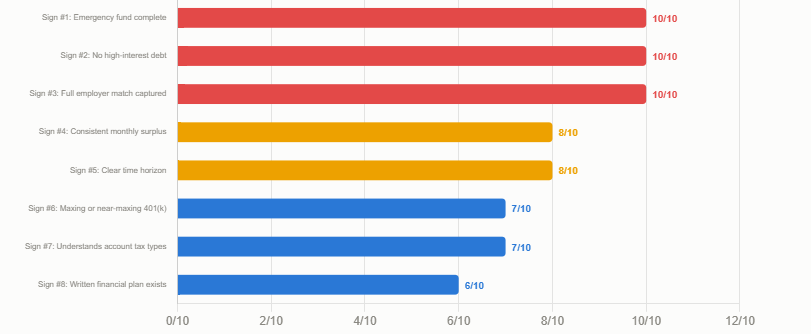
It is also not the end of the investment conversation for anyone who gets there. The eight signs in this guide — emergency fund complete, high-interest debt gone, employer match fully captured, consistent monthly surplus, clear time horizon, maxing or near-maxing the 401(k), tax-literacy in place, and a written financial plan — mark the point at which the 401(k)'s structural constraints (contribution ceiling, tax concentration, access restrictions) become meaningful and the case for the next accounts becomes clear.
The next accounts — Roth IRA, HSA, taxable brokerage, backdoor Roth, mega backdoor Roth — are not complicated in concept. The Roth IRA is a $7,500 annual after-tax contribution that grows and withdraws tax-free. The HSA is the most tax-efficient account structure in the entire US tax code when invested for the long term. The taxable brokerage is where everything else goes, with no limits and no lock-in. The sequence of priority is well established. The only remaining step is confirming that the eight signs are in place — and then taking the next one. Not financial advice — consult a qualified financial adviser and CPA for guidance specific to your situation.
After maxing your 401(k) employee deferrals ($24,500 in 2026, or $32,500/$35,750 for those 50+/60-63), the investment priority sequence — supported by sources including ChooseFI, Citizens Bank 2026, and Experian — suggests: first, confirm you have a complete emergency fund (3-6 months of essential expenses in a HYSA); second, confirm no high-interest debt remains; third, open and max a Roth IRA if eligible (2026 limit $7,500; income phase-out $153,000-$168,000 single / $242,000-$252,000 MFJ). If your income exceeds the Roth IRA limits, use the backdoor Roth conversion strategy. Fourth, max an HSA if you have an HSA-eligible high-deductible health plan (2026: $4,400 self-only / $8,750 family). Fifth, if surplus remains, open a taxable brokerage account and invest in low-cost, tax-efficient broad index funds. For high earners whose employer plan permits it, explore the mega backdoor Roth as an additional Roth-wrapper contribution strategy beyond standard limits. Not financial advice — consult a CPA or financial adviser.
When should I open a Roth IRA vs a taxable brokerage account?
If you are eligible for a Roth IRA (2026 MAGI under $153,000 single / $242,000 married filing jointly), the Roth IRA should come before the taxable brokerage account in the investment priority sequence. The Roth IRA's tax-free growth and tax-free qualified withdrawals are more valuable than the taxable brokerage account's flexibility and unlimited contributions for most long-term investors. The exception: if you need access to invested capital before age 59½ (specifically the investment gains, not the contributions, which can be withdrawn from a Roth IRA at any time penalty-free), the taxable brokerage provides earlier access without penalties. A common approach once both accounts are available is to max the Roth IRA first each year, then direct surplus to the taxable brokerage. For those above the Roth IRA income limits, the backdoor Roth strategy restores Roth IRA access for most taxpayers, and the mega backdoor Roth (if the employer plan allows it) can create even more Roth-wrapper capacity. Not financial advice.
What is the HSA investment strategy and why is it considered so powerful?
The Health Savings Account (HSA) has a triple tax benefit that no other account in the US tax code replicates: contributions are tax-deductible (or pre-tax through payroll), reducing AGI; the balance grows tax-free; and withdrawals for qualified medical expenses are completely tax-free at any age. The 2026 contribution limits are $4,400 for self-only coverage and $8,750 for family coverage, with a $1,000 catch-up for those aged 55 and over. The power of the HSA as an investment vehicle (rather than just a healthcare spending account) comes from treating it as a 'stealth retirement account': pay current medical expenses out of pocket when possible, allow the HSA balance to grow invested in index funds over decades, and withdraw tax-free in retirement (when healthcare costs are typically highest). After age 65, HSA funds can be withdrawn for any purpose — not just medical — taxed at ordinary income rates like a traditional IRA, making it a secondary retirement account if medical costs do not exhaust the balance. The requirement to be eligible: enrollment in an HSA-qualified high-deductible health plan (HDHP) and not enrolled in Medicare. Not financial advice.
What is the backdoor Roth IRA and who needs to use it?
The backdoor Roth IRA is a strategy that allows high-income earners above the Roth IRA contribution income limits to access the Roth IRA's tax-free growth benefits. In 2026, the Roth IRA contribution phase-out begins at $153,000 MAGI for single filers and $242,000 for married filing jointly. Above these thresholds, direct Roth IRA contributions are either reduced or eliminated. The backdoor strategy works by making a non-deductible (after-tax) traditional IRA contribution — there is no income limit for this — and then converting the traditional IRA balance to a Roth IRA. If done correctly with no pre-existing pre-tax IRA balances, the conversion generates no income tax because the contribution was already after-tax. The critical caution: the pro-rata rule. If you have any pre-existing pre-tax balances in traditional IRAs, the IRS applies a blended tax calculation across all IRA assets, which can make the backdoor conversion partially taxable. The solution is to roll pre-tax IRA balances into an employer 401(k) plan before executing the backdoor conversion. Not tax advice — consult a CPA before implementing.
How do I know if I am ready to invest in a taxable brokerage account?
Experian's investing readiness guide identifies four specific signs: you have your debt under control or have a plan to become debt-free; you have a budget or at least track spending vs income; you have an emergency fund covering three to six months of basic expenses; and you are working toward other goals that matter to you (a home, education) and have a plan for those before committing surplus to a brokerage account. Beyond these foundational signs, you are ready for a taxable brokerage specifically after: the emergency fund is complete; high-interest debt is paid; the employer 401(k) match is fully captured; a Roth IRA is open and being maxed (or backdoor Roth executed for high earners); an HSA is open and maxed if eligible; and the 401(k) is at or approaching the full $24,500 employee limit. The taxable brokerage account is the last step in the priority sequence, but it is also the most flexible: no contribution limits, no income restrictions, no mandatory lock-up period, accessible at any age for any purpose. For most long-term investors in a taxable account, the right investment is a low-cost, broad index fund — FZROX (Fidelity, 0% expense ratio), VTI (Vanguard, 0.03%), or SCHB (Schwab, 0.03%). Not financial advice.
Table of Contents
- The Question After the 401(k) Milestone
- Why the 401(k) Has a Ceiling — and Why That Matters
- Sign #1 — Your Emergency Fund Is Complete
- Sign #2 — You Have No High-Interest Debt
- Sign #3 — You Are Capturing Your Full Employer Match
- Sign #4 — You Have Consistent Monthly Surplus After Expenses
- Sign #5 — You Have a Clear Time Horizon for Extra Savings
- Sign #6 — You Are Maxing or Close to Maxing Your 401(k)
- Sign #7 — You Understand the Tax Efficiency of Each Account
- Sign #8 — You Have a Written Financial Plan (or Are Ready to Build One)
- Where to Go After the 401(k): The Investment Priority Sequence
- Roth IRA vs Taxable Brokerage vs HSA: A Side-by-Side Comparison
- The Backdoor Roth and Mega Backdoor Roth: Advanced Moves for High Earners
- Conclusion: The 401(k) Was the Start, Not the Finish
- Frequently Asked Questions
Who maxes out the 401(k) — and who doesn't
The 8 readiness signs: are you ready for the next account?
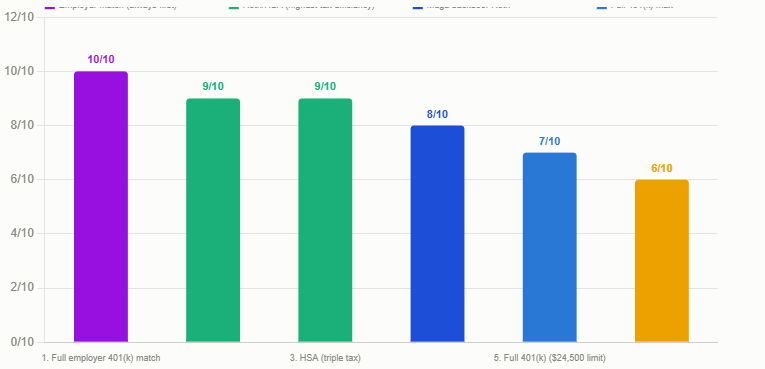
Investment priority sequence after the 401(k)
The Question After the 401(k) Milestone
There is a specific moment in a financially disciplined person's life when the question shifts. For years, the advice is the same: contribute enough to get the employer match, then increase contributions over time, then eventually push toward the limit. The 401(k) is the starting point, the default retirement vehicle, the first account everyone opens and the one that gets the most consistent attention. Then one day — through a raise, a bonus, a promotion, or simply years of systematic increases — the 401(k) is maxed. And the financial content that guided you to that point largely stops.Only 14% of 401(k) participants ever reach that point, according to Vanguard's How America Saves 2025 report, covering Vanguard-managed defined contribution plans. Among those who do, the next move is rarely obvious. The financial industry builds extensive infrastructure around helping people save more in their 401(k). It builds far less around what comes after. The result is that many disciplined savers who have done everything right within their employer's retirement plan are either leaving money in low-yield savings, inadvertently over-concentrating their tax exposure in pre-tax accounts, or simply not investing the surplus that their savings discipline has created.
This guide identifies eight specific signs that you are genuinely ready to invest beyond the 401(k) — signs that indicate the prerequisite financial foundations are in place and that additional investment dollars will actually reach their growth potential rather than being needed for something more urgent. It then maps the specific accounts and strategies available once those prerequisites are confirmed, in priority order, with the 2026 contribution limits and tax rules that determine which options are most valuable for your situation.
Only 14% of 401(k) participants maxed out employee deferrals in 2024 (Vanguard 2025 report; Yahoo Finance 2026). By income: 49% of $150k+ earners max out; just 2% of $75k-$99k earners (Vanguard 2025). By age: under 25 = 3%; ages 25-34 = 9%; ages 35-44 = 14%; ages 45-54 = 16%; ages 55-64 = 19%; ages 65+ = 18% (Apollo / Vanguard 2025). Average combined 401(k) savings rate Q1 2026: 14.4% (employee 9.6% + employer 4.8%) — Fidelity all-time record. Total 401(k) assets: $9.9 trillion (ICI March 2026). Only ~35% of Americans in their 60s hold a taxable brokerage account despite 80%+ in retirement plans (Yahoo Finance / Fed Reserve 2025). 2026 IRA limit: $7,500. 2026 HSA limit: $4,400 self-only / $8,750 family.
Why the 401(k) Has a Ceiling — and Why That Matters
The 401(k) is a powerful retirement savings vehicle, but it has structural constraints that make it insufficient as a sole investment strategy for anyone who wants flexibility, tax diversification, or access to invested capital before retirement age. Understanding those constraints is what makes the decision to invest beyond it both logical and necessary for financially prepared savers.The contribution ceiling is the most visible constraint. In 2026, the employee deferral limit is $24,500 (up from $23,500 in 2025), with catch-up contributions of $8,000 available for those aged 50 and over and a super catch-up of $11,250 for those aged 60-63. Citizens Bank's 2026 analysis of the new limits notes: 'Reaching these numbers is a laudable goal and an impressive milestone. Yet it's uncommon: only 14% of participants hit the maximum, according to Vanguard's How America Saves 2025 report.'
Beyond the contribution limit, the 401(k) creates a tax concentration problem. Every dollar contributed to a traditional (pre-tax) 401(k) reduces taxable income now and grows tax-deferred, but is taxed as ordinary income at withdrawal. A large traditional 401(k) balance generates large required minimum distributions (RMDs) beginning at age 73 — distributions that must be taken regardless of need, can push income into higher brackets, trigger Social Security taxability, and activate Medicare IRMAA surcharges. Citizens Bank's 2026 analysis, citing 247WallSt/Marc Guberti, quantifies the exposure: 'A $2.3M 401(k) growing at 6% produces six-figure RMDs at 73, stacking with Social Security to trigger IRMAA surcharges and approximately 40% effective rates.'
The access constraint is the third limitation. Penalty-free withdrawals from a 401(k) are not available until age 59½ (with specific exceptions). Money invested in a taxable brokerage account is accessible at any time, for any reason, with only capital gains tax consequences. For those pursuing early retirement, bridging to a second career, or simply wanting flexibility before 59½, the taxable account is an essential complement that the 401(k) cannot provide. This is why the sequence matters: 401(k) first, then the accounts that provide tax diversification and flexibility.
The goal of investing beyond the 401(k) is not to replace it — it is to complement it. A well-structured retirement portfolio combines pre-tax accounts (traditional 401(k), traditional IRA) that provide tax deferral now; Roth accounts (Roth IRA, Roth 401(k)) that provide tax-free growth and withdrawals; HSAs that provide triple tax benefits for healthcare costs; and taxable brokerage accounts that provide unlimited contributions, full flexibility, and preferential capital gains tax treatment. This mix creates options in retirement that a 401(k)-only approach does not. Not financial advice.
Sign #1 — Your Emergency Fund Is Complete
The most important prerequisite for investing beyond the 401(k) — or beyond any retirement account — is the completion of an emergency fund that covers three to six months of essential living expenses in a liquid, accessible account. Without this, investment dollars are not actually available for long-term compounding: they are one car repair, one medical bill, or one period of job uncertainty away from being liquidated, often at an inopportune time.Experian's investing readiness guide states this directly: 'Without this, you're at risk of using money to invest that would be better put to use ensuring your financial security.' The emergency fund is not an investment — it is insurance. Its purpose is to keep investment accounts untouched through the events that are not emergencies in retrospect but felt like them at the time. Invest1Now's 2026 investing guide frames the sequence: 'Once you hit three to six months of living expenses in that HYSA, you can start moving additional money into investments.'
Emergency fund readiness check. What it looks like: three to six months of essential expenses (housing, utilities, groceries, transportation, minimum debt payments, insurance) held in a high-yield savings account paying 4.00%+ APY in September 2026. What 'essential expenses' means: what you genuinely need to survive, not what you currently spend. For most Americans, this is $2,500-$5,000/month, meaning a complete emergency fund is $7,500-$30,000 depending on monthly costs and desired buffer size. Where to keep it: online bank HYSA (Ally, Marcus, Discover, Synchrony, Bread Financial) — FDIC insured, accessible in 1-3 business days, currently earning 4.00-4.50%+ APY. Not financial advice.
Sign #2 — You Have No High-Interest Debt
The second sign is the absence of high-interest consumer debt — specifically, credit card balances, personal loans above 8-10% APR, and buy-now-pay-later balances at double-digit rates. This prerequisite applies to investing beyond the 401(k), but it deserves careful framing: it does not mean all debt must be eliminated. A mortgage, auto loan, or student loans at rates below 7-8% exist alongside investing in most financially healthy households.The reason high-interest debt must be resolved before expanding investment accounts is mathematical. Investing at a long-term average equity return of 7-10% per year while carrying credit card debt at 20% APR generates a guaranteed net loss of 10-13% per year on every dollar that could pay down the debt but is invested instead. Invest1Now's 2026 guide states this plainly: 'Investing at 7-8% while paying 20% interest is a net loss every year. In 2026, it still makes far more sense for most people to pay off credit cards and high-rate personal loans before investing extra.'
The sign that you are ready: no balances on credit cards carried month-to-month, no personal loans above 8-10% APR, and debt-to-income ratio that is manageable and declining rather than growing. Mortgage debt, low-rate auto loans, and student loans at rates below 6-7% do not trigger this prerequisite. Carrying these alongside investment accounts is a rational financial structure — particularly when tax deductions apply (mortgage interest deduction) or when refinancing at today's rates is not beneficial.
The trap to avoid: opening a taxable brokerage account, Roth IRA, or any investment account beyond the employer-matched 401(k) while simultaneously carrying credit card debt above 15% APR. Every dollar in that investment account is generating an expected return of 7-10% while the credit card charges 20%. The math is not close. Pay the high-interest debt first, even if the investment account feels more exciting. The guaranteed 20% return from debt elimination is not available anywhere in the investment markets. Not financial advice.
Sign #3 — You Are Capturing Your Full Employer Match
The employer match is the only guaranteed immediate return available in the investment world. A 50% match on contributions up to 6% of salary on a $80,000 income means the first $4,800 of 401(k) contributions generates $2,400 in employer matching — a 50% immediate return before the funds are invested. Capturing the full match must happen before any other investment step, because no subsequent account can replicate that return.The sign that confirms readiness to go beyond: you are contributing at least enough to your 401(k) to capture the full employer match, and you are not leaving any matching dollars on the table. If the employer matches 100% of the first 3% of salary, you are contributing at least 3%. If the employer matches 50% of the first 6%, you are contributing at least 6%. This is the floor, not the ceiling, of 401(k) contributions.
Many workers who begin investing beyond their 401(k) are already maxing the full $24,500 limit — having progressed well past the matching minimum. But for those in the earlier stages of this journey, the sign to watch for is the confirmation that the match is fully captured. Any 401(k) contribution below the full-match threshold, redirected toward a Roth IRA or brokerage account instead, is leaving guaranteed employer money uncollected. The match comes first, always. Not financial advice.
Sign #4 — You Have Consistent Monthly Surplus After Expenses
The fourth sign is the existence of a consistent, predictable monthly surplus — money that remains after all essential expenses, all debt payments, and all existing savings contributions. This surplus is what funds investment accounts beyond the 401(k), and its consistency is as important as its size.A $500 monthly surplus that is reliably available every month for twelve months generates $6,000 per year — nearly a full Roth IRA contribution ($7,500 limit in 2026). A $1,000 monthly surplus generates $12,000 per year, covering a Roth IRA and a meaningful HSA contribution. Experian's investing readiness guide identifies this as a critical signal: 'You have a budget. Or, you're at least keeping an eye on how much you earn versus how much you spend — and coming out at the end of the month with some savings to set aside.'
The distinction between a surplus and spending leftover is important. A surplus is the result of deliberate allocation — paying yourself first through automatic savings transfers, then living on the remainder. Spending leftover is whatever is in the checking account at month end before it gets spent on something unplanned. A budget, a spending tracker, or even a simple automatic transfer to a savings or investment account the day of each paycheck are all mechanisms that convert spending leftover into a reliable surplus. The sign to look for: the surplus appears consistently, not just in unusually good months.
Sign #5 — You Have a Clear Time Horizon for Extra Savings
The fifth sign is knowing what the additional investment money is for and when you might need it. Time horizon is the single most important variable in determining which account type and which investment within that account are appropriate for extra savings beyond the 401(k).Money needed within one to three years — a home down payment, a vehicle purchase, a planned family expense, a sabbatical — does not belong in the stock market regardless of which account it is in. That money belongs in a high-yield savings account or a short-term CD ladder. Putting it into equities exposes it to the possibility of a 30-40% drawdown right before the date it is needed, which could delay or prevent the goal.
Money that is genuinely not needed for five or more years — additional retirement savings, wealth building beyond the working years, leaving assets to the next generation — belongs in a diversified, low-cost equity index fund inside the most tax-advantaged wrapper available (Roth IRA, HSA invested for the long term, or taxable brokerage with tax-efficient index funds). The key insight: the account type matters less than the time horizon. A Roth IRA holding a money market fund for a 2-year goal is not optimal. A taxable brokerage holding a low-cost total market index fund for a 20-year goal is entirely sound.
Time horizon and account choice, simplified. UNDER 3 YEARS: High-yield savings account (HYSA, 4.00-4.50% APY in September 2026); no-penalty CD or short CD ladder; I Bonds (after 12-month lockout); money market account. REASON: these assets cannot suffer a 30-40% equity market drawdown. 3-5 YEARS: Hybrid approach — some in HYSA/CDs, some in a conservative allocation in a Roth IRA (bonds + some equities). REASON: time enough for some equity recovery if drawdown occurs early. 5+ YEARS: Roth IRA, HSA, or taxable brokerage with low-cost equity index funds. REASON: long enough for equity volatility to smooth out; tax-advantaged compounding most powerful over long periods. 10+ YEARS: maximize Roth IRA and HSA; taxable brokerage with broad index funds; consider mega backdoor Roth if employer plan permits. Not financial advice.
Sign #6 — You Are Maxing or Close to Maxing Your 401(k)
The sixth sign is the most concrete: you are either already contributing $24,500 per year to your 401(k) (or $32,500 if aged 50+, or $35,750 for ages 60-63 in 2026), or you are on a trajectory toward that level. This is the sign that triggers the actual question this guide addresses — what comes next?Citizens Bank's 2026 401(k) limit analysis frames the milestone precisely: 'Reaching these numbers is a laudable goal and an impressive milestone... for high-income earners, the story is different. Nearly 49% of top-tier earners max out their plans. With the new 2026 limits, the question for high-income earners becomes whether increasing contributions to the workplace plan is the best move, or whether other investment options could deliver greater tax efficiency and flexibility.'
The sign is not necessarily that the 401(k) is already at the maximum. It can be that you are consistently increasing your contribution rate and have a reasonable trajectory to reach the maximum within a few years. But it is also possible — and financially rational for many high earners — to invest beyond the 401(k) before maxing it, specifically when the 401(k)'s investment options are poor (high expense ratio funds with no better alternatives), when the tax benefit of pre-tax contributions is limited (low marginal rate in the current year), or when a Roth IRA or HSA delivers superior tax efficiency for the specific situation.
Sign #7 — You Understand the Tax Efficiency of Each Account
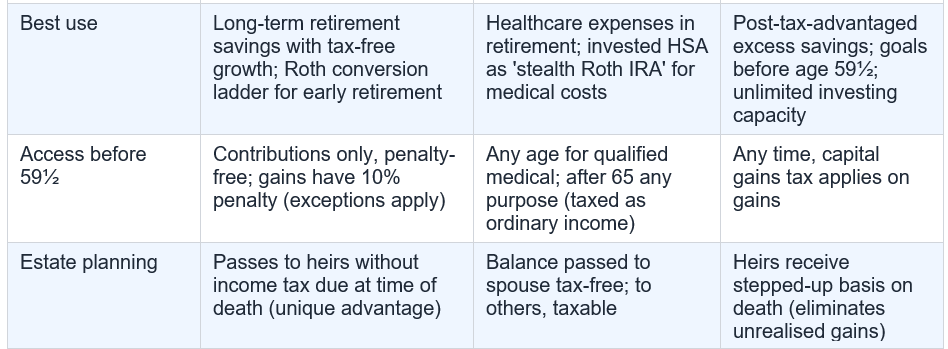
The seventh sign is less about a specific financial milestone and more about financial literacy: you understand how the tax treatment of different account types affects your lifetime wealth, and you can make allocation decisions that reflect that understanding.The core principle is account tax character. Traditional pre-tax accounts (traditional 401(k), traditional IRA) reduce taxable income now and grow tax-deferred, but every dollar withdrawn is taxed as ordinary income at whatever rates apply at withdrawal. Roth accounts (Roth IRA, Roth 401(k)) are funded with after-tax dollars but grow and withdraw tax-free. HSAs are uniquely triple tax-advantaged — contributions are pre-tax (or deductible), growth is tax-free, and withdrawals are tax-free for qualified medical expenses. Taxable brokerage accounts are funded with after-tax dollars, generate annual tax events on dividends and interest, and are taxed at long-term capital gains rates on eventual sale.
ChooseFI's investment sequencing analysis describes what the tax-aware investor does differently: 'Long-term capital gains in a taxable brokerage are taxed at 0% for individuals earning under approximately $47,025. Many early retirees pay zero federal tax on their investment gains by keeping earned income low. This makes the taxable brokerage account one of the most powerful tools in the FI toolkit — unlimited contributions now, and potentially tax-free growth later.' The 0% LTCG rate is a planning opportunity that only arises if the taxable brokerage account exists to take advantage of it.
The sign that confirms readiness: you know which of your accounts is pre-tax, which is Roth, and which is taxable; you know the contribution limits and income thresholds for each; and you have at least a basic understanding of how RMDs, IRMAA, and Social Security taxability interact with large pre-tax balances in retirement. You do not need to be an expert — you need to know enough to have the right conversation with a financial adviser.
Sign #8 — You Have a Written Financial Plan (or Are Ready to Build One)
The eighth and final sign is behavioural rather than financial: you are operating from a documented plan rather than making investment decisions reactively. This does not require a formal document from a financial planning firm. It can be a personal spreadsheet, a one-page household financial summary, or a set of written goals with timelines and account assignments. What matters is that the plan exists outside your head.A written financial plan performs several functions that unwritten intentions cannot. It makes investment goals concrete and measurable. It establishes the connection between specific accounts and specific goals (this Roth IRA is for retirement at 62; this taxable brokerage is for the down payment on a rental property in 8 years; this HSA is for healthcare costs in retirement). It provides a reference point when market volatility or life events create pressure to make reactive decisions. And it is the document a financial adviser can review, question, and improve.
Citizens Bank's 2026 investing analysis recommends exactly this before redirecting dollars beyond the 401(k): 'This is the right time to revisit your retirement strategy holistically.' The review involves understanding current pre-tax vs Roth vs taxable balance proportions, projecting forward to estimate RMD size at age 73, assessing whether additional pre-tax contributions create future tax concentration or whether Roth contributions better serve the long-term tax picture, and deciding which specific accounts to prioritise with surplus capital.
Where to Go After the 401(k): The Investment Priority Sequence
Once the eight signs are confirmed, the investment priority sequence provides a framework for where additional dollars should go. The sequence is designed to maximise tax efficiency while providing flexibility, and it reflects the consensus of Experian, ChooseFI, Invest1Now, and Citizens Bank's 2026 analyses:- Priority 1 — Max out employer 401(k) match (if not already fully captured). The immediate 50-100% return on matched contributions is irreplaceable. This is the non-negotiable first step regardless of all other considerations.
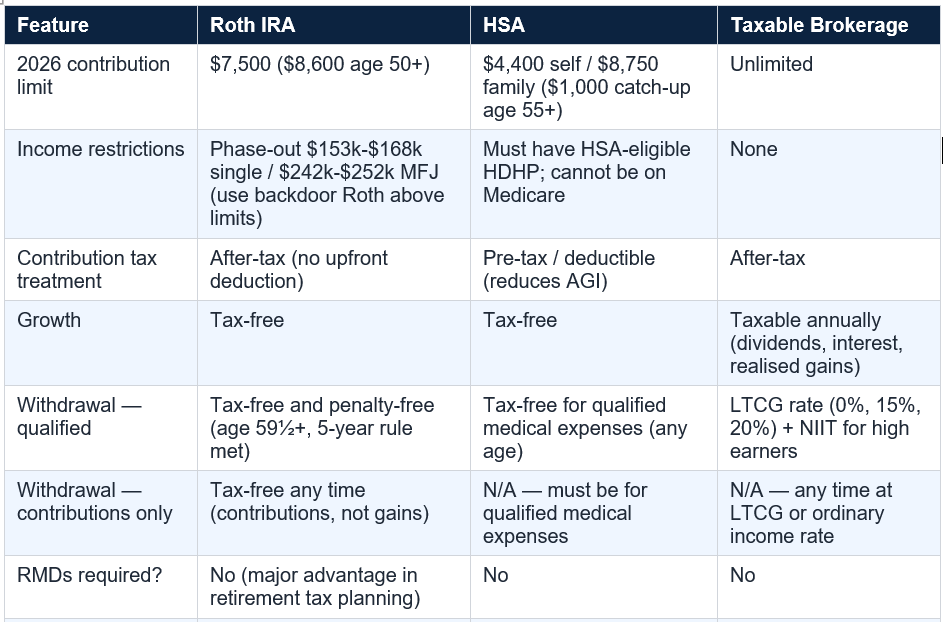
- Priority 2 — Max out a Roth IRA if eligible. 2026 limit: $7,500 ($8,600 for age 50+). Income limits: $153,000-$168,000 MAGI for single filers; $242,000-$252,000 for MFJ. For those above the income limit, the backdoor Roth conversion strategy is available (with important caveats — see Section 13). The Roth IRA's combination of tax-free growth, flexible contribution withdrawal rules, and no RMD requirement makes it the most versatile retirement account available to eligible earners.
- Priority 3 — Max out the HSA if eligible for an HSA-qualified high-deductible health plan. 2026 limits: $4,400 self-only / $8,750 family / $1,000 catch-up (age 55+). The HSA's triple tax benefit — deductible contribution, tax-free growth, tax-free withdrawal for medical expenses — is the most tax-efficient account structure available. Invested in low-cost index funds rather than held as cash, the HSA functions as a stealth Roth IRA for healthcare costs, which represent a significant and predictable retirement expense.
- Priority 4 — Max out the 401(k) employee deferral to the full $24,500 limit ($32,500 / $35,750 for those with catch-up eligibility). For those not already at the limit, this step completes the tax-advantaged account stack before opening any taxable account.
- Priority 5 — Explore the Mega Backdoor Roth if the employer plan permits. This strategy uses after-tax (non-Roth) 401(k) contributions — above the employee deferral limit — combined with in-plan Roth conversions or in-service withdrawals to Roth IRA. It can unlock up to approximately $43,500 in additional annual Roth contributions beyond the standard limits (the gap between the $24,500 employee limit and the $69,000 total 401(k) limit for 2026, minus employer contributions). Not all employer plans permit this — check the plan document or HR.
- Priority 6 — Open a taxable brokerage account. No contribution limits. No income restrictions. No early withdrawal penalties. Accessible at any time for any purpose. Long-term capital gains tax rates apply (0%, 15%, or 20% depending on income) on holdings held more than one year. Invest in tax-efficient, low-cost broad index funds (total market or S&P 500) from Vanguard, Fidelity (FZROX — 0% expense ratio), or Schwab. The taxable brokerage is the final and unlimited investment layer.
Roth IRA vs Taxable Brokerage vs HSA: A Side-by-Side Comparison
The Backdoor Roth and Mega Backdoor Roth: Advanced Moves for High Earners
For earners above the Roth IRA income limits ($168,000 single / $252,000 MFJ in 2026), the backdoor Roth IRA conversion provides access to the Roth's tax-free growth benefits without direct eligibility. The mechanics: make a non-deductible traditional IRA contribution (any income is eligible for this), then convert the traditional IRA balance to a Roth IRA. Since the contribution was non-deductible, no income tax is owed on the converted amount — only on any earnings between contribution and conversion, which are minimised by converting quickly.The critical constraint is the pro-rata rule: if you have existing pre-tax dollars in any traditional IRA, the conversion is taxed proportionally across all IRA balances, not just the non-deductible contribution. A person with $100,000 in a pre-tax traditional IRA who makes a $7,500 non-deductible contribution and converts it cannot treat the $7,500 as 100% after-tax — the IRS pro-rates the conversion across the full $107,500 in IRA assets. The solution for those with large pre-tax IRA balances is to roll those balances into an employer 401(k) plan (if the plan accepts rollovers) before executing the backdoor conversion.
The Mega Backdoor Roth is a more powerful strategy available inside 401(k) plans that allow after-tax (non-Roth) contributions and either in-plan Roth conversions or in-service withdrawals. ChooseFI describes it: 'Your 401(k) plan may also allow you to contribute beyond [the standard limit] with after-tax contributions. This can potentially allow over $60,000 in total annual contributions.' In 2026, the total 401(k) contribution limit (employee + employer + after-tax) is $69,000 ($76,500 for those with standard catch-up). After capturing employer match ($X) and maxing employee deferrals ($24,500), the remaining gap can potentially be filled with after-tax contributions, then converted to Roth — creating an additional Roth-wrapper contribution that bypasses both the $7,500 IRA limit and the income restrictions.
Both the backdoor Roth and the mega backdoor Roth are legal, well-documented strategies that have been in use for over a decade. They are also complex, sensitive to specific plan document provisions (mega backdoor), and have nuances (pro-rata rule, in-service withdrawal availability) that make them difficult to implement correctly without professional guidance. Both are worth exploring with a fee-only CPA or financial adviser once the basic priority sequence (emergency fund, debt-free, full employer match, Roth IRA, HSA, full 401(k)) has been completed. Not tax advice.
Conclusion
The 401(k) is the financial planning system's most successful creation: an automatic, employer-supported, tax-advantaged savings mechanism that has accumulated $9.9 trillion in assets across 70 million American participants. It works. It compounds. It builds retirement security for the people who use it consistently over decades.It is also not the end of the investment conversation for anyone who gets there. The eight signs in this guide — emergency fund complete, high-interest debt gone, employer match fully captured, consistent monthly surplus, clear time horizon, maxing or near-maxing the 401(k), tax-literacy in place, and a written financial plan — mark the point at which the 401(k)'s structural constraints (contribution ceiling, tax concentration, access restrictions) become meaningful and the case for the next accounts becomes clear.
The next accounts — Roth IRA, HSA, taxable brokerage, backdoor Roth, mega backdoor Roth — are not complicated in concept. The Roth IRA is a $7,500 annual after-tax contribution that grows and withdraws tax-free. The HSA is the most tax-efficient account structure in the entire US tax code when invested for the long term. The taxable brokerage is where everything else goes, with no limits and no lock-in. The sequence of priority is well established. The only remaining step is confirming that the eight signs are in place — and then taking the next one. Not financial advice — consult a qualified financial adviser and CPA for guidance specific to your situation.
Frequently Asked Questions
What should I do after maxing out my 401(k)?After maxing your 401(k) employee deferrals ($24,500 in 2026, or $32,500/$35,750 for those 50+/60-63), the investment priority sequence — supported by sources including ChooseFI, Citizens Bank 2026, and Experian — suggests: first, confirm you have a complete emergency fund (3-6 months of essential expenses in a HYSA); second, confirm no high-interest debt remains; third, open and max a Roth IRA if eligible (2026 limit $7,500; income phase-out $153,000-$168,000 single / $242,000-$252,000 MFJ). If your income exceeds the Roth IRA limits, use the backdoor Roth conversion strategy. Fourth, max an HSA if you have an HSA-eligible high-deductible health plan (2026: $4,400 self-only / $8,750 family). Fifth, if surplus remains, open a taxable brokerage account and invest in low-cost, tax-efficient broad index funds. For high earners whose employer plan permits it, explore the mega backdoor Roth as an additional Roth-wrapper contribution strategy beyond standard limits. Not financial advice — consult a CPA or financial adviser.
When should I open a Roth IRA vs a taxable brokerage account?
If you are eligible for a Roth IRA (2026 MAGI under $153,000 single / $242,000 married filing jointly), the Roth IRA should come before the taxable brokerage account in the investment priority sequence. The Roth IRA's tax-free growth and tax-free qualified withdrawals are more valuable than the taxable brokerage account's flexibility and unlimited contributions for most long-term investors. The exception: if you need access to invested capital before age 59½ (specifically the investment gains, not the contributions, which can be withdrawn from a Roth IRA at any time penalty-free), the taxable brokerage provides earlier access without penalties. A common approach once both accounts are available is to max the Roth IRA first each year, then direct surplus to the taxable brokerage. For those above the Roth IRA income limits, the backdoor Roth strategy restores Roth IRA access for most taxpayers, and the mega backdoor Roth (if the employer plan allows it) can create even more Roth-wrapper capacity. Not financial advice.
What is the HSA investment strategy and why is it considered so powerful?
The Health Savings Account (HSA) has a triple tax benefit that no other account in the US tax code replicates: contributions are tax-deductible (or pre-tax through payroll), reducing AGI; the balance grows tax-free; and withdrawals for qualified medical expenses are completely tax-free at any age. The 2026 contribution limits are $4,400 for self-only coverage and $8,750 for family coverage, with a $1,000 catch-up for those aged 55 and over. The power of the HSA as an investment vehicle (rather than just a healthcare spending account) comes from treating it as a 'stealth retirement account': pay current medical expenses out of pocket when possible, allow the HSA balance to grow invested in index funds over decades, and withdraw tax-free in retirement (when healthcare costs are typically highest). After age 65, HSA funds can be withdrawn for any purpose — not just medical — taxed at ordinary income rates like a traditional IRA, making it a secondary retirement account if medical costs do not exhaust the balance. The requirement to be eligible: enrollment in an HSA-qualified high-deductible health plan (HDHP) and not enrolled in Medicare. Not financial advice.
What is the backdoor Roth IRA and who needs to use it?
The backdoor Roth IRA is a strategy that allows high-income earners above the Roth IRA contribution income limits to access the Roth IRA's tax-free growth benefits. In 2026, the Roth IRA contribution phase-out begins at $153,000 MAGI for single filers and $242,000 for married filing jointly. Above these thresholds, direct Roth IRA contributions are either reduced or eliminated. The backdoor strategy works by making a non-deductible (after-tax) traditional IRA contribution — there is no income limit for this — and then converting the traditional IRA balance to a Roth IRA. If done correctly with no pre-existing pre-tax IRA balances, the conversion generates no income tax because the contribution was already after-tax. The critical caution: the pro-rata rule. If you have any pre-existing pre-tax balances in traditional IRAs, the IRS applies a blended tax calculation across all IRA assets, which can make the backdoor conversion partially taxable. The solution is to roll pre-tax IRA balances into an employer 401(k) plan before executing the backdoor conversion. Not tax advice — consult a CPA before implementing.
How do I know if I am ready to invest in a taxable brokerage account?
Experian's investing readiness guide identifies four specific signs: you have your debt under control or have a plan to become debt-free; you have a budget or at least track spending vs income; you have an emergency fund covering three to six months of basic expenses; and you are working toward other goals that matter to you (a home, education) and have a plan for those before committing surplus to a brokerage account. Beyond these foundational signs, you are ready for a taxable brokerage specifically after: the emergency fund is complete; high-interest debt is paid; the employer 401(k) match is fully captured; a Roth IRA is open and being maxed (or backdoor Roth executed for high earners); an HSA is open and maxed if eligible; and the 401(k) is at or approaching the full $24,500 employee limit. The taxable brokerage account is the last step in the priority sequence, but it is also the most flexible: no contribution limits, no income restrictions, no mandatory lock-up period, accessible at any age for any purpose. For most long-term investors in a taxable account, the right investment is a low-cost, broad index fund — FZROX (Fidelity, 0% expense ratio), VTI (Vanguard, 0.03%), or SCHB (Schwab, 0.03%). Not financial advice.

0 Comments Comments