
Emotional Development
Study Finds 1,260 Genetic Variants Linked to Big Five Traits

Published in Nature on September 2, 2026 by the Revived Genomics of Personality Consortium; 46 cohorts; 611,037 to 1.14 million participants per trait; within-family analysis of up to 50,725 people. Findings: 1,260 lead genetic variants (824 novel, about 65%); 706 for neuroticism, 258 extraversion, 131 conscientiousness, 126 openness and 39 agreeableness; common variants explain about 4.8%–9.3% of trait variance (9.3%–13.3% with typical measurement reliability). Design check: within-family analyses suggest shared family environment, population structure and assortative mating contribute little to the associations; spouses show only minimal genetic similarity for personality. Limits: polygenic indices cannot predict an individual’s personality or behavior; predictions are weaker for people with African-like genomes; effects on life outcomes are modest.
In September 2026, that suspicion got its biggest test yet. A consortium of researchers published a study in Nature that combined data from 46 cohorts and up to 1.14 million people, and identified 1,260 genetic variants associated with the five major dimensions of personality, including 824 never linked to those traits before. The headlines were dramatic. The truth, as usual, is more interesting and more careful, and it is worth understanding both what the study found and what it does not mean.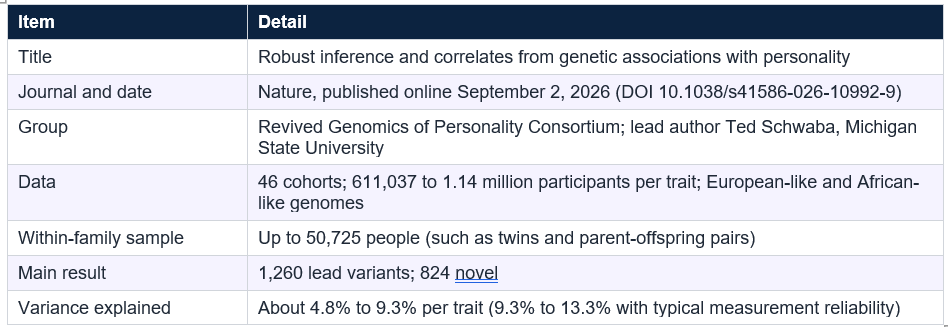
These are not types or boxes. They are dimensions, and most people sit somewhere in the middle of each. Psychologists measure them with questionnaires, sometimes self-reported and sometimes rated by people who know the person well. The study took that into account: the researchers checked whether the genetic signals held up across different measurement tools and across self-reports and reports by others, and found them broadly consistent, though with some variation.
Because each variant has such a small effect, you need enormous samples to see it. That is why this study mattered: with up to 1.14 million participants per trait and roughly 10 million common variants tested for each, it could detect effects that smaller studies would miss. The result is a map of statistical associations, not a list of causes. A variant can sit near a gene that matters, or it can simply travel alongside one. Researchers call the strongest signal in each region a lead variant. A GWAS finds associations, not mechanisms. A “lead variant” marks a genomic region linked to a trait; it does not by itself prove which gene is responsible or how it works.
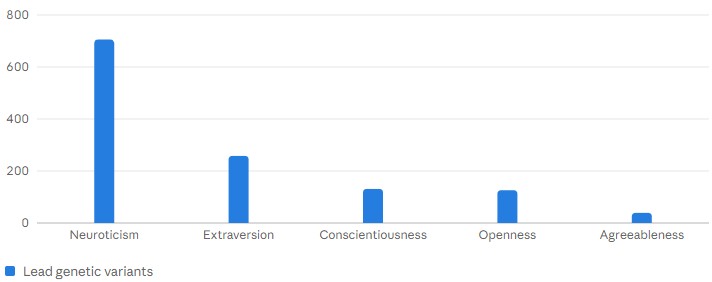
The distribution across traits is lopsided. According to a breakdown reported by Geopop, 706 variants were linked to neuroticism, 258 to extraversion, 131 to conscientiousness, 126 to openness and just 39 to agreeableness. That pattern fits another finding: agreeableness turned out to be the least heritable of the five. More variants usually reflect a trait with a stronger and cleaner genetic signal, a larger sample or a more reliably measured trait, which is one reason neuroticism leads the list.
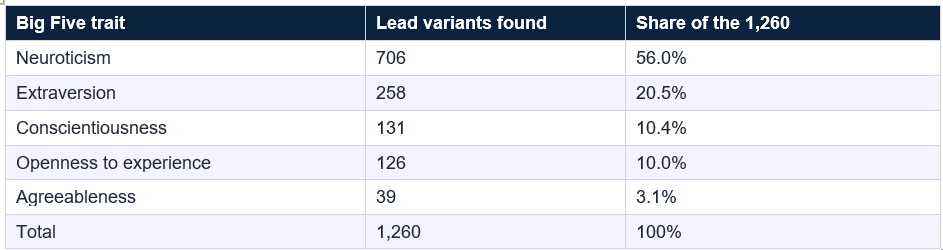
1,260 lead variants, 824 novel (about 65%). By trait: neuroticism 706; extraversion 258; conscientiousness 131; openness 126; agreeableness 39 (per Geopop’s breakdown). Sample: 611,037 to 1.14 million per trait across 46 cohorts.
Does that mean DNA is only about 5% to 13% of personality? Not quite, and the researchers were careful about this. These figures describe the contribution of common variants measured by this method, often called SNP heritability. Twin studies have long suggested a larger overall genetic share for personality, and the gap is not a mystery to be filled by environment alone. The remainder includes rare variants, interactions between genes, environmental influences and unavoidable error in psychological measurement. Still, the message is the same: even with a million people, the measured genetic signal is moderate, and most differences between individuals are not captured by it.
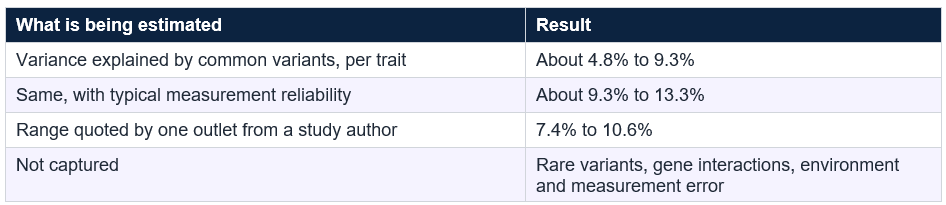
The result was reassuring. In contrast to many other social and behavioral traits, the genetic associations with personality appear minimally confounded by shared family environment. The analysis also found that population stratification, assortative mating and parental genetic effects contributed relatively little overall, though small trait-specific effects remained. The study also found only minimal genetic similarity between spouses for personality, which suggests that people do not choose partners in any major way based on genetic profiles for these traits. And the signals were broadly consistent across cohorts, age groups, geography and measurement methods. Within-family designs compare relatives who grew up in the same home. When a genetic link survives that test, it is less likely to be an artifact of shared environment.
Behavior and place showed up too. Higher genetic propensity for neuroticism and lower agreeableness was linked to behaviors such as running away from home and school suspension. Higher openness scores predicted later movement toward cosmopolitan professional areas, while higher conscientiousness scores predicted moves toward affluent suburban communities. On health, Mendelian randomization analyses, a method that uses genetic variants to probe cause and effect, provided evidence that extraversion increases the risk of COVID-19 infection, while conscientiousness-linked profiles were associated with more sports participation, lower body mass index, less substance use, fewer hospital stays and healthier aging.
Mental health showed the broadest overlap. Neuroticism-linked genetic profiles were associated with a higher risk of internalizing disorders such as anxiety and depression. Extraversion showed the opposite pattern for those conditions but a higher risk of neurodevelopmental disorders. Conscientiousness was associated with lower neurodevelopmental risk but a higher risk of compulsive disorders, and openness showed broad positive genetic associations with psychopathology. These are statistical links across large groups, not diagnoses, and the study describes the causal evidence as potential.
One finding challenges a popular shortcut. The analyses found little support for simple links between individual personality traits and dopamine- or serotonin-related neuron types, despite how often these chemicals are blamed in casual explanations. The biology appears broader and more distributed, with some shared pathways across traits. That is consistent with personality being a product of many small influences, not one chemical dial.
It does not say personality cannot change, and it does not rank people or groups. The predictions were strongest in people with European-like genomes and weaker for extraversion, neuroticism and openness in those with African-like genomes, a reminder that today’s genetic datasets are not yet representative of everyone. And the study does not offer a consumer-ready test. Scores that explain a small share of group differences are poor tools for judging individuals, whatever a commercial product might claim. Do not use polygenic scores to judge, select or label individuals or groups. The researchers say the scores cannot predict one person’s personality or behavior, and weaker accuracy in some ancestry groups makes misuse more harmful.
For psychology, the findings also bring personality into the same quantitative framework as height, heart disease and educational attainment. And the large sample and consistency across cohorts, measurement methods and reporters give the results weight. Future work could test other ancestry and cultural groups, examine age and sex differences and combine genetic data with studies of brain gene activity to clarify how personality develops.
Most of all, remember that “genetic” does not mean “unchangeable” or “destined.” Genes and environment are interwoven, and the study itself leaves most of the story open. That is not a weakness of the science. It is the honest shape of the answer.
So, what makes you, you? This study adds a rigorous, humbling piece to the answer. Your DNA nudges you, in thousands of tiny ways, but it does not write your personality for you. Your experiences, relationships, choices and chance fill in much of the rest. Read the science with curiosity, treat any claim of personal prediction with caution and keep the question open. This is general science communication, not personal advice, and the original Nature paper is the best source for the details.
The Big Five: extraversion, agreeableness, conscientiousness, neuroticism and openness to experience. They are five broad dimensions psychologists use to describe stable differences in how people think, feel and behave.
Is there a gene for personality?
No. The study found 1,260 lead genetic variants across the five traits, and each has a tiny effect. The lead author, Ted Schwaba of Michigan State University, emphasized that there is no single personality gene. Personality is highly polygenic, meaning many variants each contribute a little.
How much of personality is explained by DNA in this study?
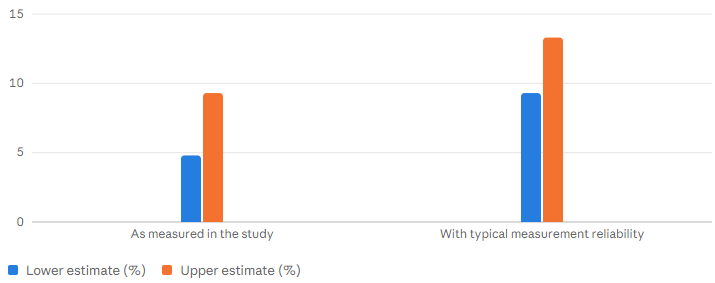
Common genetic variants measured in the study explained about 4.8% to 9.3% of the variation in measures of each trait, rising to about 9.3% to 13.3% for instruments with typical measurement reliability, according to the Nature abstract. Some news outlets quoted a slightly different range of 7.4% to 10.6%, so check which measure is being cited.
Can a genetic test tell me my personality?
No. The researchers stress that polygenic indices cannot predict an individual’s personality or future behavior. The scores describe averages across large groups, are weaker in people with African-like genomes and explain only a small slice of differences between individuals.
Does this mean personality is fixed at birth?
No. The estimates capture only part of the genetic contribution and leave plenty of room for environment, experience, chance and rare genetic variation. The researchers noted that a person’s surroundings still play a major role in development, and nothing in the study says personality cannot change.
Table of Contents
- “What Makes Me, Me?”
- The Short Answer
- The Study at a Glance
- A Quick Refresher on the Big Five
- How a Genome-Wide Study Works
- The Headline Numbers: 1,260 and 824
- How Much of Personality Does DNA Explain?
- Why Researchers Say the Findings Are Robust
- Genes, Personality and Life Outcomes
- What the Brain Biology Shows
- What the Study Does Not Say
- Why It Matters
- How to Read Headlines About Genes and Behavior
- Conclusion
- Frequently Asked Questions
1,260 lead genetic variants by Big Five trait
Number of lead variants by Breakdown as reported by Geopop; Nature, Sept 2, 2026 (ReGPC meta-analysis)
How much trait variance do common genetic variants explain? (%)
% of variance explained by Range across the Big Five traits; Nature abstract. Most differences between people are not captured
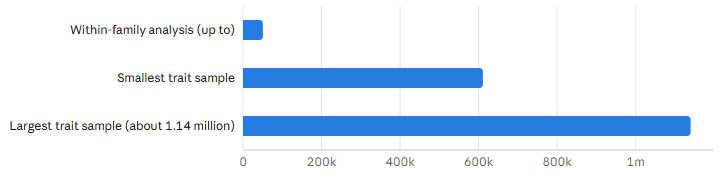
The scale of the study: participants per analysis
“What Makes Me, Me?”
It is one of the oldest questions people ask about themselves. Why am I the one who needs a quiet weekend while my sibling thrives at parties? Why do I worry when others shrug, plan every detail when others improvise, or stay curious when others prefer the familiar? We tend to explain these differences with stories about upbringing, culture and choices. But for a century, scientists have also suspected that part of the answer is written in our DNA.In September 2026, that suspicion got its biggest test yet. A consortium of researchers published a study in Nature that combined data from 46 cohorts and up to 1.14 million people, and identified 1,260 genetic variants associated with the five major dimensions of personality, including 824 never linked to those traits before. The headlines were dramatic. The truth, as usual, is more interesting and more careful, and it is worth understanding both what the study found and what it does not mean.
The Short Answer
Researchers pooled genetic data from more than a million people and found 1,260 places in the genome statistically associated with the Big Five personality traits: extraversion, agreeableness, conscientiousness, neuroticism and openness to experience. Of those, 824 were new discoveries. But the individual effects are tiny, the variants together explain only a modest share of why people differ, and the scores built from them cannot predict any one person’s personality. There is no “gene for” extraversion. Personality is shaped by thousands of small genetic nudges working with a lifetime of experiences.The Study at a Glance
A Quick Refresher on the Big Five
The Big Five is the most widely used framework in personality science. Extraversion describes how sociable, energetic and assertive someone tends to be. Agreeableness describes warmth, trust and cooperation. Conscientiousness describes organization, diligence and self-discipline. Neuroticism describes how easily someone experiences stress, worry and low mood. Openness to experience describes curiosity, imagination and a taste for novelty.These are not types or boxes. They are dimensions, and most people sit somewhere in the middle of each. Psychologists measure them with questionnaires, sometimes self-reported and sometimes rated by people who know the person well. The study took that into account: the researchers checked whether the genetic signals held up across different measurement tools and across self-reports and reports by others, and found them broadly consistent, though with some variation.
How a Genome-Wide Study Works
The method behind the headline is called a genome-wide association study, or GWAS. In plain English: researchers take genetic data from a huge number of people, along with a measurement of a trait, and look across the genome for tiny spots of DNA that differ between people, called variants. Then they ask a simple statistical question for each spot: do people who carry one version of this variant tend to score a little higher or lower on the trait than people who carry another?Because each variant has such a small effect, you need enormous samples to see it. That is why this study mattered: with up to 1.14 million participants per trait and roughly 10 million common variants tested for each, it could detect effects that smaller studies would miss. The result is a map of statistical associations, not a list of causes. A variant can sit near a gene that matters, or it can simply travel alongside one. Researchers call the strongest signal in each region a lead variant. A GWAS finds associations, not mechanisms. A “lead variant” marks a genomic region linked to a trait; it does not by itself prove which gene is responsible or how it works.
The Headline Numbers: 1,260 and 824
The study identified 1,260 lead variants across the five traits. Of these, 824, or about 65%, were in genomic regions not previously associated with the relevant trait, according to the Nature paper. The remaining 436 were in regions already linked to the relevant trait. ScienceAlert described it as the largest genetic investigation of the Big Five to date.The distribution across traits is lopsided. According to a breakdown reported by Geopop, 706 variants were linked to neuroticism, 258 to extraversion, 131 to conscientiousness, 126 to openness and just 39 to agreeableness. That pattern fits another finding: agreeableness turned out to be the least heritable of the five. More variants usually reflect a trait with a stronger and cleaner genetic signal, a larger sample or a more reliably measured trait, which is one reason neuroticism leads the list.
1,260 lead variants, 824 novel (about 65%). By trait: neuroticism 706; extraversion 258; conscientiousness 131; openness 126; agreeableness 39 (per Geopop’s breakdown). Sample: 611,037 to 1.14 million per trait across 46 cohorts.
How Much of Personality Does DNA Explain?
This is the number most people want, and it is the one most often misunderstood. According to the Nature abstract, the common genetic variants captured in the study explain about 4.8% to 9.3% of the variance in measures of each trait. When the analysis looks only at questionnaires with typical reliability, the estimate rises to about 9.3% to 13.3%. Some news reports quoted a slightly different range of 7.4% to 10.6%, which a researcher gave to one outlet, so it is worth checking exactly which measure a report uses.Does that mean DNA is only about 5% to 13% of personality? Not quite, and the researchers were careful about this. These figures describe the contribution of common variants measured by this method, often called SNP heritability. Twin studies have long suggested a larger overall genetic share for personality, and the gap is not a mystery to be filled by environment alone. The remainder includes rare variants, interactions between genes, environmental influences and unavoidable error in psychological measurement. Still, the message is the same: even with a million people, the measured genetic signal is moderate, and most differences between individuals are not captured by it.
Why Researchers Say the Findings Are Robust
Genetic studies of social and behavioral traits have a known weakness: family environment can masquerade as genetics. If educated parents pass on both genes and a book-filled home, a gene might look linked to reading when the home is doing the work. To test for this, the team ran within-family analyses on up to 50,725 people, including twins and parent-offspring pairs, comparing relatives who share family background but differ genetically.The result was reassuring. In contrast to many other social and behavioral traits, the genetic associations with personality appear minimally confounded by shared family environment. The analysis also found that population stratification, assortative mating and parental genetic effects contributed relatively little overall, though small trait-specific effects remained. The study also found only minimal genetic similarity between spouses for personality, which suggests that people do not choose partners in any major way based on genetic profiles for these traits. And the signals were broadly consistent across cohorts, age groups, geography and measurement methods. Within-family designs compare relatives who grew up in the same home. When a genetic link survives that test, it is less likely to be an artifact of shared environment.
Genes, Personality and Life Outcomes
The team built polygenic indices, which add up the tiny effects of many variants into a single score, and used them to explore how personality-related genetics connect to the rest of life. The associations were real but small. Genetic profiles linked to less neuroticism and more agreeableness, extraversion and openness were slightly more likely to go with interviewers rating someone as having an attractive personality. Profiles linked to higher conscientiousness and agreeableness were associated with ratings of being better groomed.Behavior and place showed up too. Higher genetic propensity for neuroticism and lower agreeableness was linked to behaviors such as running away from home and school suspension. Higher openness scores predicted later movement toward cosmopolitan professional areas, while higher conscientiousness scores predicted moves toward affluent suburban communities. On health, Mendelian randomization analyses, a method that uses genetic variants to probe cause and effect, provided evidence that extraversion increases the risk of COVID-19 infection, while conscientiousness-linked profiles were associated with more sports participation, lower body mass index, less substance use, fewer hospital stays and healthier aging.
Mental health showed the broadest overlap. Neuroticism-linked genetic profiles were associated with a higher risk of internalizing disorders such as anxiety and depression. Extraversion showed the opposite pattern for those conditions but a higher risk of neurodevelopmental disorders. Conscientiousness was associated with lower neurodevelopmental risk but a higher risk of compulsive disorders, and openness showed broad positive genetic associations with psychopathology. These are statistical links across large groups, not diagnoses, and the study describes the causal evidence as potential.
What the Brain Biology Shows
The researchers also asked where in the body these variants seem to act. Using gene-expression data from human and mouse brain tissue, they found that most traits showed genetic enrichment in neuronal tissues and the prefrontal cortex, the region behind the forehead involved in planning, judgment and self-control. That fits the idea that personality is related to how the brain processes information and regulates behavior.One finding challenges a popular shortcut. The analyses found little support for simple links between individual personality traits and dopamine- or serotonin-related neuron types, despite how often these chemicals are blamed in casual explanations. The biology appears broader and more distributed, with some shared pathways across traits. That is consistent with personality being a product of many small influences, not one chemical dial.
What the Study Does Not Say
Because this topic invites overreading, it helps to be explicit. The study does not say there is a gene for any personality trait. Lead author Ted Schwaba stressed that no single personality gene exists and that even the largest effects of individual variants remain very small. It does not say that genes determine who you will be. The researchers emphasized that polygenic indices cannot predict an individual’s personality or future behavior, and that environment still plays a major role.It does not say personality cannot change, and it does not rank people or groups. The predictions were strongest in people with European-like genomes and weaker for extraversion, neuroticism and openness in those with African-like genomes, a reminder that today’s genetic datasets are not yet representative of everyone. And the study does not offer a consumer-ready test. Scores that explain a small share of group differences are poor tools for judging individuals, whatever a commercial product might claim. Do not use polygenic scores to judge, select or label individuals or groups. The researchers say the scores cannot predict one person’s personality or behavior, and weaker accuracy in some ancestry groups makes misuse more harmful.
Why It Matters
If the scores are weak predictors, why does the study matter? Because it gives scientists a new kind of tool. As one researcher put it in coverage, genes offer a way to link personality, in the aggregate across groups of people, to the many outcomes previously studied with genome-wide methods. They let researchers test whether personality traits plausibly cause outcomes such as health behaviors, and they reveal overlap with conditions such as anxiety and depression that could guide future research into mental health.For psychology, the findings also bring personality into the same quantitative framework as height, heart disease and educational attainment. And the large sample and consistency across cohorts, measurement methods and reporters give the results weight. Future work could test other ancestry and cultural groups, examine age and sex differences and combine genetic data with studies of brain gene activity to clarify how personality develops.
How to Read Headlines About Genes and Behavior
A few habits help. Look for the effect size, not just the count of variants: 1,260 sounds huge, but each effect is tiny. Ask how much variance is explained and for whom. Check whether the sample is diverse. Distinguish association from causation, and notice words such as “potentially causal.” Be cautious about any claim that a score can tell you who someone is. And read the limitations paragraph, which good reports and the original paper usually include.Most of all, remember that “genetic” does not mean “unchangeable” or “destined.” Genes and environment are interwoven, and the study itself leaves most of the story open. That is not a weakness of the science. It is the honest shape of the answer.
Conclusion
The largest genetic study of personality to date found 1,260 variants tied to the Big Five traits, 824 of them new, using data from up to 1.14 million people across 46 cohorts. It showed that personality is deeply polygenic, that the genetic signals are consistent and not much distorted by family environment, and that personality-related genetics link to health, behavior and mental health in small but real ways. It also showed the limits: common variants explain only about 4.8% to 9.3% of differences in each trait, and the scores cannot predict any individual.So, what makes you, you? This study adds a rigorous, humbling piece to the answer. Your DNA nudges you, in thousands of tiny ways, but it does not write your personality for you. Your experiences, relationships, choices and chance fill in much of the rest. Read the science with curiosity, treat any claim of personal prediction with caution and keep the question open. This is general science communication, not personal advice, and the original Nature paper is the best source for the details.
Frequently Asked Questions
Which personality traits did the study examine?The Big Five: extraversion, agreeableness, conscientiousness, neuroticism and openness to experience. They are five broad dimensions psychologists use to describe stable differences in how people think, feel and behave.
Is there a gene for personality?
No. The study found 1,260 lead genetic variants across the five traits, and each has a tiny effect. The lead author, Ted Schwaba of Michigan State University, emphasized that there is no single personality gene. Personality is highly polygenic, meaning many variants each contribute a little.
How much of personality is explained by DNA in this study?
Common genetic variants measured in the study explained about 4.8% to 9.3% of the variation in measures of each trait, rising to about 9.3% to 13.3% for instruments with typical measurement reliability, according to the Nature abstract. Some news outlets quoted a slightly different range of 7.4% to 10.6%, so check which measure is being cited.
Can a genetic test tell me my personality?
No. The researchers stress that polygenic indices cannot predict an individual’s personality or future behavior. The scores describe averages across large groups, are weaker in people with African-like genomes and explain only a small slice of differences between individuals.
Does this mean personality is fixed at birth?
No. The estimates capture only part of the genetic contribution and leave plenty of room for environment, experience, chance and rare genetic variation. The researchers noted that a person’s surroundings still play a major role in development, and nothing in the study says personality cannot change.
0 Comments
Be the first to share your thoughts on this article.