

Emotional Development
How to Retrain for the AI Job Market in 6 Months


Table of Contents
- The AI Job Market in 2026: What the Data Actually Shows
- The Two Tracks: Technical vs AI-Augmented
- Track 1: The AI-Augmented Professional
- Track 2: The AI/ML Technical Specialist
- The 6-Month Retraining Plan: Month by Month
- The Best Free and Low-Cost Learning Resources
- Free Resources
- Paid but High-Value Resources
- What 6 Months Realistically Achieves — and What It Does Not
- Conclusion
- Frequently Asked Questions (FAQ)
- External References & Further Reading
AI job postings grew 74% year-over-year in 2025-2026, according to LinkedIn's Global Talent Trends data. For every qualified AI professional, there are 3.4 open positions, creating one of the most seller-friendly talent markets in the history of technology hiring. And the barriers to entry are lower than most people assume: only 23% of AI job postings now require an advanced degree, down from 67% in 2020. Companies are hiring for demonstrated skill, not credentials.
This is not a future story. PwC's 2026 Global AI Jobs Barometer — the most comprehensive analysis of AI hiring ever produced, drawing on over one billion job advertisements across six continents released on 15 June 2026 — found that workers in AI-exposed 'professionalised' roles are already earning 42% higher wage growth than comparable workers in non-AI roles. Workers with prompt engineering skills command a 56% wage premium over non-AI peers according to Index.dev's analysis. Oxford University researchers studying over 10 million UK job postings found that AI skills deliver a 23% salary premium — higher than the premium conferred by a Bachelor's degree (8%) or a Master's degree (13%).
The question is not whether the AI job market is real or whether it is growing fast enough to be worth pursuing. It is growing faster than the market can fill it. The question is: what is the most efficient path from where you are now to a role that capitalises on this shift in a realistic six-month timeframe? This guide provides that path — grounded in the skills employers are actually asking for, structured into a month-by-month plan that works whether you are coming from a technical background, a business background, or a creative background, and honest about what is achievable versus what requires longer investment.
The AI Job Market in 2026: What the Data Actually Shows
Before committing to any retraining plan, it is worth understanding the specific shape of the opportunity — because not all AI roles are equal, and the fastest-growing parts of the market are not always what most people expect: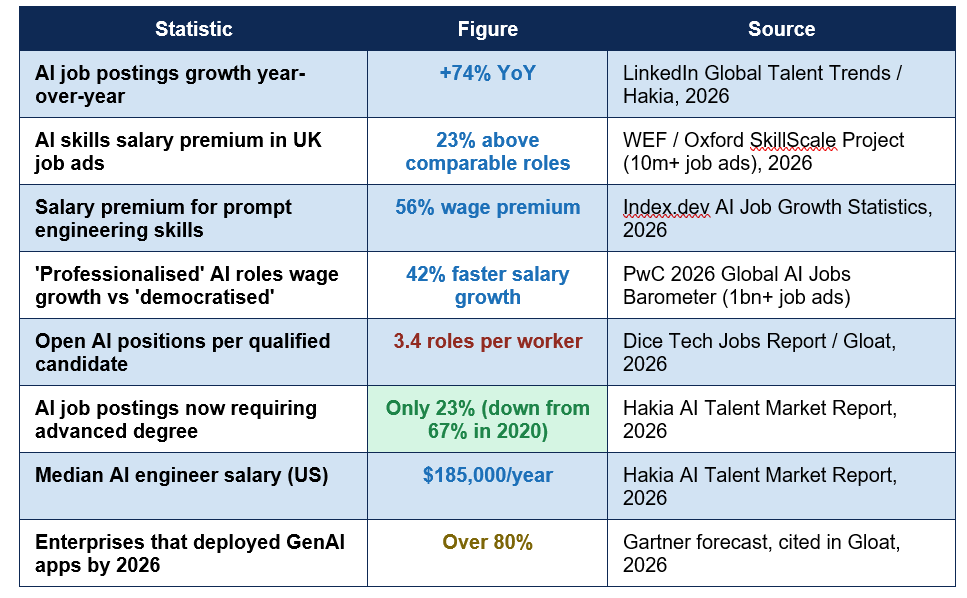
The 'professionalised' vs 'democratised' split: Professionalised AI roles grow twice as fast with 42% higher wage growth — PwC's 2026 Barometer identified two distinct tracks: 'professionalised' roles (radiologists, recruiters, lawyers, engineers using AI to enhance human judgement) growing twice as fast as 'democratised' roles (IT service managers, medical secretaries, whose jobs become easier for non-experts through AI) — and 42% faster wage growth in the professionalised track
The degree premium reversal: Oxford SkillScale Project research published in the World Economic Forum in 2026 found that AI skills now outperform formal educational qualifications in immediate labour market returns. A Bachelor's degree adds approximately 8% to advertised salaries and a Master's adds approximately 13%, but AI skills add 23%. This is not just a marginal difference — it represents a structural shift in which employers are moving toward skill-based hiring over credential-based hiring at a pace unprecedented in modern recruitment history. For career changers, this is the most important single data point in this guide: your degree (or lack of one) matters less than what you can demonstrably do.
The Two Tracks: Technical vs AI-Augmented
The single most important decision in any AI retraining plan is clarifying which of two broad tracks you are aiming for, because the skills, timelines, and resource requirements are substantially different:Track 1: The AI-Augmented Professional
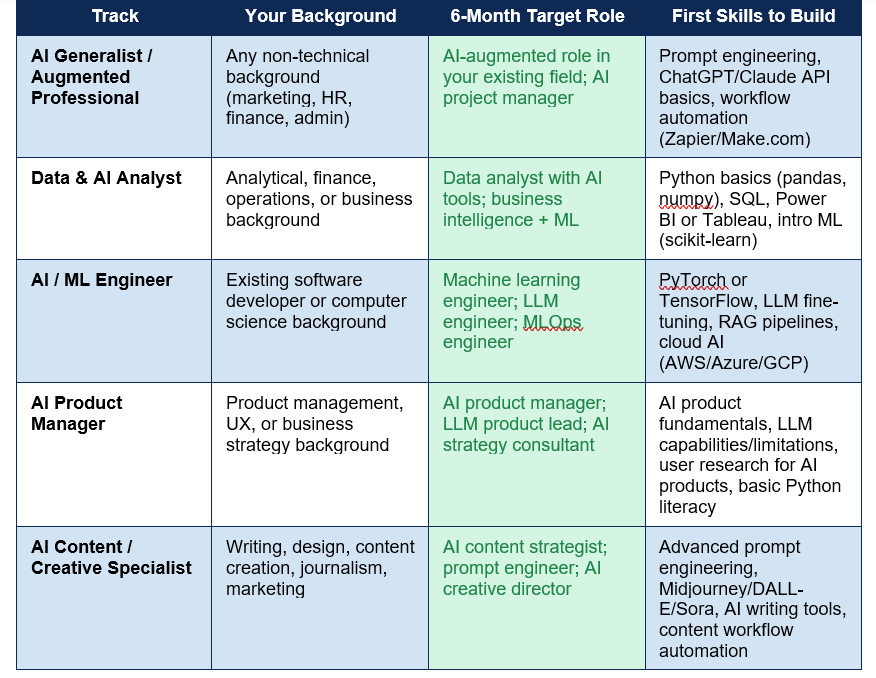
This track does not require learning to code. It is about becoming fluent in using AI tools to dramatically enhance your performance in your existing domain — marketing, HR, legal, finance, healthcare, education, content creation, or any other field. The skills it requires are prompt engineering, AI workflow design, the ability to evaluate AI outputs critically, and knowledge of which tools apply to which business problems. In six months, a person on this track can move from minimal AI exposure to being genuinely marketable as someone who brings AI capability to a team that needs it. This is the largest and fastest-growing segment of the AI employment opportunity by headcount.Track 2: The AI/ML Technical Specialist
This track requires a more significant foundational investment. To work as an ML engineer, AI engineer, or data scientist with AI specialisation, you need strong Python proficiency, familiarity with frameworks like PyTorch or TensorFlow, and increasingly the ability to work with LLM infrastructure, retrieval-augmented generation (RAG), and MLOps deployment. In six months, an existing software developer can realistically transition into an AI/ML engineering role by adding these specialisms to existing programming fundamentals. Someone with no programming background would need longer than six months to reach the same destination, though they can make substantial progress toward it.The table below maps five career tracks to starting background, six-month target roles, and the first priority skills:
The 6-Month Retraining Plan: Month by Month
The following plan is structured around an investment of approximately 10-15 hours per week for someone retraining alongside existing work commitments. For those pursuing this full-time, each phase can be compressed. The plan is described for Track 1 (AI-Augmented Professional) and Track 2 (Technical), with clear distinctions between them:MONTH 1 Foundation — Understand the Landscape and Choose Your Stack
Week 1-2: Complete a free AI literacy course to get oriented. Google's 'Introduction to Generative AI' on Google Cloud Skills Boost is 45 minutes and provides the conceptual grounding every track needs. Microsoft's AI Skills Navigator identifies which Microsoft AI tools align with your role. Week 3-4: Choose your primary tool and learn it deeply. Track 1 — become a genuine power user of ChatGPT, Claude, or Gemini: learn system prompting, multi-turn context management, and output formatting. Track 2 — install Python, complete the first two weeks of freeCodeCamp's Python curriculum, and run your first Jupyter notebook. Goal: confident foundation, chosen direction, first structured learning complete.MONTH 2 Core Skill Development — The Skills Employers Actually Pay For
Track 1: Complete a dedicated prompt engineering course (DeepLearning.AI's 'ChatGPT Prompt Engineering for Developers' with Andrew Ng is free and takes 1-2 hours). Then spend the rest of the month learning automation: Zapier or Make.com for no-code AI workflow automation; Microsoft Copilot Studio or ChatGPT custom GPTs if you are in an Office 365 environment. Track 2: Python data manipulation with pandas and numpy; basic SQL for data querying; introduction to scikit-learn for classic ML. Recommended: fast.ai's 'Practical Deep Learning for Coders' — deliberately practical, zero-prerequisites, widely respected. Goal: first practical AI project completed and documented, however small.MONTH 3 Specialisation — Go Deep on Your Highest-Value Skill
This is where the plan diverges most significantly by track and sector. Track 1 in healthcare: learn AI medical documentation tools, clinical note automation, and NHS AI governance frameworks. Track 1 in marketing: master AI content pipelines, Midjourney for creative assets, and AI-driven SEO and analytics. Track 1 in finance: learn AI-assisted financial modelling, Microsoft 365 Copilot for Excel, and AI compliance tools. Track 2: choose between NLP (Hugging Face transformers, LLM fine-tuning) or computer vision (OpenCV, YOLO object detection) as your primary specialisation — NLP has 155% higher growth in job postings than computer vision and is recommended for most career changers. Goal: identifiable specialisation completed, able to describe the skill confidently in an interview.MONTH 4 Build — Create the Portfolio That Gets You Hired
The shift in AI hiring from credentials to portfolio is well-documented: Hakia's research found that GitHub repositories, deployed applications, and open-source contributions now carry more weight than academic credentials in the majority of AI job applications. This month is project month. Track 1: build one substantive AI tool or automation that solves a real problem in your current or target industry — document it thoroughly with before/after metrics, publish it on a portfolio page, and demonstrate it in video form. Track 2: build end-to-end: scrape or download a dataset, clean it, train a model, evaluate it, and deploy it as a simple API or web app. Host on GitHub. Goal: one publicly accessible portfolio project completed.MONTH 5 Certifications — The Credentials That Actually Signal Competence
Certifications from credible institutions now function as a quality signal in AI hiring that partially compensates for lack of traditional academic credentials, according to WEF research showing that AI skills combined with a recognised certificate produce even stronger call-back rates than AI skills alone. Track 1 recommended: Google Career Certificate in Data Analytics (widely recognised, can be completed in approximately six weeks at 10 hours/week) or Microsoft AI-900 Azure AI Fundamentals (approximately 4-6 hours of preparation). Track 2 recommended: AWS Machine Learning Specialty or Azure AI Engineer Associate — both correlate with 10-15% higher salaries than uncertified equivalents. Complete at least one certification this month, publish it to LinkedIn immediately. Goal: minimum one industry-recognised certification added to profile.MONTH 6 Job-Ready — Network, Apply, and Land the Interview
Month 6 is full application mode. Update every surface: LinkedIn headline to include your AI specialism (e.g. 'Marketing Manager | AI Workflow Automation | ChatGPT, Make.com, Midjourney'); GitHub profile with portfolio projects pinned; CV updated to quantify AI achievements with metrics. Apply strategically, not broadly: target companies whose job descriptions mention specific tools you have learned. Tailor each application to demonstrate you already understand their AI environment. For networking: LinkedIn outreach to people in your target role asking for a 15-minute informational conversation generates significantly better results than cold applications alone. Attend one AI meetup or webinar per week — Eventbrite and Meetup.com have free AI/ML events in most major UK and US cities every week. Goal: 3 interviews booked; at minimum, one AI-adjacent internal role or freelance project commenced.The Best Free and Low-Cost Learning Resources
The following are the most widely cited, highest-quality learning resources currently available for AI retraining, at each price point:Free Resources
- Google AI Essentials and Introduction to Generative AI: Google Cloud Skills Boost platform, covering AI fundamentals, generative AI basics, and responsible AI. Completable in a single day.
- DeepLearning.AI Short Courses (Andrew Ng): A growing library of two-to-four hour courses on prompt engineering, LangChain, RAG systems, fine-tuning, and AI product development. All free. The single most recommended resource by AI hiring managers for demonstrating structured AI knowledge.
- fast.ai — Practical Deep Learning for Coders: Deliberately beginner-friendly, builds from practical applications to theory rather than the reverse. Peer-reviewed by academic AI community as genuinely high quality.
- freeCodeCamp — Machine Learning with Python Certification: 300 hours of project-based Python and ML content, completely free, widely recognised by employers as a credible learning path.
Paid but High-Value Resources
- Coursera IBM AI Engineering Professional Certificate: A structured, credential-producing programme covering machine learning, deep learning, and AI deployment. Costs approximately £40/month on Coursera; financial aid available.
- Udemy AI and ML courses: Frequently on sale for £10-£15; Jose Portilla's Python and ML courses and Jose Marcial Portilla's NLP courses are consistently among the highest-reviewed options.
- LinkedIn Learning AI Skills Path: Available with a LinkedIn Premium subscription; directly feeds demonstrated skills into your LinkedIn profile, which recruiters actively filter for.
What 6 Months Realistically Achieves — and What It Does Not
Honesty about timelines is as important as any skill recommendation in a guide like this. Six months of structured retraining at 10-15 hours per week will make you competitive for AI-adjacent roles in your existing domain (Track 1) and will position software developers for genuine AI/ML engineering transitions (Track 2). It will not produce a qualified machine learning researcher from scratch, a senior AI engineer with zero programming background, or a specialist in the most demanding cutting-edge sub-fields like reinforcement learning or AI safety research.The realistic six-month outcomes by track are: Track 1 — a marketing manager, HR professional, or financial analyst who can command an AI skill premium in their existing field and compete for roles specifically requiring AI augmentation capabilities; Track 2 (existing developer) — a junior to mid-level ML or AI engineer with genuine portfolio projects, a relevant certification, and market-ready technical vocabulary. Both outcomes are well-supported by the current labour market data, which shows 3.4 open positions per qualified AI worker.
The career-equaliser effect of AI skills: Oxford SkillScale research published in 2026 found that AI skills help offset conventional disadvantages in hiring. Older applicants and candidates without advanced degrees — groups that often face lower call-back rates in traditional hiring — saw their hiring prospects improve substantially when AI skills were present on their CVs. When those skills were supported by a recognised certificate, the effect was even stronger. This is a rare and genuine piece of evidence that skill-based retraining in this specific area can partially offset structural labour market disadvantages, not just for those who are already advantaged.
Conclusion
The AI job market in 2026 is not a promise about the future — it is a present-tense reality with documented, quantified characteristics that make retraining one of the most reliably high-return investments in time available to working adults today. AI job postings are growing at 74% year-over-year. There are 3.4 open positions for every qualified candidate. The skills gap index sits at 8.2 out of 10. AI skills produce salary premiums that now exceed the premium conferred by a university degree. And the credential barriers have fallen dramatically, with advanced degrees required by less than a quarter of AI job postings compared with two-thirds just six years ago.Six months of structured, focused learning is enough time to make a meaningful transition — not to the most technically demanding roles, but to the real, growing, well-compensated segment of the AI labour market that is desperate for people who can bridge domain expertise and AI capability. That is precisely the position of most people reading this guide: you already have domain knowledge in something. AI skills are the bridge between that existing expertise and the market's current most urgent need.
Start with Month 1 this week, not next month. The skills gap is real, the demand is current, and the advantage of learning now rather than in six months is six months of head start in a market where the value of early AI skill acquisition is compounding faster than almost any other investment you can make in your professional development.
Frequently Asked Questions (FAQ)
Can I get an AI job without a degree or coding background?
Yes — and increasingly yes. Hakia's AI talent market analysis found that only 23% of AI job postings now require an advanced degree, down from 67% in 2020. Oxford University's SkillScale research found that AI skills produce a 23% salary premium in UK job ads, larger than the premium associated with a Bachelor's or Master's degree. Track 1 of this guide — the AI-Augmented Professional path — specifically does not require coding ability, focusing instead on prompt engineering, AI workflow automation, and domain-specific AI tool mastery that is applicable regardless of educational background.What AI skill has the highest salary premium right now?
Prompt engineering currently commands the highest documented wage premium, with Index.dev's 2026 analysis reporting a 56% wage premium for workers with prompt engineering skills — up from 25% the prior year, representing the fastest-growing premium of any AI skill category. Machine learning skills add 40% to hourly earnings, TensorFlow expertise adds 38%, deep learning adds 27%, NLP adds 19%, and data science adds 17%. LLM fine-tuning has emerged as the most sought-after specialised skill in enterprise AI, according to Second Talent's May 2026 analysis.How many hours per week do I need to commit to retrain in 6 months?
The plan in this guide is structured around 10-15 hours per week alongside existing work commitments. This is enough to complete the core learning for each month's phase, build one substantial portfolio project by month four, and achieve at least one industry-recognised certification by month five. Those who can commit 20+ hours per week (for example, those pursuing retraining full-time or semi-full-time) can compress the plan to three to four months. The minimum viable commitment is approximately eight hours per week; below that, the six-month timeline becomes difficult to maintain.Which industries are hiring the most AI talent in 2026?
Technology, Media, and Telecoms leads all sectors in AI hiring intensity, with nearly one in eight new job roles now AI related according to PwC's 2026 Barometer. Professional services (consulting, legal, accounting) is the fastest-growing sector for AI adoption, with hiring intensity rising sharply. Data from Index.dev identifies AI-skilled workers in wholesale and retail trade experiencing 123% wage growth, energy sector workers 103%, and information and communication 97% — the three highest AI wage growth sectors. Healthcare, finance, and marketing are also significant hiring verticals, particularly for Track 1 (AI-Augmented Professional) roles.What is the difference between 'professionalised' and 'democratised' AI roles?
These terms come from PwC's 2026 Global AI Jobs Barometer. 'Professionalised' roles are those where AI automates routine tasks, allowing human workers to focus on higher-order judgement, creativity, and expertise — radiologists, recruiters, lawyers, and engineers whose work AI enhances rather than simplifies. 'Democratised' roles are those where AI makes the job itself easier to perform for non-experts, potentially lowering the skill threshold and putting wage pressure on existing workers — IT service managers and medical secretaries were cited as examples. Professionalised roles are growing twice as fast and showing 42% higher wage growth. The strategic goal of any AI retraining plan should be to position yourself in the professionalised segment of your chosen field rather than the democratised one.
External References
The following authoritative sources were used in researching this article and are recommended for further reading:1. PwC — 2026 Global AI Jobs Barometer (Press Release, 15 June 2026)
https://www.pwc.com/gx/en/news-room/press-releases/2026/pwc-2026-ai-jobs-barometer.html
2. World Economic Forum — AI Skills and Wages: Oxford SkillScale Research (2026)
https://www.weforum.org/stories/2026/02/ai-improving-wages-job-quality/
3. IMF — New Skills and AI Are Reshaping the Future of Work (January 2026)
https://www.imf.org/en/blogs/articles/2026/01/14/new-skills-and-ai-are-reshaping-the-future-of-work
4. Hakia — The AI Talent Market: Skills in Demand and Salary Trends 2026
https://www.hakia.com/tech-insights/ai-talent-market/
5. Index.dev — AI Job Growth Statistics 2026: Skills, Salaries and Automation
https://www.index.dev/blog/ai-job-growth-statistics
6. DeepLearning.AI — Free Short Courses on Prompt Engineering, LangChain, and AI Development
https://www.deeplearning.ai/short-courses/
7. fast.ai — Practical Deep Learning for Coders (Free Course)
https://course.fast.ai/
8. Google Cloud Skills Boost — Introduction to Generative AI (Free)
https://www.cloudskillsboost.google/course_templates/536
0 Comments
Be the first to share your thoughts on this article.