

Mental / Intellectual Development
The 4 C’s of Mental Toughness: Control, Commitment, Challenge, Confidence
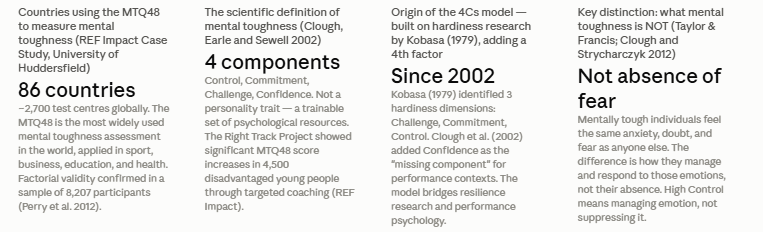
Mental toughness is the quality that determines how effectively you deal with challenge, stressors and pressure, irrespective of prevailing circumstances. First conceptualised by psychologists Peter Clough, Keith Earle and David Sewell in 2002, the 4Cs model has become the most widely validated framework for understanding and building mental toughness, now used across 86 countries in sport, business, education, and health. This guide breaks down each component, what the research says about it, and how to deliberately develop it.
The most rigorous and widely adopted scientific definition comes from Peter Clough, Keith Earle, and David Sewell (2002): mental toughness is ‘the quality that determines how people effectively deal with challenge, stressors and pressure, irrespective of prevailing circumstances.’ The three key words in this definition are ‘effectively,’ ‘irrespective,’ and ‘quality.’
Effectively: the goal is not to survive stress but to perform well during it. Irrespective of circumstances: the effect applies across different environments, pressures, and stakes. Quality: it is a measurable, multi-dimensional attribute, not a binary state.
What mental toughness is not is equally important. It is not the absence of anxiety or fear. Research consistently shows that mentally tough individuals experience the same emotional responses to pressure as everyone else — the difference is in how they interpret and respond to those responses. It is also not recklessness or emotional suppression. The Control component of the 4Cs model specifically includes emotional control — the ability to manage emotional responses productively, not eliminate them. Mental toughness is a calibrated set of psychological resources, not a hardened indifference to experience.
Mental toughness is measured globally through the MTQ48, the most widely used assessment of the construct, used in approximately 2,700 test centres across 86 countries in business, health, sport, and education (REF Impact Case Study, University of Huddersfield). Factorial validity confirmed in a sample of 8,207 participants across senior management, middle management, clerical/administrative staff, athletes, and students (Perry et al. 2012; REF Impact Case Study). The 4Cs model draws on hardiness research by Kobasa (1979) and Maddi and Kobasa (1984), adding Confidence as a fourth dimension specific to performance contexts (Frontiers in Psychology July 2021). Several studies have provided support for the 4Cs across various contexts (Perry et al. 2013, 2015; Frontiers in Psychology 2021).
Maddi and Kobasa (1984) extended this work by demonstrating that hardiness encouraged resilience by motivating coping and social interaction. Hardiness was not merely a passive buffer — it actively shaped how people engaged with stressors, driving them toward problem-solving and connection rather than avoidance and isolation (Frontiers in Psychology July 2021).
Peter Clough, Keith Earle, and David Sewell (2002) synthesised this hardiness research and applied it to the performance context of competitive sport, where the psychological demands include not just stress management but active performance under scrutiny, high stakes, and direct competition. They identified that hardiness accounted for three of the four critical components of mental toughness but was missing a crucial element that sport and high-performance settings specifically require: Confidence. Confidence — the unshakeable self-belief in one’s ability to succeed under pressure — was the dimension that the hardiness literature had underemphasised but that performance psychology consistently identified as decisive.
The resulting 4Cs model — Control, Commitment, Challenge, and Confidence — was operationalised through the Mental Toughness Questionnaire-48 (MTQ48), which provides a validated, psychometrically tested measurement of all four components. This measurement tool is what distinguishes the 4Cs from many other frameworks in the personal development space: it is not merely a conceptual model but a tested, falsifiable scientific instrument with documented validity across multiple populations, contexts, and cultures.
The progression from Kobasa (1979) to Clough et al. (2002) reflects a broader development in psychological science: the integration of resilience research (which asks how people survive adversity) with performance psychology (which asks how people excel under pressure). The 4Cs model bridges these two traditions, making it applicable not just to people facing crisis but to anyone who wants to perform more effectively and consistently across all areas of life. Not a substitute for professional psychological support.
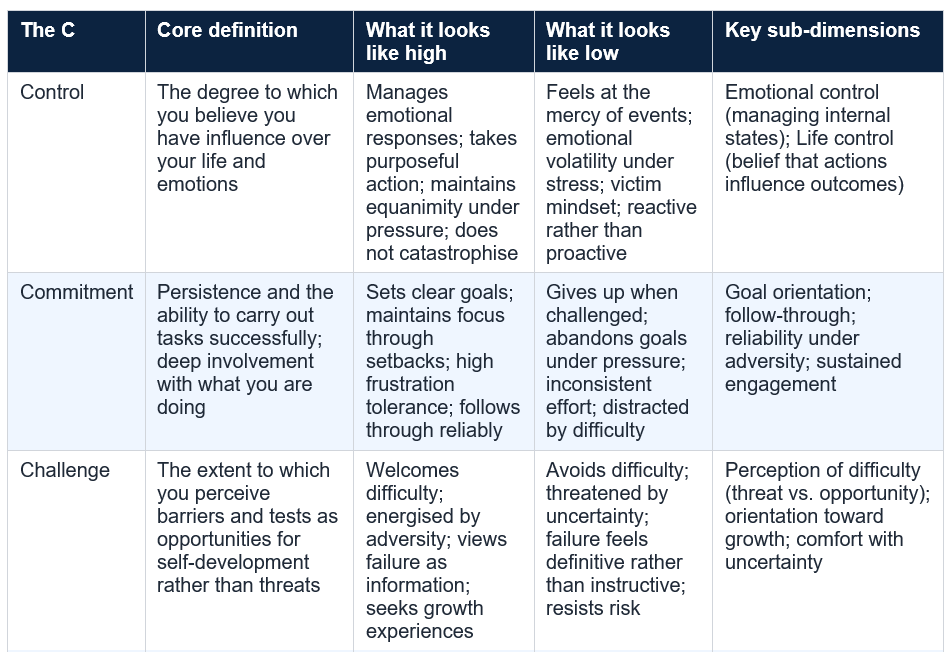
In the 4Cs framework, Control has two sub-dimensions. The first is life control: the conviction that your choices, actions, and responses meaningfully shape your outcomes. A person high in life control approaches obstacles as problems to be solved rather than verdicts about what they can achieve. They take purposeful action rather than waiting for circumstances to change.
The second sub-dimension is emotional control: the ability to manage internal emotional states productively during high-pressure situations. This is not emotional suppression — the research does not support the idea that high-Control individuals feel less anxiety, fear, or frustration. What distinguishes them is their ability to experience these emotions without allowing them to determine their behaviour. A high-Control athlete can feel nervous before a competition and still execute with precision. A high-Control executive can feel frustrated in a difficult negotiation and still make clear-headed decisions.
Research on control in the 4Cs framework finds that it is particularly predictive of performance in high-uncertainty environments — situations where the outcome is genuinely unclear and where the individual’s sense of agency is being tested. In education research (McGeown, St.Clair-Thompson, and Clough 2015), adolescents described Control as ‘keeping your emotions in check’ and ‘not letting things get to you’ — consistent with the dual-dimension structure of the construct.
What high Control looks like: You face an unexpected setback at work. Rather than dwelling on the unfairness of the situation or catastrophising about what it means for the future, you immediately ask: 'What can I do about this right now? What can I control?' You manage the frustration internally enough to communicate clearly with colleagues. You take the most purposeful available action and monitor the outcome. Not financial or psychological advice.
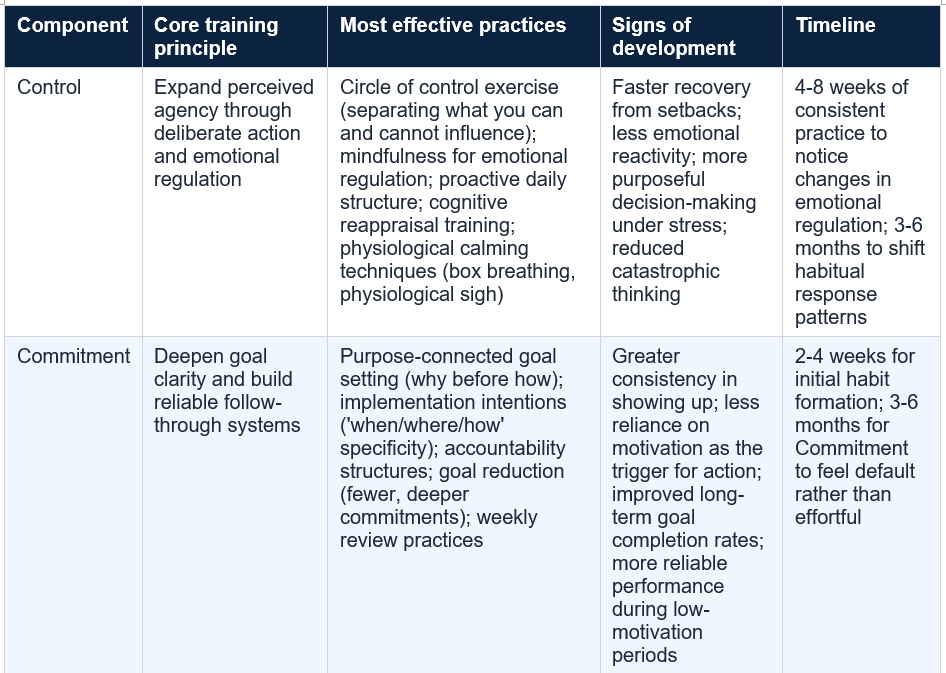
Building Control: (1) Practice the 'circle of control' exercise: when faced with a stressor, explicitly separate what you can influence from what you cannot. Invest energy only in the former. (2) Develop an emotional regulation practice: research supports mindfulness, controlled breathing (box breathing or physiological sigh), and cognitive reappraisal as effective emotional regulation techniques. These do not eliminate emotion but increase the gap between stimulus and response. (3) Build a proactive daily structure: autonomy over your routine increases perceived control even when external events are uncertain. (4) Notice and challenge catastrophic thinking: when you find yourself thinking 'this will ruin everything,' explicitly test this against evidence. Control-building is largely a practice of cognitive restructuring.
The Taylor & Francis description of the 4Cs highlights a specific quality of Commitment that distinguishes it from mere stubbornness or rigidity: it involves deep involvement rather than mechanical compliance. A committed individual is not simply grinding through a task they hate. They are genuinely engaged with the purpose behind the task, which sustains effort more effectively than willpower alone. In educational research on the 4Cs, adolescents associated Commitment with ‘not giving up’ and ‘working hard even when you don’t want to,’ but also with the sense that the goal was genuinely worth pursuing (LJMU 2016).
Commitment is also the dimension most associated with what psychologists call delayed gratification — the ability to accept a short-term cost (effort, discomfort, sacrifice) for a long-term reward (achievement, mastery, goal realisation). Research on delayed gratification consistently finds it to be a better predictor of long-term outcomes (academic performance, career success, health behaviours) than intelligence or talent.
In the context of the MTQ48, Commitment is the sub-scale most strongly associated with sustained performance over time, as distinct from peak performance in isolated high-pressure moments (which is more predicted by Confidence and Control). The committed individual does not just perform well when it matters — they show up, do the work, and maintain standards even when no one is watching and the stakes are low. This consistency is what separates high-Commitment individuals from those who perform brilliantly in crises but struggle to maintain baseline effort during normal conditions.
Commitment: What high Commitment looks like: You are three months into a project that has become more difficult and less rewarding than it initially appeared. The early momentum is gone. Colleagues have begun to disengage. A high-Commitment person does not wait for the motivation to return -- they act from the clarity of the original purpose. They do not renegotiate the goal at the first sign of difficulty; they renegotiate the plan. They find ways to re-engage with the meaning behind the work, not just the mechanics of it. Not professional advice.
Building Commitment: (1) Define the why before the how: research consistently shows that purpose-connected goals persist longer than outcome-connected goals. Before setting a goal, articulate the specific values or meaning it serves. (2) Use implementation intentions: instead of 'I will work on this tomorrow,' specify 'I will work on this at 9:00 AM at my desk for 45 minutes.' Specificity dramatically increases follow-through. (3) Reduce goal quantity and increase goal depth: Commitment is diluted across too many goals. Fewer, deeper commitments produce more consistent outcomes than wide, shallow goal lists. (4) Build accountability structures: consistent external check-ins with a coach, mentor, or accountability partner sustain Commitment during low-motivation periods.
The roots of this dimension in Kobasa’s hardiness research are clear. Kobasa found that individuals who remained healthy under high stress were characterised partly by their tendency to view change and difficulty not as disruption to be endured but as a stimulus for growth to be engaged. This does not mean that high-Challenge individuals feel no discomfort when facing adversity. It means that their first interpretation of adversity is curious and anticipatory rather than fearful and defensive.
In the Taylor & Francis account of the 4Cs, Challenge is linked to the idea that mentally tough individuals are ‘energised’ by difficulty rather than ‘demoralised’ by it. The evidence for this in performance contexts is substantial: in sport, elite athletes consistently report that competitive pressure enhances their performance rather than impairing it; in business, research on high-performing managers finds that those who rise under adversity (the phenomenon of ‘hardiness under fire’) are characterised precisely by this reframing orientation.
Challenge is also the dimension most directly connected to what Carol Dweck calls the growth mindset — the belief that abilities are developable rather than fixed. A high-Challenge individual, when they fail at a task, interprets the failure primarily as information about what to do differently rather than as evidence of a fixed limitation. This interpretation keeps the feedback loop productive rather than destructive.
Challenge: What high Challenge looks like: You receive highly critical feedback on a presentation you worked hard on. A low-Challenge response is defensive, demoralising, or avoidant. A high-Challenge response is curious: 'What specifically can I learn from this? What does this criticism tell me about what I need to develop?' The high-Challenge individual is not immune to disappointment -- they feel it. But their default processing of the feedback is developmental rather than conclusive. They ask 'What next?' before they ask 'Why me?' Not professional advice.
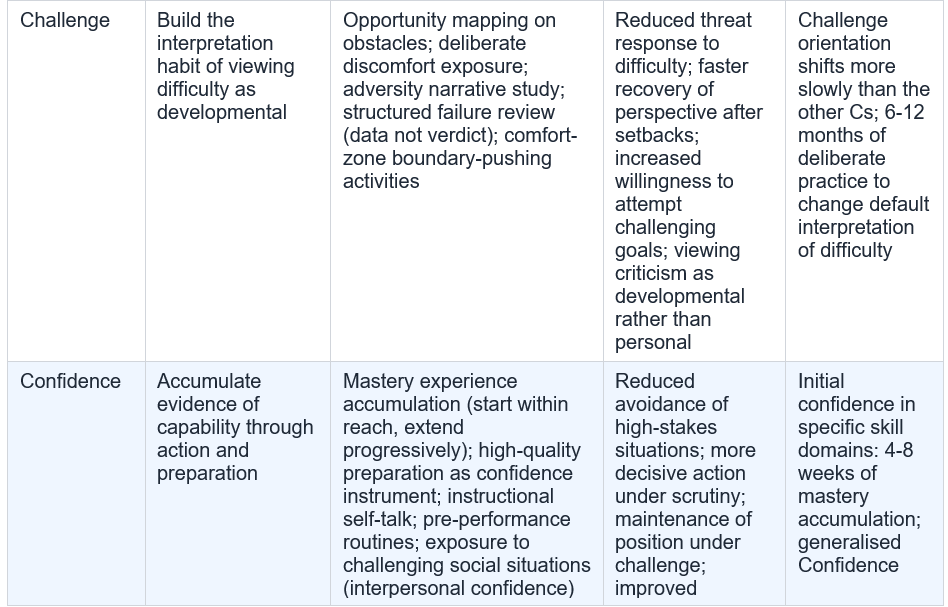
Building Challenge: (1) Practice 'opportunity mapping': when facing an obstacle, deliberately spend two minutes writing down what the obstacle teaches you, what capabilities it forces you to develop, and what opportunities its resolution creates. This is not positive thinking -- it is structured reframing. (2) Embrace deliberate discomfort: seek out situations that are slightly beyond your current competence (the research term is the 'zone of proximal development'). Repeated exposure to manageable challenge builds the neural and psychological infrastructure of the Challenge response. (3) Study adversity narratives: one of the most consistent findings in resilience research is that exposure to stories of others' successful navigation of adversity increases an individual's own perceived capacity for Challenge. (4) Reframe failure as data: after any significant failure, conduct a brief structured review -- not of what went wrong emotionally, but of what specific information the failure contains that improves future performance.
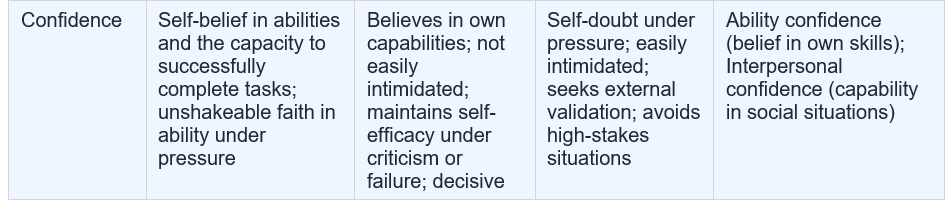
The word ‘unshakeable’ requires unpacking. It does not mean that high-Confidence individuals are immune to self-doubt or that they never feel intimidated. It means that self-doubt and intimidation do not fundamentally alter their belief in their ability to succeed. The high-Confidence individual can acknowledge that a situation is difficult, that they are uncertain about the outcome, that a competitor is formidable — and simultaneously maintain a baseline conviction that their abilities are sufficient for the task. This is distinct from arrogance (believing the outcome is guaranteed) and from delusional positivity (denying the difficulty). It is a calibrated self-belief that survives encounter with evidence of difficulty.
Confidence in the 4Cs model has two sub-dimensions that map the scope of the construct. Ability confidence is the belief in one’s personal capabilities — the sense that one has the skills, knowledge, experience, and capacity to handle what is in front of them. Interpersonal confidence is the capability to handle social situations effectively — to assert one’s views in groups, to maintain composure when challenged publicly, to engage with sceptical audiences without losing conviction. Both sub-dimensions are measurable in the MTQ48 and have distinct predictive relationships with performance in different contexts.
The research on Confidence in the 4Cs framework consistently finds that it is the dimension most directly predictive of performance in high-visibility, high-stakes situations — exactly the contexts where self-doubt has the most damaging effect. An athlete who believes in their training going into a competition will execute their preparation more fully than one who enters with significant self-doubt, independent of their objective skill level. This is one of the most robust findings in performance psychology: belief mediates execution.
Confidence: What high Confidence looks like: You are about to present a business case to a sceptical senior audience. A low-Confidence individual rehearses the possible criticisms with anxiety and may over-qualify their recommendations, hedge unnecessarily, or speak with reduced conviction. A high-Confidence individual enters with the belief that their preparation is sufficient and their perspective is worth hearing. They can receive a sharp challenge without losing their position, acknowledge what they don't know without losing credibility, and persist with their recommendation through pushback. Not professional advice.
Building Confidence: (1) Accumulate small evidence: Confidence is built by doing, not by waiting to feel ready. Begin with tasks that are within reach, complete them reliably, and use that completion evidence to extend into more challenging territory. The research on self-efficacy (Bandura) is clear: the most powerful source of Confidence is mastery experience -- having actually done the thing. (2) Use preparation as a confidence instrument: uncertainty about performance is often uncertainty about preparation. Increasing the quality and completeness of preparation directly addresses the source of doubt. (3) Control self-talk: the internal narrative during high-pressure situations is consequential. Research supports instructional self-talk ('I know how to do this') over motivational self-talk ('I can do it!') for skill execution under pressure. (4) Develop a pre-performance routine: research on athletes and performers consistently finds that a consistent pre-performance routine channels arousal, builds focus, and sustains Confidence by creating a familiar psychological anchor.
Control and Confidence share a particular relationship. Control — the belief that your actions influence outcomes — is a necessary condition for Confidence to function productively. A person who lacks Control (feels at the mercy of external forces) finds that Confidence becomes hollow: believing in your ability to do something is functionally meaningless if you simultaneously believe that what you do does not change what happens. Conversely, a person high in Control who lacks Confidence may know that their actions matter without believing that their specific actions are good enough.
Commitment and Challenge also interact in a specific way that the research highlights. Commitment without Challenge produces persistence that is brittle in the face of genuine adversity — the individual keeps going when the path is clear but loses commitment when the path becomes truly difficult. Challenge without Commitment produces an orientation toward growth that is not sustained long enough to produce the outcomes that growth enables. Together, they describe the individual who stays in the difficulty long enough to actually grow from it.
The full 4Cs profile — Control, Commitment, Challenge, and Confidence all operating at meaningful levels — produces what Clough and Strycharczyk describe as the core quality of mental toughness: performing effectively under challenge and pressure, irrespective of circumstances. None of the four Cs alone achieves this. Each is necessary but not sufficient. The development goal is not to maximise one component at the expense of the others but to bring all four components into a productive equilibrium.
The practical implication of the interactive model: when diagnosing a mental toughness gap, identify which of the four components is the limiting factor. A person who gives up on goals (low Commitment) needs different development than a person who performs brilliantly in calm conditions but falls apart under pressure (low Control or low Confidence). The MTQ48's ability to measure all four components independently is what allows this targeted diagnosis rather than a general prescription of 'be tougher.' Not professional advice.
In sport: this is the original context of the model, and the evidence is most extensive here. High-Challenge individuals are more likely to recover from injury and return to competition. High-Control athletes maintain technique under competition stress. High-Commitment athletes sustain training intensity across the full season, not just at peak periods. High-Confidence athletes execute their preparation fully in high-stakes moments.
In business and management: research using the MTQ48 across senior management, middle management, and clerical staff (Perry et al. 2012; the 8,207-participant validation study) found consistent relationships between mental toughness scores and performance ratings. High-Control managers make cleaner decisions under time pressure. High-Commitment employees are more reliable in project delivery and more resistant to burnout than their lower-Commitment peers. The Right Track Project (funded by the UK Department for Education) demonstrated that mental toughness training and coaching could be systematically delivered to produce measurable wellbeing and performance improvements.
In education: mental toughness research in schools has found that the 4Cs align with academic predictors including self-efficacy, motivation, and resilience (McGeown, St.Clair-Thompson, and Clough 2015). The Right Track Project delivered mental toughness assessments and coaching to 4,500 disadvantaged young people and demonstrated significant increases in mental toughness alongside improved attitudes to learning. The All-Party Parliamentary Group on social mobility discussed the 4Cs model directly, concluding that ‘developing psychometric tools is crucial to identifying the best forms of intervention.’
In health: research has found relationships between mental toughness scores and adherence to medical treatment plans, recovery behaviours, and psychological responses to chronic illness. High-Control and high-Commitment individuals show better treatment adherence. High-Challenge individuals demonstrate more adaptive coping with chronic conditions. The health applications of the model are perhaps the most directly consequential, given the degree to which health outcomes depend on sustained behavioural change under difficulty.
The four components are distinct, measurable, and trainable. Control is the belief that your actions influence outcomes, including your emotional responses to events. Commitment is the persistent, purposeful engagement with goals through difficulty. Challenge is the orientation that interprets adversity as developmental rather than threatening. Confidence is the self-belief that your capabilities are sufficient for the demands you face. Together, they define the psychological profile of someone who consistently performs effectively under pressure — not because they are free from doubt, fear, or difficulty, but because they have developed the specific resources to respond to those experiences productively.
The practical implication is both demanding and genuinely hopeful. Demanding, because developing the 4Cs requires deliberate effort, sustained practice, and a willingness to engage with difficulty rather than avoid it. Hopeful, because the research is clear: these qualities can be built. They are not distributed at birth and then fixed for life. The Right Track Project showed it in disadvantaged youth. The MTQ48 validation study showed it across populations from clerical workers to elite athletes. The most important finding in the entire 4Cs research literature may be the simplest: mental toughness is a skill, not a trait. If you are reading this, you are already in the process of building it. Not professional advice — consult a qualified mental health professional if you are experiencing significant psychological difficulties.
The 4Cs of mental toughness are Control, Commitment, Challenge, and Confidence — a model developed by psychologists Peter Clough, Keith Earle, and David Sewell (2002). Control refers to the degree to which you believe your actions influence your life and your ability to manage your emotions under pressure. Commitment refers to persistence and the ability to carry out tasks successfully, characterised by deep involvement and sustained effort through setbacks. Challenge refers to the extent to which you perceive obstacles and difficulties as opportunities for self-development rather than threats. Confidence refers to self-belief in your abilities, particularly the capacity to perform successfully under pressure, without being intimidated. The model builds on hardiness research by Kobasa (1979) and is measured through the Mental Toughness Questionnaire-48 (MTQ48), the most widely used assessment of mental toughness globally, used in approximately 2,700 test centres across 86 countries (Frontiers in Psychology July 2021; REF Impact Case Study, University of Huddersfield). Not professional psychological advice.
Is mental toughness a skill you can develop?
Yes. One of the most consistent findings in the 4Cs research literature is that mental toughness is a trainable quality, not a fixed personality trait. All four components — Control, Commitment, Challenge, and Confidence — can be developed through targeted practice and, where available, professional coaching or assessment. The Right Track Project, funded by the UK Department for Education and informed by Dr Clough's model, delivered mental toughness assessments and coaching to 4,500 disadvantaged young people and demonstrated significant, statistically measurable increases in mental toughness scores alongside improved attitudes to learning (REF Impact Case Study, University of Huddersfield). Sports psychology research has consistently shown that pre-performance routines, cognitive reappraisal training, and deliberate exposure to managed adversity all produce measurable increases in mental toughness scores on the MTQ48. Not professional advice. Timelines for development vary significantly by individual starting point and practice consistency.
What is the difference between mental toughness and resilience?
Mental toughness and resilience are related but distinct constructs. Resilience, in most psychological definitions, refers primarily to the ability to recover from adversity — to bounce back to a baseline following a setback, loss, or stressor. Mental toughness, as defined by the 4Cs model, encompasses this recovery capacity but also includes proactive performance under pressure (not just recovery from setbacks) and a developmental orientation toward difficulty (the Challenge dimension). In Clough’s model, mental toughness is broader than resilience: it describes how people perform irrespective of circumstances, not just how they recover when circumstances are negative. The hardiness research by Kobasa (1979) and Maddi and Kobasa (1984) on which the 4Cs builds showed that hardy individuals not only recovered from adversity but were motivated by it toward coping and social interaction. The 4Cs model captures this proactive orientation in a way that simple resilience frameworks do not. Sources: Frontiers in Psychology (July 2021); Taylor & Francis; Kobasa (1979). Not professional psychological advice.
What is the MTQ48?
The MTQ48 (Mental Toughness Questionnaire-48) is the psychometric instrument developed by Clough, Earle, and Sewell to measure the 4Cs model of mental toughness. It is a 48-item questionnaire that provides individual scores on each of the four components (Control, Commitment, Challenge, and Confidence) and a total mental toughness score, expressed in relation to a normative population database. The MTQ48 is the most widely used assessment of mental toughness globally, used in approximately 2,700 test centres across 86 countries in business, sport, education, and health (REF Impact Case Study). Its factorial validity was confirmed in a sample of 8,207 participants across senior management, middle management, clerical staff, athletes, and students (Perry et al. 2012). The MTQ48 is available through AQR International (aqrinternational.co.uk). A preliminary self-assessment can be developed using the reflection questions in Section 11 of this guide, but these do not provide normative comparison to population data or the diagnostic precision of the validated instrument. Not professional psychological advice.
How do the 4Cs apply in a business or work context?
In business and workplace contexts, the 4Cs map directly to performance challenges that managers, leaders, and individual contributors face regularly. Control is most predictive of decision-making quality under time pressure and emotional management in difficult conversations and negotiations. Commitment is most predictive of sustained performance over time, project completion rates, and resistance to burnout — the ability to maintain standards and effort across the full work cycle, not just at deadline or crisis. Challenge is most predictive of how individuals respond to failure, criticism, and disruption — their ability to extract developmental value from setbacks rather than becoming defensive or avoidant. Confidence is most predictive of performance in high-visibility contexts: presenting to senior audiences, asserting positions in group settings, and making decisive recommendations under scrutiny. The 8,207-participant validation study of the MTQ48 (Perry et al. 2012) specifically included senior management, middle management, and clerical/administrative staff, confirming the validity of the 4Cs framework across all levels of organisational hierarchy. Source: REF Impact Case Study, University of Huddersfield; Frontiers in Psychology July 2021. Not professional or management advice.
Table of Contents
- What Is Mental Toughness? The Scientific Definition
- The Origins: From Hardiness to the 4Cs
- The 4Cs Model: An Overview
- C #1 — Control: The Belief That You Influence Your Life
- C #2 — Commitment: The Ability to Stay the Course
- C #3 — Challenge: Turning Obstacles Into Opportunities
- C #4 — Confidence: The Unshakeable Belief in Your Ability
- How the Four Cs Work Together
- The 4Cs Across Domains: Sport, Business, Education, Health
- Building Each C: A Practical Development Framework
- The 4Cs Self-Assessment: Where Are You Right Now?
- Common Myths About Mental Toughness
- Conclusion: Mental Toughness Is a Skill, Not a Trait
- Frequently Asked Questions
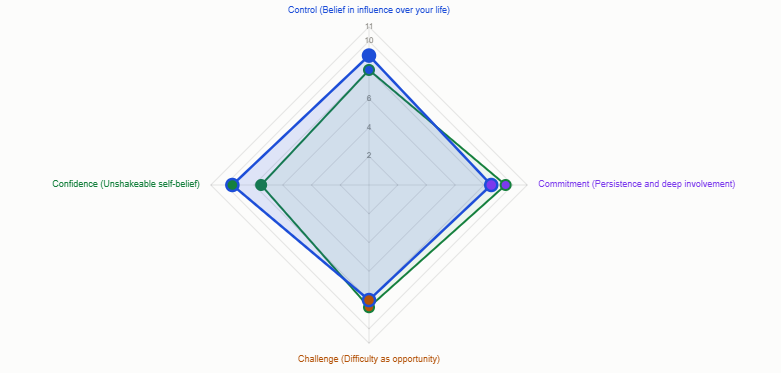
The 4Cs model — what each component means and contributes
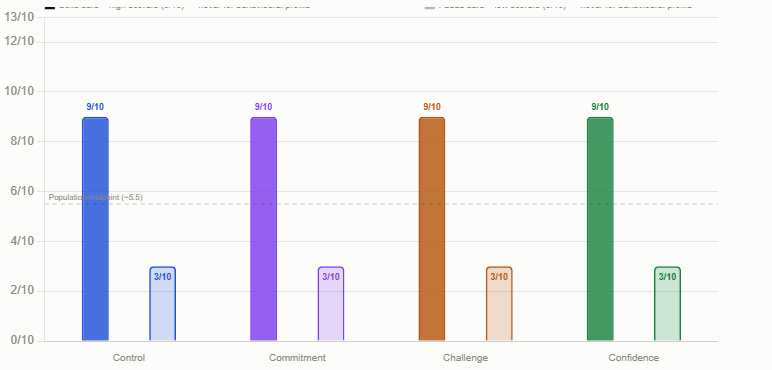
High vs low scores — what each C looks like in practice
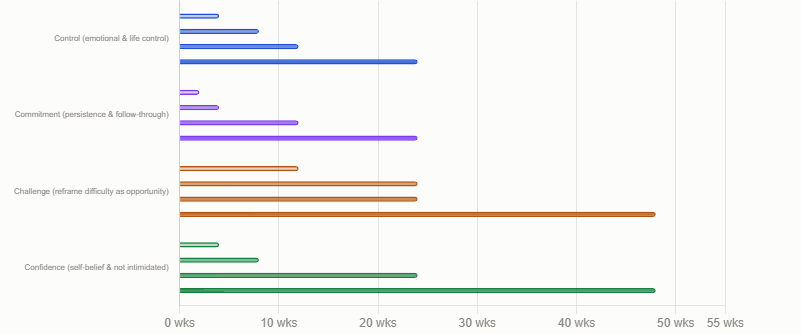
Building each C — development timeline and key practices
What Is Mental Toughness? The Scientific Definition
The phrase ‘mental toughness’ appears in sports commentary, business advice, military training, and self-help content, usually without a precise definition. Most usages conflate toughness with stoicism (not showing emotion), aggression (pushing through regardless of cost), or simple persistence (trying harder). None of these adequately captures what psychological research has identified as the actual construct.The most rigorous and widely adopted scientific definition comes from Peter Clough, Keith Earle, and David Sewell (2002): mental toughness is ‘the quality that determines how people effectively deal with challenge, stressors and pressure, irrespective of prevailing circumstances.’ The three key words in this definition are ‘effectively,’ ‘irrespective,’ and ‘quality.’
Effectively: the goal is not to survive stress but to perform well during it. Irrespective of circumstances: the effect applies across different environments, pressures, and stakes. Quality: it is a measurable, multi-dimensional attribute, not a binary state.
What mental toughness is not is equally important. It is not the absence of anxiety or fear. Research consistently shows that mentally tough individuals experience the same emotional responses to pressure as everyone else — the difference is in how they interpret and respond to those responses. It is also not recklessness or emotional suppression. The Control component of the 4Cs model specifically includes emotional control — the ability to manage emotional responses productively, not eliminate them. Mental toughness is a calibrated set of psychological resources, not a hardened indifference to experience.
Mental toughness is measured globally through the MTQ48, the most widely used assessment of the construct, used in approximately 2,700 test centres across 86 countries in business, health, sport, and education (REF Impact Case Study, University of Huddersfield). Factorial validity confirmed in a sample of 8,207 participants across senior management, middle management, clerical/administrative staff, athletes, and students (Perry et al. 2012; REF Impact Case Study). The 4Cs model draws on hardiness research by Kobasa (1979) and Maddi and Kobasa (1984), adding Confidence as a fourth dimension specific to performance contexts (Frontiers in Psychology July 2021). Several studies have provided support for the 4Cs across various contexts (Perry et al. 2013, 2015; Frontiers in Psychology 2021).
The Origins: From Hardiness to the 4Cs
The 4Cs model did not emerge in isolation. It builds directly on a substantial prior body of psychological research, most importantly the work of Suzanne Kobasa (1979) on psychological hardiness. Kobasa’s research identified three dimensions that distinguished individuals who remained healthy under high stress from those who did not: Challenge (the tendency to view change and difficulty as a stimulus for growth), Commitment (a sense of purpose and deep engagement with activities and relationships), and Control (the belief that one’s actions influence what happens to them). These three factors, Kobasa argued, functioned as a psychological buffer against the damaging effects of stress.Maddi and Kobasa (1984) extended this work by demonstrating that hardiness encouraged resilience by motivating coping and social interaction. Hardiness was not merely a passive buffer — it actively shaped how people engaged with stressors, driving them toward problem-solving and connection rather than avoidance and isolation (Frontiers in Psychology July 2021).
Peter Clough, Keith Earle, and David Sewell (2002) synthesised this hardiness research and applied it to the performance context of competitive sport, where the psychological demands include not just stress management but active performance under scrutiny, high stakes, and direct competition. They identified that hardiness accounted for three of the four critical components of mental toughness but was missing a crucial element that sport and high-performance settings specifically require: Confidence. Confidence — the unshakeable self-belief in one’s ability to succeed under pressure — was the dimension that the hardiness literature had underemphasised but that performance psychology consistently identified as decisive.
The resulting 4Cs model — Control, Commitment, Challenge, and Confidence — was operationalised through the Mental Toughness Questionnaire-48 (MTQ48), which provides a validated, psychometrically tested measurement of all four components. This measurement tool is what distinguishes the 4Cs from many other frameworks in the personal development space: it is not merely a conceptual model but a tested, falsifiable scientific instrument with documented validity across multiple populations, contexts, and cultures.
The progression from Kobasa (1979) to Clough et al. (2002) reflects a broader development in psychological science: the integration of resilience research (which asks how people survive adversity) with performance psychology (which asks how people excel under pressure). The 4Cs model bridges these two traditions, making it applicable not just to people facing crisis but to anyone who wants to perform more effectively and consistently across all areas of life. Not a substitute for professional psychological support.
The 4Cs Model: An Overview
The 4Cs model understands mental toughness as a multidimensional construct composed of four related but distinct components. Each component can be measured independently, trained independently, and contributes differently to the overall mental toughness profile of an individual. None of the four is reducible to the others, and the full model requires all four to be present at meaningful levels.
C #1 — Control: The Belief That You Influence Your Life
Control is the dimension of the 4Cs model most closely related to the psychological concept of locus of control — the degree to which people believe that their own actions, rather than external forces (luck, fate, other people’s decisions), determine what happens to them. In the Taylor & Francis description of the 4Cs model, Control is explicitly connected to the opposite of learned helplessness: the condition identified by Martin Seligman in which individuals who have experienced repeated situations in which their actions did not affect outcomes develop a generalised belief that their actions are futile.In the 4Cs framework, Control has two sub-dimensions. The first is life control: the conviction that your choices, actions, and responses meaningfully shape your outcomes. A person high in life control approaches obstacles as problems to be solved rather than verdicts about what they can achieve. They take purposeful action rather than waiting for circumstances to change.
The second sub-dimension is emotional control: the ability to manage internal emotional states productively during high-pressure situations. This is not emotional suppression — the research does not support the idea that high-Control individuals feel less anxiety, fear, or frustration. What distinguishes them is their ability to experience these emotions without allowing them to determine their behaviour. A high-Control athlete can feel nervous before a competition and still execute with precision. A high-Control executive can feel frustrated in a difficult negotiation and still make clear-headed decisions.
Research on control in the 4Cs framework finds that it is particularly predictive of performance in high-uncertainty environments — situations where the outcome is genuinely unclear and where the individual’s sense of agency is being tested. In education research (McGeown, St.Clair-Thompson, and Clough 2015), adolescents described Control as ‘keeping your emotions in check’ and ‘not letting things get to you’ — consistent with the dual-dimension structure of the construct.
What high Control looks like: You face an unexpected setback at work. Rather than dwelling on the unfairness of the situation or catastrophising about what it means for the future, you immediately ask: 'What can I do about this right now? What can I control?' You manage the frustration internally enough to communicate clearly with colleagues. You take the most purposeful available action and monitor the outcome. Not financial or psychological advice.
Building Control: (1) Practice the 'circle of control' exercise: when faced with a stressor, explicitly separate what you can influence from what you cannot. Invest energy only in the former. (2) Develop an emotional regulation practice: research supports mindfulness, controlled breathing (box breathing or physiological sigh), and cognitive reappraisal as effective emotional regulation techniques. These do not eliminate emotion but increase the gap between stimulus and response. (3) Build a proactive daily structure: autonomy over your routine increases perceived control even when external events are uncertain. (4) Notice and challenge catastrophic thinking: when you find yourself thinking 'this will ruin everything,' explicitly test this against evidence. Control-building is largely a practice of cognitive restructuring.
C #2 — Commitment: The Ability to Stay the Course
Commitment is the dimension of the 4Cs that is most closely related to what the broader psychology literature discusses under concepts including grit (Angela Duckworth), conscientiousness (Big Five personality research), and self-discipline. In Clough’s framework, Commitment is defined as persistence and the ability to carry out tasks successfully, characterised by deep involvement with whatever one is doing. It is the engine that keeps a person working toward a goal when the initial motivation has faded, the difficulty is real, and the reward is distant.The Taylor & Francis description of the 4Cs highlights a specific quality of Commitment that distinguishes it from mere stubbornness or rigidity: it involves deep involvement rather than mechanical compliance. A committed individual is not simply grinding through a task they hate. They are genuinely engaged with the purpose behind the task, which sustains effort more effectively than willpower alone. In educational research on the 4Cs, adolescents associated Commitment with ‘not giving up’ and ‘working hard even when you don’t want to,’ but also with the sense that the goal was genuinely worth pursuing (LJMU 2016).
Commitment is also the dimension most associated with what psychologists call delayed gratification — the ability to accept a short-term cost (effort, discomfort, sacrifice) for a long-term reward (achievement, mastery, goal realisation). Research on delayed gratification consistently finds it to be a better predictor of long-term outcomes (academic performance, career success, health behaviours) than intelligence or talent.
In the context of the MTQ48, Commitment is the sub-scale most strongly associated with sustained performance over time, as distinct from peak performance in isolated high-pressure moments (which is more predicted by Confidence and Control). The committed individual does not just perform well when it matters — they show up, do the work, and maintain standards even when no one is watching and the stakes are low. This consistency is what separates high-Commitment individuals from those who perform brilliantly in crises but struggle to maintain baseline effort during normal conditions.
Commitment: What high Commitment looks like: You are three months into a project that has become more difficult and less rewarding than it initially appeared. The early momentum is gone. Colleagues have begun to disengage. A high-Commitment person does not wait for the motivation to return -- they act from the clarity of the original purpose. They do not renegotiate the goal at the first sign of difficulty; they renegotiate the plan. They find ways to re-engage with the meaning behind the work, not just the mechanics of it. Not professional advice.
Building Commitment: (1) Define the why before the how: research consistently shows that purpose-connected goals persist longer than outcome-connected goals. Before setting a goal, articulate the specific values or meaning it serves. (2) Use implementation intentions: instead of 'I will work on this tomorrow,' specify 'I will work on this at 9:00 AM at my desk for 45 minutes.' Specificity dramatically increases follow-through. (3) Reduce goal quantity and increase goal depth: Commitment is diluted across too many goals. Fewer, deeper commitments produce more consistent outcomes than wide, shallow goal lists. (4) Build accountability structures: consistent external check-ins with a coach, mentor, or accountability partner sustain Commitment during low-motivation periods.
C #3 — Challenge: Turning Obstacles Into Opportunities
Challenge is perhaps the most counterintuitive of the four components because it describes not how hard you work or how in control you feel, but how you fundamentally interpret difficulty. The 4Cs definition of Challenge is the extent to which individuals perceive barriers and tests as opportunities for self-development rather than threats. This is a perceptual orientation — a default interpretation of adversity — rather than a cognitive strategy deployed after the fact.The roots of this dimension in Kobasa’s hardiness research are clear. Kobasa found that individuals who remained healthy under high stress were characterised partly by their tendency to view change and difficulty not as disruption to be endured but as a stimulus for growth to be engaged. This does not mean that high-Challenge individuals feel no discomfort when facing adversity. It means that their first interpretation of adversity is curious and anticipatory rather than fearful and defensive.
In the Taylor & Francis account of the 4Cs, Challenge is linked to the idea that mentally tough individuals are ‘energised’ by difficulty rather than ‘demoralised’ by it. The evidence for this in performance contexts is substantial: in sport, elite athletes consistently report that competitive pressure enhances their performance rather than impairing it; in business, research on high-performing managers finds that those who rise under adversity (the phenomenon of ‘hardiness under fire’) are characterised precisely by this reframing orientation.
Challenge is also the dimension most directly connected to what Carol Dweck calls the growth mindset — the belief that abilities are developable rather than fixed. A high-Challenge individual, when they fail at a task, interprets the failure primarily as information about what to do differently rather than as evidence of a fixed limitation. This interpretation keeps the feedback loop productive rather than destructive.
Challenge: What high Challenge looks like: You receive highly critical feedback on a presentation you worked hard on. A low-Challenge response is defensive, demoralising, or avoidant. A high-Challenge response is curious: 'What specifically can I learn from this? What does this criticism tell me about what I need to develop?' The high-Challenge individual is not immune to disappointment -- they feel it. But their default processing of the feedback is developmental rather than conclusive. They ask 'What next?' before they ask 'Why me?' Not professional advice.
Building Challenge: (1) Practice 'opportunity mapping': when facing an obstacle, deliberately spend two minutes writing down what the obstacle teaches you, what capabilities it forces you to develop, and what opportunities its resolution creates. This is not positive thinking -- it is structured reframing. (2) Embrace deliberate discomfort: seek out situations that are slightly beyond your current competence (the research term is the 'zone of proximal development'). Repeated exposure to manageable challenge builds the neural and psychological infrastructure of the Challenge response. (3) Study adversity narratives: one of the most consistent findings in resilience research is that exposure to stories of others' successful navigation of adversity increases an individual's own perceived capacity for Challenge. (4) Reframe failure as data: after any significant failure, conduct a brief structured review -- not of what went wrong emotionally, but of what specific information the failure contains that improves future performance.
C #4 — Confidence: The Unshakeable Belief in Your Ability
Confidence is the dimension that Clough, Earle and Sewell (2002) added to Kobasa’s hardiness framework, identifying it as the ‘missing component’ of mental toughness when applied to performance contexts. The Taylor & Francis description is precise: Confidence in the 4Cs framework reflects ‘a high sense of self-belief and an unshakeable faith in having the ability to achieve success while not being intimidated.’The word ‘unshakeable’ requires unpacking. It does not mean that high-Confidence individuals are immune to self-doubt or that they never feel intimidated. It means that self-doubt and intimidation do not fundamentally alter their belief in their ability to succeed. The high-Confidence individual can acknowledge that a situation is difficult, that they are uncertain about the outcome, that a competitor is formidable — and simultaneously maintain a baseline conviction that their abilities are sufficient for the task. This is distinct from arrogance (believing the outcome is guaranteed) and from delusional positivity (denying the difficulty). It is a calibrated self-belief that survives encounter with evidence of difficulty.
Confidence in the 4Cs model has two sub-dimensions that map the scope of the construct. Ability confidence is the belief in one’s personal capabilities — the sense that one has the skills, knowledge, experience, and capacity to handle what is in front of them. Interpersonal confidence is the capability to handle social situations effectively — to assert one’s views in groups, to maintain composure when challenged publicly, to engage with sceptical audiences without losing conviction. Both sub-dimensions are measurable in the MTQ48 and have distinct predictive relationships with performance in different contexts.
The research on Confidence in the 4Cs framework consistently finds that it is the dimension most directly predictive of performance in high-visibility, high-stakes situations — exactly the contexts where self-doubt has the most damaging effect. An athlete who believes in their training going into a competition will execute their preparation more fully than one who enters with significant self-doubt, independent of their objective skill level. This is one of the most robust findings in performance psychology: belief mediates execution.
Confidence: What high Confidence looks like: You are about to present a business case to a sceptical senior audience. A low-Confidence individual rehearses the possible criticisms with anxiety and may over-qualify their recommendations, hedge unnecessarily, or speak with reduced conviction. A high-Confidence individual enters with the belief that their preparation is sufficient and their perspective is worth hearing. They can receive a sharp challenge without losing their position, acknowledge what they don't know without losing credibility, and persist with their recommendation through pushback. Not professional advice.
Building Confidence: (1) Accumulate small evidence: Confidence is built by doing, not by waiting to feel ready. Begin with tasks that are within reach, complete them reliably, and use that completion evidence to extend into more challenging territory. The research on self-efficacy (Bandura) is clear: the most powerful source of Confidence is mastery experience -- having actually done the thing. (2) Use preparation as a confidence instrument: uncertainty about performance is often uncertainty about preparation. Increasing the quality and completeness of preparation directly addresses the source of doubt. (3) Control self-talk: the internal narrative during high-pressure situations is consequential. Research supports instructional self-talk ('I know how to do this') over motivational self-talk ('I can do it!') for skill execution under pressure. (4) Develop a pre-performance routine: research on athletes and performers consistently finds that a consistent pre-performance routine channels arousal, builds focus, and sustains Confidence by creating a familiar psychological anchor.
How the Four Cs Work Together
Although each of the four components can be discussed and developed independently, they are not separate modules that operate in isolation. The 4Cs model describes related dimensions of a unified construct, and in practice they interact in complex and mutually reinforcing ways. Understanding these interactions is what separates a superficial acquaintance with the framework from a genuine working knowledge of it.Control and Confidence share a particular relationship. Control — the belief that your actions influence outcomes — is a necessary condition for Confidence to function productively. A person who lacks Control (feels at the mercy of external forces) finds that Confidence becomes hollow: believing in your ability to do something is functionally meaningless if you simultaneously believe that what you do does not change what happens. Conversely, a person high in Control who lacks Confidence may know that their actions matter without believing that their specific actions are good enough.
Commitment and Challenge also interact in a specific way that the research highlights. Commitment without Challenge produces persistence that is brittle in the face of genuine adversity — the individual keeps going when the path is clear but loses commitment when the path becomes truly difficult. Challenge without Commitment produces an orientation toward growth that is not sustained long enough to produce the outcomes that growth enables. Together, they describe the individual who stays in the difficulty long enough to actually grow from it.
The full 4Cs profile — Control, Commitment, Challenge, and Confidence all operating at meaningful levels — produces what Clough and Strycharczyk describe as the core quality of mental toughness: performing effectively under challenge and pressure, irrespective of circumstances. None of the four Cs alone achieves this. Each is necessary but not sufficient. The development goal is not to maximise one component at the expense of the others but to bring all four components into a productive equilibrium.
The practical implication of the interactive model: when diagnosing a mental toughness gap, identify which of the four components is the limiting factor. A person who gives up on goals (low Commitment) needs different development than a person who performs brilliantly in calm conditions but falls apart under pressure (low Control or low Confidence). The MTQ48's ability to measure all four components independently is what allows this targeted diagnosis rather than a general prescription of 'be tougher.' Not professional advice.
The 4Cs Across Domains: Sport, Business, Education, Health
One of the most significant features of the 4Cs model is its breadth of validated application. Although it was originally developed in the context of competitive sport (Clough et al. 2002), subsequent research has extended and validated the framework across multiple domains, confirming that mental toughness as defined by the 4Cs is a domain-general psychological construct with predictive power across very different performance environments.In sport: this is the original context of the model, and the evidence is most extensive here. High-Challenge individuals are more likely to recover from injury and return to competition. High-Control athletes maintain technique under competition stress. High-Commitment athletes sustain training intensity across the full season, not just at peak periods. High-Confidence athletes execute their preparation fully in high-stakes moments.
In business and management: research using the MTQ48 across senior management, middle management, and clerical staff (Perry et al. 2012; the 8,207-participant validation study) found consistent relationships between mental toughness scores and performance ratings. High-Control managers make cleaner decisions under time pressure. High-Commitment employees are more reliable in project delivery and more resistant to burnout than their lower-Commitment peers. The Right Track Project (funded by the UK Department for Education) demonstrated that mental toughness training and coaching could be systematically delivered to produce measurable wellbeing and performance improvements.
In education: mental toughness research in schools has found that the 4Cs align with academic predictors including self-efficacy, motivation, and resilience (McGeown, St.Clair-Thompson, and Clough 2015). The Right Track Project delivered mental toughness assessments and coaching to 4,500 disadvantaged young people and demonstrated significant increases in mental toughness alongside improved attitudes to learning. The All-Party Parliamentary Group on social mobility discussed the 4Cs model directly, concluding that ‘developing psychometric tools is crucial to identifying the best forms of intervention.’
In health: research has found relationships between mental toughness scores and adherence to medical treatment plans, recovery behaviours, and psychological responses to chronic illness. High-Control and high-Commitment individuals show better treatment adherence. High-Challenge individuals demonstrate more adaptive coping with chronic conditions. The health applications of the model are perhaps the most directly consequential, given the degree to which health outcomes depend on sustained behavioural change under difficulty.
Building Each C: A Practical Development Framework
The research on the 4Cs model is clear on one point that distinguishes it from many popular discussions of resilience and toughness: mental toughness is a trainable quality, not a fixed trait. The Right Track Project demonstrated this in an educational setting. Intervention research in sport and business has shown similar results. The question is not whether the 4Cs can be developed but which specific approaches are most effective.
The 4Cs Self-Assessment: Where Are You Right Now?
The MTQ48 is the validated psychometric instrument for measuring the 4Cs — available through AQR International — and provides the most reliable individual profile of all four components. For a preliminary self-assessment, the following questions offer a directional indication of relative strengths and development areas across the four components. These are not a substitute for the MTQ48 and do not provide normative comparison to population data.- Control: When something unexpected and difficult happens in your life, what is your first response? (a) I immediately think about what I can do about it [high Control]; (b) I feel overwhelmed by how much is out of my control [low Control]. When you feel a strong negative emotion (anger, fear, frustration) in a high-stakes situation, how quickly do you recover functional composure? Quickly and reliably [high emotional Control] / Slowly and inconsistently [lower emotional Control].
- Commitment: Think about your last three significant goals. How many of them did you complete or substantially progress toward, despite encountering meaningful difficulty? All or most [high Commitment] / Fewer than half [lower Commitment]. When a project becomes more difficult than expected, do you tend to stay with it or look for reasons to redirect your energy? Stay with it reliably [high Commitment] / Often redirect [lower Commitment].
- Challenge: How do you feel in the first moment when you receive genuinely critical feedback? Primarily curious and interested [high Challenge] / Primarily defensive or deflated [lower Challenge]. When you are about to undertake something that is beyond your current comfortable competence level, what is your dominant feeling? Anticipation and energy [high Challenge] / Anxiety and reluctance [lower Challenge].
- Confidence: Before a high-stakes situation (important meeting, difficult conversation, competition, exam), what is your internal narrative? I believe my preparation is sufficient and I can handle this [high Confidence] / I am focused on what might go wrong or what I might not be able to handle [lower Confidence]. When you face significant pushback on your position or capabilities, do you maintain your conviction or do you tend to capitulate quickly? Maintain with appropriate openness [high Confidence] / Capitulate or over-qualify [lower Confidence].
Common Myths About Mental Toughness
The popular understanding of mental toughness is riddled with misconceptions that actively impede its development. Addressing the most persistent myths is as important as understanding the research-based model.- Myth 1: Mental toughness means not feeling fear, anxiety, or doubt. Research reality: mentally tough individuals experience the same emotional responses as anyone else. The distinguishing feature is how they manage and respond to those responses, not their absence. High emotional Control means managing emotion effectively, not suppressing it. The pursuit of emotional absence is not only unattainable but counterproductive: fear and anxiety are informational signals that serve useful functions.
- Myth 2: Mental toughness is a fixed personality trait — you either have it or you don’t. Research reality: the 4Cs model explicitly treats mental toughness as a trainable quality. The Right Track Project demonstrated statistically significant increases in mental toughness scores in 4,500 young people through targeted coaching and assessment. The vast body of intervention research in sport, business, and education confirms that all four components can be developed at any age and in any context.
- Myth 3: Mental toughness means pushing through regardless of cost — ignoring your body's signals and working through everything. Research reality: this conflates mental toughness with self-destructive persistence. High-Commitment individuals stay with meaningful goals; they do not ignore injury signals, override genuine limits, or confuse psychological rigidity with genuine toughness. The Control dimension of the model includes emotional awareness, not emotional suppression. High mental toughness is compatible with knowing when to stop, rest, recover, or change course.
- Myth 4: Only high performers in elite contexts need mental toughness. Research reality: the 4Cs model has been applied and validated across everyday contexts: student attainment, workplace wellbeing, chronic health management, and ordinary social mobility. The All-Party Parliamentary Group on social mobility specifically discussed the model as a tool for disadvantaged young people. Mental toughness is not an elite sport concept generalised to business — it is a domain-general psychological resource with relevance at every level of performance and in every domain of life.
Conclusion
The 4Cs model — Control, Commitment, Challenge, and Confidence — represents the most rigorously tested and broadly validated framework for understanding mental toughness in the scientific literature. It is used in 86 countries, validated in samples of thousands across management, education, sport, and health, and has been applied to programmes ranging from elite athletic training to social mobility interventions for disadvantaged youth.The four components are distinct, measurable, and trainable. Control is the belief that your actions influence outcomes, including your emotional responses to events. Commitment is the persistent, purposeful engagement with goals through difficulty. Challenge is the orientation that interprets adversity as developmental rather than threatening. Confidence is the self-belief that your capabilities are sufficient for the demands you face. Together, they define the psychological profile of someone who consistently performs effectively under pressure — not because they are free from doubt, fear, or difficulty, but because they have developed the specific resources to respond to those experiences productively.
The practical implication is both demanding and genuinely hopeful. Demanding, because developing the 4Cs requires deliberate effort, sustained practice, and a willingness to engage with difficulty rather than avoid it. Hopeful, because the research is clear: these qualities can be built. They are not distributed at birth and then fixed for life. The Right Track Project showed it in disadvantaged youth. The MTQ48 validation study showed it across populations from clerical workers to elite athletes. The most important finding in the entire 4Cs research literature may be the simplest: mental toughness is a skill, not a trait. If you are reading this, you are already in the process of building it. Not professional advice — consult a qualified mental health professional if you are experiencing significant psychological difficulties.
Frequently Asked Questions
What are the 4 Cs of mental toughness?The 4Cs of mental toughness are Control, Commitment, Challenge, and Confidence — a model developed by psychologists Peter Clough, Keith Earle, and David Sewell (2002). Control refers to the degree to which you believe your actions influence your life and your ability to manage your emotions under pressure. Commitment refers to persistence and the ability to carry out tasks successfully, characterised by deep involvement and sustained effort through setbacks. Challenge refers to the extent to which you perceive obstacles and difficulties as opportunities for self-development rather than threats. Confidence refers to self-belief in your abilities, particularly the capacity to perform successfully under pressure, without being intimidated. The model builds on hardiness research by Kobasa (1979) and is measured through the Mental Toughness Questionnaire-48 (MTQ48), the most widely used assessment of mental toughness globally, used in approximately 2,700 test centres across 86 countries (Frontiers in Psychology July 2021; REF Impact Case Study, University of Huddersfield). Not professional psychological advice.
Is mental toughness a skill you can develop?
Yes. One of the most consistent findings in the 4Cs research literature is that mental toughness is a trainable quality, not a fixed personality trait. All four components — Control, Commitment, Challenge, and Confidence — can be developed through targeted practice and, where available, professional coaching or assessment. The Right Track Project, funded by the UK Department for Education and informed by Dr Clough's model, delivered mental toughness assessments and coaching to 4,500 disadvantaged young people and demonstrated significant, statistically measurable increases in mental toughness scores alongside improved attitudes to learning (REF Impact Case Study, University of Huddersfield). Sports psychology research has consistently shown that pre-performance routines, cognitive reappraisal training, and deliberate exposure to managed adversity all produce measurable increases in mental toughness scores on the MTQ48. Not professional advice. Timelines for development vary significantly by individual starting point and practice consistency.
What is the difference between mental toughness and resilience?
Mental toughness and resilience are related but distinct constructs. Resilience, in most psychological definitions, refers primarily to the ability to recover from adversity — to bounce back to a baseline following a setback, loss, or stressor. Mental toughness, as defined by the 4Cs model, encompasses this recovery capacity but also includes proactive performance under pressure (not just recovery from setbacks) and a developmental orientation toward difficulty (the Challenge dimension). In Clough’s model, mental toughness is broader than resilience: it describes how people perform irrespective of circumstances, not just how they recover when circumstances are negative. The hardiness research by Kobasa (1979) and Maddi and Kobasa (1984) on which the 4Cs builds showed that hardy individuals not only recovered from adversity but were motivated by it toward coping and social interaction. The 4Cs model captures this proactive orientation in a way that simple resilience frameworks do not. Sources: Frontiers in Psychology (July 2021); Taylor & Francis; Kobasa (1979). Not professional psychological advice.
What is the MTQ48?
The MTQ48 (Mental Toughness Questionnaire-48) is the psychometric instrument developed by Clough, Earle, and Sewell to measure the 4Cs model of mental toughness. It is a 48-item questionnaire that provides individual scores on each of the four components (Control, Commitment, Challenge, and Confidence) and a total mental toughness score, expressed in relation to a normative population database. The MTQ48 is the most widely used assessment of mental toughness globally, used in approximately 2,700 test centres across 86 countries in business, sport, education, and health (REF Impact Case Study). Its factorial validity was confirmed in a sample of 8,207 participants across senior management, middle management, clerical staff, athletes, and students (Perry et al. 2012). The MTQ48 is available through AQR International (aqrinternational.co.uk). A preliminary self-assessment can be developed using the reflection questions in Section 11 of this guide, but these do not provide normative comparison to population data or the diagnostic precision of the validated instrument. Not professional psychological advice.
How do the 4Cs apply in a business or work context?
In business and workplace contexts, the 4Cs map directly to performance challenges that managers, leaders, and individual contributors face regularly. Control is most predictive of decision-making quality under time pressure and emotional management in difficult conversations and negotiations. Commitment is most predictive of sustained performance over time, project completion rates, and resistance to burnout — the ability to maintain standards and effort across the full work cycle, not just at deadline or crisis. Challenge is most predictive of how individuals respond to failure, criticism, and disruption — their ability to extract developmental value from setbacks rather than becoming defensive or avoidant. Confidence is most predictive of performance in high-visibility contexts: presenting to senior audiences, asserting positions in group settings, and making decisive recommendations under scrutiny. The 8,207-participant validation study of the MTQ48 (Perry et al. 2012) specifically included senior management, middle management, and clerical/administrative staff, confirming the validity of the 4Cs framework across all levels of organisational hierarchy. Source: REF Impact Case Study, University of Huddersfield; Frontiers in Psychology July 2021. Not professional or management advice.

0 Comments Comments