

Retirement
The Hardest Habit Millionaires Must Break in Retirement

One third of retirees reach their mid-eighties with 100% or more of their original savings intact. 75% of retirees say they can afford to spend freely — yet nearly half are still underspending out of fear. 55% of financial advisers say their clients spend ‘much less’ than they can afford. The hardest habit for millionaires to break in retirement is the one that made them millionaires in the first place: saving. Here is why, and what to do about it.

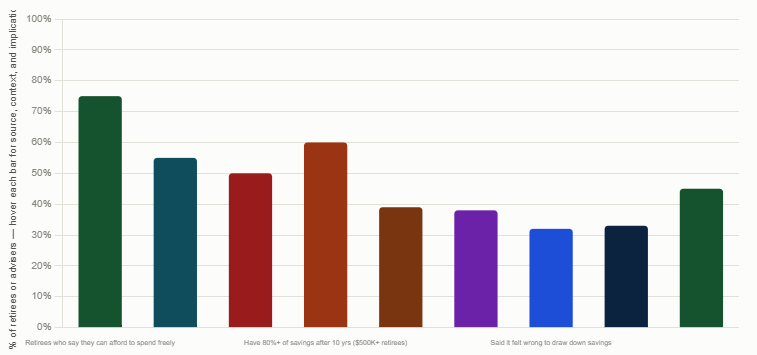
The research on this phenomenon has accelerated sharply in 2025 and 2026, and the findings are consistent enough to constitute a genuine insight about human psychology rather than an anecdote about particularly anxious individuals. The Employee Benefit Research Institute (EBRI), in research published in May 2026 drawing on three decades of Health and Retirement Study data, found that roughly one-third of retirees still held 100% or more of their original assets by their mid-eighties. These are not people who ran out of money. They are people who reached their eighties with a full balance and a list of things they never got around to doing. Kiplinger’s June 2026 investigation of a separate EBRI decumulation study found that six in ten retirees who had $500,000 or more when they retired still had at least 80% of their assets a decade in. Forty-five percent had more money than they started with.
The hardest habit for millionaires to break in retirement is not alcohol, not workaholism, not social media. It is saving — specifically, the deeply ingrained, decades-long practice of accumulating wealth that becomes so embedded in identity, routine, and self-concept that reversing it feels not like freedom but like loss.
1 in 3 retirees reach their mid-80s with 100%+ of their original savings intact (EBRI, May 2026). 6 in 10 retirees with $500K+ still have 80%+ after 10 years. 45% have MORE than they started with. 42% still have most or all after 22 years (Kiplinger Jun 2026, EBRI). 75%+ of retirees say they can afford to spend freely — but nearly half are still underspending (EBRI 2024 Spending Survey; Schwab June 2026). Only 11% of retirees identify with a 'spending mindset' vs 38% who still see themselves as 'savers' (EBRI 2024).
To contextualise that number: the 4% rule — the most widely cited safe withdrawal rate in retirement planning, based on William Bengen’s 1994 research and the Trinity Study — suggests that withdrawing 4% annually from a diversified portfolio has an extremely high historical probability of lasting 30 years. Retirees are withdrawing at half that rate. The researchers Blanchett and Finke, in a 2024 study published in the CFP Board’s Financial Planning Review journal, confirmed this empirically: they found that retirees display a ‘behavioral resistance to spending down savings,’ and that nearly 80% of a typical retiree’s lifetime spending is fuelled by Social Security, pensions, and wages rather than portfolio withdrawals. A typical 65-year-old couple withdraws just 2.1% from their portfolio annually; a single 65-year-old, just 1.9%.
The Morningstar 2025 survey of 937 retired or semi-retired people (conducted April through June 2025; reported widely through 2026) found that half of retirees rely on simplified withdrawal methods — spending only dividends, or anchoring to Required Minimum Distributions — rather than drawing down principal. And 98% had no intention of changing their withdrawal approach. Not because they had run the numbers and decided the approach was optimal. Because inertia felt safe and change felt risky.
Actual average withdrawal rate at 65: ~2% annually (Retirement Income Institute 2025; Kiplinger Jun 2026). Recommended 4% rule: half of actual withdrawals. 80% of lifetime spending fuelled by Social Security, pensions, wages — not portfolio withdrawals (Blanchett & Finke, CFP Board's Financial Planning Review, 2024). 98% of Morningstar 2025 survey respondents: no intention of changing withdrawal approach. Half rely on dividends or RMDs only (Morningstar 2025; Madison Partners Jul 2026).
For someone who has spent 35 to 45 years consistently saving 15 to 20% of their income, investing every bonus, maximising every tax-advantaged account, and making every significant financial decision through the lens of ‘does this grow or deplete my wealth?’ — the savings behaviour has been encoded deeply. It is not a strategy they implement. It is part of who they are. Fidelity research has consistently found that self-made millionaires save 15–20% or more of gross income, often starting early in their careers.
NetWorthAdvisors’ August 2026 analysis of retirement spending psychology frames the problem with unusual clarity: ‘Somewhere along the way the habit stopped being a strategy and became part of who you are. Then retirement starts and the assignment flips. The money you spent a career safeguarding is now supposed to pay for your life.’ The difficulty is not financial. It is psychological. Two households can retire simultaneously with identical savings and land in completely different places — one afraid to spend a dollar on a trip, the other spending comfortably. The variable is not the balance. It is the mindset.
“Going from the accumulating savings part to the spending part is a hard transition. Many retirees don’t spend enough, and it all comes down to their mindset.” — Kiplinger, August 2026, citing retirement adviser Van Sant
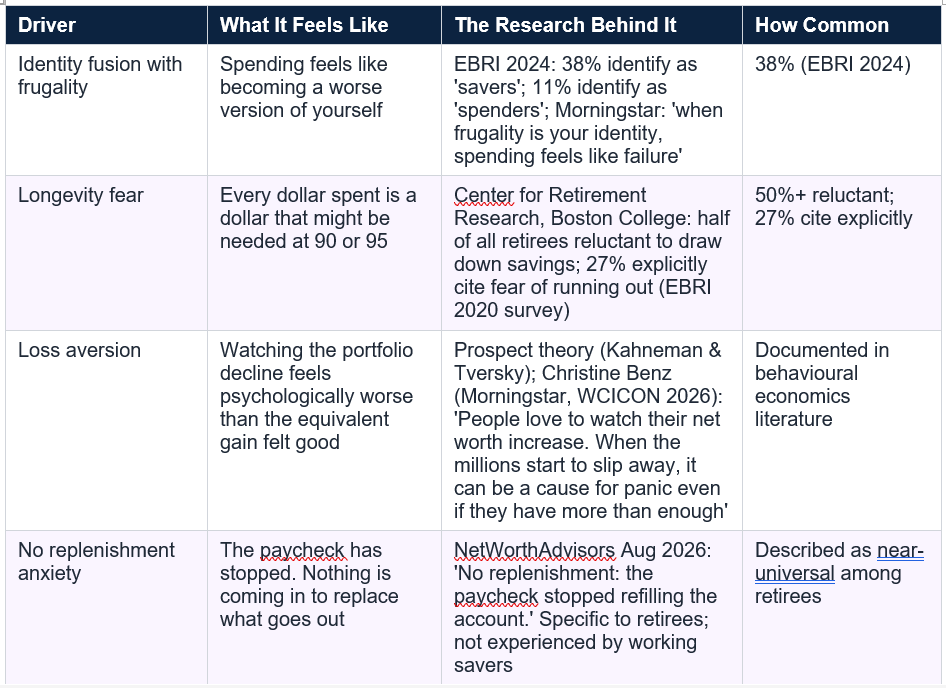
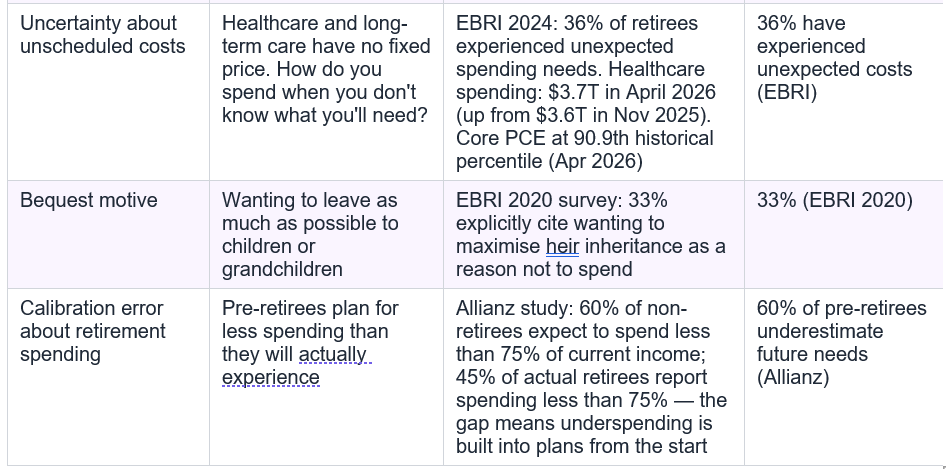
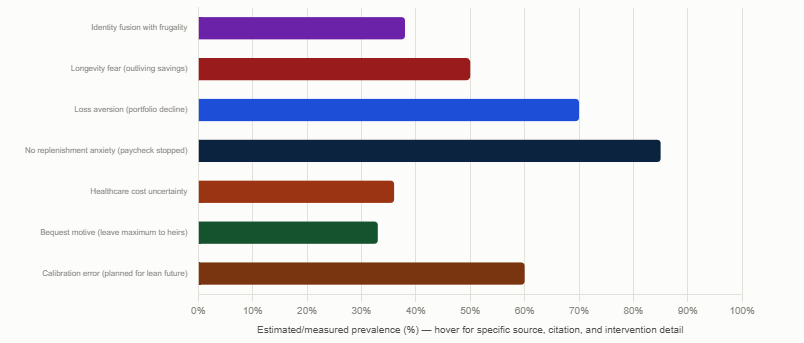
The most important insight from this list is that longevity fear and identity fusion with frugality are not the same problem and do not have the same solution. A person underspending because they genuinely fear outliving their money may benefit from a Monte Carlo analysis showing portfolio survival probabilities. A person underspending because frugality has become their identity needs a different kind of intervention — one that addresses not the financial plan but the self-concept that retirement has upended.
The three phases of retirement spending, popularised by researcher Michael Stein, align with Blanchett’s empirical data:
Schwab’s Retirement Spending Insights report (January 2026, surveying 499 semiretired and 389 retired individuals) included a respondent who expressed the dynamic with unusual clarity: ‘I know in my heart that now is the time to “treat myself,” but my frugal upbringing and worry about not having enough stop me from spending.’ Mark Riepe, CFA, head of the Schwab Center for Financial Research, made the structural point directly: ‘We tend to underestimate how disruptive it is to retire. Yes, we know it affects our finances, but it also affects our routine, our identity, and even our relationships. And this occurs no matter what kind of wealth you have.’
Christine Benz, Morningstar’s director of personal finance, described the affluent-retiree dimension of this at the 2026 White Coat Investor conference (WCICON): ‘The issue is that when it comes to turning on spending in retirement, people truly struggle with this. Especially affluent older adults who have maybe more than enough, they struggle with spending in line with what they could actually spend.’
Kiplinger’s August 2026 report on 401(k) millionaires who are afraid to spend notes that many of those clients ‘grew up watching their parents scrimp and save, and adopted that approach as well.’ The savings identity is often generational — absorbed from parents who lived through the Depression or wartime scarcity — and in those cases it carries additional emotional weight that is not responsive to financial analysis alone.
The identity problem cannot be solved by showing someone their Monte Carlo probability of portfolio survival at age 95. A person who has spent 40 years defining themselves as a saver has not built a financial strategy — they have built a self-concept. The transition to retirement spending requires updating that self-concept, not just the financial plan. For many high-net-worth retirees, this is genuinely therapeutic work, not financial work.
“The bigger fear might be the wrong one. A new study found that a third of retirees still have all their savings by their mid-80s. They saved for a life they were too scared to live.” — Briefs.co, June 8, 2026
The professional consensus on why this happens, synthesised from adviser commentary across Kiplinger, Schwab, and NetWorthAdvisors (2026):
Ramsey’s response bypassed financial analysis entirely and went straight to behavioural intervention. ‘You’ve spent 66 years building up one muscle — your saving muscle,’ Ramsey told him. Instead of making drastic financial changes, Ramsey suggested starting small. He asked Kevin how much he usually spends on a cruise vacation. Kevin estimated about $4,000. Ramsey’s suggestion: start by booking that cruise. Not $170,000. Not $17,000. $4,000. Build the spending muscle the same way you built the saving muscle — through repeated, small, intentional practice.
The Center for Retirement Research at Boston College has framed the underlying dynamic in research terms: half of all retirees are reluctant to spend or draw down savings (MoneyWise, April 2026). Kevin is not an outlier. He is the modal case. The $1.7 million makes him more visible than most, but the psychological structure of his problem — decades of saving replaced by an inability to switch modes — is experienced by a very large proportion of the population that managed to build retirement wealth.
Dave Ramsey's 'build your spending muscle' advice is behavioural economics in plain language. The habit of spending, like the habit of saving, is built through repetition. Starting with a $4,000 cruise — not a $40,000 trip — allows the brain to experience spending as safe, enjoyable, and consistent with identity. The first transaction is the hardest. The second is easier.
The actual cost is experiential. It is the trips that were deferred for ‘next year’ for ten consecutive years until the deferred health event made travel impractical. It is the grandchildren’s college funds that were not funded because it felt like too big a withdrawal. It is the renovation that would have made the house more comfortable for aging in place that was postponed until the need for the renovation and the ability to enjoy it had both passed.
Craig Copeland, EBRI’s Director of Wealth Benefits Research, was direct about this in his commentary on the May 2026 EBRI data (cited Madison Partners, July 2026): many people reaching their 80s with untouched savings means they are being far too conservative. The wealth was not built as an end in itself. It was built to provide security and enable a certain quality of life in retirement. If neither is being accessed, the wealth has failed its purpose.
NetWorthAdvisors (August 2026) identifies the warning signs of retirement underspending that are visible before the financial statement: ‘Watch for a portfolio balance that’s grown since you retired, trips you keep deferring, and withdrawals running well below what your plan allows.’ The underspending rarely announces itself as a financial problem. It announces itself as a pattern of deferred plans.
The real risk: The greatest financial risk in retirement may not be running out of money. It may be spending a life of financial abundance in a state of artificial scarcity, protecting a portfolio from a crisis that the data suggests was never coming.
Three quarters of retirees say they can afford to spend freely. Nearly half are underspending anyway. They saved brilliantly and then saved through retirement. The wealth grew. The trips were deferred. The grandchildren’s education funds waited. The renovations were delayed. The experiences that were always the point of the wealth were set aside for a financial security they had already achieved.
The answer is not to abandon financial prudence. It is to recognise that the savings habit, which was a virtue for forty years, has become a liability when the assignment changes. Retirement is not an extension of the accumulation phase. It is a different job — one for which the same habits that made the wealth possible are precisely the ones that need to be updated. The wealth was always meant to be used. The question, as with so many things in personal finance, is whether that understanding arrives in time.
The hardest habit, consistently identified in research published in 2024–2026, is the savings habit itself — specifically the deeply embedded psychological reluctance to spend down accumulated wealth. EBRI research published in May 2026, drawing on three decades of Health and Retirement Study data, found that roughly one-third of retirees still held 100% or more of their original assets by their mid-eighties. EBRI's 2024 Spending in Retirement Survey found 38% of retirees described themselves as having a 'savings mindset' versus only 11% who identified with a 'spending mindset.' More than 75% of retirees agree they can afford to spend freely — but nearly half are still underspending. The habit that built the wealth has become the habit that prevents the wealth from being used for its intended purpose.
Why are retirees afraid to spend their savings?
Research identifies several overlapping psychological drivers: (1) Identity fusion — frugality has become personality, not just strategy; (2) Longevity fear — the worry of outliving savings at 90 or 95; (3) Loss aversion — watching the portfolio decline feels worse than the equivalent gain felt good; (4) No replenishment anxiety — the paycheck stopped and nothing is refilling the account; (5) Healthcare uncertainty — unknown future costs create precautionary hoarding; (6) Bequest motive — wanting to leave maximum wealth to heirs; (7) Calibration error — 60% of pre-retirees plan to spend less than they actually will. These drivers reinforce each other and are often active simultaneously. Importantly, they are not all irrational — longevity risk, healthcare cost growth, and inflation are genuine risks — but the typical response to them (2% annual withdrawals versus the evidence-based 4% safe rate) is far more conservative than the evidence warrants.
Is it really possible to save too much in retirement?
In the strict financial sense, no — a larger portfolio provides more security. But in the experiential sense, yes: if saving behaviour in retirement means deferring experiences, gifts, and activities that were the reason for building the wealth in the first place, then the wealth has failed its purpose. EBRI's May 2026 data, drawing on 30 years of Health and Retirement Study data, found one-third of retirees reaching their mid-80s with their full nest egg intact — not because they planned to, but because the savings habit did not turn off. Kiplinger (June 2026) found that 42% of retirees still had most, all, or more than all of their original savings even after 22 years in retirement. Craig Copeland of EBRI described those with untouched savings in their 80s as 'being far too conservative.'
What is the retirement spending smile and why does it matter?
The retirement spending smile, identified by researcher David Blanchett of Morningstar, describes the U-shaped curve of real spending through retirement. In the Go-Go years (roughly 65–75), spending is highest as retirees travel, socialise, and pursue activities. In the Slow-Go years (75–85), reduced physical capability naturally reduces spending on experiences. In the No-Go years (85+), spending is dominated by healthcare and support costs while discretionary spending is minimal. Blanchett's data shows real spending drops 1–2% per year through the later phases, meaning retirees may need as much as 20% less over a full retirement than flat-line planning models assume (Madison Partners, July 2026). The implication: standard flat-line spending models overestimate future spending needs, making early-retirement underspending even more unnecessary than it appears.
How can a millionaire retiree start spending more comfortably?
Four evidence-based strategies: (1) Permission from data — ask a financial adviser for a Monte Carlo portfolio survival analysis at 4–5% withdrawal rates. Seeing 95%+ survival probability across thousands of market scenarios converts abstract fear into specific evidence; (2) Purpose-connected spending — name what you saved for (travel, grandchildren's education, gifts while alive, experiences) and connect withdrawals to those specific named purposes rather than abstract withdrawals; (3) Start small (Dave Ramsey's 'build your spending muscle' advice from April 2026) — make one intentional discretionary spending decision at a manageable scale and notice that the world does not end; (4) Paycheck replacement — restructure the income framework by setting up regular automatic portfolio transfers that replicate a salary rhythm, removing the anxiety-triggering decision from each spending event.
How much should retirees be withdrawing annually?
The 4% rule — first articulated by William Bengen in 1994 and subsequently validated by the Trinity Study — suggests that withdrawing 4% of an inflation-adjusted portfolio annually has an extremely high historical probability of lasting 30 years across most market scenarios. Research by Blanchett and Finke (CFP Board's Financial Planning Review, 2024) found that typical actual withdrawal behaviour is approximately 2% annually — half the widely recommended rate. For investors with strong risk tolerance and diversified portfolios, some research supports rates as high as 4.5–5% under current conditions. The appropriate rate for any individual depends on their specific portfolio, income sources, longevity expectations, health trajectory, and spending goals. The point is that 2% is, in most cases, far below what the evidence supports as a safe rate — and the financial cost of the gap is measured in deferred living, not financial prudence. Always consult a qualified financial adviser for individual guidance.
The Underspending Data: What Retirees say, do, And Still Have By their 80s
The 7 Psychological Drivers: Why The Savings Habit Won't Turn Off.
Table of Contents
- The Problem Nobody Warns You About
- The Data: How Much Are Retirees Actually Spending?
- The Habit That Built the Wealth Is the Same One Blocking the Life
- The Seven Psychological Drivers of Retirement Underspending
- The Retirement Spending Smile: Why Flat-Line Spending Plans Are Wrong
- The Identity Problem: When Frugality Becomes Personality
- The Fear of Running Out: Is It Rational in 2026?
- What 55% of Financial Advisers Are Seeing in Their Clients
- The Kevin Problem: Dave Ramsey’s $1.7 Million Wake-Up Call
- The Real Cost of Underspending: Trips Never Taken
- Four Strategies That Actually Help Millionaires Start Spending
- What to Say to a Financial Adviser About This Problem
- Conclusion: The Wealth Was Always Meant to Be Used
- Frequently Asked Questions
The Problem Nobody Warns You About
The financial press spends decades warning people about the risk of not saving enough for retirement. It runs relatively few articles about what happens to the people who saved brilliantly, arrived at retirement with seven figures, and then found they could not bring themselves to spend it.The research on this phenomenon has accelerated sharply in 2025 and 2026, and the findings are consistent enough to constitute a genuine insight about human psychology rather than an anecdote about particularly anxious individuals. The Employee Benefit Research Institute (EBRI), in research published in May 2026 drawing on three decades of Health and Retirement Study data, found that roughly one-third of retirees still held 100% or more of their original assets by their mid-eighties. These are not people who ran out of money. They are people who reached their eighties with a full balance and a list of things they never got around to doing. Kiplinger’s June 2026 investigation of a separate EBRI decumulation study found that six in ten retirees who had $500,000 or more when they retired still had at least 80% of their assets a decade in. Forty-five percent had more money than they started with.
The hardest habit for millionaires to break in retirement is not alcohol, not workaholism, not social media. It is saving — specifically, the deeply ingrained, decades-long practice of accumulating wealth that becomes so embedded in identity, routine, and self-concept that reversing it feels not like freedom but like loss.
1 in 3 retirees reach their mid-80s with 100%+ of their original savings intact (EBRI, May 2026). 6 in 10 retirees with $500K+ still have 80%+ after 10 years. 45% have MORE than they started with. 42% still have most or all after 22 years (Kiplinger Jun 2026, EBRI). 75%+ of retirees say they can afford to spend freely — but nearly half are still underspending (EBRI 2024 Spending Survey; Schwab June 2026). Only 11% of retirees identify with a 'spending mindset' vs 38% who still see themselves as 'savers' (EBRI 2024).
The Data: How Much Are Retirees Actually Spending?
The gap between what retirees could withdraw and what they actually withdraw is one of the most striking findings in retirement research. A 2025 analysis from the Retirement Income Institute, cited by Kiplinger in June 2026 and by the Two River Times in August–September 2026, found that 65-year-old retirees withdraw only about 2% of their savings annually on average.To contextualise that number: the 4% rule — the most widely cited safe withdrawal rate in retirement planning, based on William Bengen’s 1994 research and the Trinity Study — suggests that withdrawing 4% annually from a diversified portfolio has an extremely high historical probability of lasting 30 years. Retirees are withdrawing at half that rate. The researchers Blanchett and Finke, in a 2024 study published in the CFP Board’s Financial Planning Review journal, confirmed this empirically: they found that retirees display a ‘behavioral resistance to spending down savings,’ and that nearly 80% of a typical retiree’s lifetime spending is fuelled by Social Security, pensions, and wages rather than portfolio withdrawals. A typical 65-year-old couple withdraws just 2.1% from their portfolio annually; a single 65-year-old, just 1.9%.
The Morningstar 2025 survey of 937 retired or semi-retired people (conducted April through June 2025; reported widely through 2026) found that half of retirees rely on simplified withdrawal methods — spending only dividends, or anchoring to Required Minimum Distributions — rather than drawing down principal. And 98% had no intention of changing their withdrawal approach. Not because they had run the numbers and decided the approach was optimal. Because inertia felt safe and change felt risky.
Actual average withdrawal rate at 65: ~2% annually (Retirement Income Institute 2025; Kiplinger Jun 2026). Recommended 4% rule: half of actual withdrawals. 80% of lifetime spending fuelled by Social Security, pensions, wages — not portfolio withdrawals (Blanchett & Finke, CFP Board's Financial Planning Review, 2024). 98% of Morningstar 2025 survey respondents: no intention of changing withdrawal approach. Half rely on dividends or RMDs only (Morningstar 2025; Madison Partners Jul 2026).
The Habit That Built the Wealth Is the Same One Blocking the Life
To understand why the savings habit is so hard to break, it helps to understand what a habit actually is at the neurological level. A habit is a behaviour pattern that has been encoded into the brain’s basal ganglia — the part of the brain responsible for procedural learning and automatic behaviour. Once encoded, habitual behaviour requires less cognitive effort than conscious decision-making. It runs on autopilot.For someone who has spent 35 to 45 years consistently saving 15 to 20% of their income, investing every bonus, maximising every tax-advantaged account, and making every significant financial decision through the lens of ‘does this grow or deplete my wealth?’ — the savings behaviour has been encoded deeply. It is not a strategy they implement. It is part of who they are. Fidelity research has consistently found that self-made millionaires save 15–20% or more of gross income, often starting early in their careers.
NetWorthAdvisors’ August 2026 analysis of retirement spending psychology frames the problem with unusual clarity: ‘Somewhere along the way the habit stopped being a strategy and became part of who you are. Then retirement starts and the assignment flips. The money you spent a career safeguarding is now supposed to pay for your life.’ The difficulty is not financial. It is psychological. Two households can retire simultaneously with identical savings and land in completely different places — one afraid to spend a dollar on a trip, the other spending comfortably. The variable is not the balance. It is the mindset.
“Going from the accumulating savings part to the spending part is a hard transition. Many retirees don’t spend enough, and it all comes down to their mindset.” — Kiplinger, August 2026, citing retirement adviser Van Sant
The Seven Psychological Drivers of Retirement Underspending
The research identifies a consistent set of psychological mechanisms that produce the underspending pattern. Each is distinct; most retirees experience several simultaneously:The most important insight from this list is that longevity fear and identity fusion with frugality are not the same problem and do not have the same solution. A person underspending because they genuinely fear outliving their money may benefit from a Monte Carlo analysis showing portfolio survival probabilities. A person underspending because frugality has become their identity needs a different kind of intervention — one that addresses not the financial plan but the self-concept that retirement has upended.
The Retirement Spending Smile: Why Flat-Line Spending Plans Are Wrong
One of the most consequential errors in retirement planning is the assumption of flat or inflation-adjusted-constant spending across all years of retirement. Researcher David Blanchett of Morningstar challenged this assumption with his concept of the ‘retirement spending smile’ — a finding that real spending follows a U-shaped curve through retirement, not a flat line.The three phases of retirement spending, popularised by researcher Michael Stein, align with Blanchett’s empirical data:
- Go-Go years (roughly 65–75): active retirement. Travel, hobbies, social life, family activities. This is the phase when spending is genuinely highest and the financial case for spending now — while health and energy permit — is strongest.
- Slow-Go years (roughly 75–85): reduced physical capability means many activities become impractical. Travel becomes less common. Social activity narrows. Spending on experiences decreases organically, even in the absence of any financial pressure.
- No-Go years (roughly 85+): the phase where many retirees are doing the least — often in more sedentary or supported living situations — and where healthcare costs dominate the budget but discretionary spending is minimal. This is the phase where, per the EBRI research, a full third still have 100%+ of their original savings.
The Identity Problem: When Frugality Becomes Personality
The most persistent form of the savings habit in retirement is the one that has moved from behaviour to identity. For many high-net-worth retirees, particularly those who built wealth through a lifetime of disciplined saving rather than inheritance or windfall, frugality is not a tactic they use. It is part of who they are.Schwab’s Retirement Spending Insights report (January 2026, surveying 499 semiretired and 389 retired individuals) included a respondent who expressed the dynamic with unusual clarity: ‘I know in my heart that now is the time to “treat myself,” but my frugal upbringing and worry about not having enough stop me from spending.’ Mark Riepe, CFA, head of the Schwab Center for Financial Research, made the structural point directly: ‘We tend to underestimate how disruptive it is to retire. Yes, we know it affects our finances, but it also affects our routine, our identity, and even our relationships. And this occurs no matter what kind of wealth you have.’
Christine Benz, Morningstar’s director of personal finance, described the affluent-retiree dimension of this at the 2026 White Coat Investor conference (WCICON): ‘The issue is that when it comes to turning on spending in retirement, people truly struggle with this. Especially affluent older adults who have maybe more than enough, they struggle with spending in line with what they could actually spend.’
Kiplinger’s August 2026 report on 401(k) millionaires who are afraid to spend notes that many of those clients ‘grew up watching their parents scrimp and save, and adopted that approach as well.’ The savings identity is often generational — absorbed from parents who lived through the Depression or wartime scarcity — and in those cases it carries additional emotional weight that is not responsive to financial analysis alone.
The identity problem cannot be solved by showing someone their Monte Carlo probability of portfolio survival at age 95. A person who has spent 40 years defining themselves as a saver has not built a financial strategy — they have built a self-concept. The transition to retirement spending requires updating that self-concept, not just the financial plan. For many high-net-worth retirees, this is genuinely therapeutic work, not financial work.
The Fear of Running Out: Is It Rational in 2026?
It would be unfair to characterise retirement underspending as simply irrational. The fears that underpin it are real, and some of them are empirically grounded:- Longevity risk is genuine: life expectancy has increased substantially over the past half-century, and a 65-year-old couple today has a meaningful probability of one spouse living to 90 or beyond. A 25–30 year retirement is not unusual.
- Healthcare costs are rising: healthcare spending in the US reached $3.7 trillion in April 2026, up from $3.6 trillion in November 2025 (24/7 Wall St., citing BEA data). For a retiree, healthcare costs tend to increase with age precisely when portfolio withdrawals would otherwise be declining.
- Inflation is real and recent: core PCE, the Federal Reserve’s preferred inflation gauge, was at the 90.9th percentile of its historical distribution as of April 2026. A retiree who watched purchasing power erode significantly in 2022–2023 has reasonable grounds for inflation caution.
- Market volatility is unpredictable: the sequence-of-returns risk — a significant market decline early in retirement permanently reduces portfolio longevity at a given withdrawal rate — is a genuine structural concern, particularly for those retiring into elevated valuations.
“The bigger fear might be the wrong one. A new study found that a third of retirees still have all their savings by their mid-80s. They saved for a life they were too scared to live.” — Briefs.co, June 8, 2026
What 55% of Financial Advisers Are Seeing in Their Clients
The view from professional practice confirms what the research suggests. The White Coat Investor’s May 2026 article on retirement spending psychology reports that 55% of financial professionals say many of their clients spend “much less” than they can afford in retirement. Three-quarters of retirees reported that their assets remained the same or actually grew during retirement.The professional consensus on why this happens, synthesised from adviser commentary across Kiplinger, Schwab, and NetWorthAdvisors (2026):
- Underspending is harder to detect than overspending because it does not create a financial crisis. A balance that is flat or growing does not trigger a review. Only when the opportunity cost becomes visible — a trip deferred for the fifth year, a grandchild’s college fund not funded, a home improvement that keeps being delayed — does the pattern become apparent.
- Advisers who raise the topic of underspending proactively are more effective than those who wait for clients to bring it up, because clients with a savings identity are less likely to spontaneously identify underspending as a problem. It feels like virtue, not a problem.
- The most effective intervention is not a financial analysis but a values conversation: what did you save for? What experiences or contributions do you want your wealth to enable? When the money is connected to a specific purpose rather than an abstract security function, it becomes easier to spend.
- Permission from a trusted professional matters enormously to high-net-worth retirees who have been financially cautious their entire lives. Many clients, after a portfolio review showing comfortable survivability at higher withdrawal rates, describe a sense of relief rather than concern. The adviser’s role becomes partly permission-giver rather than solely portfolio manager.
The Kevin Problem: Dave Ramsey’s $1.7 Million Wake-Up Call
In April 2026, MoneyWise reported on a Dave Ramsey radio show segment that attracted significant attention because it articulated the savings-habit problem with unusual personal specificity. A caller — referred to as Kevin, aged 66 — called in to describe his situation: he had $1.7 million in the bank and was still afraid to spend. He was not a marginal case. He had more than enough. He was genuinely unable to bring himself to use it.Ramsey’s response bypassed financial analysis entirely and went straight to behavioural intervention. ‘You’ve spent 66 years building up one muscle — your saving muscle,’ Ramsey told him. Instead of making drastic financial changes, Ramsey suggested starting small. He asked Kevin how much he usually spends on a cruise vacation. Kevin estimated about $4,000. Ramsey’s suggestion: start by booking that cruise. Not $170,000. Not $17,000. $4,000. Build the spending muscle the same way you built the saving muscle — through repeated, small, intentional practice.
The Center for Retirement Research at Boston College has framed the underlying dynamic in research terms: half of all retirees are reluctant to spend or draw down savings (MoneyWise, April 2026). Kevin is not an outlier. He is the modal case. The $1.7 million makes him more visible than most, but the psychological structure of his problem — decades of saving replaced by an inability to switch modes — is experienced by a very large proportion of the population that managed to build retirement wealth.
Dave Ramsey's 'build your spending muscle' advice is behavioural economics in plain language. The habit of spending, like the habit of saving, is built through repetition. Starting with a $4,000 cruise — not a $40,000 trip — allows the brain to experience spending as safe, enjoyable, and consistent with identity. The first transaction is the hardest. The second is easier.
The Real Cost of Underspending: Trips Never Taken
The financial analysis of retirement underspending typically focuses on the portfolio implications: portfolios are growing when they should be declining; the 4% rule is being applied at half its recommended rate; heirs will receive unexpectedly large estates that were not planned for. These are real observations. But the actual cost of underspending is not financial.The actual cost is experiential. It is the trips that were deferred for ‘next year’ for ten consecutive years until the deferred health event made travel impractical. It is the grandchildren’s college funds that were not funded because it felt like too big a withdrawal. It is the renovation that would have made the house more comfortable for aging in place that was postponed until the need for the renovation and the ability to enjoy it had both passed.
Craig Copeland, EBRI’s Director of Wealth Benefits Research, was direct about this in his commentary on the May 2026 EBRI data (cited Madison Partners, July 2026): many people reaching their 80s with untouched savings means they are being far too conservative. The wealth was not built as an end in itself. It was built to provide security and enable a certain quality of life in retirement. If neither is being accessed, the wealth has failed its purpose.
NetWorthAdvisors (August 2026) identifies the warning signs of retirement underspending that are visible before the financial statement: ‘Watch for a portfolio balance that’s grown since you retired, trips you keep deferring, and withdrawals running well below what your plan allows.’ The underspending rarely announces itself as a financial problem. It announces itself as a pattern of deferred plans.
The real risk: The greatest financial risk in retirement may not be running out of money. It may be spending a life of financial abundance in a state of artificial scarcity, protecting a portfolio from a crisis that the data suggests was never coming.
Four Strategies That Actually Help Millionaires Start Spending
The interventions that work for retirement underspending are not primarily financial. They are behavioural, psychological, and structural. The following four approaches have the strongest evidence base across the research and adviser commentary reviewed for this article:- Strategy 1 — Permission from data: many high-net-worth retirees have never seen a Monte Carlo simulation of their portfolio’s survival probability across thousands of market scenarios. When a qualified financial adviser shows a client that their portfolio survives 95%+ of scenarios even at 4% or 5% annual withdrawals, many clients describe genuine relief. The fear is not irrational — it has simply never been tested against the evidence. Having a professional run the numbers and present the results clearly is often the first effective intervention.
- Strategy 2 — Purpose-connected spending: the financial plan needs to connect spending to specific purposes that were always the point of the wealth. Instead of asking ‘how much can I withdraw?’ — which feels like an abstract financial question — the question becomes ‘what did we save for?’ Travel, grandchildren’s education, supporting causes, making gifts while alive to see their impact, home improvements, experiences with the people we love. Named purposes are easier to spend on than abstract withdrawals.
- Strategy 3 — Start small and build the habit (Ramsey’s $4,000 cruise approach): deliberately beginning with a spending decision that is meaningful but not enormous allows the brain to experience spending as safe and as consistent with identity. The first intentional spending decision is the hardest. Each subsequent one becomes marginally easier. The goal is to build a spending habit with the same intentionality with which the saving habit was built.
- Strategy 4 — Restructure the income framework: Schwab’s June 2026 research notes that advisers who help retirees restructure their thinking from ‘I’m drawing down my savings’ to ‘I’m receiving income from my lifetime investment portfolio’ find that clients spend more freely. A ‘paycheck replacement’ strategy — setting up regular automatic transfers from the portfolio to the bank account that replicate the rhythm of a salary — removes the decision-making that triggers anxiety and creates a new habit structure that feels more like receiving income than depleting savings.
12. What to Say to a Financial Adviser About This Problem
Many retirees with this problem do not raise it with their financial adviser because it does not present as a financial problem. It presents as caution, prudence, or conservative values. Three specific conversation-starters that help:- ‘I’d like to see the Monte Carlo on my portfolio at 4% withdrawal rate.’ This requests the analysis that converts abstract fear into evidence-based probability. Most advisers can produce this immediately. Seeing 95%+ portfolio survival across thousands of simulated markets is often the most persuasive single data point available.
- ‘Can we look at what my portfolio would need to look like for me to feel comfortable spending more?’ This frames the question as a financial goal rather than a psychological limitation, which makes it easier to raise. It also gives the adviser a framework for understanding the specific threshold below which the client feels insecure.
- ‘What do your other clients at a similar wealth level typically spend each year?’ Asking for a reference class is a way of testing whether the level of spending restraint is unusual. If an adviser says ‘most clients similar to you spend significantly more than you do,’ that is meaningful social proof.
Conclusion
The hardest habit for millionaires to break in retirement is the savings habit — and the evidence from 2025–2026 shows this is not an individual quirk but a structural feature of how wealth-building affects psychology and identity. One third of retirees reach their mid-eighties with their full original savings intact, not because they planned to, but because the decades-long habit of accumulation simply did not turn off when the accumulation phase ended.Three quarters of retirees say they can afford to spend freely. Nearly half are underspending anyway. They saved brilliantly and then saved through retirement. The wealth grew. The trips were deferred. The grandchildren’s education funds waited. The renovations were delayed. The experiences that were always the point of the wealth were set aside for a financial security they had already achieved.
The answer is not to abandon financial prudence. It is to recognise that the savings habit, which was a virtue for forty years, has become a liability when the assignment changes. Retirement is not an extension of the accumulation phase. It is a different job — one for which the same habits that made the wealth possible are precisely the ones that need to be updated. The wealth was always meant to be used. The question, as with so many things in personal finance, is whether that understanding arrives in time.
Frequently Asked Questions
What is the hardest habit for millionaires to break in retirement?The hardest habit, consistently identified in research published in 2024–2026, is the savings habit itself — specifically the deeply embedded psychological reluctance to spend down accumulated wealth. EBRI research published in May 2026, drawing on three decades of Health and Retirement Study data, found that roughly one-third of retirees still held 100% or more of their original assets by their mid-eighties. EBRI's 2024 Spending in Retirement Survey found 38% of retirees described themselves as having a 'savings mindset' versus only 11% who identified with a 'spending mindset.' More than 75% of retirees agree they can afford to spend freely — but nearly half are still underspending. The habit that built the wealth has become the habit that prevents the wealth from being used for its intended purpose.
Why are retirees afraid to spend their savings?
Research identifies several overlapping psychological drivers: (1) Identity fusion — frugality has become personality, not just strategy; (2) Longevity fear — the worry of outliving savings at 90 or 95; (3) Loss aversion — watching the portfolio decline feels worse than the equivalent gain felt good; (4) No replenishment anxiety — the paycheck stopped and nothing is refilling the account; (5) Healthcare uncertainty — unknown future costs create precautionary hoarding; (6) Bequest motive — wanting to leave maximum wealth to heirs; (7) Calibration error — 60% of pre-retirees plan to spend less than they actually will. These drivers reinforce each other and are often active simultaneously. Importantly, they are not all irrational — longevity risk, healthcare cost growth, and inflation are genuine risks — but the typical response to them (2% annual withdrawals versus the evidence-based 4% safe rate) is far more conservative than the evidence warrants.
Is it really possible to save too much in retirement?
In the strict financial sense, no — a larger portfolio provides more security. But in the experiential sense, yes: if saving behaviour in retirement means deferring experiences, gifts, and activities that were the reason for building the wealth in the first place, then the wealth has failed its purpose. EBRI's May 2026 data, drawing on 30 years of Health and Retirement Study data, found one-third of retirees reaching their mid-80s with their full nest egg intact — not because they planned to, but because the savings habit did not turn off. Kiplinger (June 2026) found that 42% of retirees still had most, all, or more than all of their original savings even after 22 years in retirement. Craig Copeland of EBRI described those with untouched savings in their 80s as 'being far too conservative.'
What is the retirement spending smile and why does it matter?
The retirement spending smile, identified by researcher David Blanchett of Morningstar, describes the U-shaped curve of real spending through retirement. In the Go-Go years (roughly 65–75), spending is highest as retirees travel, socialise, and pursue activities. In the Slow-Go years (75–85), reduced physical capability naturally reduces spending on experiences. In the No-Go years (85+), spending is dominated by healthcare and support costs while discretionary spending is minimal. Blanchett's data shows real spending drops 1–2% per year through the later phases, meaning retirees may need as much as 20% less over a full retirement than flat-line planning models assume (Madison Partners, July 2026). The implication: standard flat-line spending models overestimate future spending needs, making early-retirement underspending even more unnecessary than it appears.
How can a millionaire retiree start spending more comfortably?
Four evidence-based strategies: (1) Permission from data — ask a financial adviser for a Monte Carlo portfolio survival analysis at 4–5% withdrawal rates. Seeing 95%+ survival probability across thousands of market scenarios converts abstract fear into specific evidence; (2) Purpose-connected spending — name what you saved for (travel, grandchildren's education, gifts while alive, experiences) and connect withdrawals to those specific named purposes rather than abstract withdrawals; (3) Start small (Dave Ramsey's 'build your spending muscle' advice from April 2026) — make one intentional discretionary spending decision at a manageable scale and notice that the world does not end; (4) Paycheck replacement — restructure the income framework by setting up regular automatic portfolio transfers that replicate a salary rhythm, removing the anxiety-triggering decision from each spending event.
How much should retirees be withdrawing annually?
The 4% rule — first articulated by William Bengen in 1994 and subsequently validated by the Trinity Study — suggests that withdrawing 4% of an inflation-adjusted portfolio annually has an extremely high historical probability of lasting 30 years across most market scenarios. Research by Blanchett and Finke (CFP Board's Financial Planning Review, 2024) found that typical actual withdrawal behaviour is approximately 2% annually — half the widely recommended rate. For investors with strong risk tolerance and diversified portfolios, some research supports rates as high as 4.5–5% under current conditions. The appropriate rate for any individual depends on their specific portfolio, income sources, longevity expectations, health trajectory, and spending goals. The point is that 2% is, in most cases, far below what the evidence supports as a safe rate — and the financial cost of the gap is measured in deferred living, not financial prudence. Always consult a qualified financial adviser for individual guidance.
0 Comments
Be the first to share your thoughts on this article.