

Self Development
Want to Be Happy? Here's How Much Money You Actually Need

For decades, the answer seemed settled: $75,000. That was the number Nobel Prize-winning psychologist Daniel Kahneman and economist Angus Deaton put on happiness in 2010, and the media ran with it. Beyond $75,000 a year, the story went, more money does not make you happier. Then Wharton’s Matthew Killingsworth came along with 1.7 million data points and overturned it. Then he and Kahneman collaborated to settle their disagreement. Then Killingsworth extended the data to billionaires. The science on money and happiness has never been more definitive — or more surprising. Here is what the latest research actually shows, and what it means for the rest of us. Not financial or psychological advice.

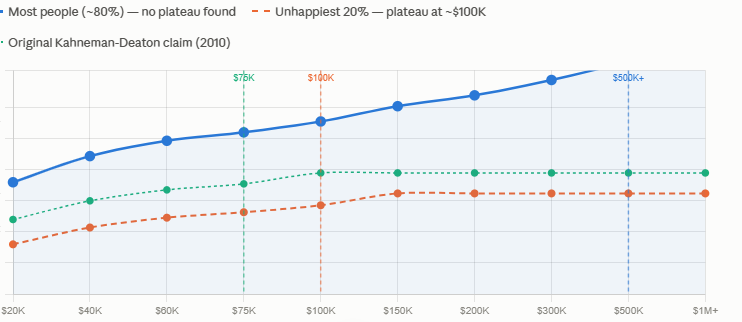
The short version of where the science stands in 2025: for most people, more money is associated with more happiness, and this association does not appear to plateau at $75,000, $200,000, or even $500,000. The happiness gap between wealthy and middle-income people is nearly three times larger than the gap between middle- and low-income people. But there is an exception group — roughly the unhappiest 20% of people, whose unhappiness stems from causes that money genuinely cannot fix. And beyond the income question, there is an entirely separate and arguably more actionable finding: how you spend money matters as much as how much you have. Not financial advice.
Key statistics in brief: Original threshold (Kahneman & Deaton 2010): $75,000/year plateau — 450,000 Americans, Gallup data. Killingsworth 2021 (1,725,994 experience samples, 33,391 US adults): no plateau found up to $200,000+. Adversarial collaboration 2023 (Kahneman, Killingsworth, Mellers): plateau confirmed for ~20% unhappiest people at ~$100,000; no plateau for ~80% majority up to $500,000+. Killingsworth 2024 extended: millionaires and billionaires significantly happier than $500K+ earners; wealth-happiness gap between rich and middle-income nearly 3x larger than middle-to-low-income gap. Sources: PNAS 2021; Penn Today 2023; Bloomberg July 2024; Wealth Management July 2024.
The nuance that got lost in translation: Kahneman and Deaton distinguished between two kinds of happiness. Life satisfaction — how you evaluate your life overall when asked — kept rising with income well beyond $75,000. It was only emotional wellbeing — how often you experience positive feelings and how rarely you experience negative ones in daily life — that appeared to level off. But the $75,000 figure entered popular culture as a clean universal threshold, and it stuck there for over a decade. The study was well-designed for its time. It used retrospective survey data — people’s recollections of their feelings — and had an upper income limit in the dataset that made it hard to say anything about earners above $120,000.
Adjusted for inflation from 2010, the $75,000 figure is approximately $108,000 in today’s dollars (NewsNation 2024). But even at that level, the subsequent research suggests the plateau was an artefact of the method, not a genuine psychological phenomenon. Not financial advice.
His finding: happiness continued to rise with income throughout the entire income range studied, with no plateau visible up to $200,000 or beyond. The more you earned, on average, the happier your moment-to-moment emotional experience. This directly contradicted the Kahneman-Deaton plateau finding. Killingsworth attributed the discrepancy partly to methodology: the real-time experience sampling captured people’s actual feelings more accurately than retrospective recall surveys, which tend to be dominated by how people think they feel rather than what they actually felt throughout their day.
The research generated significant scientific and media attention, precisely because it overturned such a well-established finding. It set the stage for an unusual scientific showdown between two of the leading researchers in the field. Not financial advice.
Killingsworth (2024, Bloomberg, July 17): 'The magnitude of the difference between the low and high end of incomes is gigantic. Within the bounds of what money can explain, a huge amount of that difference occurs above the median income.' (Bloomberg / Wealth Management July 2024.) And from the 2021 paper: 'Experienced well-being rises with income, even above $75,000 per year.' (PNAS 2021.)
The reconciled finding: both were partially right, but for different groups of people. For the approximately 80% majority of participants, happiness rose continuously with income with no clear plateau, at least up to $500,000 per year. For the unhappiest roughly 20% of participants — those experiencing the deepest unhappiness — happiness did rise with income up to approximately $100,000 per year, and then showed no further benefit from higher income. The cause of their unhappiness appeared to be something income could not address: serious relationship problems, health crises, grief, or other non-financial sources of suffering. More money was not the fix.
Killingsworth’s summary of the collaborative finding, widely cited across publications: ‘If you’re rich and miserable, more money won’t help.’ (UPenn press release, cited Kiplinger; Penn Today.) The maximum threshold — if it exists at all — is now estimated at $500,000 per year or beyond, more than six times the original $75,000 figure even before inflation adjustment. Not financial advice.
The adversarial collaboration result (Kahneman, Killingsworth & Mellers 2023): For ~80% of people: happiness rises continuously with income, no plateau up to $500,000+/year. For ~20% (unhappiest group): happiness rises to approximately $100,000/year, then stops improving. The unhappiest group's plateau reflects unhappiness from causes that income cannot address — serious health, relationship, or emotional problems. 'If you're rich and miserable, more money won't help.' Key caveat: correlation is not causation — the studies show association, not proof that money causes happiness. Sources: Penn Today 2023; Kiplinger; NewsNation; Bloomberg July 2024.
The answer: yes. Both millionaires and billionaires reported significantly higher wellbeing than people earning over $500,000 per year. The association between wealth and happiness continued up the economic ladder without any clear satiation point in the data. Crucially, Killingsworth also found that the happiness gap between wealthy and middle-income people was nearly three times larger than the gap between middle- and low-income people — directly challenging the intuition that ‘the marginal utility of money diminishes’ and that the biggest gains come from poverty to middle class.
His own caveat deserves to be quoted directly: ‘It remains possible that some threshold exists beyond which more money is no longer associated with greater happiness. But the point to recognise here is that the existence of a plateau is not predicted mathematically.’ The science does not prove there is no limit — it simply says that no limit has been found in any dataset examined so far. Not financial advice.
The counterintuitive 2024 finding: the happiness gap between WEALTHY and MIDDLE-INCOME people is nearly THREE TIMES LARGER than the gap between middle-income and low-income people. Most of us assume the biggest happiness gains from money come in pulling people out of poverty and into middle-class security. Killingsworth's data suggests the gains continue accumulating, and the absolute difference in happiness between a median earner and a millionaire is substantially larger than between a low earner and a median earner. 'This sizable difference offers a counterpoint to the frequent claim that money is only associated with small differences in well-being.' (Killingsworth 2024.) Not financial advice.
The researchers concluded that this plateau reflected the nature of these individuals’ unhappiness, not a general law about money. Their unhappiness was driven by factors that money cannot buy away: a severely damaged relationship, a grief that will not pass, a serious health diagnosis, clinical depression, or other deep personal suffering. Once the acute financial stressors were addressed at around the $100,000 level, throwing more money at the problem simply did not reach the cause. Killingsworth’s memorable summary: ‘If you’re rich and miserable, more money won’t help.’
This is perhaps the most practically useful finding in the entire body of research. If your unhappiness is primarily caused by financial stress — debt, insecurity, inability to cover emergencies, fear about the future — then increasing your income will reliably reduce it. If your unhappiness stems primarily from relationship breakdown, grief, chronic illness, or mental health conditions, then the path to happiness runs through those specific problems, not through your salary. Not financial advice. If you are experiencing mental health difficulties, please consult a qualified professional.
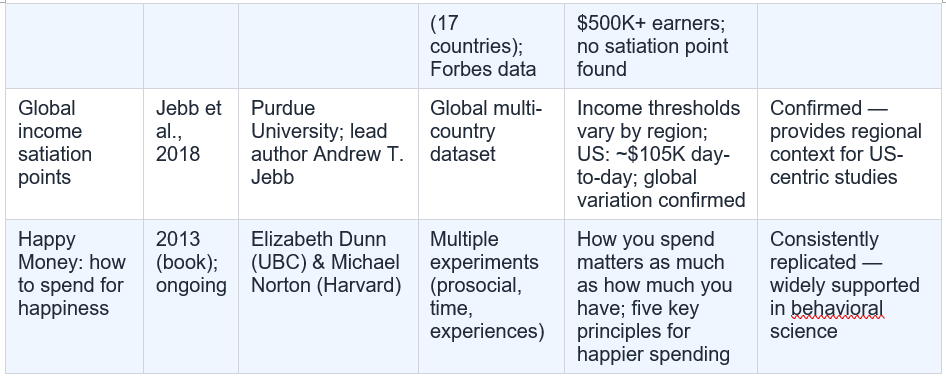
Jebb’s observation: ‘There was substantial variation across world regions, with satiation occurring later in wealthier regions for life satisfaction.’ This means that in richer countries, it takes more money to reach the point (if it exists) where additional income stops moving the happiness needle — consistent with the finding that absolute income levels matter but so does how your income compares to the reference group around you. Living in an expensive city among high-earning peers requires more income to achieve the same felt sense of financial security than living in a lower-cost community.
The Purdue findings also highlight the importance of purchasing power parity: $75,000 in San Francisco and $75,000 in rural Mississippi represent very different financial realities. Any flat dollar threshold is necessarily an oversimplification of a phenomenon that is deeply contextual. Not financial advice.
But several important qualifiers frame the answer. First, the studies measure association, not causation. Happier people may also earn more, for reasons that include their social skills, health, and psychological stability. Second, the studies measure average associations — individual variation is enormous. Third, and most crucially, the research consistently shows that how you allocate money matters as much as the total amount. Elizabeth Dunn and Michael Norton’s research on ‘Happy Money’ (see Section 10) finds that specific spending choices can significantly increase happiness without any increase in income.
Practically: if financial stress is a real and ongoing source of unhappiness, reducing it through higher income, debt reduction, or better financial management will reliably improve your wellbeing. If you are financially comfortable and still unhappy, the research strongly suggests that the answer lies elsewhere — and that the path runs through relationships, purpose, autonomy, and health, not a larger number on your bank statement. Not financial advice.
Their central finding: most people spend money in ways that do not maximise their happiness. We overspend on possessions that we adapt to quickly and underspend on experiences, time, and others — the things that produce the most durable gains. Dunn and Norton: ‘If money doesn’t make you happy, then you probably aren’t spending it right.’ Their research and that of collaborators identified five specific spending principles that reliably increase happiness per dollar, regardless of income level. Not financial advice.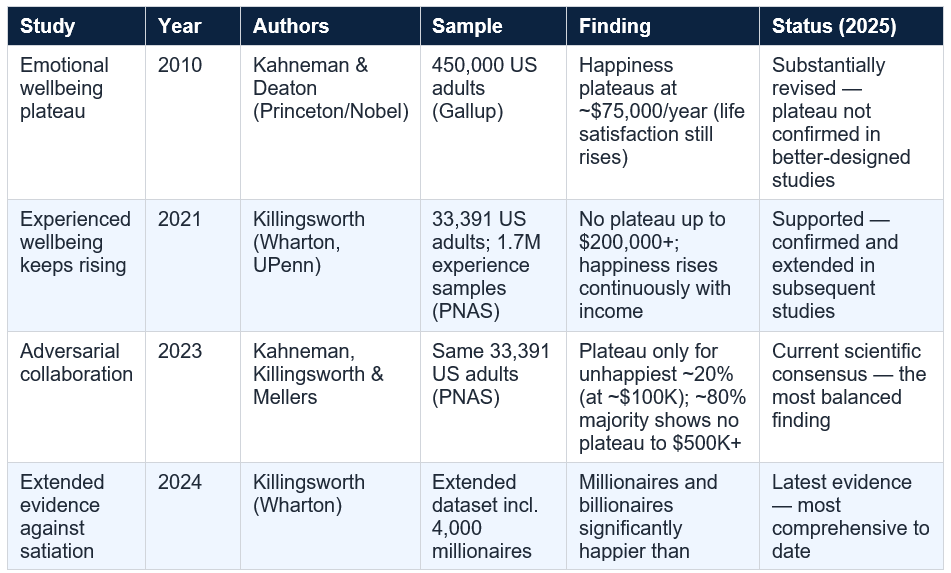
But three caveats matter enormously. First, for the unhappiest 20% — those with deep unhappiness from non-financial causes — income plateaus around $100,000. More money does not fix grief, illness, clinical depression, or a broken relationship. Second, the studies show correlation, not causation; happy people may also tend to earn more. Third, and most practically: how you spend the money you already have matters as much as how much you have. Experiences over things, time over possessions, others over yourself, anticipation over instant gratification — these spending choices can significantly increase happiness without any increase in income.
So does it take $1 million to be happy? The research says a million probably helps. But the more useful question is: given what you have, are you spending it in the ways that science has shown to maximise wellbeing? Because the evidence is unambiguous on that question, and the answer is entirely within your control. Not financial or psychological advice. The views expressed reflect the cited academic research only.
In 2010, Daniel Kahneman (Nobel laureate, Princeton) and Angus Deaton surveyed 450,000 Americans using Gallup data. They found that day-to-day emotional wellbeing (how good or bad you feel in daily life) appeared to plateau at around $75,000/year — above that level, additional income seemed to stop improving moment-to-moment happiness. However, they also found that life satisfaction (how you evaluate your life overall) continued rising beyond $75,000. The $75,000 figure entered popular culture but was always a simplification: it applied specifically to emotional wellbeing in retrospective surveys, among a US population in 2010. Adjusted for inflation, it equates to approximately $108,000 today. Subsequent research with better methodology (real-time experience sampling vs. retrospective recall) has largely failed to reproduce the plateau finding for the majority of people. Sources: Kahneman & Deaton (2010) original paper; NewsNation 2024.
Has Killingsworth’s research proven that money always buys happiness?
No — and Killingsworth himself is careful about this. His findings show that the positive association between income and wellbeing extends far up the income scale, including to millionaires and billionaires. But the studies show correlation, not causation. It is possible that happier people also tend to earn more (because of social skills, health, or psychological stability), rather than more money causing more happiness. Killingsworth's own caveat from his 2024 paper: 'It remains possible that some threshold exists beyond which more money is no longer associated with greater happiness.' The studies have simply not found that limit in the data examined so far. The honest scientific position is: more income is consistently associated with higher wellbeing across all income levels studied, including the very wealthy, but the mechanisms are not fully understood. Sources: Bloomberg July 17, 2024; Wealth Management July 2024; NewsNation; Penn Today 2023.
Why doesn’t more money help the unhappiest 20%?
The adversarial collaboration between Kahneman, Killingsworth, and Mellers (2023) found that the unhappiest ~15-20% of people in the dataset did show a happiness plateau at approximately $100,000/year. The researchers concluded that this group's unhappiness was driven by causes that income cannot address: serious relationship breakdown, grief, major health problems, clinical depression, or other deep personal suffering. Once the most acute financial stresses are relieved (at around $100,000), money stops being the binding constraint on their happiness — the real problem lies elsewhere. Killingsworth's summary: 'If you're rich and miserable, more money won't help.' This is a crucial practical finding: if your unhappiness primarily stems from financial stress, more income will help. If it stems from non-financial causes, the path to happiness runs through addressing those specific causes, not salary. Sources: Penn Today 2023; Kiplinger; NewsNation.
What are the five ways to buy happiness with money?
Based on the research of Elizabeth Dunn (University of British Columbia) and Michael Norton (Harvard Business School) in their book 'Happy Money: The Science of Happier Spending', the five evidence-based principles are: (1) Buy experiences, not things — experiences produce more durable happiness than possessions because we adapt less quickly and they connect us to others. (2) Make it a treat — deliberate scarcity preserves appreciation; daily pleasures lose their impact. (3) Buy time — outsourcing dreaded tasks to free up time for enjoyable activities; a 2017 four-country study found working adults were happier after time-saving purchases than material purchases (Whillans, Dunn, et al.). (4) Pay now, consume later — pre-paying removes the 'pain of paying' at the point of consumption and allows you to savour anticipation. (5) Invest in others — spending on others reliably increases the giver's happiness, often more durably than spending on oneself. 'If money doesn't make you happy, then you probably aren't spending it right.' (Dunn & Norton.) Not financial advice.
Is the happiness-income association the same in all countries?
No. Purdue University research led by Andrew T. Jebb examined income satiation points across world regions and found substantial variation. In North America and Australia, the estimated threshold for day-to-day emotional wellbeing is approximately $105,000-$125,000. In Western Europe, approximately $100,000. In sub-Saharan Africa and parts of East Asia, substantially lower thresholds reflect different costs of living and reference groups. Jebb's conclusion: 'There was substantial variation across world regions, with satiation occurring later in wealthier regions for life satisfaction.' This means the $75,000 figure — even the revised $500,000 figure — reflects US conditions specifically. The principle that more income associates with more happiness appears universal; the specific dollar amounts are highly context-dependent. Sources: Purdue/Jebb via World Economic Forum; BossHunting July 2024.
Table of Contents
- The Question Everyone Asks — and the Answer That Keeps Changing
- The $75,000 Myth: Where It Came From
- Killingsworth’s 1.7 Million Data Points
- The Great Collaboration: When Two Rivals Joined Forces
- The 2024 Update: Billionaires Are Happier Too
- The Unhappy Exception: Who More Money Cannot Help
- The Global Picture: What Income Buys in Different Countries
- So Do You Need $1 Million to Be Happy?
- The More Important Question: How You Spend It
- The Five Science-Backed Ways to Buy Happiness
- The Full Research Timeline: What Each Study Found
- Conclusion: The Answer Is Yes — With Caveats
- Frequently Asked Questions
The Question Everyone Asks — and the Answer That Keeps Changing
Money and happiness is one of the most studied relationships in all of behavioral science. It is also one of the most misreported. The popular narrative — ‘money can’t buy happiness after $75,000’ — was never quite what the original research said, has been challenged by larger and better-designed studies, and has now been substantially overturned by the most comprehensive research ever conducted on the question. The answer is more nuanced, more interesting, and more useful than the soundbite version. And it has direct implications for how you think about money, work, and the structure of your financial life.The short version of where the science stands in 2025: for most people, more money is associated with more happiness, and this association does not appear to plateau at $75,000, $200,000, or even $500,000. The happiness gap between wealthy and middle-income people is nearly three times larger than the gap between middle- and low-income people. But there is an exception group — roughly the unhappiest 20% of people, whose unhappiness stems from causes that money genuinely cannot fix. And beyond the income question, there is an entirely separate and arguably more actionable finding: how you spend money matters as much as how much you have. Not financial advice.
Key statistics in brief: Original threshold (Kahneman & Deaton 2010): $75,000/year plateau — 450,000 Americans, Gallup data. Killingsworth 2021 (1,725,994 experience samples, 33,391 US adults): no plateau found up to $200,000+. Adversarial collaboration 2023 (Kahneman, Killingsworth, Mellers): plateau confirmed for ~20% unhappiest people at ~$100,000; no plateau for ~80% majority up to $500,000+. Killingsworth 2024 extended: millionaires and billionaires significantly happier than $500K+ earners; wealth-happiness gap between rich and middle-income nearly 3x larger than middle-to-low-income gap. Sources: PNAS 2021; Penn Today 2023; Bloomberg July 2024; Wealth Management July 2024.
The $75,000 Myth: Where It Came From
In 2010, Daniel Kahneman — Nobel Prize-winning psychologist and the author of Thinking, Fast and Slow — and economist Angus Deaton published a paper using Gallup survey data from 450,000 Americans. Their finding: people reported more day-to-day emotional wellbeing as income rose, but this improvement appeared to plateau at around $75,000 per year. Above that, more money did not seem to produce more moment-to-moment happiness.The nuance that got lost in translation: Kahneman and Deaton distinguished between two kinds of happiness. Life satisfaction — how you evaluate your life overall when asked — kept rising with income well beyond $75,000. It was only emotional wellbeing — how often you experience positive feelings and how rarely you experience negative ones in daily life — that appeared to level off. But the $75,000 figure entered popular culture as a clean universal threshold, and it stuck there for over a decade. The study was well-designed for its time. It used retrospective survey data — people’s recollections of their feelings — and had an upper income limit in the dataset that made it hard to say anything about earners above $120,000.
Adjusted for inflation from 2010, the $75,000 figure is approximately $108,000 in today’s dollars (NewsNation 2024). But even at that level, the subsequent research suggests the plateau was an artefact of the method, not a genuine psychological phenomenon. Not financial advice.
Killingsworth’s 1.7 Million Data Points
Matthew Killingsworth, a senior fellow at the Wharton School of the University of Pennsylvania who specialises in the science of human happiness, took a different approach. Rather than asking people to recall how happy they generally were, he built an iPhone app called Track Your Happiness that pinged participants randomly throughout the day and asked them to report their current feelings in real time. The result: 1,725,994 experience samples from 33,391 employed adults, published in PNAS (Proceedings of the National Academy of Sciences) in 2021.His finding: happiness continued to rise with income throughout the entire income range studied, with no plateau visible up to $200,000 or beyond. The more you earned, on average, the happier your moment-to-moment emotional experience. This directly contradicted the Kahneman-Deaton plateau finding. Killingsworth attributed the discrepancy partly to methodology: the real-time experience sampling captured people’s actual feelings more accurately than retrospective recall surveys, which tend to be dominated by how people think they feel rather than what they actually felt throughout their day.
The research generated significant scientific and media attention, precisely because it overturned such a well-established finding. It set the stage for an unusual scientific showdown between two of the leading researchers in the field. Not financial advice.
Killingsworth (2024, Bloomberg, July 17): 'The magnitude of the difference between the low and high end of incomes is gigantic. Within the bounds of what money can explain, a huge amount of that difference occurs above the median income.' (Bloomberg / Wealth Management July 2024.) And from the 2021 paper: 'Experienced well-being rises with income, even above $75,000 per year.' (PNAS 2021.)
The Great Collaboration: When Two Rivals Joined Forces
Rather than continuing to dispute each other’s work in competing papers, Kahneman, Killingsworth, and behavioural scientist Barbara Mellers undertook what is called an ‘adversarial collaboration’ — a formal scientific process where researchers with opposing findings jointly design a new analysis, agree in advance on what would constitute evidence for each position, and then report the results together. Published in 2023, the joint paper produced a more nuanced finding than either the original $75,000 plateau or the simple ‘happiness keeps rising forever’ narrative.The reconciled finding: both were partially right, but for different groups of people. For the approximately 80% majority of participants, happiness rose continuously with income with no clear plateau, at least up to $500,000 per year. For the unhappiest roughly 20% of participants — those experiencing the deepest unhappiness — happiness did rise with income up to approximately $100,000 per year, and then showed no further benefit from higher income. The cause of their unhappiness appeared to be something income could not address: serious relationship problems, health crises, grief, or other non-financial sources of suffering. More money was not the fix.
Killingsworth’s summary of the collaborative finding, widely cited across publications: ‘If you’re rich and miserable, more money won’t help.’ (UPenn press release, cited Kiplinger; Penn Today.) The maximum threshold — if it exists at all — is now estimated at $500,000 per year or beyond, more than six times the original $75,000 figure even before inflation adjustment. Not financial advice.
The adversarial collaboration result (Kahneman, Killingsworth & Mellers 2023): For ~80% of people: happiness rises continuously with income, no plateau up to $500,000+/year. For ~20% (unhappiest group): happiness rises to approximately $100,000/year, then stops improving. The unhappiest group's plateau reflects unhappiness from causes that income cannot address — serious health, relationship, or emotional problems. 'If you're rich and miserable, more money won't help.' Key caveat: correlation is not causation — the studies show association, not proof that money causes happiness. Sources: Penn Today 2023; Kiplinger; NewsNation; Bloomberg July 2024.
The 2024 Update: Billionaires Are Happier Too
In July 2024, Killingsworth published an extension of the work that pushed the analysis further up the income ladder than any previous study had gone. He combined his original dataset with a 2018 study of 4,000 people with a median wealth of $3 million to $8 million from 17 countries, and a 1985 survey of the Forbes list of the wealthiest Americans, in order to examine whether happiness kept rising even at the very top of the wealth distribution.The answer: yes. Both millionaires and billionaires reported significantly higher wellbeing than people earning over $500,000 per year. The association between wealth and happiness continued up the economic ladder without any clear satiation point in the data. Crucially, Killingsworth also found that the happiness gap between wealthy and middle-income people was nearly three times larger than the gap between middle- and low-income people — directly challenging the intuition that ‘the marginal utility of money diminishes’ and that the biggest gains come from poverty to middle class.
His own caveat deserves to be quoted directly: ‘It remains possible that some threshold exists beyond which more money is no longer associated with greater happiness. But the point to recognise here is that the existence of a plateau is not predicted mathematically.’ The science does not prove there is no limit — it simply says that no limit has been found in any dataset examined so far. Not financial advice.
The counterintuitive 2024 finding: the happiness gap between WEALTHY and MIDDLE-INCOME people is nearly THREE TIMES LARGER than the gap between middle-income and low-income people. Most of us assume the biggest happiness gains from money come in pulling people out of poverty and into middle-class security. Killingsworth's data suggests the gains continue accumulating, and the absolute difference in happiness between a median earner and a millionaire is substantially larger than between a low earner and a median earner. 'This sizable difference offers a counterpoint to the frequent claim that money is only associated with small differences in well-being.' (Killingsworth 2024.) Not financial advice.
The Unhappy Exception: Who More Money Cannot Help
The most practically important finding from the adversarial collaboration is the unhappy minority exception, and it deserves careful explanation. Approximately 15–20% of people in the Killingsworth dataset were classified as the ‘unhappiest’ group. For these individuals, happiness did improve with income at lower income levels — more money reduced the acute stress and practical deprivation that compounds misery when you are poor. But above approximately $100,000 per year, additional income produced no further improvement in their happiness.The researchers concluded that this plateau reflected the nature of these individuals’ unhappiness, not a general law about money. Their unhappiness was driven by factors that money cannot buy away: a severely damaged relationship, a grief that will not pass, a serious health diagnosis, clinical depression, or other deep personal suffering. Once the acute financial stressors were addressed at around the $100,000 level, throwing more money at the problem simply did not reach the cause. Killingsworth’s memorable summary: ‘If you’re rich and miserable, more money won’t help.’
This is perhaps the most practically useful finding in the entire body of research. If your unhappiness is primarily caused by financial stress — debt, insecurity, inability to cover emergencies, fear about the future — then increasing your income will reliably reduce it. If your unhappiness stems primarily from relationship breakdown, grief, chronic illness, or mental health conditions, then the path to happiness runs through those specific problems, not through your salary. Not financial advice. If you are experiencing mental health difficulties, please consult a qualified professional.
The Global Picture: What Income Buys in Different Countries
Purdue University researcher Andrew T. Jebb led a study examining the income thresholds for happiness across different world regions, adding important global context to the US-centric Killingsworth and Kahneman studies. The finding: happiness satiation points exist but vary substantially by region. In North America and Australia, the threshold for day-to-day emotional wellbeing was estimated at approximately $105,000 to $125,000. In Western Europe: approximately $100,000. In sub-Saharan Africa and parts of Asia, the thresholds were substantially lower, reflecting the different cost of living and baseline conditions.Jebb’s observation: ‘There was substantial variation across world regions, with satiation occurring later in wealthier regions for life satisfaction.’ This means that in richer countries, it takes more money to reach the point (if it exists) where additional income stops moving the happiness needle — consistent with the finding that absolute income levels matter but so does how your income compares to the reference group around you. Living in an expensive city among high-earning peers requires more income to achieve the same felt sense of financial security than living in a lower-cost community.
The Purdue findings also highlight the importance of purchasing power parity: $75,000 in San Francisco and $75,000 in rural Mississippi represent very different financial realities. Any flat dollar threshold is necessarily an oversimplification of a phenomenon that is deeply contextual. Not financial advice.
So Do You Need $1 Million to Be Happy?
The direct answer: not necessarily, but more money is associated with more happiness for most people across virtually all income levels studied, including the millionaire and billionaire range. There is no evidence of a meaningful plateau below $500,000 per year for the typical person, and the 2024 data suggests the association continues well beyond that.But several important qualifiers frame the answer. First, the studies measure association, not causation. Happier people may also earn more, for reasons that include their social skills, health, and psychological stability. Second, the studies measure average associations — individual variation is enormous. Third, and most crucially, the research consistently shows that how you allocate money matters as much as the total amount. Elizabeth Dunn and Michael Norton’s research on ‘Happy Money’ (see Section 10) finds that specific spending choices can significantly increase happiness without any increase in income.
Practically: if financial stress is a real and ongoing source of unhappiness, reducing it through higher income, debt reduction, or better financial management will reliably improve your wellbeing. If you are financially comfortable and still unhappy, the research strongly suggests that the answer lies elsewhere — and that the path runs through relationships, purpose, autonomy, and health, not a larger number on your bank statement. Not financial advice.
The More Important Question: How You Spend It
The income-happiness research answers one question: does having more money correlate with being happier? But there is a second, more actionable question that a separate body of research addresses: given the money you have, how do you spend it to maximise wellbeing? Elizabeth Dunn, a psychology professor at the University of British Columbia, and Michael Norton, a behavioral scientist at Harvard Business School, spent years researching this question. Their conclusions are summarised in their book Happy Money: The Science of Happier Spending.Their central finding: most people spend money in ways that do not maximise their happiness. We overspend on possessions that we adapt to quickly and underspend on experiences, time, and others — the things that produce the most durable gains. Dunn and Norton: ‘If money doesn’t make you happy, then you probably aren’t spending it right.’ Their research and that of collaborators identified five specific spending principles that reliably increase happiness per dollar, regardless of income level. Not financial advice.
The Five Science-Backed Ways to Buy Happiness
The following five principles come from the research of Dunn, Norton, and collaborators, drawn from Happy Money and the underlying academic studies. Not financial advice.- Buy experiences, not things. Experiences — travel, concerts, lessons, shared meals — produce more durable happiness than material possessions. We adapt quickly to things (hedonic adaptation), but experiences become part of our identity and memory. They are also intrinsically social, connecting us to others. Research shows people who spend more of their money on leisure report significantly greater life satisfaction. As Dunn and Norton note: ‘Abundance, as it turns out, is the enemy of appreciation.’
- Make it a treat. By deliberately limiting access to pleasures — having coffee at a cafe as a special occasion rather than every morning — you preserve the pleasure. Scarcity boosts appreciation. Turning a pleasure into a daily routine strips it of its emotional impact. Rotating and rationing pleasures keeps them special and maintains their happiness value.
- Buy time. Outsourcing tasks you dislike — cleaning, grocery delivery, mowing — to buy back hours for things you enjoy is one of the most reliable happiness-per-dollar purchases available. A 2017 study across four countries by Whillans, Dunn, Smeets, Bekkers, and Norton found: ‘Working adults report greater happiness after spending money on a time-saving purchase than on a material purchase.’ Yet despite this, most people, even wealthy ones, resist outsourcing because it feels indulgent.
- Pay now, consume later. Pre-paying for a vacation, a dinner, or an experience and then consuming it later is double-profitable for happiness: you get the pleasure of anticipation while waiting, and you avoid the ‘pain of paying’ at the point of consumption. This is the opposite of buy-now-pay-later schemes, which front-load the pleasure and back-load the pain. Saving for something and then enjoying it without the simultaneous financial worry is a reliably more satisfying experience.
- Invest in others. In an experiment where participants were given $20 and either told to spend it on themselves or on someone else, the spend-on-others group reported higher happiness that persisted for several days. (Norton et al., cited Study Happiness / Kitces.com.) Dunn and Norton: ‘You’re likely to get the biggest happiness bang for your prosocial buck if you invest in others in ways that help you connect with people, especially people you care about.’ Charitable giving, paying for someone’s coffee, treating a friend to dinner — all produce measurable wellbeing gains for the giver.
The Full Research Timeline: What Each Study Found
Conclusion
The science’s current best answer to ‘how much money do you need to be happy?’ is: more than you probably thought, and the gains keep coming further than the old $75,000 figure ever suggested. For roughly 80% of people, the association between income and happiness appears continuous up to $500,000 per year and beyond — with millionaires and billionaires reporting significantly higher wellbeing than people earning $500,000. The happiness gap between wealthy and middle-income people is nearly three times the gap between middle- and low-income people.But three caveats matter enormously. First, for the unhappiest 20% — those with deep unhappiness from non-financial causes — income plateaus around $100,000. More money does not fix grief, illness, clinical depression, or a broken relationship. Second, the studies show correlation, not causation; happy people may also tend to earn more. Third, and most practically: how you spend the money you already have matters as much as how much you have. Experiences over things, time over possessions, others over yourself, anticipation over instant gratification — these spending choices can significantly increase happiness without any increase in income.
So does it take $1 million to be happy? The research says a million probably helps. But the more useful question is: given what you have, are you spending it in the ways that science has shown to maximise wellbeing? Because the evidence is unambiguous on that question, and the answer is entirely within your control. Not financial or psychological advice. The views expressed reflect the cited academic research only.
Frequently Asked Questions
What did Kahneman and Deaton’s $75,000 study actually find?In 2010, Daniel Kahneman (Nobel laureate, Princeton) and Angus Deaton surveyed 450,000 Americans using Gallup data. They found that day-to-day emotional wellbeing (how good or bad you feel in daily life) appeared to plateau at around $75,000/year — above that level, additional income seemed to stop improving moment-to-moment happiness. However, they also found that life satisfaction (how you evaluate your life overall) continued rising beyond $75,000. The $75,000 figure entered popular culture but was always a simplification: it applied specifically to emotional wellbeing in retrospective surveys, among a US population in 2010. Adjusted for inflation, it equates to approximately $108,000 today. Subsequent research with better methodology (real-time experience sampling vs. retrospective recall) has largely failed to reproduce the plateau finding for the majority of people. Sources: Kahneman & Deaton (2010) original paper; NewsNation 2024.
Has Killingsworth’s research proven that money always buys happiness?
No — and Killingsworth himself is careful about this. His findings show that the positive association between income and wellbeing extends far up the income scale, including to millionaires and billionaires. But the studies show correlation, not causation. It is possible that happier people also tend to earn more (because of social skills, health, or psychological stability), rather than more money causing more happiness. Killingsworth's own caveat from his 2024 paper: 'It remains possible that some threshold exists beyond which more money is no longer associated with greater happiness.' The studies have simply not found that limit in the data examined so far. The honest scientific position is: more income is consistently associated with higher wellbeing across all income levels studied, including the very wealthy, but the mechanisms are not fully understood. Sources: Bloomberg July 17, 2024; Wealth Management July 2024; NewsNation; Penn Today 2023.
Why doesn’t more money help the unhappiest 20%?
The adversarial collaboration between Kahneman, Killingsworth, and Mellers (2023) found that the unhappiest ~15-20% of people in the dataset did show a happiness plateau at approximately $100,000/year. The researchers concluded that this group's unhappiness was driven by causes that income cannot address: serious relationship breakdown, grief, major health problems, clinical depression, or other deep personal suffering. Once the most acute financial stresses are relieved (at around $100,000), money stops being the binding constraint on their happiness — the real problem lies elsewhere. Killingsworth's summary: 'If you're rich and miserable, more money won't help.' This is a crucial practical finding: if your unhappiness primarily stems from financial stress, more income will help. If it stems from non-financial causes, the path to happiness runs through addressing those specific causes, not salary. Sources: Penn Today 2023; Kiplinger; NewsNation.
What are the five ways to buy happiness with money?
Based on the research of Elizabeth Dunn (University of British Columbia) and Michael Norton (Harvard Business School) in their book 'Happy Money: The Science of Happier Spending', the five evidence-based principles are: (1) Buy experiences, not things — experiences produce more durable happiness than possessions because we adapt less quickly and they connect us to others. (2) Make it a treat — deliberate scarcity preserves appreciation; daily pleasures lose their impact. (3) Buy time — outsourcing dreaded tasks to free up time for enjoyable activities; a 2017 four-country study found working adults were happier after time-saving purchases than material purchases (Whillans, Dunn, et al.). (4) Pay now, consume later — pre-paying removes the 'pain of paying' at the point of consumption and allows you to savour anticipation. (5) Invest in others — spending on others reliably increases the giver's happiness, often more durably than spending on oneself. 'If money doesn't make you happy, then you probably aren't spending it right.' (Dunn & Norton.) Not financial advice.
Is the happiness-income association the same in all countries?
No. Purdue University research led by Andrew T. Jebb examined income satiation points across world regions and found substantial variation. In North America and Australia, the estimated threshold for day-to-day emotional wellbeing is approximately $105,000-$125,000. In Western Europe, approximately $100,000. In sub-Saharan Africa and parts of East Asia, substantially lower thresholds reflect different costs of living and reference groups. Jebb's conclusion: 'There was substantial variation across world regions, with satiation occurring later in wealthier regions for life satisfaction.' This means the $75,000 figure — even the revised $500,000 figure — reflects US conditions specifically. The principle that more income associates with more happiness appears universal; the specific dollar amounts are highly context-dependent. Sources: Purdue/Jebb via World Economic Forum; BossHunting July 2024.
0 Comments
Be the first to share your thoughts on this article.