

What Happens When You Go 100% Unavailable?

The default setting in modern life is on. Available. Reachable. Responsive. The phone in the pocket, the notifications on, the expectation — mostly unspoken but thoroughly real — that a message sent will receive a reply within some reasonable timeframe that shrinks every year. Most people have never seriously tested what happens when they turn this off entirely. Not for an hour before bed, not in the cinema, but fully and deliberately unavailable for a meaningful stretch of time. The question ‘what happens?’ turns out to have a research-backed answer, and the answer is more nuanced than either the digital detox industry or the productivity culture that resists it tends to acknowledge. In 2025, peer-reviewed studies in Communication Research and Frontiers in Human Dynamics provided the most specific data yet on what actually changes when people disconnect. This article covers what the research found, what really happens in the first hours, what the social and cognitive effects are, and what the honest limits of the disconnection experiment are.
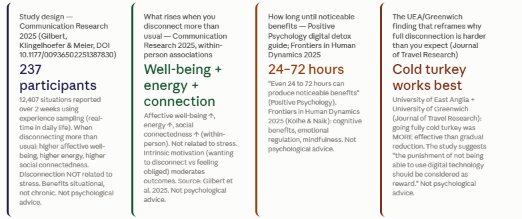
Table of Contents
- The Default Setting Is On
- The Anxiety That Hits First
- What the Peer-Reviewed Research Actually Found
- The Attention Effect: Your Mind Starts to Reassemble
- The Social Paradox: Disconnecting Makes You More Present
- The Identity Shift: What You Find When You Stop Performing
- The Honest Caveats: What the Research Also Says
- How to Structure Being Unavailable Without Burning Everything Down
- The Unavailability Framework: A Practical Timetable
- Conclusion: What Going Unavailable Is Actually For
- Frequently Asked Questions
The Default Setting Is On
The notification arrives. You glance at it. Then at the next one. Then at the one after that. At some point in the day — every day — you realise you have been available for so long and so continuously that the concept of not being available feels like an abstraction. Something that happens on holiday, maybe. Or when you turn your phone off for a film. Or in theory. Modern connectivity has made perpetual availability not just possible but quietly expected. The professional norms of most workplaces include implicit response-time expectations. Social messaging creates its own version. The infrastructure of availability is so comprehensive that opting out of it entirely, even briefly, is not the natural default — it is a deliberate act against a current.
This article is about that deliberate act. Specifically, about what the research says happens in its immediate and short-term aftermath, and what the honest limits of the experiment are. In 2025, two peer-reviewed studies — one in Communication Research and one in Frontiers in Human Dynamics — gave us the most specific data yet on what digital disconnection does, situationally and emotionally, to the people who try it. The findings are worth knowing before you attempt it, and worth knowing before you resist it.
The Anxiety That Hits First
The first thing that happens when you go 100% unavailable is not peace. It is anxiety. This is worth saying out loud because most articles about disconnecting skip it, jumping instead to the freedom and clarity that come later. The anxiety is real, it is documented, and understanding it changes the experience. The Debrief’s coverage of a digital detox mental health study noted that participants who removed internet and app access from their phones experienced a period of psychological adjustment before the benefits emerged. The urge to check, to respond, to stay across everything is not simply a bad habit. It has been reinforced by years of variable-ratio reward schedules — the same psychological mechanism that makes slot machines addictive. Every notification, every message, every reply represents a potential reward that might be there or might not, which is precisely the schedule that produces the strongest behavioural conditioning. When you go unavailable and remove that schedule entirely, the brain registers the absence. Discomfort is the normal, predictable, passing first response. The University of East Anglia and University of Greenwich study, published in the Journal of Travel Research, found that going cold turkey — full disconnection — was actually more effective than gradual reduction, partly because the complete break makes the anxiety clear rather than perpetuating it. The study suggests that what feels like punishment in the first hours should be reconsidered as the first stage of a reward.
The immediate response to full unavailability is often discomfort, checking urges, and low-level anxiety — not instant peace. This is neurological: years of variable-ratio reinforcement from notifications and messages produces a conditioned response when the stimulus is removed. The discomfort is temporary and predictable. Sources: The Debrief/PsyPost digital detox study; UEA/Greenwich Journal of Travel Research.
What the Peer-Reviewed Research Actually Found
In 2025, two significant peer-reviewed studies added to what the research now knows about digital disconnection. The first, published in Communication Research (Gilbert, Klingelhoefer & Meier, 2025), used an experience sampling design — a methodology that captures real-time reports from participants in their daily lives rather than retrospective surveys — with 237 participants reporting 12,407 situations over two weeks. The findings are specific: when participants disconnected more than usual, they reported higher affective well-being, higher energy, and higher social connectedness. Disconnection was not related to stress — in either direction. There is something important buried in those findings: disconnecting did not produce stress, but it also did not reduce it at the population level. The benefit was situational rather than chronic: the lift in well-being happened in the moments of disconnection, not as a permanent trait change for those who disconnected more generally. The second study, published in Frontiers in Human Dynamics (Kolhe & Naik, July 2025), took a positive psychology lens, examining digital detox through the frame of eudaimonic well-being — the deeper sense of flourishing and authentic living. The findings identified cognitive benefits, improved emotional regulation, and increased mindfulness as the primary mechanisms through which digital detox practices produced wellbeing gains. The study concluded that digital detox practices can significantly contribute to eudaimonic wellbeing — not just hedonic comfort, but genuine flourishing.
Communication Research 2025 (Gilbert et al., N=237, 12,407 situations, 2 weeks): disconnecting more than usual → higher affective well-being, higher energy, higher social connectedness. Disconnection NOT related to stress. Benefits situational, not permanent. Frontiers in Human Dynamics 2025 (Kolhe & Naik, Jul 10): digital detox → cognitive benefits, emotional regulation, mindfulness, eudaimonic wellbeing.
The Attention Effect: Your Mind Starts to Reassemble
One of the most commonly reported experiences of extended unavailability — and one that the research on sustained attention supports — is what might be described as the reassembly of the mind. Stanford research cited in the unplugging benefits literature confirms that switching tasks repeatedly diminishes sustained attention. When you are perpetually available, you are never not switching tasks. Every ping, every notification, every brief check-in represents a task switch, regardless of how minor it feels. The cumulative effect is attention that has been fragmented across dozens of micro-demands. When you go 100% unavailable, the switching stops. Not immediately and not cleanly — the habitual reaching for the phone continues for a while, and the mental equivalent of task-switching — anticipating messages, composing responses in your head, monitoring for changes — continues on its own momentum. But without new inputs arriving, the fragmentation gradually stops refreshing itself. The Positive Psychology resource on digital detox describes this transition: ‘When you digitally detox, you start to see how much of your energy was being pulled outward.’ What returns is not silence so much as depth — the ability to stay with a single thing long enough for something real to happen in it. A thought that completes itself rather than being interrupted. A conversation that stays present rather than competing with a background of pending replies.
Stanford research: repeated task switching diminishes sustained attention. When perpetually available, you are never not switching tasks. Going unavailable stops the switching. What returns: depth of attention — the ability to stay with a single thing long enough for something real to happen.
The Social Paradox: Disconnecting Makes You More Present
The Communication Research 2025 study found something that cuts against the intuitive assumption about digital disconnection: when people disconnected more than usual, they reported higher social connectedness. Not lower. Higher. This is the social paradox of unavailability: being digitally unavailable to many people at once can make you more genuinely present to the specific people in front of you. The mediated social connections — the replies, the group chats, the notifications of other people’s activities — are replaced by unmediated ones. The attention that was distributed across a network of digital contacts concentrates into the actual human interactions of the day. UEA and Greenwich’s digital detox study identified this as one of the primary benefits of full disconnection: participants reported the bodily joy of reconnecting with nature and surroundings, and a re-evaluation of the relationship between self and digital technology. The word ‘bodily’ is striking in that research. It suggests something more than cognitive reframing — a return to sensory and physical presence that the screen cannot substitute for. Positive Psychology’s digital detox guide puts it simply: ‘Emotionally, going offline can reconnect you with feelings you may have been brushing aside.’ The people and experiences that were sharing space with the phone are suddenly getting the full version of you.
Communication Research 2025 (Gilbert et al.): when participants disconnected more than usual, they reported HIGHER social connectedness — not lower. The paradox: being digitally unavailable to many can make you more genuinely present to the specific people in front of you. UEA/Greenwich: 'bodily joy of reconnecting.' Positive Psychology: 'reconnect with feelings you may have been brushing aside.
The Identity Shift: What You Find When You Stop Performing
There is a dimension of perpetual availability that does not often get named: the performance dimension. Being available means being responsive, which means managing how you appear — the speed of your replies, the tone of your messages, the image projected by what you share and what you respond to. Going 100% unavailable removes the performance. There is no audience for the moment you are in. The Frontiers in Human Dynamics 2025 study made this explicit in its eudaimonic wellbeing framing: it identified the intersection of digital detox and eudaimonic well-being as the key area where the deepest benefits emerge. Eudaimonic well-being is specifically about authentic flourishing — the sense of living in alignment with your actual values and character — as opposed to hedonic pleasure, which is about feeling good in the moment. The suggestion embedded in the research is that perpetual availability and the performance it requires is actually an obstacle to eudaimonic wellbeing — to the genuine sense of living authentically. In-Mind.org’s psychology of digital disconnection review notes that digital detox, digital minimalism, and smartphone-free schools all reflect a growing recognition of a desire to ‘reduce or change how we use technologies’ — which implies a growing awareness that something about the current mode of use is not quite right. What you find when you stop performing availability for a full day, or a weekend, or longer, is harder to describe than the attention and social connection benefits — but it is recognisable. It is a quieter version of yourself.
Frontiers in Human Dynamics 2025 (Kolhe & Naik): the intersection of digital detox and eudaimonic well-being — authentic flourishing — is where the deepest benefits emerge. Perpetual availability requires constant performance: managing responses, projecting appearance, being 'on.' Going unavailable removes the audience. What returns is the unperformed version of yourself.
The Honest Caveats: What the Research Also Says
The 2025 research is honest about the limits of what disconnection can deliver, and this matters. The Communication Research study (Gilbert et al., 2025) found that disconnection was related to higher well-being situationally — but not over time. People who generally disconnected more than others did not report better well-being in between-person comparisons. The lift is in the moment of disconnection, not in becoming a chronically more disconnected person. The study also found that motivation matters significantly: intrinsic motivation for disconnection positively moderated the well-being associations. Going offline because you genuinely want to, because you can feel the need for it, produces better outcomes than going offline because you feel you should or because you are trying to follow a trend. The Debrief’s coverage of the digital detox mental health research added a practical qualifier: significant psychological benefits were still observed even among those who didn’t fully comply, and simple strategies — limiting mobile internet during certain hours, scheduled offline breaks, disabling notifications — can achieve similar effects without a drastic full detox. In-Mind.org’s psychology of disconnection review acknowledged directly that ‘disconnecting from digital communication is not always easy or beneficial.’ The benefits are real and research-supported. They are also situational, motivationally dependent, and do not require total and permanent withdrawal.
Communication Research 2025: disconnection benefits are SITUATIONAL, not chronic. Those who generally disconnect more do not report better wellbeing long-term. MOTIVATION matters: intrinsic motivation for disconnecting produces better outcomes than obligation-driven disconnection. Even partial disconnection (notifications off, scheduled offline hours) produces measurable benefits.
How to Structure Being Unavailable Without Burning Everything Down
The practical question that follows from the research is not ‘should I go unavailable?’ — the evidence supports it situationally and under the right conditions. The practical question is how to structure it in a way that is sustainable and does not create the secondary anxiety of consequences: the missed message, the professional cost, the relationship that felt the absence as abandonment rather than as rest. Newport’s principle, cited in the Positive Psychology digital detox guide, is the useful framing: ‘a successful detox isn’t about abandoning digital devices but about creating healthier digital boundaries.’ The boundary can be temporal — a window of hours, a morning, a full day, a weekend — rather than permanent. It can be contextual — phone calls available but apps off, or apps available but notifications silenced. The Communication Research study found that even partial disconnection — disconnecting more than usual, rather than disconnecting completely — produced the within-person well-being benefits. The full cold-turkey approach studied by UEA and Greenwich produced strong benefits but is not the only format that works. The simplest starting point is a clear, pre-communicated boundary. Telling people you will be unavailable between certain hours, or for a defined period, removes the performance anxiety from both sides: you are not disappearing; you are choosing. The Positive Psychology guide summarises the right approach to reintegration: ‘Ask what benefits you gained during your time offline. Let those benefits guide how you reintroduce technology.
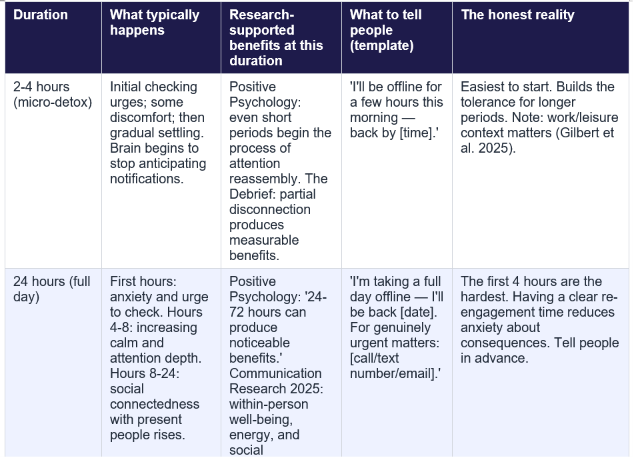
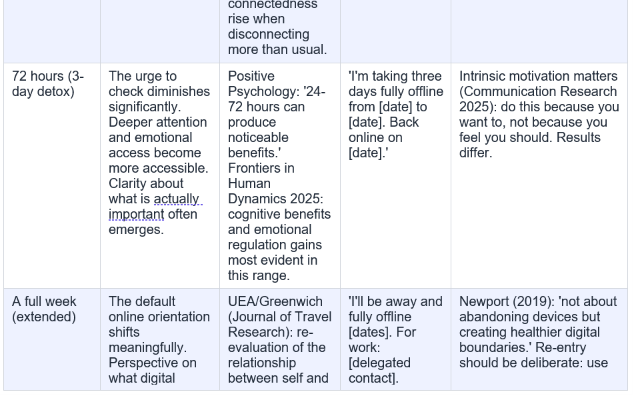
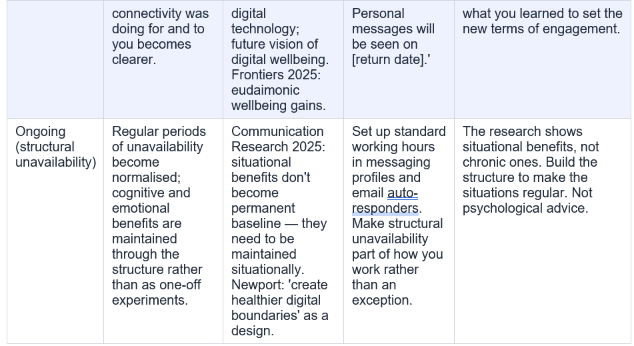
The Unavailability Framework: A Practical Timetable
Conclusion
The 2025 research gives a clearer answer than most of the popular discussion about digital detox has managed. When you go unavailable, you get — situationally, in that period, not as a permanent change — higher affective well-being, more energy, and more social connectedness with the people physically present to you. You are not less stressed, but you are not more stressed either. The attention that was distributed across dozens of micro-demands begins to consolidate into whatever you give it to. The performance of availability stops, and the quieter, less managed version of yourself becomes accessible.
But the research is also honest about the limits. The benefits are situational, not chronic. They require intrinsic motivation to maximise. They do not require total or permanent disconnection — partial disconnection, offline hours, and notification silencing produce measurable effects. The UEA and Greenwich research suggests that the most useful thing about a full disconnection period is not the absence itself but what you learn from the absence — the re-evaluation of your relationship with technology that it produces, and the future vision of digital wellbeing it makes possible. Positive Psychology’s guide puts the return to technology in the right frame: ‘Ask what benefits you gained during your time offline. Let those benefits guide how you reintroduce technology.’ Going 100% unavailable is not the destination. It is a way of finding out what you actually want when you get to decide.
Frequently Asked Questions
How long does it take to feel the benefits of going fully unavailable?
The research from Positive Psychology's digital detox guide indicates that even 24 to 72 hours can produce noticeable benefits. The Communication Research 2025 study (Gilbert, Klingelhoefer & Meier) found that disconnecting more than usual was associated with higher well-being, energy, and social connectedness on a situational basis — meaning the benefits appear during the period of disconnection. The Debrief's coverage of the digital detox mental health study found significant improvements in mental health, well-being, and attentional capacity after a period of internet and app removal. The first 2-4 hours typically involve discomfort and checking urges. Hours 4-8 tend to see increasing calm and attention depth. The 24-72 hour range appears to be where the most commonly described cognitive and emotional benefits become noticeable.
Is partial disconnection (turning off notifications) enough?
Yes, according to the research. The Debrief's coverage of the digital detox mental health study found that 'significant psychological benefits were still observed even among those who didn't fully comply,' and that 'simple strategies such as limiting mobile internet access during certain hours, taking scheduled offline breaks, or disabling notifications might help users achieve similar positive effects without needing a drastic digital detox.' The Communication Research 2025 study found that disconnecting more than usual — not necessarily fully — produced within-person well-being improvements. Newport's principle, cited by Positive Psychology, is that 'a successful detox isn't about abandoning digital devices but about creating healthier digital boundaries.' Full cold-turkey disconnection (studied by UEA and Greenwich) produced strong benefits, but it is not the only format that works. Sources: The Debrief/PsyPost; Gilbert et al. 2025; Positive Psychology.
Does going unavailable damage relationships?
The research suggests the opposite of what the availability culture assumes. The Communication Research 2025 study (Gilbert et al.) found that when participants disconnected more than usual, they reported higher social connectedness — not lower. The paradox is that digital unavailability to the many can produce greater presence and connection with the specific people in physical proximity. The UEA and Greenwich study identified the bodily joy of reconnecting with people and surroundings as one of the primary benefits of full disconnection. The qualification is pre-communication: telling people in advance that you will be unavailable, and providing a contact method for genuine emergencies, removes the anxiety from both sides. Disappearing without notice and going unavailable by deliberate choice are different actions with different social consequences. Sources: Gilbert et al. Communication Research 2025; UEA/Greenwich Journal of Travel Research.
Why does going unavailable feel so uncomfortable at first?
The discomfort is neurological, not a character flaw. Variable-ratio reinforcement — the same mechanism behind slot machines — is created when rewards (messages, notifications, responses) arrive unpredictably. This schedule produces the strongest behavioural conditioning and the strongest withdrawal-type response when the stimulus is removed. The University of East Anglia and University of Greenwich study found that going cold turkey was more effective than gradual reduction partly because the complete break makes the mechanism clear rather than perpetuating it through partial continued exposure. The Debrief's digital detox research found that significant benefits were observed even among those who didn't fully comply — meaning the adjustment process itself produces some benefit. The discomfort is temporary and predictable. The research frames it as an early stage of a process rather than a cost. Sources: UEA/Greenwich; The Debrief/PsyPost.
What should I do differently when I come back online?
The UEA and Greenwich research identified 're-evaluation of the relationship between self and digital technology' and 'future vision of digital wellbeing' as key benefits of full disconnection periods — suggesting that the return to connectivity is as important as the absence. Positive Psychology's digital detox guide gives the most practical answer: 'Ask what benefits you gained during your time offline. Let those benefits guide how you reintroduce technology.' Newport's principle is 'creating healthier digital boundaries' — not abandoning devices but redesigning the relationship with them. The Communication Research 2025 study found that benefits were situational rather than chronic, which implies that structural changes to digital habits (scheduled offline periods, notification management, clear response time expectations) are needed to maintain the benefits over time rather than hoping a one-off detox produces permanent change.
0 Comments
Be the first to share your thoughts on this article.