

Taxes
When It Makes Sense to Itemize Your 2026 Tax Deductions.

Standard deduction $16,100 single, $32,200 married filing jointly, $24,150 head of household; SALT cap $40,400 ($20,200 married filing separately), phasing down by 30 cents per dollar above $505,000 of MAGI to a $10,000 floor; mortgage interest on up to $750,000 of debt; medical expenses above 7.5% of AGI; new 0.5%-of-AGI floor on itemized charity; new non-itemizer deduction of up to $1,000 single or $2,000 joint for cash gifts to public charities. My arithmetic: a married couple with $18,000 of SALT, $14,000 of mortgage interest and $3,000 of gifts itemizes $34,250 against $34,200 for the standard deduction plus the $2,000 charitable deduction, a $50 edge; a single homeowner with $22,500 of itemized deductions beats $17,100 by $5,400, about $1,188 of tax at 22%; the SALT cap falls to $11,900 at $600,000 of income and hits the $10,000 floor near $606,000. Planning: the 2027 standard deduction is $16,600 single and $33,200 joint (IRS); giving $9,000 in one year instead of $3,000 a year over three years raises that year’s itemized total to $40,250, a gain of about $2,050 of deductions over three years in my example.
Tax year 2026 means the return you will file in early 2027, but decisions such as when to pay a bill or make a gift happen before December 31, so it is worth looking now. This guide explains what changed, what counts, how to compare the two options with worked numbers and what you can still do this year, flagging what comes from single sources.

Charity changed in two ways. From 2026, itemizers can deduct gifts only above 0.5% of adjusted gross income, so on $150,000 of income the first $750 of giving does not count, while non-itemizers can deduct up to $1,000 (single) or $2,000 (joint) of cash gifts to qualifying public charities. Medical expenses still count only above 7.5% of income. One source also mentions a new reduction in itemized deductions for the top bracket, which I could not confirm. Check each rule against the IRS instructions.
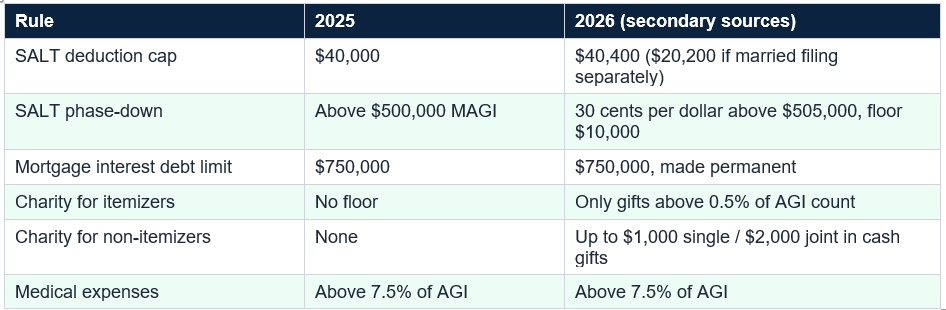
2026: standard deduction $16,100 single, $32,200 joint, $24,150 head of household. SALT cap $40,400, phasing down above $505,000 of MAGI to $10,000. Mortgage interest on up to $750,000 of debt. Charity: 0.5% AGI floor if you itemize; up to $1,000/$2,000 of cash gifts if you do not. Medical: above 7.5% of AGI.
The method is simple. Add your state income tax (or sales tax) and property tax, capped at $40,400 if your income is under $505,000, then mortgage interest, charitable gifts above the floor and medical costs above 7.5% of income. Compare the total with your standard deduction, adding the allowed charitable deduction to the standard side if you give cash. Whichever is higher wins; you cannot do both on one return.
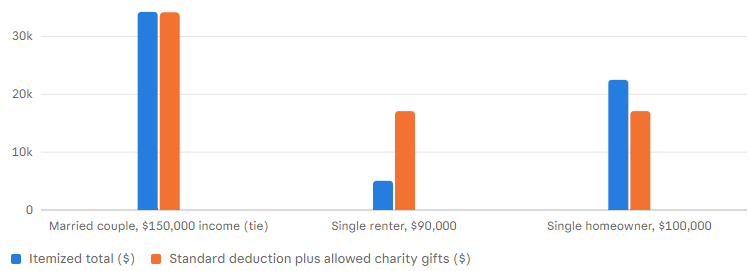
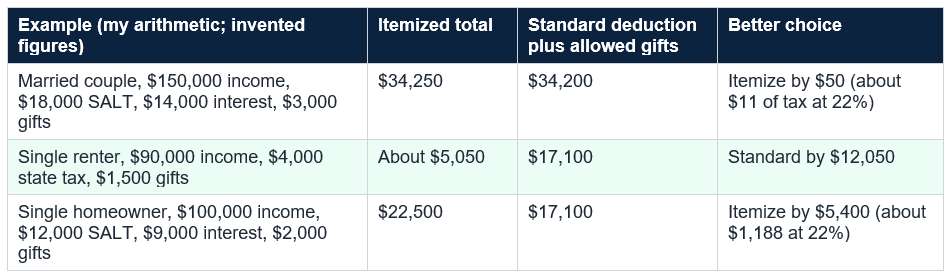
A single renter with $90,000 of income, $4,000 of state income tax and $1,500 of gifts has an itemized total of only about $5,050 against $17,100 on the standard side ($16,100 plus $1,000 for gifts), so the standard deduction wins by $12,050. A single homeowner with $100,000 of income, $7,000 of property tax, $5,000 of state income tax, $9,000 of mortgage interest and $2,000 of gifts has $22,500 of itemized deductions after a $500 floor, against $17,100, so itemizing wins by $5,400, worth about $1,188 at 22%.
Example (my arithmetic; invented figures) Itemized total Standard deduction plus allowed gifts Better choice
For households like this, small gifts are better handled with the standard deduction and bigger gifts can justify itemizing. Before 2026, many people who did not itemize got no tax benefit from gifts at all; now up to $2,000 for a couple can help. Check that the charity qualifies as a public charity, since I understand some gifts, such as to donor-advised funds, do not qualify for the non-itemizer deduction (not verified).
High earners therefore still need large mortgage interest or gifts to beat the standard deduction, and the charity floor bites in dollars: 0.5% of $850,000 is $4,250 of gifts that do not count. The people who gain most from the new cap are in the middle, below the phase-out with high state and property taxes. If you are near $505,000, be careful: extra income can reduce your SALT deduction at a steep marginal rate.

Other levers are smaller. In my general knowledge, you can sometimes pay a property tax bill due in early 2027 before year-end if your locality accepts it, bringing the deduction into 2026, but check that it is allowed and that the SALT cap has room. Giving appreciated investments instead of cash can avoid capital gains tax, though the non-itemizer deduction covers only cash, and donor-advised funds can help itemizers bunch. Give only what you genuinely want to give, and keep records of every gift.

Do not spend money just to chase a deduction. A $1 gift or expense saves you only your tax rate on that dollar, such as 22 cents, and the SALT cap and charity floor limit what counts. Always compare the full totals before changing what you do.
Two more points. Whether itemizing federally forces or allows itemizing on your state return depends on your state (general knowledge). And tax software can compare both ways, but do the math yourself first so you understand the answer; if the result is within a few hundred dollars, the simpler path may be worth more than the savings.
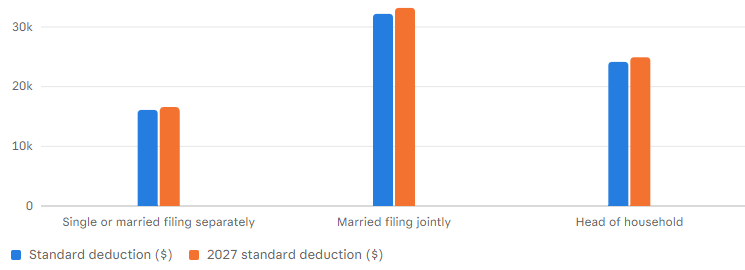
Next year’s numbers are partly known. The IRS announced that the 2027 standard deduction rises to $16,600 for single filers, $33,200 for joint filers and $24,925 for heads of household, up about 3.1% to 3.2%. Sources say the SALT cap rises about 1% a year through 2029, about $40,804 for 2027 in my arithmetic (no official figure retrieved), and after 2029 it is scheduled to return to $10,000, according to one source, which would make itemizing harder again.
Two thoughts follow. If your itemized total is above the standard deduction now, it may not stay there, since the standard deduction rises faster than a 1% cap. And if you are close to the line, think in multi-year patterns, including bunching. Recalculate each year, since mortgage interest falls as the loan is paid down, property taxes rise and the rules can change.
So add up your SALT, mortgage interest, charity and medical costs, compare with the standard deduction plus allowed gifts and take the larger. If you are close, consider timing moves such as bunching gifts before December 31, but do not spend just for a deduction, and remember high earners face the SALT phase-down above $505,000 and the cap is scheduled to expire after 2029.
When your total itemized deductions are larger than your standard deduction. For 2026 that means more than $16,100 if you are single, $32,200 if you are married filing jointly or $24,150 as head of household. Add up your state and local taxes (up to the $40,400 cap), mortgage interest, charitable gifts above 0.5% of your income and medical costs above 7.5% of your income, then compare.
Did the SALT cap change for 2026?
Yes. Under the One Big Beautiful Bill Act, the cap on the state and local tax deduction rose from $10,000 to $40,000 for 2025 and $40,400 for 2026, with a $20,200 limit if married filing separately. It phases down by 30 cents for every dollar of modified adjusted gross income above $505,000, to a floor of $10,000. Sources say the higher cap runs through 2029.
Can I deduct charity if I take the standard deduction?
Starting in 2026, yes, up to a point. Non-itemizers can deduct up to $1,000 (single) or $2,000 (joint) of cash gifts to qualifying public charities, according to several summaries. Itemizers face a new floor, so only gifts above 0.5% of adjusted gross income count. These two changes move the break-even, so compare the standard deduction plus your allowed gifts against your itemized total.
Is it worth itemizing if I only beat the standard deduction by a little?
Often not. In my example, a married couple’s itemized total of $34,250 beat the standard deduction plus the $2,000 charitable deduction ($34,200) by just $50, worth about $11 at a 22% rate. Itemizing needs more records and effort, and it can affect your state return. When the gap is tiny, the simpler standard deduction may be the better choice. This is general education, not personal tax advice.
What should I do before the end of 2026?
Total your likely itemized deductions now. If you are close to the break-even, consider timing: paying a property tax bill, making charitable gifts or bunching two years of giving into 2026 could tip you over. Gather statements such as Form 1098 for mortgage interest and receipts for gifts. Check which expenses can still be paid by December 31, and consult a tax professional for complex situations.
Table of Contents
- The Question Behind Every Tax Return
- The Short Answer
- What Changed for 2026
- What Counts as an Itemized Deduction
- Three Worked Examples
- The Charity Break-Even
- When Income Is High
- Timing Moves Before December 31
- Who Usually Itemizes and Who Does Not
- Looking Ahead to 2027
- Common Mistakes
- Conclusion
- Frequently Asked Questions
Itemize or not? Itemized total vs. standard deduction plus allowed gifts, three households ($)
Deduction ($) by Author's invented examples using 2026 rules (standard deduction $16,100 single, $32,200 joint; SALT cap $40,400; 0.5% AGI charity floor; $1,000/$2,000 non-itemizer gift deduction); not an estimate of your tax
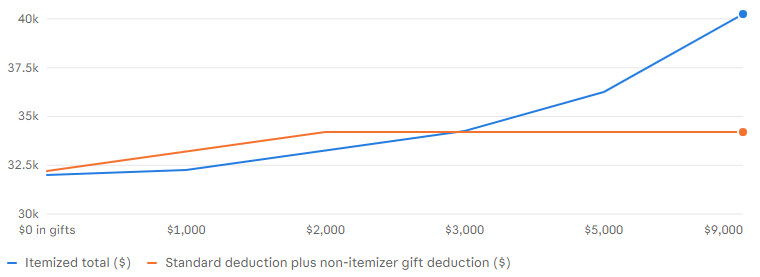
The charity break-even: a married couple's two options as cash gifts grow ($)
Deduction ($) by Author's arithmetic: $150,000 income; $18,000 SALT plus $14,000 mortgage interest; gifts above the 0.5% of AGI ($750) floor count if itemized; the standard side adds up to $2,000 of cash gifts; lines cross near $3,000
The benchmark to beat: standard deduction, 2026 vs. 2027 ($)
Standard deduction ($) by 2026 figures from earlier research and tax-information sites; 2027 figures from the IRS announcement of November 5, 2026 (IR-2026-133); itemizing must beat these, plus any allowed charity deduction
The Question Behind Every Tax Return
Every year you face a quiet choice on your tax return: take the standard deduction, a fixed amount that needs no receipts, or itemize, adding up your actual deductible expenses and using that total if it is bigger. Since 2018 most people have taken the standard deduction, because it roughly doubled while a $10,000 cap on state and local taxes made itemizing hard. For 2026 that has changed: the cap is now $40,400, and new charity rules have shifted the math.Tax year 2026 means the return you will file in early 2027, but decisions such as when to pay a bill or make a gift happen before December 31, so it is worth looking now. This guide explains what changed, what counts, how to compare the two options with worked numbers and what you can still do this year, flagging what comes from single sources.
The Short Answer
Itemize when your itemized deductions exceed your standard deduction, which for 2026 is $16,100 for single filers, $32,200 for married couples filing jointly and $24,150 for heads of household. Itemizing is more likely if you own a home in a high-tax state, since the SALT cap rises to $40,400. But two new charity rules change the break-even: non-itemizers can deduct up to $1,000 ($2,000 joint) of cash gifts, and itemizers can only deduct gifts above 0.5% of income. So compare your itemized total with the standard deduction plus the gifts you could deduct without itemizing; if the gap is tiny, the standard deduction is simpler.
What Changed for 2026
The One Big Beautiful Bill Act reshaped itemizing, according to tax-information sites. The state and local tax cap, $10,000 since 2018, rose to $40,000 for 2025 and $40,400 for 2026 ($20,200 for married filing separately), and sources say it rises about 1% a year through 2029. It phases down for high earners by 30 cents for each dollar of modified adjusted gross income over $505,000, to a floor of $10,000. The $750,000 limit on mortgage debt for interest deductions was made permanent.Charity changed in two ways. From 2026, itemizers can deduct gifts only above 0.5% of adjusted gross income, so on $150,000 of income the first $750 of giving does not count, while non-itemizers can deduct up to $1,000 (single) or $2,000 (joint) of cash gifts to qualifying public charities. Medical expenses still count only above 7.5% of income. One source also mentions a new reduction in itemized deductions for the top bracket, which I could not confirm. Check each rule against the IRS instructions.
2026: standard deduction $16,100 single, $32,200 joint, $24,150 head of household. SALT cap $40,400, phasing down above $505,000 of MAGI to $10,000. Mortgage interest on up to $750,000 of debt. Charity: 0.5% AGI floor if you itemize; up to $1,000/$2,000 of cash gifts if you do not. Medical: above 7.5% of AGI.
What Counts as an Itemized Deduction
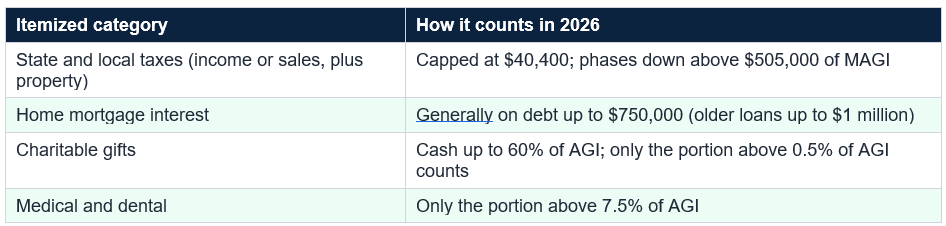
Four categories make up most itemized deductions. State and local taxes are state income tax or sales tax, whichever you choose, plus property taxes, together subject to the cap. Mortgage interest is generally on up to $750,000 of debt, with higher limits for older loans, and appears on Form 1098. Charitable gifts include cash up to 60% of income and property, now with the 0.5% floor. Medical and dental expenses count only above 7.5% of your income, which most people do not reach in a typical year.The method is simple. Add your state income tax (or sales tax) and property tax, capped at $40,400 if your income is under $505,000, then mortgage interest, charitable gifts above the floor and medical costs above 7.5% of income. Compare the total with your standard deduction, adding the allowed charitable deduction to the standard side if you give cash. Whichever is higher wins; you cannot do both on one return.
Three Worked Examples
Here are three invented households, with my arithmetic. A married couple filing jointly with $150,000 of income has $9,000 of state income tax and $9,000 of property tax ($18,000 of SALT), $14,000 of mortgage interest and $3,000 of gifts. After the 0.5% floor ($750), $2,250 of the gift counts, so itemized deductions are $34,250. The standard deduction is $32,200, plus the $2,000 charitable deduction they could take without itemizing, or $34,200. Itemizing wins by $50, about $11 of tax at 22%, essentially a tie.A single renter with $90,000 of income, $4,000 of state income tax and $1,500 of gifts has an itemized total of only about $5,050 against $17,100 on the standard side ($16,100 plus $1,000 for gifts), so the standard deduction wins by $12,050. A single homeowner with $100,000 of income, $7,000 of property tax, $5,000 of state income tax, $9,000 of mortgage interest and $2,000 of gifts has $22,500 of itemized deductions after a $500 floor, against $17,100, so itemizing wins by $5,400, worth about $1,188 at 22%.
Example (my arithmetic; invented figures) Itemized total Standard deduction plus allowed gifts Better choice
The Charity Break-Even
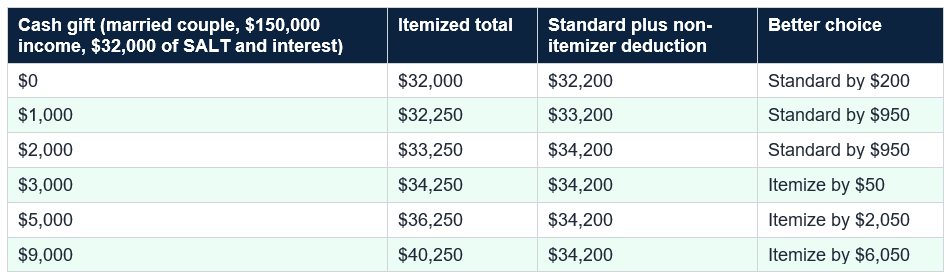
The new charity rules matter most near the line. The married couple’s SALT and mortgage interest total $32,000, just under the $32,200 standard deduction. With no gifts they take the standard deduction. With $1,000 or $2,000 of cash gifts the non-itemizer deduction lifts the standard side to $33,200 or $34,200, while itemizing reaches only $32,250 or $33,250, so the standard deduction still wins. At $3,000 they roughly tie, at $5,000 itemizing wins by about $2,050 and at $9,000 by about $6,050.For households like this, small gifts are better handled with the standard deduction and bigger gifts can justify itemizing. Before 2026, many people who did not itemize got no tax benefit from gifts at all; now up to $2,000 for a couple can help. Check that the charity qualifies as a public charity, since I understand some gifts, such as to donor-advised funds, do not qualify for the non-itemizer deduction (not verified).
When Income Is High
For high earners, the bigger SALT cap does not help much, since it is reduced by 30 cents for every dollar of MAGI above $505,000. In my arithmetic, at $550,000 the cap falls to $26,900 and at $600,000 to $11,900, and it hits the $10,000 floor at about $606,000, so for a couple earning $850,000 the SALT deduction is effectively back to $10,000. One source also describes a separate 2/37 reduction of itemized deductions for the top bracket, which I could not confirm.High earners therefore still need large mortgage interest or gifts to beat the standard deduction, and the charity floor bites in dollars: 0.5% of $850,000 is $4,250 of gifts that do not count. The people who gain most from the new cap are in the middle, below the phase-out with high state and property taxes. If you are near $505,000, be careful: extra income can reduce your SALT deduction at a steep marginal rate.
Timing Moves Before December 31
If you are near the break-even, timing can tip the result. Gifts count in the year you make them, so a gift on December 30 counts for 2026, and some people bunch two or three years of giving into one year to itemize then and take the standard deduction in the others. In my example, giving $9,000 in one year instead of $3,000 a year makes that year’s itemized total $40,250 against $34,200, a gain of $6,050, but loses $2,000 of the charitable deduction in each of the other two years, netting about $2,050 more in deductions over three years, roughly $450 at 22%.Other levers are smaller. In my general knowledge, you can sometimes pay a property tax bill due in early 2027 before year-end if your locality accepts it, bringing the deduction into 2026, but check that it is allowed and that the SALT cap has room. Giving appreciated investments instead of cash can avoid capital gains tax, though the non-itemizer deduction covers only cash, and donor-advised funds can help itemizers bunch. Give only what you genuinely want to give, and keep records of every gift.
Do not spend money just to chase a deduction. A $1 gift or expense saves you only your tax rate on that dollar, such as 22 cents, and the SALT cap and charity floor limit what counts. Always compare the full totals before changing what you do.
Who Usually Itemizes and Who Does Not
As a rough guide, itemizing is most likely if you own a home with a sizable mortgage or high property taxes, live in a high-tax state, give substantial amounts to charity or have large medical costs, and least likely if you rent, have a small or paid-off mortgage, live in a low-tax state and give modestly. The bigger SALT cap pulls many homeowners in states such as New York, New Jersey, California, Illinois, Connecticut and Massachusetts back toward itemizing, according to several summaries, but each household’s numbers differ.Two more points. Whether itemizing federally forces or allows itemizing on your state return depends on your state (general knowledge). And tax software can compare both ways, but do the math yourself first so you understand the answer; if the result is within a few hundred dollars, the simpler path may be worth more than the savings.
Next year’s numbers are partly known. The IRS announced that the 2027 standard deduction rises to $16,600 for single filers, $33,200 for joint filers and $24,925 for heads of household, up about 3.1% to 3.2%. Sources say the SALT cap rises about 1% a year through 2029, about $40,804 for 2027 in my arithmetic (no official figure retrieved), and after 2029 it is scheduled to return to $10,000, according to one source, which would make itemizing harder again.
Two thoughts follow. If your itemized total is above the standard deduction now, it may not stay there, since the standard deduction rises faster than a 1% cap. And if you are close to the line, think in multi-year patterns, including bunching. Recalculate each year, since mortgage interest falls as the loan is paid down, property taxes rise and the rules can change.
Common mistakes include assuming you cannot itemize because you could not before, forgetting that the standard deduction plus the non-itemizer charity deduction is the real benchmark, ignoring the 0.5% floor on charity, overlooking the SALT phase-down at high incomes, deducting taxes above the cap, forgetting receipts and itemizing for a tiny gain. Run your own numbers instead of reacting to a headline about a big cap.
Conclusion
For 2026, itemizing makes sense when your deductible expenses beat the standard deduction, which is $16,100 for single filers, $32,200 for joint filers and $24,150 for heads of household. The SALT cap of $40,400 pulls more homeowners in high-tax states back toward itemizing, while the new 0.5% floor on charity and the $1,000/$2,000 non-itemizer deduction move the break-even. In my examples, a single homeowner gained about $5,400 of deductions by itemizing, a renter should take the standard deduction and a married couple near the line gained just $50, a tie.So add up your SALT, mortgage interest, charity and medical costs, compare with the standard deduction plus allowed gifts and take the larger. If you are close, consider timing moves such as bunching gifts before December 31, but do not spend just for a deduction, and remember high earners face the SALT phase-down above $505,000 and the cap is scheduled to expire after 2029.
Frequently Asked Questions
When should I itemize instead of taking the standard deduction?When your total itemized deductions are larger than your standard deduction. For 2026 that means more than $16,100 if you are single, $32,200 if you are married filing jointly or $24,150 as head of household. Add up your state and local taxes (up to the $40,400 cap), mortgage interest, charitable gifts above 0.5% of your income and medical costs above 7.5% of your income, then compare.
Did the SALT cap change for 2026?
Yes. Under the One Big Beautiful Bill Act, the cap on the state and local tax deduction rose from $10,000 to $40,000 for 2025 and $40,400 for 2026, with a $20,200 limit if married filing separately. It phases down by 30 cents for every dollar of modified adjusted gross income above $505,000, to a floor of $10,000. Sources say the higher cap runs through 2029.
Can I deduct charity if I take the standard deduction?
Starting in 2026, yes, up to a point. Non-itemizers can deduct up to $1,000 (single) or $2,000 (joint) of cash gifts to qualifying public charities, according to several summaries. Itemizers face a new floor, so only gifts above 0.5% of adjusted gross income count. These two changes move the break-even, so compare the standard deduction plus your allowed gifts against your itemized total.
Is it worth itemizing if I only beat the standard deduction by a little?
Often not. In my example, a married couple’s itemized total of $34,250 beat the standard deduction plus the $2,000 charitable deduction ($34,200) by just $50, worth about $11 at a 22% rate. Itemizing needs more records and effort, and it can affect your state return. When the gap is tiny, the simpler standard deduction may be the better choice. This is general education, not personal tax advice.
What should I do before the end of 2026?
Total your likely itemized deductions now. If you are close to the break-even, consider timing: paying a property tax bill, making charitable gifts or bunching two years of giving into 2026 could tip you over. Gather statements such as Form 1098 for mortgage interest and receipts for gifts. Check which expenses can still be paid by December 31, and consult a tax professional for complex situations.
0 Comments
Be the first to share your thoughts on this article.