

Finance
Why a Legal Moat Is Your Best Defense Against Lawsuits
Over 100 million cases are filed in US state courts every year. Small businesses bear $160 billion in annual tort costs — seven times the burden per dollar of revenue compared to large companies. And 43% of small business owners have already been threatened with or involved in a civil lawsuit. A legal moat — a structured barrier of entities, exemptions, and trusts placed between your personal wealth and anyone seeking to claim it — is not paranoia. It is the financial equivalent of not leaving your front door open.
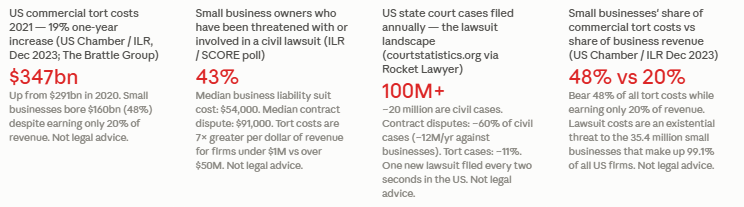
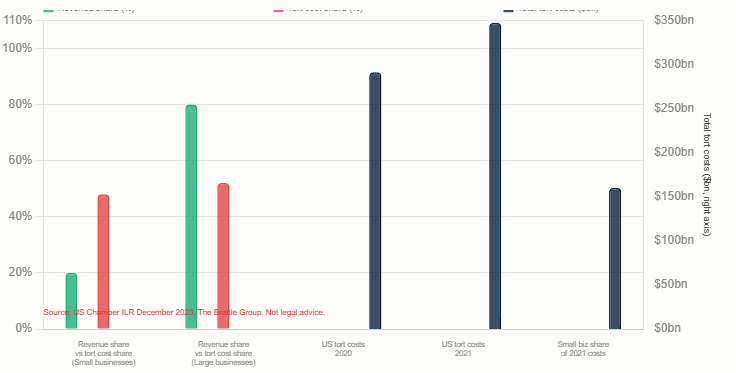
The burden falls most heavily on the smallest businesses. The US Chamber of Commerce Institute for Legal Reform (ILR) published its landmark study, ‘Tort Costs for Small Businesses,’ in December 2023. It found that US commercial liability costs totaled $347 billion in 2021 — a 19% increase in a single year from $291 billion in 2020. Small businesses (defined as those earning $10 million or less annually) bore $160 billion of that total, representing 48% of all commercial tort costs despite generating only 20% of business revenue. There are 35.4 million small businesses in the US, accounting for 99.1% of all firms. In proportion to revenue earned, tort costs are seven times greater for firms earning $1 million or less than for firms earning $50 million or more.
The personal dimension is equally sobering. A poll conducted by the Institute for Legal Reform found that 43% of small business owners report having been threatened with or involved in a civil lawsuit. The median cost of a business liability suit is $54,000; the median contract dispute costs $91,000 to litigate, according to courtstatistics.org. For a small business owner without a legal moat, a single lawsuit — even one that is entirely without merit — can consume savings, threaten a home, and end a business. This is not a risk that only affects the careless or the negligent. It affects every business owner, every landlord, every professional, and every person who has accumulated assets that someone else might want.
US commercial tort costs 2021: $347 billion (19% increase from $291bn in 2020). Small businesses bore $160 billion (48%) despite earning only 20% of revenue. Tort costs are 7x greater per dollar of revenue for firms earning <$1M vs >$50M. 43% of small business owners have been threatened with or involved in a civil lawsuit. 100 million+ cases filed in US state courts per year. 12 million contract lawsuits against small businesses annually. Median business liability suit cost: $54,000. Median contract dispute: $91,000. Sources: US Chamber ILR December 2023; courtstatistics.org; Rocket Lawyer; SCORE.org. Not legal advice.
A legal moat is not hiding money. It is not tax evasion. It is not fraud. It is the deliberate, legally compliant reorganisation of asset ownership — using entities, trusts, exemptions, and titling strategies that are explicitly sanctioned by law — so that assets that would otherwise be exposed to a creditor judgment are instead owned by structures that the law protects from that judgment. SJKP LLP’s asset protection practice articulates it precisely: ‘Effective asset protection is not about hiding assets: it is about reorganising ownership within the bounds of the law to make it mathematically and legally unfeasible for a creditor to seize your capital.’
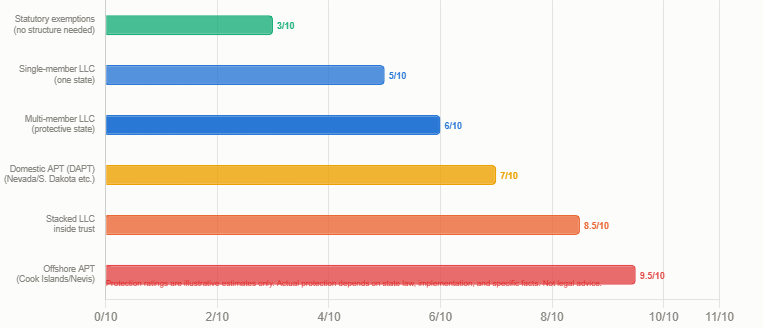
A legal moat has multiple layers. The outer layer is statutory exemptions — categories of assets that the law protects automatically regardless of any structure you build. The next layer is business entities, primarily LLCs, which separate business liability from personal wealth. The inner layer is trust structures, which remove assets from your taxable and reachable estate entirely. The most sophisticated moats stack all three layers, creating barriers that a determined creditor would find prohibitively expensive to penetrate and legally difficult to circumvent.
Critically, a legal moat works best as a deterrent. When a plaintiff’s attorney conducts a pre-lawsuit asset search and discovers that all assets are held in protected structures, they often advise their client that pursuing the lawsuit is economically irrational. The cost and difficulty of execution is not justified by the likely recovery. This is the asymmetric advantage of a well-built legal moat: it reduces the probability of being sued in the first place by making you an unattractive litigation target. Not legal advice.
The legitimate window for asset protection planning is before any specific lawsuit is threatened or filed, and before any specific creditor claim becomes foreseeable. The courts and statutes look at two factors: whether the transfer was made with ‘actual intent’ to defraud (subjective test) and whether it was made under ‘constructive fraud’ conditions (objective test, focusing on whether the transferor was or became insolvent as a result of the transfer). The statute of limitations on fraudulent conveyance claims varies by state but typically runs from two to seven years from the date of the transfer.
This creates a practical urgency: the right time to build a legal moat is when you do not need it. The doctor in a stable practice, the landlord with no pending disputes, the entrepreneur whose business is thriving — these are exactly the people who should be building their legal moat, precisely because they are not currently under threat. By the time the threat appears, the window may already be closed.
CRITICAL TIMING RULE: Asset protection structures MUST be established BEFORE a lawsuit is filed or a creditor claim becomes reasonably foreseeable. Transferring assets to an LLC, trust, or other protective structure after a lawsuit is filed or threatened is likely to be treated as a fraudulent conveyance and can be unwound by a court. Federal and state fraudulent conveyance laws explicitly prohibit transfers made with the intent to hinder, delay, or defraud creditors. Structures put in place pre-emptively, when no specific claim exists, are the only reliably protected ones. Sources: MJCPA.com; UpCounsel; lawyer-monthly.com. Not legal advice. Consult a qualified attorney.
The homestead exemption is the most widely known. It protects a specified equity amount in your primary residence from creditor seizure. The protection varies enormously by state: Texas and Florida offer unlimited homestead exemptions (meaning your primary residence is fully protected from most creditors regardless of value), while other states cap the exemption at modest amounts. For business owners and professionals who live in states with strong homestead exemptions, owning the primary residence outright (and ensuring it is properly designated as a homestead) is itself a significant asset protection strategy.
Other common statutory exemptions include: retirement accounts (IRAs and 401(k)s have federal protection under ERISA, and many states add additional layers; retirement accounts are among the most creditor-protected assets available); annuities and life insurance cash value (protected in many states up to specified limits or without limit); wages (a portion of wages are exempt from garnishment in most states); tools of the trade (equipment used in a profession is exempt up to specified limits in most states); and tenancy by the entirety (in states that recognise this form of ownership for married couples, a debt owed by only one spouse cannot reach property held jointly as tenants by the entirety).
The highest-leverage starting point for most people: maximise contributions to retirement accounts. IRAs and 401(k)/403(b) plans have strong federal creditor protection under ERISA and state-level additions. A $1 million 401(k) is typically better protected than $1 million in a bank account, at no additional structural cost beyond the contribution itself. For self-employed individuals, a Solo 401(k) or SEP-IRA provides both tax advantages and asset protection benefits simultaneously. Not legal or financial advice. Consult a qualified attorney and financial adviser.
The LLC creates two types of protection. The first is ‘outside-in’ protection: a creditor who has a judgment against you personally cannot reach the assets inside the LLC. The second is ‘inside-out’ protection: a creditor who has a claim arising from the LLC’s activities cannot typically reach your personal assets beyond whatever you have invested in the LLC. It is the outside-in protection — the charging order limitation — that makes LLCs particularly powerful as a creditor defence tool.
For real estate investors, the standard recommendation is to hold each property in a separate LLC. This creates asset silos: a lawsuit arising from a slip-and-fall at one rental property can only reach the assets of that property’s LLC, not the assets of any other LLC or any personal assets. The litigation risk of the entire portfolio is compartmentalised. A single LLC holding multiple properties provides no such compartmentalisation — a judgment against the LLC reaches all properties within it.
The LLC must be properly maintained to preserve its protection. ‘Piercing the corporate veil’ — a court order that disregards the LLC’s separate existence and allows a creditor to reach the owner’s personal assets — is most commonly obtained when: the LLC and the owner have commingled funds; the LLC lacks adequate capitalisation; the LLC has failed to observe its own formalities; or the LLC was being used as an alter ego to perpetrate fraud. Maintaining a separate LLC bank account, keeping adequate capitalisation, documenting major decisions, and observing the formalities of the operating agreement are not bureaucratic box-ticking — they are the practices that make the protection real.
LLC maintenance checklist to preserve asset protection: (1) Open a dedicated LLC bank account. NEVER mix personal and LLC funds. (2) Pay LLC expenses from the LLC account only; pay personal expenses from personal accounts only. (3) Adequately capitalise the LLC (don't leave it deliberately underfunded). (4) Sign all contracts and leases in the LLC's name, not your personal name. (5) Have a written operating agreement and follow it. (6) Hold required meetings (if any) and document key decisions. (7) File required annual reports and pay state fees on time. (8) Never personally guarantee LLC obligations unnecessarily. Source: SJKP LLP / daeryunlaw.com; UpCounsel; general asset protection practice. Not legal advice.
The creditor cannot force the LLC to make distributions. The other members (or the manager, in a manager-managed LLC) control whether distributions are made. If the LLC simply retains its profits and makes no distributions, the charging order holder receives nothing. But here is the particularly punishing element: under IRS rules, the charging order holder may still be taxed on their proportionate share of the LLC’s income as a passive investor — even if they receive no actual cash distribution. This creates what practitioners call the ‘poison pill’ of the charging order: the creditor can find themselves owing income tax on profits they never received.
This dynamic makes the charging order an exceptionally effective deterrent. A rational creditor, advised by competent counsel, will calculate: the probability of ever receiving a distribution, the tax cost of holding the charging order in the interim, the legal costs of enforcement, and the timeline of the process. In many cases, the economic analysis leads to a settlement far below the face value of the judgment, or an abandonment of collection efforts entirely. Not legal advice.
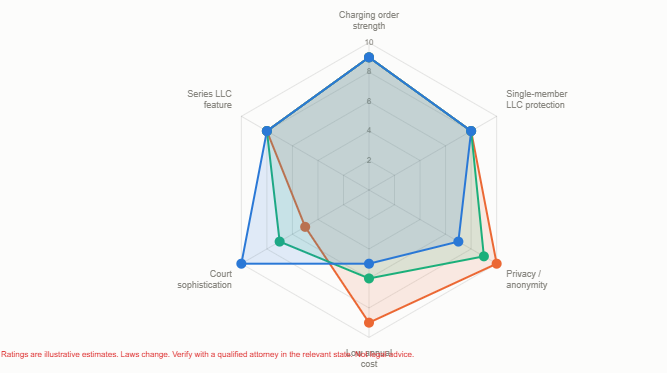
Important caveat: charging order protection is stronger for multi-member LLCs than for single-member LLCs in many states. Some courts have held that a creditor can ‘foreclose’ on the interest of a single-member LLC, effectively obtaining ownership and control of the entity. States vary significantly on this point. Delaware, Nevada, and Wyoming are the strongest states for single-member LLC charging order protection. Not legal advice — consult a qualified attorney in the relevant state.
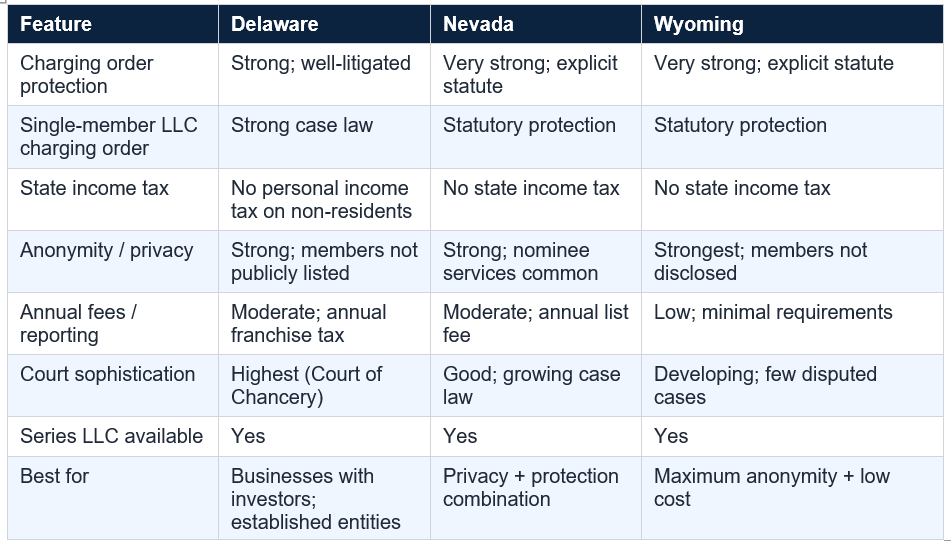
Delaware is the most established and widely recognised jurisdiction for business entities of all types. Its Court of Chancery, with its deep body of corporate and LLC law, provides predictability and sophistication that practitioners rely on. Delaware LLCs benefit from strong charging order protection and do not require members’ names to be listed in publicly filed documents. Delaware’s LLC statute is flexible and well-tested in litigation.
Nevada has aggressively positioned itself as a business-friendly state with strong asset protection laws. Nevada offers strong charging order protection, no state income tax, no franchise tax (for LLCs), and a charging order that explicitly prohibits foreclosure in most circumstances. Nevada also provides for ‘nominee’ services that allow the owner’s identity to be shielded from public records, adding a layer of privacy.
Wyoming emerged more recently as an asset protection haven and has attracted significant attention for combining low fees, minimal reporting requirements, and strong charging order protection. Wyoming LLCs can be formed with complete anonymity — the names of members are not publicly filed — and the state explicitly limits creditor remedies to charging orders. Wyoming also offers Series LLCs, allowing a single LLC to hold multiple ‘series’ of assets with internal separation.
The distinction between a revocable and irrevocable trust is critical. A revocable living trust — the kind commonly used in estate planning — provides NO asset protection from creditors. Because you can revoke the trust and take the assets back at any time, the law treats the assets as still effectively yours, available to your creditors. Only irrevocable trusts, in which you genuinely give up control and the right to revoke, provide meaningful asset protection.
The tradeoff is control. By placing assets in an irrevocable trust, you are genuinely giving up the right to change your mind and take them back — or at least creating a meaningful barrier to doing so. This is not an academic distinction: an irrevocable trust that gives you too much control or is too easy to unwind will likely be found by a court to provide no asset protection. The protection comes from the genuine transfer of ownership and control. The trust can still be structured to benefit you and your family through the trustee’s discretionary distributions — but the trustee must exercise genuine independent discretion, not simply do whatever you say.
Asset protection trusts typically use an independent trustee (someone other than yourself) to manage the assets and make distribution decisions. Some sophisticated structures include a Trust Protector — an independent party with the power to modify certain trust terms, remove and replace the trustee, or veto distributions — to add flexibility without undermining the protective structure. Lawyer-monthly.com notes that trusts are frequently used in tandem with LLCs and Limited Partnerships to provide ‘the client with greater protection, control and anonymity.’ Not legal advice.
Domestic Asset Protection Trusts (DAPTs) are available in a growing number of states — Nevada, South Dakota, Delaware, Alaska, Ohio, and others have enacted DAPT statutes. They allow the settlor (the person creating the trust) to be a discretionary beneficiary while still obtaining asset protection. DAPTs are less expensive to establish and maintain than offshore trusts, have no foreign reporting requirements, and are subject to US law and courts. However, they have limitations: courts in other states may not respect another state’s DAPT laws (the Full Faith and Credit issue has produced inconsistent case law), and a US court has the power to order the trustee to distribute assets to a creditor.
Offshore Asset Protection Trusts, typically formed in jurisdictions such as the Cook Islands, Nevis, or Belize, are widely considered to provide the strongest available protection. UpCounsel notes: ‘This is widely considered the best method of protecting company money from lawsuits and is one of the only asset protection strategies to reliably do so.’ These jurisdictions do not recognise US court orders, have short statutes of limitations for fraudulent conveyance claims, place the burden of proof on creditors rather than the trust, and have local trustees who are not subject to US contempt of court orders.
The practical result: when a creditor obtains a US court judgment and attempts to enforce it against an offshore trust, they face the prospect of litigating in a foreign jurisdiction under foreign law, against a foreign trustee, with a high burden of proof, a short time window, and no ability to leverage US courts. This makes offshore trusts a powerful deterrent against collection efforts — and helps explain why, in many cases, plaintiffs seeking to collect against offshore trust assets settle for a fraction of the judgment. Not legal advice.
Offshore trusts carry significant compliance requirements. They typically require disclosure to the IRS (Form 3520 / 3520-A for foreign trusts with US owners), carry FBAR requirements for foreign financial accounts, and must be structured to avoid characterisation as a sham or fraudulent conveyance. Failure to comply with reporting requirements can result in severe civil and criminal penalties. The legal and administrative costs are substantial. Offshore trusts are not appropriate for modest estates and should only be considered as part of a comprehensive strategy under the guidance of attorneys and tax advisers with specific offshore experience. Not legal advice.
How this works in practice: an investor holds three rental properties, each in its own single-purpose LLC. The membership interests in all three LLCs are held by an irrevocable trust (possibly with a Nevada or Cook Islands trustee). A creditor who wins a judgment against the investor personally seeks to collect. They cannot directly reach the properties (inside the LLCs). They cannot foreclose on the LLC interests (because of the charging order limitation). They cannot reach the trust assets (because the trust owns the LLC interests, not the investor). To pierce all three layers, the creditor must successfully argue fraudulent conveyance, pierce the corporate veil of each LLC, and penetrate the trust — each requiring separate legal proceedings at significant cost. This is the economic deterrence of the stacked structure.
Limited Partnerships (LPs) are also frequently incorporated into stacked structures alongside LLCs, often with a general partner (which can be an LLC) holding a small interest and managing the LP, and a trust holding the limited partnership interests. This provides the charging order protection of the LP combined with the liability protection of the LLC general partner and the asset protection of the trust. Not legal advice.
The key design principle of a stacked structure: each layer must serve a legitimate legal purpose beyond asset protection. Operating businesses need legal structures for liability purposes. Trusts serve estate planning and wealth transfer functions. LLCs serve management and operational purposes. Structures that exist solely to defraud creditors, with no genuine business purpose, are most vulnerable to fraudulent conveyance challenges. Substance matters: legitimate structures have real economic activity, real governance, real documentation, and real compliance. Not legal advice.
The Uniform Voidable Transactions Act (UVTA), adopted in most US states as the successor to the Uniform Fraudulent Transfer Act (UFTA), provides courts with two grounds to void a transfer: actual fraud (the transfer was made with actual intent to hinder, delay, or defraud any creditor) and constructive fraud (the transfer was made without receiving reasonably equivalent value in exchange and the debtor was insolvent at the time, became insolvent as a result, or had unreasonably small remaining capital). Courts look at a list of ‘badges of fraud’ — objective factors that suggest fraudulent intent, including: the transfer was to an insider (family member, business associate); the debtor retained control; the transfer was concealed; the debtor was sued or threatened before the transfer; and the transfer was of substantially all the debtor’s assets.
The practical lesson is stark: the mere filing of a lawsuit does not mean all is lost, but it does mean the window for effective asset protection planning has almost certainly closed. Any transfer made after a lawsuit is filed, or while a claim is pending or reasonably foreseeable, will face intense scrutiny for fraudulent conveyance. Even a transfer made months or years before a lawsuit, if it can be shown that the debtor knew the risk was coming, can be unwound. The best and only reliable defence against fraudulent conveyance challenge is implementation well in advance of any specific threat.
External liability refers to the risk that a lawsuit against you personally could reach your business assets — or conversely, that a lawsuit against your business could reach your personal assets. This is the classic ‘piercing the corporate veil’ scenario. The LLC or corporation is designed to address external liability by creating a legal barrier between the business and the individual. When correctly maintained, a judgment against the LLC cannot reach the owner’s personal assets (inside-out protection), and a judgment against the owner personally cannot reach the LLC’s assets (outside-in protection).
Internal liability refers to the risk that a claim arising within one asset can contaminate other assets within the same legal structure. A landlord who holds five properties in a single LLC has no internal protection: a judgment arising from events at property A can reach all five properties inside the LLC. Creating a separate LLC for each property is the standard response — it creates internal silos so that liability is contained within the specific entity that generated it.
The most robust structures combine both internal and external liability management: multiple single-purpose LLCs (internal silos) with their membership interests held by a holding entity or trust (external protection). This means a creditor must first overcome the trust’s external protection, then penetrate the multi-layered holding structure, then reach the specific operating LLC, before they can access any specific asset. The cost and uncertainty of doing so makes the economics of collection sufficiently unattractive that settlement or abandonment becomes more rational than pursuit.
The relevant comparison is not the cost of asset protection versus zero, but the cost of asset protection versus the cost of being unprotected when a lawsuit arrives. The median business liability lawsuit costs $54,000 to litigate. The median contract dispute costs $91,000. A judgment for $500,000 against an unprotected individual can reach their home equity, savings, and investments. The cost of the legal moat is fixed and known; the cost of being unprotected is open-ended and potentially catastrophic.
There is also an often-overlooked benefit: reduced settlement pressure. A defendant whose assets are protected by a well-structured legal moat has significantly more negotiating leverage in a settlement discussion than one who knows a judgment will be immediately collectible from accessible personal assets. The asset-protected defendant can afford to fight a frivolous lawsuit on the merits; the unprotected defendant often cannot. Not legal advice.
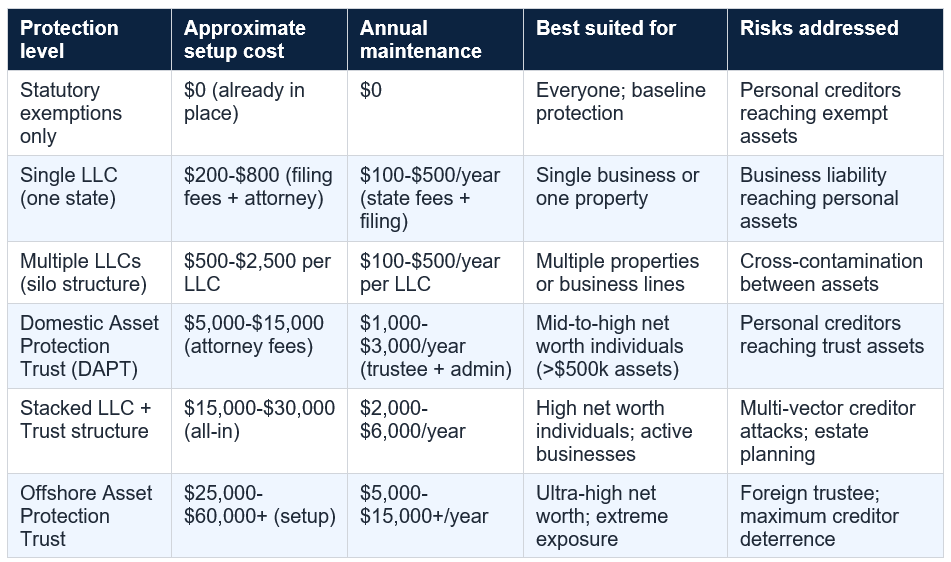
All cost estimates are approximate and vary significantly by state, attorney, structure complexity, and specific circumstances. Consult a qualified attorney for costs applicable to your situation. Not legal advice.
The statistics make the case for urgency. Over 100 million cases filed in US state courts every year. $347 billion in commercial tort costs in 2021 alone. Forty-three per cent of small business owners already touched by litigation. Tort costs seven times more burdensome per dollar of revenue for small firms than large ones. The lawsuit machine does not discriminate by size, reputation, or moral standing. It is an environmental risk that every business owner, landlord, professional, and wealth accumulator faces, and the only rational response is structural preparation.
The building blocks of a legal moat — statutory exemptions, LLC structures, irrevocable trusts, and their combinations — are all explicitly lawful, widely used, and professionally supported. They are not exotic or aggressive. They are the standard tools that advisers routinely recommend to anyone who has assets worth protecting. The question is not whether to build a moat, but how soon. Not legal, financial, or tax advice. Always consult a qualified attorney specialising in asset protection.
Doing so is very difficult and potentially counterproductive. Federal and state fraudulent conveyance laws (codified in most states as the Uniform Voidable Transactions Act or its predecessor) prohibit transferring assets with the intent to hinder, delay, or defraud existing or foreseeable future creditors. A transfer made after a lawsuit is filed, threatened, or reasonably foreseeable is likely to be treated as a fraudulent conveyance and can be unwound by a court — potentially leaving you in a worse position than if you had done nothing. The critical rule of asset protection is that structures must be established well before any specific claim arises. If you are already facing a lawsuit, consult an attorney immediately about your options, which will be more limited. Sources: MJCPA.com; UpCounsel; UVTA. Not legal advice.
Does an LLC really protect my personal assets?
A properly maintained LLC provides meaningful protection against business liability reaching personal assets (and personal liability reaching business assets), but it is not absolute. Protection depends on: (1) maintaining the LLC as a genuinely separate entity (separate accounts, adequate capitalisation, no commingling of funds); (2) not personally guaranteeing LLC obligations; (3) the state of formation's strength of charging order protection; (4) single-member vs multi-member status (multi-member LLCs generally have stronger protection); and (5) the specific facts of the claim. Courts will 'pierce the corporate veil' and disregard the LLC's separate existence when the owner has treated it as an alter ego or used it to perpetuate fraud. An LLC alone is not a complete asset protection plan — it is one layer of a broader structure. Source: UpCounsel; SJKP LLP. Not legal advice.
What assets are already protected from creditors without any additional structure?
Several categories of assets have statutory protection in most US states: qualified retirement accounts (IRAs, 401(k)s, 403(b)s) have strong federal protection under ERISA plus additional state protections; primary residence equity up to the state homestead exemption (unlimited in Texas and Florida; capped in other states); life insurance cash value and annuity values (up to state-specific limits); a portion of wages (exempt from garnishment under federal law and state additions); and tools of the trade or profession (up to specified limits). The specific exemption amounts and categories vary significantly by state — a qualified attorney can advise on the exemptions applicable in your jurisdiction. Not legal advice.
What is the difference between a revocable and irrevocable trust for asset protection?
A revocable trust (also called a living trust or revocable living trust) provides NO meaningful asset protection from creditors. Because you retain the right to revoke the trust and take the assets back, the law treats the assets as still effectively yours and available to your creditors. Asset protection requires an irrevocable trust — one in which you genuinely give up the right to revoke and take the assets back. The protection comes precisely from the genuine transfer of ownership and control. Some irrevocable trusts (particularly domestic asset protection trusts and offshore asset protection trusts) are specifically designed to allow the settlor to be a discretionary beneficiary while still providing creditor protection, but this requires very careful legal drafting to avoid being unwound. Source: UpCounsel; MJCPA.com. Not legal advice.
Are offshore asset protection trusts legal?
Yes, offshore asset protection trusts are entirely legal when properly structured and fully disclosed to the IRS and relevant authorities. They do NOT exempt you from US tax on income or assets held in the trust. They DO require: disclosure to the IRS via Form 3520 and Form 3520-A (for foreign trusts with US grantors or beneficiaries); FBAR (FinCEN 114) filing for foreign financial accounts exceeding $10,000; and compliance with FATCA and other international reporting frameworks. The protection comes not from secrecy but from the practical difficulty of enforcing a US court judgment in a foreign jurisdiction with its own legal system, its own trustee, and its own rules (typically more protective of the trust than US courts would be). Failure to comply with reporting requirements carries severe civil penalties and potential criminal liability. Only implement offshore structures under the guidance of attorneys and tax advisers with specific offshore trust experience. Sources: UpCounsel; MJCPA.com. Not legal advice.
Table of Contents
- The Lawsuit Landscape: Why the Risk Is Real and Growing
- What a Legal Moat Actually Is
- The Golden Rule: Timing Is Everything
- Layer One: Statutory Exemptions — What the Law Protects by Default
- Layer Two: The LLC Shield — Separating Business from Personal Risk
- The Charging Order: The LLC’s Secret Weapon Against Creditors
- The Best States for LLC Protection: Delaware, Nevada, and Wyoming
- Layer Three: The Irrevocable Trust — The Most Powerful Tool in the Arsenal
- Domestic vs Offshore Asset Protection Trusts
- Layer Four: Stacking the Structures — LLC Inside a Trust
- What a Legal Moat Cannot Do
- Fraudulent Conveyance: The Rule That Invalidates Everything If Ignored
- Internal vs External Liability: Building Silos for Risk Isolation
- The Cost-Benefit Calculation: Is a Legal Moat Worth It?
- Conclusion: Build the Moat Before You Need It
- Frequently Asked Questions
Small business lawsuit burden — the disproportionate cost
The legal moat layers — protection by structure type
Best states for LLC protection — Delaware, Nevada, Wyoming
The Lawsuit Landscape: Why the Risk Is Real and Growing
The United States files more lawsuits per capita than any other developed nation. At $264 billion annually at its peak, the US legal liability system costs double that of the United Kingdom as a percentage of the economy, three times France, and five times Japan. More than 100 million cases are filed in US state courts every year. Approximately 20 million of these are civil cases, with contract disputes alone accounting for roughly 60% of that total — approximately 12 million contract lawsuits against businesses annually, according to courtstatistics.org via Rocket Lawyer.The burden falls most heavily on the smallest businesses. The US Chamber of Commerce Institute for Legal Reform (ILR) published its landmark study, ‘Tort Costs for Small Businesses,’ in December 2023. It found that US commercial liability costs totaled $347 billion in 2021 — a 19% increase in a single year from $291 billion in 2020. Small businesses (defined as those earning $10 million or less annually) bore $160 billion of that total, representing 48% of all commercial tort costs despite generating only 20% of business revenue. There are 35.4 million small businesses in the US, accounting for 99.1% of all firms. In proportion to revenue earned, tort costs are seven times greater for firms earning $1 million or less than for firms earning $50 million or more.
The personal dimension is equally sobering. A poll conducted by the Institute for Legal Reform found that 43% of small business owners report having been threatened with or involved in a civil lawsuit. The median cost of a business liability suit is $54,000; the median contract dispute costs $91,000 to litigate, according to courtstatistics.org. For a small business owner without a legal moat, a single lawsuit — even one that is entirely without merit — can consume savings, threaten a home, and end a business. This is not a risk that only affects the careless or the negligent. It affects every business owner, every landlord, every professional, and every person who has accumulated assets that someone else might want.
US commercial tort costs 2021: $347 billion (19% increase from $291bn in 2020). Small businesses bore $160 billion (48%) despite earning only 20% of revenue. Tort costs are 7x greater per dollar of revenue for firms earning <$1M vs >$50M. 43% of small business owners have been threatened with or involved in a civil lawsuit. 100 million+ cases filed in US state courts per year. 12 million contract lawsuits against small businesses annually. Median business liability suit cost: $54,000. Median contract dispute: $91,000. Sources: US Chamber ILR December 2023; courtstatistics.org; Rocket Lawyer; SCORE.org. Not legal advice.
What a Legal Moat Actually Is
The term ‘legal moat’ is borrowed from the business strategy concept of a competitive moat — a durable, structural advantage that prevents competitors from reaching and consuming a company’s market position. Applied to personal and business wealth, a legal moat is a set of proactively structured legal barriers that make it mathematically and legally impractical, expensive, and unattractive for a creditor or plaintiff to pursue your assets.A legal moat is not hiding money. It is not tax evasion. It is not fraud. It is the deliberate, legally compliant reorganisation of asset ownership — using entities, trusts, exemptions, and titling strategies that are explicitly sanctioned by law — so that assets that would otherwise be exposed to a creditor judgment are instead owned by structures that the law protects from that judgment. SJKP LLP’s asset protection practice articulates it precisely: ‘Effective asset protection is not about hiding assets: it is about reorganising ownership within the bounds of the law to make it mathematically and legally unfeasible for a creditor to seize your capital.’
A legal moat has multiple layers. The outer layer is statutory exemptions — categories of assets that the law protects automatically regardless of any structure you build. The next layer is business entities, primarily LLCs, which separate business liability from personal wealth. The inner layer is trust structures, which remove assets from your taxable and reachable estate entirely. The most sophisticated moats stack all three layers, creating barriers that a determined creditor would find prohibitively expensive to penetrate and legally difficult to circumvent.
Critically, a legal moat works best as a deterrent. When a plaintiff’s attorney conducts a pre-lawsuit asset search and discovers that all assets are held in protected structures, they often advise their client that pursuing the lawsuit is economically irrational. The cost and difficulty of execution is not justified by the likely recovery. This is the asymmetric advantage of a well-built legal moat: it reduces the probability of being sued in the first place by making you an unattractive litigation target. Not legal advice.
The Golden Rule: Timing Is Everything
The single most important principle of asset protection is also the most frequently violated: the moat must be built before the attack. Federal and state fraudulent conveyance laws — which exist in every US jurisdiction and are closely mirrored in most common law countries — prohibit transferring assets to a trust, entity, or other structure with the intent to hinder, delay, or defraud existing or foreseeable future creditors. If you transfer your house to an LLC the day after being served with a lawsuit, that transfer is almost certainly voidable by a court. If you set up an offshore trust the week after a car accident on your property, the timing creates an inference of fraudulent intent that will likely unwind the structure.The legitimate window for asset protection planning is before any specific lawsuit is threatened or filed, and before any specific creditor claim becomes foreseeable. The courts and statutes look at two factors: whether the transfer was made with ‘actual intent’ to defraud (subjective test) and whether it was made under ‘constructive fraud’ conditions (objective test, focusing on whether the transferor was or became insolvent as a result of the transfer). The statute of limitations on fraudulent conveyance claims varies by state but typically runs from two to seven years from the date of the transfer.
This creates a practical urgency: the right time to build a legal moat is when you do not need it. The doctor in a stable practice, the landlord with no pending disputes, the entrepreneur whose business is thriving — these are exactly the people who should be building their legal moat, precisely because they are not currently under threat. By the time the threat appears, the window may already be closed.
CRITICAL TIMING RULE: Asset protection structures MUST be established BEFORE a lawsuit is filed or a creditor claim becomes reasonably foreseeable. Transferring assets to an LLC, trust, or other protective structure after a lawsuit is filed or threatened is likely to be treated as a fraudulent conveyance and can be unwound by a court. Federal and state fraudulent conveyance laws explicitly prohibit transfers made with the intent to hinder, delay, or defraud creditors. Structures put in place pre-emptively, when no specific claim exists, are the only reliably protected ones. Sources: MJCPA.com; UpCounsel; lawyer-monthly.com. Not legal advice. Consult a qualified attorney.
Layer One: Statutory Exemptions — What the Law Protects by Default
Before building any structure, it is worth understanding what is already protected by law. Every US state has statutory exemptions — categories of property that are shielded from most creditor claims regardless of how they are titled. These exemptions are a free layer of protection that requires no entity formation, no legal fees, and no ongoing maintenance. Understanding them is the starting point of any asset protection analysis.The homestead exemption is the most widely known. It protects a specified equity amount in your primary residence from creditor seizure. The protection varies enormously by state: Texas and Florida offer unlimited homestead exemptions (meaning your primary residence is fully protected from most creditors regardless of value), while other states cap the exemption at modest amounts. For business owners and professionals who live in states with strong homestead exemptions, owning the primary residence outright (and ensuring it is properly designated as a homestead) is itself a significant asset protection strategy.
Other common statutory exemptions include: retirement accounts (IRAs and 401(k)s have federal protection under ERISA, and many states add additional layers; retirement accounts are among the most creditor-protected assets available); annuities and life insurance cash value (protected in many states up to specified limits or without limit); wages (a portion of wages are exempt from garnishment in most states); tools of the trade (equipment used in a profession is exempt up to specified limits in most states); and tenancy by the entirety (in states that recognise this form of ownership for married couples, a debt owed by only one spouse cannot reach property held jointly as tenants by the entirety).
The highest-leverage starting point for most people: maximise contributions to retirement accounts. IRAs and 401(k)/403(b) plans have strong federal creditor protection under ERISA and state-level additions. A $1 million 401(k) is typically better protected than $1 million in a bank account, at no additional structural cost beyond the contribution itself. For self-employed individuals, a Solo 401(k) or SEP-IRA provides both tax advantages and asset protection benefits simultaneously. Not legal or financial advice. Consult a qualified attorney and financial adviser.
Layer Two: The LLC Shield — Separating Business from Personal Risk
The Limited Liability Company (LLC) is the workhorse of the asset protection toolkit. It is the most widely used business entity for asset protection purposes, combining the tax flexibility of a partnership with the liability protection of a corporation, in a structure that is relatively simple and inexpensive to maintain.The LLC creates two types of protection. The first is ‘outside-in’ protection: a creditor who has a judgment against you personally cannot reach the assets inside the LLC. The second is ‘inside-out’ protection: a creditor who has a claim arising from the LLC’s activities cannot typically reach your personal assets beyond whatever you have invested in the LLC. It is the outside-in protection — the charging order limitation — that makes LLCs particularly powerful as a creditor defence tool.
For real estate investors, the standard recommendation is to hold each property in a separate LLC. This creates asset silos: a lawsuit arising from a slip-and-fall at one rental property can only reach the assets of that property’s LLC, not the assets of any other LLC or any personal assets. The litigation risk of the entire portfolio is compartmentalised. A single LLC holding multiple properties provides no such compartmentalisation — a judgment against the LLC reaches all properties within it.
The LLC must be properly maintained to preserve its protection. ‘Piercing the corporate veil’ — a court order that disregards the LLC’s separate existence and allows a creditor to reach the owner’s personal assets — is most commonly obtained when: the LLC and the owner have commingled funds; the LLC lacks adequate capitalisation; the LLC has failed to observe its own formalities; or the LLC was being used as an alter ego to perpetrate fraud. Maintaining a separate LLC bank account, keeping adequate capitalisation, documenting major decisions, and observing the formalities of the operating agreement are not bureaucratic box-ticking — they are the practices that make the protection real.
LLC maintenance checklist to preserve asset protection: (1) Open a dedicated LLC bank account. NEVER mix personal and LLC funds. (2) Pay LLC expenses from the LLC account only; pay personal expenses from personal accounts only. (3) Adequately capitalise the LLC (don't leave it deliberately underfunded). (4) Sign all contracts and leases in the LLC's name, not your personal name. (5) Have a written operating agreement and follow it. (6) Hold required meetings (if any) and document key decisions. (7) File required annual reports and pay state fees on time. (8) Never personally guarantee LLC obligations unnecessarily. Source: SJKP LLP / daeryunlaw.com; UpCounsel; general asset protection practice. Not legal advice.
The Charging Order: The LLC’s Secret Weapon Against Creditors
The charging order is the mechanism that makes LLC asset protection particularly effective and, for creditors, particularly unpleasant. When a creditor obtains a judgment against an LLC member (owner) personally, the most they can typically obtain against that member’s LLC interest is a charging order. A charging order does not give the creditor ownership of the LLC interest, voting rights, or management rights. It entitles the creditor to receive whatever distributions the LLC makes to that member — but crucially, only if the LLC actually makes distributions, and only when the LLC makes them.The creditor cannot force the LLC to make distributions. The other members (or the manager, in a manager-managed LLC) control whether distributions are made. If the LLC simply retains its profits and makes no distributions, the charging order holder receives nothing. But here is the particularly punishing element: under IRS rules, the charging order holder may still be taxed on their proportionate share of the LLC’s income as a passive investor — even if they receive no actual cash distribution. This creates what practitioners call the ‘poison pill’ of the charging order: the creditor can find themselves owing income tax on profits they never received.
This dynamic makes the charging order an exceptionally effective deterrent. A rational creditor, advised by competent counsel, will calculate: the probability of ever receiving a distribution, the tax cost of holding the charging order in the interim, the legal costs of enforcement, and the timeline of the process. In many cases, the economic analysis leads to a settlement far below the face value of the judgment, or an abandonment of collection efforts entirely. Not legal advice.
Important caveat: charging order protection is stronger for multi-member LLCs than for single-member LLCs in many states. Some courts have held that a creditor can ‘foreclose’ on the interest of a single-member LLC, effectively obtaining ownership and control of the entity. States vary significantly on this point. Delaware, Nevada, and Wyoming are the strongest states for single-member LLC charging order protection. Not legal advice — consult a qualified attorney in the relevant state.
The Best States for LLC Protection: Delaware, Nevada, and Wyoming
Not all LLCs are created equal. The state in which an LLC is formed determines the legal framework governing its operation, including the strength of charging order protection, the availability of anonymity, and the level of formality required. For asset protection purposes, three states stand out: Delaware, Nevada, and Wyoming.Delaware is the most established and widely recognised jurisdiction for business entities of all types. Its Court of Chancery, with its deep body of corporate and LLC law, provides predictability and sophistication that practitioners rely on. Delaware LLCs benefit from strong charging order protection and do not require members’ names to be listed in publicly filed documents. Delaware’s LLC statute is flexible and well-tested in litigation.
Nevada has aggressively positioned itself as a business-friendly state with strong asset protection laws. Nevada offers strong charging order protection, no state income tax, no franchise tax (for LLCs), and a charging order that explicitly prohibits foreclosure in most circumstances. Nevada also provides for ‘nominee’ services that allow the owner’s identity to be shielded from public records, adding a layer of privacy.
Wyoming emerged more recently as an asset protection haven and has attracted significant attention for combining low fees, minimal reporting requirements, and strong charging order protection. Wyoming LLCs can be formed with complete anonymity — the names of members are not publicly filed — and the state explicitly limits creditor remedies to charging orders. Wyoming also offers Series LLCs, allowing a single LLC to hold multiple ‘series’ of assets with internal separation.
Layer Three: The Irrevocable Trust — The Most Powerful Tool in the Arsenal
If the LLC is the workhorse of asset protection, the irrevocable trust is the fortress. An irrevocable trust transfers legal ownership of assets from you to the trust itself. Once established and funded, you no longer own the assets — the trust does. And assets you do not legally own cannot be seized by your creditors. This is the foundational logic of trust-based asset protection.The distinction between a revocable and irrevocable trust is critical. A revocable living trust — the kind commonly used in estate planning — provides NO asset protection from creditors. Because you can revoke the trust and take the assets back at any time, the law treats the assets as still effectively yours, available to your creditors. Only irrevocable trusts, in which you genuinely give up control and the right to revoke, provide meaningful asset protection.
The tradeoff is control. By placing assets in an irrevocable trust, you are genuinely giving up the right to change your mind and take them back — or at least creating a meaningful barrier to doing so. This is not an academic distinction: an irrevocable trust that gives you too much control or is too easy to unwind will likely be found by a court to provide no asset protection. The protection comes from the genuine transfer of ownership and control. The trust can still be structured to benefit you and your family through the trustee’s discretionary distributions — but the trustee must exercise genuine independent discretion, not simply do whatever you say.
Asset protection trusts typically use an independent trustee (someone other than yourself) to manage the assets and make distribution decisions. Some sophisticated structures include a Trust Protector — an independent party with the power to modify certain trust terms, remove and replace the trustee, or veto distributions — to add flexibility without undermining the protective structure. Lawyer-monthly.com notes that trusts are frequently used in tandem with LLCs and Limited Partnerships to provide ‘the client with greater protection, control and anonymity.’ Not legal advice.
Domestic vs Offshore Asset Protection Trusts
Asset protection trusts come in two broad categories: domestic (formed in a US state that allows them) and offshore (formed in a foreign jurisdiction). The difference matters significantly in terms of both the level of protection offered and the complexity and cost of implementation.Domestic Asset Protection Trusts (DAPTs) are available in a growing number of states — Nevada, South Dakota, Delaware, Alaska, Ohio, and others have enacted DAPT statutes. They allow the settlor (the person creating the trust) to be a discretionary beneficiary while still obtaining asset protection. DAPTs are less expensive to establish and maintain than offshore trusts, have no foreign reporting requirements, and are subject to US law and courts. However, they have limitations: courts in other states may not respect another state’s DAPT laws (the Full Faith and Credit issue has produced inconsistent case law), and a US court has the power to order the trustee to distribute assets to a creditor.
Offshore Asset Protection Trusts, typically formed in jurisdictions such as the Cook Islands, Nevis, or Belize, are widely considered to provide the strongest available protection. UpCounsel notes: ‘This is widely considered the best method of protecting company money from lawsuits and is one of the only asset protection strategies to reliably do so.’ These jurisdictions do not recognise US court orders, have short statutes of limitations for fraudulent conveyance claims, place the burden of proof on creditors rather than the trust, and have local trustees who are not subject to US contempt of court orders.
The practical result: when a creditor obtains a US court judgment and attempts to enforce it against an offshore trust, they face the prospect of litigating in a foreign jurisdiction under foreign law, against a foreign trustee, with a high burden of proof, a short time window, and no ability to leverage US courts. This makes offshore trusts a powerful deterrent against collection efforts — and helps explain why, in many cases, plaintiffs seeking to collect against offshore trust assets settle for a fraction of the judgment. Not legal advice.
Offshore trusts carry significant compliance requirements. They typically require disclosure to the IRS (Form 3520 / 3520-A for foreign trusts with US owners), carry FBAR requirements for foreign financial accounts, and must be structured to avoid characterisation as a sham or fraudulent conveyance. Failure to comply with reporting requirements can result in severe civil and criminal penalties. The legal and administrative costs are substantial. Offshore trusts are not appropriate for modest estates and should only be considered as part of a comprehensive strategy under the guidance of attorneys and tax advisers with specific offshore experience. Not legal advice.
Layer Four: Stacking the Structures — LLC Inside a Trust
The most sophisticated legal moats combine entities and trusts in a layered structure where each layer addresses a different attack vector. The most common advanced structure places LLC interests inside an irrevocable trust. The LLC owns the operating assets (real estate, business interests, liquid assets) and provides the charging order protection and operational flexibility. The trust owns the LLC membership interests and provides the deeper creditor protection against judgment enforcement, estate taxes, and generational wealth transfer.How this works in practice: an investor holds three rental properties, each in its own single-purpose LLC. The membership interests in all three LLCs are held by an irrevocable trust (possibly with a Nevada or Cook Islands trustee). A creditor who wins a judgment against the investor personally seeks to collect. They cannot directly reach the properties (inside the LLCs). They cannot foreclose on the LLC interests (because of the charging order limitation). They cannot reach the trust assets (because the trust owns the LLC interests, not the investor). To pierce all three layers, the creditor must successfully argue fraudulent conveyance, pierce the corporate veil of each LLC, and penetrate the trust — each requiring separate legal proceedings at significant cost. This is the economic deterrence of the stacked structure.
Limited Partnerships (LPs) are also frequently incorporated into stacked structures alongside LLCs, often with a general partner (which can be an LLC) holding a small interest and managing the LP, and a trust holding the limited partnership interests. This provides the charging order protection of the LP combined with the liability protection of the LLC general partner and the asset protection of the trust. Not legal advice.
The key design principle of a stacked structure: each layer must serve a legitimate legal purpose beyond asset protection. Operating businesses need legal structures for liability purposes. Trusts serve estate planning and wealth transfer functions. LLCs serve management and operational purposes. Structures that exist solely to defraud creditors, with no genuine business purpose, are most vulnerable to fraudulent conveyance challenges. Substance matters: legitimate structures have real economic activity, real governance, real documentation, and real compliance. Not legal advice.
What a Legal Moat Cannot Do
An honest discussion of asset protection must include its limits. A legal moat is not a magic shield against all financial claims. There are categories of claims that penetrate even the most sophisticated legal structure, and understanding them is essential to having realistic expectations.- Tax obligations: the IRS and state tax authorities have collection powers that supersede most asset protection structures. Federal tax liens attach to all property, including property in LLCs and many trust structures. Tax planning and asset protection planning are related but separate disciplines. Not legal advice.
- Child support and alimony: court-ordered domestic support obligations penetrate most asset protection structures. Attempting to shield assets from a child support order is not only legally vulnerable but potentially criminal. Source: UpCounsel; MJCPA.com.
- Fraudulent conveyance (transfers made after a claim arises): as discussed in Section 3, transfers made after a lawsuit is filed, threatened, or reasonably foreseeable can be unwound. The timing window is the most critical variable in asset protection planning.
- Claims within the statute of limitations: creditors who file suit within the applicable statute of limitations on both the underlying claim and the fraudulent conveyance window may still be able to reach assets. Statutes vary by state and claim type.
- Criminal fines and penalties: asset protection does not protect against criminal restitution orders or government fines arising from criminal conduct.
- Fraud and bad acts: lawyer-monthly.com notes: ‘The other cases where asset protection strategies fail are where bad acts or fraud is committed. Asset protection strategies protect good people from falling prey to frivolous lawsuits and bad decisions.’ Not legal advice.
Fraudulent Conveyance: The Rule That Invalidates Everything If Ignored
Fraudulent conveyance law is the single most important limit on asset protection planning, and it is the rule that trips up the largest number of people who try to implement protection in a crisis rather than proactively. At its core, fraudulent conveyance law says: you cannot give away assets to avoid paying your debts, and courts will undo any transfer that was made with that intent.The Uniform Voidable Transactions Act (UVTA), adopted in most US states as the successor to the Uniform Fraudulent Transfer Act (UFTA), provides courts with two grounds to void a transfer: actual fraud (the transfer was made with actual intent to hinder, delay, or defraud any creditor) and constructive fraud (the transfer was made without receiving reasonably equivalent value in exchange and the debtor was insolvent at the time, became insolvent as a result, or had unreasonably small remaining capital). Courts look at a list of ‘badges of fraud’ — objective factors that suggest fraudulent intent, including: the transfer was to an insider (family member, business associate); the debtor retained control; the transfer was concealed; the debtor was sued or threatened before the transfer; and the transfer was of substantially all the debtor’s assets.
The practical lesson is stark: the mere filing of a lawsuit does not mean all is lost, but it does mean the window for effective asset protection planning has almost certainly closed. Any transfer made after a lawsuit is filed, or while a claim is pending or reasonably foreseeable, will face intense scrutiny for fraudulent conveyance. Even a transfer made months or years before a lawsuit, if it can be shown that the debtor knew the risk was coming, can be unwound. The best and only reliable defence against fraudulent conveyance challenge is implementation well in advance of any specific threat.
Internal vs External Liability: Building Silos for Risk Isolation
Sophisticated asset protection addresses two distinct types of liability, which require different structural responses. SJKP LLP’s analysis defines them as internal and external liability, and the distinction is central to designing an effective moat.External liability refers to the risk that a lawsuit against you personally could reach your business assets — or conversely, that a lawsuit against your business could reach your personal assets. This is the classic ‘piercing the corporate veil’ scenario. The LLC or corporation is designed to address external liability by creating a legal barrier between the business and the individual. When correctly maintained, a judgment against the LLC cannot reach the owner’s personal assets (inside-out protection), and a judgment against the owner personally cannot reach the LLC’s assets (outside-in protection).
Internal liability refers to the risk that a claim arising within one asset can contaminate other assets within the same legal structure. A landlord who holds five properties in a single LLC has no internal protection: a judgment arising from events at property A can reach all five properties inside the LLC. Creating a separate LLC for each property is the standard response — it creates internal silos so that liability is contained within the specific entity that generated it.
The most robust structures combine both internal and external liability management: multiple single-purpose LLCs (internal silos) with their membership interests held by a holding entity or trust (external protection). This means a creditor must first overcome the trust’s external protection, then penetrate the multi-layered holding structure, then reach the specific operating LLC, before they can access any specific asset. The cost and uncertainty of doing so makes the economics of collection sufficiently unattractive that settlement or abandonment becomes more rational than pursuit.
The Cost-Benefit Calculation: Is a Legal Moat Worth It?
The cost of building a legal moat varies significantly based on complexity. A simple Nevada or Wyoming LLC for a single rental property can be formed for a few hundred dollars and maintained for a modest annual fee. A comprehensive structure including multiple LLCs, a domestic asset protection trust, and coordinated tax planning might cost $10,000–$25,000 in legal fees to implement and several thousand dollars per year to maintain. An offshore trust structure adds significant additional cost — $25,000–$50,000 or more for initial setup, plus ongoing trustee fees, compliance costs, and foreign reporting obligations.The relevant comparison is not the cost of asset protection versus zero, but the cost of asset protection versus the cost of being unprotected when a lawsuit arrives. The median business liability lawsuit costs $54,000 to litigate. The median contract dispute costs $91,000. A judgment for $500,000 against an unprotected individual can reach their home equity, savings, and investments. The cost of the legal moat is fixed and known; the cost of being unprotected is open-ended and potentially catastrophic.
There is also an often-overlooked benefit: reduced settlement pressure. A defendant whose assets are protected by a well-structured legal moat has significantly more negotiating leverage in a settlement discussion than one who knows a judgment will be immediately collectible from accessible personal assets. The asset-protected defendant can afford to fight a frivolous lawsuit on the merits; the unprotected defendant often cannot. Not legal advice.
All cost estimates are approximate and vary significantly by state, attorney, structure complexity, and specific circumstances. Consult a qualified attorney for costs applicable to your situation. Not legal advice.
Conclusion
The legal moat is one of the few financial strategies where the timing of implementation is more important than the specifics of the structure. A mediocre structure built years before any lawsuit is better protection than a perfect structure built the day after one is filed. This is the central lesson of asset protection planning: it is proactive, not reactive. It belongs in the category of insurance — something you build when you do not need it, specifically so it is in place when you do.The statistics make the case for urgency. Over 100 million cases filed in US state courts every year. $347 billion in commercial tort costs in 2021 alone. Forty-three per cent of small business owners already touched by litigation. Tort costs seven times more burdensome per dollar of revenue for small firms than large ones. The lawsuit machine does not discriminate by size, reputation, or moral standing. It is an environmental risk that every business owner, landlord, professional, and wealth accumulator faces, and the only rational response is structural preparation.
The building blocks of a legal moat — statutory exemptions, LLC structures, irrevocable trusts, and their combinations — are all explicitly lawful, widely used, and professionally supported. They are not exotic or aggressive. They are the standard tools that advisers routinely recommend to anyone who has assets worth protecting. The question is not whether to build a moat, but how soon. Not legal, financial, or tax advice. Always consult a qualified attorney specialising in asset protection.
Frequently Asked Questions
Can I protect my assets after a lawsuit has already been filed?Doing so is very difficult and potentially counterproductive. Federal and state fraudulent conveyance laws (codified in most states as the Uniform Voidable Transactions Act or its predecessor) prohibit transferring assets with the intent to hinder, delay, or defraud existing or foreseeable future creditors. A transfer made after a lawsuit is filed, threatened, or reasonably foreseeable is likely to be treated as a fraudulent conveyance and can be unwound by a court — potentially leaving you in a worse position than if you had done nothing. The critical rule of asset protection is that structures must be established well before any specific claim arises. If you are already facing a lawsuit, consult an attorney immediately about your options, which will be more limited. Sources: MJCPA.com; UpCounsel; UVTA. Not legal advice.
Does an LLC really protect my personal assets?
A properly maintained LLC provides meaningful protection against business liability reaching personal assets (and personal liability reaching business assets), but it is not absolute. Protection depends on: (1) maintaining the LLC as a genuinely separate entity (separate accounts, adequate capitalisation, no commingling of funds); (2) not personally guaranteeing LLC obligations; (3) the state of formation's strength of charging order protection; (4) single-member vs multi-member status (multi-member LLCs generally have stronger protection); and (5) the specific facts of the claim. Courts will 'pierce the corporate veil' and disregard the LLC's separate existence when the owner has treated it as an alter ego or used it to perpetuate fraud. An LLC alone is not a complete asset protection plan — it is one layer of a broader structure. Source: UpCounsel; SJKP LLP. Not legal advice.
What assets are already protected from creditors without any additional structure?
Several categories of assets have statutory protection in most US states: qualified retirement accounts (IRAs, 401(k)s, 403(b)s) have strong federal protection under ERISA plus additional state protections; primary residence equity up to the state homestead exemption (unlimited in Texas and Florida; capped in other states); life insurance cash value and annuity values (up to state-specific limits); a portion of wages (exempt from garnishment under federal law and state additions); and tools of the trade or profession (up to specified limits). The specific exemption amounts and categories vary significantly by state — a qualified attorney can advise on the exemptions applicable in your jurisdiction. Not legal advice.
What is the difference between a revocable and irrevocable trust for asset protection?
A revocable trust (also called a living trust or revocable living trust) provides NO meaningful asset protection from creditors. Because you retain the right to revoke the trust and take the assets back, the law treats the assets as still effectively yours and available to your creditors. Asset protection requires an irrevocable trust — one in which you genuinely give up the right to revoke and take the assets back. The protection comes precisely from the genuine transfer of ownership and control. Some irrevocable trusts (particularly domestic asset protection trusts and offshore asset protection trusts) are specifically designed to allow the settlor to be a discretionary beneficiary while still providing creditor protection, but this requires very careful legal drafting to avoid being unwound. Source: UpCounsel; MJCPA.com. Not legal advice.
Are offshore asset protection trusts legal?
Yes, offshore asset protection trusts are entirely legal when properly structured and fully disclosed to the IRS and relevant authorities. They do NOT exempt you from US tax on income or assets held in the trust. They DO require: disclosure to the IRS via Form 3520 and Form 3520-A (for foreign trusts with US grantors or beneficiaries); FBAR (FinCEN 114) filing for foreign financial accounts exceeding $10,000; and compliance with FATCA and other international reporting frameworks. The protection comes not from secrecy but from the practical difficulty of enforcing a US court judgment in a foreign jurisdiction with its own legal system, its own trustee, and its own rules (typically more protective of the trust than US courts would be). Failure to comply with reporting requirements carries severe civil penalties and potential criminal liability. Only implement offshore structures under the guidance of attorneys and tax advisers with specific offshore trust experience. Sources: UpCounsel; MJCPA.com. Not legal advice.

0 Comments Comments