

Credits
Why Bad Credit Triggers High Car Insurance Bills
Drivers with very poor credit pay an average of $4,581 more per year for car insurance than those with exceptional credit — even with an identical driving record. In some states, bad credit raises your premium more than a DUI conviction. Yet most drivers have no idea their credit score is being used this way. This guide explains the mechanism, the scale of the penalty, the states where the practice is banned, and the concrete steps that reduce the damage.
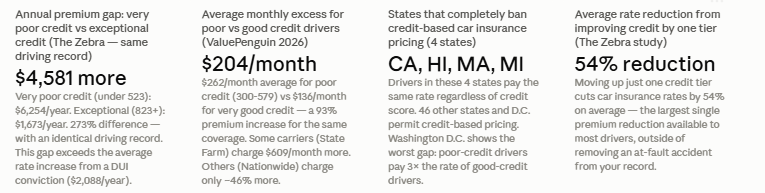
The numbers are stark. Drivers with very poor credit (scores under 523) pay an average of $6,254 per year for car insurance. Drivers with exceptional credit (823 and above) pay $1,673 per year for the same coverage, with the same car, and — crucially — the same driving record. The annual gap is $4,581, or 273%. That is not a rounding error in actuarial tables. That is a structural feature of how most US car insurance is priced (The Zebra study on credit and insurance rates).
The mechanism behind this gap is the credit-based insurance score: a proprietary metric that insurers calculate from the data in your credit report, and which they use to determine how likely you are to file a claim. It is not the same as your FICO credit score. It is not regulated by the same standards. And in most states, you have no right to see it, no guaranteed right to dispute it, and no ability to opt out. Four states — California, Hawaii, Massachusetts, and Michigan — have banned the practice entirely. Forty-six states and Washington, D.C. have not.
This guide explains how credit-based insurance scoring works, why the penalty is so large, which states and carriers produce the worst outcomes, and what drivers with poor credit can do right now to reduce their premiums while working to improve the underlying credit problem.
Drivers with very poor credit (under 523) pay $6,254/year vs $1,673/year for exceptional credit (823+) -- a $4,581 gap (273% more) with the same driving record (The Zebra). Drivers with poor credit (300-579) pay $262/month on average -- 93% more than very good credit drivers at $136/month (The Zebra 2026). $204/month average excess for bad vs good credit on full coverage (ValuePenguin 2026). As of July 2026: 118% more for poor credit vs excellent; ~$125/month gap (FirstCard.app). 4 states ban credit-based insurance pricing: California, Hawaii, Massachusetts, Michigan. Improving credit by one tier lowers rates by an average of 54% (The Zebra study). State Farm charges $609/month more for bad credit; Nationwide charges only 46% more. Bad credit raises rates more than a DUI conviction in many states (Consumer Federation of America).
Insurify’s 2026 analysis explains the comparison clearly. A standard FICO credit score weighs payment history at 35%, amounts owed at 30%, credit history length at 15%, new credit at 10%, and credit mix at 10%. A credit-based insurance score weighs the same factors but differently: payment history typically carries approximately 40% of the weight, amounts owed approximately 30%, credit history length approximately 15%, new credit approximately 10%, and credit mix approximately 5%. The specific weightings vary by insurer and scoring model, and are not publicly disclosed.
The result is a score that can differ meaningfully from your FICO score — and which a given insurer may classify differently. Review42.com’s 2026 car insurance statistics note: ‘Insurance companies don’t all use your credit score the same way. Instead, companies use your credit score as part of their own scoring system, sometimes called an insurance score. So, a ‘good’ score with one company may be considered ‘average’ or even ‘poor’ elsewhere.’ This insurer-specific variation is one of the primary reasons why shopping around matters so much for drivers with below-average credit.
The credit check performed for a car insurance quote is a soft pull — it does not appear on your credit report as an inquiry and does not affect your FICO score. This is important: comparing quotes from multiple insurers does not damage your credit. ValuePenguin’s 2026 guide confirms: ‘Getting a car insurance quote won’t affect your credit score.’
Credit-based insurance scores were developed in the 1990s after actuarial studies suggested that certain credit behaviours correlated with claim frequency, even controlling for other risk factors. The National Association of Insurance Commissioners (NAIC) has published guidance on their use. The scores are legal in 46 states and D.C., and approximately 95% of major auto insurers use them in states that permit it. Insurers argue they are predictive; consumer advocates argue they are discriminatory. Both arguments have supporting evidence. Not financial advice.
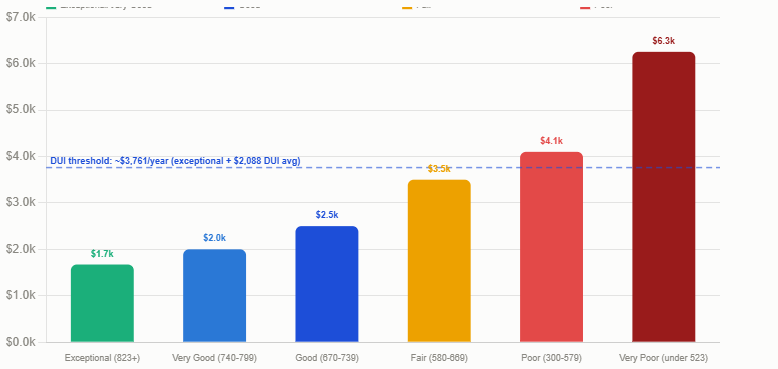
The Zebra’s analysis of insurance rates by credit score is among the most comprehensive available. At the extreme ends: drivers with exceptional credit (823+) pay an average of $1,673 per year for full coverage. Drivers with very poor credit (under 523) pay $6,254 per year — a $4,581 gap even with an identical driving record. To put that in context: the average insurance rate increase after a hit-and-run accident is $2,088. Bad credit costs more than twice that, in terms of annual premium impact.
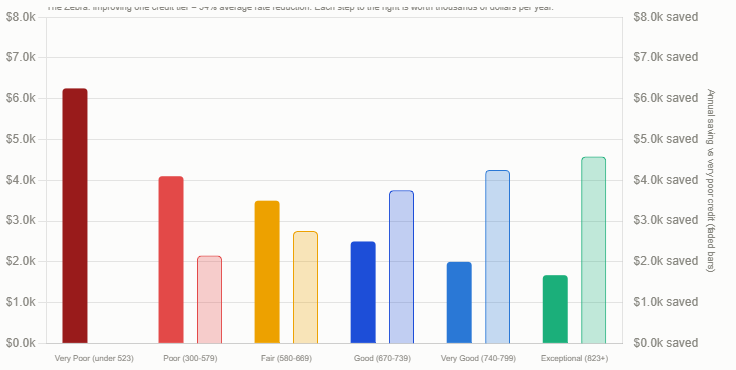
Annual premium by credit tier (The Zebra study, full coverage, same driving record): Exceptional credit (823+): $1,673/year. Very good credit (740-799): approximately $2,000/year. Good credit: approximately $2,500/year. Fair credit: approximately $3,500/year. Poor credit (300-579): approximately $4,000/year (The Zebra) or $3,500/year (Insurify 2026 shows $2,602/year for poor credit). Very poor credit (under 523): $6,254/year. MONTHLY EQUIVALENT for very poor credit: $521/month. Vs exceptional credit: $139/month. MONTHLY EXCESS: $382/month. ANNUAL EXCESS: $4,581/year. SOURCE: The Zebra study. Note: Insurify 2026 shows a smaller average gap ($749/year) and FirstCard.app July 2026 shows $125/month ($1,500/year) excess -- range reflects variation in methodology. The underlying direction is consistent: bad credit raises premiums substantially, with specific magnitude depending on insurer, state, and methodology. Not financial advice. Individual rates vary.
The variation across data sources reflects genuine differences in the sample populations, geographic distribution, coverage levels, and the specific driver profiles used. The Insurify 2026 figure ($749/year gap) may reflect a mix of states including the four ban states where credit has zero effect. The Zebra’s $4,581 figure compares the extreme ends of the credit distribution. The FirstCard.app July 2026 figure ($125/month excess) reflects mid-range credit tiers. All sources agree on the direction: poor credit raises premiums, consistently and substantially, across most US states.
Ocho.co’s February 2026 analysis puts average monthly rates at $341 for bad credit versus $175 for good credit — a $166 monthly gap and a 95% premium increase. Review42.com’s 2026 car insurance statistics note that Bankrate’s aggregate methodology puts the poor-versus-excellent credit gap at approximately 105%.
Washington, D.C. is the extreme case: drivers with poor credit in D.C. pay three times more for full coverage than those with good credit (ValuePenguin 2026). Minnesota produces a 172% premium increase for poor credit versus excellent (Consumer Federation of America). Florida sees a 143% increase. Alabama and Alaska see 90% and 94% increases respectively (ValuePenguin 2026). These states have not banned credit-based pricing, have large numbers of drivers with below-average credit, and have insurance markets where carriers lean heavily on credit as a pricing variable.
At the other end, Washington state shows the smallest increase among states that permit credit-based pricing — approximately 42% for poor credit (ValuePenguin 2026). This is still a meaningful premium increase but significantly below the national average for states that allow the practice.
The Consumer Federation of America’s report on credit score use in auto insurance states: ‘In most states, consumers with perfect driving records and poor credit pay more for auto insurance than drivers with a conviction of driving under the influence of alcohol.’ That finding — that credit history outweighs DUI status as an insurance pricing factor in many states — is perhaps the starkest illustration of how heavily the industry weights credit information.
If you have poor credit and are considering moving states, insurance premium impact is one factor worth researching alongside income tax rates, cost of living, and other considerations. Drivers in California, Hawaii, Massachusetts, or Michigan pay the same insurance rate regardless of credit score. A driver with very poor credit moving from Washington D.C. (where they might pay three times the good-credit rate) to California (where credit has zero impact on insurance pricing) could see significant insurance savings purely from the regulatory change. Not financial, legal, or relocation advice.
The California ban has been in place the longest and is the most frequently cited as a model for other states considering similar legislation. California’s Proposition 103, passed in 1988, established a framework for insurance pricing that prohibited credit-based rating before credit-based insurance scores were even widely used nationally. Hawaii’s ban followed. Massachusetts and Michigan both banned the practice more recently, with Michigan’s ban being particularly significant given that Michigan previously had some of the most severe credit-based premiums in the country — Consumer Federation of America data shows Michigan drivers with poor credit paying 263% more than those with excellent credit before the ban.
Consumer advocacy groups including the Consumer Federation of America have published recommendations that more states follow these four in banning credit-based insurance pricing, arguing that the practice constitutes indirect economic discrimination because lower income and minority communities are disproportionately represented in lower credit tiers. The insurance industry counters that credit-based scores are the most statistically reliable predictors of claim frequency available, and that removing them would require other pricing variables to absorb the actuarial load — potentially raising rates for everyone.
If you live in California, Hawaii, Massachusetts, or Michigan: your credit score has zero impact on your car insurance premium. Improving your driving record and shopping around among carriers are the most productive premium-reduction strategies in your state. If you live in any other state: your credit score is almost certainly being used to price your insurance, and the strategies in Section 11 are directly relevant to your situation. Not insurance advice.
The specific correlation that insurers typically cite involves payment behaviour and financial stress. Someone who regularly misses debt payments, carries high balances relative to credit limits, and has a high density of negative marks on their credit report is, according to actuarial studies, more likely to file a car insurance claim in a given year. The proposed mechanisms include financial stress leading to deferred vehicle maintenance, reduced attention to driving safety due to financial anxiety, and a higher likelihood of living in neighbourhoods with elevated accident rates due to the correlation between credit score and zip code income level.
Insurers also note that credit-based pricing, whatever its distributive effects, may produce more accurately priced policies than alternatives. If removing credit as a pricing variable requires raising rates for all drivers to cross-subsidise higher-risk policyholders, the outcome may be higher average premiums across the market rather than more equitable distribution.
The Consumer Federation of America’s report on the subject identifies several specific inequities. First, the practice disproportionately affects racial and ethnic minorities, who are statistically more likely to have lower credit scores due to historical and systemic factors that have nothing to do with driving behaviour. Second, the practice creates a regressive effect: the people with the least financial resources pay the highest premiums for a mandatory product, meaning the financial burden of insurance is heaviest precisely where household budgets are tightest. Third, and most jarring: in many states, a perfect driving record combined with poor credit produces a higher premium than an average driving record combined with excellent credit.
The CFA report concludes: ‘State governments should put consumers first and ban the use of credit information in auto insurance.’ The four states that have done so demonstrate that insurance markets continue to function without credit-based pricing. Whether the broader industry will move in this direction remains a contested regulatory and political question as of September 2026.
The Zebra’s study found that drivers with very poor credit (under 523) pay $6,254 per year for full coverage on average. The average rate increase after a DUI conviction is approximately $2,088 per year above the clean-record rate. In other words, the annual premium cost of very poor credit — $4,581 above the excellent-credit rate — exceeds the annual cost of a DUI by approximately $2,493. A person with excellent credit who gets a DUI pays substantially less than a person with very poor credit who has never had a moving violation.
The Consumer Federation of America’s report on credit-based insurance pricing makes this comparison explicitly: ‘In most states, consumers with perfect driving records and poor credit pay more for auto insurance than drivers with a conviction of driving under the influence of alcohol.’ This is not a hypothetical — it is documented across multiple state-level datasets. Florida, Minnesota, and Michigan data all show this pattern, as does the national aggregate from multiple insurance research organisations.
The implication is significant: the insurance pricing system as currently constituted values financial history over driving history as a risk predictor, at least in the states that permit credit-based pricing. Whether this reflects the true predictive power of credit versus driving record, or whether it reflects an industry optimisation that has drifted away from its actuarial foundations, is a question that consumer advocates and insurance regulators continue to debate.
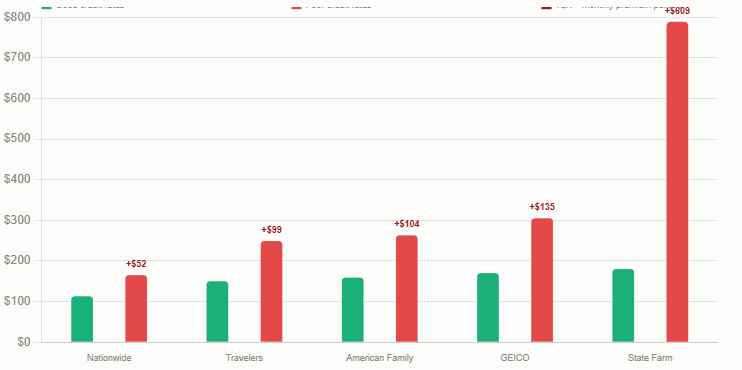
Review42.com’s 2026 car insurance statistics document the spread directly: one analysis found State Farm raising rates approximately 336% for poor credit, while Nationwide raised them only 46%. ValuePenguin’s 2026 analysis found American Family charging $104 per month more for bad credit than good credit, while State Farm charges $609 per month more for the same comparison. These are not edge cases involving obscure regional carriers — they are differences between two of the largest auto insurers in the United States, applied to the same credit profile.
The practical consequence: a driver with poor credit who calls the first insurer they find and accepts the quote is almost certainly overpaying relative to what the most credit-forgiving major carrier would offer. The gap between the most and least expensive major carrier for poor-credit drivers can exceed $400 per month for the same coverage level in some states. Ocho.co’s February 2026 guide notes: ‘Most large insurance companies will run a credit check before issuing car insurance, and having bad credit or no credit means you may pay higher rates.’ But those rates are not the same across companies.
The implication for poor-credit drivers is clear: shopping around is not a nice-to-have. It is the single most impactful immediate action available, capable of saving more in a single comparison session than a full year of incremental credit improvement.
The most impactful credit actions for improving an insurance score, based on the weighting structure described by NAIC and Insurify (payment history approximately 40%, amounts owed approximately 30%) are: establishing or restoring on-time payment history across all accounts (the single largest factor); reducing credit utilisation — the ratio of outstanding balances to credit limits — toward 30% or below; and allowing negative marks such as missed payments and collections to age off the report over time (most negative marks fall off after seven years under the Fair Credit Reporting Act).
The timing matters: most insurers re-check credit or re-score customers at policy renewal, typically every six to twelve months. A meaningful credit improvement made during a policy period may not be reflected until the next renewal. Proactively notifying your insurer of a significant credit improvement and requesting a re-evaluation may accelerate the rate reduction. Some insurers will run a soft pull mid-term if requested.
Credit improvement priorities for insurance rate reduction: (1) Never miss a bill payment again — payment history carries approximately 40% of the insurance score weight. Set up automatic minimum payments on all accounts. (2) Pay down revolving balances below 30% of credit limits — amounts owed carries approximately 30% weight. (3) Do not close old credit card accounts — this reduces available credit and increases utilisation. (4) Avoid applying for new credit unless necessary — new inquiries carry about 10% weight. (5) Check your credit report annually at AnnualCreditReport.com and dispute any errors. (6) At each policy renewal: re-shop rates. A one-tier credit improvement of 54% rate reduction means your renewal price may be dramatically different. Not financial advice.
When an insurer checks your credit for a quote, they perform what is known as a soft inquiry or soft pull. Soft inquiries are visible to you on your credit report but are not visible to other lenders and are not factored into any credit score calculation. They are different from a hard inquiry, which occurs when you apply for a credit card, mortgage, or loan — hard inquiries do temporarily reduce your credit score slightly. Car insurance quote checks are soft pulls and leave no negative trace on your credit report.
ValuePenguin’s 2026 guide is explicit: ‘Getting a car insurance quote won’t affect your credit score.’ This means that the single most powerful action available to a driver with poor credit — comparing quotes from multiple insurers — has zero cost in terms of credit impact. You can get ten quotes from ten insurers in a single afternoon and your credit score will be unchanged at the end.
The practical implication: there is no reason to limit quote comparisons out of credit score concern. Compare as many carriers as possible. Use aggregator tools that compare multiple carriers simultaneously. And repeat the comparison at every renewal, because both your credit score and the insurance market change over time.
Four states have concluded that this pricing practice is incompatible with fair insurance markets and have banned it. Forty-six states have not. In those states, the credit-insurance link is a legal and active feature of how almost every major insurer prices your policy.
The response strategy is practical and specific. In the short term: compare quotes from multiple carriers immediately, because the gap between the most and least credit-sensitive major insurers can exceed $400 per month for the same coverage. Check your credit report for errors that may be artificially raising your insurance score. Consider usage-based insurance programmes that price on driving behaviour rather than credit history. In the medium term: prioritise payment history and credit utilisation reduction, which together carry approximately 70% of insurance score weight. At every policy renewal: re-shop. A one-tier credit improvement produces an average 54% rate reduction. That is not a small reward for the effort of credit repair. Not financial or insurance advice — consult a licensed insurance agent and a qualified financial adviser.
The premium impact of bad credit depends on the severity of the credit problem, the state you live in, and the specific insurer. Across the data available for 2026: drivers with poor credit (scores 300-579) pay an average of $262/month for full coverage, compared to $136/month for very good credit drivers — a 93% increase (The Zebra 2026). At the extreme ends of the credit distribution, drivers with very poor credit (under 523) pay $6,254/year on average versus $1,673/year for exceptional credit (823+) — a $4,581 annual gap or 273% more for the same coverage and the same driving record (The Zebra study). ValuePenguin’s 2026 analysis puts the average excess at $204/month for bad versus good credit. Insurify’s 2026 data shows a $749/year average gap between poor and excellent credit. The variation across methodologies reflects differences in credit tier definitions, geographic samples, and coverage assumptions. All sources agree that the penalty is large and consistent in direction. Not insurance advice.
What is a credit-based insurance score?
A credit-based insurance score (also called an insurance score or auto insurance score) is a proprietary number calculated by auto insurers from the data in your credit report. It is different from your standard FICO credit score: it uses similar input data (payment history, amounts owed, credit history length, new credit, credit mix) but weights them differently and uses a different formula that varies by insurer. Insurers use this score to predict how likely you are to file a car insurance claim. Payment history carries approximately 40% of a typical insurance score’s weight, making consistent on-time payment the most important factor. The insurance score is not shared with you in the same way as your FICO score and is not regulated by the same standards. Checking it for insurance quotes requires only a soft pull that does not affect your FICO credit score. Not insurance advice. Sources: Insurify 2026; NAIC; myFICO.
Which states ban credit-based car insurance pricing?
Four states currently prohibit auto insurers from using credit reports or credit history to set car insurance rates: California, Hawaii, Massachusetts, and Michigan. In these states, your credit score has zero impact on your car insurance premium. Pricing is based on driving record, vehicle type, annual mileage, age, location, and other factors approved by state regulators. Drivers in these four states should focus on maintaining a clean driving record and comparing quotes among carriers as their primary premium-reduction strategies. Consumer advocacy groups including the Consumer Federation of America have called for more states to adopt similar bans. All other US states and Washington, D.C. currently permit credit-based insurance pricing. Sources: ValuePenguin 2026; Insurify 2026; Consumer Federation of America; FirstCard.app July 2026. Not insurance advice.
Does getting a car insurance quote hurt my credit score?
No. Car insurance quotes use a soft credit inquiry, which does not appear on your credit report as a hard inquiry and does not affect your FICO credit score. This is fundamentally different from applying for a loan, mortgage, or credit card, which uses a hard inquiry that does temporarily reduce your score slightly. The soft pull used for insurance quotes is visible to you if you review your full credit report, but it is not visible to other lenders and is not factored into any credit scoring model. This means there is no credit-score cost to shopping around for car insurance quotes. You can compare quotes from any number of insurers without any impact on your credit. Source: ValuePenguin 2026. Not financial advice.
What is the fastest way to lower car insurance with bad credit?
The fastest path to lower car insurance premiums with bad credit combines immediate shopping with medium-term credit improvement. Immediate actions: (1) Compare quotes from at least five major carriers — the gap between the most and least credit-sensitive major carriers can exceed $400/month for the same coverage (State Farm vs Nationwide, for example). This single action can produce the largest immediate saving and does not affect your credit. (2) Check your credit report for errors at AnnualCreditReport.com and dispute any inaccuracies — incorrect negative marks may be artificially raising your insurance score. (3) Ask your insurer about telematics/usage-based insurance programmes that price on driving behaviour rather than credit. Medium-term: (4) Establish consistent on-time payment history across all accounts (payment history is approximately 40% of insurance score weight). (5) Reduce credit card balances below 30% of credit limits (amounts owed is approximately 30%). (6) At every renewal, re-shop. The Zebra’s research shows that improving credit by one tier lowers rates by an average of 54%. Not financial or insurance advice.
Table of Contents
- The Hidden Cost on Your Declarations Page
- What Is a Credit-Based Insurance Score?
- he Scale of the Penalty: How Much More Bad Credit Costs
- The Worst States for Bad-Credit Insurance Premiums
- The Four States That Banned the Practice
- Why Insurers Say Credit Predicts Claims
- The Counterargument: Why Critics Call It Unfair
- Bad Credit vs a DUI: A Disturbing Comparison
- The Insurer Variation: Why Shopping Around Matters More With Bad Credit
- The Cheapest Carriers for Drivers With Poor Credit
- Six Steps to Lower Your Car Insurance Bill With Bad Credit
- How Improving Your Credit Score Changes Your Rate
- Does Getting a Car Insurance Quote Affect Your Credit?
- Conclusion: The Credit-Insurance Link Is Real — and Fixable
- Frequently Asked Questions
Annual premium by credit tier — the full cost picture
Insurer variation — who penalises bad credit most and least
How improving credit cuts your premium — and by how much
The Hidden Cost on Your Declarations Page
Most drivers understand that a speeding ticket raises their car insurance premium. They know that an at-fault accident makes rates go up. They expect younger drivers to pay more. What most drivers do not know — and what the insurance industry rarely volunteers — is that a low credit score can raise a car insurance premium by more than any single accident, in most states in America.The numbers are stark. Drivers with very poor credit (scores under 523) pay an average of $6,254 per year for car insurance. Drivers with exceptional credit (823 and above) pay $1,673 per year for the same coverage, with the same car, and — crucially — the same driving record. The annual gap is $4,581, or 273%. That is not a rounding error in actuarial tables. That is a structural feature of how most US car insurance is priced (The Zebra study on credit and insurance rates).
The mechanism behind this gap is the credit-based insurance score: a proprietary metric that insurers calculate from the data in your credit report, and which they use to determine how likely you are to file a claim. It is not the same as your FICO credit score. It is not regulated by the same standards. And in most states, you have no right to see it, no guaranteed right to dispute it, and no ability to opt out. Four states — California, Hawaii, Massachusetts, and Michigan — have banned the practice entirely. Forty-six states and Washington, D.C. have not.
This guide explains how credit-based insurance scoring works, why the penalty is so large, which states and carriers produce the worst outcomes, and what drivers with poor credit can do right now to reduce their premiums while working to improve the underlying credit problem.
Drivers with very poor credit (under 523) pay $6,254/year vs $1,673/year for exceptional credit (823+) -- a $4,581 gap (273% more) with the same driving record (The Zebra). Drivers with poor credit (300-579) pay $262/month on average -- 93% more than very good credit drivers at $136/month (The Zebra 2026). $204/month average excess for bad vs good credit on full coverage (ValuePenguin 2026). As of July 2026: 118% more for poor credit vs excellent; ~$125/month gap (FirstCard.app). 4 states ban credit-based insurance pricing: California, Hawaii, Massachusetts, Michigan. Improving credit by one tier lowers rates by an average of 54% (The Zebra study). State Farm charges $609/month more for bad credit; Nationwide charges only 46% more. Bad credit raises rates more than a DUI conviction in many states (Consumer Federation of America).
What Is a Credit-Based Insurance Score?
When you apply for car insurance, the insurer almost certainly checks your credit — but not in the way you might expect. They do not pull your standard FICO credit score and compare it to a chart. Instead, they use the raw data in your credit report to calculate a proprietary figure called a credit-based insurance score (also called an insurance score or auto insurance score). This number is not the same as your FICO score, it is not shared with you in the same way as your FICO score, and it is calculated using weightings that differ from the standard credit score formula.Insurify’s 2026 analysis explains the comparison clearly. A standard FICO credit score weighs payment history at 35%, amounts owed at 30%, credit history length at 15%, new credit at 10%, and credit mix at 10%. A credit-based insurance score weighs the same factors but differently: payment history typically carries approximately 40% of the weight, amounts owed approximately 30%, credit history length approximately 15%, new credit approximately 10%, and credit mix approximately 5%. The specific weightings vary by insurer and scoring model, and are not publicly disclosed.
The result is a score that can differ meaningfully from your FICO score — and which a given insurer may classify differently. Review42.com’s 2026 car insurance statistics note: ‘Insurance companies don’t all use your credit score the same way. Instead, companies use your credit score as part of their own scoring system, sometimes called an insurance score. So, a ‘good’ score with one company may be considered ‘average’ or even ‘poor’ elsewhere.’ This insurer-specific variation is one of the primary reasons why shopping around matters so much for drivers with below-average credit.
The credit check performed for a car insurance quote is a soft pull — it does not appear on your credit report as an inquiry and does not affect your FICO score. This is important: comparing quotes from multiple insurers does not damage your credit. ValuePenguin’s 2026 guide confirms: ‘Getting a car insurance quote won’t affect your credit score.’
Credit-based insurance scores were developed in the 1990s after actuarial studies suggested that certain credit behaviours correlated with claim frequency, even controlling for other risk factors. The National Association of Insurance Commissioners (NAIC) has published guidance on their use. The scores are legal in 46 states and D.C., and approximately 95% of major auto insurers use them in states that permit it. Insurers argue they are predictive; consumer advocates argue they are discriminatory. Both arguments have supporting evidence. Not financial advice.
The Scale of the Penalty: How Much More Bad Credit Costs
The credit penalty in car insurance is not a modest surcharge. It is, in many cases, the largest single pricing factor in an insurance quote — larger than driving record, larger than the vehicle, and in some states larger than the driver’s age and location combined. Understanding the scale begins with the data.The Zebra’s analysis of insurance rates by credit score is among the most comprehensive available. At the extreme ends: drivers with exceptional credit (823+) pay an average of $1,673 per year for full coverage. Drivers with very poor credit (under 523) pay $6,254 per year — a $4,581 gap even with an identical driving record. To put that in context: the average insurance rate increase after a hit-and-run accident is $2,088. Bad credit costs more than twice that, in terms of annual premium impact.
Annual premium by credit tier (The Zebra study, full coverage, same driving record): Exceptional credit (823+): $1,673/year. Very good credit (740-799): approximately $2,000/year. Good credit: approximately $2,500/year. Fair credit: approximately $3,500/year. Poor credit (300-579): approximately $4,000/year (The Zebra) or $3,500/year (Insurify 2026 shows $2,602/year for poor credit). Very poor credit (under 523): $6,254/year. MONTHLY EQUIVALENT for very poor credit: $521/month. Vs exceptional credit: $139/month. MONTHLY EXCESS: $382/month. ANNUAL EXCESS: $4,581/year. SOURCE: The Zebra study. Note: Insurify 2026 shows a smaller average gap ($749/year) and FirstCard.app July 2026 shows $125/month ($1,500/year) excess -- range reflects variation in methodology. The underlying direction is consistent: bad credit raises premiums substantially, with specific magnitude depending on insurer, state, and methodology. Not financial advice. Individual rates vary.
The variation across data sources reflects genuine differences in the sample populations, geographic distribution, coverage levels, and the specific driver profiles used. The Insurify 2026 figure ($749/year gap) may reflect a mix of states including the four ban states where credit has zero effect. The Zebra’s $4,581 figure compares the extreme ends of the credit distribution. The FirstCard.app July 2026 figure ($125/month excess) reflects mid-range credit tiers. All sources agree on the direction: poor credit raises premiums, consistently and substantially, across most US states.
Ocho.co’s February 2026 analysis puts average monthly rates at $341 for bad credit versus $175 for good credit — a $166 monthly gap and a 95% premium increase. Review42.com’s 2026 car insurance statistics note that Bankrate’s aggregate methodology puts the poor-versus-excellent credit gap at approximately 105%.
The Worst States for Bad-Credit Insurance Premiums
The credit penalty in car insurance is not uniform across states. State-specific insurance regulations, market structures, and the demographics of insured drivers all affect how large the credit surcharge is in any given location. The variation is enormous.Washington, D.C. is the extreme case: drivers with poor credit in D.C. pay three times more for full coverage than those with good credit (ValuePenguin 2026). Minnesota produces a 172% premium increase for poor credit versus excellent (Consumer Federation of America). Florida sees a 143% increase. Alabama and Alaska see 90% and 94% increases respectively (ValuePenguin 2026). These states have not banned credit-based pricing, have large numbers of drivers with below-average credit, and have insurance markets where carriers lean heavily on credit as a pricing variable.
At the other end, Washington state shows the smallest increase among states that permit credit-based pricing — approximately 42% for poor credit (ValuePenguin 2026). This is still a meaningful premium increase but significantly below the national average for states that allow the practice.
The Consumer Federation of America’s report on credit score use in auto insurance states: ‘In most states, consumers with perfect driving records and poor credit pay more for auto insurance than drivers with a conviction of driving under the influence of alcohol.’ That finding — that credit history outweighs DUI status as an insurance pricing factor in many states — is perhaps the starkest illustration of how heavily the industry weights credit information.
If you have poor credit and are considering moving states, insurance premium impact is one factor worth researching alongside income tax rates, cost of living, and other considerations. Drivers in California, Hawaii, Massachusetts, or Michigan pay the same insurance rate regardless of credit score. A driver with very poor credit moving from Washington D.C. (where they might pay three times the good-credit rate) to California (where credit has zero impact on insurance pricing) could see significant insurance savings purely from the regulatory change. Not financial, legal, or relocation advice.
The Four States That Banned the Practice
California, Hawaii, Massachusetts, and Michigan have each passed legislation or regulatory rules that prohibit auto insurers from using credit reports or credit history to set insurance rates. In these states, a driver with a 500 credit score and a driver with an 800 credit score are quoted the same rate, all else being equal. The pricing variables that do apply in these states include driving record, vehicle type, annual mileage, age, gender (in states where permitted), and location.The California ban has been in place the longest and is the most frequently cited as a model for other states considering similar legislation. California’s Proposition 103, passed in 1988, established a framework for insurance pricing that prohibited credit-based rating before credit-based insurance scores were even widely used nationally. Hawaii’s ban followed. Massachusetts and Michigan both banned the practice more recently, with Michigan’s ban being particularly significant given that Michigan previously had some of the most severe credit-based premiums in the country — Consumer Federation of America data shows Michigan drivers with poor credit paying 263% more than those with excellent credit before the ban.
Consumer advocacy groups including the Consumer Federation of America have published recommendations that more states follow these four in banning credit-based insurance pricing, arguing that the practice constitutes indirect economic discrimination because lower income and minority communities are disproportionately represented in lower credit tiers. The insurance industry counters that credit-based scores are the most statistically reliable predictors of claim frequency available, and that removing them would require other pricing variables to absorb the actuarial load — potentially raising rates for everyone.
If you live in California, Hawaii, Massachusetts, or Michigan: your credit score has zero impact on your car insurance premium. Improving your driving record and shopping around among carriers are the most productive premium-reduction strategies in your state. If you live in any other state: your credit score is almost certainly being used to price your insurance, and the strategies in Section 11 are directly relevant to your situation. Not insurance advice.
Why Insurers Say Credit Predicts Claims
The insurance industry’s justification for credit-based pricing rests on actuarial correlation data. Multiple studies, including research published by the NAIC and by insurers themselves, have found that drivers with lower credit-based insurance scores file more claims, on average, than those with higher scores — even after controlling for demographic variables, driving history, vehicle type, and location. The argument is straightforward: insurers are in the business of pricing risk, and if credit score is a statistically significant predictor of claim frequency, it is a legitimate pricing variable.The specific correlation that insurers typically cite involves payment behaviour and financial stress. Someone who regularly misses debt payments, carries high balances relative to credit limits, and has a high density of negative marks on their credit report is, according to actuarial studies, more likely to file a car insurance claim in a given year. The proposed mechanisms include financial stress leading to deferred vehicle maintenance, reduced attention to driving safety due to financial anxiety, and a higher likelihood of living in neighbourhoods with elevated accident rates due to the correlation between credit score and zip code income level.
Insurers also note that credit-based pricing, whatever its distributive effects, may produce more accurately priced policies than alternatives. If removing credit as a pricing variable requires raising rates for all drivers to cross-subsidise higher-risk policyholders, the outcome may be higher average premiums across the market rather than more equitable distribution.
The Counterargument: Why Critics Call It Unfair
Consumer advocates, including the Consumer Federation of America, challenge the credit-based insurance pricing model on multiple grounds. The most fundamental objection is to the direction of causation: the actuarial correlation between low credit and higher claims does not establish that low credit causes higher claims. Poverty, neighbourhood risk factors, vehicle age, and occupational driving patterns may all correlate with both low credit and higher claim rates without credit being the operative variable. Using credit as a proxy for these underlying factors produces a pricing system that punishes people for being poor rather than for being risky drivers.The Consumer Federation of America’s report on the subject identifies several specific inequities. First, the practice disproportionately affects racial and ethnic minorities, who are statistically more likely to have lower credit scores due to historical and systemic factors that have nothing to do with driving behaviour. Second, the practice creates a regressive effect: the people with the least financial resources pay the highest premiums for a mandatory product, meaning the financial burden of insurance is heaviest precisely where household budgets are tightest. Third, and most jarring: in many states, a perfect driving record combined with poor credit produces a higher premium than an average driving record combined with excellent credit.
The CFA report concludes: ‘State governments should put consumers first and ban the use of credit information in auto insurance.’ The four states that have done so demonstrate that insurance markets continue to function without credit-based pricing. Whether the broader industry will move in this direction remains a contested regulatory and political question as of September 2026.
Bad Credit vs a DUI: A Disturbing Comparison
One of the most counterintuitive findings in the credit-insurance literature is the comparison between the premium impact of poor credit and the premium impact of a DUI conviction. Most drivers intuitively expect a DUI — a criminal conviction for driving under the influence, directly relevant to driving risk — to raise insurance premiums more than a credit score. The data suggests the opposite is often true.The Zebra’s study found that drivers with very poor credit (under 523) pay $6,254 per year for full coverage on average. The average rate increase after a DUI conviction is approximately $2,088 per year above the clean-record rate. In other words, the annual premium cost of very poor credit — $4,581 above the excellent-credit rate — exceeds the annual cost of a DUI by approximately $2,493. A person with excellent credit who gets a DUI pays substantially less than a person with very poor credit who has never had a moving violation.
The Consumer Federation of America’s report on credit-based insurance pricing makes this comparison explicitly: ‘In most states, consumers with perfect driving records and poor credit pay more for auto insurance than drivers with a conviction of driving under the influence of alcohol.’ This is not a hypothetical — it is documented across multiple state-level datasets. Florida, Minnesota, and Michigan data all show this pattern, as does the national aggregate from multiple insurance research organisations.
The implication is significant: the insurance pricing system as currently constituted values financial history over driving history as a risk predictor, at least in the states that permit credit-based pricing. Whether this reflects the true predictive power of credit versus driving record, or whether it reflects an industry optimisation that has drifted away from its actuarial foundations, is a question that consumer advocates and insurance regulators continue to debate.
9. The Insurer Variation: Why Shopping Around Matters More With Bad Credit
Among the most actionable findings in the credit-insurance research is the variation between insurers in how heavily they weight credit. This variation is enormous — far larger than most consumers realise — and it means that for a driver with poor credit, the difference between the cheapest and most expensive quote from major national carriers can be hundreds of dollars per month.Review42.com’s 2026 car insurance statistics document the spread directly: one analysis found State Farm raising rates approximately 336% for poor credit, while Nationwide raised them only 46%. ValuePenguin’s 2026 analysis found American Family charging $104 per month more for bad credit than good credit, while State Farm charges $609 per month more for the same comparison. These are not edge cases involving obscure regional carriers — they are differences between two of the largest auto insurers in the United States, applied to the same credit profile.
The practical consequence: a driver with poor credit who calls the first insurer they find and accepts the quote is almost certainly overpaying relative to what the most credit-forgiving major carrier would offer. The gap between the most and least expensive major carrier for poor-credit drivers can exceed $400 per month for the same coverage level in some states. Ocho.co’s February 2026 guide notes: ‘Most large insurance companies will run a credit check before issuing car insurance, and having bad credit or no credit means you may pay higher rates.’ But those rates are not the same across companies.
The implication for poor-credit drivers is clear: shopping around is not a nice-to-have. It is the single most impactful immediate action available, capable of saving more in a single comparison session than a full year of incremental credit improvement.
The Cheapest Carriers for Drivers With Poor Credit
Based on 2026 industry data from The Zebra, FirstCard.app (July 2026), and Ocho.co (February 2026), the major national carriers with the most favourable average rates for drivers with poor credit are:- Nationwide: consistently ranked among the cheapest for poor-credit drivers, with reported average full-coverage rates of approximately $165 per month for drivers with credit scores in the poor range. Rate increase for poor credit versus good credit is approximately 46% — the smallest proportional penalty among major carriers in published research (The Zebra; FirstCard.app July 2026).
- Travelers: reported average full-coverage rate of approximately $249 per month for bad-credit drivers as of July 2026 (FirstCard.app). Specific credit penalty percentage not separately reported but positioned among lower-penalty carriers.
- American Family: reported average of approximately $263 per month for bad-credit drivers. ValuePenguin’s 2026 comparison finds American Family charges $104/month more for bad credit than good credit — the smallest dollar-amount penalty among the specific carriers they compare.
- GEICO: reported approximately $305 per month for poor-credit drivers, with The Zebra ranking it among the more affordable major carriers for this profile (The Zebra 2026).
- USAA: often the cheapest overall for poor-credit drivers but available exclusively to active military members, veterans, and their immediate family members. Not available to the general public.
Six Steps to Lower Your Car Insurance Bill With Bad Credit
Improving your credit score is the most powerful long-term solution to a credit-inflated insurance premium, but it takes time. In the meantime, the following steps can reduce your car insurance cost immediately, or at least significantly, while the credit repair process progresses:- Step 1 — Compare quotes from at least five carriers: As documented above, the premium gap between the most and least credit-sensitive major insurers can exceed $400/month for the same driver and coverage. Comparison sites (The Zebra, Insurify, ValuePenguin) make this fast. Get quotes before assuming your current insurer’s rate is competitive. This step costs nothing and cannot hurt your credit.
- Step 2 — Check your credit report for errors: Incorrect information in your credit report may be artificially lowering your insurance score. Ocho.co’s February 2026 guide flags this directly: ‘To avoid paying more than you should, check your credit report for errors — incorrect information could be driving up your rates unnecessarily.’ Dispute errors through AnnualCreditReport.com (the federally mandated free access site) and the relevant credit bureau. Correcting an error can improve your insurance score faster than almost any other action.
- Step 3 — Ask about usage-based insurance (UBI) / telematics programmes: Many carriers offer programmes (Progressive’s Snapshot, Allstate’s Drivewise, State Farm’s Drive Safe & Save) that price based on actual driving behaviour rather than credit history. A safe driver with poor credit may see meaningful savings from a telematics programme, because safe driving habits earn discounts that partially offset the credit penalty. Ask your insurer or compare carriers that offer UBI programmes.
- Step 4 — Raise your deductible: Increasing your comprehensive and collision deductible from $500 to $1,000 or $1,500 typically reduces the full-coverage premium meaningfully. This is a trade-off (higher out-of-pocket cost after an accident) but reduces monthly costs immediately. Ensure you have the deductible amount available in an emergency fund before making this change.
- Step 5 — Re-shop your rate every six to twelve months: Insurance pricing models change. Your credit score may improve incrementally. Insurers run promotions and adjust risk pools. A rate that was the cheapest one year ago may not be the cheapest today. Set a calendar reminder to compare quotes annually. Drivers who actively shop save an average of $700-$1,000 per year according to industry estimates.
- Step 6 — Consider state minimum coverage carefully: If finances are extremely tight, state minimum liability-only coverage is significantly cheaper than full coverage and may be appropriate for older vehicles with lower market value. However, state minimum coverage leaves significant financial risk if you are at fault in an accident. Consult with a licensed insurance agent before reducing coverage levels.
How Improving Your Credit Score Changes Your Rate
The credit-to-insurance score relationship is not linear, but the data on credit tier changes is clear: moving up even one tier in credit classification produces a significant insurance premium reduction. The Zebra’s study on credit and insurance rates finds that improving credit by one tier lowers insurance rates by an average of 54%. That is the largest single premium reduction available to most drivers, outside of eliminating an at-fault accident from their record.The most impactful credit actions for improving an insurance score, based on the weighting structure described by NAIC and Insurify (payment history approximately 40%, amounts owed approximately 30%) are: establishing or restoring on-time payment history across all accounts (the single largest factor); reducing credit utilisation — the ratio of outstanding balances to credit limits — toward 30% or below; and allowing negative marks such as missed payments and collections to age off the report over time (most negative marks fall off after seven years under the Fair Credit Reporting Act).
The timing matters: most insurers re-check credit or re-score customers at policy renewal, typically every six to twelve months. A meaningful credit improvement made during a policy period may not be reflected until the next renewal. Proactively notifying your insurer of a significant credit improvement and requesting a re-evaluation may accelerate the rate reduction. Some insurers will run a soft pull mid-term if requested.
Credit improvement priorities for insurance rate reduction: (1) Never miss a bill payment again — payment history carries approximately 40% of the insurance score weight. Set up automatic minimum payments on all accounts. (2) Pay down revolving balances below 30% of credit limits — amounts owed carries approximately 30% weight. (3) Do not close old credit card accounts — this reduces available credit and increases utilisation. (4) Avoid applying for new credit unless necessary — new inquiries carry about 10% weight. (5) Check your credit report annually at AnnualCreditReport.com and dispute any errors. (6) At each policy renewal: re-shop rates. A one-tier credit improvement of 54% rate reduction means your renewal price may be dramatically different. Not financial advice.
Does Getting a Car Insurance Quote Affect Your Credit?
This is one of the most frequently asked questions about credit and insurance — and the answer is consistently clear across all major sources: no. Getting a car insurance quote does not affect your credit score.When an insurer checks your credit for a quote, they perform what is known as a soft inquiry or soft pull. Soft inquiries are visible to you on your credit report but are not visible to other lenders and are not factored into any credit score calculation. They are different from a hard inquiry, which occurs when you apply for a credit card, mortgage, or loan — hard inquiries do temporarily reduce your credit score slightly. Car insurance quote checks are soft pulls and leave no negative trace on your credit report.
ValuePenguin’s 2026 guide is explicit: ‘Getting a car insurance quote won’t affect your credit score.’ This means that the single most powerful action available to a driver with poor credit — comparing quotes from multiple insurers — has zero cost in terms of credit impact. You can get ten quotes from ten insurers in a single afternoon and your credit score will be unchanged at the end.
The practical implication: there is no reason to limit quote comparisons out of credit score concern. Compare as many carriers as possible. Use aggregator tools that compare multiple carriers simultaneously. And repeat the comparison at every renewal, because both your credit score and the insurance market change over time.
Conclusion
The link between credit score and car insurance premium is one of the least well-understood pricing mechanisms in personal finance — and one of the most consequential for households with below-average credit. The average annual premium gap between very poor and exceptional credit is $4,581, even with an identical driving record. In the worst states, poor-credit drivers pay three times the good-credit rate. In many states, a clean driving record plus poor credit produces a higher premium than a DUI conviction plus excellent credit.Four states have concluded that this pricing practice is incompatible with fair insurance markets and have banned it. Forty-six states have not. In those states, the credit-insurance link is a legal and active feature of how almost every major insurer prices your policy.
The response strategy is practical and specific. In the short term: compare quotes from multiple carriers immediately, because the gap between the most and least credit-sensitive major insurers can exceed $400 per month for the same coverage. Check your credit report for errors that may be artificially raising your insurance score. Consider usage-based insurance programmes that price on driving behaviour rather than credit history. In the medium term: prioritise payment history and credit utilisation reduction, which together carry approximately 70% of insurance score weight. At every policy renewal: re-shop. A one-tier credit improvement produces an average 54% rate reduction. That is not a small reward for the effort of credit repair. Not financial or insurance advice — consult a licensed insurance agent and a qualified financial adviser.
Frequently Asked Questions
How much does bad credit raise car insurance rates?The premium impact of bad credit depends on the severity of the credit problem, the state you live in, and the specific insurer. Across the data available for 2026: drivers with poor credit (scores 300-579) pay an average of $262/month for full coverage, compared to $136/month for very good credit drivers — a 93% increase (The Zebra 2026). At the extreme ends of the credit distribution, drivers with very poor credit (under 523) pay $6,254/year on average versus $1,673/year for exceptional credit (823+) — a $4,581 annual gap or 273% more for the same coverage and the same driving record (The Zebra study). ValuePenguin’s 2026 analysis puts the average excess at $204/month for bad versus good credit. Insurify’s 2026 data shows a $749/year average gap between poor and excellent credit. The variation across methodologies reflects differences in credit tier definitions, geographic samples, and coverage assumptions. All sources agree that the penalty is large and consistent in direction. Not insurance advice.
What is a credit-based insurance score?
A credit-based insurance score (also called an insurance score or auto insurance score) is a proprietary number calculated by auto insurers from the data in your credit report. It is different from your standard FICO credit score: it uses similar input data (payment history, amounts owed, credit history length, new credit, credit mix) but weights them differently and uses a different formula that varies by insurer. Insurers use this score to predict how likely you are to file a car insurance claim. Payment history carries approximately 40% of a typical insurance score’s weight, making consistent on-time payment the most important factor. The insurance score is not shared with you in the same way as your FICO score and is not regulated by the same standards. Checking it for insurance quotes requires only a soft pull that does not affect your FICO credit score. Not insurance advice. Sources: Insurify 2026; NAIC; myFICO.
Which states ban credit-based car insurance pricing?
Four states currently prohibit auto insurers from using credit reports or credit history to set car insurance rates: California, Hawaii, Massachusetts, and Michigan. In these states, your credit score has zero impact on your car insurance premium. Pricing is based on driving record, vehicle type, annual mileage, age, location, and other factors approved by state regulators. Drivers in these four states should focus on maintaining a clean driving record and comparing quotes among carriers as their primary premium-reduction strategies. Consumer advocacy groups including the Consumer Federation of America have called for more states to adopt similar bans. All other US states and Washington, D.C. currently permit credit-based insurance pricing. Sources: ValuePenguin 2026; Insurify 2026; Consumer Federation of America; FirstCard.app July 2026. Not insurance advice.
Does getting a car insurance quote hurt my credit score?
No. Car insurance quotes use a soft credit inquiry, which does not appear on your credit report as a hard inquiry and does not affect your FICO credit score. This is fundamentally different from applying for a loan, mortgage, or credit card, which uses a hard inquiry that does temporarily reduce your score slightly. The soft pull used for insurance quotes is visible to you if you review your full credit report, but it is not visible to other lenders and is not factored into any credit scoring model. This means there is no credit-score cost to shopping around for car insurance quotes. You can compare quotes from any number of insurers without any impact on your credit. Source: ValuePenguin 2026. Not financial advice.
What is the fastest way to lower car insurance with bad credit?
The fastest path to lower car insurance premiums with bad credit combines immediate shopping with medium-term credit improvement. Immediate actions: (1) Compare quotes from at least five major carriers — the gap between the most and least credit-sensitive major carriers can exceed $400/month for the same coverage (State Farm vs Nationwide, for example). This single action can produce the largest immediate saving and does not affect your credit. (2) Check your credit report for errors at AnnualCreditReport.com and dispute any inaccuracies — incorrect negative marks may be artificially raising your insurance score. (3) Ask your insurer about telematics/usage-based insurance programmes that price on driving behaviour rather than credit. Medium-term: (4) Establish consistent on-time payment history across all accounts (payment history is approximately 40% of insurance score weight). (5) Reduce credit card balances below 30% of credit limits (amounts owed is approximately 30%). (6) At every renewal, re-shop. The Zebra’s research shows that improving credit by one tier lowers rates by an average of 54%. Not financial or insurance advice.

0 Comments Comments