
Technology & AI
Why Companies Have Changed Course on AI Hiring


Table of Contents
- Why Companies Have Changed Course on AI Hiring in 2026
- Table of Contents
- Introduction: The Most Overstated and Underestimated Story in Business
- What Actually Happened: The Real Story Behind the AI Hiring Headlines
- Phase 1: Pandemic Overhiring (2020-2022)
- Phase 2: The Correction and the AI Narrative (2023-2025)
- Phase 3: The Course Correction (2026)
- The Numbers: AI Hiring Statistics 2025-2026
- Which Jobs Are Changing -- and Which Are Becoming More Valuable
- Five Shifts That Define How Companies Have Changed Course on AI Hiring
- Conclusion: The Course Correction Is the Real Story of AI Hiring in 2026
- Frequently Asked Questions (FAQ)
- How many jobs has AI replaced so far?
- Which jobs are most at risk from AI in 2026?
- Why are companies rehiring after AI-driven layoffs?
- What AI skills should workers develop to stay relevant?
- Is AI overhyped as a cause of job displacement?
The Most Overstated and Underestimated Story in Business
No business story of the past three years has generated more headlines, more board-level anxiety, and more individual career worry than artificial intelligence and jobs. The predictions arrived with certainty: AI would automate millions of roles, flatten hierarchies, hollow out middle management, and eliminate entire job categories within years. The data that has accumulated since those predictions were made is considerably more complicated -- and considerably more interesting.Here is what the most current research shows as of July 2026. HR Dive (September 22, 2025): in a survey of 1,000 US business leaders, nearly 3 in 10 companies said they had already replaced jobs with AI, and 37% expected to have replaced jobs with AI by the end of 2026. Half of those same leaders had pulled back on hiring, 39% had conducted layoffs in 2025, and 58% believed further layoffs were likely in 2026. Leaders cited economic uncertainty, trade policy, and AI as the top three reasons. The technology sector led all industries in job cuts, with more than 154,000 in 2025 alone -- up 15% from 2024, according to Apollo Technical.
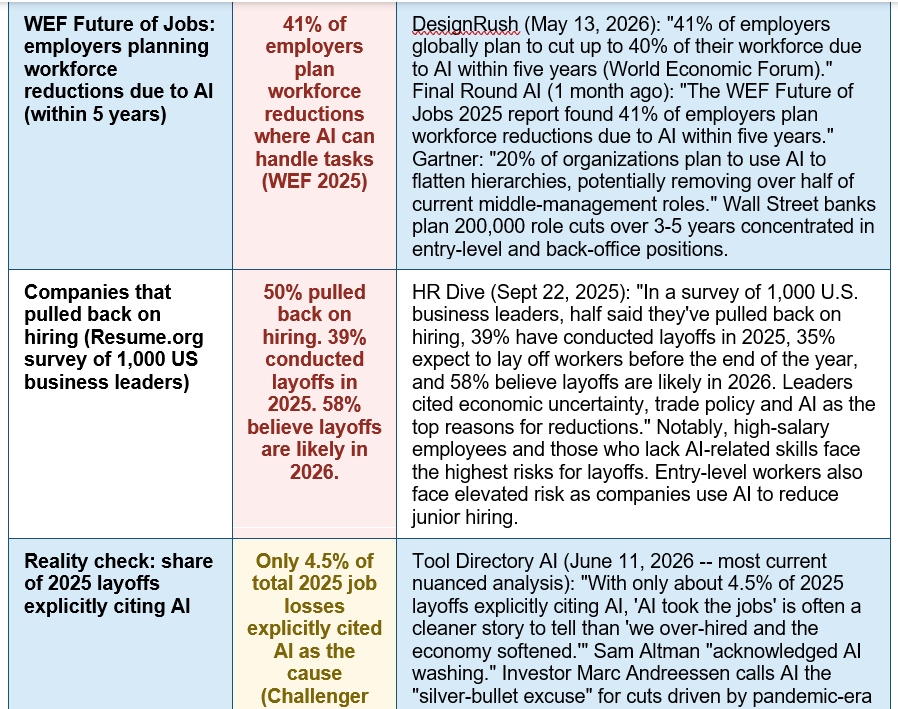
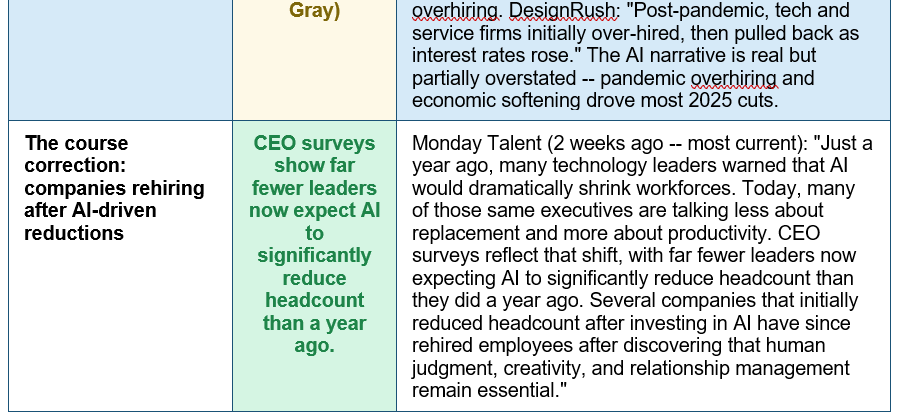
Yet alongside these numbers sits a different and equally important finding. Tool Directory AI (June 11, 2026 -- most current nuanced analysis): 'With only about 4.5% of 2025 layoffs explicitly citing AI, 'AI took the jobs' is often a cleaner story to tell than 'we over-hired and the economy softened.' Sam Altman acknowledged what he called AI washing. Investor Marc Andreessen called AI the silver-bullet excuse for cuts driven by pandemic-era overhiring.' And Monday Talent (published two weeks ago): 'Just a year ago, many technology leaders warned that AI would dramatically shrink workforces. Today, many of those same executives are talking less about replacement and more about productivity. CEO surveys reflect that shift, with far fewer leaders now expecting AI to significantly reduce headcount than they did a year ago.' This is the course correction that this guide examines.
What Actually Happened: The Real Story Behind the AI Hiring Headlines
Understanding why companies changed course on AI hiring requires understanding what actually drove the 2023-2025 workforce reshaping -- and separating the genuinely AI-driven change from the noise.Phase 1: Pandemic Overhiring (2020-2022)
Between 2020 and 2022, the technology sector hired at an extraordinary rate. Remote work expanded the addressable labour market. Revenue growth accelerated as the pandemic digitised consumer behaviour faster than anticipated. Investment capital was cheap, valuations were high, and growth-at-all-costs thinking dominated. Companies built headcount for a sustained boom that did not materialise. DesignRush (May 2026): 'Post-pandemic, tech and service firms initially over-hired, then pulled back as interest rates rose to combat inflation, which slowed demand and prompted hiring freezes, cost-cutting, layoffs, and slower payroll growth.'Phase 2: The Correction and the AI Narrative (2023-2025)
When the correction came -- rising interest rates, slowing revenue, compressed valuations -- companies needed to reduce headcount. The simultaneous emergence of capable large language models (GPT-4 in 2023, subsequent releases throughout 2024-2025) provided a compelling narrative for workforce reductions: AI was making roles redundant, so headcount reductions were strategic rather than reactive. Tool Directory AI (June 2026): 'AI took the jobs is often a cleaner story to tell than we over-hired and the economy softened.' Sam Altman himself said in May 2026 that he was 'delighted to be wrong' that more entry-level jobs had not already been eliminated. This is not a trivial admission from the CEO of the company most responsible for commercialising large language models.The actual data is more modest than the narrative suggested. Apollo Technical (two weeks ago -- most current): 'AI related layoffs made up roughly 5% of all announced job cuts in the U.S. during 2025.' Challenger Gray and Christmas, the outplacement firm that tracks this data most rigorously, reported that companies cited AI in 54,836 announced layoff plans in 2025. HiWave (March 2026): 'In just the first six months of 2025, nearly 78,000 tech job losses were directly attributed to AI adoption.' These are real and significant numbers -- but they represent a specific segment of a much larger labour market restructuring driven primarily by macroeconomic factors and overhiring correction.
Phase 3: The Course Correction (2026)
The most important development in 2026 is the course correction itself. Monday Talent (two weeks ago): 'While some companies initially reduced headcount after investing in AI, several have since rehired employees after discovering that human judgment, creativity, and relationship management remain essential.' CEO sentiment surveys have shifted measurably: far fewer leaders in mid-2026 expect AI to significantly reduce headcount than said the same twelve months earlier. The question has changed from 'how many jobs will AI replace?' to 'how do we make our best people more productive using AI?' HiWave (March 2026): 'AI job displacement in 2026 often looks less like a dramatic layoff event and more like a quieter structural shift. Fewer junior openings. Smaller teams. Higher output expectations.'AI hiring in 2026 -- the defining numbers: 37% of companies plan AI job replacement by end 2026. 77,999 tech jobs cut in H1 2025. Only 4.5% of 2025 layoffs cited AI. CEO sentiment shifting toward productivity over replacement. — HR Dive (Sept 22, 2025): 'Nearly 3 in 10 companies replaced jobs with AI; 37% expect to by end 2026.' Apollo Technical (2 weeks ago -- most current): '77,999 tech job losses directly tied to AI in H1 2025; tech sector led all industries with 154,000+ cuts in 2025.' Tool Directory AI (June 11, 2026 -- most current nuanced analysis): 'Only about 4.5% of 2025 layoffs explicitly cited AI.' Monday Talent (2 weeks ago): 'CEO surveys show far fewer leaders now expecting AI to significantly reduce headcount than a year ago.' WEF Future of Jobs 2025: '41% of employers plan workforce reductions due to AI within five years.'
The Numbers: AI Hiring Statistics 2025-2026
The following table maps the most current data on AI and hiring from the best available sources as of July 2026: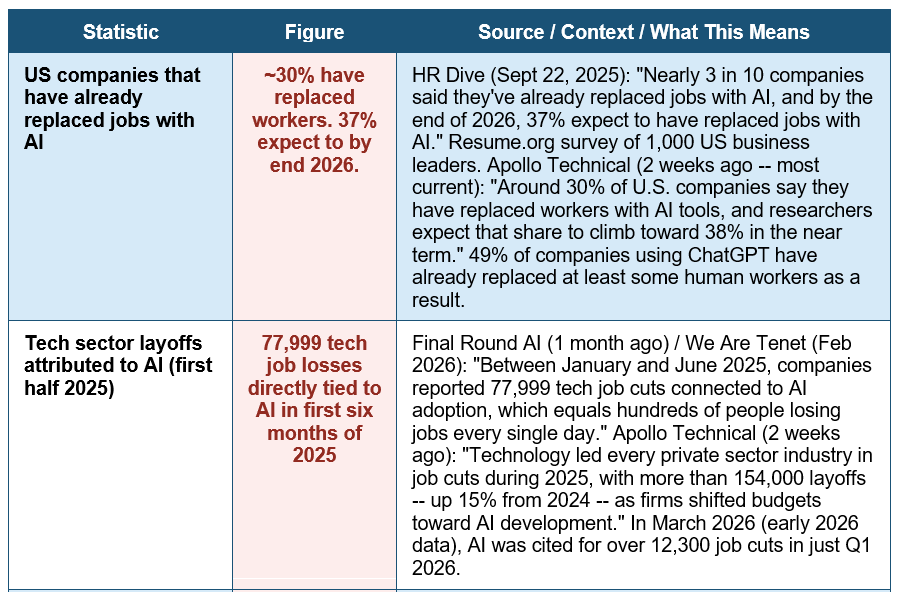
Which Jobs Are Changing -- and Which Are Becoming More Valuable
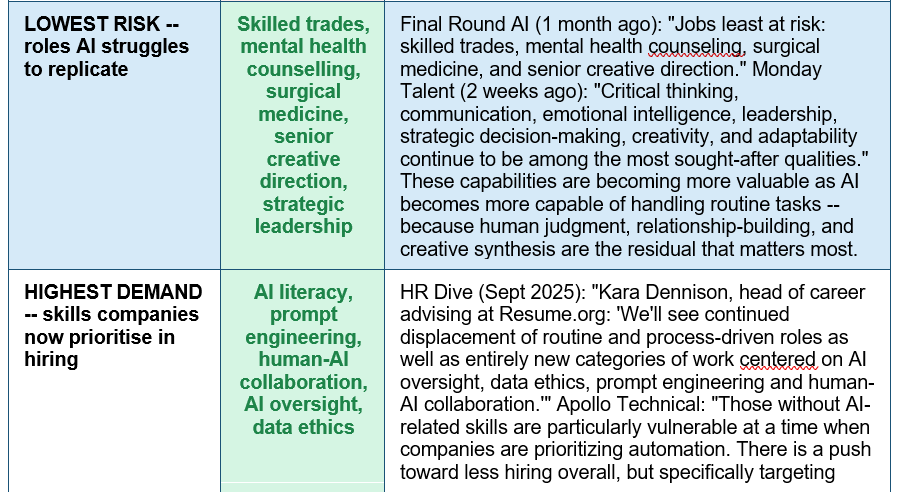
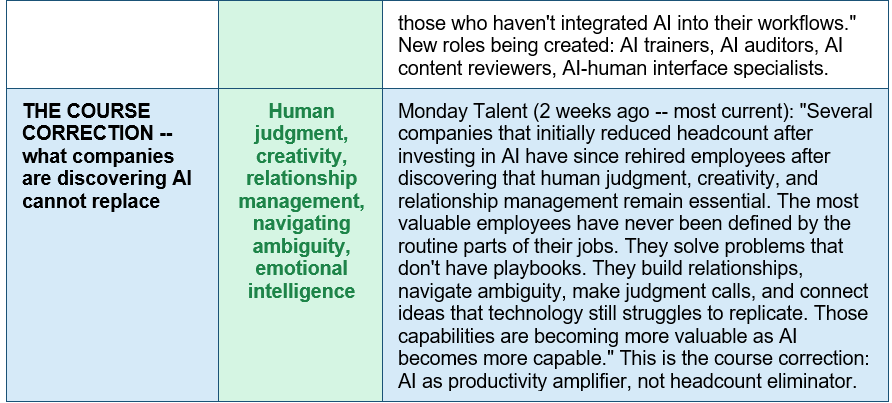
The most practically useful question in the AI and employment debate is not 'how many jobs will AI replace overall?' -- a number that depends on assumptions spanning decades -- but 'which specific roles are changing right now, and what skills are becoming more or less valuable?'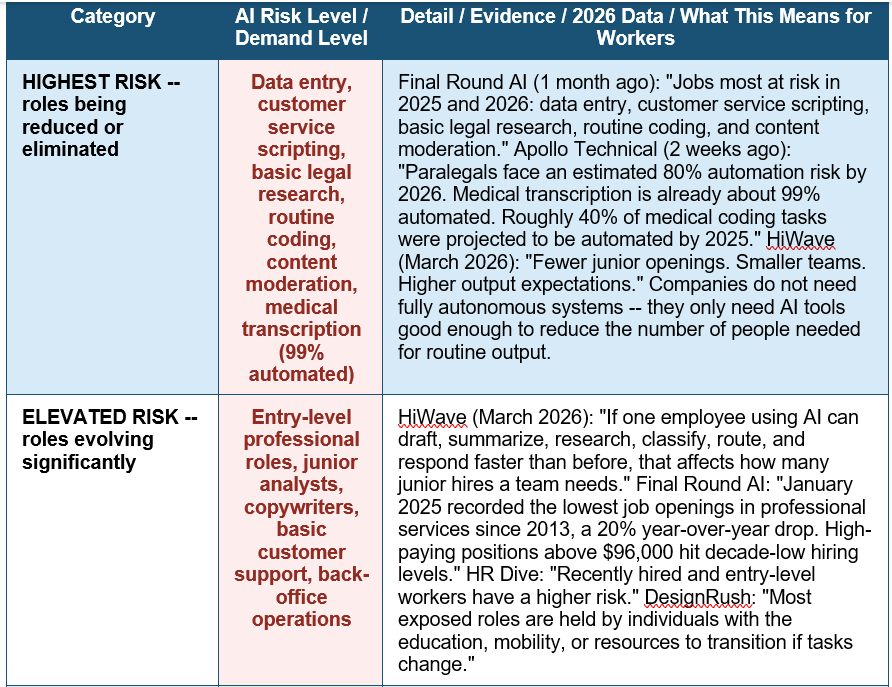
Five Shifts That Define How Companies Have Changed Course on AI Hiring
SHIFT #1: FROM REPLACEMENT NARRATIVE TO PRODUCTIVITY NARRATIVE | The most important shift in how companies talk about AI and people
The single most significant change in corporate AI hiring strategy between 2024 and 2026 is a change in the dominant narrative. In 2023 and 2024, the leading framing was replacement: AI would make human roles redundant, and the companies that moved fastest to automate would gain the most competitive advantage. By mid-2026, that narrative has been substantially revised at the leadership level. Monday Talent (two weeks ago -- most current): 'Just a year ago, many technology leaders warned that AI would dramatically shrink workforces. Today, many of those same executives are talking less about replacement and more about productivity. The organizations seeing the greatest success are using AI to make talented people more effective, not to replace them.' This is not a retreat from AI adoption -- it is a more sophisticated understanding of where AI creates value. AI excels at routine, pattern-based, high-volume tasks. It is significantly weaker at judgment, relationship management, creative synthesis, and navigating novel situations without precedent. The companies that initially over-rotated toward replacement have discovered this the hard way -- and are rehiring the people who solve problems without playbooks.SHIFT #2: ENTRY-LEVEL ROLES TAKING THE BIGGEST HIT -- BUT NOT FOR REASONS MOST PEOPLE THINK | The quiet disappearance of junior hiring and what it means for career ladders
HiWave (March 2026): 'AI job displacement in 2026 often looks less like a dramatic layoff event and more like a quieter structural shift. Fewer junior openings. Smaller teams. Higher output expectations.' Final Round AI (one month ago): 'January 2025 recorded the lowest job openings in professional services since 2013, a 20% year-over-year drop.' This collapse in entry-level and junior professional hiring is one of the most concrete and consequential AI effects on the labour market in 2026 -- and it works through a subtler mechanism than mass layoffs. When one mid-level employee using AI can accomplish the output that previously required two or three junior employees, companies simply post fewer junior positions. HR Dive (Sept 2025): 'Recently hired and entry-level workers have a higher risk.' The issue for career formation is significant: if the entry-level roles that historically provided the training ground for professional development are reduced, the pipeline for developing senior-level human expertise is compressed. Companies that have over-indexed on AI at the junior level are beginning to recognise this -- adding another dimension to the course correction underway.SHIFT #3: AI SKILLS HAVE BECOME THE PRIMARY HIRING DIFFERENTIATOR | The bifurcation of the labour market: those with AI fluency and those without
HR Dive (September 2025): 'Those without AI-related skills are particularly vulnerable at a time when companies are prioritizing automation. There is a push toward less hiring overall, but specifically targeting those who haven't integrated AI into their workflows.' This is the clearest practical implication of the AI hiring shift for individual workers: AI literacy has become a primary differentiator in hiring decisions across a wide range of roles, including many that are not primarily technical. The specific skills in highest demand, according to Resume.org's survey (via HR Dive): prompt engineering (the ability to direct AI tools to produce useful output); human-AI collaboration (working effectively alongside AI tools without being displaced by them); AI oversight (reviewing, quality-checking, and improving AI-generated output); and data ethics (understanding the limitations, biases, and appropriate uses of AI systems). Apollo Technical (two weeks ago): the new roles being created include AI trainers, AI auditors, AI content reviewers, and AI-human interface specialists. The course correction has created a two-speed labour market: workers who have built AI fluency are more valuable than ever; workers who have not are at elevated risk even in roles that are not directly automated.SHIFT #4: THE REHIRING WAVE -- COMPANIES DISCOVERING WHAT AI CANNOT DO | Critical thinking, emotional intelligence, and relationship management are resurging in demand
Monday Talent (published two weeks ago -- most current source on the course correction): 'While some companies initially reduced headcount after investing in AI, several have since rehired employees after discovering that human judgment, creativity, and relationship management remain essential. As AI takes over more repetitive tasks, employers are placing greater value on skills that technology cannot easily replicate. Critical thinking, communication, emotional intelligence, leadership, strategic decision-making, creativity, and adaptability continue to be among the most sought-after qualities.' This rehiring wave is the most underreported dimension of the AI hiring story in 2026. The companies that moved most aggressively to replace human roles with AI automation found -- often within months -- that the loss of judgment, contextual understanding, client relationship management, and creative problem-solving degraded output quality in ways that were not captured in the initial efficiency calculations. Goldman Sachs, which estimated AI could displace 300 million jobs globally in its widely cited 2023 report, has more recently been among the financial institutions discovering that AI augments analyst capacity without eliminating the need for human analysis, supervision, and client relationship management.SHIFT #5: AI WASHING AND THE REALITY CHECK -- HOW MUCH IS GENUINELY AI-DRIVEN? | The inconvenient data that complicates the replacement narrative
Tool Directory AI (June 11, 2026 -- most current nuanced analysis): 'Sam Altman has acknowledged 'AI washing,' and investor Marc Andreessen calls AI the 'silver-bullet excuse' for cuts driven by pandemic-era overhiring. With only about 4.5% of 2025 layoffs explicitly citing AI, 'AI took the jobs' is often a cleaner story to tell than 'we over-hired and the economy softened.'' This observation is significant for how to interpret the data. The 77,999 tech job cuts attributed to AI in the first half of 2025, and the 37% of companies planning AI-driven job replacement by end 2026, are real numbers -- but they exist within a context where the dominant driver of 2023-2025 workforce reduction was macroeconomic (interest rate shock, demand cooling, investor pressure for efficiency) rather than technological. DesignRush (May 2026): 'High inflation and economic uncertainty have been cited repeatedly by economists and employers as key drivers of 2025-2026 job cuts, rather than solely automation. AI adoption is real, but its labour market impact so far appears modest and nuanced rather than dramatic.' The practical implication: workers and organisations should take AI seriously as a genuine labour market force while maintaining appropriate scepticism toward headlines that attribute wholesale job loss to automation when the fuller picture involves multiple economic drivers.The Dario Amodei warning vs the Sam Altman admission: the leadership split on AI's job impact. Two of the most prominent AI company leaders are on record with dramatically different views on AI's employment impact. Tool Directory AI (June 11, 2026): 'Dario Amodei warned in 2025 of a possible 10-20% unemployment spike within five years. Goldman Sachs estimates AI is currently displacing on the order of 11,000 US jobs a month -- meaningful, but small against a workforce of about 160 million. Even Sam Altman said in May 2026 that he was "delighted to be wrong" that more entry-level jobs hadn't already been eliminated.' The Altman admission is particularly striking: the CEO of OpenAI -- whose products have been cited more often than any others in AI-driven workforce discussions -- acknowledged in mid-2026 that AI's job displacement effect has been smaller and slower than he had expected. This does not mean the displacement will not accelerate. It means the timeline is uncertain, the impact more nuanced than the replacement narrative suggested, and the human capabilities that AI is struggling to replicate are more durable than many initial predictions assumed. HiWave (March 2026): 'The question is no longer whether AI will affect your job. It is whether you will evolve fast enough to stay relevant while it does.'
FIVE THINGS THE AI HIRING HEADLINES ARE GETTING WRONG: (1) TREATING 'AI REPLACED THESE JOBS' AS THE FULL STORY. Tool Directory AI (June 2026): only 4.5% of 2025 layoffs explicitly cited AI. The dominant drivers of the 2023-2025 workforce reduction were macroeconomic -- interest rate shock, investor pressure for efficiency, and the unwinding of pandemic-era overhiring. AI is a genuine and growing force, but it is not the primary cause of most recent job losses. (2) ASSUMING ALL JOBS ARE EQUALLY AT RISK. The AI risk is highly concentrated: data entry, content moderation, basic legal and medical coding, routine customer service scripting. It is minimal in: skilled trades, mental health, surgical medicine, senior creative and strategic roles. The undifferentiated 'AI will take all the jobs' framing is not supported by current data. (3) IGNORING THE COURSE CORRECTION. Monday Talent (2 weeks ago): several companies that initially reduced headcount after AI investment have since rehired. CEO sentiment has shifted measurably toward productivity-first rather than headcount-reduction. This course correction is not widely reported because it is a less dramatic story than mass layoffs. (4) TREATING AI LITERACY AS A TECHNICAL REQUIREMENT ONLY. The highest-demand AI skills include prompt engineering and human-AI collaboration -- skills accessible to anyone willing to learn them, not only to software engineers. Workers who integrate AI tools into non-technical roles (marketing, legal, finance, HR) are among the most valuable employees in 2026. (5) CONFUSING 'FEWER JUNIOR JOBS' WITH 'NO FUTURE IN THESE FIELDS.' The reduction in entry-level hiring is real and significant -- but it means the ladder has fewer rungs, not that the top of the ladder has disappeared. Workers who develop AI fluency alongside core professional skills are advancing into senior roles faster in many sectors where junior hiring has contracted.
WHAT WORKERS AND EMPLOYERS SHOULD DO NOW -- THE 2026 AI HIRING ACTION PLAN: FOR INDIVIDUAL WORKERS: (1) Audit your role for AI exposure. Which specific tasks you perform today are highest-risk for automation? (Research, drafting, data classification, report generation are high-exposure. Judgment calls, relationship management, creative synthesis, team leadership are low-exposure.) (2) Build AI fluency now -- not in your own field later. Learn to use the AI tools most relevant to your industry today. The workers least at risk are not those whose jobs AI cannot do -- they are those who use AI better than colleagues do. (3) Develop the skills AI cannot replicate: critical thinking, communication, emotional intelligence, leadership, adaptability. Monday Talent: "Those capabilities are becoming more valuable as AI becomes more capable." (4) Position yourself for hybrid roles. The most resilient career positions in 2026 combine domain expertise with AI tool proficiency -- the human who understands the industry AND can direct AI tools to serve it. FOR EMPLOYERS AND HIRING MANAGERS: (5) Focus on AI literacy in hiring criteria across all roles, not just technical ones. HR Dive: those without AI skills face the highest layoff risk -- meaning hiring people who integrate AI from day one reduces future restructuring pressure. (6) Do not over-reduce junior hiring. The short-term efficiency gains from replacing junior roles with AI can create medium-term skill gaps when senior roles need filling. (7) Design roles for human-AI collaboration from the outset rather than retrofitting AI into existing roles. Monday Talent: "The strongest hiring strategies focus on how AI can support employees rather than replace them." (8) Track what AI cannot do, not just what it can. The course correction stories of 2025-26 consistently involve companies discovering limits of AI at exactly the moments human judgment, relationship management, or creative problem-solving was most needed.
Conclusion
The AI hiring story of 2025-2026 is simultaneously more significant and more nuanced than most headlines suggest. Thirty-seven percent of companies plan AI-driven job replacement by the end of 2026. Seventy-seven thousand nine hundred and ninety-nine tech jobs were directly attributed to AI displacement in the first six months of 2025. The World Economic Forum projects 41% of employers will reduce workforces due to AI within five years. These are real numbers with real consequences for real people. They cannot be dismissed.And yet. Only 4.5% of 2025 layoffs explicitly cited AI as the cause. Sam Altman said in May 2026 he was 'delighted to be wrong' that more entry-level jobs had not already disappeared. CEO surveys show measurably fewer leaders expecting significant AI-driven headcount reduction in 2026 than said the same twelve months earlier. Several companies that aggressively reduced staff after AI investment have since rehired, discovering that human judgment, relationship management, and creative problem-solving are not optional features of productive organisations -- they are the features that AI, even current-generation AI, cannot yet supply at the required quality and reliability.
HiWave (March 2026): 'The question is no longer whether AI will affect your job. It is whether you will evolve fast enough to stay relevant while it does.' Monday Talent (two weeks ago): 'The most valuable employees have never been defined by the routine parts of their jobs. They solve problems that don't have playbooks. They build relationships, navigate ambiguity, make judgment calls, and connect ideas that technology still struggles to replicate. Those capabilities are becoming more valuable as AI becomes more capable.' The course correction is the story: not that AI is not disrupting hiring, but that the disruption is producing a different outcome than mass replacement -- one of structural shift, skills bifurcation, and growing premium on human capabilities that AI has demonstrated it struggles to substitute.
Frequently Asked Questions (FAQ)
How many jobs has AI replaced so far?The data on this varies significantly depending on the source methodology and how 'AI replacement' is defined. The most reliable and current figures: Apollo Technical (two weeks ago -- most current): 'Around 30% of US companies say they have replaced workers with AI tools, and researchers expect that share to climb toward 38% in the near term.' In the first half of 2025 specifically, 77,999 tech job losses were directly attributed to AI adoption (Final Round AI, one month ago), and AI was cited in 54,836 announced layoff plans across all sectors for the full year 2025 (Challenger Gray and Christmas). However, Tool Directory AI (June 11, 2026) provides important context: only about 4.5% of all 2025 layoffs explicitly cited AI as the cause. The dominant drivers of the 2023-2025 workforce reduction were macroeconomic -- the unwinding of pandemic-era overhiring, rising interest rates, and compressed valuations. AI was a factor, sometimes a genuine one and sometimes a narrative used to explain economically-driven decisions more palatably. The most careful analysis suggests AI contributed to a meaningful but not dominant share of 2025 job losses, while its structural effect on junior hiring (fewer openings rather than dramatic mass layoffs) may be its more significant near-term impact on the labour market.
Which jobs are most at risk from AI in 2026?
The jobs with the highest near-term AI displacement risk share a common characteristic: they involve routine, high-volume, pattern-based tasks where AI tools have already achieved performance at or above human-level accuracy and speed. Final Round AI (one month ago): 'Jobs most at risk in 2025 and 2026: data entry, customer service scripting, basic legal research, routine coding, and content moderation.' Apollo Technical (two weeks ago): 'Paralegals face an estimated 80% automation risk by 2026. Medical transcription is already about 99% automated. Roughly 40% of medical coding tasks were projected to be automated by 2025.' Wall Street banks are planning to cut approximately 200,000 roles over 3-5 years, concentrated in entry-level and back-office functions. The roles least at risk share the opposite characteristic: they require human judgment, relationship management, creative synthesis, or physical dexterity in variable environments. Final Round AI: 'Jobs least at risk: skilled trades, mental health counseling, surgical medicine, and senior creative direction.' Gartner projects that 20% of organisations will use AI to flatten hierarchies, eliminating over half of current middle management roles. The key principle: if a role consists predominantly of tasks that can be described as a set of rules applied consistently to inputs, it has high AI exposure. If it consists predominantly of judgment calls made in novel situations, relationship-building, or creative problem-solving, it has lower exposure.
Why are companies rehiring after AI-driven layoffs?
The rehiring trend after AI-driven headcount reductions reflects a pattern of discovering, in practice, what the initial replacement hypothesis got wrong about the distribution of human value in organisations. Monday Talent (two weeks ago -- most current): 'While some companies initially reduced headcount after investing in AI, several have since rehired employees after discovering that human judgment, creativity, and relationship management remain essential. As AI takes over more repetitive tasks, employers are placing greater value on skills that technology cannot easily replicate. Critical thinking, communication, emotional intelligence, leadership, strategic decision-making, creativity, and adaptability continue to be among the most sought-after qualities.' The specific pattern: companies that used AI to reduce customer service, legal research, content creation, or data analysis teams found that AI-generated output in these areas required more human review, quality assurance, and contextual judgment than anticipated. The cost of the errors, inconsistencies, and relationship failures produced by pure AI automation exceeded the payroll savings from reduced headcount. Monday Talent: 'The strongest hiring strategies focus on how AI can support employees rather than replace them. Organizations should identify where automation creates efficiencies while continuing to invest in talent that drives innovation, builds relationships, solves complex problems, and leads teams through change.'
What AI skills should workers develop to stay relevant?
The AI skills that make workers most resilient in the 2026 labour market are not primarily technical coding skills -- they are a combination of tool fluency and meta-skills that allow effective collaboration with AI systems across any professional domain. HR Dive (September 2025), reporting on Resume.org's survey of 1,000 business leaders, identified the highest-demand AI-adjacent skills as: prompt engineering (the ability to direct AI tools to produce accurate, useful, specific outputs rather than generic responses); human-AI collaboration (the ability to divide work effectively between human and AI capabilities, identifying where each adds most value); AI oversight (reviewing, quality-checking, improving, and where necessary overriding AI-generated output to maintain quality standards); and data ethics (understanding the limitations, biases, hallucination tendencies, and appropriate uses of current AI systems). Apollo Technical (two weeks ago): the new roles being created include AI trainers, AI auditors, AI content reviewers, and AI-human interface specialists. The practical recommendation: any worker who develops genuine proficiency with the AI tools most commonly used in their industry -- and who builds the judgment to know when AI output is reliable, when it needs revision, and when human judgment should override it entirely -- is significantly more valuable in 2026 than a comparable worker who has not developed these capabilities. This is accessible across virtually all professional fields, not just technology roles.
Is AI overhyped as a cause of job displacement?
The most credible current analysis suggests AI is simultaneously real and overhyped as a cause of near-term job displacement -- real in its structural effects, overhyped in the dramatic narrative of mass replacement. Tool Directory AI (June 11, 2026 -- most current): 'Sam Altman has acknowledged 'AI washing,' and investor Marc Andreessen calls AI the 'silver-bullet excuse' for cuts driven by pandemic-era overhiring. With only about 4.5% of 2025 layoffs explicitly citing AI, 'AI took the jobs' is often a cleaner story to tell than 'we over-hired and the economy softened.'' DesignRush (May 2026): 'AI adoption is real, but its labour market impact so far appears modest and nuanced rather than dramatic. AI can cut down on the need to hire for routine or automatable tasks, but it's not the main reason overall employment is falling.' At the same time, the structural effects -- fewer junior openings, smaller teams, higher output expectations per employee, and the growing skills bifurcation between AI-fluent and non-AI-fluent workers -- are real and consequential even if they produce a quieter displacement than mass layoff events. McKinsey projects 30% of all work hours could be automated by 2030 and 70% of job skills will need to change. The Dario Amodei prediction of a potential 10-20% unemployment spike within five years remains a serious projection from a credible source. The honest answer: AI's labour market impact is already measurable and structurally significant, but the dramatic replacement narrative of 2023-2024 has been revised downward by the actual experience of companies implementing AI at scale.
0 Comments
Be the first to share your thoughts on this article.