

Computer
Why Japanese Firms Are So Slow to Use AI in 2026

Key Statistics: 88% of US companies use AI in at least one business function (McKinsey, 2026); only 26% of Japanese companies say the same (Yano Research Institute, 2026). US ranked 1st globally in private AI investment in 2024; Japan ranked 14th (Stanford AI Index 2025). Japanese companies struggle more than US counterparts with AI talent shortages (OECD, November 2025). Japan government target: develop 2.3 million ‘AI-capable human resources’ by FY2026. By mid-2026, productivity differential between AI-advanced and AI-lagging firms could reach 3–4x in knowledge work (QMS analysis). Japan’s healthcare sector: some hospitals have not fully digitalised patient files (BBC/AOL, August 2026). Japan‘s working-age population projected to decline by 10 million by 2030. Consensus decision-making (nemawashi and ringi systems) requires multiple sign-offs before any system change. Japan’s lifetime employment model means AI = job loss fear. Professor Parrisa Haghirian, Kyoto University of Advanced Science: ‘tolerance for AI errors is close to zero.’ HBR (July 2026): 88% US vs 26% Japan AI adoption gap documented by major research institutions.
And yet, as of 2026, Japan is using AI at roughly a third of the rate of its major economic competitors. Recent research cited by Harvard Business Review in July 2026 found that 88 percent of US companies use AI in at least one business function. Comparable research from the Yano Research Institute found just 26 percent of Japanese companies say the same. Japan ranked 14th globally in private AI investment in 2024, behind not only the United States but numerous smaller economies that lack Japan’s industrial infrastructure and capital.
The gap is not primarily a technology problem. Japan has access to the same large language models, the same automation platforms, and the same generative AI tools as any other developed economy. The barriers are deeper: cultural, structural, organisational, and rooted in the specific ways Japanese firms are organised, staffed, and managed. This article examines each barrier in detail and asks whether Japan’s caution will prove a costly mistake or, as some analysts argue, an eventual source of advantage.
The Noh Analogy: Japan’s reaction to AI is beginning to resemble the traditional slow-paced Noh drama. All the masked characters on stage agree that immediate action is needed, the same call is repeated seriously, but the actors remain stationary in their places.
Note: This article is for general informational and educational purposes only. It discusses broad cultural and structural observations about AI adoption in Japan, drawing on academic and media sources. Individual companies and sectors vary significantly in their AI adoption progress.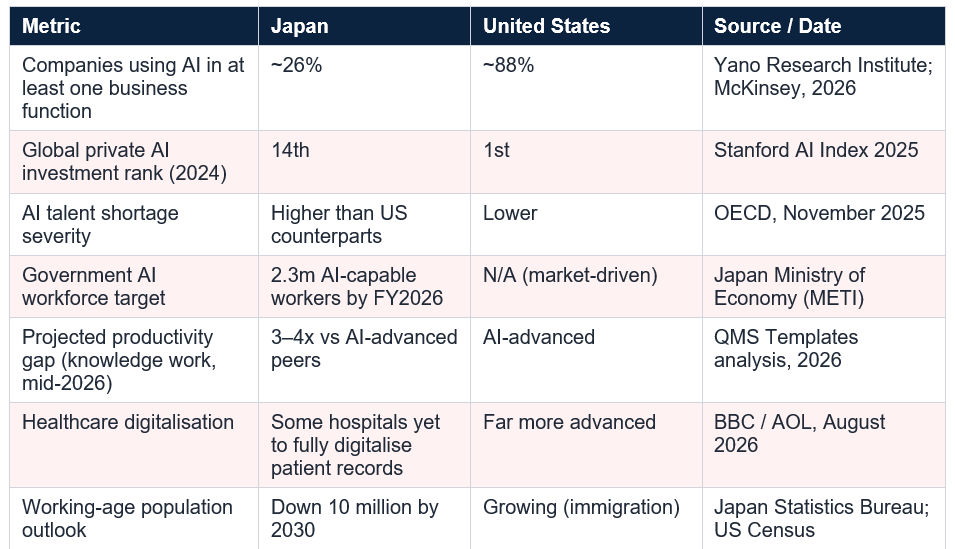
The 88 versus 26 percent adoption gap is not a gap in awareness of AI. Japanese business leaders are acutely aware of the technology and its potential. The gap is in deployment — in the decision to move from knowing about AI to actually integrating it into business operations. Understanding why that decision is so difficult for Japanese firms requires understanding the specific structural features of Japanese corporate life.
East Asia Forum, June 2026: Japanese firms have been slow to adopt AI even for basic tasks such as translation, document drafting and coding. Japan’s core challenge lies in two mutually reinforcing barriers — a weak competitive environment among firms and structural deficiencies in higher education. These dual constraints form negative feedback loops that suppress investment, limit talent development and ultimately slow AI adoption.
Professor Parrisa Haghirian of the Kyoto University of Advanced Science articulates this directly in comments to the BBC published in August 2026: since generative AI is still not fully reliable, it is mainly used in Japan for low-risk tasks such as writing, summarising, or information gathering, but much less for core operations or decision-making and for improving overall processes. The implication is precise: Japanese firms are not refusing to use AI. They are using it in the peripheral, low-stakes spaces where an error is recoverable. They are not using it in the core operations where its value — and its error risk — would be greatest.
This risk aversion is not irrational. Japanese corporate culture has historically built its competitive advantage on quality and reliability — the kaizen philosophy of continuous incremental improvement, the monozukuri tradition of craftsman-like manufacturing precision. An error in a Toyota production line or a Mitsubishi financial calculation has reputational and operational consequences that a technology with acknowledged failure modes is not easily trusted to avoid. The same cultural strengths that made Japanese manufacturing dominant in the 1980s create a structural resistance to deploying technology that is not yet fully predictable.
Analyst Yao Su, commenting in the same BBC report, describes the contrast with US practice precisely: in the US, the attitude of bosses is often ‘let it try, then correct it.’ In Japan, the tolerance for AI mistakes is close to zero, especially in anything client-facing. Some would rather leave a role unfilled than let a machine handle it.
In a US company, deploying AI that replaces or reduces the need for specific tasks is a straightforward efficiency calculation. In a Japanese company that has implicitly committed to its workforce that they will not be made redundant, deploying AI that eliminates roles creates a conflict between technological efficiency and institutional obligation. The organisation cannot simply hire an AI and reduce headcount.
This creates a peculiar dynamic described by the February 2026 analysis from Japanese business commentator Kafa: companies cannot adopt AI without changing their systems, but individuals can start using it tomorrow. As a result, Japan is in a rare situation where corporate adoption is slow but individual usage is advancing rapidly. Individual Japanese workers are using AI tools at their personal initiative, not because their employer has deployed them. The company’s formal systems have not changed, but the people within them are quietly working differently.
The lifetime employment constraint also suppresses AI adoption because reducing staff is not the only way AI can create value — but it is the most visible and most feared consequence. Japanese firms would benefit from AI-driven productivity gains that allowed existing staff to do more valuable work. But the institutional anxiety about the staffing implications of AI prevents the conversation about its productivity benefits from progressing to deployment decisions.
Deploying an AI system in a Japanese organisation typically requires consensus from IT, compliance, legal, HR, operations, and senior management. Each of these stakeholders has legitimate concerns about AI — data privacy, regulatory compliance, employment implications, quality control, customer service standards — that are genuine and not easily dismissed. In an organisation designed to require consensus before action, each veto point is a potential delay of months.
Analyst Yao Su describes this dynamic: in some organisations, a culture based on process and consensus genuinely slows decision-making. Where tolerance for AI mistakes is close to zero, especially in work directly related to customers, the process of building sufficient consensus to deploy AI becomes a multi-year undertaking rather than a quarterly project. By the time consensus is reached, the AI tools available may have changed significantly — which restarts the evaluation process.
The structural causes of this talent deficit are documented by the East Asia Forum’s June 2026 analysis: Japan’s higher education system does not produce AI-capable graduates at the scale the economy requires. Computer science and data science enrolment at Japanese universities remains below the levels seen in the US, China, and even some smaller Asian economies. The interdisciplinary skills required for effective AI deployment — combining domain knowledge in a specific industry with technical AI competence — are particularly scarce.
The Japanese government has set a target of developing 2.3 million ‘human resources for advancing digital technology implementation’ between FY2022 and FY2026. Meeting this target requires not just university education but corporate training programmes, reskilling initiatives, and a cultural reorientation toward technological skill-building that competes with the seniority-based promotion structures that currently dominate most large Japanese firms.
The Japanese healthcare example, cited by BBC’s August 2026 report, is among the most striking illustrations. Some hospitals have not yet fully digitalised patient files. One employee at a Japanese hospital, who asked not to be named, described the situation as ‘like the Stone Age’: paper documents accumulate at a staggering scale. For a hospital that has not yet moved to electronic records, the question of which AI model to use for patient outcome prediction is not just premature — it is literally unanswerable without the underlying digital infrastructure.
This pattern is not unique to healthcare. Japanese government administration is famous for its reliance on the hanko — the official seal that must physically be stamped on documents as a form of approval. Despite government digitalisation initiatives, including a specific programme to eliminate mandatory hanko use from administrative processes, physical paperwork remains deeply embedded in many business workflows. Without digitisation, the data inputs that AI requires to function simply do not exist in usable form.
Japanese Hospital Employee (Anonymous, BBC August 2026): Paper documents accumulate at a staggering scale. It’s like the Stone Age. AI deployment requires digital infrastructure. Without it, we cannot even begin to have the AI conversation.
Japanese markets in many sectors are dominated by established incumbents with stable customer bases, regulatory protection, and long-standing business relationships (keiretsu networks) that reduce the competitive threat from new entrants. In this environment, a firm that does not adopt AI is unlikely to be immediately displaced by one that does — particularly if both firms operate in the same relatively sheltered domestic market. The competitive pressure that would make AI adoption urgent in a more open market simply does not apply at the same intensity.
This stands in stark contrast to the US environment, where AI-first startups and disruptive technology companies have created genuine urgency for established players to adopt AI or face market share erosion. The threat of disruption — real, immediate, and sometimes existential — is a more powerful driver of AI adoption than any government programme or awareness campaign.
Kafa’s February 2026 analysis describes this as a rare situation: corporate adoption is slow but individual usage is advancing rapidly. Companies cannot adopt AI without changing their systems, but individuals can start using it tomorrow. This creates a two-speed Japan: corporate Japan moving cautiously through consensus processes and legacy IT constraints, while individual Japan experiments quietly with the same tools its companies are debating whether to formally evaluate.
The practical implication of this disconnect is that when Japanese companies eventually do deploy AI formally, they will not be deploying it to a workforce with no experience of the tools. They will be formalising what many workers are already doing informally. The adoption gap at the corporate level is partly masked by individual-level usage that is not captured in corporate adoption statistics.
QMS Templates’ January 2026 analysis notes that if Japanese companies can leverage their strengths in meticulousness and sense of responsibility to establish highly reliable AI utilisation models, this could become a global differentiation factor. The cultural traits that slow Japan’s AI adoption — the demand for quality, the intolerance of error, the focus on process integrity — are precisely the traits that would produce responsible, reliable, well-tested AI deployments when they do arrive.
In sectors where AI errors carry catastrophic consequences — nuclear power management, aerospace, medical devices, financial systemic risk — the US approach of ‘let it try, then correct it’ may not be appropriate. Japan’s higher bar for deployment readiness could produce AI systems that, when deployed, are more trustworthy than those rushed to market under competitive pressure.
HBR’s July 2026 analysis of the US-Japan comparison argues that each country’s struggles offer lessons for the other: Japanese caution offers lessons about responsible deployment; US speed offers lessons about overcoming institutional inertia. The optimal approach likely involves elements of both.
The government’s target of developing 2.3 million AI-capable human resources by FY2026 reflects the recognition that the talent shortage is as significant a barrier as the cultural one. Educational investment in AI and data science at the university level, combined with corporate reskilling programmes, is the structural response to the OECD’s finding that Japan lags in AI talent availability.
Japan is also investing heavily in AI infrastructure: the government has designated specific AI data centre investments, supported domestic AI model development, and created policy frameworks designed to make AI adoption more straightforward for small and medium-sized enterprises. These supply-side interventions address some of the structural barriers but do not resolve the cultural and organisational barriers that are ultimately the most significant constraints on adoption.
The 88 versus 26 percent adoption gap between the US and Japan is real, documented, and consequential. If the productivity differential between AI-advanced and AI-lagging firms reaches 3 to 4 times in knowledge work by the end of 2026, as QMS analysis suggests, Japan’s competitive position in globally traded services will be at genuine risk. The labour shortage that makes AI most necessary is also the force that will eventually make AI resistance unsustainable.
Japan’s caution is not without virtue. The country’s eventual AI deployments may be more reliable, more carefully validated, and more deeply integrated into quality management systems than those rushed to market under competitive pressure elsewhere. But the Noh play must eventually move. Every month of delay in the go-go slow-go drama of Japanese AI adoption is a month of productivity foregone, a month of talent gap widening, and a month of competitive disadvantage accumulating against economies that are less cautious and less patient.
According to research cited by Harvard Business Review in July 2026, 88% of US companies use AI in at least one business function, compared to just 26% of Japanese companies (Yano Research Institute). The Stanford AI Index 2025 ranked the US first globally in private AI investment in 2024 and Japan 14th. QMS analysis projected that by mid-2026, the productivity gap between AI-advanced and AI-lagging firms could reach 3 to 4 times in knowledge work sectors.
Why don’t Japanese companies just adopt AI like US firms do?
The barriers are cultural and structural rather than technical or financial. Key factors include: a corporate culture of near-zero tolerance for AI errors; the lifetime employment system that makes redundancy implied by AI threatening; consensus decision-making (nemawashi and ringi systems) that makes deployment decisions slow; a shortage of AI-capable talent; legacy paper-based IT systems that lack the digital data AI requires; and weaker competitive pressure from domestic markets.
What is Japan doing about its AI adoption lag?
The Japanese government has set a target of developing 2.3 million AI-capable workers by FY2026. METI updated its AI guidelines in 2024 to emphasise transparency and human oversight. The government has invested in AI data centre infrastructure, domestic AI model development, and policy frameworks to help SMEs adopt AI. However, most analysts view the cultural and structural barriers as the primary constraints, which are harder to address through government policy than talent development.
Could Japan’s cautious AI approach become an advantage?
Potentially, yes. Analysts including QMS Templates and HBR argue that Japan’s culture of meticulousness and intolerance for error could produce AI deployments that are more reliable and trustworthy than those rushed to market under competitive pressure. If Japanese companies can establish highly reliable AI utilisation models, this attention to quality could become a global differentiating factor in sectors where AI accuracy is critical, such as medical devices, aerospace, and financial systems.
Why is Japan’s healthcare sector particularly slow to adopt AI?
Japan’s healthcare sector faces a convergence of multiple barriers. Many hospitals have not fully digitalised patient records, making AI analysis of health data impossible at scale. Medical AI carries high stakes for patient safety, making zero-error tolerance particularly intense. Regulatory approval processes for clinical AI tools are lengthy and conservative. Administrative and nursing workforces are large and protected by employment norms. The result is a sector that could benefit enormously from AI but where deployment timelines stretch to years rather than months.
Are Japanese individuals using AI even if their companies aren’t?
Yes. Analysts describe a two-speed Japan: corporate AI adoption is lagging, but individual workers are using AI tools (ChatGPT, Gemini, and others) privately for writing, research, translation, and problem-solving at rates not dramatically different from other countries. This individual-corporate disconnect means that when companies do formally deploy AI, they will be formalising what many employees are already doing informally, rather than introducing an entirely unfamiliar technology.
What would accelerate Japan’s AI adoption?
Key potential catalysts include: a competitive shock where a major firm loses market share to an AI-enabled competitor (the most powerful immediate driver); the labour shortage reaching a critical operational point where AI becomes existentially necessary rather than merely desirable; demonstrated improvements in AI reliability that meet Japan’s quality standards; and generational change in corporate leadership as younger AI-native workers rise into decision-making positions. None of these catalysts require government intervention; all of them are likely to materialise over the coming decade.
Table of Contents
- AI’s Most Ironic Customer
- The Data: How Wide Is the Gap?
- The Paradox: Why Japan Should Be AI’s Biggest Champion
- Barrier 1: Corporate Culture — The Zero-Error Trap
- Barrier 2: Lifetime Employment and the Fear of Redundancy
- Barrier 3: The Consensus Decision-Making System
- Barrier 4: Structural Talent Deficits
- Barrier 5: Legacy IT Systems and Paper-Based Operations
- Barrier 6: Weak Competitive Pressure
- The Individual vs. Corporate Disconnect
- Japan’s Healthcare Sector: A Case Study in Slow Adoption
- What Japan Is Getting Right — and Where It Could Lead
- The Government’s Response
- What Could Change
- Conclusion: The Noh Play Must Eventually Move
- Frequently Asked Questions
AI’s Most Ironic Customer
Japan is, on paper, artificial intelligence’s ideal customer. The country faces an acute labour shortage driven by one of the world’s fastest-ageing populations. Its working-age population is projected to decline by 10 million by 2030. Productivity in many sectors has stagnated for decades. The country has a proud tradition of technological innovation, from robotics to semiconductors to consumer electronics. It has the economic scale, the industrial complexity, and the need to make AI adoption not merely attractive but existentially necessary.And yet, as of 2026, Japan is using AI at roughly a third of the rate of its major economic competitors. Recent research cited by Harvard Business Review in July 2026 found that 88 percent of US companies use AI in at least one business function. Comparable research from the Yano Research Institute found just 26 percent of Japanese companies say the same. Japan ranked 14th globally in private AI investment in 2024, behind not only the United States but numerous smaller economies that lack Japan’s industrial infrastructure and capital.
The gap is not primarily a technology problem. Japan has access to the same large language models, the same automation platforms, and the same generative AI tools as any other developed economy. The barriers are deeper: cultural, structural, organisational, and rooted in the specific ways Japanese firms are organised, staffed, and managed. This article examines each barrier in detail and asks whether Japan’s caution will prove a costly mistake or, as some analysts argue, an eventual source of advantage.
The Noh Analogy: Japan’s reaction to AI is beginning to resemble the traditional slow-paced Noh drama. All the masked characters on stage agree that immediate action is needed, the same call is repeated seriously, but the actors remain stationary in their places.
Note: This article is for general informational and educational purposes only. It discusses broad cultural and structural observations about AI adoption in Japan, drawing on academic and media sources. Individual companies and sectors vary significantly in their AI adoption progress.
The Data: How Wide Is the Gap?
The 88 versus 26 percent adoption gap is not a gap in awareness of AI. Japanese business leaders are acutely aware of the technology and its potential. The gap is in deployment — in the decision to move from knowing about AI to actually integrating it into business operations. Understanding why that decision is so difficult for Japanese firms requires understanding the specific structural features of Japanese corporate life.
The Paradox: Why Japan Should Be AI’s Biggest Champion
The case for Japan as the country most likely to embrace AI aggressively is genuinely compelling. Consider the structural situation:- Labour shortage: Japan’s working-age population is shrinking rapidly. The country already relies on significant overtime from existing workers and a growing cohort of part-time employees to maintain output. AI-powered automation could directly address the labour gap that no immigration policy has yet been willing to fill at the required scale.
- Productivity stagnation: Japan’s labour productivity has consistently lagged behind other G7 economies for decades. This is precisely the kind of environment where AI’s potential to multiply knowledge worker output should be most attractive.
- Industrial complexity: Japan’s manufacturing sector — particularly automotive, electronics, and precision engineering — involves exactly the kind of complex, quality-critical process optimisation where AI has demonstrated measurable gains globally.
- Existing technology culture: Japan has the world’s most extensive deployment of industrial robots. The country is comfortable with machine automation. The leap to AI-powered cognition is, conceptually, not foreign.
East Asia Forum, June 2026: Japanese firms have been slow to adopt AI even for basic tasks such as translation, document drafting and coding. Japan’s core challenge lies in two mutually reinforcing barriers — a weak competitive environment among firms and structural deficiencies in higher education. These dual constraints form negative feedback loops that suppress investment, limit talent development and ultimately slow AI adoption.
Barrier 1: Corporate Culture — The Zero-Error Trap
The most frequently cited explanation for Japan’s slow AI adoption is the most culturally specific: Japanese firms have an exceptionally low tolerance for error, particularly in customer-facing operations and in anything that touches regulatory or compliance functions.Professor Parrisa Haghirian of the Kyoto University of Advanced Science articulates this directly in comments to the BBC published in August 2026: since generative AI is still not fully reliable, it is mainly used in Japan for low-risk tasks such as writing, summarising, or information gathering, but much less for core operations or decision-making and for improving overall processes. The implication is precise: Japanese firms are not refusing to use AI. They are using it in the peripheral, low-stakes spaces where an error is recoverable. They are not using it in the core operations where its value — and its error risk — would be greatest.
This risk aversion is not irrational. Japanese corporate culture has historically built its competitive advantage on quality and reliability — the kaizen philosophy of continuous incremental improvement, the monozukuri tradition of craftsman-like manufacturing precision. An error in a Toyota production line or a Mitsubishi financial calculation has reputational and operational consequences that a technology with acknowledged failure modes is not easily trusted to avoid. The same cultural strengths that made Japanese manufacturing dominant in the 1980s create a structural resistance to deploying technology that is not yet fully predictable.
Analyst Yao Su, commenting in the same BBC report, describes the contrast with US practice precisely: in the US, the attitude of bosses is often ‘let it try, then correct it.’ In Japan, the tolerance for AI mistakes is close to zero, especially in anything client-facing. Some would rather leave a role unfilled than let a machine handle it.
Barrier 2: Lifetime Employment and the Fear of Redundancy
Japan’s lifetime employment system — in which major employers historically commit to employing workers for their entire careers in exchange for loyalty and flexibility — creates a specific and powerful structural barrier to AI adoption that does not exist in the same form in the US or UK.In a US company, deploying AI that replaces or reduces the need for specific tasks is a straightforward efficiency calculation. In a Japanese company that has implicitly committed to its workforce that they will not be made redundant, deploying AI that eliminates roles creates a conflict between technological efficiency and institutional obligation. The organisation cannot simply hire an AI and reduce headcount.
This creates a peculiar dynamic described by the February 2026 analysis from Japanese business commentator Kafa: companies cannot adopt AI without changing their systems, but individuals can start using it tomorrow. As a result, Japan is in a rare situation where corporate adoption is slow but individual usage is advancing rapidly. Individual Japanese workers are using AI tools at their personal initiative, not because their employer has deployed them. The company’s formal systems have not changed, but the people within them are quietly working differently.
The lifetime employment constraint also suppresses AI adoption because reducing staff is not the only way AI can create value — but it is the most visible and most feared consequence. Japanese firms would benefit from AI-driven productivity gains that allowed existing staff to do more valuable work. But the institutional anxiety about the staffing implications of AI prevents the conversation about its productivity benefits from progressing to deployment decisions.
Barrier 3: The Consensus Decision-Making System
Japanese organisations are famous for their consensus-based decision-making processes — nemawashi (the practice of building consensus informally before a formal decision) and ringi (the formal document circulation process that requires multiple sign-offs from multiple levels of the organisation before any significant change can be implemented). These systems produce decisions that, when made, have broad institutional support. They are not designed for speed.Deploying an AI system in a Japanese organisation typically requires consensus from IT, compliance, legal, HR, operations, and senior management. Each of these stakeholders has legitimate concerns about AI — data privacy, regulatory compliance, employment implications, quality control, customer service standards — that are genuine and not easily dismissed. In an organisation designed to require consensus before action, each veto point is a potential delay of months.
Analyst Yao Su describes this dynamic: in some organisations, a culture based on process and consensus genuinely slows decision-making. Where tolerance for AI mistakes is close to zero, especially in work directly related to customers, the process of building sufficient consensus to deploy AI becomes a multi-year undertaking rather than a quarterly project. By the time consensus is reached, the AI tools available may have changed significantly — which restarts the evaluation process.
Barrier 4: Structural Talent Deficits
Japan’s AI adoption gap is also a talent gap. The OECD’s November 2025 analysis of AI use in the Japanese workplace found that Japanese companies struggle more than their US counterparts with a shortage of AI-related talent, with the most pressing challenge being a lack of employees capable of promoting AI adoption using their workplace experience and basic AI knowledge.The structural causes of this talent deficit are documented by the East Asia Forum’s June 2026 analysis: Japan’s higher education system does not produce AI-capable graduates at the scale the economy requires. Computer science and data science enrolment at Japanese universities remains below the levels seen in the US, China, and even some smaller Asian economies. The interdisciplinary skills required for effective AI deployment — combining domain knowledge in a specific industry with technical AI competence — are particularly scarce.
The Japanese government has set a target of developing 2.3 million ‘human resources for advancing digital technology implementation’ between FY2022 and FY2026. Meeting this target requires not just university education but corporate training programmes, reskilling initiatives, and a cultural reorientation toward technological skill-building that competes with the seniority-based promotion structures that currently dominate most large Japanese firms.
Barrier 5: Legacy IT Systems and Paper-Based Operations
AI deployment requires digital data. You cannot use machine learning to analyse paper records, and you cannot use generative AI to improve processes that are not yet digitised. Japan’s legacy IT infrastructure and persistent reliance on paper-based administration creates a foundational barrier that precedes the question of which AI tools to deploy.The Japanese healthcare example, cited by BBC’s August 2026 report, is among the most striking illustrations. Some hospitals have not yet fully digitalised patient files. One employee at a Japanese hospital, who asked not to be named, described the situation as ‘like the Stone Age’: paper documents accumulate at a staggering scale. For a hospital that has not yet moved to electronic records, the question of which AI model to use for patient outcome prediction is not just premature — it is literally unanswerable without the underlying digital infrastructure.
This pattern is not unique to healthcare. Japanese government administration is famous for its reliance on the hanko — the official seal that must physically be stamped on documents as a form of approval. Despite government digitalisation initiatives, including a specific programme to eliminate mandatory hanko use from administrative processes, physical paperwork remains deeply embedded in many business workflows. Without digitisation, the data inputs that AI requires to function simply do not exist in usable form.
Japanese Hospital Employee (Anonymous, BBC August 2026): Paper documents accumulate at a staggering scale. It’s like the Stone Age. AI deployment requires digital infrastructure. Without it, we cannot even begin to have the AI conversation.
Barrier 6: Weak Competitive Pressure
The East Asia Forum’s June 2026 analysis identifies a structural economic factor that compounds all the cultural barriers: Japan’s domestic competitive environment is less intense than that of the US or UK. When market competition is fierce, the productivity gains from AI adoption become a survival imperative. When competition is more muted, the urgency to deploy AI — and to bear the risks and disruption of deployment — is lower.Japanese markets in many sectors are dominated by established incumbents with stable customer bases, regulatory protection, and long-standing business relationships (keiretsu networks) that reduce the competitive threat from new entrants. In this environment, a firm that does not adopt AI is unlikely to be immediately displaced by one that does — particularly if both firms operate in the same relatively sheltered domestic market. The competitive pressure that would make AI adoption urgent in a more open market simply does not apply at the same intensity.
This stands in stark contrast to the US environment, where AI-first startups and disruptive technology companies have created genuine urgency for established players to adopt AI or face market share erosion. The threat of disruption — real, immediate, and sometimes existential — is a more powerful driver of AI adoption than any government programme or awareness campaign.
The Individual vs. Corporate Disconnect
One of the most interesting and distinctive features of Japan’s AI situation is the gap between individual adoption and corporate adoption. While Japanese firms lag dramatically in formal AI deployment, individual Japanese workers are using AI tools at rates that are not dramatically different from their counterparts in other countries. Workers use ChatGPT, Gemini, and other general-purpose AI tools for writing, research, translation, and problem-solving as personal productivity tools.Kafa’s February 2026 analysis describes this as a rare situation: corporate adoption is slow but individual usage is advancing rapidly. Companies cannot adopt AI without changing their systems, but individuals can start using it tomorrow. This creates a two-speed Japan: corporate Japan moving cautiously through consensus processes and legacy IT constraints, while individual Japan experiments quietly with the same tools its companies are debating whether to formally evaluate.
The practical implication of this disconnect is that when Japanese companies eventually do deploy AI formally, they will not be deploying it to a workforce with no experience of the tools. They will be formalising what many workers are already doing informally. The adoption gap at the corporate level is partly masked by individual-level usage that is not captured in corporate adoption statistics.
Japan’s Healthcare Sector: A Case Study in Slow Adoption
Healthcare is described in BBC’s August 2026 report as particularly slow to embrace AI, and the sector’s situation illustrates the convergence of multiple barriers in one setting:- Legacy infrastructure: many hospitals have not yet fully digitalised patient records. Without digital data, AI analysis of patient outcomes, diagnostic imaging, or treatment protocols is not possible at scale.
- Risk aversion: medical decisions directly affect patient safety. The zero-error culture is most intense in healthcare, where an AI-generated diagnostic error could have life-or-death consequences. The verification process required before any AI tool could be deployed in clinical settings is extensive.
- Regulatory complexity: Japanese healthcare regulation is detailed, multi-layered, and risk-conservative. New technology must be approved through extensive regulatory channels before clinical deployment.
- Employment sensitivity: Japan’s nursing and administrative workforce in healthcare is large, deeply embedded, and protected by the lifetime employment norms that make redundancy uncomfortable to contemplate.
What Japan Is Getting Right — and Where It Could Lead
The analysis of Japan’s AI adoption barriers should not be read as an unambiguous critique. Several of the same analysts who document the slowness also identify genuine virtues in Japan’s cautious approach that could, over time, become a competitive advantage.QMS Templates’ January 2026 analysis notes that if Japanese companies can leverage their strengths in meticulousness and sense of responsibility to establish highly reliable AI utilisation models, this could become a global differentiation factor. The cultural traits that slow Japan’s AI adoption — the demand for quality, the intolerance of error, the focus on process integrity — are precisely the traits that would produce responsible, reliable, well-tested AI deployments when they do arrive.
In sectors where AI errors carry catastrophic consequences — nuclear power management, aerospace, medical devices, financial systemic risk — the US approach of ‘let it try, then correct it’ may not be appropriate. Japan’s higher bar for deployment readiness could produce AI systems that, when deployed, are more trustworthy than those rushed to market under competitive pressure.
HBR’s July 2026 analysis of the US-Japan comparison argues that each country’s struggles offer lessons for the other: Japanese caution offers lessons about responsible deployment; US speed offers lessons about overcoming institutional inertia. The optimal approach likely involves elements of both.
The Government’s Response
The Japanese government is acutely aware of the AI adoption gap and has been attempting to address it through multiple channels. The Ministry of Economy, Trade and Industry (METI) updated its AI guidelines in 2024 to emphasise transparency, accountability, and human oversight — principles consistent with Japanese corporate culture that may reduce institutional resistance to AI deployment by framing it within familiar values.The government’s target of developing 2.3 million AI-capable human resources by FY2026 reflects the recognition that the talent shortage is as significant a barrier as the cultural one. Educational investment in AI and data science at the university level, combined with corporate reskilling programmes, is the structural response to the OECD’s finding that Japan lags in AI talent availability.
Japan is also investing heavily in AI infrastructure: the government has designated specific AI data centre investments, supported domestic AI model development, and created policy frameworks designed to make AI adoption more straightforward for small and medium-sized enterprises. These supply-side interventions address some of the structural barriers but do not resolve the cultural and organisational barriers that are ultimately the most significant constraints on adoption.
What Could Change
Several catalysts could accelerate Japan’s AI adoption faster than the current trajectory suggests:- • A competitive shock: if a major Japanese company in a key sector loses significant market share to an AI-enabled competitor — domestic or foreign — the urgency of AI adoption would increase dramatically and quickly across the sector. The demonstration effect of competitive AI deployment may prove more powerful than any government campaign.
- • Labour shortage reaching a critical point: as Japan’s workforce continues to decline, the argument that AI is existentially necessary rather than merely desirable will become increasingly difficult to resist. The lifetime employment commitment may be renegotiated as companies face the practical reality of operating with insufficient staff.
- • AI reliability improvement: as AI tools become demonstrably more reliable — making fewer errors, providing more consistent outputs, and being validated across more deployment contexts — the zero-error culture may become less of a barrier. Japanese firms may be waiting for AI to pass a reliability threshold that would make its deployment consistent with their quality standards.
- • Generational shift: younger Japanese workers who use AI tools personally and instinctively may, as they rise through corporate hierarchies, create organisations that are more comfortable with AI deployment. The individual-corporate disconnect documented today may resolve itself through demographic change in corporate leadership over the next decade.
Conclusion
The metaphor of Japan’s AI response as a Noh drama — all participants stationary despite unanimous agreement that movement is needed — captures something genuinely important about the situation. The barriers to AI adoption in Japan are not ignorance, not poverty, not lack of access to technology, and not absence of need. They are cultural, structural, and institutional. They are the product of the same values and organisational practices that made Japan one of the world’s most successful industrial economies for most of the twentieth century.The 88 versus 26 percent adoption gap between the US and Japan is real, documented, and consequential. If the productivity differential between AI-advanced and AI-lagging firms reaches 3 to 4 times in knowledge work by the end of 2026, as QMS analysis suggests, Japan’s competitive position in globally traded services will be at genuine risk. The labour shortage that makes AI most necessary is also the force that will eventually make AI resistance unsustainable.
Japan’s caution is not without virtue. The country’s eventual AI deployments may be more reliable, more carefully validated, and more deeply integrated into quality management systems than those rushed to market under competitive pressure elsewhere. But the Noh play must eventually move. Every month of delay in the go-go slow-go drama of Japanese AI adoption is a month of productivity foregone, a month of talent gap widening, and a month of competitive disadvantage accumulating against economies that are less cautious and less patient.
Frequently Asked Questions
How far behind the US is Japan in AI adoption?According to research cited by Harvard Business Review in July 2026, 88% of US companies use AI in at least one business function, compared to just 26% of Japanese companies (Yano Research Institute). The Stanford AI Index 2025 ranked the US first globally in private AI investment in 2024 and Japan 14th. QMS analysis projected that by mid-2026, the productivity gap between AI-advanced and AI-lagging firms could reach 3 to 4 times in knowledge work sectors.
Why don’t Japanese companies just adopt AI like US firms do?
The barriers are cultural and structural rather than technical or financial. Key factors include: a corporate culture of near-zero tolerance for AI errors; the lifetime employment system that makes redundancy implied by AI threatening; consensus decision-making (nemawashi and ringi systems) that makes deployment decisions slow; a shortage of AI-capable talent; legacy paper-based IT systems that lack the digital data AI requires; and weaker competitive pressure from domestic markets.
What is Japan doing about its AI adoption lag?
The Japanese government has set a target of developing 2.3 million AI-capable workers by FY2026. METI updated its AI guidelines in 2024 to emphasise transparency and human oversight. The government has invested in AI data centre infrastructure, domestic AI model development, and policy frameworks to help SMEs adopt AI. However, most analysts view the cultural and structural barriers as the primary constraints, which are harder to address through government policy than talent development.
Could Japan’s cautious AI approach become an advantage?
Potentially, yes. Analysts including QMS Templates and HBR argue that Japan’s culture of meticulousness and intolerance for error could produce AI deployments that are more reliable and trustworthy than those rushed to market under competitive pressure. If Japanese companies can establish highly reliable AI utilisation models, this attention to quality could become a global differentiating factor in sectors where AI accuracy is critical, such as medical devices, aerospace, and financial systems.
Why is Japan’s healthcare sector particularly slow to adopt AI?
Japan’s healthcare sector faces a convergence of multiple barriers. Many hospitals have not fully digitalised patient records, making AI analysis of health data impossible at scale. Medical AI carries high stakes for patient safety, making zero-error tolerance particularly intense. Regulatory approval processes for clinical AI tools are lengthy and conservative. Administrative and nursing workforces are large and protected by employment norms. The result is a sector that could benefit enormously from AI but where deployment timelines stretch to years rather than months.
Are Japanese individuals using AI even if their companies aren’t?
Yes. Analysts describe a two-speed Japan: corporate AI adoption is lagging, but individual workers are using AI tools (ChatGPT, Gemini, and others) privately for writing, research, translation, and problem-solving at rates not dramatically different from other countries. This individual-corporate disconnect means that when companies do formally deploy AI, they will be formalising what many employees are already doing informally, rather than introducing an entirely unfamiliar technology.
What would accelerate Japan’s AI adoption?
Key potential catalysts include: a competitive shock where a major firm loses market share to an AI-enabled competitor (the most powerful immediate driver); the labour shortage reaching a critical operational point where AI becomes existentially necessary rather than merely desirable; demonstrated improvements in AI reliability that meet Japan’s quality standards; and generational change in corporate leadership as younger AI-native workers rise into decision-making positions. None of these catalysts require government intervention; all of them are likely to materialise over the coming decade.
0 Comments
Be the first to share your thoughts on this article.