

Health
Why Is My First Medicare Bill So High? Explained
You’ve just enrolled in Medicare and your first bill arrives. It’s hundreds of dollars — possibly over $600 — and you were expecting something closer to the $202.90 standard Part B monthly premium you read about. Nothing is wrong. The bill is almost certainly correct. But understanding why it is so high — and what four specific factors drive first-bill shock — can save you stress, and in some cases, real money.
Nothing went wrong. The bill is almost certainly correct. But the gap between what people expect to pay and what the first bill actually shows is explained by four specific factors that Medicare’s billing system does not make obvious: the three-month billing cycle for new enrollees not yet receiving Social Security; the IRMAA surcharge for higher-income beneficiaries based on income from two years ago; the combination of Part B, Part D, and potentially Part A costs on the same statement; and the standard Medicare cost increases that took effect on 1 January 2026.
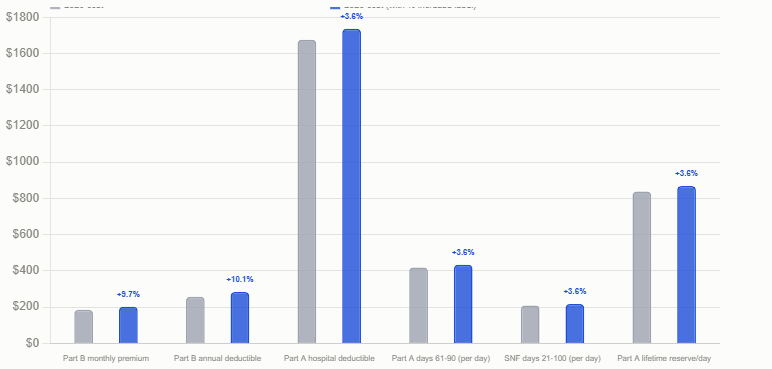
The standard Medicare Part B premium rose 9.7% from $185 in 2025 to $202.90 in 2026 — one of the larger year-on-year increases in recent memory. The Part A inpatient hospital deductible rose to $1,736. The Part B annual deductible rose to $283. Understanding all of these costs, how they combine in a first bill, and what can be done to reduce or appeal some of them is the purpose of this guide.
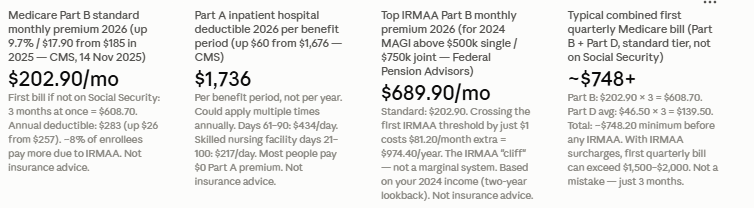
2026 Medicare costs (CMS, November 14, 2025 official announcement): Part B standard monthly premium: $202.90 (up $17.90/9.7% from $185 in 2025). Part B annual deductible: $283 (up $26 from $257). Part A hospital deductible: $1,736 per benefit period (up $60 from $1,676). Part A daily coinsurance days 61-90: $434 (up $15). Skilled nursing facility days 21-100: $217/day (up $7.50). Part D average standalone premium: ~$46.50/month. IRMAA surcharges (Part B) range from $0 to $487/month extra; combined premium range $202.90 to $689.90/month (Federal Pension Advisors). IRMAA surcharges (Part D): $14.50 to $91/month extra. First bill if not on Social Security: typically 3 months at once = $608.70 for Part B alone. Sources: CMS; Healthcare Finance News; WFMJ; New Horizons Marketing; Ritter Insurance Marketing; Federal Pension Advisors.
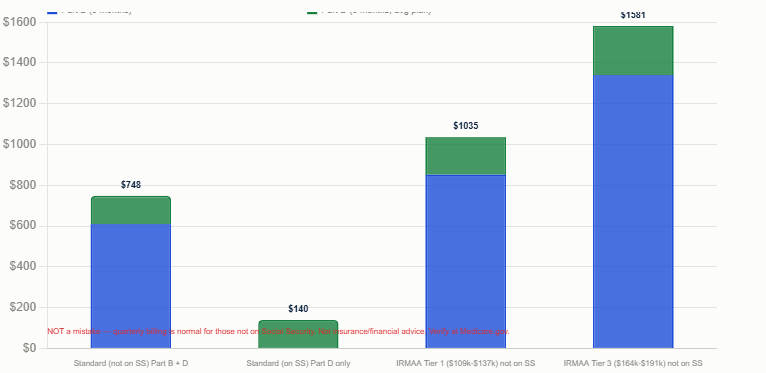
Your first quarterly Medicare bill typically covers three months of Part B premiums at once. At $202.90 per month in 2026, three months of Part B alone amounts to $608.70. If you also have a standalone Part D prescription drug plan (average premium approximately $46.50 per month), three months of that adds another $139.50. Combined, your first direct bill could easily total $748.20 or more for Part B and Part D combined, before any IRMAA surcharges.
This is not a double charge. It is not an error. It is simply the Medicare billing cycle applied to people who are not receiving Social Security. Once you start receiving Social Security — or if you are already receiving it when you enrol — the premium is automatically deducted each month, making the billing invisible and the amount much less shocking. But for the growing number of people who delay Social Security to age 67, 68, 69, or 70 to maximise their benefit, the direct quarterly billing is their reality, and the first bill invariably surprises.
How Medicare billing works for new enrollees (2026): (1) If you receive Social Security: your Part B premium ($202.90/month) is deducted automatically from your monthly SS payment. You see it as a reduced SS deposit, not a separate bill. (2) If you do NOT receive Social Security: Medicare sends you a quarterly bill (every 3 months). Your FIRST bill typically covers 3 months at once. At $202.90/month x 3 = $608.70 for Part B alone. You can also be billed monthly if you set up automatic bank payments. Contact Medicare at 1-800-633-4227 to arrange this if quarterly billing creates a cash flow problem. Source: CMS Medicare.gov; general Medicare billing guidance.
The standard monthly Part B premium for 2026 is $202.90, announced by CMS on November 14, 2025. This represents an increase of $17.90 (9.7%) from the 2025 premium of $185.00. About 8% of Part B enrollees pay more than the standard premium because their income exceeds the IRMAA threshold — covered in detail in sections 5 and 6. For the remaining approximately 92% of enrollees, $202.90 is the full monthly premium.
The annual Part B deductible in 2026 is $283, up $26 from $257 in 2025. The deductible must be met before Medicare begins paying its share (80%) of covered Part B services. Until the deductible is met each year, you pay 100% of the cost of covered services. After the deductible, you pay 20% (coinsurance) and Medicare pays 80% for most Part B services. There is no out-of-pocket maximum in Original Medicare — a significant gap that most people address with a Medigap (Medicare Supplement) plan or a Medicare Advantage plan that includes cost caps.
The Part B premium is the same regardless of when during the year you enrol. But the Part B deductible resets each January 1, meaning that if you enrol mid-year, you pay the full $283 deductible before Medicare pays its share of any Part B services in that calendar year, even if you only have coverage for six months.
What surprises many new enrollees is not the Part A premium (there usually is none) but the Part A deductible: $1,736 in 2026 for each hospital benefit period. This deductible applies the first time you are admitted to a hospital in each ‘benefit period,’ which begins with your first inpatient hospital day and ends after 60 consecutive days without inpatient or SNF care. Unlike the Part B deductible (which resets each calendar year), you could theoretically owe multiple Part A deductibles in a single year if you have multiple hospitalisations with more than 60-day gaps between them.
The coinsurance structure adds further complexity. For days 61-90 of a hospital stay within a benefit period, you pay $434 per day (2026). For ‘lifetime reserve days’ (an additional 60 days you can use across your lifetime after exhausting the standard 90 days in a benefit period), you pay $868 per day. For skilled nursing facility care, Medicare covers the first 20 days in full; days 21-100 cost you $217 per day in 2026. Most people address the Part A cost sharing gaps with Medigap insurance.
The Part A deductible of $1,736 is per benefit period, not per year. You could owe it multiple times in the same year if you are hospitalised more than once. There is NO daily limit on hospital stays under Part A alone (after the lifetime reserve days are used up). This is the most significant financial exposure in Original Medicare, and it is the primary reason most people are advised to have either a Medigap plan or a Medicare Advantage plan with an out-of-pocket maximum. Source: CMS; New Horizons Marketing 2026. Not medical or insurance advice.
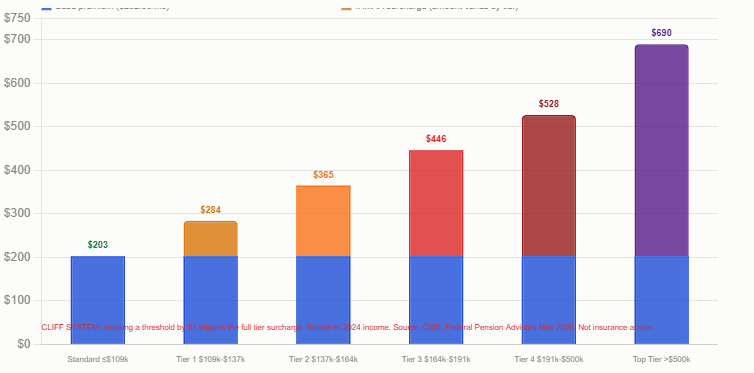
At its highest tier, the 2026 combined Part B premium (standard premium plus maximum IRMAA surcharge) reaches $689.90 per month per person — more than three times the standard premium. A married couple in the highest IRMAA tier pays $689.90 × 2 = $1,379.80 per month for Part B alone, before Part A costs, Part D premiums, or any actual medical expenses. This is the figure that produces the most dramatic first-bill shock.
Federal Pension Advisors (updated May 2026) notes that ‘although the 2026 IRMAA income thresholds were adjusted slightly for inflation, the increases were modest’ — CPI-U rose just 1.02% for the 12 months ending August 2025. As a result, many retirees are crossing IRMAA thresholds not because of lifestyle changes but due to routine income events such as required minimum distributions (RMDs), pension COLAs, or portfolio gains. The income that triggered the surcharge may have been a one-time event in 2024, but the premium increase has applied throughout 2026.
The example from Michael Ryan Money is instructive: a small bonus of $1,000 received by a retired teacher in 2024 pushed their MAGI just over the first IRMAA threshold. The result is an extra $1,200 in Medicare premiums in 2026 — compared to the $1,000 income increase that caused it. The extra Medicare cost exceeded the income that triggered it. This is the IRMAA cliff at work.
The cliff is particularly dangerous around income events that retirees and their advisers may not be thinking of as Medicare-affecting. A Roth IRA conversion that moves money from a pre-tax account to a post-tax account creates ordinary income in the year of the conversion. If that conversion — even one designed to reduce future RMDs — pushes 2024 MAGI above $109,000, the result is higher Medicare premiums two years later in 2026.
Similarly, selling a rental property or other investment asset creates capital gain income that is included in MAGI. A retiree who sells a long-held property in 2024 may find that the capital gain, even after applying exclusions, pushes their MAGI into an IRMAA tier. Required Minimum Distributions from traditional IRAs and 401(k)s, which become mandatory from age 73, similarly increase MAGI and can create or worsen IRMAA exposure.
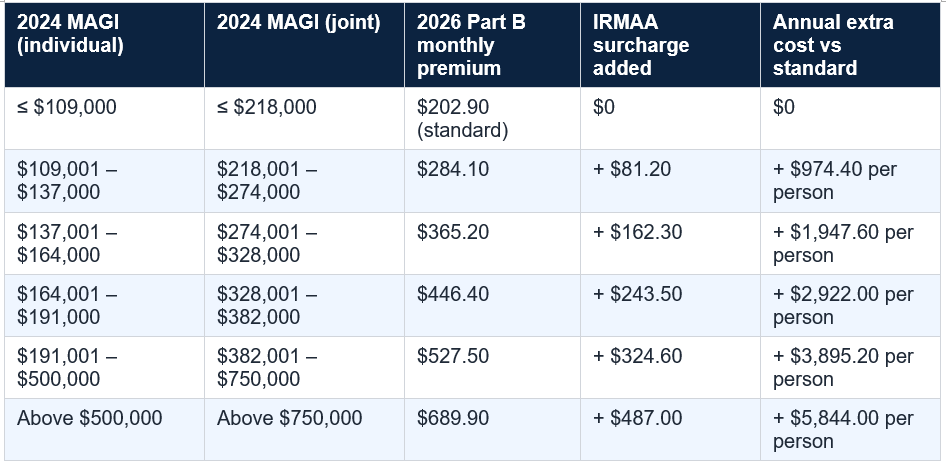
The IRMAA cliff in numbers (2026): crossing the first IRMAA threshold ($109,000 single, $218,000 joint) by just $1 costs an additional $81.20/month or $974.40/year in Part B premiums per person. Crossing the second threshold costs an additional $162.30/month or $1,947.60/year. The top IRMAA tier adds $487/month or $5,844/year per person to the base premium. A married couple in the top tier pays $5,844 x 2 = $11,688 more per year than a couple in the standard tier. Sources: CMS; Federal Pension Advisors May 2026; Michael Ryan Money. Not financial or insurance advice. Verify at Medicare.gov.
This means that someone who retired in January 2025 and whose income in 2025 and 2026 is substantially lower than it was during their working years may still be paying IRMAA surcharges in 2026 based on their full pre-retirement income from 2024. Their Medicare bill reflects their last working year’s earnings, not their current retired income. This is particularly acute for people who retire mid-year and have both employment income and early retirement distributions in the same year, producing an unusually high MAGI in their final working year.
The mechanism works through the IRS and SSA data systems: in 2024, your income is reported on your tax return, filed with the IRS in early 2025. By late 2025, the IRS shares that 2024 MAGI data with the Social Security Administration. In 2026, the SSA uses that two-year-old income data to set your current Medicare Part B and D premiums. You may not even know you are subject to IRMAA until you receive the premium notice from SSA — often arriving just before Medicare coverage begins.
If your income has decreased since 2024 — due to retirement, reduced work hours, a change in filing status, or another reason — you may be able to appeal your IRMAA surcharge using Form SSA-44. Medicare IRMAA appeals based on a 'life-changing event' can reduce or eliminate the surcharge based on your more recent (lower) income. The appeal must be filed within 60 days of receiving your IRMAA notice. Qualifying events include: retirement or work reduction, marriage, divorce, death of a spouse, loss of income-producing property, loss of employer pension, and others. A Roth conversion or capital gain alone generally does NOT qualify as a life-changing event for appeal purposes. Source: Humana; GoodRx; Michael Ryan Money. Not legal or insurance advice.
The average standalone Part D premium in 2026 is approximately $46.50 per month, but premiums vary significantly by plan, formulary, and state. Your specific plan premium will appear on your first bill. In your first quarterly bill, three months of Part D at $46.50 per month adds $139.50 to the Part B total of $608.70, bringing the combined quarterly bill to approximately $748.20 before any IRMAA surcharges.
Part D is also subject to IRMAA for higher-income enrollees. The 2026 Part D IRMAA surcharges range from $14.50 to $91.00 per month, on top of your plan’s own premium. These surcharges are charged regardless of which Part D plan you choose — the IRMAA amount is an additional charge imposed by Medicare based on income, separate from the plan’s base premium. A person in the highest Part D IRMAA tier ($91.00 per month surcharge) pays $91 per month more than the standard enrollee in addition to the plan premium.
From 2026, Medicare Part D includes a significant structural change from the Inflation Reduction Act: the annual out-of-pocket cap for Part D enrollees reaches $2,000, up from $2,100 in the original announcement (check the current year’s cap at Medicare.gov, as the figure varies). This cap provides a meaningful ceiling on catastrophic drug costs for beneficiaries with expensive medications, one of the most meaningful consumer protections in recent Medicare history.
If you are already receiving Social Security retirement or disability benefits when you become eligible for Medicare, your Part B premium is automatically deducted each month from your Social Security payment. You never see a separate Medicare bill — just a slightly smaller Social Security direct deposit. The billing is seamless, invisible, and never shocking. The $202.90 per month simply disappears from your cheque.
If you are NOT receiving Social Security when you enrol in Medicare — which is increasingly common as more people delay Social Security to maximise their monthly benefit (claiming at 70 produces a benefit up to 32% higher than claiming at 67 for those born after 1960) — you must pay your Medicare premiums directly to the Centers for Medicare & Medicaid Services. And CMS bills directly-billed enrollees on a quarterly basis, meaning three months of premiums at once. This is the mechanism behind the $608.70 first bill for Part B alone.
The solution, if quarterly billing creates a hardship, is to contact Medicare (1-800-633-4227) and arrange monthly auto-pay from your bank account. Medicare does offer the option of monthly electronic billing for directly-billed enrollees, which converts the payment to $202.90 per month rather than $608.70 per quarter.
If you are directly billed (not on Social Security): call 1-800-MEDICARE (1-800-633-4227) or visit Medicare.gov to set up monthly automatic bank payments (Electronic Funds Transfer). This converts quarterly billing to monthly billing, spreading the cost across 12 equal monthly payments of $202.90 (standard Part B) rather than four quarterly bills of $608.70. This does not reduce the total amount owed for the year; it simply spreads payments more evenly. Not financial advice. Verify process at Medicare.gov.
The qualifying life-changing events for an IRMAA appeal using Form SSA-44 include: marriage, divorce or annulment, death of a spouse, work stoppage (including retirement), work reduction (reducing hours or pay), loss of income-producing property (such as a foreclosure or natural disaster affecting rental income), loss of employer pension, and certain employer pension terminations. GoodRx notes that ‘you can file an appeal to reduce or eliminate the IRMAA surcharge if you have had a life-changing event such as a divorce, deceased spouse, or reduced income.’
What does NOT qualify as a life-changing event for IRMAA appeal purposes: a Roth IRA conversion, a capital gain from selling an investment property, a one-time bonus, taking a Required Minimum Distribution, or a COLA on a pension. These income events are specifically excluded from the appeal pathway because they are considered voluntary or predictable. If your 2024 MAGI was elevated due solely to a Roth conversion or asset sale, you must pay the resulting 2026 IRMAA surcharge for the full year and plan more carefully around future year’s income to avoid repeating it.
The appeal process involves filing Form SSA-44 with the SSA. The form requires documentation of the life-changing event and proof of reduced income. The 60-day filing deadline from receipt of the IRMAA notice is strictly enforced. Federal Pension Advisors notes that ‘crossing an IRMAA threshold by just $1 can trigger the full surcharge for the next tier, costing you over $900 per person annually.’ For this reason, proactive income planning in the years before Medicare eligibility — particularly managing the timing of Roth conversions, RMDs, and asset sales — is among the highest-value financial planning activities for pre-retirees.
If you believe you qualify to appeal your IRMAA surcharge: (1) Obtain Form SSA-44 from your local Social Security Administration office or download from SSA.gov. (2) Document your life-changing event (retirement letter, death certificate, divorce decree, etc.). (3) Provide evidence of your more recent (lower) income. (4) File within 60 days of receiving your initial IRMAA notice. (5) Contact SSA at 1-800-772-1213 or visit ssa.gov for guidance. Not legal or financial advice. Consult a SHIP counsellor (free) or qualified Medicare adviser for assistance with your specific situation.
The second most important thing is to verify the bill rather than simply pay it uncritically. Confirm the premium amount matches what CMS announced ($202.90 for standard Part B in 2026). Confirm that any IRMAA surcharge corresponds to your actual 2024 MAGI using the bracket table above. If you believe there is an error, or if your income has significantly decreased since 2024 due to a qualifying life-changing event, the appeal process via Form SSA-44 is available within 60 days of the notice.
The broader lesson is one of planning. Medicare costs are predictable, income-linked, and manageable with the right preparation. People who understand how IRMAA works — particularly the two-year lookback and the cliff system — can take strategic action in the years before Medicare eligibility to minimise premium exposure. Free help is available from SHIP counsellors in every state. Not medical, insurance, or financial advice.
The most common reasons first Medicare bills are higher than expected: (1) The first bill typically covers three months of premiums at once, not one month. If you are not receiving Social Security benefits, Medicare bills you quarterly. At $202.90 per month for Part B in 2026, three months equals $608.70 for Part B alone. (2) IRMAA surcharge: if your 2024 MAGI exceeded $109,000 (individual) or $218,000 (joint), you pay more than the standard $202.90. IRMAA can raise your monthly Part B premium up to $689.90. (3) Part D plan premium is added to the same bill, potentially adding another $100-300 for three months. (4) The 2026 Part B premium increased 9.7% ($17.90) from 2025, making first-year 2026 bills higher than people who researched 2025 costs expected. Not financial or insurance advice. Source: CMS; Federal Pension Advisors; New Horizons Marketing.
What is the Medicare Part B premium in 2026?
The standard Medicare Part B monthly premium in 2026 is $202.90, up from $185.00 in 2025 — an increase of $17.90 (9.7%). This was announced by the Centers for Medicare & Medicaid Services (CMS) on November 14, 2025. About 8% of Part B enrollees pay more than $202.90 due to IRMAA (Income-Related Monthly Adjustment Amount) surcharges based on income above $109,000 (individual) or $218,000 (joint), as reported on their 2024 tax return. At the highest IRMAA tier (2024 MAGI above $500,000 individual / $750,000 joint), the 2026 Part B monthly premium is $689.90. The annual Part B deductible in 2026 is $283. Source: CMS; Healthcare Finance News; WFMJ; Ritter Insurance Marketing.
What is IRMAA and how does it affect my Medicare bill?
IRMAA (Income-Related Monthly Adjustment Amount) is a surcharge applied to Medicare Part B and Part D premiums for people whose income exceeds certain thresholds. In 2026, IRMAA applies if your 2024 Modified Adjusted Gross Income (MAGI) exceeded $109,000 (individual filer) or $218,000 (married filing jointly). IRMAA operates as a cliff system: exceeding a threshold by even $1 triggers the full surcharge for the next tier, which can cost over $900 per person annually in extra premiums. The 2026 Part B IRMAA surcharge ranges from $81.20 to $487.00 per month, raising the total Part B premium from $284.10 to $689.90. The 2026 Part D IRMAA surcharge ranges from $14.50 to $91.00 per month. IRMAA is determined by the SSA based on IRS income data from two years prior (the 'two-year lookback rule'). Source: CMS; NerdWallet; Federal Pension Advisors; Humana; GoodRx. Not financial or insurance advice.
Can I appeal my Medicare IRMAA surcharge?
Yes, in specific circumstances. You can appeal your IRMAA surcharge if your income has decreased due to a qualifying 'life-changing event' as defined by the Social Security Administration. Qualifying events include: retirement or work reduction, marriage, divorce, death of a spouse, loss of income-producing property, and loss of employer pension or significant reduction in pension. To appeal, complete Form SSA-44 and file it with the SSA within 60 days of receiving your IRMAA notice. A Roth IRA conversion, capital gain, one-time bonus, or Required Minimum Distribution does NOT qualify as a life-changing event for IRMAA appeal purposes. Source: GoodRx; Humana; Michael Ryan Money; Federal Pension Advisors. Not legal or insurance advice. Contact SSA at 1-800-772-1213 or ssa.gov.
What is the Medicare Part A deductible in 2026?
The Medicare Part A inpatient hospital deductible in 2026 is $1,736 per benefit period, up from $1,676 in 2025 (an increase of $60). This deductible applies to the first 60 days of a hospital stay within each benefit period. A benefit period begins on the first day you receive inpatient hospital care and ends when you have been out of a hospital or skilled nursing facility for 60 consecutive days. You could owe the $1,736 deductible multiple times in the same calendar year if you have multiple qualifying hospital admissions with 60+ day gaps between them. For days 61-90, you pay $434 per day coinsurance. For skilled nursing facility care, the first 20 days are covered in full; days 21-100 cost $217 per day. Most people do not pay a Part A premium if they or their spouse worked 40+ quarters. Source: CMS; New Horizons Marketing; Healthcare Finance News. Not insurance advice.
Table of Contents
- First-Bill Shock: You Are Not Alone
- The Big Reason: Your First Bill Covers Three Months
- What Is Medicare Part B and What Does It Cost in 2026?
- Medicare Part A: What New Enrollees Are Often Surprised By
- IRMAA: The Surcharge That Hits High-Income Enrollees Hardest
- The IRMAA Cliff: How $1 of Extra Income Can Cost $900+
- How the Two-Year Lookback Makes IRMAA Feel Like a Trap
- Medicare Part D: Adding Prescription Drug Costs to the Mix
- Why Your Bill Is Higher If You Haven’t Claimed Social Security
- The Full First-Bill Breakdown: What Each Charge Actually Is
- Can You Appeal an IRMAA Surcharge?
- How to Reduce Your Medicare Costs Going Forward
- Free Help: SHIP Counsellors and Medicare.gov
- Conclusion: High, But Not Wrong
- Frequently Asked Questions
First bill breakdown — what's on it and why
IRMAA tiers — how income raises your premium
2026 vs 2025 — what's increased and by how much
First-Bill Shock: You Are Not Alone
The experience is nearly universal among new Medicare enrollees: the first bill arrives, and the number on it is significantly higher than expected. People who researched Medicare carefully before enrolling, who knew about the $202.90 standard Part B monthly premium for 2026, who read all the right materials — still find themselves staring at a bill for $600, $800, or more and wondering what went wrong.Nothing went wrong. The bill is almost certainly correct. But the gap between what people expect to pay and what the first bill actually shows is explained by four specific factors that Medicare’s billing system does not make obvious: the three-month billing cycle for new enrollees not yet receiving Social Security; the IRMAA surcharge for higher-income beneficiaries based on income from two years ago; the combination of Part B, Part D, and potentially Part A costs on the same statement; and the standard Medicare cost increases that took effect on 1 January 2026.
The standard Medicare Part B premium rose 9.7% from $185 in 2025 to $202.90 in 2026 — one of the larger year-on-year increases in recent memory. The Part A inpatient hospital deductible rose to $1,736. The Part B annual deductible rose to $283. Understanding all of these costs, how they combine in a first bill, and what can be done to reduce or appeal some of them is the purpose of this guide.
2026 Medicare costs (CMS, November 14, 2025 official announcement): Part B standard monthly premium: $202.90 (up $17.90/9.7% from $185 in 2025). Part B annual deductible: $283 (up $26 from $257). Part A hospital deductible: $1,736 per benefit period (up $60 from $1,676). Part A daily coinsurance days 61-90: $434 (up $15). Skilled nursing facility days 21-100: $217/day (up $7.50). Part D average standalone premium: ~$46.50/month. IRMAA surcharges (Part B) range from $0 to $487/month extra; combined premium range $202.90 to $689.90/month (Federal Pension Advisors). IRMAA surcharges (Part D): $14.50 to $91/month extra. First bill if not on Social Security: typically 3 months at once = $608.70 for Part B alone. Sources: CMS; Healthcare Finance News; WFMJ; New Horizons Marketing; Ritter Insurance Marketing; Federal Pension Advisors.
The Big Reason: Your First Bill Covers Three Months
This is the single most common explanation for first-bill shock, and it is the one that surprises people most because it is not mentioned in most Medicare introductory materials. If you have not yet claimed Social Security benefits when you enrol in Medicare, your Medicare premiums are not deducted automatically from your Social Security payment. Instead, Medicare bills you directly — and it bills you quarterly, meaning every three months.Your first quarterly Medicare bill typically covers three months of Part B premiums at once. At $202.90 per month in 2026, three months of Part B alone amounts to $608.70. If you also have a standalone Part D prescription drug plan (average premium approximately $46.50 per month), three months of that adds another $139.50. Combined, your first direct bill could easily total $748.20 or more for Part B and Part D combined, before any IRMAA surcharges.
This is not a double charge. It is not an error. It is simply the Medicare billing cycle applied to people who are not receiving Social Security. Once you start receiving Social Security — or if you are already receiving it when you enrol — the premium is automatically deducted each month, making the billing invisible and the amount much less shocking. But for the growing number of people who delay Social Security to age 67, 68, 69, or 70 to maximise their benefit, the direct quarterly billing is their reality, and the first bill invariably surprises.
How Medicare billing works for new enrollees (2026): (1) If you receive Social Security: your Part B premium ($202.90/month) is deducted automatically from your monthly SS payment. You see it as a reduced SS deposit, not a separate bill. (2) If you do NOT receive Social Security: Medicare sends you a quarterly bill (every 3 months). Your FIRST bill typically covers 3 months at once. At $202.90/month x 3 = $608.70 for Part B alone. You can also be billed monthly if you set up automatic bank payments. Contact Medicare at 1-800-633-4227 to arrange this if quarterly billing creates a cash flow problem. Source: CMS Medicare.gov; general Medicare billing guidance.
What Is Medicare Part B and What Does It Cost in 2026?
Medicare Part B is the medical insurance component of Original Medicare. It covers doctor visits, outpatient services, preventive care (including many annual wellness visits and screenings at no cost sharing), laboratory tests, durable medical equipment (wheelchairs, walkers, home oxygen), some home health care, and outpatient mental health services. It is the component of Medicare that most people interact with most frequently and the one that generates the most billing questions.The standard monthly Part B premium for 2026 is $202.90, announced by CMS on November 14, 2025. This represents an increase of $17.90 (9.7%) from the 2025 premium of $185.00. About 8% of Part B enrollees pay more than the standard premium because their income exceeds the IRMAA threshold — covered in detail in sections 5 and 6. For the remaining approximately 92% of enrollees, $202.90 is the full monthly premium.
The annual Part B deductible in 2026 is $283, up $26 from $257 in 2025. The deductible must be met before Medicare begins paying its share (80%) of covered Part B services. Until the deductible is met each year, you pay 100% of the cost of covered services. After the deductible, you pay 20% (coinsurance) and Medicare pays 80% for most Part B services. There is no out-of-pocket maximum in Original Medicare — a significant gap that most people address with a Medigap (Medicare Supplement) plan or a Medicare Advantage plan that includes cost caps.
The Part B premium is the same regardless of when during the year you enrol. But the Part B deductible resets each January 1, meaning that if you enrol mid-year, you pay the full $283 deductible before Medicare pays its share of any Part B services in that calendar year, even if you only have coverage for six months.
Medicare Part A: What New Enrollees Are Often Surprised By
Medicare Part A covers inpatient hospital care, skilled nursing facility (SNF) care after a qualifying hospital stay, some home health care, and hospice care. For most people, Part A has no premium — it is ‘free’ if you or your spouse worked and paid Medicare taxes for at least 40 qualifying quarters (10 years). This is why most people associate Medicare cost questions with Part B rather than Part A.What surprises many new enrollees is not the Part A premium (there usually is none) but the Part A deductible: $1,736 in 2026 for each hospital benefit period. This deductible applies the first time you are admitted to a hospital in each ‘benefit period,’ which begins with your first inpatient hospital day and ends after 60 consecutive days without inpatient or SNF care. Unlike the Part B deductible (which resets each calendar year), you could theoretically owe multiple Part A deductibles in a single year if you have multiple hospitalisations with more than 60-day gaps between them.
The coinsurance structure adds further complexity. For days 61-90 of a hospital stay within a benefit period, you pay $434 per day (2026). For ‘lifetime reserve days’ (an additional 60 days you can use across your lifetime after exhausting the standard 90 days in a benefit period), you pay $868 per day. For skilled nursing facility care, Medicare covers the first 20 days in full; days 21-100 cost you $217 per day in 2026. Most people address the Part A cost sharing gaps with Medigap insurance.
The Part A deductible of $1,736 is per benefit period, not per year. You could owe it multiple times in the same year if you are hospitalised more than once. There is NO daily limit on hospital stays under Part A alone (after the lifetime reserve days are used up). This is the most significant financial exposure in Original Medicare, and it is the primary reason most people are advised to have either a Medigap plan or a Medicare Advantage plan with an out-of-pocket maximum. Source: CMS; New Horizons Marketing 2026. Not medical or insurance advice.
IRMAA: The Surcharge That Hits High-Income Enrollees Hardest
IRMAA stands for Income-Related Monthly Adjustment Amount. It is a surcharge applied to Medicare Part B and Part D premiums for people whose income exceeds certain thresholds. If your 2024 Modified Adjusted Gross Income (MAGI) was above $109,000 (individual filer) or $218,000 (joint filer), you will pay more than the standard $202.90 Part B premium in 2026. How much more depends on which of five IRMAA tiers your income falls into.At its highest tier, the 2026 combined Part B premium (standard premium plus maximum IRMAA surcharge) reaches $689.90 per month per person — more than three times the standard premium. A married couple in the highest IRMAA tier pays $689.90 × 2 = $1,379.80 per month for Part B alone, before Part A costs, Part D premiums, or any actual medical expenses. This is the figure that produces the most dramatic first-bill shock.
Federal Pension Advisors (updated May 2026) notes that ‘although the 2026 IRMAA income thresholds were adjusted slightly for inflation, the increases were modest’ — CPI-U rose just 1.02% for the 12 months ending August 2025. As a result, many retirees are crossing IRMAA thresholds not because of lifestyle changes but due to routine income events such as required minimum distributions (RMDs), pension COLAs, or portfolio gains. The income that triggered the surcharge may have been a one-time event in 2024, but the premium increase has applied throughout 2026.
The IRMAA Cliff: How $1 of Extra Income Can Cost $900+
IRMAA does not work like a marginal tax bracket, where only the income above a threshold is taxed at the higher rate. It works as a cliff system: once your MAGI exceeds a bracket threshold by even one dollar, you pay the full IRMAA surcharge for the entire next tier on every dollar of your Part B premium. This is one of the most financially consequential ‘cliff effects’ in the US retirement tax code.The example from Michael Ryan Money is instructive: a small bonus of $1,000 received by a retired teacher in 2024 pushed their MAGI just over the first IRMAA threshold. The result is an extra $1,200 in Medicare premiums in 2026 — compared to the $1,000 income increase that caused it. The extra Medicare cost exceeded the income that triggered it. This is the IRMAA cliff at work.
The cliff is particularly dangerous around income events that retirees and their advisers may not be thinking of as Medicare-affecting. A Roth IRA conversion that moves money from a pre-tax account to a post-tax account creates ordinary income in the year of the conversion. If that conversion — even one designed to reduce future RMDs — pushes 2024 MAGI above $109,000, the result is higher Medicare premiums two years later in 2026.
Similarly, selling a rental property or other investment asset creates capital gain income that is included in MAGI. A retiree who sells a long-held property in 2024 may find that the capital gain, even after applying exclusions, pushes their MAGI into an IRMAA tier. Required Minimum Distributions from traditional IRAs and 401(k)s, which become mandatory from age 73, similarly increase MAGI and can create or worsen IRMAA exposure.
The IRMAA cliff in numbers (2026): crossing the first IRMAA threshold ($109,000 single, $218,000 joint) by just $1 costs an additional $81.20/month or $974.40/year in Part B premiums per person. Crossing the second threshold costs an additional $162.30/month or $1,947.60/year. The top IRMAA tier adds $487/month or $5,844/year per person to the base premium. A married couple in the top tier pays $5,844 x 2 = $11,688 more per year than a couple in the standard tier. Sources: CMS; Federal Pension Advisors May 2026; Michael Ryan Money. Not financial or insurance advice. Verify at Medicare.gov.
How the Two-Year Lookback Makes IRMAA Feel Like a Trap
The most disorienting feature of IRMAA for people encountering it for the first time is the two-year lookback rule. Your 2026 Medicare premiums are determined by your 2024 Modified Adjusted Gross Income — not by your 2026 income, not by your 2025 income, and not by whether your income situation has changed since then.This means that someone who retired in January 2025 and whose income in 2025 and 2026 is substantially lower than it was during their working years may still be paying IRMAA surcharges in 2026 based on their full pre-retirement income from 2024. Their Medicare bill reflects their last working year’s earnings, not their current retired income. This is particularly acute for people who retire mid-year and have both employment income and early retirement distributions in the same year, producing an unusually high MAGI in their final working year.
The mechanism works through the IRS and SSA data systems: in 2024, your income is reported on your tax return, filed with the IRS in early 2025. By late 2025, the IRS shares that 2024 MAGI data with the Social Security Administration. In 2026, the SSA uses that two-year-old income data to set your current Medicare Part B and D premiums. You may not even know you are subject to IRMAA until you receive the premium notice from SSA — often arriving just before Medicare coverage begins.
If your income has decreased since 2024 — due to retirement, reduced work hours, a change in filing status, or another reason — you may be able to appeal your IRMAA surcharge using Form SSA-44. Medicare IRMAA appeals based on a 'life-changing event' can reduce or eliminate the surcharge based on your more recent (lower) income. The appeal must be filed within 60 days of receiving your IRMAA notice. Qualifying events include: retirement or work reduction, marriage, divorce, death of a spouse, loss of income-producing property, loss of employer pension, and others. A Roth conversion or capital gain alone generally does NOT qualify as a life-changing event for appeal purposes. Source: Humana; GoodRx; Michael Ryan Money. Not legal or insurance advice.
Medicare Part D: Adding Prescription Drug Costs to the Mix
Medicare Part D is optional prescription drug coverage, available either as a standalone plan (for Original Medicare beneficiaries) or as an integrated benefit within a Medicare Advantage plan. If you enrol in a standalone Part D plan, its premium is separate from your Part B premium and adds to the total of your first Medicare bill.The average standalone Part D premium in 2026 is approximately $46.50 per month, but premiums vary significantly by plan, formulary, and state. Your specific plan premium will appear on your first bill. In your first quarterly bill, three months of Part D at $46.50 per month adds $139.50 to the Part B total of $608.70, bringing the combined quarterly bill to approximately $748.20 before any IRMAA surcharges.
Part D is also subject to IRMAA for higher-income enrollees. The 2026 Part D IRMAA surcharges range from $14.50 to $91.00 per month, on top of your plan’s own premium. These surcharges are charged regardless of which Part D plan you choose — the IRMAA amount is an additional charge imposed by Medicare based on income, separate from the plan’s base premium. A person in the highest Part D IRMAA tier ($91.00 per month surcharge) pays $91 per month more than the standard enrollee in addition to the plan premium.
From 2026, Medicare Part D includes a significant structural change from the Inflation Reduction Act: the annual out-of-pocket cap for Part D enrollees reaches $2,000, up from $2,100 in the original announcement (check the current year’s cap at Medicare.gov, as the figure varies). This cap provides a meaningful ceiling on catastrophic drug costs for beneficiaries with expensive medications, one of the most meaningful consumer protections in recent Medicare history.
Why Your Bill Is Higher If You Haven’t Claimed Social Security
The reason your first Medicare bill is so high is, in many cases, directly tied to whether you are receiving Social Security benefits at the time of Medicare enrolment. The mechanics are simple but the consequences are significant.If you are already receiving Social Security retirement or disability benefits when you become eligible for Medicare, your Part B premium is automatically deducted each month from your Social Security payment. You never see a separate Medicare bill — just a slightly smaller Social Security direct deposit. The billing is seamless, invisible, and never shocking. The $202.90 per month simply disappears from your cheque.
If you are NOT receiving Social Security when you enrol in Medicare — which is increasingly common as more people delay Social Security to maximise their monthly benefit (claiming at 70 produces a benefit up to 32% higher than claiming at 67 for those born after 1960) — you must pay your Medicare premiums directly to the Centers for Medicare & Medicaid Services. And CMS bills directly-billed enrollees on a quarterly basis, meaning three months of premiums at once. This is the mechanism behind the $608.70 first bill for Part B alone.
The solution, if quarterly billing creates a hardship, is to contact Medicare (1-800-633-4227) and arrange monthly auto-pay from your bank account. Medicare does offer the option of monthly electronic billing for directly-billed enrollees, which converts the payment to $202.90 per month rather than $608.70 per quarter.
If you are directly billed (not on Social Security): call 1-800-MEDICARE (1-800-633-4227) or visit Medicare.gov to set up monthly automatic bank payments (Electronic Funds Transfer). This converts quarterly billing to monthly billing, spreading the cost across 12 equal monthly payments of $202.90 (standard Part B) rather than four quarterly bills of $608.70. This does not reduce the total amount owed for the year; it simply spreads payments more evenly. Not financial advice. Verify process at Medicare.gov.
The Full First-Bill Breakdown: What Each Charge Actually Is
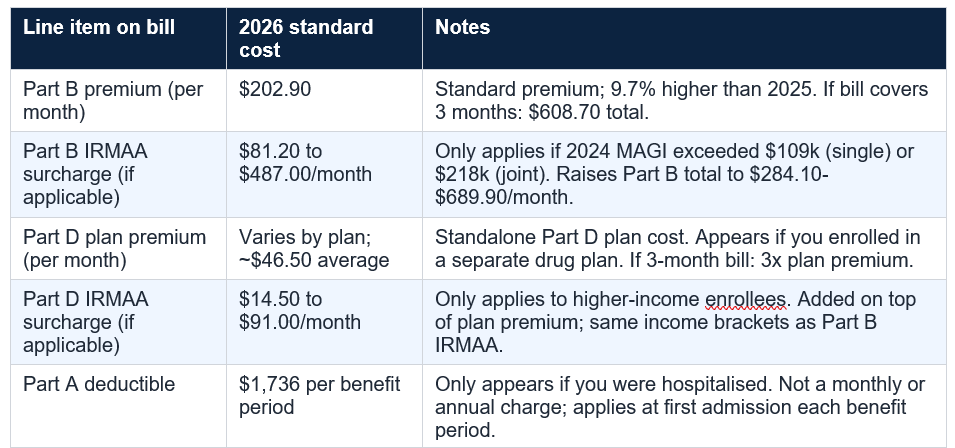
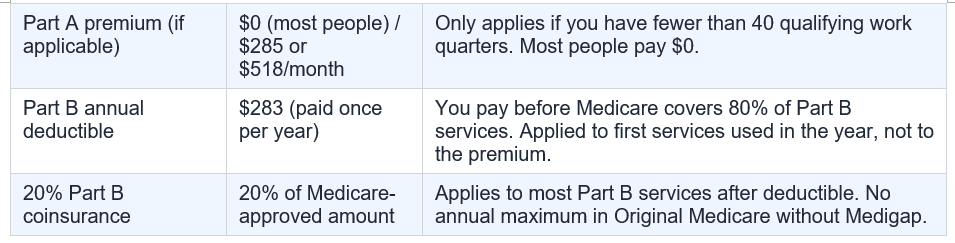
When your first Medicare bill arrives, it may include several distinct line items that combine into the total. Understanding what each line represents helps you verify the bill is correct and identify any unexpected charges.
Can You Appeal an IRMAA Surcharge?
Yes — but only under specific qualifying circumstances. The IRMAA surcharge can be appealed if your income has decreased due to a ‘life-changing event’ as defined by the Social Security Administration. An appeal allows you to ask the SSA to use more recent income information rather than the two-year-old MAGI that triggered the surcharge.The qualifying life-changing events for an IRMAA appeal using Form SSA-44 include: marriage, divorce or annulment, death of a spouse, work stoppage (including retirement), work reduction (reducing hours or pay), loss of income-producing property (such as a foreclosure or natural disaster affecting rental income), loss of employer pension, and certain employer pension terminations. GoodRx notes that ‘you can file an appeal to reduce or eliminate the IRMAA surcharge if you have had a life-changing event such as a divorce, deceased spouse, or reduced income.’
What does NOT qualify as a life-changing event for IRMAA appeal purposes: a Roth IRA conversion, a capital gain from selling an investment property, a one-time bonus, taking a Required Minimum Distribution, or a COLA on a pension. These income events are specifically excluded from the appeal pathway because they are considered voluntary or predictable. If your 2024 MAGI was elevated due solely to a Roth conversion or asset sale, you must pay the resulting 2026 IRMAA surcharge for the full year and plan more carefully around future year’s income to avoid repeating it.
The appeal process involves filing Form SSA-44 with the SSA. The form requires documentation of the life-changing event and proof of reduced income. The 60-day filing deadline from receipt of the IRMAA notice is strictly enforced. Federal Pension Advisors notes that ‘crossing an IRMAA threshold by just $1 can trigger the full surcharge for the next tier, costing you over $900 per person annually.’ For this reason, proactive income planning in the years before Medicare eligibility — particularly managing the timing of Roth conversions, RMDs, and asset sales — is among the highest-value financial planning activities for pre-retirees.
If you believe you qualify to appeal your IRMAA surcharge: (1) Obtain Form SSA-44 from your local Social Security Administration office or download from SSA.gov. (2) Document your life-changing event (retirement letter, death certificate, divorce decree, etc.). (3) Provide evidence of your more recent (lower) income. (4) File within 60 days of receiving your initial IRMAA notice. (5) Contact SSA at 1-800-772-1213 or visit ssa.gov for guidance. Not legal or financial advice. Consult a SHIP counsellor (free) or qualified Medicare adviser for assistance with your specific situation.
How to Reduce Your Medicare Costs Going Forward
Understanding what drives your Medicare bill is the first step; understanding what you can do about it is the second. Several legitimate strategies can reduce Medicare costs, though the right approach depends entirely on your individual circumstances and should be developed with a qualified adviser.- Manage MAGI before Medicare eligibility: the most powerful lever is planning income in the two years before Medicare enrolment. If you know you will be enrolling in Medicare in 2028 (for example), your 2026 income directly determines your 2028 premiums. Strategic choices about when to take Roth conversions, whether to delay or accelerate RMDs, and how to time capital gains can make the difference between standard and IRMAA-tier premiums. A 0% or 15% long-term capital gains year may be an ideal time for a Roth conversion that would otherwise push MAGI into IRMAA territory.
- Add Medigap (Medicare Supplement) insurance: Original Medicare’s 20% coinsurance on Part B has no annual maximum. A Medigap plan covers some or all of that 20%, as well as Part A deductibles and coinsurance. Medigap plans have their own premiums, but they convert unlimited liability exposure into a fixed monthly cost, which is valuable for budgeting and risk management. In most states, Medigap plans are standardised and labelled A through N.
- Consider Medicare Advantage: Medicare Advantage plans (Part C) replace Original Medicare with a private insurer’s plan that typically includes out-of-pocket maximums, often includes drug coverage, and may include dental and vision benefits not covered by Original Medicare. Premiums vary widely from $0 to $100+ per month; some plans are lower-cost than Original Medicare + Medigap + Part D. However, Medicare Advantage uses networks, prior authorisation, and referrals, which adds complexity relative to Original Medicare’s open-access model.
- Apply for Low Income Subsidy (LIS / Extra Help) for Part D: people with limited income and assets may qualify for the Extra Help programme, which reduces Part D premiums, deductibles, and copayments. Eligibility thresholds are updated annually. Contact the SSA or Medicare.gov to check eligibility.
- Check for state pharmaceutical assistance programmes: many states offer programs for Medicare beneficiaries with income above Extra Help levels but still facing high drug costs. SHIP counsellors can advise on state-specific options.
- Verify all charges and look for billing errors: Medicare bills, like all medical bills, can contain errors. Enrollees who receive Medicare Summary Notices (MSNs, the Medicare equivalent of an Explanation of Benefits) should review them for any charges for services not received or for services billed at incorrect rates.
Free Help: SHIP Counsellors and Medicare.gov
Navigating Medicare costs, plan options, IRMAA appeals, and Medigap choices is genuinely complex. The good news is that free, unbiased help is available from two primary sources.- State Health Insurance Assistance Programs (SHIP): SHIP provides free, objective, one-on-one counselling to Medicare beneficiaries and their families. SHIP counsellors are trained volunteers and staff who can help you understand your Medicare bills, compare plan options, identify eligibility for cost-saving programmes, and assist with IRMAA appeals. Every state has a SHIP office. Find your state’s SHIP at shiphelp.org or by calling 1-800-MEDICARE (1-800-633-4227).
- Medicare.gov: the official Medicare website provides comprehensive information on all parts of Medicare, current cost figures, plan comparison tools, the Medicare Plan Finder (for comparing Part D and Medicare Advantage plans), and information on supplemental coverage. The site is updated with current-year costs and can be used to verify any charge on your bill.
- 1-800-MEDICARE (1-800-633-4227): the national Medicare helpline is available 24 hours a day, 7 days a week. Representatives can explain charges on your bill, help set up direct payment arrangements, and provide information on IRMAA and appeals.
- Social Security Administration (SSA): for IRMAA-specific questions, the SSA administers the surcharge determination. Call 1-800-772-1213 or visit ssa.gov. For IRMAA appeals, the SSA is the correct agency to contact, not Medicare directly.
Conclusion
If your first Medicare bill was higher than expected, the most important thing to understand is that this is normal. It is experienced by the majority of new Medicare enrollees and is explained by a small number of specific, understandable factors: the three-month billing cycle for people not receiving Social Security; the 9.7% increase in the 2026 Part B premium to $202.90; the addition of Part D premiums to the same bill; and, for higher-income beneficiaries, the IRMAA surcharge triggered by 2024 income.The second most important thing is to verify the bill rather than simply pay it uncritically. Confirm the premium amount matches what CMS announced ($202.90 for standard Part B in 2026). Confirm that any IRMAA surcharge corresponds to your actual 2024 MAGI using the bracket table above. If you believe there is an error, or if your income has significantly decreased since 2024 due to a qualifying life-changing event, the appeal process via Form SSA-44 is available within 60 days of the notice.
The broader lesson is one of planning. Medicare costs are predictable, income-linked, and manageable with the right preparation. People who understand how IRMAA works — particularly the two-year lookback and the cliff system — can take strategic action in the years before Medicare eligibility to minimise premium exposure. Free help is available from SHIP counsellors in every state. Not medical, insurance, or financial advice.
Frequently Asked Questions
Why is my first Medicare bill so high?The most common reasons first Medicare bills are higher than expected: (1) The first bill typically covers three months of premiums at once, not one month. If you are not receiving Social Security benefits, Medicare bills you quarterly. At $202.90 per month for Part B in 2026, three months equals $608.70 for Part B alone. (2) IRMAA surcharge: if your 2024 MAGI exceeded $109,000 (individual) or $218,000 (joint), you pay more than the standard $202.90. IRMAA can raise your monthly Part B premium up to $689.90. (3) Part D plan premium is added to the same bill, potentially adding another $100-300 for three months. (4) The 2026 Part B premium increased 9.7% ($17.90) from 2025, making first-year 2026 bills higher than people who researched 2025 costs expected. Not financial or insurance advice. Source: CMS; Federal Pension Advisors; New Horizons Marketing.
What is the Medicare Part B premium in 2026?
The standard Medicare Part B monthly premium in 2026 is $202.90, up from $185.00 in 2025 — an increase of $17.90 (9.7%). This was announced by the Centers for Medicare & Medicaid Services (CMS) on November 14, 2025. About 8% of Part B enrollees pay more than $202.90 due to IRMAA (Income-Related Monthly Adjustment Amount) surcharges based on income above $109,000 (individual) or $218,000 (joint), as reported on their 2024 tax return. At the highest IRMAA tier (2024 MAGI above $500,000 individual / $750,000 joint), the 2026 Part B monthly premium is $689.90. The annual Part B deductible in 2026 is $283. Source: CMS; Healthcare Finance News; WFMJ; Ritter Insurance Marketing.
What is IRMAA and how does it affect my Medicare bill?
IRMAA (Income-Related Monthly Adjustment Amount) is a surcharge applied to Medicare Part B and Part D premiums for people whose income exceeds certain thresholds. In 2026, IRMAA applies if your 2024 Modified Adjusted Gross Income (MAGI) exceeded $109,000 (individual filer) or $218,000 (married filing jointly). IRMAA operates as a cliff system: exceeding a threshold by even $1 triggers the full surcharge for the next tier, which can cost over $900 per person annually in extra premiums. The 2026 Part B IRMAA surcharge ranges from $81.20 to $487.00 per month, raising the total Part B premium from $284.10 to $689.90. The 2026 Part D IRMAA surcharge ranges from $14.50 to $91.00 per month. IRMAA is determined by the SSA based on IRS income data from two years prior (the 'two-year lookback rule'). Source: CMS; NerdWallet; Federal Pension Advisors; Humana; GoodRx. Not financial or insurance advice.
Can I appeal my Medicare IRMAA surcharge?
Yes, in specific circumstances. You can appeal your IRMAA surcharge if your income has decreased due to a qualifying 'life-changing event' as defined by the Social Security Administration. Qualifying events include: retirement or work reduction, marriage, divorce, death of a spouse, loss of income-producing property, and loss of employer pension or significant reduction in pension. To appeal, complete Form SSA-44 and file it with the SSA within 60 days of receiving your IRMAA notice. A Roth IRA conversion, capital gain, one-time bonus, or Required Minimum Distribution does NOT qualify as a life-changing event for IRMAA appeal purposes. Source: GoodRx; Humana; Michael Ryan Money; Federal Pension Advisors. Not legal or insurance advice. Contact SSA at 1-800-772-1213 or ssa.gov.
What is the Medicare Part A deductible in 2026?
The Medicare Part A inpatient hospital deductible in 2026 is $1,736 per benefit period, up from $1,676 in 2025 (an increase of $60). This deductible applies to the first 60 days of a hospital stay within each benefit period. A benefit period begins on the first day you receive inpatient hospital care and ends when you have been out of a hospital or skilled nursing facility for 60 consecutive days. You could owe the $1,736 deductible multiple times in the same calendar year if you have multiple qualifying hospital admissions with 60+ day gaps between them. For days 61-90, you pay $434 per day coinsurance. For skilled nursing facility care, the first 20 days are covered in full; days 21-100 cost $217 per day. Most people do not pay a Part A premium if they or their spouse worked 40+ quarters. Source: CMS; New Horizons Marketing; Healthcare Finance News. Not insurance advice.

0 Comments Comments