
Real Estate
Do Mortgage Buydowns Save Buyers More Money Than Price Cuts?

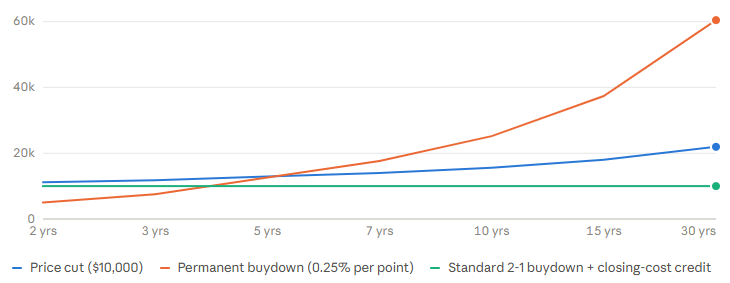
Freddie Mac 30-year fixed average: 6.36% (May 14), 6.95% (Sept 17), 7.03% (Sept 24), 7.28% (Oct 1), 7.40% (Oct 8 and Oct 15, 2026). A year earlier: about 6.3%. Example ($400,000 home, 20% down, 7.40%): a $10,000 price cut lowers the payment by about $55 a month; a permanent buydown by about $168 (at 0.25% per point); a 2-1 buydown by $419 in year one and $214 in year two. Savings versus no concession after 5 / 10 / 30 years: price cut $12,885 / $15,575 / $21,941; permanent buydown $12,589 / $25,195 / $60,460; 2-1 buydown $10,000 at every horizon. Break-even for permanent buydown versus price cut: roughly 5 to 7 years (illustrative). Builders: 13.8% of listings advertised reduced rates, averaging 3.92%, but the data includes temporary buydowns and adjustable-rate loans (August data, The Close, Sept 18, 2026).
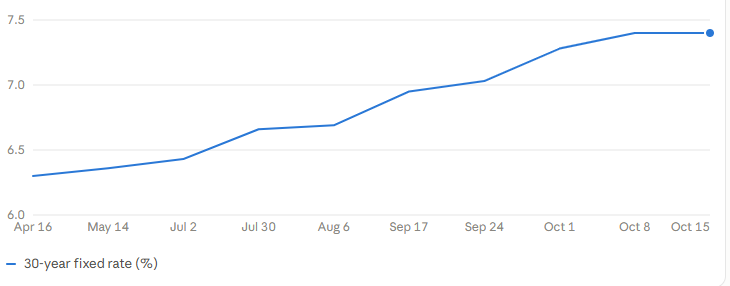
The timing is not an accident. Freddie Mac’s weekly average for a 30-year fixed mortgage hit 7.40% on October 15, up from 6.36% in mid-May, after the Federal Reserve raised interest rates on September 16. When a payment suddenly feels heavy, anything that lowers it looks attractive. So I ran the same $10,000 through three ways of spending it, using one consistent set of assumptions.
The numbers: Freddie Mac 30-year fixed: 6.36% (May 14) to 7.40% (Oct 15, 2026), an increase of about a full percentage point in five months. The 10-year Treasury was about 5.24% on October 12.
Seller concessions have limits that price cuts do not. Sources cited here say conventional loans allow up to 3% of the price with less than 10% down and up to 9% with more than 25% down, with a middle tier between. Concessions can pay for discount points, title insurance, prepaid costs or a temporary buydown.
A price cut’s $60 lasts every month of the loan. A 2-1 buydown’s $400 lasts twelve months, then falls by about half, then disappears. Comparing the biggest month of one to the permanent month of the other is comparing a sprint to a marathon. The fair question is total money over the time you actually hold the loan. That is what I calculated.
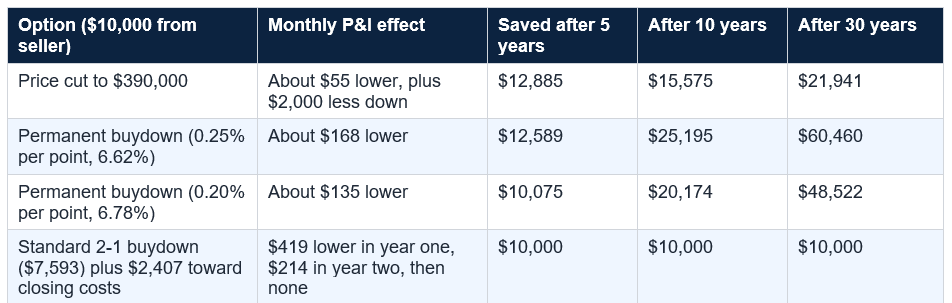
Look at the last row first. A temporary buydown is a prepayment of interest, so the savings equal the money spent, no more. Here a standard 2-1 costs about $7,593 and the remaining $2,407 can cover other costs, for exactly $10,000 of benefit. That can still be valuable if early cash flow is your constraint. But it is not a way of getting more than a dollar for a dollar.
That lines up with the rule of thumb one lender gives: if you plan to hold more than five to seven years, points usually win, and under three years, a price cut or temporary buydown usually does. My numbers back the rule with a specific example, though your own break-even depends on the rate reduction your lender actually quotes per point.
Worth knowing: A quick check on any points quote: divide the cost by the monthly payment saving. $10,000 divided by $168 is about 60 months, or five years. If you will likely move or refinance sooner, the points probably do not pay for themselves.
So the more likely you are to refinance, the more the arithmetic tilts toward the price cut or the temporary buydown, and the less it favors points. If you think this is your long-term rate, points get better. Nobody can reliably forecast rates, which is why the honest advice is to match your choice to how long you expect to keep the loan, not to a guess about the Fed.
It also assumes the seller will give $10,000 in either form. Sellers often prefer credits, since a credit can help preserve the home’s recorded value. That preference is negotiating leverage for you, not a reason to assume every seller will say yes.
One way to see it: a temporary buydown lowers your early payment without changing the underlying loan, while a price cut leaves you with a smaller mortgage and a lower payment after any subsidy ends. Both are legitimate. Just compare the payment you will actually be paying in year three.
With rates at 7.40% and a possible refinance on many buyers’ minds, the best choice is the one that matches how long you expect to hold the loan and how much cash flow you need now. Ask for clear numbers, compare year-three payments, and use a professional’s help for your specific loan. This is an illustration, not advice.
It depends on how long you will keep the loan. In my equal-cost example at a 7.40% rate, a permanent buydown beat a price cut after roughly five to seven years, while a price cut was better earlier. A price cut also keeps its value if you refinance, which points do not.
How much does a price cut lower my monthly payment?
Less than most people expect. On a $400,000 home with 20% down at 7.40%, a $10,000 price cut lowered principal-and-interest by about $55 a month in my calculation. Online sources quote roughly $40 to $94 a month per $10,000, depending on the rate and down payment they assume.
What is a 2-1 buydown?
It is a temporary buydown. The rate is cut by 2 points in year one and 1 point in year two, then returns to the full note rate in year three. A seller or builder typically funds an escrow account to cover the payment difference, so the total savings roughly equal the money put in.
How much does a seller concession cap at?
Limits depend on the loan type and down payment. Sources cited here say conventional loans allow up to 3% of the price with less than 10% down and up to 9% with more than 25% down, with a middle tier in between. Confirm the current limits with your lender.
Should I plan to refinance if rates fall?
Nobody knows where rates will go. If you expect to refinance, remember that points paid for a permanent buydown are lost when the old loan is paid off, while the lower balance from a price cut carries over to the new loan.
Total saved vs no concession, by years you keep the loan ($)
Total saved ($, nominal) by Years held (illustration: $400k home, 20% down, 7.40%)
Freddie Mac 30-year fixed mortgage rate, 2026 (%)
Rate (%) by Weekly survey date (2026)
Table of Contents
- The Question Everyone Is Asking at 7.40%
- Where Mortgage Rates Stand
- Three Ways to Spend the Same $10,000
- Why Online Comparisons Mislead
- The Head-to-Head Test
- The Break-Even: When Each Option Wins
- The Refinance Catch
- What the Math Leaves Out
- Builders and Sellers: What They Are Offering
- A Simple Decision Guide
- How to Negotiate
- Conclusion
- Frequently Asked Questions
The Question Everyone Is Asking at 7.40%
If you have toured a house lately, someone has probably said the magic words: rate buydown. A builder is offering one, a seller’s agent is hinting at one, a lender is pitching one. They all make the same claim, that a buydown is a smarter use of money than knocking the price down. Is it true? It can be, but not for the reasons most pitches give, and not for every buyer.The timing is not an accident. Freddie Mac’s weekly average for a 30-year fixed mortgage hit 7.40% on October 15, up from 6.36% in mid-May, after the Federal Reserve raised interest rates on September 16. When a payment suddenly feels heavy, anything that lowers it looks attractive. So I ran the same $10,000 through three ways of spending it, using one consistent set of assumptions.
Where Mortgage Rates Stand
The climb has been steady and recent. Freddie Mac’s survey showed 6.36% on May 14, 6.43% on July 2, 6.66% on July 30 and 6.69% on August 6. By September 17 it was 6.95%, then 7.03% a week later, the first reading above 7% since January 2025, according to Trading Economics. October 1 came in at 7.28%, versus 6.34% a year earlier. October 8 and October 15 both printed 7.40%. Freddie Mac’s survey describes conventional loans for borrowers with 20% down and excellent credit, so your own quote may differ.The numbers: Freddie Mac 30-year fixed: 6.36% (May 14) to 7.40% (Oct 15, 2026), an increase of about a full percentage point in five months. The 10-year Treasury was about 5.24% on October 12.
Three Ways to Spend the Same $10,000
Imagine a seller has agreed to give up $10,000. They can do it three ways. First, a price cut: the home sells for $390,000 instead of $400,000. Second, a permanent buydown: the money pays discount points at closing, lowering the rate for the whole loan. A common rule is that one point, 1% of the loan, lowers the rate by about 0.25%, though lenders price this differently and Opendoor’s guide says to compare Loan Estimates side by side. Third, a temporary buydown, such as a 2-1, where the rate is two points lower in year one and one point lower in year two before returning to the full rate.Seller concessions have limits that price cuts do not. Sources cited here say conventional loans allow up to 3% of the price with less than 10% down and up to 9% with more than 25% down, with a middle tier between. Concessions can pay for discount points, title insurance, prepaid costs or a temporary buydown.
Why Online Comparisons Mislead
Search for this topic and you will find confident claims. One lender says a $10,000 price cut saves roughly $60 a month while a 2-1 buydown on the same dollars can save $400 or more in year one. Another puts a $10,000 cut at $40 to $50. A real estate agent in Austin says $53 at 6.5%. These monthly figures are broadly consistent with each other. What is misleading is the comparison.A price cut’s $60 lasts every month of the loan. A 2-1 buydown’s $400 lasts twelve months, then falls by about half, then disappears. Comparing the biggest month of one to the permanent month of the other is comparing a sprint to a marathon. The fair question is total money over the time you actually hold the loan. That is what I calculated.
The Head-to-Head Test
Assumptions: a $400,000 home, 20% down, a 30-year fixed loan at 7.40% on a $320,000 balance, and $10,000 from the seller in each case. The baseline payment is about $2,216 a month for principal and interest. I measured each option by net cost: down payment plus all payments made plus the loan balance still owed at a chosen year, compared with doing nothing. That treats the home’s value as identical in every scenario, since the market does not care what you paid.Look at the last row first. A temporary buydown is a prepayment of interest, so the savings equal the money spent, no more. Here a standard 2-1 costs about $7,593 and the remaining $2,407 can cover other costs, for exactly $10,000 of benefit. That can still be valuable if early cash flow is your constraint. But it is not a way of getting more than a dollar for a dollar.
The Break-Even: When Each Option Wins
The price cut’s benefit grows slowly, because a smaller loan saves interest every month. Even so, it holds up well early: $12,885 after five years. The permanent buydown starts behind, since you pay the cost up front, and catches up with the price cut at around the five-to-seven-year mark. At 0.25% per point the crossover is about five years; at 0.20% per point it is closer to seven. After that the buydown pulls ahead decisively, to $25,195 at ten years and $60,460 over the full term, versus $15,575 and $21,941 for the price cut.That lines up with the rule of thumb one lender gives: if you plan to hold more than five to seven years, points usually win, and under three years, a price cut or temporary buydown usually does. My numbers back the rule with a specific example, though your own break-even depends on the rate reduction your lender actually quotes per point.
Worth knowing: A quick check on any points quote: divide the cost by the monthly payment saving. $10,000 divided by $168 is about 60 months, or five years. If you will likely move or refinance sooner, the points probably do not pay for themselves.
The Refinance Catch
This is the factor most pitches skip, and at 7.40% it may be the most important. Many buyers today plan to refinance if rates fall. A permanent buydown is tied to the loan it was bought for. If you refinance in three years, the points you paid go with the old loan. A price cut works the other way: the lower purchase price means a smaller balance, and that smaller balance follows you into any new loan. A temporary buydown has already delivered its savings in the first two years, so a later refinance costs it little.So the more likely you are to refinance, the more the arithmetic tilts toward the price cut or the temporary buydown, and the less it favors points. If you think this is your long-term rate, points get better. Nobody can reliably forecast rates, which is why the honest advice is to match your choice to how long you expect to keep the loan, not to a guess about the Fed.
What the Math Leaves Out
My comparison is deliberately simple, so here is what it omits. It ignores the time value of money: relief now is worth more than relief later, which helps temporary buydowns. It ignores taxes, since the deductibility of points and interest depends on your situation. It ignores property taxes, which in some places reset to the purchase price, and mortgage insurance on smaller down payments, which a lower price can also reduce. And it ignores appraisals, where a price cut can matter if a home is borderline.It also assumes the seller will give $10,000 in either form. Sellers often prefer credits, since a credit can help preserve the home’s recorded value. That preference is negotiating leverage for you, not a reason to assume every seller will say yes.
Builders and Sellers: What They Are Offering
Builders are leaning on financing incentives. The Close reported on September 18, 2026 that reduced mortgage rates appeared on 13.8% of listings in August data, with an average advertised rate of 3.92%, and that price reductions are also becoming more common. The important warning is that this data includes temporary buydowns and adjustable-rate loans, so an advertised rate may not apply for the full term. Ask whether it is temporary, adjustable or fixed for 30 years, and what the payment will be after the subsidy ends.One way to see it: a temporary buydown lowers your early payment without changing the underlying loan, while a price cut leaves you with a smaller mortgage and a lower payment after any subsidy ends. Both are legitimate. Just compare the payment you will actually be paying in year three.
A Simple Decision Guide
Here is a framework, not a recommendation. If you expect to stay at least seven years and do not plan to refinance, a permanent buydown looks strongest in my example. If you may refinance or sell within about five years, a price cut holds up well and keeps its value through a refinance. If your constraint is cash flow in the first two years, a temporary buydown solves that directly, though its total savings are limited to the credit. Run the numbers on your own loan before choosing.How to Negotiate
A few practical points. Ask the seller for a credit and decide how to use it later, because loan types have different rules for what a credit can pay. Get written Loan Estimates from more than one lender showing the cost of points and the resulting rate. Compare the payment in year three, not only year one. And remember that concessions are more likely on homes that have sat on the market, particularly after a price reduction, as one lender guide notes. No seller is required to offer anything. Do not lock in a decision on a buydown before your lender confirms, in writing, what the credit can legally pay for and what rate and payment result.Conclusion
Do rate buydowns save buyers more than price cuts? Sometimes. A permanent buydown can beat a price cut if you keep the loan long enough, and in my example the break-even was about five to seven years. A temporary buydown never returns more than the money behind it, though it can give valuable early relief. A price cut has the least dramatic monthly effect, but it works on day one, shrinks the loan for good and survives a refinance.With rates at 7.40% and a possible refinance on many buyers’ minds, the best choice is the one that matches how long you expect to hold the loan and how much cash flow you need now. Ask for clear numbers, compare year-three payments, and use a professional’s help for your specific loan. This is an illustration, not advice.
Frequently Asked Questions
Is a rate buydown or a price cut better right now?It depends on how long you will keep the loan. In my equal-cost example at a 7.40% rate, a permanent buydown beat a price cut after roughly five to seven years, while a price cut was better earlier. A price cut also keeps its value if you refinance, which points do not.
How much does a price cut lower my monthly payment?
Less than most people expect. On a $400,000 home with 20% down at 7.40%, a $10,000 price cut lowered principal-and-interest by about $55 a month in my calculation. Online sources quote roughly $40 to $94 a month per $10,000, depending on the rate and down payment they assume.
What is a 2-1 buydown?
It is a temporary buydown. The rate is cut by 2 points in year one and 1 point in year two, then returns to the full note rate in year three. A seller or builder typically funds an escrow account to cover the payment difference, so the total savings roughly equal the money put in.
How much does a seller concession cap at?
Limits depend on the loan type and down payment. Sources cited here say conventional loans allow up to 3% of the price with less than 10% down and up to 9% with more than 25% down, with a middle tier in between. Confirm the current limits with your lender.
Should I plan to refinance if rates fall?
Nobody knows where rates will go. If you expect to refinance, remember that points paid for a permanent buydown are lost when the old loan is paid off, while the lower balance from a price cut carries over to the new loan.
0 Comments
Be the first to share your thoughts on this article.