

Investing
Finance & Investing: Through a Lemonade Stand

Key Financial Concepts Covered: Capital; Equity; Debt; Revenue; Profit; Gross vs. Net Margin; Valuation; Return on Investment (ROI); Compounding; Risk; Diversification; Liquidity; Cash Flow; Balance Sheet; Income Statement; Market Timing; Passive vs. Active Investing; Reinvestment; Opportunity Cost; Partnership; Shares; Dividends; Exit Strategy.
Finance and investing have a reputation for being complicated. They are not. They are merely dressed in jargon that makes simple ideas seem inaccessible. Strip away the terminology, and every principle in personal finance — every concept that separates people who build wealth from people who do not — can be explained with two people, a folding table, some lemons, and a sunny afternoon.
Meet Alex and Jordan. Two friends who have decided to start a lemonade stand together. Their journey from their first cup sold to a thriving little enterprise will teach you every major concept in finance and investing: capital, equity, debt, profit, compounding, diversification, valuation, and more. By the time they are done, you will have the mental framework to understand not just lemonade stands but stock markets, bonds, business partnerships, retirement accounts, and the entire financial world that operates on exactly the same principles.
Let’s start at the beginning.
Capital is the money used to start and run a business or investment. Without capital, there is no business. Getting capital is the foundational challenge of every entrepreneurial and investment endeavour. There are two ways to get it, and they have different consequences.
The Lemonade Stand: Alex and Jordan need $50 to start. They have two options: borrow it or share ownership to raise it.
This choice — between borrowing and giving up ownership — is the same choice made by Amazon before its IPO, by a homebuyer choosing a mortgage versus a down payment, and by a government issuing bonds instead of raising taxes. The principles are identical. The scale is just different.
Debt is a promise. The borrower gets capital now in exchange for a commitment to repay later. Bonds work the same way: a company or government borrows money from investors, promises to pay regular interest (the coupon), and returns the principal at maturity. Mortgages, car loans, credit cards, and student loans are all debt.
Equity is ownership. When you buy a share of stock in a company, you are buying a small piece of its equity — a proportional claim on its assets and earnings. Shareholders are owners. Bondholders are lenders. This is the central distinction that underpins the entire financial world.
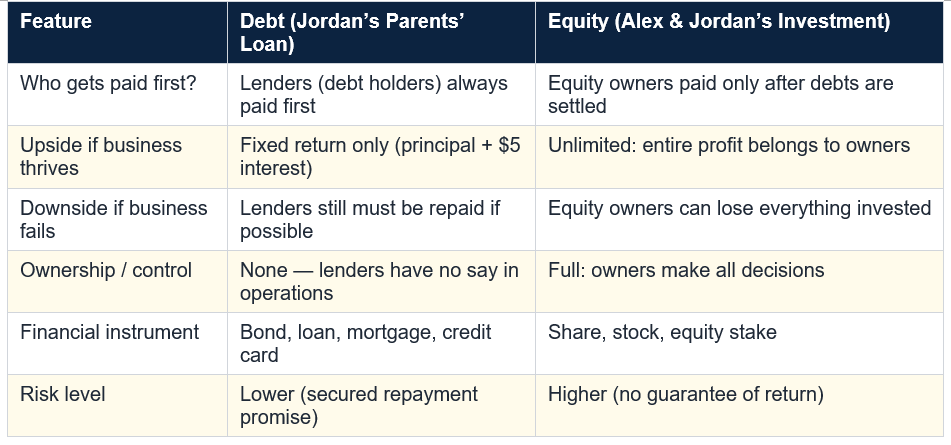
The Golden Rule of Capital Structure: Debt is always cheaper than equity because debt holders are paid first and face lower risk. Equity holders demand higher returns to compensate for higher risk. This is why stock markets historically return more than bond markets — equity investors bear more risk and are rewarded for it.
But revenue is not profit. To make 80 cups of lemonade, they spent $20 on lemons, $5 on sugar, and $3 on cups. Their cost of goods sold (COGS) is $28. Revenue minus COGS equals gross profit: $80 minus $28 equals $52 gross profit.
But wait: they also need to repay the $5 interest on the loan, $3 for the sign they bought, and $4 for the table rental. These are operating expenses. Gross profit minus operating expenses equals net profit: $52 minus $12 equals $40 net profit.
The Lemonade Stand: Revenue ($80) minus Costs ($28 COGS + $12 operating) equals Net Profit ($40). The stand is profitable. But by how much, proportionally?
The gross margin is gross profit divided by revenue: $52 divided by $80 equals 65 percent. The net margin is net profit divided by revenue: $40 divided by $80 equals 50 percent. These percentages tell you how efficiently the business converts sales into profit. A restaurant typically has a gross margin of 60 to 70 percent and a net margin of 3 to 9 percent. A software company might have a gross margin of 80 percent and a net margin of 20 to 30 percent. The lemonade stand, at 50 percent net margin, is a remarkably efficient business.
Return on Investment (ROI) equals the profit divided by the original investment, expressed as a percentage. Here: $75 profit divided by $25 invested equals 300 percent ROI in one month.
That is extraordinary. But ROI must always be considered in the context of time and risk. Three hundred percent in one month is better than 300 percent in ten years. And the same 300 percent return that looks brilliant in hindsight might have been -100 percent if it had rained every day and they sold nothing. The expected return of any investment must always be weighed against its risk.
The Rule of 72: Divide 72 by your annual return rate to estimate how long it takes to double your money. At 7% annual return (roughly the historical average of a diversified stock index): 72 ÷ 7 = approximately 10.3 years to double. At 10%: 7.2 years. At 1% (typical savings account): 72 years. This is why investment accounts grow dramatically faster than savings accounts over time.
Cash flow is the actual movement of money in and out of a business. Profit is what remains when you subtract costs from revenue on paper. A business can be profitable but fail because it runs out of cash. Cash is oxygen. A business can survive losing money for a period, but it cannot survive running out of cash. This is why investors look at both the income statement (profit) and the cash flow statement (actual cash movements) before making investment decisions.
In personal finance: you may be technically solvent (assets exceed liabilities) while experiencing a cash flow crisis because a big bill arrives before your paycheck. An emergency fund — typically three to six months of expenses in cash or liquid savings — is the personal equivalent of healthy business cash reserves. It solves cash flow problems before they become solvency problems.
Valuation is one of the most important and most debated concepts in all of finance. There are several methods:
The Lemonade Stand: Alex and Jordan decide the neighbour’s offer of $2,400 — equivalent to 5 years of earnings at current levels — is too low. They know demand is growing. They decline and keep building.
Every investment has risk. The question is never ‘how do I eliminate risk?’ The question is always ‘how do I understand, measure, and manage risk relative to the potential return?’
The main types of investment risk are:
Harry Markowitz, who won the Nobel Prize in Economics for developing modern portfolio theory, described diversification as the only free lunch in investing. By combining assets with different risk profiles and different responses to market conditions, you can reduce the overall risk of a portfolio without necessarily reducing its expected return.
The Lemonade Stand: Alex and Jordan open a second stand selling hot drinks in winter. Their total annual revenue is now more stable because the two products’ seasonal patterns offset each other. One stand makes money in summer. The other makes money in winter. Together, they smooth out the income curve.
In investment portfolios, diversification works the same way. Combining domestic stocks, international stocks, bonds, real estate, and cash creates a portfolio where the decline of any single asset class is partially offset by the performance of others. A 2022 investor in a 100 percent US stock portfolio fell 18 percent. A diversified 60/40 investor fell 17.5 percent. An investor with international diversification fell less. Diversification does not eliminate losses. It reduces their severity.
Albert Einstein is often (perhaps apocryphally) credited with calling compound interest the eighth wonder of the world. The principle is simple: when your returns generate their own returns, the growth curve becomes exponential rather than linear. The longer the timeframe, the more dramatic the effect.
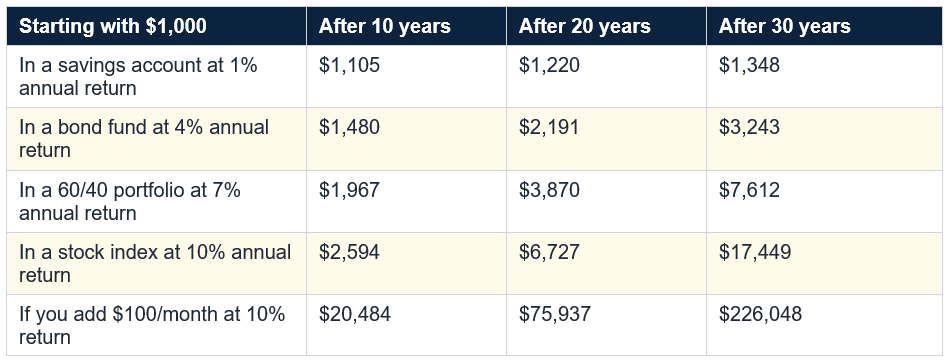
The bottom row of the table is the most important: the combination of consistent contributions and compounding returns over 30 years turns $100 per month into over $226,000. Not because of exceptional investment performance or extraordinary insight. Simply because of time and consistency. This is why every financial adviser, every research study, and every wealth statistics analysis consistently identifies starting early as the single most impactful wealth-building decision an individual can make.
The investors who buy shares become part-owners. Each share gives them a claim on 1 percent of the business’s profits and 1 percent of its value if it is ever sold. This is exactly how stock markets work. When you buy a share of Apple, Microsoft, or any publicly traded company, you are buying a small proportional claim on that company’s earnings, assets, and future.
At the end of a profitable quarter, Alex and Jordan decide to distribute some of the profit to shareholders. They pay $0.50 per share — a dividend. An investor who owns 10 shares receives $5. This is passive income. You do not have to pour lemonade to receive a dividend. You simply have to own the share. Dividend-paying stocks and funds work identically: you hold the shares, the company generates profit, and a portion is distributed to you on a regular schedule.
The Lemonade Stand: Owning shares in the lemonade stand means you get paid when the stand does well, even if you never visit it. This is the core appeal of equity investing: your money earns money without your active participation.
Active investing is like Alex’s approach to the broader market: researching individual stocks, buying and selling based on analysis, attempting to identify winners before the market does. It requires significant time, expertise, and judgment. Most professional active fund managers, with all their resources and research teams, fail to consistently outperform a simple index fund over the long term.
Passive investing is like Jordan’s approach: buy a diversified index fund, hold it, reinvest dividends, and let the market do its work over time. Index funds track a broad market index (like the S&P 500) at minimal cost. According to S&P’s SPIVA Report, approximately 85 to 90 percent of active fund managers underperform their benchmark index over 15-year periods. The evidence for passive, low-cost index investing is the strongest empirical finding in retail investment research.
This is the market timing problem in miniature. Investors who try to predict when markets will fall (to sell) and when they will recover (to buy back in) almost universally fail to do so consistently. The cost of being wrong on timing is severe: as JPMorgan Asset Management’s research consistently shows, missing just the ten best trading days in any decade eliminates approximately 80 percent of that decade’s total return — and those ten best days cluster immediately after the worst days.
The investor who sold during COVID-19’s worst market days in March 2020 locked in a real loss. The S&P 500 recovered to its pre-COVID level within five months and ended 2020 up 16 percent. The investor who stayed invested captured that recovery. The one who tried to time the bottom did not.
Time in the market beats timing the market. The best investment strategy for most investors is also the simplest: invest in a diversified index fund, automate contributions, reinvest dividends, and do not sell when markets fall. Boring, consistent, long-term ownership is statistically the most effective approach.
The Lemonade Stand: The lemonade stand at month one: Assets: $100 cash, $20 supplies. Liabilities: $55 (loan repayment due). Equity = $120 - $55 = $65. That $65 is what Alex and Jordan actually own.
In personal finance, your personal balance sheet works identically. Your assets are your home, investments, savings, and other property. Your liabilities are your mortgage, student loans, car loans, and credit card balances. Assets minus liabilities equals your net worth. Building wealth means growing assets faster than liabilities. The income statement equivalent for an individual is your monthly budget: income minus expenses equals savings or deficit.
They negotiate a sale price of $8,640 — four years of current annual earnings, which seems fair given the business is growing. After splitting the proceeds and deducting their original investments, Alex and Jordan each walk away with approximately $4,000 from a $25 investment. That is a 15,900 percent return over 18 months.
The exit strategy — the planned method of selling an investment or business position — is a fundamental part of any investment decision. Knowing when and how you will exit shapes what you buy and how you manage it. In personal investing, common exit strategies include: selling when a stock reaches your target price (price discipline); selling after a fixed holding period (time discipline); selling to rebalance a portfolio back to target allocations; or selling assets in retirement to fund living expenses (a systematic drawdown plan).
The worst exit strategy is no strategy: selling in panic during a market downturn, or holding indefinitely because selling triggers a difficult decision. Smart investors define their exit criteria before they enter, not after.
Every financial concept in this article — capital, equity, debt, profit, cash flow, valuation, risk, diversification, compounding, dividends, passive income, and exit strategy — operates at the same fundamental level whether the business is a lemonade stand generating $40 a month or a technology company generating $40 billion a quarter. The scale differs. The principles are identical.
The smartest investment decision Alex and Jordan made was not which flavour of lemonade to sell, or when to open, or how to price their product. The smartest decision they made was to start. To put in the $25, accept the risk, and begin the compounding process. Every additional day they waited to start was a day of potential compounding they sacrificed.
Your financial life works the same way. The concepts are simple. The mathematics are accessible. The evidence on what works is clear. The only thing between where you are and where you want to be is the decision to start — and then to stay consistent long enough for compounding to do what it always does, given enough time.
Equity is ownership. When you own equity in a business, you own a share of its assets and profits. Your return depends on how well the business performs; there is no guaranteed payment. Debt is a loan. When you hold debt (like a bond), you are owed a fixed repayment of principal plus interest on a schedule, regardless of the business’s performance. Debt holders are paid before equity holders; equity holders take on more risk but have unlimited upside potential.
What is compound interest and why does it matter?
Compound interest is interest earned on both the original principal and the previously accumulated interest. When you invest $1,000 at 10% annual return and reinvest each year’s gain, you earn $100 in year one, $110 in year two (10% on $1,100), $121 in year three, and so on. Over 30 years, the same $1,000 grows to $17,449. Without compounding (simple interest), it would be $4,000. The difference is $13,449 of compound growth. This is why starting to invest early is the single most impactful financial decision most people can make.
What is an income statement and a balance sheet?
An income statement shows a business’s financial performance over a period of time: revenue minus costs equals profit. It tells you whether the business is making or losing money. A balance sheet shows what a business owns (assets) and owes (liabilities) at a specific point in time; the difference is equity (the owners’ stake). For individuals: your income statement is your monthly budget (income minus expenses), and your balance sheet is your personal net worth (assets minus liabilities).
What is diversification and why is it important?
Diversification means spreading investments across different assets, industries, geographies, and asset types so that a decline in any single investment does not devastate the whole portfolio. When the lemonade stand had a rainy week, the stand lost revenue. But if Alex and Jordan had also invested in an umbrella company, that investment would have gained value in the same rainy week. Diversification reduces concentration risk — the risk of having all your financial eggs in one basket.
What is the difference between active and passive investing?
Active investing involves researching and selecting individual stocks or assets, buying and selling frequently, and attempting to outperform the market. Passive investing means buying a broad market index fund and holding it for the long term with minimal trading. S&P’s SPIVA data consistently shows that approximately 85–90% of active fund managers underperform their benchmark index over 15-year periods. For most individual investors, low-cost passive index fund investing produces better long-term outcomes than active stock picking.
What is an exit strategy in investing?
An exit strategy is the planned method for selling an investment. It could be a target price (sell when the stock reaches $X), a time horizon (hold for 10 years then reassess), a rebalancing trigger (sell when any asset class exceeds a target percentage), or a systematic retirement drawdown plan. Defining your exit strategy before you invest helps prevent emotional, panic-driven selling during market downturns — which is one of the most common and most costly investor mistakes.
What is the minimum I need to start investing?
There is no minimum. Most major brokerages — Fidelity, Schwab, Vanguard — have $0 account minimums and offer fractional shares that allow investment from $1. Many 401(k) plans allow contributions starting with the first dollar of paycheck. The question is not what the minimum is. The question is how much of your regular income you can automate into investing, starting now, so that compounding has the maximum time to work. Alex and Jordan started with $25 each. It became $4,000+ in 18 months. Starting is the most important step.
Table of Contents
- Why a Lemonade Stand Teaches You Everything
- Capital: Where Does the Money to Start Come From?
- Equity and Debt: Two Ways to Fund Anything
- Revenue, Cost, and Profit: The Three Numbers That Matter
- Return on Investment (ROI): Was It Worth It?
- Cash Flow vs. Profit: They Are Not the Same Thing
- Valuation: What Is the Business Actually Worth?
- Risk: The Hidden Price Tag on Every Decision
- Diversification: Why One Lemonade Stand Is Never Enough
- Compounding: The Magic That Changes Everything
- Shares, Dividends, and Equity Ownership
- Passive vs. Active Investing: The Lemonade Stand You Don’t Run
- Market Timing vs. Time in the Market
- The Balance Sheet and Income Statement Explained
- Exit Strategy: Knowing When to Sell
- Conclusion: Every Business Is a Lemonade Stand
- Frequently Asked Questions
- External References and Further Reading
Why a Lemonade Stand Teaches You Everything
Finance and investing have a reputation for being complicated. They are not. They are merely dressed in jargon that makes simple ideas seem inaccessible. Strip away the terminology, and every principle in personal finance — every concept that separates people who build wealth from people who do not — can be explained with two people, a folding table, some lemons, and a sunny afternoon.Meet Alex and Jordan. Two friends who have decided to start a lemonade stand together. Their journey from their first cup sold to a thriving little enterprise will teach you every major concept in finance and investing: capital, equity, debt, profit, compounding, diversification, valuation, and more. By the time they are done, you will have the mental framework to understand not just lemonade stands but stock markets, bonds, business partnerships, retirement accounts, and the entire financial world that operates on exactly the same principles.
Let’s start at the beginning.
Capital: Where Does the Money to Start Come From?
Alex and Jordan want to start their lemonade stand. They need supplies: lemons, sugar, a pitcher, cups, a folding table, and a sign. Total startup cost: $50. They do not have $50. This is the first problem that every business — from a lemonade stand to Apple — must solve. It is the question of capital.Capital is the money used to start and run a business or investment. Without capital, there is no business. Getting capital is the foundational challenge of every entrepreneurial and investment endeavour. There are two ways to get it, and they have different consequences.
The Lemonade Stand: Alex and Jordan need $50 to start. They have two options: borrow it or share ownership to raise it.
This choice — between borrowing and giving up ownership — is the same choice made by Amazon before its IPO, by a homebuyer choosing a mortgage versus a down payment, and by a government issuing bonds instead of raising taxes. The principles are identical. The scale is just different.
Equity and Debt: Two Ways to Fund Anything
Option A: Debt
Jordan asks her parents to lend the stand $50, to be repaid with $5 interest after one month. The stand now owes $55. This is debt financing. The stand gets the money it needs immediately. In exchange, it promises to pay back the principal plus interest on a fixed schedule. The parents do not own any part of the lemonade stand. They have no say in how it is run. They just get their $55 back whether the stand makes money or not.Debt is a promise. The borrower gets capital now in exchange for a commitment to repay later. Bonds work the same way: a company or government borrows money from investors, promises to pay regular interest (the coupon), and returns the principal at maturity. Mortgages, car loans, credit cards, and student loans are all debt.
Option B: Equity
Alex and Jordan each contribute $25 of their own money. They own the business equally — 50/50. This is equity financing. Each partner has a claim on 50 percent of the business’s value and 50 percent of its profits. If the business fails, they lose their $25. If it succeeds spectacularly, they each keep half of the success. There is no debt, no interest payment, and no repayment obligation.Equity is ownership. When you buy a share of stock in a company, you are buying a small piece of its equity — a proportional claim on its assets and earnings. Shareholders are owners. Bondholders are lenders. This is the central distinction that underpins the entire financial world.
The Golden Rule of Capital Structure: Debt is always cheaper than equity because debt holders are paid first and face lower risk. Equity holders demand higher returns to compensate for higher risk. This is why stock markets historically return more than bond markets — equity investors bear more risk and are rewarded for it.
Revenue, Cost, and Profit: The Three Numbers That Matter
The stand opens. Alex and Jordan sell lemonade at $1 per cup. On their first day, they sell 80 cups. Their revenue — the total money earned from sales — is $80.But revenue is not profit. To make 80 cups of lemonade, they spent $20 on lemons, $5 on sugar, and $3 on cups. Their cost of goods sold (COGS) is $28. Revenue minus COGS equals gross profit: $80 minus $28 equals $52 gross profit.
But wait: they also need to repay the $5 interest on the loan, $3 for the sign they bought, and $4 for the table rental. These are operating expenses. Gross profit minus operating expenses equals net profit: $52 minus $12 equals $40 net profit.
The Lemonade Stand: Revenue ($80) minus Costs ($28 COGS + $12 operating) equals Net Profit ($40). The stand is profitable. But by how much, proportionally?
The gross margin is gross profit divided by revenue: $52 divided by $80 equals 65 percent. The net margin is net profit divided by revenue: $40 divided by $80 equals 50 percent. These percentages tell you how efficiently the business converts sales into profit. A restaurant typically has a gross margin of 60 to 70 percent and a net margin of 3 to 9 percent. A software company might have a gross margin of 80 percent and a net margin of 20 to 30 percent. The lemonade stand, at 50 percent net margin, is a remarkably efficient business.
Return on Investment (ROI): Was It Worth It?
Alex and Jordan each invested $25. At the end of the first month, after repaying the loan, paying all costs, and splitting the remaining profit, they each receive $100 net. Their initial $25 investment returned $100, a profit of $75 each.Return on Investment (ROI) equals the profit divided by the original investment, expressed as a percentage. Here: $75 profit divided by $25 invested equals 300 percent ROI in one month.
That is extraordinary. But ROI must always be considered in the context of time and risk. Three hundred percent in one month is better than 300 percent in ten years. And the same 300 percent return that looks brilliant in hindsight might have been -100 percent if it had rained every day and they sold nothing. The expected return of any investment must always be weighed against its risk.
The Rule of 72: Divide 72 by your annual return rate to estimate how long it takes to double your money. At 7% annual return (roughly the historical average of a diversified stock index): 72 ÷ 7 = approximately 10.3 years to double. At 10%: 7.2 years. At 1% (typical savings account): 72 years. This is why investment accounts grow dramatically faster than savings accounts over time.
Cash Flow vs. Profit: They Are Not the Same Thing
The stand is profitable. But in week two, Alex and Jordan pre-order a large batch of lemons for a big community event — paying $40 in advance. Their cash on hand drops below zero before the event generates any revenue. The stand is technically profitable but temporarily cash-strapped. This is the difference between profit and cash flow.Cash flow is the actual movement of money in and out of a business. Profit is what remains when you subtract costs from revenue on paper. A business can be profitable but fail because it runs out of cash. Cash is oxygen. A business can survive losing money for a period, but it cannot survive running out of cash. This is why investors look at both the income statement (profit) and the cash flow statement (actual cash movements) before making investment decisions.
In personal finance: you may be technically solvent (assets exceed liabilities) while experiencing a cash flow crisis because a big bill arrives before your paycheck. An emergency fund — typically three to six months of expenses in cash or liquid savings — is the personal equivalent of healthy business cash reserves. It solves cash flow problems before they become solvency problems.
Valuation: What Is the Business Actually Worth?
After three months, the lemonade stand is consistently generating $40 in monthly net profit. A neighbour offers to buy the entire business from Alex and Jordan. What is it worth?Valuation is one of the most important and most debated concepts in all of finance. There are several methods:
Price-to-Earnings Multiple (P/E)
If businesses like the lemonade stand typically sell for 12 times their annual earnings, and the stand earns $480 per year ($40 x 12 months), then the valuation would be $480 x 12 equals $5,760. The multiple (12 in this case) represents how many years of earnings a buyer is willing to pay upfront, reflecting confidence in the business’s durability and growth prospects. The S&P 500’s historical average P/E ratio is approximately 15 to 16.Discounted Cash Flow (DCF)
A DCF analysis projects future cash flows and discounts them back to their present value, accounting for the fact that money today is worth more than money in the future. If the stand will generate $40 per month for the next two years before the partners move away, the present value of those 24 cash flows — discounted at a reasonable rate — represents the business’s intrinsic value. This is the method Warren Buffett famously uses.The Lemonade Stand: Alex and Jordan decide the neighbour’s offer of $2,400 — equivalent to 5 years of earnings at current levels — is too low. They know demand is growing. They decline and keep building.
Risk: The Hidden Price Tag on Every Decision
The lemonade stand faces risks that Alex and Jordan have to manage. What happens if it rains for a week? What if a competitor opens a stand three doors down? What if the price of lemons spikes because of a drought? What if a customer slips on a puddle near the stand and sues?Every investment has risk. The question is never ‘how do I eliminate risk?’ The question is always ‘how do I understand, measure, and manage risk relative to the potential return?’
The main types of investment risk are:
- Market risk: the overall market falls, dragging all investments down with it. The lemonade stand equivalent: a recession means fewer people are buying treats.
- Business risk (unsystematic risk): a specific business fails while others succeed. The lemonade stand equivalent: a competitor opens nearby and takes your customers.
- Liquidity risk: you cannot sell your investment when you need cash. The lemonade stand equivalent: you cannot quickly sell a profitable stand because no buyer is immediately available.
- Concentration risk: all your money is in one investment. If the lemonade stand fails, Alex and Jordan lose everything. Diversification eliminates this risk.
- Inflation risk: your returns do not keep pace with rising prices. Money in a jar under a bed loses purchasing power every year. Even 1 percent annual returns may be negative in real terms during periods of 3 to 4 percent inflation.
Diversification: Why One Lemonade Stand Is Never Enough
After a rainy month wipes out the lemonade stand’s revenue, Alex has a revelation: if they had also been selling hot chocolate, rainy days would have been their best days. This is diversification — the practice of spreading investments across assets that do not all move in the same direction at the same time.Harry Markowitz, who won the Nobel Prize in Economics for developing modern portfolio theory, described diversification as the only free lunch in investing. By combining assets with different risk profiles and different responses to market conditions, you can reduce the overall risk of a portfolio without necessarily reducing its expected return.
The Lemonade Stand: Alex and Jordan open a second stand selling hot drinks in winter. Their total annual revenue is now more stable because the two products’ seasonal patterns offset each other. One stand makes money in summer. The other makes money in winter. Together, they smooth out the income curve.
In investment portfolios, diversification works the same way. Combining domestic stocks, international stocks, bonds, real estate, and cash creates a portfolio where the decline of any single asset class is partially offset by the performance of others. A 2022 investor in a 100 percent US stock portfolio fell 18 percent. A diversified 60/40 investor fell 17.5 percent. An investor with international diversification fell less. Diversification does not eliminate losses. It reduces their severity.
Compounding: The Magic That Changes Everything
Alex and Jordan make $40 profit in month one. Instead of spending it, they reinvest it — buying more supplies, expanding the stand’s capacity. In month two, they can now serve more customers and generate $52 in profit. In month three: $67. The profits are growing not because the business is changing but because the previous profits are now generating their own profits. This is compounding.Albert Einstein is often (perhaps apocryphally) credited with calling compound interest the eighth wonder of the world. The principle is simple: when your returns generate their own returns, the growth curve becomes exponential rather than linear. The longer the timeframe, the more dramatic the effect.
The bottom row of the table is the most important: the combination of consistent contributions and compounding returns over 30 years turns $100 per month into over $226,000. Not because of exceptional investment performance or extraordinary insight. Simply because of time and consistency. This is why every financial adviser, every research study, and every wealth statistics analysis consistently identifies starting early as the single most impactful wealth-building decision an individual can make.
Shares, Dividends, and Equity Ownership
The lemonade stand is going so well that Alex and Jordan want to expand to three locations. They need $300. They decide to sell ownership stakes to friends and family. They divide the business into 100 shares and sell 30 of them at $10 each, raising $300 while retaining 70 percent ownership.The investors who buy shares become part-owners. Each share gives them a claim on 1 percent of the business’s profits and 1 percent of its value if it is ever sold. This is exactly how stock markets work. When you buy a share of Apple, Microsoft, or any publicly traded company, you are buying a small proportional claim on that company’s earnings, assets, and future.
At the end of a profitable quarter, Alex and Jordan decide to distribute some of the profit to shareholders. They pay $0.50 per share — a dividend. An investor who owns 10 shares receives $5. This is passive income. You do not have to pour lemonade to receive a dividend. You simply have to own the share. Dividend-paying stocks and funds work identically: you hold the shares, the company generates profit, and a portion is distributed to you on a regular schedule.
The Lemonade Stand: Owning shares in the lemonade stand means you get paid when the stand does well, even if you never visit it. This is the core appeal of equity investing: your money earns money without your active participation.
Passive vs. Active Investing: The Lemonade Stand You Don't Run
Alex is actively involved in running the stand: sourcing lemons, managing the stand, training new staff, developing new flavours. Jordan is more passive: she contributed her $25, attends monthly meetings, and receives her share of the profits without handling the day-to-day.Active investing is like Alex’s approach to the broader market: researching individual stocks, buying and selling based on analysis, attempting to identify winners before the market does. It requires significant time, expertise, and judgment. Most professional active fund managers, with all their resources and research teams, fail to consistently outperform a simple index fund over the long term.
Passive investing is like Jordan’s approach: buy a diversified index fund, hold it, reinvest dividends, and let the market do its work over time. Index funds track a broad market index (like the S&P 500) at minimal cost. According to S&P’s SPIVA Report, approximately 85 to 90 percent of active fund managers underperform their benchmark index over 15-year periods. The evidence for passive, low-cost index investing is the strongest empirical finding in retail investment research.
Market Timing vs. Time in the Market
One rainy week, the lemonade stand closes. Alex panics: what if summer ends early? What if no one ever buys lemonade again? Alex wants to close the stand permanently. Jordan says: “Alex, rain is temporary. Summer always comes back. If we close now, we miss the rest of the season.”This is the market timing problem in miniature. Investors who try to predict when markets will fall (to sell) and when they will recover (to buy back in) almost universally fail to do so consistently. The cost of being wrong on timing is severe: as JPMorgan Asset Management’s research consistently shows, missing just the ten best trading days in any decade eliminates approximately 80 percent of that decade’s total return — and those ten best days cluster immediately after the worst days.
The investor who sold during COVID-19’s worst market days in March 2020 locked in a real loss. The S&P 500 recovered to its pre-COVID level within five months and ended 2020 up 16 percent. The investor who stayed invested captured that recovery. The one who tried to time the bottom did not.
Time in the market beats timing the market. The best investment strategy for most investors is also the simplest: invest in a diversified index fund, automate contributions, reinvest dividends, and do not sell when markets fall. Boring, consistent, long-term ownership is statistically the most effective approach.
The Balance Sheet and Income Statement Explained
Every business — and, metaphorically, every individual — has two fundamental financial documents:The Income Statement
The income statement tells you what the business earned and what it spent over a period of time. Revenue minus costs equals profit. It is a movie: it shows performance over time. For the lemonade stand: revenue $80, costs $40, profit $40. Simple.The Balance Sheet
The balance sheet tells you what the business owns and what it owes at a specific point in time. Assets minus liabilities equals equity (the owners’ stake). It is a photograph: it captures a moment.The Lemonade Stand: The lemonade stand at month one: Assets: $100 cash, $20 supplies. Liabilities: $55 (loan repayment due). Equity = $120 - $55 = $65. That $65 is what Alex and Jordan actually own.
In personal finance, your personal balance sheet works identically. Your assets are your home, investments, savings, and other property. Your liabilities are your mortgage, student loans, car loans, and credit card balances. Assets minus liabilities equals your net worth. Building wealth means growing assets faster than liabilities. The income statement equivalent for an individual is your monthly budget: income minus expenses equals savings or deficit.
Exit Strategy: Knowing When to Sell
After 18 months, the lemonade stand has become a genuine business. Alex is heading to college. Jordan is moving cities. They decide to sell. Their neighbour, who made that low offer earlier, is still interested. Alex and Jordan have built the business significantly since then: three locations, a loyal customer base, and consistent monthly profits of $180 total.They negotiate a sale price of $8,640 — four years of current annual earnings, which seems fair given the business is growing. After splitting the proceeds and deducting their original investments, Alex and Jordan each walk away with approximately $4,000 from a $25 investment. That is a 15,900 percent return over 18 months.
The exit strategy — the planned method of selling an investment or business position — is a fundamental part of any investment decision. Knowing when and how you will exit shapes what you buy and how you manage it. In personal investing, common exit strategies include: selling when a stock reaches your target price (price discipline); selling after a fixed holding period (time discipline); selling to rebalance a portfolio back to target allocations; or selling assets in retirement to fund living expenses (a systematic drawdown plan).
The worst exit strategy is no strategy: selling in panic during a market downturn, or holding indefinitely because selling triggers a difficult decision. Smart investors define their exit criteria before they enter, not after.
Conclusion
Apple is a lemonade stand with better branding. Amazon is a lemonade stand that chose to reinvest every dollar of profit for twenty years before paying dividends. Your 401(k) is a piggy bank where the lemons compound into an orchard over time. Your mortgage is Jordan’s parents’ loan, extended to thirty years on a much larger table.Every financial concept in this article — capital, equity, debt, profit, cash flow, valuation, risk, diversification, compounding, dividends, passive income, and exit strategy — operates at the same fundamental level whether the business is a lemonade stand generating $40 a month or a technology company generating $40 billion a quarter. The scale differs. The principles are identical.
The smartest investment decision Alex and Jordan made was not which flavour of lemonade to sell, or when to open, or how to price their product. The smartest decision they made was to start. To put in the $25, accept the risk, and begin the compounding process. Every additional day they waited to start was a day of potential compounding they sacrificed.
Your financial life works the same way. The concepts are simple. The mathematics are accessible. The evidence on what works is clear. The only thing between where you are and where you want to be is the decision to start — and then to stay consistent long enough for compounding to do what it always does, given enough time.
17. Frequently Asked Questions
What is the difference between equity and debt?Equity is ownership. When you own equity in a business, you own a share of its assets and profits. Your return depends on how well the business performs; there is no guaranteed payment. Debt is a loan. When you hold debt (like a bond), you are owed a fixed repayment of principal plus interest on a schedule, regardless of the business’s performance. Debt holders are paid before equity holders; equity holders take on more risk but have unlimited upside potential.
What is compound interest and why does it matter?
Compound interest is interest earned on both the original principal and the previously accumulated interest. When you invest $1,000 at 10% annual return and reinvest each year’s gain, you earn $100 in year one, $110 in year two (10% on $1,100), $121 in year three, and so on. Over 30 years, the same $1,000 grows to $17,449. Without compounding (simple interest), it would be $4,000. The difference is $13,449 of compound growth. This is why starting to invest early is the single most impactful financial decision most people can make.
What is an income statement and a balance sheet?
An income statement shows a business’s financial performance over a period of time: revenue minus costs equals profit. It tells you whether the business is making or losing money. A balance sheet shows what a business owns (assets) and owes (liabilities) at a specific point in time; the difference is equity (the owners’ stake). For individuals: your income statement is your monthly budget (income minus expenses), and your balance sheet is your personal net worth (assets minus liabilities).
What is diversification and why is it important?
Diversification means spreading investments across different assets, industries, geographies, and asset types so that a decline in any single investment does not devastate the whole portfolio. When the lemonade stand had a rainy week, the stand lost revenue. But if Alex and Jordan had also invested in an umbrella company, that investment would have gained value in the same rainy week. Diversification reduces concentration risk — the risk of having all your financial eggs in one basket.
What is the difference between active and passive investing?
Active investing involves researching and selecting individual stocks or assets, buying and selling frequently, and attempting to outperform the market. Passive investing means buying a broad market index fund and holding it for the long term with minimal trading. S&P’s SPIVA data consistently shows that approximately 85–90% of active fund managers underperform their benchmark index over 15-year periods. For most individual investors, low-cost passive index fund investing produces better long-term outcomes than active stock picking.
What is an exit strategy in investing?
An exit strategy is the planned method for selling an investment. It could be a target price (sell when the stock reaches $X), a time horizon (hold for 10 years then reassess), a rebalancing trigger (sell when any asset class exceeds a target percentage), or a systematic retirement drawdown plan. Defining your exit strategy before you invest helps prevent emotional, panic-driven selling during market downturns — which is one of the most common and most costly investor mistakes.
What is the minimum I need to start investing?
There is no minimum. Most major brokerages — Fidelity, Schwab, Vanguard — have $0 account minimums and offer fractional shares that allow investment from $1. Many 401(k) plans allow contributions starting with the first dollar of paycheck. The question is not what the minimum is. The question is how much of your regular income you can automate into investing, starting now, so that compounding has the maximum time to work. Alex and Jordan started with $25 each. It became $4,000+ in 18 months. Starting is the most important step.
0 Comments
Be the first to share your thoughts on this article.