

Taxes
Got a Tax Refund Coming? Match It to the Goal You’ve Delayed

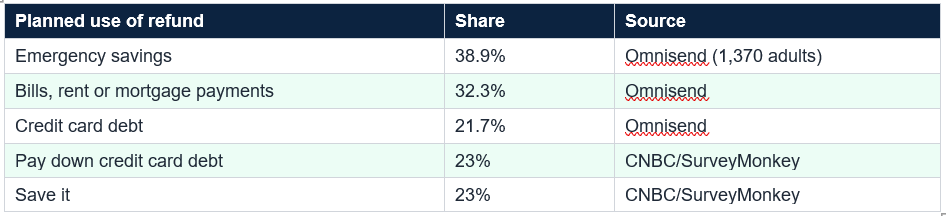
Average refund $3,276 through May 8 (up 11.5% from $2,939), with about 99.1 million refunds totalling $324.8 billion, the highest average for that point since 2009; prior-year full-season average $3,167, with about 63% of taxpayers getting a refund; the typical increase was closer to $300 than the $600–$700 many expected. What people plan to do: emergency savings 38.9%, bills or housing 32.3%, credit card debt 21.7% (Omnisend, 1,370 adults); 23% pay down card debt and 23% save (CNBC/SurveyMonkey). Context: card APR about 20.9%, top savings 4.35%, 46% of Americans could cover three months of expenses. My arithmetic on $3,276: against a 20.9% card, about $685 a year of interest avoided; at 4.35% savings, about $143 a year; invested at a constant 7% for 30 years, about $24,900; it equals about 1.1 months of $3,000 spending and about $273 a month of over-withholding, which in a 4.35% account would earn about $66.
The danger is that unplanned money disappears into everyday spending. The better approach is to match it to a specific goal, ideally the one you have been putting off, before it arrives. It is November, the next filing season is a few months away and there is time to decide. This guide shows what refunds looked like in 2026, what people do with theirs and how to match yours to a goal with some arithmetic.
Some cautions. The IRS reports the average, not the median, so a few large refunds can pull it up. Many households expected bigger checks: Axios reported the typical increase was closer to $300 than the $600 to $700 many had expected, even though new deductions such as those for tips, overtime and seniors cut taxes for some, with Schedule 1-A filers seeing an average tax cut of over $800, per Treasury figures reported by CNBC. Your own refund could be much smaller, larger or negative; the average is a benchmark, not a promise.
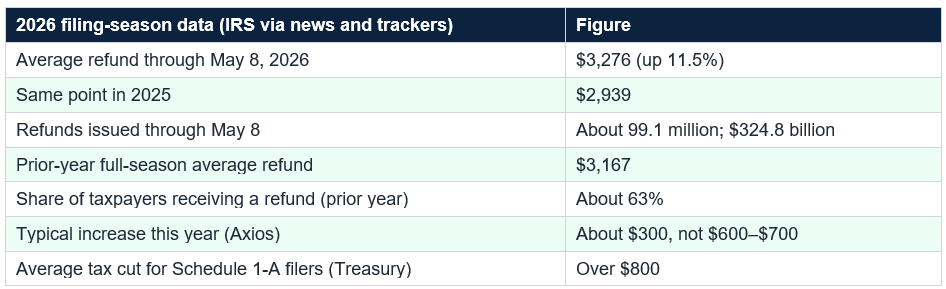
IRS data through May 8, 2026: average refund $3,276 (up 11.5%), about 99.1 million refunds, $324.8 billion total. The prior-year full-season average was $3,167, and about 63% of taxpayers got one. The typical increase was about $300, not $600–$700.
Practical goals dominate. Bankrate found only 47% of Americans could cover a $1,000 emergency and 46% three months of expenses, which helps explain why emergency savings and bills top the list. The takeaway is not to copy the crowd but to notice that a refund is a rare chance to move a goal forward.
If you would rather have the money during the year, for example to pay down a 20% card faster, you can adjust your withholding: the IRS offers a Tax Withholding Estimator, linked below, and you can change your W-4 with your employer (a general point, not retrieved). Do not cut withholding so far that you owe a large bill or penalty. If you are not sure, a refund is a safer error than a bill.
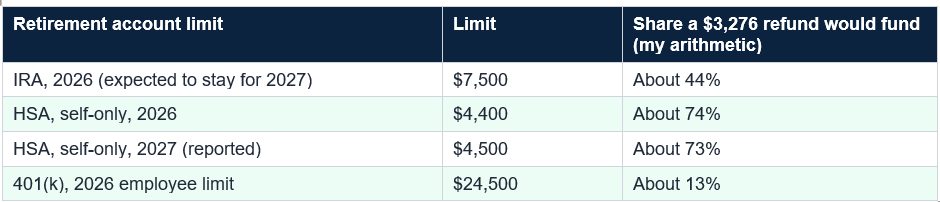
For retirement, the 2026 IRA limit is $7,500 and is expected to stay there for 2027, though one formula-based page suggests $8,000. The 2026 401(k) limit is $24,500, with a $25,500 projection for 2027 that the IRS had not announced as of late October, and HSA limits are $4,400 (self-only) and $8,750 (family) for 2026, reported at $4,500 and $9,000 for 2027. A $3,276 refund would fund about 44% of the IRA limit or about 74% of a self-only HSA; check eligibility, income limits and deductions before contributing.
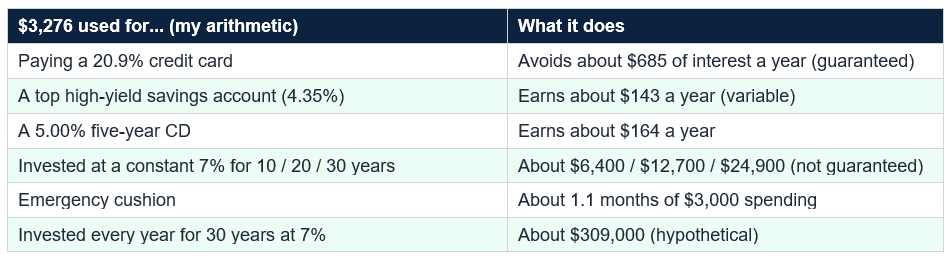
As a cushion, $3,276 is about 1.1 months of spending at $3,000 a month, a real buffer against a job loss or car repair. Investing an average refund of $3,276 every year for 30 years at a constant 7% would grow to about $309,000, a hypothetical that shows why a refund treated as an annual investment can matter more than a one-time splurge. The right place depends on which goal is most urgent for you, not on which number is biggest.
A practical test: for each delayed goal, estimate what it costs you each month it stays undone, in money or risk, and do the highest first. If your refund cannot cover a goal in full, put a meaningful share toward it and automate the rest. Allow a small slice for enjoyment, since a plan with no room for pleasure is one you may abandon, and write it down: for example, 50% to the card, 30% to the emergency fund and 20% to the goal.

A refund is not guaranteed and is not income you can count on to pay for essentials. Do not spend it before it arrives, and avoid borrowing against it.
Write your plan in one sentence and put it where you will see it, for example, “The first $1,000 goes to the emergency fund, the rest to the card.” If you share finances, agree on it with your partner now, and decide what you will do if the refund is smaller than you hoped, since the order of priorities should still hold.
Be careful with products that promise your refund early, such as refund advance loans, which can carry fees (a general point, not retrieved), and with scams: fraudsters impersonate the IRS and tax preparers to steal refunds. Use official IRS tools, file with a reputable preparer or software and be skeptical of anyone who promises a bigger refund for a fee or asks for personal information by text. The FTC publishes guidance on refund scams. Common mistakes include spending the refund before it arrives, leaving it in checking where it dissolves into everyday spending, using it for a low-return goal while carrying a 20% card, skipping the starter emergency fund, using refund advance loans, withholding too little and owing a bill and not deciding at all. The simplest fix is a written plan, an automatic transfer and a separate account for the money.
In my illustrations, $3,276 avoids about $685 a year against a 20.9% card, earns about $143 in a 4.35% savings account and could grow to about $24,900 over 30 years at a constant 7%. Write the plan down, automate it, keep a small slice for enjoyment and do not spend the money before it lands. If you would rather have the money during the year, check your withholding.
The IRS reported an average refund of $3,276 through May 8, 2026, up 11.5% from $2,939 at the same point in 2025, with about 99.1 million refunds totalling $324.8 billion, according to a summary of the IRS data. The full-season average for the prior year was $3,167, and about 63% of taxpayers received a refund. The IRS reports the average, not the median, so a few large refunds can lift it.
What do most people do with their refund?
Surveys point to practical uses first. An Omnisend survey of 1,370 Americans found 38.9% planned to put their refund into emergency savings, 32.3% toward bills, rent or mortgage payments and 21.7% toward credit card debt, while a CNBC and SurveyMonkey poll found 23% would pay down credit card debt and 23% would save it. The best use depends on your situation.
Should I use my refund to pay off debt or save?
If you have credit card debt at about 20% to 21%, paying it down is usually the highest guaranteed return, but build a small emergency fund first so a surprise does not go back on the card. In my illustration, $3,276 against a 20.9% card avoids about $685 of interest a year, against about $143 earned at 4.35% in a top savings account. This is general education, not personal advice.
Is a big refund a good thing?
It is your own money returned, so a large refund means you overpaid during the year, in effect an interest-free loan to the government. Some people like it as forced saving. If you prefer the money sooner, you can adjust your withholding. My illustration suggests a $3,276 refund equals about $273 a month, which if saved in a 4.35% account would earn roughly $66 over the year.
Can I use my refund for an IRA?
Often yes. The IRA limit was $7,500 for 2026 and is expected to stay there for 2027, and in my general knowledge you can generally make a prior-year IRA contribution until the filing deadline, which I did not retrieve from a source. A refund of $3,276 would fund about 44% of the 2026 limit. Eligibility and deduction rules depend on your income and workplace plan, so check them or ask a professional.
Table of Contents
- A Windfall That Isn’t
- The Short Answer: Match, Don’t Spend
- What Refunds Looked Like in 2026
- What People Actually Do
- It Is Your Money: The Withholding Question
- Matching Your Refund to a Goal
- What $3,276 Does in Each Place
- The Goal You Keep Putting Off
- Make It Automatic Before It Arrives
- Timing, Tools and Scams
- Common Mistakes
- Conclusion
- Frequently Asked Questions
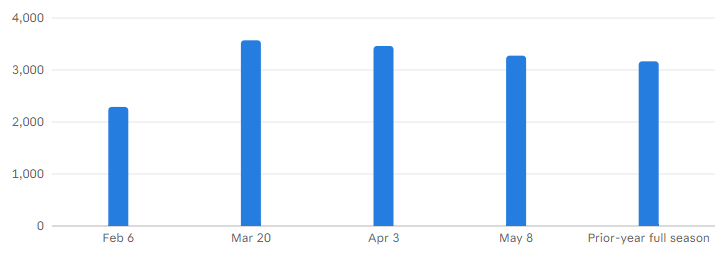
The 2026 average refund moved through the season ($)
Average refund ($) by IRS filing-season data via NewsNation, Fox Business, Tax Foundation, Choice Tax Relief and The Motley Fool; the mix of returns changes through the season; the IRS reports averages, not medians
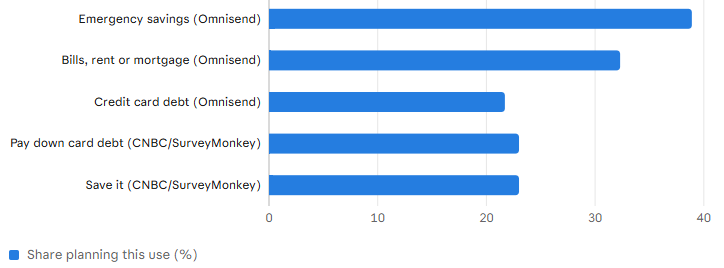
What people plan to do with a refund: two 2026 surveys (%)
% of respondents by Omnisend survey of 1,370 adults; CNBC and SurveyMonkey Quarterly Money Survey (3,494 adults); different questions and samples, so treat as indications
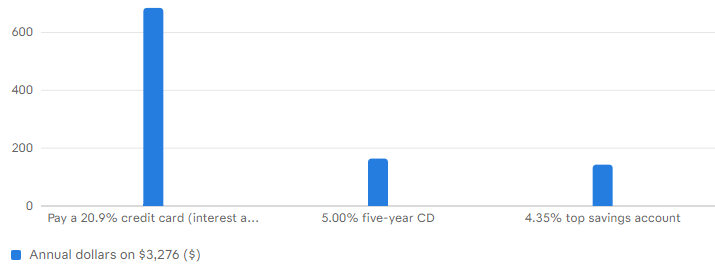
What $3,276 earns or saves in a year, by where it goes ($)
Dollars per year by my arithmetic on the 2026 average refund; card APR from earlier research; savings rates per Bankrate and NerdWallet; invested at a constant 7% for 30 years it would grow to about $24,900 (not guaranteed)
A Windfall That Isn’t
A tax refund feels like a gift: a check arrives, often in the spring, and for a few days it is easy to believe you have come into money. In reality it is your own money coming back, since you paid more during the year than you owed. That does not make it less useful. For many households it is the largest single deposit of the year, and it lands at a moment you can plan for.The danger is that unplanned money disappears into everyday spending. The better approach is to match it to a specific goal, ideally the one you have been putting off, before it arrives. It is November, the next filing season is a few months away and there is time to decide. This guide shows what refunds looked like in 2026, what people do with theirs and how to match yours to a goal with some arithmetic.
The Short Answer: Match, Don’t Spend
Decide the destination before the money arrives. With no emergency fund, put the refund there first. With credit card debt at about 20%, paying it down is usually the best guaranteed return. With both covered, use the refund for an IRA or HSA or the goal you keep delaying, whether a down payment, a certification or an overdue repair. A small slice for enjoyment, such as 5% to 10%, makes the plan easier to keep. The 2026 average refund of $3,276 is enough to move any of these meaningfully.
What Refunds Looked Like in 2026
The 2026 filing season, covering tax year 2025, produced bigger refunds. According to IRS data as summarized by trackers, the average refund was $3,276 through May 8, up 11.5% from $2,939 at the same point a year earlier and the highest for that point in the IRS weekly data going back to 2009, with about 99.1 million refunds totalling $324.8 billion. The prior year’s full-season average was $3,167, and about 63% of taxpayers received a refund. Early in the season the number looked different, $2,290 on February 6 and $3,571 on March 20, because the mix of returns changes as the season progresses.Some cautions. The IRS reports the average, not the median, so a few large refunds can pull it up. Many households expected bigger checks: Axios reported the typical increase was closer to $300 than the $600 to $700 many had expected, even though new deductions such as those for tips, overtime and seniors cut taxes for some, with Schedule 1-A filers seeing an average tax cut of over $800, per Treasury figures reported by CNBC. Your own refund could be much smaller, larger or negative; the average is a benchmark, not a promise.
IRS data through May 8, 2026: average refund $3,276 (up 11.5%), about 99.1 million refunds, $324.8 billion total. The prior-year full-season average was $3,167, and about 63% of taxpayers got one. The typical increase was about $300, not $600–$700.
What People Actually Do
Surveys show most people use refunds sensibly, though the numbers differ by poll. Omnisend’s survey of 1,370 Americans found 38.9% planned to put their refund into emergency savings, 32.3% toward bills, rent or mortgage payments and 21.7% toward credit card debt, while a CNBC and SurveyMonkey poll found that of filers expecting a refund, 23% planned to pay down credit card debt and 23% to save it. These are company and media polls with different questions, so treat them as indications.Practical goals dominate. Bankrate found only 47% of Americans could cover a $1,000 emergency and 46% three months of expenses, which helps explain why emergency savings and bills top the list. The takeaway is not to copy the crowd but to notice that a refund is a rare chance to move a goal forward.
It Is Your Money: The Withholding Question
A refund is an interest-free loan you made to the government. A $3,276 refund means about $273 a month was withheld beyond what you owed. In my illustration, saving $273 a month in a top savings account paying 4.35% would leave about $3,342 after a year, roughly $66 more, a small gain, which is why many people are happy to treat a refund as forced saving. The larger value is in how you use the money.If you would rather have the money during the year, for example to pay down a 20% card faster, you can adjust your withholding: the IRS offers a Tax Withholding Estimator, linked below, and you can change your W-4 with your employer (a general point, not retrieved). Do not cut withholding so far that you owe a large bill or penalty. If you are not sure, a refund is a safer error than a bill.
Matching Your Refund to a Goal
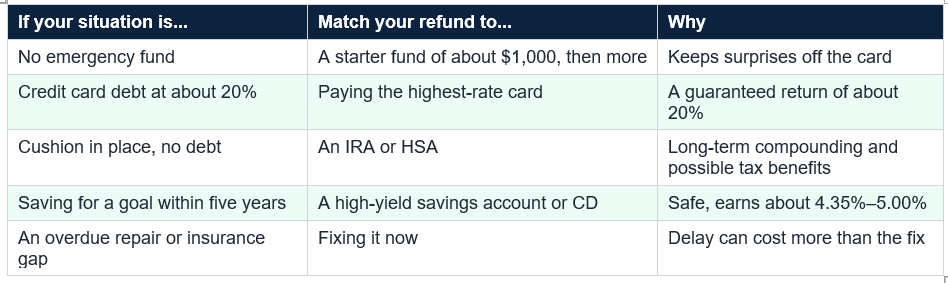
Choose in order. First, if you have no starter emergency fund, build one of about $1,000, because otherwise every surprise lands on a card at about 20.9%. Second, send the next dollars to the highest-rate card balance, a guaranteed cost no savings account matches. Third, build a full emergency fund of three to six months of essentials, since only 27% of Americans could cover six months, per Bankrate. Fourth, fund long-term goals, starting with retirement accounts.For retirement, the 2026 IRA limit is $7,500 and is expected to stay there for 2027, though one formula-based page suggests $8,000. The 2026 401(k) limit is $24,500, with a $25,500 projection for 2027 that the IRS had not announced as of late October, and HSA limits are $4,400 (self-only) and $8,750 (family) for 2026, reported at $4,500 and $9,000 for 2027. A $3,276 refund would fund about 44% of the IRA limit or about 74% of a self-only HSA; check eligibility, income limits and deductions before contributing.
What $3,276 Does in Each Place
Using my own arithmetic, $3,276 against a 20.9% credit card avoids about $685 of interest a year, a guaranteed return. In a top high-yield savings account paying about 4.35% it earns about $143 a year, and in a 5.00% five-year CD about $164. Invested at a constant 7%, it grows to about $6,400 in 10 years, $12,700 in 20 and $24,900 in 30, though real returns vary and are not guaranteed.As a cushion, $3,276 is about 1.1 months of spending at $3,000 a month, a real buffer against a job loss or car repair. Investing an average refund of $3,276 every year for 30 years at a constant 7% would grow to about $309,000, a hypothetical that shows why a refund treated as an annual investment can matter more than a one-time splurge. The right place depends on which goal is most urgent for you, not on which number is biggest.
The Goal You Keep Putting Off
Most of us have one: the will we have not written, the dental work we keep postponing, the insurance review, the certification course, the car that needs new tires, the down payment fund we have not started. Ask which delayed goal has the highest cost of waiting. A dental problem or worn tires can become expensive and unsafe, a missing emergency fund exposes you to debt, a skill course could raise your pay and a down payment fund benefits from an early start.A practical test: for each delayed goal, estimate what it costs you each month it stays undone, in money or risk, and do the highest first. If your refund cannot cover a goal in full, put a meaningful share toward it and automate the rest. Allow a small slice for enjoyment, since a plan with no room for pleasure is one you may abandon, and write it down: for example, 50% to the card, 30% to the emergency fund and 20% to the goal.
A refund is not guaranteed and is not income you can count on to pay for essentials. Do not spend it before it arrives, and avoid borrowing against it.
Make It Automatic Before It Arrives
The best way to keep a plan is to remove the temptation. In my general knowledge (not retrieved), the IRS lets you split a direct-deposit refund among up to three accounts using Form 8888, so part can go to savings without touching it. You can also set up an automatic transfer for the day it arrives and keep the refund in a separate savings account, which is easy to open now, before the filing season.Write your plan in one sentence and put it where you will see it, for example, “The first $1,000 goes to the emergency fund, the rest to the card.” If you share finances, agree on it with your partner now, and decide what you will do if the refund is smaller than you hoped, since the order of priorities should still hold.
Timing, Tools and Scams
Plan around the calendar. The 2026 filing season opened on January 26, and the IRS must hold refunds that include the Earned Income Tax Credit and Additional Child Tax Credit until after mid-February, according to the Tax Foundation, which is why average refunds rise in late February and settle later. Filing early with direct deposit usually means a faster refund, in my general knowledge, and the IRS Where’s My Refund tool shows the status. Do not count on a specific date or spend the money before it lands.Be careful with products that promise your refund early, such as refund advance loans, which can carry fees (a general point, not retrieved), and with scams: fraudsters impersonate the IRS and tax preparers to steal refunds. Use official IRS tools, file with a reputable preparer or software and be skeptical of anyone who promises a bigger refund for a fee or asks for personal information by text. The FTC publishes guidance on refund scams. Common mistakes include spending the refund before it arrives, leaving it in checking where it dissolves into everyday spending, using it for a low-return goal while carrying a 20% card, skipping the starter emergency fund, using refund advance loans, withholding too little and owing a bill and not deciding at all. The simplest fix is a written plan, an automatic transfer and a separate account for the money.
Conclusion
A tax refund is a rare chance to move a goal forward, and the best time to decide where it goes is before it arrives. In 2026 the average refund was $3,276, up 11.5%, though the typical increase was about $300, and people most often aim refunds at emergency savings, bills and credit card debt. Match yours to your situation: a starter emergency fund first, then card debt at about 20%, then a full cushion, then retirement accounts or the goal you have been delaying.In my illustrations, $3,276 avoids about $685 a year against a 20.9% card, earns about $143 in a 4.35% savings account and could grow to about $24,900 over 30 years at a constant 7%. Write the plan down, automate it, keep a small slice for enjoyment and do not spend the money before it lands. If you would rather have the money during the year, check your withholding.
Frequently Asked Questions
What was the average tax refund in 2026?The IRS reported an average refund of $3,276 through May 8, 2026, up 11.5% from $2,939 at the same point in 2025, with about 99.1 million refunds totalling $324.8 billion, according to a summary of the IRS data. The full-season average for the prior year was $3,167, and about 63% of taxpayers received a refund. The IRS reports the average, not the median, so a few large refunds can lift it.
What do most people do with their refund?
Surveys point to practical uses first. An Omnisend survey of 1,370 Americans found 38.9% planned to put their refund into emergency savings, 32.3% toward bills, rent or mortgage payments and 21.7% toward credit card debt, while a CNBC and SurveyMonkey poll found 23% would pay down credit card debt and 23% would save it. The best use depends on your situation.
Should I use my refund to pay off debt or save?
If you have credit card debt at about 20% to 21%, paying it down is usually the highest guaranteed return, but build a small emergency fund first so a surprise does not go back on the card. In my illustration, $3,276 against a 20.9% card avoids about $685 of interest a year, against about $143 earned at 4.35% in a top savings account. This is general education, not personal advice.
Is a big refund a good thing?
It is your own money returned, so a large refund means you overpaid during the year, in effect an interest-free loan to the government. Some people like it as forced saving. If you prefer the money sooner, you can adjust your withholding. My illustration suggests a $3,276 refund equals about $273 a month, which if saved in a 4.35% account would earn roughly $66 over the year.
Can I use my refund for an IRA?
Often yes. The IRA limit was $7,500 for 2026 and is expected to stay there for 2027, and in my general knowledge you can generally make a prior-year IRA contribution until the filing deadline, which I did not retrieve from a source. A refund of $3,276 would fund about 44% of the 2026 limit. Eligibility and deduction rules depend on your income and workplace plan, so check them or ask a professional.
0 Comments
Be the first to share your thoughts on this article.