

Real Estate
How to Buy Your First Home: Complete UK Guide
There were 967,000 first-time buyers in the UK in 2025 — but the average buyer is now 33.9 years old, the average deposit is £61,090, and 71% of prospective buyers say the rising cost of living is making their journey harder. The good news: affordability has marginally improved, the Lifetime ISA still provides a £1,000 annual bonus, and buying is now cheaper than renting in many parts of the UK. This is the complete, step-by-step guide to buying your first home in 2026.
But the headline numbers mask a more complicated story. The first-time buyer house price-to-earnings ratio has improved to 4.7 in 2026 — slightly below its 20-year average — suggesting that affordability has marginally improved from recent peaks (Nationwide January 2026 Affordability Report). Mortgage rates, while still elevated at around 5.42% on average for a two-year fix, have fallen from their 2023 crisis highs, and some deals fall below 4% for buyers with larger deposits. Buying is now cheaper than renting on a monthly basis in many parts of the UK — according to TwentyCi, homeowners save an average of £493 per month compared to tenants.
And there were still 967,000 first-time buyers in the UK in 2025, demonstrating that people do get there. The average deposit that prospective buyers plan to put down is £48,200 — half of what recent buyers actually paid — which reflects both aspiration and the reality that many end up saving more than originally planned, taking longer, or receiving family help. This guide walks through every step of the process, with the 2026 data at each stage so you can make a plan grounded in what the market actually looks like.
967,000 first-time buyers in the UK in 2025 (finder.com / UK Finance). Average FTB age: 33.9 years. Average FTB house price (January 2026 ONS/UKHPI): £226,000. Average FTB price paid (Aldermore 2026 actual buyers): £371,900. Average deposit (Aldermore 2026 actual buyers): £89,400 (25.6% of purchase price). Average planned deposit (prospective buyers): £48,200. 71% impacted by rising cost of living; 63% impacted by high house prices; 46% not saved as much as planned (Aldermore First Time Buyer Index 2026). FTB house price-to-earnings ratio improved to 4.7 (below 20-year average) -- Nationwide January 2026. 10% deposit on typical FTB property: ~£23,000; takes nearly 6 years to save at 10% of average net pay (Nationwide). Sources: Aldermore; finder.com; Nationwide; Barratt Homes; ONS. Not financial advice.
The Aldermore First Time Buyer Index 2026 reports that the average prospective first-time buyer has a salary of £38,700. At a 4.5x income multiple, that produces a maximum borrowing of approximately £174,150. Add a 10% deposit of £17,415 (10% of a £174,150 mortgage property) and the maximum purchase price is approximately £193,400. This is significantly below the average FTB house price in most English regions, which is why many first-time buyers save for a larger deposit — and why joint applications (with a partner or family member) and higher-income buyers have a material advantage.
Beyond income multiples, lenders conduct ‘affordability stress tests.’ They calculate whether you could continue to afford the repayments if interest rates rose by 2–3 percentage points from the current level. This stress testing means that even if you technically qualify for a 4.5x income multiple, the monthly repayment at a stressed rate may push the actual borrowing lower. Using a whole-of-market mortgage broker — rather than going directly to a single lender — gives you access to a wider range of products and an adviser who can model your specific position.
How to calculate your buying budget: (1) Multiply your annual gross salary by 4.5 (or 4.0 for a conservative estimate). For a joint application, add both salaries first. (2) Add your available deposit to the borrowing figure to get your maximum purchase price. (3) Use a repayment mortgage calculator (MoneyHelper has a free one at moneyhelper.org.uk) to work out the monthly repayment at current rates. Check it is comfortably affordable against your monthly budget AFTER all outgoings. (4) Contact a whole-of-market mortgage broker for a personalised calculation. (5) Get a Mortgage in Principle before you start viewing properties. Not financial advice.
Most lenders accept a minimum deposit of 5% of the purchase price, though the mortgage rates available at 5% LTV are significantly higher than those at 10%, 15%, or 25% LTV. A larger deposit provides access to better rates, which can significantly reduce the monthly repayment over the full mortgage term. The practical saving strategy therefore has two components: save as quickly as possible to get into homeownership, but also maximise the size of the deposit (within your timeline) to access lower mortgage rates.
The most powerful deposit-saving tool available to eligible first-time buyers is the Lifetime ISA, covered in detail in the next section. Beyond the LISA, the most important discipline is putting deposit savings into the highest-rate savings account available — currently easy-access rates of 4–5% AER are available from various providers, and 1-year fixed bonds offer up to 5%+ from some providers. At £300 per month saved at 4.5% AER, a first-time buyer accumulates approximately £18,700 over five years, plus £840 in interest. With a LISA contribution of £4,000 per year producing £1,000 annual bonus, the same five-year saving effort produces approximately £27,700 (£18,700 in cash savings plus £5,000 LISA savings and £4,000 in LISA bonuses).
Deposit saving order of priority: (1) Open a Lifetime ISA first if you are 18-39 and buying a home under £450,000 (see next section). (2) Contribute up to £4,000 to the LISA each tax year to get the full £1,000 bonus. (3) Put remaining deposit savings in the highest-rate savings account you can find (check moneyfactscompare.co.uk or moneysavingexpert.com savings tables). (4) Avoid putting deposit savings at equity risk in stocks or funds unless your buying timeline is at least 5 years away. (5) Set up a standing order the day you get paid so saving becomes automatic. Not financial advice.
The LISA can be used to purchase a first home valued at up to £450,000, and the bonus can only be used once a LISA has been open for at least 12 months.
Over a five-year saving period, a buyer contributing £4,000 per year to a LISA receives £5,000 in government bonuses on top of their £20,000 in contributions, plus interest or investment growth on the accumulated balance. The 25% bonus is the equivalent of a 25% guaranteed return on the money saved — which is higher than any savings rate currently available and higher than almost any investment return you could achieve over a short period with similar certainty.
The LISA has rules that must be understood before opening one. You cannot access the money without paying a withdrawal penalty (currently 25% of the withdrawal amount, which effectively removes the bonus plus a further penalty on contributions) unless you are buying your first home (under £450,000), turning 60, or are terminally ill. The property must be purchased using a mortgage — not outright. And the LISA must have been open for at least 12 months before use. This means the very first action for any first-time buyer who has not yet opened a LISA is to open one immediately — even with a nominal initial contribution — to start the 12-month clock.
Government Scheme: Lifetime ISA 2026: who can open one: aged 18-39. Maximum annual contribution: £4,000. Annual government bonus: 25% (£1,000 maximum per year). Property price limit: £450,000. Minimum holding period: 12 months before use. Withdrawal penalty (not for first home purchase): 25% of the amount withdrawn (effectively removes bonus and penalises some contributions). Best use: open immediately if eligible; contribute £4,000/year for maximum bonus; combine with a competitive Cash LISA or Stocks & Shares LISA for growth. Provider comparison: check moneysavingexpert.com LISA comparison. Not financial advice. Verify rules at gov.uk/lifetime-isa.
The most important thing to understand about credit scores for mortgage purposes is that different lenders use different data, different agencies, and different scoring models. A score that appears ‘good’ on Experian may look different on Equifax. Rather than focusing obsessively on a single score number, focus on the underlying credit file data: are there any errors? Any missed payments? Any defaults? Any county court judgements (CCJs)? Any applications for credit in the past 6–12 months that might not be visible on a score summary?
Steps that reliably improve credit profile for mortgage purposes include: registering on the electoral roll at your current address (one of the simplest and most impactful actions); ensuring no accounts show missed or late payments; keeping credit utilisation low (using less than 30% of available credit limits); avoiding applying for new credit in the 3–6 months before a mortgage application; and closing unused credit accounts where balances are zero. Check your credit reports for free using Experian (with free CreditExpert trial), Credit Karma (Equifax data free), and Credit Club at MoneySavingExpert (Experian data free). Check all three, as lenders may use any of them.
Credit score action plan before a mortgage application: (1) Register on the electoral roll at your current address immediately (gov.uk/register-to-vote). (2) Check all three credit reports for free: Experian, Equifax, TransUnion. Dispute any errors in writing. (3) Pay down any outstanding balances on credit cards. (4) Do NOT apply for any new credit in the 3-6 months before your mortgage application (this includes 0% balance transfers). (5) Make all existing bill and debt payments on time, every time, without exception. (6) Check you are linked to any financial associations (e.g. a joint account with someone who has poor credit) and consider whether to disassociate. Not financial advice.
Getting a Mortgage in Principle is typically a straightforward process that takes 15–30 minutes with a broker or directly with a lender. You provide basic information about your income, outgoings, debts, and deposit. Most lenders run a ‘soft’ credit check at this stage — one that appears on your credit report but is not visible to other lenders and does not affect your credit score. Some run a ‘hard’ check, which does affect your score; check which type of check will be run before proceeding, and avoid multiple hard searches. An MIP typically remains valid for 60–90 days.
The Aldermore First Time Buyer Index 2026 reports that 53% of first-time buyers are on fixed-rate mortgages. With the Bank of England base rate at 3.75% and some lenders offering sub-4% deals for borrowers with larger deposits, the two-year and five-year fixed rate comparison is the most common decision point for first-time buyers in 2026. A two-year fixed provides lower rates in a potentially falling rate environment but creates a remortgage event sooner; a five-year fixed provides stability but may lock you into a rate that becomes relatively unfavourable if base rates fall significantly.
Using a whole-of-market mortgage broker (as opposed to going directly to a single bank or building society) gives you access to hundreds of mortgage products rather than the range offered by one lender. A good broker will assess your full financial picture, recommend the most suitable products for your circumstances, and manage much of the application process. Broker fees vary: some charge a flat fee (typically £300-£500), some charge a percentage of the loan, and some are paid by commission from the lender (free to you but check for any conflicts of interest). MoneyHelper has a directory of qualified mortgage advisers at moneyhelper.org.uk. Not financial advice.
Visit properties multiple times if possible — once for excitement and once for scrutiny. On the second visit, open every cupboard, test every tap, check every window for damp or condensation, examine the external walls for cracks, look at the age and condition of the boiler and roof, and ask directly about anything that concerns you. Ask the agent why the seller is moving, how long the property has been on the market (and whether any previous sales have fallen through), whether there is a chain above or below the sale, and what the seller’s ideal timeline is.
When you make an offer, you are under no legal obligation and neither is the seller until contracts are exchanged. In England and Wales, offers are not legally binding — this is why ‘gazumping’ (a seller accepting a higher offer from another buyer after accepting yours) is legal if inconvenient. In Scotland, the system is different: offers are made through solicitors and acceptance is legally binding earlier in the process. If your offer is accepted: ask the estate agent to mark the property as ‘under offer’ or ‘sold subject to contract’ immediately, and confirm the asking price was agreed subject to your mortgage being approved and a satisfactory survey.
First-time buyers are often in a strong negotiating position because they are ‘chain-free’ — they have no property to sell, which reduces the risk of a chain collapse and can be attractive to sellers who want a clean, fast transaction. REalyse data from 2026 shows that time on market has fallen from 100+ days in 2024 to 25-35 days in 2026 — a seller’s market signal that suggests the most in-demand properties may not have room for significant negotiation. But in slower-moving segments and regions, there is often scope to offer below asking price.
Choose a conveyancer or solicitor before you have an offer accepted so you are ready to move quickly. Cost comparison sites and recommendations from your mortgage broker are useful starting points. Costs typically range from £1,500 to £3,000 for a standard purchase, including the conveyancer’s legal fee and the costs of the required searches (local authority, water and drainage, environmental, and others). Your conveyancer will handle: reviewing the draft contract and title documents; raising enquiries with the seller’s solicitor; ordering and reviewing searches; and managing the exchange and completion process.
The searches are a critical element of the conveyancing process. The local authority search reveals information about the property in council records: planning permissions, building regulations history, nearby road schemes, listed building status, conservation area designations, and various other matters. The environmental search identifies whether the property is in a flood zone or on contaminated land. These searches are not the same as a survey — they are legal and administrative checks, not physical inspections of the property’s condition.
The conveyancing timeline from offer acceptance to exchange typically runs 8–12 weeks, though it can be significantly longer in complex transactions or if chains are involved. The period between exchange and completion is usually 1–4 weeks but can be arranged to suit both parties. During this period, buildings insurance should be in place — technically your obligation from exchange.
There are three main survey types in England and Wales. A Level 1 Condition Report (previously called a HomeBuyer Report without a valuation) provides a basic overview of the property’s condition using a traffic-light rating system. It is suitable only for new or recently built properties in good condition. A Level 2 HomeBuyer Survey (with or without a valuation) is the most commonly commissioned survey and provides a more detailed assessment suitable for most conventional properties. A Level 3 Building Survey (previously called a Full Structural Survey) is the most comprehensive and detailed option, recommended for older properties, unusual construction, or any property where significant works may be needed.
Survey costs range from approximately £500 for a basic Level 1 to £800–1,500 for a Level 2 with valuation to £1,000–2,000+ for a Level 3 Building Survey on a larger or older property. The cost of a survey is among the best money you will spend in the home-buying process: a survey that identifies £15,000 of necessary roof work before exchange gives you the opportunity to renegotiate the purchase price or walk away. A missed defect discovered after completion is your problem and your cost.
NEVER skip the survey, regardless of cost. The lender's valuation is NOT a survey and provides no protection against structural defects, damp, subsidence, or expensive necessary repairs. In a competitive market, buyers are sometimes tempted to skip the survey to complete faster. This is one of the most financially dangerous decisions you can make when buying a first home. Source: general industry guidance; RICS. Not financial advice.
At exchange, you pay your deposit to your solicitor (typically 10% of the purchase price, though this can be negotiated; note: this is your exchange deposit, not necessarily the same as your mortgage deposit). You also agree a completion date — the day on which the remaining funds are transferred and ownership legally changes hands.
On completion day, your solicitor sends the remaining purchase funds (the mortgage advance from the lender plus your personal deposit contribution, minus the exchange deposit already paid) to the seller’s solicitor. Once the funds are received and confirmed, the estate agent releases the keys. You are a homeowner. Your mortgage begins from this date, and buildings insurance must be in force from the exchange date (check your policy’s commencement conditions).
After completion, your solicitor submits the Stamp Duty Land Tax (SDLT) return to HMRC (if applicable) and registers the change of ownership at the Land Registry. The registration can take several months but does not affect your right to occupy and use the property from completion day.
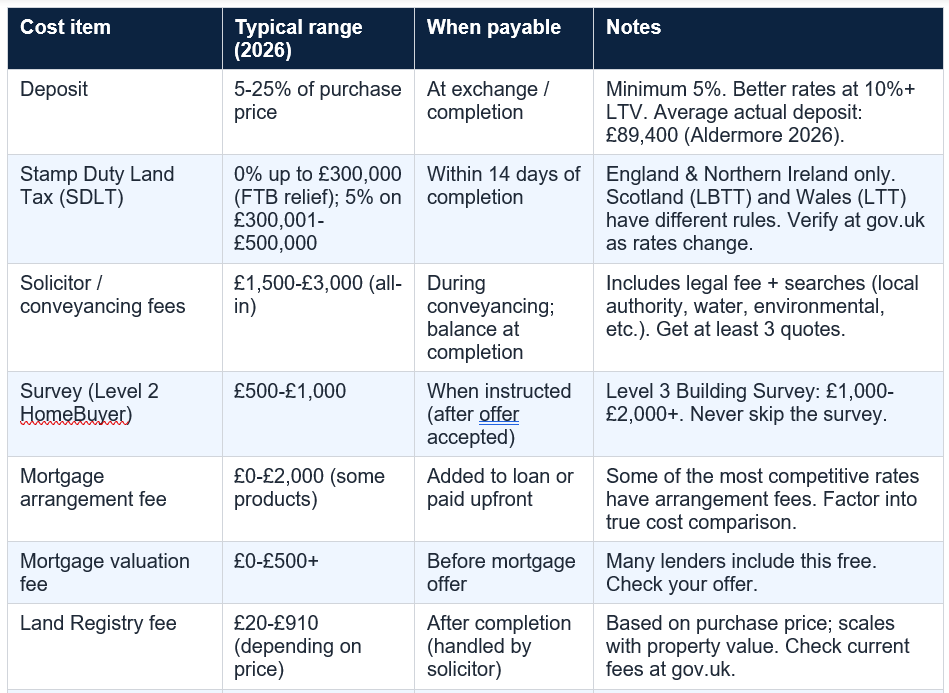
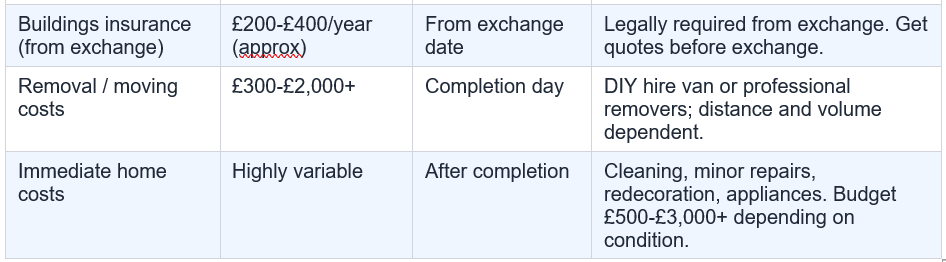
Note: SDLT rates for first-time buyers in England were changed from April 1, 2025 (threshold reduced from £425,000 to £300,000). Always verify current rates and thresholds at gov.uk/stamp-duty-land-tax as they change regularly. Scotland: Land and Buildings Transaction Tax (LBTT) applies at revenue.scot. Wales: Land Transaction Tax (LTT) applies at gov.wales. Not financial or legal advice.
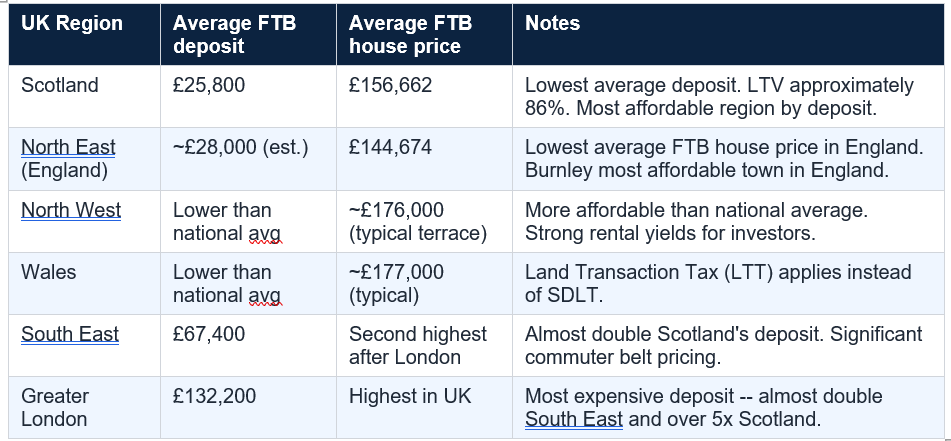
Finder.com, citing ONS data, identifies Burnley as the most affordable place for first-time buyers in England, and Inverclyde in Scotland as the most affordable in the whole of the UK. The Nationwide’s January 2026 Affordability Report emphasises the regional dimension starkly: a 10% deposit in London is over three times larger than the equivalent in the North. This is not just about lower house prices in the North — it reflects genuinely different access to homeownership across the country.
The practical implication for first-time buyers who have flexibility over where they live is significant. A buyer who is open to purchasing in the North East, West Midlands, Wales, or Scotland faces dramatically lower barriers to entry than one who is set on London or the South East. This does not mean everyone should move North — career opportunities, family ties, and quality of life are all legitimate factors in where to live. But the data is worth knowing: in Burnley and Inverclyde, the dream of homeownership at 30 is significantly more achievable than in Islington or Guildford.
But people do get there — 967,000 of them did in 2025 alone. The first-time buyer house price-to-earnings ratio has improved slightly from its recent peaks. Mortgage rates are lower than their 2023 crisis highs. In many parts of the UK, buying is now cheaper on a monthly basis than renting the equivalent property. The Lifetime ISA still provides a guaranteed 25% return on up to £4,000 per year for eligible buyers. And first-time buyers are chain-free — which gives them a genuine negotiating advantage in a market where sellers value certainty as much as price.
The eight steps in this guide — calculate your budget, save your deposit, check your credit, get a Mortgage in Principle, find and offer on a property, instruct a solicitor, get a survey, and exchange and complete — are not complicated in themselves. The difficulty is the duration and the discipline. Start with Step 1 today, even if Step 8 is years away. The difference between starting your LISA at 25 and starting at 30 is £5,000 in government bonuses. Not financial advice — always consult a qualified IFA and whole-of-market mortgage broker. Free regulated guidance: MoneyHelper at moneyhelper.org.uk or 0800 138 3944.
The minimum deposit most mortgage lenders will accept is 5% of the purchase price. On the average UK first-time buyer house price of approximately £226,000 (ONS/UKHPI January 2026, finder.com), that is approximately £11,300. However, first-time buyers who actually completed purchases in 2026 put down an average of £89,400 (25.6% of the purchase price), according to the Aldermore First Time Buyer Index 2026. This is significantly higher than the minimum, reflecting both the realities of lender affordability requirements and the better mortgage rates available with a larger deposit. In practice, the most achievable target for most buyers is a 10% deposit: on £226,000, that is approximately £22,600, which the Nationwide (January 2026) estimates takes nearly six years to save at 10% of average net pay. The Lifetime ISA can materially speed this up. Not financial advice.
What is the average age of a first-time buyer in the UK?
The average age of a first-time buyer in the UK is 33.9 years old (government data cited by finder.com, 2025 figures). In London, the average is 34.5; outside London, 33.8. This has risen from an average of 30 in 2007 and 32 in 2012, reflecting the combined impact of house price rises, stricter mortgage lending rules following the 2007-08 banking crisis, and the higher deposit requirements of the current market. The average age has actually begun to stabilise and tick down slightly in London after peaking at nearly 37 in 2019. Sources: finder.com citing UK government data; Nationwide.
What government help is available for first-time buyers in 2026?
The main schemes available in 2026 include: the Lifetime ISA (LISA) — save up to £4,000/year and receive a 25% government bonus (max £1,000/year); for homes up to £450,000; ages 18-39; open for at least 12 months before use. The Mortgage Guarantee Scheme, which enables 5% deposit mortgages on homes up to £600,000 (extended to June 2027 at time of writing; verify at gov.uk). The First Homes scheme, which sells new-build properties at a 30-50% discount to eligible first-time buyers. Shared Ownership, which allows buying a share of a property (typically 10-75%) and paying rent on the rest. The Help to Buy ISA is closed to new applicants but can still be used by those who already have one. Always verify the current status and eligibility for each scheme at gov.uk. Not financial advice.
How long does buying a first home take in the UK?
The legal and practical process from having an offer accepted to completing the purchase typically takes 8-12 weeks, though this can vary widely depending on chain complexity, solicitor workload, search results, and survey findings. Before making an offer, you should allow time to build your deposit (which can take years), get a Mortgage in Principle (days to weeks), and find a suitable property (weeks to months). The full journey from 'I want to buy' to 'I have the keys' often takes 2-5 years for many first-time buyers, though it can be shorter for buyers in more affordable regions or those who receive gifted deposits. Not financial or legal advice.
Is it better to buy or rent in 2026?
In many parts of the UK in 2026, buying is cheaper than renting on a monthly basis. TwentyCi's Q1 2026 Property & Homemover Report found that on average, UK homeowners save £493 per month compared to tenants — widening to nearly £1,000 per month in London. Zoopla's February 2026 data found that 40% of homes for sale are cheaper to buy with a monthly mortgage than rent locally (assuming 20% deposit), up from 25% the year before. In Northern England, Scotland, and Wales, buying is typically substantially cheaper per month. In London and the South East, the comparison is less clear-cut, and the deposit barrier is much higher. The right choice depends on individual circumstances — but the monthly cost comparison has shifted significantly in favour of buying in 2026 relative to 2022-23. Not financial advice. Sources: TwentyCi Q1 2026; Zoopla February 2026.
Table of Contents
- The Reality in 2026: Where First-Time Buyers Actually Stand
- Step 1: Work Out What You Can Afford
- Step 2: Start Saving Your Deposit — And Use Every Advantage
- The Lifetime ISA: Still the Best Free Money Available
- Step 3: Check and Improve Your Credit Score
- Step 4: Get a Mortgage in Principle
- Step 5: Find Your Property and Make an Offer
- Step 6: Instruct a Solicitor and Begin Conveyancing
- Step 7: Get a Survey
- Step 8: Exchange and Complete
- The True Cost of Buying: Everything You Need to Budget For
- First-Time Buyer Schemes in 2026
- Where in the UK Is Most Affordable?
- Conclusion: The Climb Is Hard, But the View Is Worth It
- Frequently Asked Questions
The Reality in 2026: Where First-Time Buyers Actually Stand
Buying your first home in 2026 is genuinely hard. The average first-time buyer in the UK is 33.9 years old — up from 30 in 2007 and 32 in 2012. The journey from renter to owner takes longer than it ever has in the modern era. The average deposit that first-time buyers actually put down in 2026 is £89,400, equivalent to 25.6% of the purchase price, according to the Aldermore First Time Buyer Index 2026. The average house price a first-time buyer pays is £371,900. And 71% of prospective first-time buyers say the rising cost of living is directly impacting their ability to save.But the headline numbers mask a more complicated story. The first-time buyer house price-to-earnings ratio has improved to 4.7 in 2026 — slightly below its 20-year average — suggesting that affordability has marginally improved from recent peaks (Nationwide January 2026 Affordability Report). Mortgage rates, while still elevated at around 5.42% on average for a two-year fix, have fallen from their 2023 crisis highs, and some deals fall below 4% for buyers with larger deposits. Buying is now cheaper than renting on a monthly basis in many parts of the UK — according to TwentyCi, homeowners save an average of £493 per month compared to tenants.
And there were still 967,000 first-time buyers in the UK in 2025, demonstrating that people do get there. The average deposit that prospective buyers plan to put down is £48,200 — half of what recent buyers actually paid — which reflects both aspiration and the reality that many end up saving more than originally planned, taking longer, or receiving family help. This guide walks through every step of the process, with the 2026 data at each stage so you can make a plan grounded in what the market actually looks like.
967,000 first-time buyers in the UK in 2025 (finder.com / UK Finance). Average FTB age: 33.9 years. Average FTB house price (January 2026 ONS/UKHPI): £226,000. Average FTB price paid (Aldermore 2026 actual buyers): £371,900. Average deposit (Aldermore 2026 actual buyers): £89,400 (25.6% of purchase price). Average planned deposit (prospective buyers): £48,200. 71% impacted by rising cost of living; 63% impacted by high house prices; 46% not saved as much as planned (Aldermore First Time Buyer Index 2026). FTB house price-to-earnings ratio improved to 4.7 (below 20-year average) -- Nationwide January 2026. 10% deposit on typical FTB property: ~£23,000; takes nearly 6 years to save at 10% of average net pay (Nationwide). Sources: Aldermore; finder.com; Nationwide; Barratt Homes; ONS. Not financial advice.
Step 1: Work Out What You Can Afford
Before you can buy a home, you need to know what price you can realistically purchase at — which means understanding both what you can borrow and what you can afford to repay each month. These are related but not identical questions. What you can borrow is determined primarily by your income (most lenders offer 4.0–4.5x your annual salary, with some specialist lenders offering 5x or more in specific circumstances). What you can afford to repay depends on your monthly outgoings, your existing debts, and the rate at which the mortgage is offered.The Aldermore First Time Buyer Index 2026 reports that the average prospective first-time buyer has a salary of £38,700. At a 4.5x income multiple, that produces a maximum borrowing of approximately £174,150. Add a 10% deposit of £17,415 (10% of a £174,150 mortgage property) and the maximum purchase price is approximately £193,400. This is significantly below the average FTB house price in most English regions, which is why many first-time buyers save for a larger deposit — and why joint applications (with a partner or family member) and higher-income buyers have a material advantage.
Beyond income multiples, lenders conduct ‘affordability stress tests.’ They calculate whether you could continue to afford the repayments if interest rates rose by 2–3 percentage points from the current level. This stress testing means that even if you technically qualify for a 4.5x income multiple, the monthly repayment at a stressed rate may push the actual borrowing lower. Using a whole-of-market mortgage broker — rather than going directly to a single lender — gives you access to a wider range of products and an adviser who can model your specific position.
How to calculate your buying budget: (1) Multiply your annual gross salary by 4.5 (or 4.0 for a conservative estimate). For a joint application, add both salaries first. (2) Add your available deposit to the borrowing figure to get your maximum purchase price. (3) Use a repayment mortgage calculator (MoneyHelper has a free one at moneyhelper.org.uk) to work out the monthly repayment at current rates. Check it is comfortably affordable against your monthly budget AFTER all outgoings. (4) Contact a whole-of-market mortgage broker for a personalised calculation. (5) Get a Mortgage in Principle before you start viewing properties. Not financial advice.
Step 2: Start Saving Your Deposit — And Use Every Advantage
The deposit is the primary practical barrier to first-time homeownership in the UK. The Nationwide’s January 2026 Affordability Report makes the mathematics concrete: a 10% deposit on a typical UK first-time buyer property is around £23,000. At saving 10% of average net pay (approximately £320 per month), it would take a prospective buyer nearly six years to accumulate this. And a 10% deposit in London is over three times larger than the equivalent in the North — reflecting the enormous regional variation in house prices.Most lenders accept a minimum deposit of 5% of the purchase price, though the mortgage rates available at 5% LTV are significantly higher than those at 10%, 15%, or 25% LTV. A larger deposit provides access to better rates, which can significantly reduce the monthly repayment over the full mortgage term. The practical saving strategy therefore has two components: save as quickly as possible to get into homeownership, but also maximise the size of the deposit (within your timeline) to access lower mortgage rates.
The most powerful deposit-saving tool available to eligible first-time buyers is the Lifetime ISA, covered in detail in the next section. Beyond the LISA, the most important discipline is putting deposit savings into the highest-rate savings account available — currently easy-access rates of 4–5% AER are available from various providers, and 1-year fixed bonds offer up to 5%+ from some providers. At £300 per month saved at 4.5% AER, a first-time buyer accumulates approximately £18,700 over five years, plus £840 in interest. With a LISA contribution of £4,000 per year producing £1,000 annual bonus, the same five-year saving effort produces approximately £27,700 (£18,700 in cash savings plus £5,000 LISA savings and £4,000 in LISA bonuses).
Deposit saving order of priority: (1) Open a Lifetime ISA first if you are 18-39 and buying a home under £450,000 (see next section). (2) Contribute up to £4,000 to the LISA each tax year to get the full £1,000 bonus. (3) Put remaining deposit savings in the highest-rate savings account you can find (check moneyfactscompare.co.uk or moneysavingexpert.com savings tables). (4) Avoid putting deposit savings at equity risk in stocks or funds unless your buying timeline is at least 5 years away. (5) Set up a standing order the day you get paid so saving becomes automatic. Not financial advice.
The Lifetime ISA: Still the Best Free Money Available
The Lifetime ISA (LISA) remains one of the most underutilised and most valuable financial products available to UK first-time buyers. The basic mechanics: you can open a LISA if you are aged 18–39. You can save up to £4,000 per year into it. The government adds a 25% bonus on everything you put in — so a £4,000 annual contribution earns you a £1,000 bonus.The LISA can be used to purchase a first home valued at up to £450,000, and the bonus can only be used once a LISA has been open for at least 12 months.
Over a five-year saving period, a buyer contributing £4,000 per year to a LISA receives £5,000 in government bonuses on top of their £20,000 in contributions, plus interest or investment growth on the accumulated balance. The 25% bonus is the equivalent of a 25% guaranteed return on the money saved — which is higher than any savings rate currently available and higher than almost any investment return you could achieve over a short period with similar certainty.
The LISA has rules that must be understood before opening one. You cannot access the money without paying a withdrawal penalty (currently 25% of the withdrawal amount, which effectively removes the bonus plus a further penalty on contributions) unless you are buying your first home (under £450,000), turning 60, or are terminally ill. The property must be purchased using a mortgage — not outright. And the LISA must have been open for at least 12 months before use. This means the very first action for any first-time buyer who has not yet opened a LISA is to open one immediately — even with a nominal initial contribution — to start the 12-month clock.
Government Scheme: Lifetime ISA 2026: who can open one: aged 18-39. Maximum annual contribution: £4,000. Annual government bonus: 25% (£1,000 maximum per year). Property price limit: £450,000. Minimum holding period: 12 months before use. Withdrawal penalty (not for first home purchase): 25% of the amount withdrawn (effectively removes bonus and penalises some contributions). Best use: open immediately if eligible; contribute £4,000/year for maximum bonus; combine with a competitive Cash LISA or Stocks & Shares LISA for growth. Provider comparison: check moneysavingexpert.com LISA comparison. Not financial advice. Verify rules at gov.uk/lifetime-isa.
Step 3: Check and Improve Your Credit Score
Your credit score is one of the most important factors in determining whether a lender will offer you a mortgage and at what interest rate. Mortgage lenders use your credit file — compiled by credit reference agencies including Experian, Equifax, and TransUnion — to assess how reliably you have managed debt in the past, and to predict how reliably you will manage mortgage repayments in the future. A strong credit history improves both your chances of approval and the rates available to you.The most important thing to understand about credit scores for mortgage purposes is that different lenders use different data, different agencies, and different scoring models. A score that appears ‘good’ on Experian may look different on Equifax. Rather than focusing obsessively on a single score number, focus on the underlying credit file data: are there any errors? Any missed payments? Any defaults? Any county court judgements (CCJs)? Any applications for credit in the past 6–12 months that might not be visible on a score summary?
Steps that reliably improve credit profile for mortgage purposes include: registering on the electoral roll at your current address (one of the simplest and most impactful actions); ensuring no accounts show missed or late payments; keeping credit utilisation low (using less than 30% of available credit limits); avoiding applying for new credit in the 3–6 months before a mortgage application; and closing unused credit accounts where balances are zero. Check your credit reports for free using Experian (with free CreditExpert trial), Credit Karma (Equifax data free), and Credit Club at MoneySavingExpert (Experian data free). Check all three, as lenders may use any of them.
Credit score action plan before a mortgage application: (1) Register on the electoral roll at your current address immediately (gov.uk/register-to-vote). (2) Check all three credit reports for free: Experian, Equifax, TransUnion. Dispute any errors in writing. (3) Pay down any outstanding balances on credit cards. (4) Do NOT apply for any new credit in the 3-6 months before your mortgage application (this includes 0% balance transfers). (5) Make all existing bill and debt payments on time, every time, without exception. (6) Check you are linked to any financial associations (e.g. a joint account with someone who has poor credit) and consider whether to disassociate. Not financial advice.
Step 4: Get a Mortgage in Principle
A Mortgage in Principle (MIP) — also called an Agreement in Principle (AIP) or Decision in Principle (DIP) — is a conditional statement from a lender confirming that, based on an initial assessment of your financial information, they would be prepared to lend you a specified amount. It is not a formal mortgage offer, and it does not guarantee you will receive a mortgage. But it serves two important practical functions: it tells you what price range you can realistically search in, and it signals to estate agents and sellers that you are a serious, finance-ready buyer.Getting a Mortgage in Principle is typically a straightforward process that takes 15–30 minutes with a broker or directly with a lender. You provide basic information about your income, outgoings, debts, and deposit. Most lenders run a ‘soft’ credit check at this stage — one that appears on your credit report but is not visible to other lenders and does not affect your credit score. Some run a ‘hard’ check, which does affect your score; check which type of check will be run before proceeding, and avoid multiple hard searches. An MIP typically remains valid for 60–90 days.
The Aldermore First Time Buyer Index 2026 reports that 53% of first-time buyers are on fixed-rate mortgages. With the Bank of England base rate at 3.75% and some lenders offering sub-4% deals for borrowers with larger deposits, the two-year and five-year fixed rate comparison is the most common decision point for first-time buyers in 2026. A two-year fixed provides lower rates in a potentially falling rate environment but creates a remortgage event sooner; a five-year fixed provides stability but may lock you into a rate that becomes relatively unfavourable if base rates fall significantly.
Using a whole-of-market mortgage broker (as opposed to going directly to a single bank or building society) gives you access to hundreds of mortgage products rather than the range offered by one lender. A good broker will assess your full financial picture, recommend the most suitable products for your circumstances, and manage much of the application process. Broker fees vary: some charge a flat fee (typically £300-£500), some charge a percentage of the loan, and some are paid by commission from the lender (free to you but check for any conflicts of interest). MoneyHelper has a directory of qualified mortgage advisers at moneyhelper.org.uk. Not financial advice.
Step 5: Find Your Property and Make an Offer
With a Mortgage in Principle in hand and a clear budget, you are ready to begin viewing properties. The practical mechanics are straightforward — search on Rightmove, Zoopla, and OnTheMarket; register with local estate agents; arrange viewings for properties within your budget — but the discipline required to make a good purchase decision is more nuanced.Visit properties multiple times if possible — once for excitement and once for scrutiny. On the second visit, open every cupboard, test every tap, check every window for damp or condensation, examine the external walls for cracks, look at the age and condition of the boiler and roof, and ask directly about anything that concerns you. Ask the agent why the seller is moving, how long the property has been on the market (and whether any previous sales have fallen through), whether there is a chain above or below the sale, and what the seller’s ideal timeline is.
When you make an offer, you are under no legal obligation and neither is the seller until contracts are exchanged. In England and Wales, offers are not legally binding — this is why ‘gazumping’ (a seller accepting a higher offer from another buyer after accepting yours) is legal if inconvenient. In Scotland, the system is different: offers are made through solicitors and acceptance is legally binding earlier in the process. If your offer is accepted: ask the estate agent to mark the property as ‘under offer’ or ‘sold subject to contract’ immediately, and confirm the asking price was agreed subject to your mortgage being approved and a satisfactory survey.
First-time buyers are often in a strong negotiating position because they are ‘chain-free’ — they have no property to sell, which reduces the risk of a chain collapse and can be attractive to sellers who want a clean, fast transaction. REalyse data from 2026 shows that time on market has fallen from 100+ days in 2024 to 25-35 days in 2026 — a seller’s market signal that suggests the most in-demand properties may not have room for significant negotiation. But in slower-moving segments and regions, there is often scope to offer below asking price.
Step 6: Instruct a Solicitor and Begin Conveyancing
Conveyancing is the legal process of transferring ownership of a property from seller to buyer. You need a licensed conveyancer or solicitor to handle this on your behalf. It is the part of the homebuying process that most first-time buyers find most opaque and frustrating, primarily because it takes longer than expected, involves a great deal of waiting, and requires understanding documents that are not written in everyday language.Choose a conveyancer or solicitor before you have an offer accepted so you are ready to move quickly. Cost comparison sites and recommendations from your mortgage broker are useful starting points. Costs typically range from £1,500 to £3,000 for a standard purchase, including the conveyancer’s legal fee and the costs of the required searches (local authority, water and drainage, environmental, and others). Your conveyancer will handle: reviewing the draft contract and title documents; raising enquiries with the seller’s solicitor; ordering and reviewing searches; and managing the exchange and completion process.
The searches are a critical element of the conveyancing process. The local authority search reveals information about the property in council records: planning permissions, building regulations history, nearby road schemes, listed building status, conservation area designations, and various other matters. The environmental search identifies whether the property is in a flood zone or on contaminated land. These searches are not the same as a survey — they are legal and administrative checks, not physical inspections of the property’s condition.
The conveyancing timeline from offer acceptance to exchange typically runs 8–12 weeks, though it can be significantly longer in complex transactions or if chains are involved. The period between exchange and completion is usually 1–4 weeks but can be arranged to suit both parties. During this period, buildings insurance should be in place — technically your obligation from exchange.
Step 7: Get a Survey
A survey is a professional assessment of the physical condition of the property you are buying. It is separate from the mortgage valuation — which is conducted by the lender to confirm the property is worth the amount they are lending against, and which provides you with almost no useful information about the property’s actual condition. The lender’s valuation protects the lender. A survey protects you.There are three main survey types in England and Wales. A Level 1 Condition Report (previously called a HomeBuyer Report without a valuation) provides a basic overview of the property’s condition using a traffic-light rating system. It is suitable only for new or recently built properties in good condition. A Level 2 HomeBuyer Survey (with or without a valuation) is the most commonly commissioned survey and provides a more detailed assessment suitable for most conventional properties. A Level 3 Building Survey (previously called a Full Structural Survey) is the most comprehensive and detailed option, recommended for older properties, unusual construction, or any property where significant works may be needed.
Survey costs range from approximately £500 for a basic Level 1 to £800–1,500 for a Level 2 with valuation to £1,000–2,000+ for a Level 3 Building Survey on a larger or older property. The cost of a survey is among the best money you will spend in the home-buying process: a survey that identifies £15,000 of necessary roof work before exchange gives you the opportunity to renegotiate the purchase price or walk away. A missed defect discovered after completion is your problem and your cost.
NEVER skip the survey, regardless of cost. The lender's valuation is NOT a survey and provides no protection against structural defects, damp, subsidence, or expensive necessary repairs. In a competitive market, buyers are sometimes tempted to skip the survey to complete faster. This is one of the most financially dangerous decisions you can make when buying a first home. Source: general industry guidance; RICS. Not financial advice.
Step 8: Exchange and Complete
Exchange of contracts is the legal moment at which both parties become contractually bound to complete the transaction. Before exchange, either party can withdraw from the sale without legal penalty (though you may lose survey and solicitor costs). After exchange, withdrawing means forfeiting your deposit and potentially facing legal action. Exchange is therefore the point at which you can feel genuinely certain that the purchase is going ahead.At exchange, you pay your deposit to your solicitor (typically 10% of the purchase price, though this can be negotiated; note: this is your exchange deposit, not necessarily the same as your mortgage deposit). You also agree a completion date — the day on which the remaining funds are transferred and ownership legally changes hands.
On completion day, your solicitor sends the remaining purchase funds (the mortgage advance from the lender plus your personal deposit contribution, minus the exchange deposit already paid) to the seller’s solicitor. Once the funds are received and confirmed, the estate agent releases the keys. You are a homeowner. Your mortgage begins from this date, and buildings insurance must be in force from the exchange date (check your policy’s commencement conditions).
After completion, your solicitor submits the Stamp Duty Land Tax (SDLT) return to HMRC (if applicable) and registers the change of ownership at the Land Registry. The registration can take several months but does not affect your right to occupy and use the property from completion day.
The True Cost of Buying: Everything You Need to Budget For
The deposit is the most visible cost of buying a first home, but it is not the only significant one. Failing to budget for all the additional costs is one of the most common mistakes first-time buyers make, and can leave them short of funds at a critical point in the process.Note: SDLT rates for first-time buyers in England were changed from April 1, 2025 (threshold reduced from £425,000 to £300,000). Always verify current rates and thresholds at gov.uk/stamp-duty-land-tax as they change regularly. Scotland: Land and Buildings Transaction Tax (LBTT) applies at revenue.scot. Wales: Land Transaction Tax (LTT) applies at gov.wales. Not financial or legal advice.
First-Time Buyer Schemes in 2026
Several government schemes are available or remain relevant to first-time buyers in 2026. Understanding which apply to your circumstances can materially improve your position.- Lifetime ISA (LISA): the most valuable scheme currently available. Save up to £4,000/year; receive 25% bonus (up to £1,000/year) from the government. For homes up to £450,000. For buyers aged 18–39. Must be open 12 months before use. See Section 4 for full details.
- Mortgage Guarantee Scheme: enables buyers with 5% deposits to access government-backed mortgages on homes up to £600,000. The scheme was extended until June 2027 at the time of writing. Check current status at gov.uk/government/collections/mortgage-guarantee-scheme as availability and details can change.
- First Homes scheme: newly built homes sold at a 30–50% discount to eligible first-time buyers. Eligibility criteria include a local connection requirement and income caps. The discount is permanent and passes on to subsequent buyers. Find participating developments at gov.uk.
- Shared Ownership: buy a share (typically 10–75%) of a property and pay rent on the rest. You can buy additional shares over time (known as staircasing). Available on new-build and resale shared ownership properties from housing associations. A useful route for those who cannot afford to buy outright in their target area.
- Help to Buy ISA: closed to new applicants since November 2019. If you already have one, you can continue contributing until November 2029 and claim the bonus on property purchase (through your solicitor) until November 2030.
- The Renters’ Rights Act (2024) and its implications: the ending of no-fault Section 21 evictions provides slightly more security for renters who are saving toward a deposit. It does not directly help with buying, but it reduces the risk of forced displacement during the saving period.
Where in the UK Is Most Affordable?
The Barratt Homes First Time Buyer Report 2026 (July 2026, using ONS/UKHPI data and a survey of 660 prospective first-time buyers) provides a definitive regional breakdown of where the first-time buyer ladder is most and least accessible. Scotland has the lowest average first-time buyer deposit at £25,800 (on an average house price of £156,662 and LTV of approximately 86%). The North East of England has the lowest average first-time buyer house price at £144,674. London has the highest average deposit at £132,200, followed by the South East at £67,400.Finder.com, citing ONS data, identifies Burnley as the most affordable place for first-time buyers in England, and Inverclyde in Scotland as the most affordable in the whole of the UK. The Nationwide’s January 2026 Affordability Report emphasises the regional dimension starkly: a 10% deposit in London is over three times larger than the equivalent in the North. This is not just about lower house prices in the North — it reflects genuinely different access to homeownership across the country.
The practical implication for first-time buyers who have flexibility over where they live is significant. A buyer who is open to purchasing in the North East, West Midlands, Wales, or Scotland faces dramatically lower barriers to entry than one who is set on London or the South East. This does not mean everyone should move North — career opportunities, family ties, and quality of life are all legitimate factors in where to live. But the data is worth knowing: in Burnley and Inverclyde, the dream of homeownership at 30 is significantly more achievable than in Islington or Guildford.
Conclusion
Buying your first home in 2026 requires patience, planning, and realistic expectations. The average first-time buyer is nearly 34 years old. The average deposit is £61,090. The majority of prospective buyers have had their saving disrupted by the rising cost of living. These are the facts, and acknowledging them honestly is a prerequisite for building a plan that actually gets you there.But people do get there — 967,000 of them did in 2025 alone. The first-time buyer house price-to-earnings ratio has improved slightly from its recent peaks. Mortgage rates are lower than their 2023 crisis highs. In many parts of the UK, buying is now cheaper on a monthly basis than renting the equivalent property. The Lifetime ISA still provides a guaranteed 25% return on up to £4,000 per year for eligible buyers. And first-time buyers are chain-free — which gives them a genuine negotiating advantage in a market where sellers value certainty as much as price.
The eight steps in this guide — calculate your budget, save your deposit, check your credit, get a Mortgage in Principle, find and offer on a property, instruct a solicitor, get a survey, and exchange and complete — are not complicated in themselves. The difficulty is the duration and the discipline. Start with Step 1 today, even if Step 8 is years away. The difference between starting your LISA at 25 and starting at 30 is £5,000 in government bonuses. Not financial advice — always consult a qualified IFA and whole-of-market mortgage broker. Free regulated guidance: MoneyHelper at moneyhelper.org.uk or 0800 138 3944.
Frequently Asked Questions
How much deposit do I need to buy my first home in the UK in 2026?The minimum deposit most mortgage lenders will accept is 5% of the purchase price. On the average UK first-time buyer house price of approximately £226,000 (ONS/UKHPI January 2026, finder.com), that is approximately £11,300. However, first-time buyers who actually completed purchases in 2026 put down an average of £89,400 (25.6% of the purchase price), according to the Aldermore First Time Buyer Index 2026. This is significantly higher than the minimum, reflecting both the realities of lender affordability requirements and the better mortgage rates available with a larger deposit. In practice, the most achievable target for most buyers is a 10% deposit: on £226,000, that is approximately £22,600, which the Nationwide (January 2026) estimates takes nearly six years to save at 10% of average net pay. The Lifetime ISA can materially speed this up. Not financial advice.
What is the average age of a first-time buyer in the UK?
The average age of a first-time buyer in the UK is 33.9 years old (government data cited by finder.com, 2025 figures). In London, the average is 34.5; outside London, 33.8. This has risen from an average of 30 in 2007 and 32 in 2012, reflecting the combined impact of house price rises, stricter mortgage lending rules following the 2007-08 banking crisis, and the higher deposit requirements of the current market. The average age has actually begun to stabilise and tick down slightly in London after peaking at nearly 37 in 2019. Sources: finder.com citing UK government data; Nationwide.
What government help is available for first-time buyers in 2026?
The main schemes available in 2026 include: the Lifetime ISA (LISA) — save up to £4,000/year and receive a 25% government bonus (max £1,000/year); for homes up to £450,000; ages 18-39; open for at least 12 months before use. The Mortgage Guarantee Scheme, which enables 5% deposit mortgages on homes up to £600,000 (extended to June 2027 at time of writing; verify at gov.uk). The First Homes scheme, which sells new-build properties at a 30-50% discount to eligible first-time buyers. Shared Ownership, which allows buying a share of a property (typically 10-75%) and paying rent on the rest. The Help to Buy ISA is closed to new applicants but can still be used by those who already have one. Always verify the current status and eligibility for each scheme at gov.uk. Not financial advice.
How long does buying a first home take in the UK?
The legal and practical process from having an offer accepted to completing the purchase typically takes 8-12 weeks, though this can vary widely depending on chain complexity, solicitor workload, search results, and survey findings. Before making an offer, you should allow time to build your deposit (which can take years), get a Mortgage in Principle (days to weeks), and find a suitable property (weeks to months). The full journey from 'I want to buy' to 'I have the keys' often takes 2-5 years for many first-time buyers, though it can be shorter for buyers in more affordable regions or those who receive gifted deposits. Not financial or legal advice.
Is it better to buy or rent in 2026?
In many parts of the UK in 2026, buying is cheaper than renting on a monthly basis. TwentyCi's Q1 2026 Property & Homemover Report found that on average, UK homeowners save £493 per month compared to tenants — widening to nearly £1,000 per month in London. Zoopla's February 2026 data found that 40% of homes for sale are cheaper to buy with a monthly mortgage than rent locally (assuming 20% deposit), up from 25% the year before. In Northern England, Scotland, and Wales, buying is typically substantially cheaper per month. In London and the South East, the comparison is less clear-cut, and the deposit barrier is much higher. The right choice depends on individual circumstances — but the monthly cost comparison has shifted significantly in favour of buying in 2026 relative to 2022-23. Not financial advice. Sources: TwentyCi Q1 2026; Zoopla February 2026.

0 Comments Comments